Hire Wrong, Pay Twice: How to Choose an Ecommerce Development Partner in 2026
.avif)
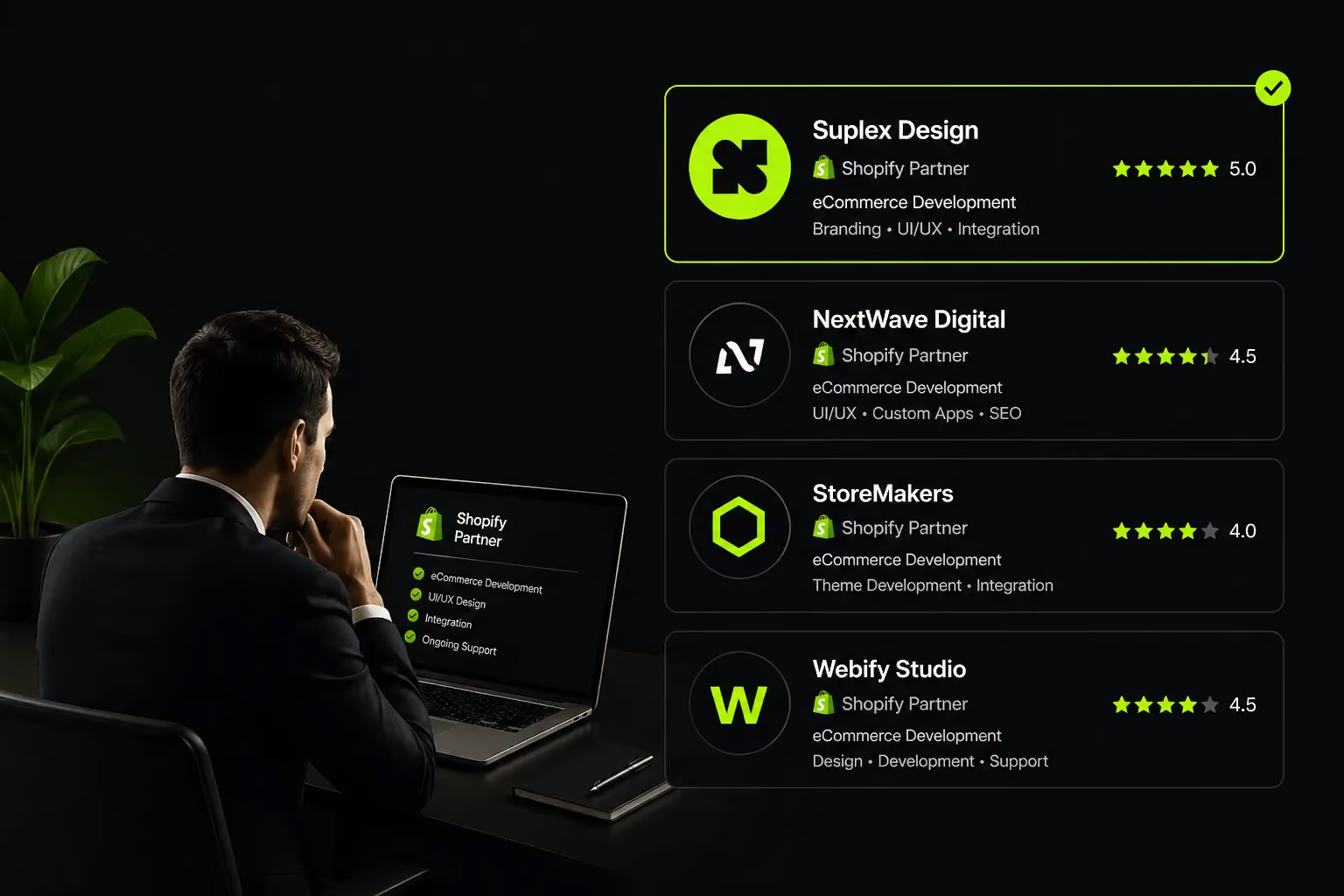
Hire Wrong, Pay Twice: How to Choose an Ecommerce Development Partner in 2026
Most businesses that end up on the wrong platform, over budget or six months behind schedule did not make a bad decision at launch they made a bad hiring decision.
Choosing the wrong ecommerce development partner is one of the most expensive mistakes a growing brand can make. It costs money, time, and in some cases, organic search rankings and customer trust that take years to rebuild.
Choosing the right one means knowing what criteria actually matter, what questions to ask before you sign anything, and what warning signs to walk away from.
This blog covers all three with specific context for UAE and Gulf market requirements that most development partner guides ignore entirely.
What Does an Ecommerce Development Partner Actually Do?
The term "development partner" gets used broadly. Before evaluating anyone, it is worth being precise about what you are actually buying because the scope of what different providers offer varies enormously.
Development Partner vs. Freelancer vs. Ecommerce Platform Agency
A freelancer is typically one person managing design, development, and project communication simultaneously. They can deliver strong results on contained, well-scoped projects: a basic Shopify store, a theme customisation, a specific integration.
The risk is single-point dependency: if they are unavailable, unwell, or move on, the project stalls and knowledge transfer becomes difficult.
An ecommerce platform agency specialises in one platform usually Shopify, Magento, or WooCommerce and builds primarily within that ecosystem.
They know the platform deeply, have certified developers, and follow established implementation methodologies. The limitation is breadth: if your requirements evolve beyond their platform specialisation, you may need to move.
A full-service ecommerce development partner covers the full commercial lifecycle: strategy, UX design, platform selection, technical development, integration, QA, launch, and ongoing optimisation.
They are positioned as a long-term partner rather than a project vendor which is the right model for businesses where ecommerce is a primary revenue channel, not a side project.
Full-Service vs. Specialist: What Scope of Work to Expect
The scope of work your partner handles determines the risk you retain internally. A specialist developer who builds a technically excellent store but does not consider conversion UX, post-launch performance or integration dependencies hands you a site that looks functional but underperforms commercially.
A full-service partner covers everything from discovery and architecture planning through to QA, deployment and post-launch support.
Knowing which of these you need covered externally and which your team can own internally before starting conversations misaligned scope expectations are the most common source of project disputes.
Why the Right Partner Is a Long-Term Strategic Relationship
An ecommerce store is not a one-time deliverable. It requires continuous improvement of new features, A/B testing, platform updates, integration changes and seasonal performance optimisation.
A partner who executes a launch and disappears leaves you managing a system you did not build, with no institutional knowledge of how decisions were made. The right development partner is invested in what happens after launch, not just on launch day.
That investment shows up in how they structure post-launch support, how they document their work, and whether their commercial interests align with your store's performance, not just the size of the initial project invoice.
Define Your Requirements Before You Start Searching
The most common mistake in hiring an ecommerce development partner is starting the search before the requirements are clear.
Agencies will size and scope their proposals based on what they hear from you. Vague requirements produce vague proposals that are impossible to compare meaningfully.
Map Your Business Goals
Start with commercial outcomes, not technical requirements. What does this ecommerce investment need to deliver in 12 and 36 months?
A partner who understands your commercial goals, revenue targets, market expansion plans, operational efficiency improvements can make better architectural decisions than one who only receives a feature list.
Document your goals before briefing anyone: what the store needs to generate, which markets it will serve, whether you are migrating from an existing platform or building from scratch and what operational problems it needs to solve. This takes an afternoon. Not doing it costs months.
Identify the Platform You Are Building On
You may need guidance on platform selection, or you may already know the platform and need a specialist. Either way, document your current thinking before briefing agencies.
Shopify and Shopify Plus suit most UAE SMBs and mid-market D2C brands with fast to launch, managed infrastructure, and a strong app ecosystem.
Magento and Adobe Commerce are enterprise-grade, with strong B2B capability and multi-store support for cross-GCC operations.
WooCommerce suits content-heavy brands already on WordPress. Custom or headless builds using Next.js are growing in adoption for performance-critical, high-volume stores where template limitations are a constraint.
If you are unsure which platform fits, a good development partner should be able to recommend based on your business requirements not based on what they prefer to build.
Budget, Timeline and Gulf-Specific Requirements
Budget and timeline shape every architectural decision. A realistic budget for a mid-market ecommerce build in the UAE sits between AED 30,000 and AED 150,000, depending on platform, product complexity, and integrations required.
Enterprise builds with ERP integration and custom checkout logic run significantly higher. On timeline: a Shopify store on a premium theme launches in 4–8 weeks, a custom-designed Shopify build takes 8–14 weeks and Magento or headless builds run 16–32 weeks minimum.
Rushing a timeline does not compress the work, it compresses the quality of testing, documentation and QA.
For the UAE and Gulf specifically, your development partner must be equipped to handle Arabic RTL support full right-to-left layout across every page, navigation, checkout flow and transactional email, not just translated text sitting inside a left-to-right layout.
They need direct technical integration experience with regional payment gateways: Telr, PayTabs, Tabby, Tamara, and Noon Pay. UAE's 5% VAT requires correct pricing display, compliant invoice generation, and exportable tax reports.
And with over 70% of UAE ecommerce purchases happening on mobile and smartphone penetration above 98%, the mobile experience is the primary customer touchpoint not a secondary consideration.
8 Criteria to Evaluate an Ecommerce Development Partner
These are the factors that separate partners who deliver strong commercial outcomes from those who deliver technically functional stores that underperform. Use them as a structured evaluation framework when comparing proposals.
1. Relevant Ecommerce Experience and Platform Certifications
General web development experience is not the same as ecommerce development experience. The two involve different technical decisions, different UX considerations, and different performance requirements.
Look for official platform certifications Shopify Partner status, Adobe Commerce certification, BigCommerce Partner combined with years of ecommerce-specific work and demonstrated experience at the scale you are building for.
An agency that has built stores for 10-person brands may not be equipped for a 500-SKU, multi-market operation. Certifications narrow the field; references and live portfolio confirm the choice.
2. Portfolio and Case Studies Depth Over Breadth
A portfolio of 50 stores with no commercial context tells you less than three case studies with real outcome data. Visit the stores live on a mobile device not in the screenshots provided.
Look for work in your product category or at a similar scale of operation, and ask for case studies that include metrics: conversion rate changes, page speed improvements, post-launch revenue growth.
If a partner cannot point to at least one verifiable example of a store similar to what you are building, they are learning on your budget.
3. Technical Stack and Integration Capabilities
Modern ecommerce stores connect to multiple systems. Your development partner needs to demonstrate specific experience with the integrations your business requires: ERP systems, CRM platforms, UAE-specific payment gateways, logistics APIs like Aramex and Fetchr and order management systems for high-SKU operations.
Ask for specific examples of each integration type relevant to your business. "We can integrate anything" is not an answer. "We have integrated Aramex into eight Shopify stores. Here is one you can review" is.
4. UX and Conversion Design Competency
Development without UX thinking produces technically functional stores that fail commercially. Conversion rate optimisation is not a post-launch discipline.
It is embedded in every design decision, from product page layout to checkout flow structure. Strong UX competency means the team includes a dedicated UX designer, not just a graphic designer applying brand elements to a template. Discovery should include customer journey mapping.
Design decisions should be explained in commercial terms why the CTA sits here, why the checkout has three steps and why product imagery is structured in this order. An agency that cannot articulate the commercial rationale behind their design choices is making aesthetic decisions, not commercial ones.
5. Post-Launch Support Model
Post-launch is where most agency relationships break down. The project is delivered, the invoice is paid, and the client discovers that every subsequent request is treated as a new project with its own scope and timeline.
Before signing, establish in writing what the SLA response time is for critical issues like payment failures or site downtime measured in hours, not days. Confirm whether post-launch support is included in the project fee or billed separately, how platform updates and security patches are handled and whether there is a named account contact or all support goes to a generic helpdesk.
A partner who addresses this proactively before the project starts is invested in long-term outcomes. One who avoids it until the invoice is paid is not.
6. Team Structure: In-House vs. Outsourced
Some agencies present themselves as a UAE-based team while outsourcing all development to a separate team in another country, without disclosing this.
Offshore development is a legitimate cost structure; the lack of transparency is what matters. Ask directly where the development team is located, whether they are in-house employees or contractors, who the project manager is and what their availability in your timezone looks like and what happens if the lead developer leaves mid-project.
These answers tell you about communication reliability and whether the person selling you the project is the person building it.
7. Security Practices: PCI DSS, GDPR, and UAE PDPL
An ecommerce store handles payment data, customer personal data, and order history. Your development partner must demonstrate awareness of PCI DSS requirements and how custom code or integrations can introduce vulnerabilities even on a certified platform like Shopify.
The UAE Personal Data Protection Law requires specific technical and procedural safeguards for personal data, a requirement many international agencies miss entirely. If your store serves customers in EU countries, GDPR applies regardless of where your store is based.
An agency that cannot speak to these requirements clearly is not equipped for the legal obligations of a modern ecommerce operation.
8. AI-Readiness and Future-Proofing
The ecommerce technology landscape is changing faster than at any point in the past decade. A development partner worth investing in for a multi-year relationship should have an informed perspective on headless and composable commerce architecture, AI-driven personalisation and recommendation engines and automation integrations for inventory forecasting, customer service, and content.
You do not need to implement all of this at launch. But a partner with no awareness of where the technology is heading will not be able to advise you effectively as your business scales into it.
Questions to Ask an Ecommerce Development Partner Before Signing
The quality of answers to these questions is more revealing than any portfolio or credentials document. Specific, concrete responses indicate genuine experience. Vague answers indicate surface-level familiarity with the problem.
Discovery and Scoping Questions
Before any agency discusses design or development, they should be able to walk you through a structured discovery process. Ask how they gather requirements, how they handle scope that emerges mid-project, and whether they have built in your product category before.
Ask what platform they would recommend for your specific requirements and critically, why that platform over the alternatives. A strong partner answers this without defaulting to whichever platform they prefer to build on.
Team and Workflow Questions
Find out who manages your project day-to-day, not who presents in the sales meeting. Where is the development team located and are they employees or contractors?
How is communication structured across the project lifecycle: project management tools, weekly calls, progress reporting. And what the contingency plan is if the lead developer on your project leaves mid-build.
These are not uncomfortable questions. They are standard due diligence, and any experienced agency will answer them without hesitation.
Risk, Commercial and Ownership Questions
Ask what the most common reason is for projects in their experience running over budget or timeline and how they prevent it. Ask about rollback plans if a site launch has a critical issue.
Then cover the commercial specifics: what are the payment milestones and what deliverables trigger each, who owns all code and design assets at project end and what post-launch support includes at a detailed level.
The most revealing question of all: if you want to move to a different agency after this project ends, how do they facilitate the handover?
A partner confident in the quality of their work answers without hesitation. One who deflects it is telling you something.
Red Flags to Watch Out For When Hiring an Ecommerce Developer
Vague proposals with no clear deliverables or milestones. A professional proposal specifies what will be delivered, by when, at each stage of the project. A proposal that describes services in general terms without specific outputs is designed to be interpreted in the agency's favour when disputes arise.
No discovery phase. Agencies that skip discovery do so because it is expensive and requires genuine expertise to execute well. The consequence is a build that solves the problem the agency assumed you had, rather than the one you actually have. Discovery is how scope is controlled without it, scope creep is not a risk, it is a certainty.
Portfolio that shows only visual design, no technical detail. Beautiful mockups with no live store references, no performance data, and no technical context indicate a design-led agency with limited development depth. Ask to see live stores on a mobile device, not Figma files.
Suspiciously low bids with fast delivery timelines. A quote that is 40% below market rate on a comparable scope is not a bargain. It signals that scope has been misunderstood, work will be done by junior developers at a speed that compromises quality, or the agency plans to recover margin through scope change fees once the project is underway.
No post-launch support plan and unwillingness to provide references. If post-launch support is not discussed proactively before the project starts, it will become a painful negotiation after the invoice is paid. Similarly, any agency with a genuine track record will provide client references without hesitation one that cannot or will not be telling you something about that track record.
How to Compare Proposals and Evaluate Total Cost of Ownership
Comparing development proposals is not straightforward. Scope is rarely identical between two proposals, hourly rates are presented without context, and the true cost of a platform decision extends years beyond the launch invoice.
Build vs. Buy vs. Customise
Three approaches carry different cost structures. Buying using a premium theme with minimal customisation is the lowest upfront cost and fastest to launch, but design is constrained to the theme architecture.
Customising means starting with a theme and modifying design and functionality, covering most mid-market requirements at a middle-ground cost.
The building is a fully custom or headless storefront with no platform constraints on design or functionality, but carries the highest upfront cost and longest timeline.
Most mid-market brands underestimate how quickly "customise" becomes "build" when the list of required changes grows. Get specific about which category your project falls into before comparing quotes. This one clarification will make proposals significantly easier to compare.
Hidden Costs Over 36 Months
The initial development invoice is rarely the total cost. Model the following before finalising a budget:
A Shopify store that looks cost-efficient at $79/month can cost AED 8,000–15,000 per month when app subscriptions, transaction fees and ongoing development are modelled correctly. That number changes the comparison significantly.
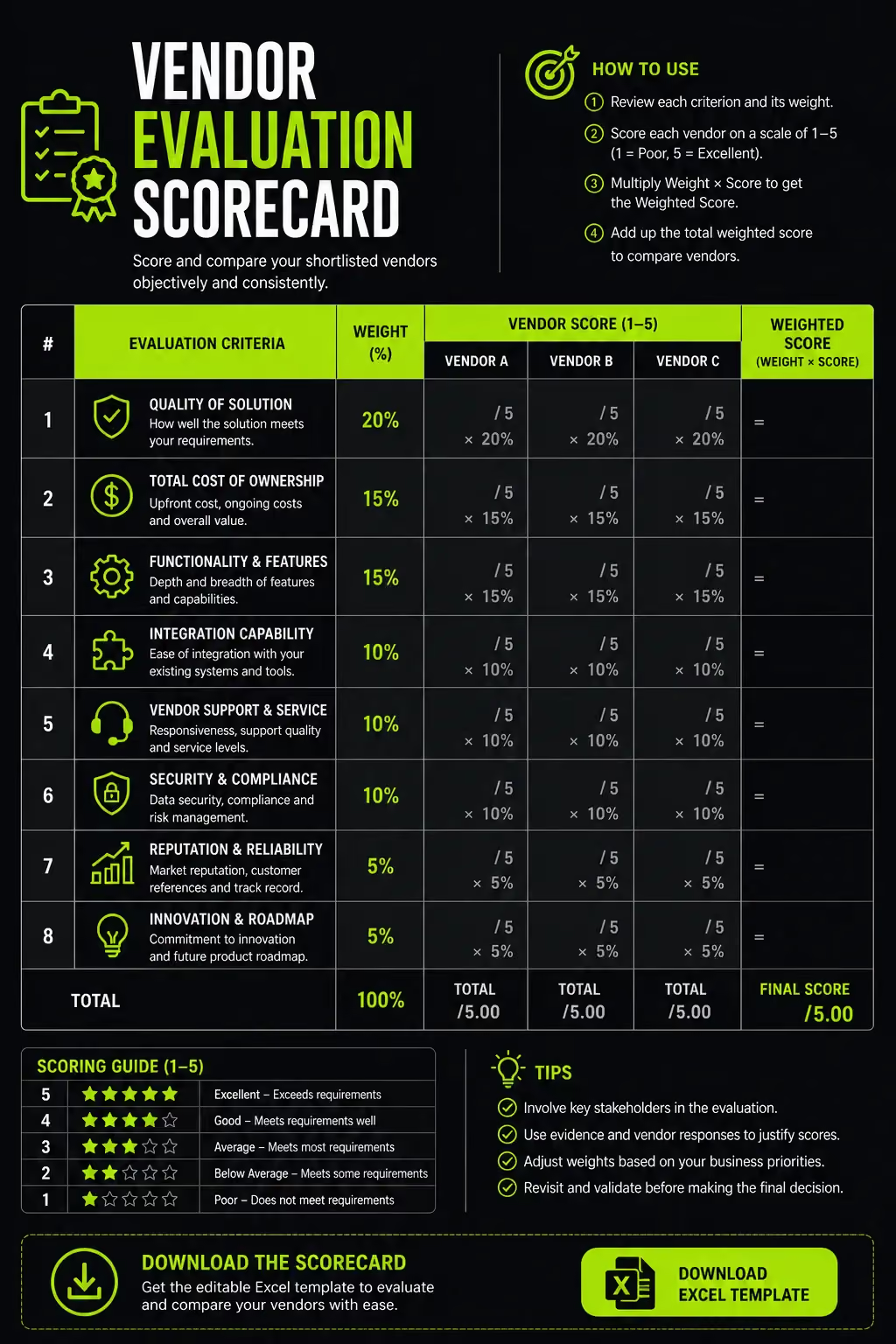
Using a Vendor Evaluation Scorecard
A scorecard removes the bias of comparing agencies based on how well they present rather than how well they actually perform. Score each shortlisted partner on the eight criteria above, weighted by what matters most for your specific project.
Adjust the weights to reflect your priorities. A brand with complex post-launch operational requirements should weight support more heavily.
A brand in a design-sensitive category should weigh UX higher. The discipline of applying the same framework to every agency you evaluate is what makes the comparison reliable.
Why Ecommerce Businesses in the UAE and Gulf Need a Specialised Development Partner
Building an ecommerce store for the UAE market is not the same as building one for the UK or the US. The technical requirements, consumer behaviour and regulatory environment are distinct and a generic development partner without regional experience will miss requirements that matter both commercially and legally.
UAE Ecommerce Market Size and Growth
The UAE ecommerce market is projected to exceed $9.2 billion by 2026, according to Statista. The market grew at over 30% annually during 2020–2023 and continues to attract significant retail investment from both local brands and international entrants using Dubai as their Gulf entry point.
Saudi Arabia, the region's largest ecommerce market, adds further scale for brands with cross-GCC ambitions.
This growth has produced a competitive environment where site performance, localisation quality, and mobile experience directly determine market share, not just marketing spend.
Local Requirements Your Partner Must Understand
Arabic RTL design goes well beyond translation. It requires full layout mirroring across navigation, icons, checkout flows, form field alignment, and transactional emails.
Not all Shopify themes and third-party apps handle this without modification, and a development partner without prior RTL experience will discover this mid-project rather than plan for it upfront.
Payment gateway integration means direct technical experience with Telr, PayTabs, Tabby, Tamara, and Noon Pay each carries specific API requirements, sandbox environments, and integration quirks that are not interchangeable.
UAE VAT compliance must be handled correctly in pricing display, checkout calculation, and invoice generation for tax reporting. These are not edge cases. For a Gulf ecommerce partner, they are standard deliverables.
Cross-Border Ecommerce and Mobile-First Audience
Many UAE-based brands are not building for the UAE alone. Expanding into Saudi Arabia, Kuwait, and Bahrain from a Dubai-headquartered operation requires multi-currency, multi-language and country-specific tax configuration all of which must be planned into the architecture before the store is built, not discovered after it launches.
At the same time, over 70% of UAE ecommerce purchases happen on mobile, and smartphone penetration exceeds 98%. A development partner who tests primarily on desktop and treats mobile as a responsive afterthought will produce a store that underperforms for the majority of its actual audience.
How Suplex Approaches Ecommerce Development Partnerships
Suplex is a Dubai-based ecommerce design and development studio working with D2C brands across the UAE, GCC, India, and the US. The approach is design-led and commercially oriented, not order-taking against a feature list.
Every project starts with a discovery phase. Before any design or development begins, the team works to understand the commercial goals, the customer journey, the existing technical environment and the constraints that matter: budget, timeline, platform, and regional requirements.
Discovery is where scope is controlled, risks are identified, and the decisions that will determine the quality of the build are actually made. It is also where Suplex earns or loses the right to be the partner which is the right way for that conversation to go.
The team works primarily on Shopify and Webflow for ecommerce, with capability across custom builds and platform migrations. UAE-specific requirements Arabic RTL, Gulf payment gateway integration, UAE PDPL compliance, VAT configuration are built into the standard process, not added as afterthoughts.
The focus throughout is on outcomes: conversion rate, mobile performance, and post-launch commercial results. Recent ecommerce work spans health and wellness (Miduty D2C Shopify store), hospitality (Kimi Cafe iOS and Android app, Dubai), and lifestyle and fashion brands across the Gulf.
If you are evaluating development partners for a new build or a replatforming project, the starting point is a discovery conversation not a proposal. Talk to the Suplex team here.
FAQs: Choosing an Ecommerce Development Partner
Q1: How much does it cost to hire an ecommerce development partner?
Costs range from $5,000 for a freelancer handling a basic store to $500,000 or more for an enterprise custom build. Most mid-market projects run between $20,000 and $100,000. In the UAE, equivalent AED ranges are AED 18,000 to AED 370,000+. Final cost depends on platform, number of integrations, UX complexity, and post-launch support scope.
Always requesting a detailed deliverables scope before comparing quotes hourly rate alone is a misleading comparison point.
Q2: What is the difference between an ecommerce development agency and a freelancer?
An agency offers a full team project management, design, development, QA, and ongoing support. A freelancer is typically one person handling all roles.
Agencies cost more but offer continuity, broader technical capability, and reduced dependency on a single individual. For anything beyond a basic store complex integrations, Arabic localisation, multi-payment gateway setup an agency is the lower-risk choice.
Q3: How long does it take to build an ecommerce website?
Simple Shopify stores on premium templates launch in 4–8 weeks. Mid-complexity custom builds take 3–5 months. Enterprise builds with ERP, CRM, and logistics integrations run 6–12 months. Timeline depends on scope clarity, content readiness, and third-party integration complexity.
Timelines that get compressed almost always transfer that pressure to testing and QA which shows up as problems post-launch.
Q4: What questions should I ask an ecommerce development partner?
Ask who manages your project day-to-day, how they handle scope changes mid-project, what their post-launch support model is, who owns all code and design assets at project end and for direct references from at least three clients.
Also ask how they have handled projects similar to yours in scale, platform, or industry and ask to visit those stores live on a mobile device, not in a portfolio PDF.
Q5: What platform should my ecommerce development partner specialise in?
It depends on your business requirements. Shopify suits most SMBs and mid-market D2C brands. Shopify Plus or Adobe Commerce works for higher-volume brands with complex pricing or B2B requirements.
Custom or headless builds fit highly specific performance or design needs. Choose a partner with verified, deep expertise in the platform that matches your current needs and your realistic 36-month growth trajectory, not just the one they happen to build on most frequently.
Q6: How do I verify an ecommerce development agency's credibility?
Check platform certifications Shopify Partner status, Adobe Commerce certification. Review third-party profiles on Clutch.co or GoodFirms where client reviews are independently verified.
Request direct references and actually contact them. Examine live stores in their portfolio on a mobile device, not in screenshots.
Agencies with published case studies that include measurable outcomes carry more credibility than those with design-only portfolios and award badges.
Q7: Do I need a local ecommerce development partner in the UAE?
Not necessarily, but regional experience matters more than proximity. A local or regionally experienced partner understands Arabic RTL design, UAE payment gateway integration, UAE PDPL compliance and the mobile-first behaviour of Gulf consumers.
Remote agencies can deliver quality work, but they need proven, specific experience with Gulf market requirements to back it up. Ask for UAE or GCC portfolio examples regardless of where the agency is physically based.
Hi, I’m Rishabh Jain
I believe great design has the power to shape perception, build trust, and move businesses forward. That belief is what led me to found Suplex Design Studio, a global branding and packaging studio working with FMCG and D2C brands across markets.I started suplex at 25 with a clear intent, to create design that is strategic, thoughtful, and commercially meaningful. By 28, the studio had scaled globally, guided by a strong foundation in Integrated Design that I developed during my academic journey in London, where I was honoured with the Dean’s Award.
Over the years, I’ve had the opportunity to work with 100+ brands, from Fortune 500 organizations to family-run businesses, helping them build packaging and brand systems that create recall, relevance, and long-term value.
Suplex’s work has been recognized internationally, including the Manifest Award (2024), the Clutch Global Award (2025), and features on platforms such as Packaging of the World, The Dieline, and the World Brand Design Society.
None of this would be possible without the people behind the work. I’m deeply grateful to the suplex team, whose commitment, creativity, and attention to detail turn ideas into meaningful brand experiences every day.
At the heart of my work is a simple philosophy, design should be intentional, honest, and built to last, and that continues to guide everything we create at suplex.





























Let’s Make It Happen
E-Commerce Success Stories
%201.avif)






.avif)
.avif)
Build Your D2C Business The Right Way
Build It With Suplex.


