Ecommerce Website Development Cost in 2026: Full Pricing Breakdown for UAE and Global Markets
.avif)

Ecommerce Website Development Cost in 2026: Full Pricing Breakdown for UAE and Global Markets
Building an ecommerce website costs anywhere from $1,500 to $250,000+, depending on what you are building and who builds it.
In the UAE, that range translates to AED 10,000 for a basic template store to AED 350,000+ for a custom platform with Arabic support, local payment gateways and enterprise-grade infrastructure.
This blog breaks down every cost tier, every major cost driver, and every hidden expense most agencies do not put in front of you so you can budget accurately before you brief anyone.
What Is the Average Cost of Ecommerce Website Development?
The average cost of ecommerce website development depends on the complexity of the build. A template-based store on Shopify or WooCommerce starts around $1,500.
A semi-custom build for a growing SME runs $5,000 – $25,000. A fully custom platform built for scale costs $25,000 – $250,000 or more. No single average covers all three scenarios.
Here is how the four main tiers break down:
These figures cover the build only. Hosting, maintenance, marketing, and platform fees are ongoing costs covered separately below.
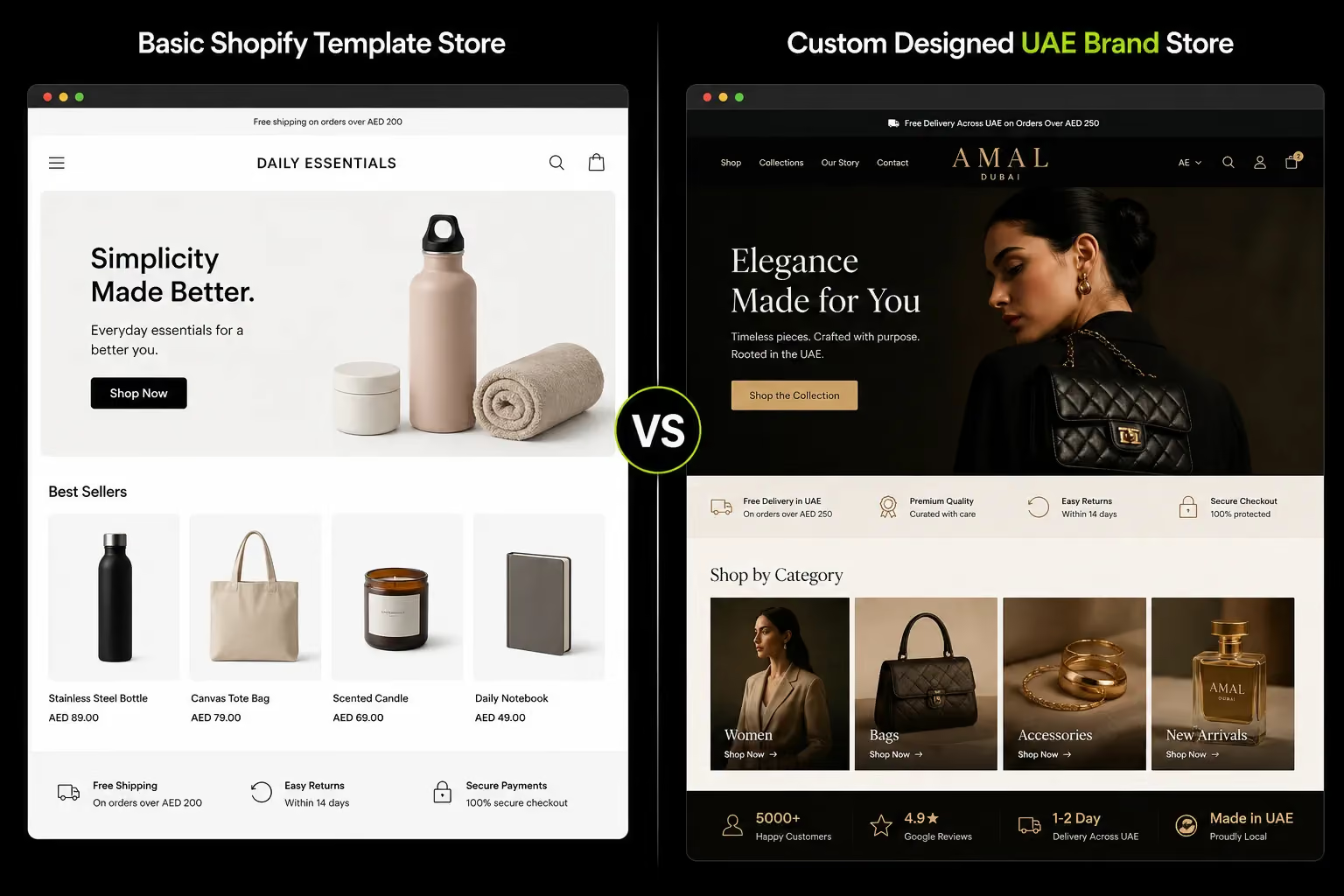
Template-Based Ecommerce Sites ($1,500 – $10,000 / AED 5,500 – AED 36,000)
This is the entry tier. You pick a pre-built theme on Shopify, WooCommerce or Wix, configure your products, connect a payment gateway and launch. The development work is minimal, mostly setup, configuration, and light customisation.
What you get:
- A working store within 2 – 4 weeks
- A design that looks like thousands of other stores using the same theme
- Limited ability to customise checkout, product pages, or user flows
- Performance dependent on the theme's code quality
Best for early-stage sellers, single-product stores, or businesses testing a concept before committing to a full build.
If you are generating under AED 500,000 annually and your catalog is simple, a template store is a defensible starting point.
Semi-Custom Ecommerce Builds ($10,000 – $30,000 / AED 36,000 – AED 110,000)
This is where most growing UAE businesses land. You start with a commercial theme and a developer customises it by modifying layouts, building custom product page templates, adding integrations and fine-tuning checkout flows.
The result looks and behaves like a proper brand experience without the cost of building from scratch.
Most small-to-mid retailers in Dubai fall in this range. It works well for stores with 50 – 500 products, a team that needs to manage inventory and content without developer support and brands that want a distinct look without a six-figure build budget.
Fully Custom Ecommerce Development ($30,000 – $250,000+ / AED 110,000 – AED 920,000+)
At this level, everything is engineered to specification. The UX is designed from scratch, the frontend is custom-built, and the backend is architected for the specific needs of your catalog, integrations and traffic volumes.
Platforms at this tier include heavily customised WooCommerce, Magento Open Source, Adobe Commerce, or a proprietary stack.
This tier is appropriate for high-SKU stores (1,000+ products), B2B operations with complex pricing rules, multi-vendor marketplaces, or GCC-wide brands running multi-language and multi-currency operations from a single platform.
If you are building for this scale, the build cost is not the biggest risk. Underspecifying your requirements and having to rebuild 18 months later is.
Key Factors That Determine Ecommerce Website Development Cost
No two ecommerce projects cost the same because no two businesses have identical requirements. These are the variables that move the number most.
Platform Choice
Your platform choice has the single biggest impact on both build cost and long-term running costs. Here is a direct comparison:
One UAE-specific note on Shopify: it does not have native Arabic RTL support. Achieving a proper bilingual Arabic-English store on Shopify requires third-party apps or custom theme development, which adds cost.
Factor this in before defaulting to Shopify because it is the familiar option.
UX and UI Design
Design is not cosmetic. It directly affects your conversion rate, and a poor conversion rate has a real financial cost that compounds over time.
A store converting at 1.5% that spends AED 8,000 on custom UX design and moves to 2.5% conversion does not just look better. It generates 66% more revenue from the same traffic. The ROI calculation on design investment is direct.
At Suplex, every ecommerce project starts with a UX strategy phase mapping customer journeys and identifying friction points before any design begins.
That process routinely prevents costly design revisions mid-build and improves conversion outcomes post-launch.
Number of Products and Catalogue Complexity
A store with 20 products and no variants builds differently from a store with 2,000 products, multiple size and colour combinations, bundle pricing and filterable category pages.
More complexity means more development hours across every layer: product import and structuring, database architecture, frontend filtering logic and search functionality.
Beyond a certain threshold typically 500+ SKUs you also need to think about how products are imported and maintained.
Manual entry at that scale is not viable. Bulk import tools, feed management, and ERP integration add scope and cost.
Integrations and Custom Features
Every integration adds development time and, often, ongoing subscription cost. Common integrations and their cost impact:
- Payment gateways: Basic gateway setup (Stripe, PayPal) is often free via plugins. UAE-specific gateways Telr, PayFort, Network International typically require AED 1,800 – AED 11,000 in development work for clean integration. BNPL providers Tabby and Tamara add further scope.
- ERP and inventory management: Integrating with systems like SAP, Oracle, or local UAE ERP providers is a significant development investment, typically AED 18,000 – AED 75,000+ depending on the integration depth.
- CRM integration: Salesforce, HubSpot, and similar platforms add AED 5,500 – AED 36,000.
- Multi-currency and multi-language: An Arabic + English store with AED and USD pricing is not double the work, but it adds 20 – 35% to development scope.
- Loyalty programmes and subscriptions: Custom builds for both. Budget AED 11,000 – AED 55,000 depending on complexity.
Hosting and Infrastructure
Hosting is a recurring cost that directly affects site performance and search rankings. Your options:
For UAE-based stores, server location matters. A store hosted on AWS Bahrain or UAE-region Azure nodes will load faster for GCC users than one hosted in Europe or the US.
A CDN (Cloudflare or Akamai with Middle East edge nodes) is a standard requirement for any serious ecommerce operation in this market.
Localisation and Compliance Costs in the UAE
These costs are unique to the Gulf market and are routinely underestimated by businesses briefing agencies for the first time:
- Arabic RTL development: Adds 15 – 25% to development time. This covers not just text direction but font selection, layout mirroring, button placement, and checkout flow adaptation for Arabic-reading users.
- UAE VAT compliance: 5% VAT has been in effect since 2018. Your checkout needs to calculate, display, and record VAT correctly across all product types. Configuring this properly especially across multi-country GCC operations requires deliberate development work.
- Data protection compliance: UAE Federal Law No. 45 of 2021 on Personal Data Protection has requirements for how you collect, store, and process customer data. Your ecommerce build needs to account for consent management and data handling architecture.
- Trade licence: Selling online in the UAE requires an ecommerce trade licence. Costs range from AED 5,500 – AED 15,000 depending on emirate and business activity. This is not a development cost, but it is a launch requirement.
Ecommerce Website Development Cost Breakdown by Component
Every ecommerce build is made up of discrete components with their own cost ranges. Here is what each component typically costs:
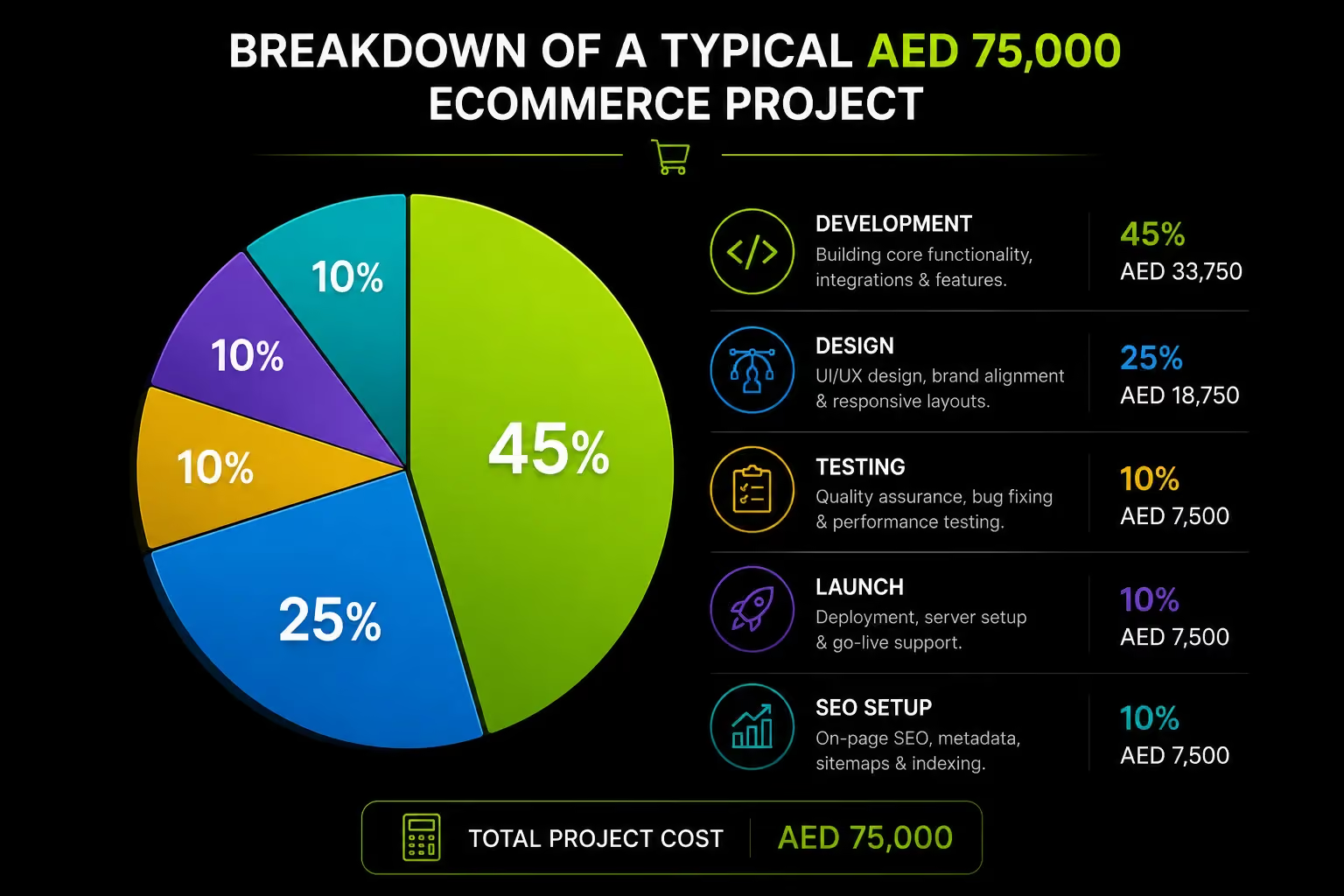
Domain, hosting, and SSL are annual or monthly commitments that continue regardless of whether you make changes to the site.
Development, design, and QA are typically one-time project costs, though you will return to all three as the site evolves.
Ongoing Ecommerce Website Costs After Launch
The build cost gets the most attention during planning. The running costs catch most businesses off guard. Here is what you are actually committing to.
Monthly Platform and Hosting Fees
If you are on Shopify, you are paying $29 – $299/month before any app subscriptions. WooCommerce has no platform fee but requires paid hosting ($50 – $500/month for managed WordPress).
Magento on cloud infrastructure runs $500 – $2,000+/month. These are baseline operational costs, not optional.
Maintenance and Security Updates
A WooCommerce store without active maintenance is a security liability. WordPress core, theme, and plugin updates need to be applied, tested, and monitored.
One conflicting plugin update or an unpatched vulnerability can take your store offline or expose customer data. Budget AED 500 – AED 3,000/month for a maintenance retainer depending on store complexity.
Digital Marketing Costs
Your store cannot generate revenue without traffic. Ongoing marketing spend is not optional, it is the cost of operating in a competitive ecommerce market.
- SEO: AED 1,800 – AED 11,000/month
- Google and Meta paid advertising: Varies by budget, but AED 5,000 – AED 30,000/month is a realistic range for UAE retailers
- Email marketing tools (Klaviyo, Mailchimp): AED 180 – AED 1,800/month
Payment Processing Fees
Standard global gateways (Stripe, PayPal) charge approximately 2.9% + $0.30 per transaction. UAE-specific gateways have different fee structures Telr, PayFort and Network International typically charge 2.5 – 3.5% per transaction, sometimes with a monthly gateway fee on top.
At scale, these percentages become a significant line item. A store doing AED 1 million per month pays AED 25,000 – 35,000 in gateway fees alone.
Annual Running Cost Summary
Most businesses spend 15 – 30% of their initial build cost on maintenance and updates annually. Plan for it from Day 1.
Ecommerce Website Development Cost in the UAE and Gulf
UAE ecommerce is a distinct market, and pricing reflects that. Agency day rates in Dubai are higher than in Eastern Europe or South Asia. Localisation requirements add scope. Regulatory compliance adds scope. And the payment infrastructure here is different from the US or UK baseline that most global platform guides assume.
Typical price ranges from UAE agencies based on current market data:
- Basic template store setup: AED 10,000 – AED 25,000
- Semi-custom store with local payment integration: AED 25,000 – AED 90,000
- Fully custom store with Arabic support and ERP integration: AED 90,000 – AED 350,000+
Factors specific to the Gulf market that increase cost relative to global benchmarks:
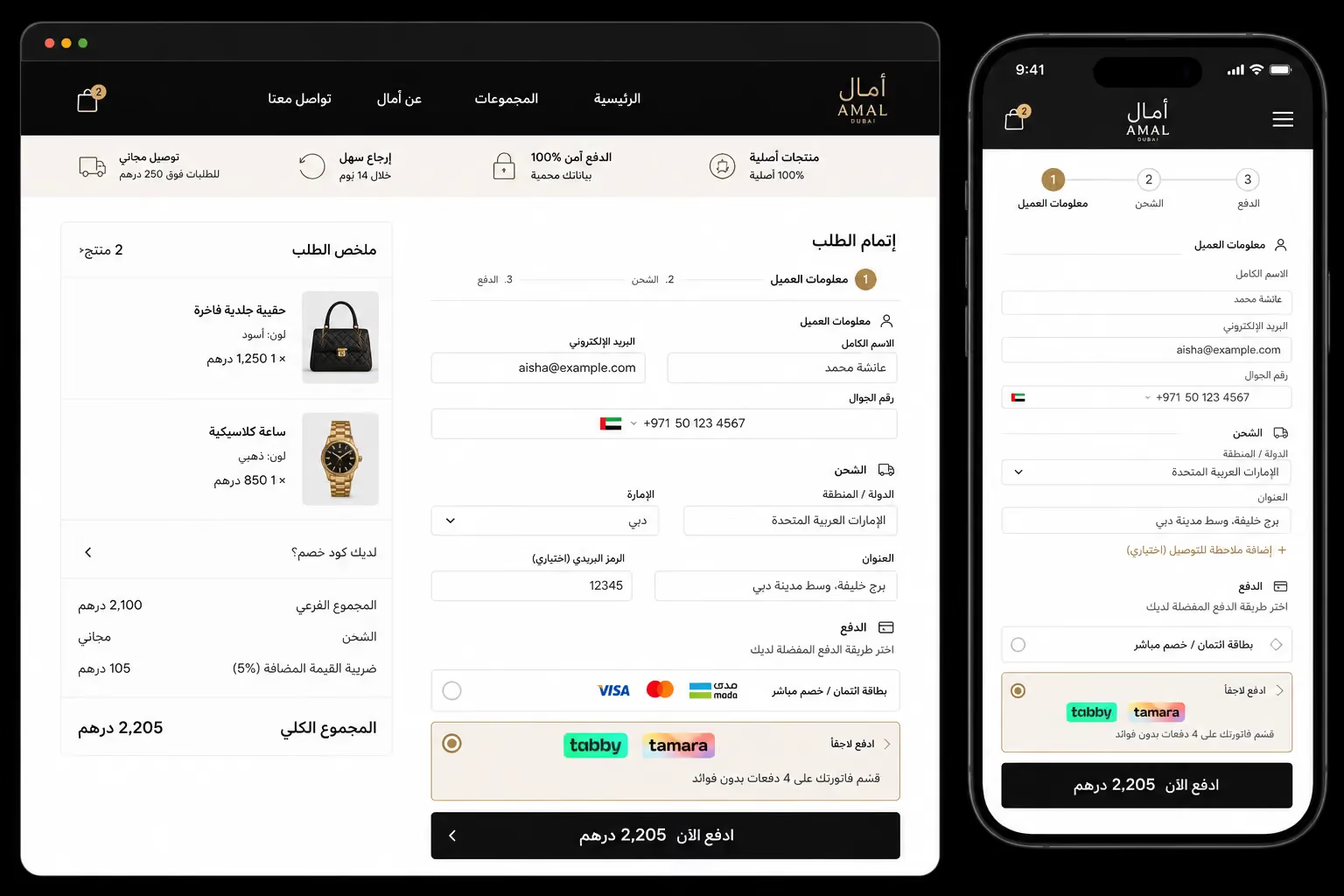
Arabic RTL support is not a toggle, it is a development workstream. Fonts, layout logic, form fields, checkout flow, and CMS input all behave differently in RTL. Budget an additional 15 – 25% of your development cost for a properly executed bilingual store.
COD (Cash on Delivery) remains a significant payment method in the UAE and is dominant in Saudi Arabia. Implementing COD with proper order management, courier API integration, and confirmation workflows adds development scope.
BNPL integration: Tabby and Tamara are the leading BNPL providers in the GCC. Their presence at checkout increases average order value and conversion rates, particularly for fashion, electronics, and home goods. Integration is straightforward on some platforms and requires custom development on others.
UAE Consumer Protection Law compliance: Return policies, pricing transparency, and terms of sale must be clearly presented at checkout. This affects page design and copy, not just legal documentation.
Before you sign with any UAE agency, get at least three scoped quotes and check that each quote includes: Arabic RTL development, local payment gateway integration, VAT configuration, and post-launch support terms. Quotes that exclude these items will look cheaper and cost more.
DIY vs Agency vs Freelancer: Which Is Right for Your Business?
Your build approach is as important as your platform choice. Each option has a different cost profile, risk profile, and output ceiling.
DIY becomes a liability when your store outgrows template constraints typically at AED 1 – 2 million annual revenue and you need custom checkout flows, integrations, or conversion optimisation that a theme cannot deliver.
At that point you are either paying a developer to fight the template or rebuilding from scratch, both of which cost more than getting the right build initially.
Freelancers are appropriate for small, well-defined projects with clear deliverables. The risk is limited accountability on timeline and quality and minimal support after launch. If your project is under AED 20,000 and straightforward, a vetted freelancer can deliver good value.
Agencies carry higher costs but bring a team of UX designers, developers, QA engineers and project managers working together. For UAE-specific builds that require Arabic localisation, local payment gateway expertise, and VAT compliance, a local agency with regional experience is worth the cost premium.
Hidden Costs of Ecommerce Development Most Businesses Miss
These do not appear in agency quotes, and they catch most clients off guard.
App and plugin subscriptions on Shopify accumulate faster than most business owners expect. A typical Shopify store running reviews, upsells, loyalty, email capture, and live chat easily hits $200 – $500/month in app fees. That is AED 2,640 – AED 6,600/year on top of your Shopify subscription.
Product photography: Every product needs quality images. A full catalogue shoot in the UAE professional photographer, studio rental, post-production costs AED 2,000 – AED 15,000 depending on product count. This is non-negotiable for conversion rate. Buyers do not purchase what they cannot see clearly.

Content writing and translation: If you are running an Arabic-English store, every product description, category page, blog post and email needs to be written and translated.
Arabic translation by a native e-commerce copywriter costs AED 0.15 – AED 0.40 per word. A 500-product store with 100-word descriptions per product is AED 7,500 – AED 20,000 in translation alone.
Team training on the CMS: Someone on your team needs to manage products, process orders, run promotions, and update content after launch. Training sessions with your agency or a platform trainer cost AED 1,500 – AED 7,500 depending on team size and complexity.
Launch-day marketing spend: A new store with no traffic is a new store with no sales. Budget for a paid media push at launch Google Shopping, Meta ads, influencer seeding to generate initial traction. AED 5,000 – AED 20,000 for the first month is realistic for a UAE market launch.
Post-launch bug fixes: Regardless of how well a project is scoped and tested, the first 90 days post-launch generate bug reports. Buttons that behave unexpectedly on certain devices, checkout issues on specific browsers, performance issues under real traffic loads. Budget 10 – 15% of your development cost for post-launch fixes in the first three months.
How Suplex Approaches Ecommerce Website Development
Most ecommerce projects fail not because the development was poor but because the discovery phase was rushed. Features get added without a clear user journey.
Budgets are allocated to visual design before the purchase flow has been mapped. The result is a store that looks good in a Figma presentation and converts poorly in production.
Suplex is a design and digital studio based in the UAE, working across retail, fashion, F&B, and B2B ecommerce. The process for every ecommerce project runs through: discovery and business goal mapping, UX strategy and journey design, visual design, development, QA, launch, and post-launch support. Nothing is built before the business logic is clear.
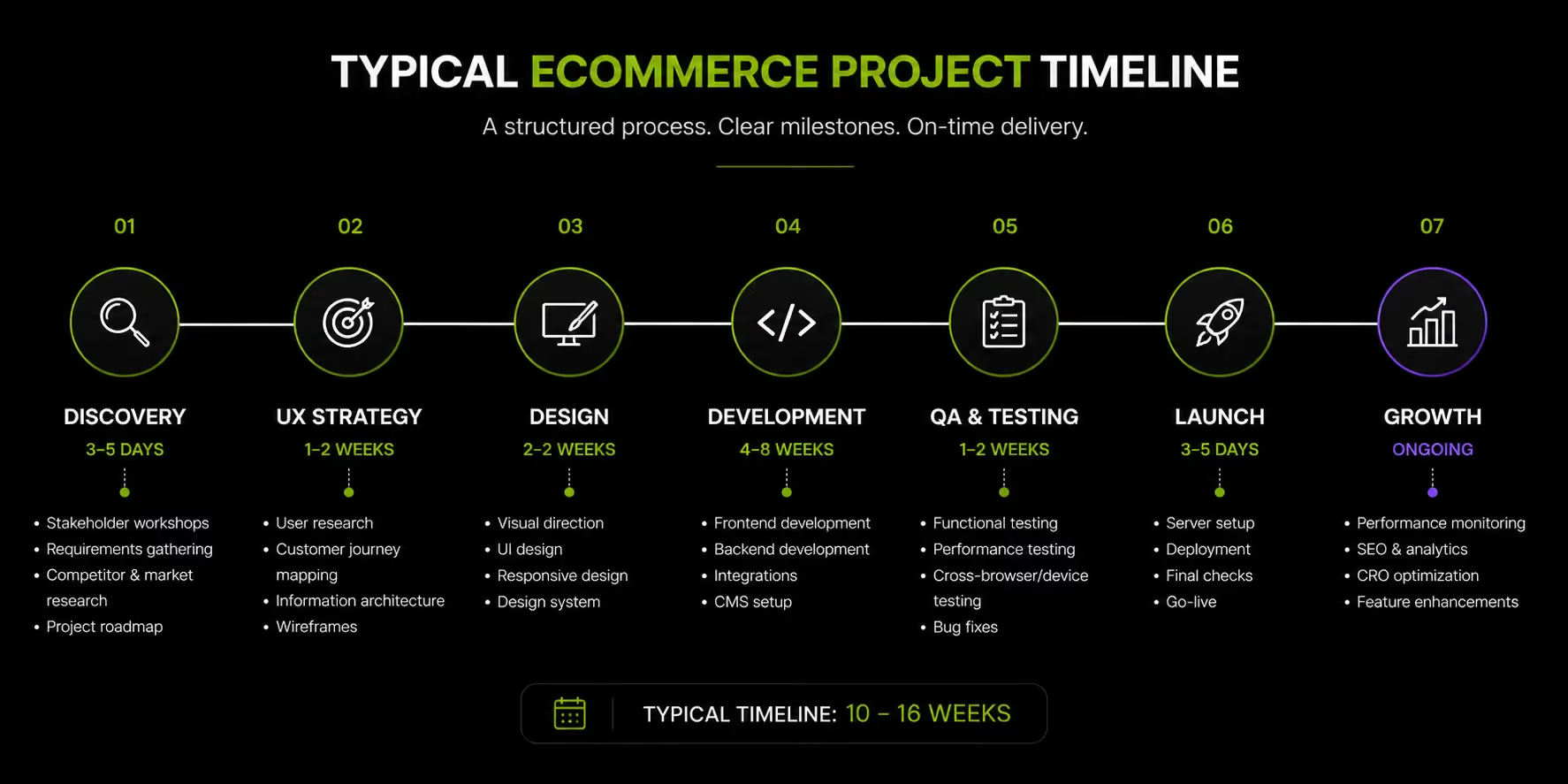
Transparent scoping matters. Before any development begins, Suplex defines what is in scope, what the deliverables are, what the timeline looks like and what post-launch support covers.
Clients who have had bad experiences with other agencies almost always trace it back to a vague initial brief and a quote that did not reflect the real work.
If you are evaluating ecommerce development in the UAE and want a clear scope and honest cost estimate before you commit, the Suplex team is a starting point worth exploring.
How to Get the Best Value From Your Ecommerce Development Budget
You do not need to spend more. You need to spend on the right things at the right time.
Start with an MVP and iterate. A focused store with your core products, a clean purchase flow, and reliable payment processing will outperform a feature-heavy build with performance issues every time. Add features based on data, not assumptions.
Prioritise performance over features at launch. A store that loads in under 2 seconds converts better than a feature-rich store that loads in 4 seconds.
Google's data shows 53% of mobile users abandon pages that take over 3 seconds to load. Hosting quality, image optimisation, and code cleanliness are not optional.
Do not retrofit SEO. Building SEO into your URL structure, page architecture, and content strategy from Day 1 costs a fraction of what it costs to fix after launch.
Every month you run with poor URL structures or missing metadata is a compounded lost ranking opportunity.
Get a fixed-price contract with clear milestones. Time-and-materials contracts transfer the risk of unclear scope to you.
Fixed-price contracts with defined deliverables and payment milestones tied to project stages protect you if the timeline or scope shifts.
Ask about post-launch support before you sign. What is covered, for how long, and at what cost? A 30-day warranty period on a $50,000 build is not a post-launch support model. Get the support terms in writing before you commit.
Frequently Asked Questions
How much does ecommerce website development cost in the UAE?
Ecommerce website development in the UAE typically ranges from AED 10,000 for a basic template-based store to AED 350,000+ for a fully custom platform. Most SMEs in Dubai spend between AED 25,000 and AED 90,000. Costs vary based on platform choice, features, Arabic RTL support, and whether you work with a freelancer or a full-service agency.
What is the cheapest way to build an ecommerce website?
The cheapest option is using a SaaS platform like Shopify or Wix and setting it up yourself. A basic Shopify store with a paid theme can be live for under AED 1,800. However, DIY stores have limited scalability and no custom features which creates costly workarounds as your business grows beyond the template's constraints.
How much does a custom ecommerce website cost?
A fully custom ecommerce website built on Magento, custom WooCommerce, or a proprietary stack typically costs between $30,000 and $150,000 (AED 110,000 – AED 550,000). The exact figure depends on catalog size, required integrations, design complexity, and the experience level of the development team.
What ongoing costs should I budget for after my ecommerce site launches?
Budget for hosting ($20 – $500/month), platform subscription if you are on Shopify or similar, security maintenance, payment gateway fees (2 – 3.5% per transaction), digital marketing (AED 1,800 – AED 40,000/month depending on channels), and periodic feature development. Most businesses spend 15 – 30% of their initial build cost on maintenance and updates annually.
Should I use Shopify or build a custom ecommerce site?
Shopify suits businesses that want to launch quickly with minimal technical complexity. Custom development makes sense when you need specific workflows, deep integrations, or a user experience that a theme cannot deliver. Most UAE businesses launch on Shopify and move to a custom platform when they exceed AED 2 – 3 million in annual revenue and hit the limits of what Shopify apps and themes can handle.
How long does it take to build an ecommerce website?
A template-based store can go live in 2 – 4 weeks. Semi-custom builds typically take 6 – 12 weeks. Fully custom platforms require 3 – 6 months from discovery to launch. Timelines extend when Arabic localisation, multiple payment gateway integrations, or complex product catalog migrations are part of the scope.
Hi, I’m Rishabh Jain
I believe great design has the power to shape perception, build trust, and move businesses forward. That belief is what led me to found Suplex Design Studio, a global branding and packaging studio working with FMCG and D2C brands across markets.I started suplex at 25 with a clear intent, to create design that is strategic, thoughtful, and commercially meaningful. By 28, the studio had scaled globally, guided by a strong foundation in Integrated Design that I developed during my academic journey in London, where I was honoured with the Dean’s Award.
Over the years, I’ve had the opportunity to work with 100+ brands, from Fortune 500 organizations to family-run businesses, helping them build packaging and brand systems that create recall, relevance, and long-term value.
Suplex’s work has been recognized internationally, including the Manifest Award (2024), the Clutch Global Award (2025), and features on platforms such as Packaging of the World, The Dieline, and the World Brand Design Society.
None of this would be possible without the people behind the work. I’m deeply grateful to the suplex team, whose commitment, creativity, and attention to detail turn ideas into meaningful brand experiences every day.
At the heart of my work is a simple philosophy, design should be intentional, honest, and built to last, and that continues to guide everything we create at suplex.





































Let’s Make It Happen
E-Commerce Success Stories
%201.avif)






.avif)

.avif)
Build Your D2C Business The Right Way
Build It With Suplex.


