Shopify vs Magento: Which Ecommerce Platform is Right for Your Business?
.avif)
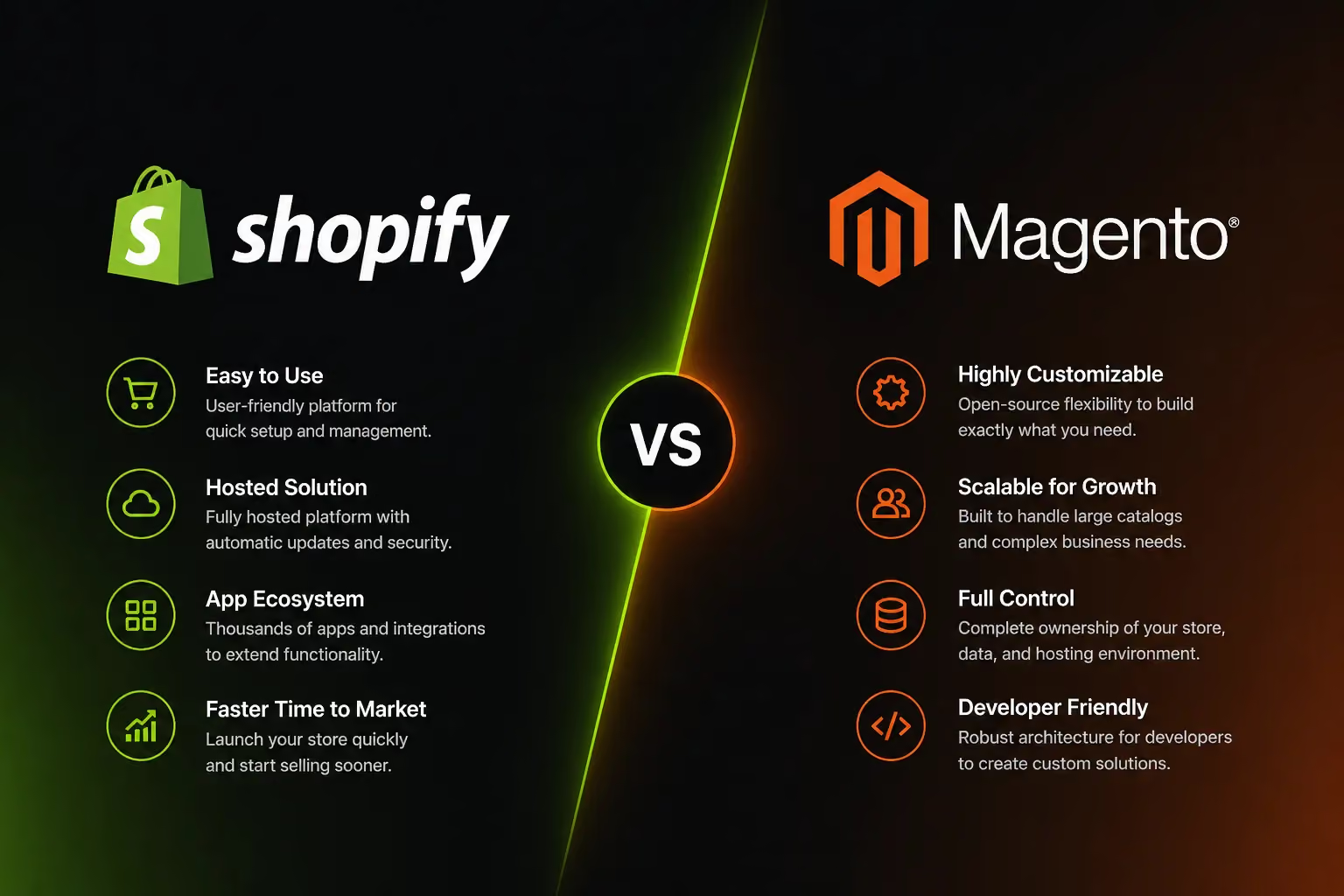
Shopify vs Magento: Which Ecommerce Platform is Right for Your Business?
Shopify suits SMBs and fast-launch brands. Magento (Adobe Commerce) is built for enterprise-scale, high-customisation operations.
Neither is universally better. The right choice depends on your team size, technical capacity, and how complex your business will become over the next three years.
This blog breaks down both platforms across nine decision-critical factors, with specific context for businesses operating in the UAE and Gulf region.
Quick Comparison: Shopify vs Magento at a Glance
Before going into depth on each factor, here is the summary. If one column already looks clearly wrong for your situation, the detailed sections will confirm it.
The table above gives you a starting frame. The sections below explain the reasoning behind each row and where the nuance matters for your specific situation.
What Is Shopify? (And Who It's Built For)
Shopify is a hosted SaaS (Software as a Service) ecommerce platform. You pay a monthly subscription and Shopify manages hosting, security, PCI compliance and platform updates. You configure your store, install apps, and run your business without touching a server.
The Hosted, Hands-Off Model
The fundamental appeal of Shopify is that it removes infrastructure from the equation. There are no servers to manage, no security patches to apply and no hosting bills to negotiate. Shopify handles all of that as part of the subscription.
The platform has over 7,000 apps in its marketplace covering everything from email marketing and loyalty programmes to ERP integrations and advanced inventory management. Most install in one click. Most charge a monthly fee.
Current plan pricing:
- Basic: $29/month suitable for new or very small stores
- Shopify: $79/month adds reporting and more staff accounts
- Advanced: $299/month lower transaction fees, advanced reporting
- Shopify Plus: From $2,300/month enterprise features, B2B, unlimited staff, checkout customisation
Where Shopify Excels
Shopify's strongest advantage is time to market. A functional online store can go live in days, not months. The theme editor is visual and drag-and-drop no development experience required for most customisations.
Built-in features that matter operationally: abandoned cart recovery, multichannel selling (Instagram, TikTok, Google), basic analytics, and discount engine. These come standard across all plans.
Mobile UX is strong by default. Shopify's themes are built with mobile-first principles, which matters significantly in the UAE where over 70% of ecommerce purchases happen on mobile.
Shopify's Limitations
Shopify's constraints become more visible as the business grows or becomes more complex.
- Transaction fees: Shopify charges 0.5%–2% on every sale processed through a non-Shopify Payment gateway. In the UAE, where Shopify Payments is unavailable, this fee applies to every transaction
- App dependency: Features that are native in Magento advanced B2B pricing, complex product bundling, deep ERP sync require paid Shopify apps. A fully-featured Shopify store commonly spends $300–$800 per month on apps alone
- Checkout customisation: On plans below Shopify Plus, the checkout page is largely locked. You cannot significantly alter its structure, layout, or logic a meaningful constraint for brands with specific conversion optimisation needs
- Backend customisation limits: Shopify's Liquid templating language is accessible but constrained. Deep structural changes to how the platform behaves require workarounds or app dependencies
What Is Magento? (Adobe Commerce Explained)
Magento is an open-source ecommerce platform originally launched in 2008 and acquired by Adobe in 2018.
It now exists in two versions: Magento Open Source (free to download, self-hosted) and Adobe Commerce (licensed, with cloud hosting options and enterprise support).
Open-Source Power vs Enterprise Cost
The key distinction: Magento gives you the full codebase. You can modify anything, the database schema, the checkout logic, the admin interface, the front-end rendering. There are no platform-level restrictions on what you can build.
The trade-off is that this flexibility requires technical expertise to manage. Magento is built on PHP and requires developers with Magento-specific knowledge to configure, extend, and maintain.
Most enterprise Magento stores run with either a dedicated in-house engineering team or a committed agency partner.
Adobe Commerce licensing costs:
- Open Source: Free to download; hosting, development, and maintenance costs apply
- Adobe Commerce (on-premise): $22,000–$125,000+ per year depending on revenue tier
- Adobe Commerce Cloud: Higher cost; includes managed hosting, CDN, and enterprise support
Where Magento Excels
Magento's architecture is built for complexity. It performs at a level that Shopify's standard plans cannot match in specific scenarios:
- Large catalogues: Magento handles millions of SKUs without structural limits. Product variants, complex attribute sets, and configurable products are native to the data model
- Native B2B features: Adobe Commerce includes company accounts, purchase orders, requisition lists, custom pricing tiers, negotiable quotes, and quick order functionality all out of the box
- Multi-store from one backend: Run multiple storefronts different countries, languages, currencies, and brands from a single admin panel. This is a core capability for Gulf brands expanding from UAE into Saudi Arabia, Kuwait, and Bahrain simultaneously
- Deep integration capability: ERP (SAP, Oracle), CRM (Salesforce), WMS, and accounting systems connect to Magento with significantly more integration depth than Shopify's app-based approach allows
- Arabic RTL: Magento supports full RTL layout configuration, Arabic language packs, and right-to-left checkout flows. The implementation requires development work, but the platform architecture supports it natively
Magento's Limitations
The same openness that makes Magento powerful makes it expensive to run.
- High TCO: Total cost of ownership across hosting, development, security, and maintenance is substantial. This is not a platform for businesses that want to minimise technical overhead
- Slow to launch: A well-built Magento store takes 3–6 months minimum. Complex enterprise implementations run longer. There is no shortcut
- Security responsibility: On Magento Open Source, security patches are the merchant's responsibility. Unpatched Magento stores are a known and frequently exploited attack vector. Adobe Commerce Cloud shifts this responsibility to Adobe, but at significant cost
- Developer dependency: Every meaningful change to a Magento store requires a developer. Non-technical business owners cannot manage Magento independently the way they can manage Shopify
Cost Comparison: What You'll Actually Pay
Platform pricing is not what's listed on the pricing page. The real cost is the total of all fees, developer time, apps, hosting, and maintenance over 12–36 months.
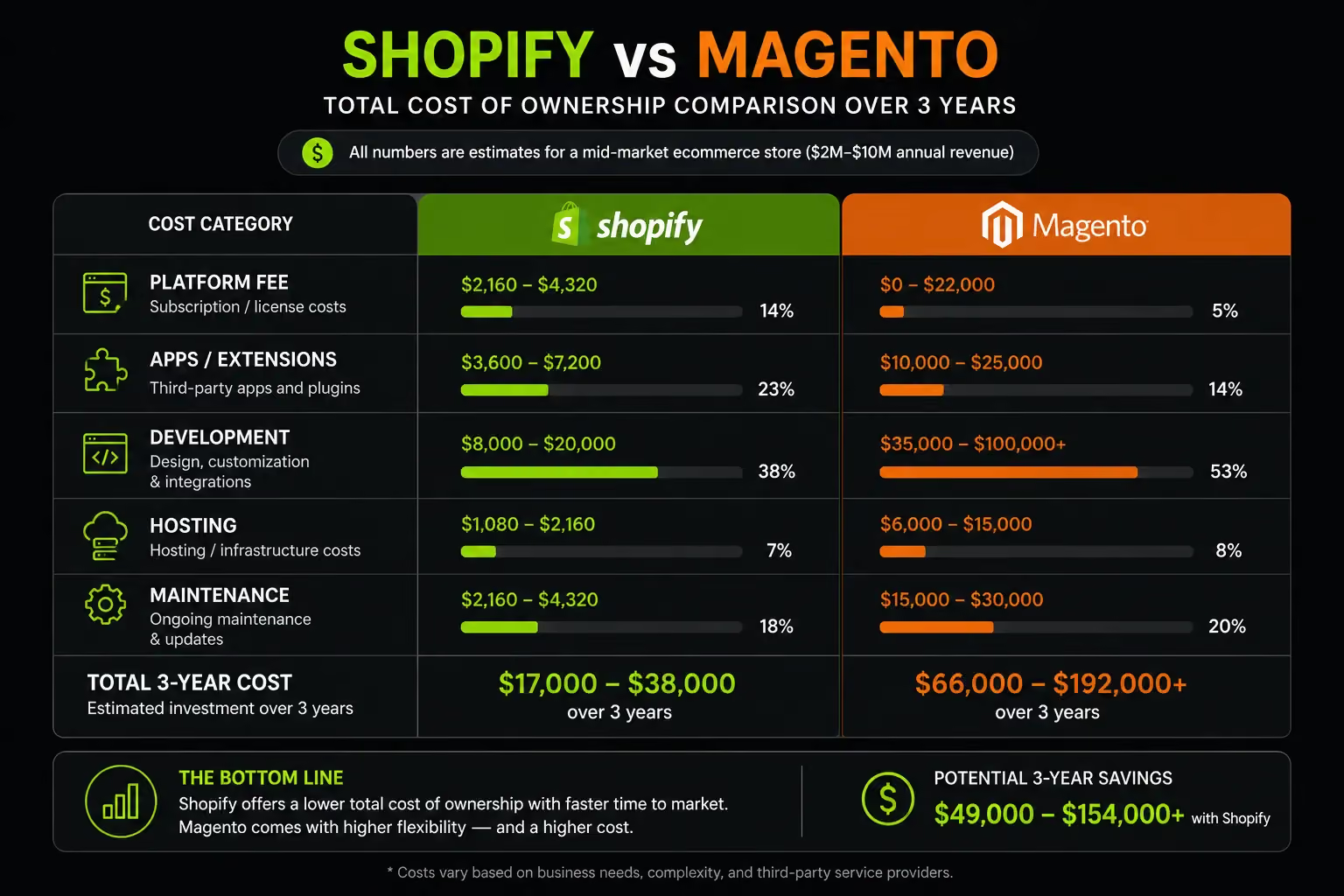
Shopify Total Cost of Ownership
The transaction fee is a significant variable for UAE stores. At AED 500,000/month in revenue, a 1% transaction fee is AED 5,000 per month and AED 60,000 per year on top of all other costs.
Magento Total Cost of Ownership
Shopify's own comparison data claims its TCO is 29% lower than Adobe Commerce on average. That figure is self-reported and reflects a specific comparison context but the directional point holds.
For businesses operating below enterprise scale, Magento's TCO is harder to justify.
Hidden Costs to Watch in UAE and Gulf
Both platforms carry additional costs specific to the Gulf market that generic pricing guides do not account for:
- Payment gateway setup: Telr, PayTabs, and Checkout.com each charge setup fees and ongoing transaction fees. These stack on top of platform costs
- Arabic localisation: Professional Arabic translation for product descriptions, marketing content, and transactional emails is typically billed separately from development
- VAT compliance: UAE's 5% VAT and KSA's 15% VAT require correctly configured tax modules, VAT-inclusive pricing display, and compliant invoice generation. Some platforms require additional extensions or development to meet these requirements fully
- Local developer rates: Dubai and Abu Dhabi-based development agencies typically charge AED 200–600 per hour. For Magento projects requiring certified developers, rates sit at the higher end of this range
Ease of Use Speed vs Control
One of the most practical differences between the two platforms is how much technical knowledge you need to run the store day-to-day after launch.
Shopify's Learning Curve
Shopify's admin interface is designed for non-technical users. Adding products, creating discount codes, updating content, managing orders, and reading analytics all happen in a clean, intuitive dashboard.
Most business owners can manage Shopify operations without a developer after the initial build. The drag-and-drop theme editor allows visual customisation without writing code.
Onboarding time for a new team member is measured in days, not weeks. Shopify's support covers 24/7 chat, phone, and email all accessible in UAE time zones.
Magento's Learning Curve
Magento's admin panel is powerful, but it is not designed for casual users. The menu structure is complex, configuration options are deep and tasks that take one click in Shopify can require navigating multiple admin layers in Magento.
More significantly, meaningful changes to a Magento store require developer involvement. Updating a theme layout, modifying checkout logic, or adding a new integration all require PHP development.
Onboarding a non-technical marketing manager to run Magento independently is not a realistic expectation.
Magento Open Source has community support only. Adobe Commerce includes dedicated support, a relevant consideration for businesses without in-house Magento expertise.
Who Wins on Usability?
Shopify wins for internal management post-launch. If your team is lean or non-technical, Shopify reduces your dependency on external developers for day-to-day operations.
Magento wins for technical teams that need deep control. If you have development resources in-house or a committed agency partner, Magento's complexity is manageable and its capabilities justify it.
Design and Storefront Experience
Both platforms can produce excellent-looking stores. The difference is in where the ceiling sits and how much it costs to reach it.

Shopify Themes and Customisation
Shopify offers 100+ themes, both free and paid ($150–$350 one-time cost). The theme editor uses a sections and blocks system that allows flexible layout customisation without code.
For most brand use cases clean product presentation, visual storytelling, campaign landing pages the built-in system is sufficient.
The constraint is Shopify's Liquid templating language. It is accessible for front-end developers but limits deep structural changes.
You can customize within the theme's architecture; you cannot fundamentally change how Shopify renders pages without significant engineering effort.
Where Shopify themes consistently perform well: mobile-first design defaults, fast load times on standard hosting infrastructure, and visual consistency across devices.
Magento Design Capabilities
Magento's front-end is fully open. HTML, CSS, JavaScript, and PHP are all available for customisation. There are no structural constraints imposed by the platform. You can build any interface you can design and develop.
Magento's default Luma theme is functional but visually dated. Almost every enterprise Magento build uses a custom front-end.
Adobe Commerce supports headless commerce architecture via PWA Studio and React-based storefronts giving brands the performance and flexibility of a modern JavaScript front-end with Magento's commerce engine in the backend.
The design ceiling on Magento is higher. But reaching it requires significantly more investment in design and engineering than a Shopify theme customisation.
Why Design Decisions Impact Conversion, Not Just Aesthetics
Platform choice constrains or enables your design potential and design directly affects revenue. Page speed, visual hierarchy, mobile UX, and checkout flow are conversion variables, not cosmetic ones.
A custom Magento build executed by an experienced team can outperform a default Shopify theme on conversion rate.
An off-the-shelf Shopify theme built with conversion principles in mind can outperform a poorly implemented Magento build. The platform sets the range of possibilities; execution determines the outcome.
SEO Performance Which Platform Ranks Better?
Both platforms can rank well. The difference is in how much control you have over technical SEO configuration and how much work the platform requires you to do versus what it handles automatically.
Shopify SEO Capabilities
Shopify generates XML sitemaps automatically, applies canonical tags by default, and includes SSL across all plans. These are strong defaults that cover the basics without configuration.
The limitations are structural. Shopify forces specific URL patterns /collections/ for category pages, /products/ for product pages.
You cannot change these. For most stores, this is a non-issue. For stores migrating from a different platform with established URL authority, this forced structure can complicate redirect mapping.
Duplicate content is a known Shopify challenge. When products appear in multiple collections, Shopify can generate multiple URLs for the same product. Managing this requires careful use of canonical tags or SEO apps.
The Shopify app ecosystem covers most SEO needs: XML sitemaps, structured data, meta field management, and redirect management are all available via well-supported apps.
Magento SEO Capabilities
Magento gives full URL control. You define the structure with no platform-imposed prefixes or constraints. For large catalogues where URL architecture affects crawl efficiency and keyword targeting, this control is meaningful.
Meta fields, canonical tags, rich snippets, and structured data are all configurable natively. For stores with complex faceted navigation filter combinations creating thousands of URL variations Magento allows precise control over what gets indexed and what gets blocked, which matters significantly for crawl budget management.
Core Web Vitals and Page Speed
Neither platform guarantees fast performance. Both can achieve excellent Core Web Vitals scores and both can fail them badly.
Shopify's managed hosting includes a global CDN, which gives baseline speed without configuration. The main speed risk on Shopify is app overloading too many third-party scripts slowing load times on every page.
Magento's performance is almost entirely determined by hosting infrastructure and caching configuration. A Magento store on well-configured managed hosting with Varnish caching and Redis can match or exceed Shopify's speed. A Magento store on inadequate shared hosting will fail Core Web Vitals on every metric.
Scalability: What Happens When You Grow?
As your store expands, the real test is how well your platform handles increasing traffic, operational complexity, and multi-market demands without slowing you down.
Shopify Scalability
Shopify manages infrastructure scaling automatically. Traffic spikes White Friday, Ramadan campaigns, flash sales are absorbed by Shopify's cloud infrastructure without merchant intervention. Shopify Plus is specifically designed for high-volume merchants handling 1,000+ orders per day.
The scaling limitation on Shopify is not infrastructure, it is capability. As business complexity grows (more complex pricing logic, deeper B2B requirements, multi-region operations), the gap between what Shopify can do natively and what the business needs grows wider. Bridging that gap with apps compounds monthly costs.
Multi-store management on Shopify requires separate accounts. Shopify Markets partially addresses cross-border selling, but running genuinely independent storefronts for different GCC countries from a single backend is not a native Shopify capability at the level Magento offers.
Magento Scalability
Magento is purpose-built for operational complexity at scale. Multi-store, multi-region, multi-currency, and multi-language from one instance this is core architecture, not an add-on.
A UAE brand expanding simultaneously into Saudi Arabia, Kuwait, and Bahrain can manage all four storefronts from one Magento admin, with country-specific pricing, language, currency, and VAT rates configured independently.
The caveat: scaling Magento requires infrastructure investment. As order volume and catalogue size grow, server requirements grow with them. This is a manageable cost at enterprise scale; it is not a viable approach for a brand doing AED 500,000 per year in revenue.
UAE and Gulf-Specific Scalability Considerations
Security and Hosting
This is where platform responsibility becomes critical, as security, compliance, and uptime can directly impact revenue and customer trust.
Shopify Security
Shopify holds PCI DSS Level 1 certification, the highest level of payment security compliance and manages all server-level security on behalf of merchants. SSL is included across all plans. Security updates happen automatically. The merchant has no server-level responsibilities.
This is one of Shopify's most underappreciated practical advantages. The security overhead of running a production ecommerce environment is entirely Shopify's problem, not yours.
Magento Security
Magento Open Source puts security responsibility on the merchant. Adobe releases security patches regularly and unpatched Magento installations are actively targeted by attackers. Magento stores with outdated core versions are a known and well-documented vulnerability category.
Managing Magento security correctly requires a dedicated developer or managed hosting provider who monitors and applies patches on a consistent schedule.
Reputable managed Magento hosting providers Nexcess, Cloudways, MGT-Commerce include security patch management as part of their service.
Adobe Commerce Cloud shifts security responsibility to Adobe, similar to Shopify's model. The cost reflects this but for enterprise operations, the trade-off is worth it.
Integrations, Apps, and Extensions
As your tech stack grows, the ease of adding new tools and the long-term cost of maintaining them become key decision factors.
Shopify App Store
Shopify's marketplace has over 7,000 apps covering every commercial category. Installation is typically one click, and most apps are configured in the Shopify admin without code. The breadth of the ecosystem means a solution exists for almost every standard use case.
The cost structure to watch: Shopify apps are almost universally subscription-based. A store with a loyalty programme, advanced analytics, an email marketing platform, a subscription management tool, a returns portal and a product review app will commonly pay $300–$800 per month in app subscriptions before the platform fee.
For UAE and Gulf stores, the ecosystem includes integrations for Telr, PayTabs, Aramex, Fetchr, and Zoho Books covering the most common local requirements.
Magento Marketplace
Magento's extension marketplace has over 4,000 extensions, many purpose-built for complex or enterprise-specific use cases.
The pricing model differs from Shopify: many Magento extensions are purchased once, not subscribed to monthly. At scale, this can produce better long-term cost outcomes than Shopify's recurring app fees.
The trade-off: Magento extensions require developer installation and thorough compatibility testing. A Shopify app that causes a conflict can be uninstalled in one click.
A Magento extension conflict can break functionality and require development time to diagnose and resolve.
For deep enterprise integrations SAP, Oracle, Salesforce, custom ERP systems Magento's open architecture allows integration depth that Shopify's app-based model cannot match.
UAE and Gulf-Specific Integrations
Both platforms can integrate the key tools Gulf market ecommerce stores need. The difference is in how and how deeply.
hopify vs Magento for B2B Ecommerce
B2B ecommerce requirements are where the platform gap is most pronounced. If your business model includes wholesale, distributor pricing, purchase order workflows, or company account management, this section is critical.
Magento's B2B Advantage
Adobe Commerce includes a dedicated B2B module with features that are native to the platform rather than bolted on:
- Company accounts: Multiple buyers under one account, with defined roles and permissions
- Custom pricing tiers: Different price lists for different customers or customer groups down to the individual SKU level
- Purchase orders: Buyers can submit purchase orders; approvers review and release them on defined workflows
- Requisition lists: Buyers save frequently ordered product lists for repeat purchasing
- Negotiable quotes: Sales reps can create custom quotes for specific buyers, negotiated outside the standard storefront pricing
- Quick order: Buyers enter SKUs directly to add multiple products to cart in bulk
For UAE trading companies, distributors, and manufacturers with dealer networks across the Gulf, these features are not optional extras; they are the core purchase workflow. Magento handles them natively. Shopify requires complex workarounds or third-party apps that do not fully replicate the experience.
Shopify B2B Capabilities
Shopify B2B is a Shopify Plus feature. It covers wholesale pricing, draft orders, company profiles, and net payment terms (Net 30, Net 60). For brands adding a straightforward wholesale channel alongside a D2C business, this is functional.
For complex B2B operations, tiered pricing across multiple customer groups, purchase order workflows with approval chains, negotiated quote management.
Shopify B2B does not match Magento's depth. The gap is not a development limitation; it is a product architecture decision. Shopify is primarily designed for B2C, with B2B added as a Plus-tier capability.
How Suplex Approaches Platform Selection for Clients
Platform selection is one of the most consequential decisions in an ecommerce build. Getting it wrong is expensive not because of the licence fee, but because of the cost of rebuilding on the right platform 18 months later.
At Suplex, the approach to platform recommendation is built around six evaluation factors: catalogue complexity, B2B requirements, design customisation needs, the client's internal technical capacity, realistic budget over three years and the business's growth trajectory into new markets or categories.
The costliest mistakes in platform selection are not choosing the "wrong" platform in the abstract; they are choosing the right platform and executing it poorly, or choosing based on upfront cost without modelling scaling costs honestly.
A brand that picks Shopify because the monthly fee looks manageable, without accounting for transaction fees on Gulf gateways and the app subscriptions needed to support their operations, often ends up paying more than they expected.
A brand that picks Magento because they want full control, without the development resources to actually maintain it, ends up with a slow, unmaintained store that underperforms a well-built Shopify equivalent.
The platform decision looks different depending on the specific business. A mid-size retail brand in Dubai with 800 SKUs and plans to expand to Saudi Arabia and Kuwait in year two has different needs than a D2C health brand launching its first Shopify store.
Both conversations start from the same place: what does the business need to do in 36 months, and which platform makes that possible at a cost the business can sustain?
If you are evaluating platforms for a new build or a replatforming project, a short discovery conversation can prevent months of costly decisions. Talk to the Suplex team here.

Migrating from Magento to Shopify
This is the most common migration path in the UAE market brands reducing Magento's maintenance overhead by moving to Shopify's managed infrastructure.
What transfers: products, customers, and orders can all be migrated via migration apps (LitExtension, Cart2Cart) or custom scripts. The process is well-documented and manageable for most catalogue sizes.
What does not transfer easily: custom Magento functionality, complex B2B pricing logic, and any integrations built on custom API work require rebuilding on Shopify's architecture. Custom front-end designs do not transfer; you will build a new theme on Shopify.
The highest risk in this migration is SEO. Magento URL structures are often very different from Shopify's forced /collections/ and /products/ format. A comprehensive redirect map covering every product, category, and content page is non-negotiable.
Skipping this step can cause permanent organic traffic loss on pages with established rankings and backlinks.
Migrating from Shopify to Magento
Less common, but relevant for brands that have scaled beyond Shopify's capability ceiling. The trigger is usually one of three things: B2B requirements that Shopify Plus cannot meet, multi-store complexity that Shopify Markets cannot handle, or integration needs that Shopify's app ecosystem cannot deliver.
This migration is a full rebuild, not just a data transfer. Plan for 3–6 months minimum, a dedicated development budget and the internal or agency engineering capacity to execute it.
Data migration (products, customers, orders) is the straightforward part rebuilding functionality and front-end on Magento is the majority of the work.
Shopify vs Magento Final Verdict
Shopify wins for speed, simplicity, and lower operational overhead. For UAE SMBs and D2C brands launching or scaling to mid-market, Shopify is the practical choice in the vast majority of cases.
It gets you to market faster and keeps ongoing management within reach of a non-technical team.
Magento wins for complexity, scale, and enterprise control. For regional retail chains, B2B wholesalers, and businesses running multi-country GCC operations with complex pricing and integration requirements, Adobe Commerce justifies the investment.
The platform's ceiling is higher and its architecture genuinely supports operational complexity that Shopify cannot match.
The right platform is the one that fits your business at its current state and its realistic three-year state, not the one with the best marketing page.
Frequently Asked Questions
Q1: Is Magento cheaper than Shopify?
Magento Open Source is free to download, but total costs are high. Hosting, development, and maintenance typically run $30,000–$300,000+ for a custom build, with ongoing maintenance costs on top.
Shopify has predictable monthly fees starting at $29, but app subscriptions and transaction fees accumulate significantly especially in the UAE where Shopify Payments is unavailable.
For most SMBs, Shopify is cheaper. For enterprise operations at scale, Magento's TCO can become more cost-efficient long-term when transaction fees and per-unit app costs are modelled over 3+ years.
Q2: What is the downside of Shopify?
Shopify charges transaction fees of 0.5%–2% on every sale when you are not using Shopify Payments. In the UAE and most Gulf markets, Shopify Payments is unavailable so every UAE Shopify merchant pays these fees.
App dependency is a real and compounding cost: advanced features require multiple paid monthly subscriptions. Checkout customisation is restricted on plans below Shopify Plus. At a higher revenue scale, these limitations become significant operational and cost constraints.
Q3: Which ecommerce platform is best in the UAE? Shopify is the most widely used platform for UAE SMBs and D2C brands due to its speed of setup, managed infrastructure and strong app ecosystem.
Magento (Adobe Commerce) is preferred by larger UAE retailers, B2B operators, and businesses expanding across multiple GCC markets who need multi-store capability, Arabic localisation, and deep ERP integrations.
The right choice depends on your business size, technical capacity, and product complexity. There is no single correct answer.
Q4: Is Shopify legal in the UAE?
Yes, Shopify is legal in the UAE. The platform itself does not require a licence to use. However, operating an ecommerce business commercially in the UAE requires a valid trade licence from the Department of Economic Development (DED) or a relevant Free Zone authority. Running a commercial online store without a valid licence is not permitted under UAE law; this is a business registration requirement, not a Shopify-specific one.
Q5: Does Magento support Arabic and RTL in the UAE?
Yes. Magento (Adobe Commerce) supports Arabic language and right-to-left layout through localisation configuration and Arabic language packs.
This includes RTL checkout flows, mirrored navigation, and Arabic numeral formatting where required. Multi-currency support makes it well-suited for businesses operating across the UAE, Saudi Arabia, and wider GCC.
Shopify supports Arabic too, but RTL implementation typically requires a specifically designed RTL-compatible theme and potentially additional apps for complete coverage.
Hi, I’m Rishabh Jain
I believe great digital experiences have the power to shape perception, build trust, and move businesses forward. That belief led me to found Suplex Design Studio, a global digital design and development studio helping FMCG and D2C brands build websites and digital experiences that are strategic, thoughtful, and commercially meaningful.
I started Suplex at 25 with a clear intent, to create digital experiences that look appealing, work seamlessly, and help D2C businesses grow. By 28, the studio had scaled globally, guided by a strong foundation in integrated design that I developed during my academic journey in London, where I was honoured with the Dean’s Award.
Over the years, I’ve had the opportunity to work with 100+ brands, from Fortune 500 organisations to family-run businesses, helping them build websites, e-commerce experiences, and digital products that create clarity, credibility, and long-term value.
Our work has been recognised internationally, including the Manifest Award (2024), the Clutch Global Award (2025), and features across platforms such as The Dieline, Packaging of the World, and the World Brand Design Society.
None of this would be possible without the people behind the work. I’m deeply grateful to the Suplex team, whose commitment, creativity, and attention to detail turn ideas into meaningful digital experiences every day.
At the heart of our work is a simple philosophy, digital design should be intentional, functional, and built to create real business value. That continues to guide everything we create at Suplex.






































Let’s Make It Happen
E-Commerce Success Stories
%201.avif)






.avif)

.avif)
Build Your D2C Business The Right Way
Build It With Suplex.


