Best Ecommerce Development Companies in Dubai: What to Look For Before You Hire
.avif)
Best Ecommerce Development Companies in Dubai: What to Look For Before You Hire
The UAE ecommerce market is projected to exceed $9.2 billion by 2026. Dubai, as the region's commercial centre, has a dense cluster of agencies claiming to build ecommerce stores.
Most lists of "top companies" online are either outdated, paid placements or agencies reviewing themselves.
This blog gives you a vetted list of ecommerce development companies operating in Dubai, alongside a practical framework for evaluating them yourself covering pricing, platform expertise, UAE-specific capabilities and the red flags that other buyer's guides never mention.
Why Dubai Is a Hotspot for Ecommerce Development
Understanding the market context tells you why the demand for ecommerce development in Dubai is so high and why local expertise matters more here than in most other markets.
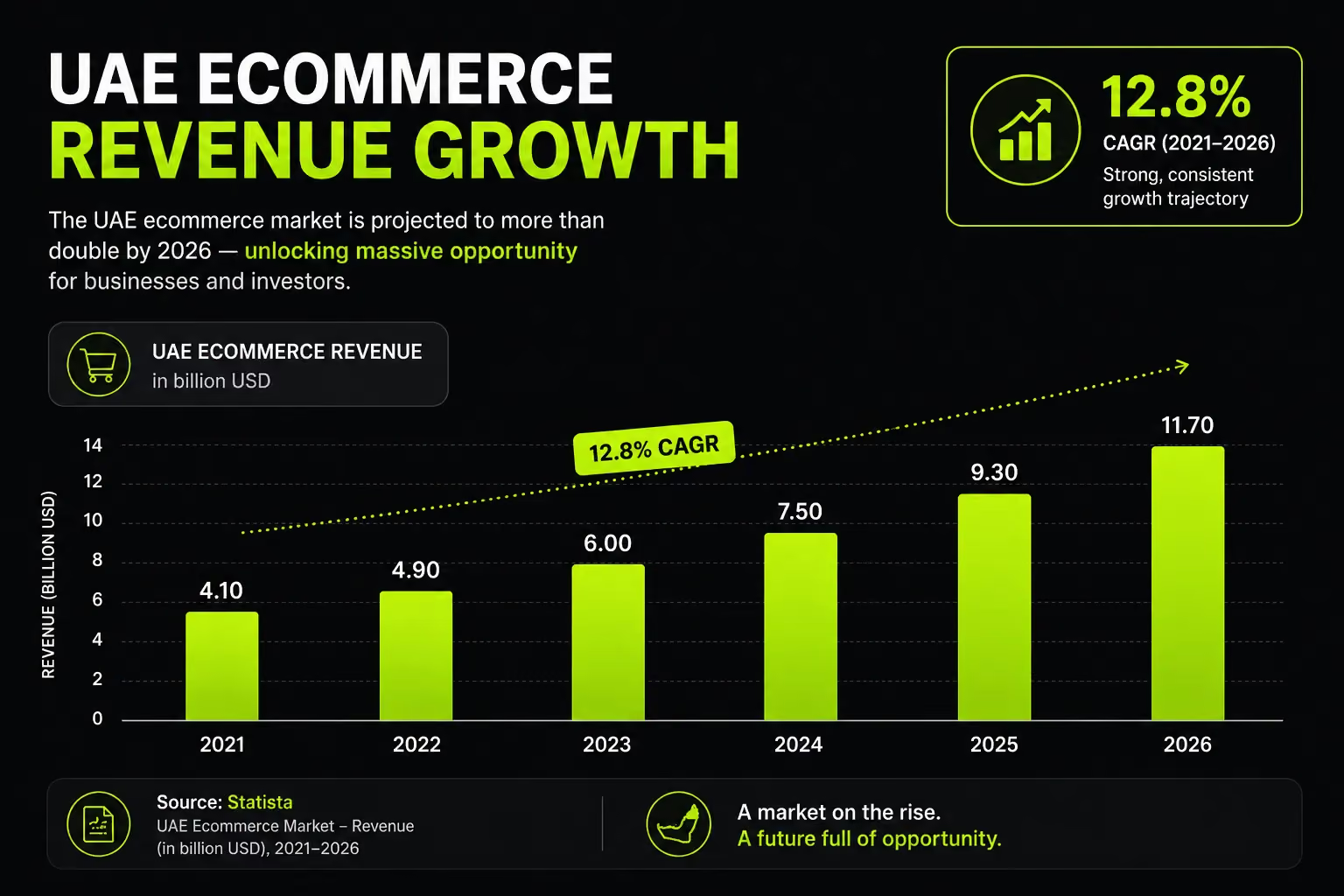
UAE Ecommerce Growth at a Glance
The numbers are hard to ignore. The UAE has a 96%+ internet penetration rate, one of the highest globally. Over 70% of online purchases happen via smartphone.
The government has actively backed digital commerce through initiatives like Dubai CommerCity, a dedicated free zone for ecommerce businesses and the broader UAE Digital Economy Strategy targeting a doubling of the digital economy's contribution to GDP by 2031.
Combined, these factors have created sustained demand for ecommerce development that shows no signs of slowing. Retail brands that operated purely offline five years ago are now building full digital storefronts.
D2C brands that started in Riyadh or Mumbai are using Dubai as their entry point to the Gulf. And regional brands born digitally are scaling into multi-market operations requiring complex, localised infrastructure.
What Makes Dubai Different From Other Markets
Building an ecommerce store for the UAE is not the same as building one for the UK, US, or India. The technical and cultural requirements are distinct.
Key differences any competent Dubai ecommerce agency should be equipped to handle:
- Arabic RTL design: A significant share of the UAE population shops in Arabic. Right-to-left layouts require more than translation the entire UI needs to mirror, including navigation, icons, checkout flows, and form alignment
- Local payment gateways: UAE consumers expect to pay via gateways like Telr, PayTabs, Checkout.com, Network International, and Amazon Payment Services not just Stripe or PayPal
- BNPL integration: Buy Now Pay Later adoption is growing fast. Tabby and Tamara are now standard expectations among UAE shoppers, particularly for fashion, electronics, and beauty
- VAT compliance: UAE introduced 5% VAT in 2018. Ecommerce stores must display VAT-inclusive pricing correctly and generate compliant tax invoices
- Cash on delivery: Despite strong digital payment infrastructure, COD remains a preferred method in parts of the Gulf. Removing it loses real orders
- Cross-border commerce: Many Dubai-based brands sell into Saudi Arabia, Kuwait, Bahrain, and Oman. Logistics integrations (Aramex, Fetchr, Emirates Post) and multi-currency pricing add complexity that generic ecommerce agencies are not equipped to handle
What to Look for in an Ecommerce Development Company in Dubai
This is the section most competitor articles skip entirely. They list companies without giving you the tools to evaluate them. Here is what actually matters.
Platform Expertise
The platform your store is built on affects cost, speed to launch, scalability, and the complexity of future updates.
Any agency you work with should have demonstrable, deep expertise in at least one platform and should be able to give you a clear recommendation based on your business requirements, not based on what they prefer to build.
Shopify is the most common choice for UAE brands entering the market or scaling to the mid-market.
It has a mature ecosystem of UAE-compatible payment gateways, Arabic-language themes, and apps for localisation. Shopify Plus suits brands with higher volume and more complex requirements promotional logic, multi-storefront, and B2B portals.
Magento (now Adobe Commerce) still powers large enterprise retailers in the Gulf, particularly those with complex product catalogues, custom pricing rules, or deep ERP integration needs.
The development overhead is higher and the ongoing maintenance cost is significant; it suits businesses with either a dedicated in-house tech team or a committed agency relationship.
Custom headless builds using Next.js or Remix with a Shopify or Medusa backend are the fastest-growing category, driven by brands that have hit the ceiling of what template-based platforms can deliver.
Performance, flexibility, and UI control are the main reasons. The cost is higher, and the agency requires serious front-end engineering capability.
UAE-Specific Technical Capabilities
Platform expertise is table stakes. These are the capabilities that separate agencies that understand the UAE market from those that do not.
A qualified Dubai ecommerce agency should demonstrate experience with:
- Arabic RTL interface development not just translation, but full layout mirroring and RTL-compatible checkout flows
- Integration with UAE payment gateways: Telr, PayTabs, Network International, Amazon Payment Services
- BNPL setup: Tabby and Tamara plugin/API integration
- UAE VAT module configuration correct tax display, invoice generation, and reporting
- Logistics integrations: Aramex, Fetchr, Emirates Post, and third-party fulfilment APIs
- Multi-currency and multi-language store configurations for cross-GCC selling
If an agency cannot speak fluently about at least four of these, they are not a specialist in the UAE market regardless of how good their portfolio looks.
Post-Launch Support and Maintenance
The store launch is not the finish line. It is the start of ongoing operations. A surprising number of brands negotiate aggressively on the development fee and fail to budget for or contractually agree on post-launch support.
Before signing, confirm:
- What is the SLA (Service Level Agreement) response time for critical bugs? Hours or days?
- Is post-launch support included or billed separately, and at what rate?
- How are security updates and platform upgrades handled?
- Do they offer ongoing performance optimisation, or is the handover final?
Agencies that disappear after launch are common in the UAE market. Get post-launch commitments in writing.
Proven Track Record in the Gulf Market
Portfolio review is non-negotiable. Ask to see live URLs of ecommerce stores built for UAE or Gulf clients. Then visit those stores on your mobile phone not a desktop and assess load speed, navigation, and checkout flow quality yourself.
For independent verification, check the agency's profile on Clutch.co, which publishes verified client reviews. Google reviews and Trustpilot are secondary but useful. Be sceptical of any agency whose entire portfolio consists of concept work or mockups rather than live, functioning stores.
Industry experience also matters. Fashion, F&B, beauty and electronics are the dominant UAE ecommerce verticals. An agency that has built stores in your category understands the specific UX patterns, product presentation challenges, and customer expectations that come with it.
Transparent Pricing Models
The UAE agency market is not consistent on pricing transparency. Some agencies publish starting rates; many do not. What you should expect and how to interpret it:
- Fixed project scope: Best for well-defined projects with clear requirements. The agency quotes a single price for a specified deliverable. Scope creep is the main risk if requirements are not documented precisely upfront.
- Retainer model: Common for ongoing development, CRO, or maintenance. You pay a monthly fee for a set number of hours or deliverables.
- Hourly billing: UAE agencies typically range from AED 200 to AED 600 per hour depending on seniority and specialism.
Red flags to watch for:
- No written project scope or proposal verbal agreements protect no one
- A quote with no staging or testing environment included
- No ownership clause you must own all code, design files, and domain assets at the end of the project
- Promises of first-page Google rankings within 30 days this is not possible and signals dishonesty
Top Ecommerce Development Companies in Dubai (2026)
The companies below are included based on publicly available data, SERP performance, Clutch reviews, and demonstrated UAE market presence. This is not an exhaustive list, and inclusion does not constitute an endorsement. Verify each agency's current capabilities directly before engaging.
1. Suplex Design
Best for: D2C brands, Shopify development, mobile-first ecommerce, UAE and Gulf market builds
Key services:
- Shopify and custom ecommerce store development
- UX design, mobile-first design, and conversion rate optimisation
- Arabic RTL layout and Gulf payment gateway integration
- iOS and Android app development for ecommerce brands
Platforms: Shopify, Webflow, WordPress, Custom Development
Notable verticals: Food and beverage, fashion, health and wellness, hospitality, lifestyle
Location: Dubai, UAE (Al Garhoud)
Suplex is a design-led ecommerce agency based in Dubai, working with D2C brands across the UAE, India, and the US.
Their portfolio spans Shopify builds for health and wellness brands (Miduty), iOS/Android apps for hospitality businesses (Kimi Cafe in Dubai), and ecommerce websites for lifestyle, food, and personal care brands.
The team is a Google Partner, Meta Business Partner, and Shopify Partner. Founders take direct client calls as a signal of the agency's scale and accessibility for brands that want senior involvement throughout a project.
2. Tomsher Technologies
Best for: Mid-market and enterprise ecommerce, Shopify Plus, Magento
Key services:
- Shopify and Shopify Plus development
- Magento / Adobe Commerce builds
- Mobile app development
- Digital marketing integration
Platforms: Shopify, Magento, WooCommerce
Location: Dubai, UAE
Tomsher consistently ranks among the top organic results for UAE ecommerce keywords, which indicates both SEO investment and content authority. They have a broad platform capability and serve clients across the Gulf region.
3. Digital Gravity
Best for: UI/UX-focused ecommerce builds, custom web development
Key services:
- UX research and interface design
- Custom ecommerce development
- Shopify development
- Mobile commerce
Platforms: Shopify, custom builds
Location: Dubai, UAE
Digital Gravity appears consistently in the top three for core UAE ecommerce search terms. Their positioning leans toward design quality, a useful differentiator for brands where brand expression and user experience are primary concerns.
4. Branex Dubai
Best for: Cross-platform ecommerce, mid-size businesses
Key services:
- Ecommerce website design and development
- Shopify, Magento, WooCommerce
- Mobile ecommerce development
- Digital branding
Platforms: Shopify, Magento, WooCommerce, custom
Location: Dubai, UAE
Branex appears across multiple top-10 ecommerce agency lists for the UAE market. Their breadth of platform coverage makes them a candidate for businesses that have not yet decided on a platform and want a vendor-neutral recommendation.
5. Lucidly
Best for: UAE-market ecommerce, growing D2C brands
Key services:
- Shopify development
- Ecommerce UX design
- Payment gateway integration
- SEO for ecommerce
Platforms: Shopify, custom
Location: UAE
Lucidly has been gaining SERP traction in 2025–2026, particularly for UAE ecommerce keywords. A newer but active presence in the market, worth evaluating for D2C brands looking for a focused Shopify specialist.
6. Element8
Best for: Established SMEs, design-focused builds
Key services:
- Ecommerce website design
- Shopify and WooCommerce development
- Digital marketing
- Branding
Platforms: Shopify, WooCommerce
Location: Dubai, UAE
Element8 is an established Dubai agency with a long track record in web design. Their ecommerce capability is strongest in the SME segment, and their design portfolio is publicly available for review.
7. Ceymox Technologies
Best for: Ecommerce-specific development, mobile app plus store builds
Key services:
- Magento / Adobe Commerce development
- Shopify development
- Mobile ecommerce apps
- API and third-party integrations
Platforms: Magento, Shopify, custom
Location: UAE (with India development base)
Ceymox is an ecommerce-focused agency with specific depth in Magento useful for businesses with complex catalogue or pricing structures that require enterprise-grade platform capability.
8. Cloud6
Best for: UAE ecommerce, multi-platform capability
Key services:
- Shopify and Magento development
- WooCommerce builds
- Ecommerce SEO
- Maintenance and support
Platforms: Shopify, Magento, WooCommerce
Location: UAE
Cloud6 ranks consistently for UAE ecommerce development keywords. Their service breadth covers development, SEO, and ongoing support which reduces vendor fragmentation for businesses that want a single agency relationship post-launch.
9. GCC Marketing
Best for: Gulf-market-first ecommerce, multilingual and Arabic builds
Key services:
- Arabic ecommerce development
- Multilingual and multi-currency store configuration
- Regional payment gateway integration
- Digital marketing for Gulf markets
Platforms: Shopify, WooCommerce, custom
Location: UAE / GCC region
GCC Marketing focuses specifically on the Gulf market. For brands that need Arabic-first design, multi-country configuration, or marketing beyond the UAE into Saudi Arabia, Kuwait, and Bahrain, their regional specialisation is relevant.
Ecommerce Development Costs in Dubai: What to Expect
Pricing is the topic most agency comparison articles avoid. The ranges below are based on UAE agency market data and should be used as planning benchmarks.
Actual quotes will vary based on scope, product complexity, integrations required, and whether Arabic localisation is included.
Cost Ranges by Project Type
Most mid-market UAE brands end up spending between AED 30,000 and AED 80,000 for a solid, custom-designed Shopify store with payment gateway integration, Arabic language support and basic performance optimisation.
Anything quoted significantly below this range for a full custom build warrants scrutiny either the scope is thinner than presented, or the development will be white-labelled to a cheaper offshore team without disclosure.
Hidden Costs to Budget For
The project invoice is rarely the total cost. Budget separately for:
- Payment gateway setup: Most UAE gateways charge a setup fee and a monthly or per-transaction rate. Telr, PayTabs, and Checkout.com each have their own fee structures
- SSL certificate and hosting: Basic Shopify plans include SSL; custom builds on VPS or cloud hosting require separate SSL and server management costs
- CDN: Critical for fast load times in the Gulf, particularly for stores serving Saudi Arabia and other GCC markets alongside the UAE
- Arabic translation and localisation: Professional Arabic translation for product descriptions, email templates, and marketing content is typically billed separately from development
- Third-party app integrations: Loyalty platforms, CRM connectors (Klaviyo, HubSpot), and ERP integrations (SAP, Oracle) all carry licensing and integration costs
- Annual maintenance retainer: A live ecommerce store requires ongoing support. Budget 15–20% of the original development cost annually for maintenance, updates, and minor feature additions
Red Flags When Hiring an Ecommerce Agency in Dubai
Most buyers research agencies on their best behaviour. These are the signs that indicate a company may not deliver what they promise.
- No detailed written proposal or project scope. A professional agency provides a written scope that specifies deliverables, milestones, revision rounds, and ownership of assets.
Verbal agreements and informal WhatsApp discussions are not binding and create disputes.
- No UAE-based clients in their portfolio. A generic portfolio of international work does not demonstrate familiarity with local payment gateways, VAT compliance, Arabic UX, or Gulf logistics.
Ask specifically for UAE or GCC client references.
- Inability to explain their QA process. Quality assurance device testing, browser testing, performance benchmarking, checkout flow testing should be a standard part of every project.
If an agency cannot describe their QA process clearly, their testing is likely informal at best.
- No post-launch support plan. The conversation should not end at "we'll hand over the files." Get SLA response times, bug fix policies and maintenance rates agreed in writing before the project starts.
- First-page Google rankings promised within 30 days. This is a common claim in the UAE agency market and it is not possible. Organic search rankings take months to build.
Any agency making this promise is either uninformed or dishonest about how search works.
- White-label development without disclosure. Some Dubai-based agencies present themselves as in-house development teams but outsource all actual build work to agencies in Pakistan, India, or Egypt without telling the client. This is not inherently bad, offshoring is a legitimate cost structure but the lack of disclosure is a transparency problem.
Ask directly where the development work will be executed.
Questions to Ask Before You Sign
Get answers to these before committing to any agency. Specific, concrete responses indicate genuine capability. Vague answers indicate surface-level experience.
- Have you built ecommerce stores for UAE or GCC businesses before? Can I speak to one of those clients directly?
- Which payment gateways have you integrated in the UAE market? Which ones are you familiar with technically, not just at a plugin level?
- Do you support Arabic RTL development? Can you show me a live example of a store you have built with a full RTL layout?
- What does your post-launch support package include, and what is the SLA for critical issues?
- Can you share case studies that include traffic or conversion data not just design screenshots?
- Will I own all code, design files, and domain assets at the end of the project? Is that in the contract?
- How do you handle scope changes mid-project? Is there a change order process or does the original price flex?
An experienced agency will answer these questions quickly and specifically. An agency that struggles with them is signalling that their experience in the UAE market is shallower than their pitch suggests.
How Suplex Approaches Ecommerce Development in Dubai
Suplex is a Dubai-based ecommerce design and development agency working with D2C brands across the UAE, GCC, India and the US.
The team builds Shopify stores, custom ecommerce platforms, and iOS/Android apps with a consistent focus on mobile performance and conversion outcomes, not just visual design.
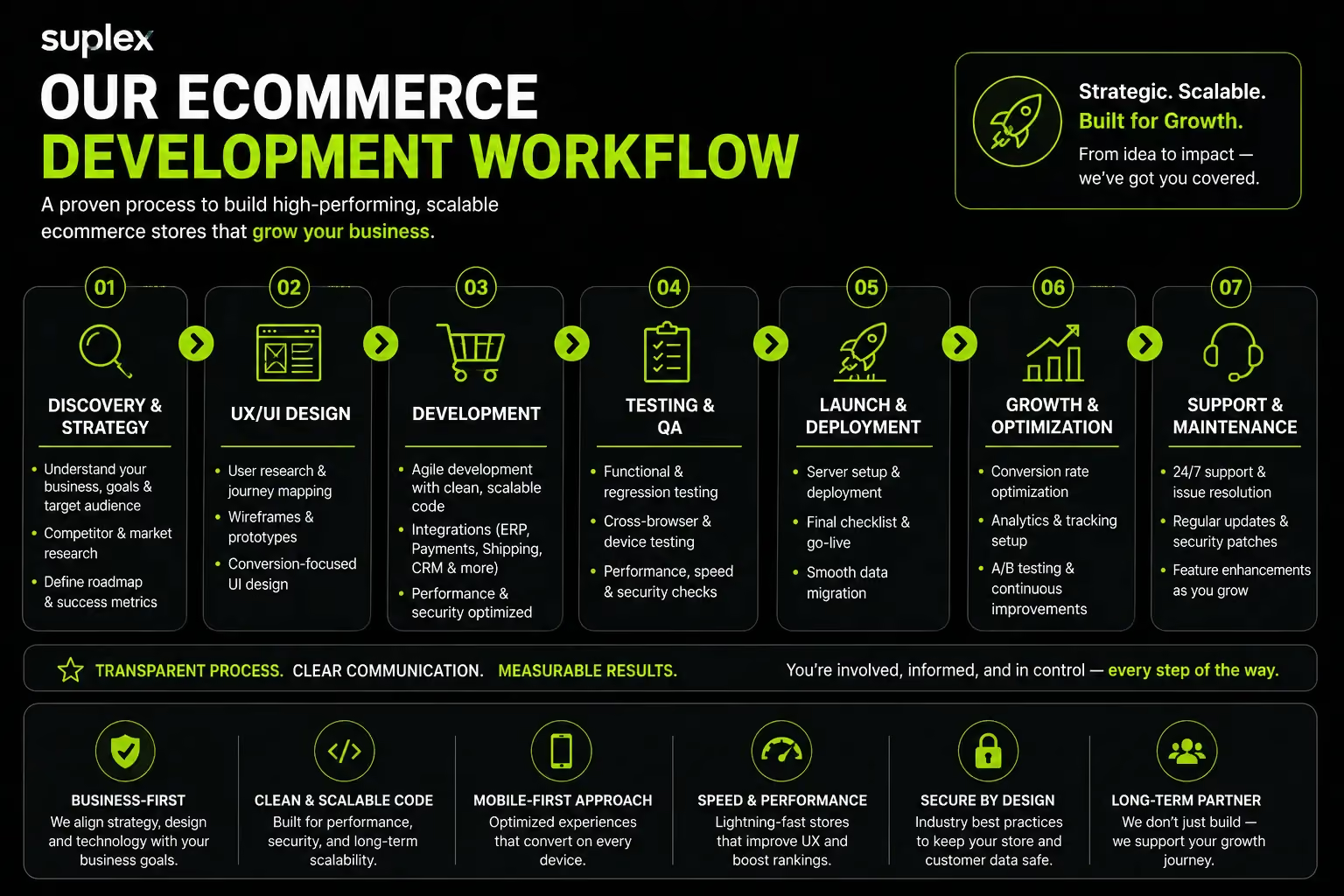
What Sets a Strong Ecommerce Partner Apart
The distinction between an agency that builds websites and one that builds ecommerce stores that generate revenue comes down to a few non-negotiables.
Performance-first development. Every store Suplex builds is assessed against Core Web Vitals targets LCP under 2.5 seconds, INP under 200ms, CLS under 0.1. Speed is not a nice-to-have; it directly affects conversion rates and Google rankings.
Mobile-first design. Over 70% of UAE ecommerce purchases happen on mobile. The mobile experience is designed first, with the desktop treated as a scale-up of that foundation not the other way around.
Conversion-focused UX. The design process starts with how customers make buying decisions, not with what looks good in a Figma mockup. Checkout flow, product page hierarchy, and navigation structure are all evaluated against conversion data and established UX principles.
Gulf-market integrations built in. Payment gateways (Telr, PayTabs, Tabby, Tamara), logistics partners (Aramex, Fetchr), Arabic RTL layouts, and VAT-compliant invoicing are part of the standard workflow not afterthoughts bolted on at the end.
Recent projects include the Kimi Cafe iOS and Android app in Dubai (built to drive customer loyalty and new menu marketing), the Miduty Shopify D2C store (focused on conversion optimisation and average order value), and Shopify builds for lifestyle, fashion, and food and beverage brands across multiple markets.
For brands that want to build a new ecommerce store or audit an existing one, the Suplex founders take direct consultation calls. Book a call here.
Frequently Asked Questions About Ecommerce Development in Dubai
Q1: What is the cost of ecommerce website development in Dubai?
Costs range from AED 8,000 for a basic Shopify store using a premium template, to AED 400,000 or more for a fully custom headless build.
Most mid-market UAE businesses spend between AED 30,000 and AED 80,000 for a custom-designed Shopify store with local payment gateway integration and Arabic localisation. Final cost depends on platform, product count, integrations, and scope complexity.
Q2: Which ecommerce platform is best for businesses in the UAE?
Shopify is the most common choice for UAE SMEs. It launches fast, has a mature ecosystem of Gulf-compatible payment gateways, and supports Arabic via RTL-compatible themes and apps. Shopify Plus suits higher-volume brands.
Magento fits enterprise retailers with complex catalogues. Custom headless builds using Next.js are growing in adoption for performance-critical, high-traffic stores where template limitations are a constraint.
Q3: How long does it take to build an ecommerce website in Dubai?
A Shopify store on a premium template typically takes 2–4 weeks. A custom-designed Shopify build runs 6–10 weeks. Magento or WooCommerce projects take 10–20 weeks depending on complexity.
Fully custom builds can take 6–12 months. Timelines extend when content, product data, or client approvals are delayed which is common. Build delays are rarely the agency's fault alone.
Q4: Do Dubai ecommerce developers support Arabic language websites?
Most established UAE agencies do, but verify it before signing. Arabic ecommerce requires RTL layout support across every page, Arabic-language content, RTL-compatible payment flows, and correctly mirrored navigation icons and UI elements.
Not all Shopify themes and third-party apps are RTL-compatible out of the box and ask to see a live Arabic store example from the agency's portfolio.
Q5: What payment gateways do UAE ecommerce sites use? The most commonly integrated gateways in the UAE are Telr, PayTabs, Checkout.com, Network International, and Amazon Payment Services. BNPL options, specifically Tabby and Tamara, are increasingly standard for fashion, electronics, and beauty categories.
Your development agency should have direct technical experience integrating at least two or three UAE-specific gateways, not just Stripe or PayPal.
Q6: How do I verify if an ecommerce company in Dubai is reputable? Check their Clutch.co profile for verified reviews from real clients. Review their live portfolio not mockups, but working stores you can visit and test. Ask for direct references from UAE or GCC clients and actually call them.
Agencies with published case studies that include measurable outcomes (traffic growth, conversion rate changes) are demonstrably more accountable than those showing only design aesthetics.
Q7: Can a Dubai ecommerce agency help with SEO and marketing after launch? Many full-service agencies in Dubai offer post-launch SEO, Google Shopping campaigns, and social commerce setup.
However, development expertise and marketing expertise are distinct skill sets an agency that excels at building stores may not be equally strong at growing organic traffic. Ask specifically about their in-house SEO team, their approach to technical SEO, and whether they can share examples of stores where they have driven measurable organic growth after launch.
Hi, I’m Rishabh Jain
I believe great digital experiences have the power to shape perception, build trust, and move businesses forward. That belief led me to found Suplex Design Studio, a global digital design and development studio helping FMCG and D2C brands build websites and digital experiences that are strategic, thoughtful, and commercially meaningful.
I started Suplex at 25 with a clear intent, to create digital experiences that look appealing, work seamlessly, and help D2C businesses grow. By 28, the studio had scaled globally, guided by a strong foundation in integrated design that I developed during my academic journey in London, where I was honoured with the Dean’s Award.
Over the years, I’ve had the opportunity to work with 100+ brands, from Fortune 500 organisations to family-run businesses, helping them build websites, e-commerce experiences, and digital products that create clarity, credibility, and long-term value.
Our work has been recognised internationally, including the Manifest Award (2024), the Clutch Global Award (2025), and features across platforms such as The Dieline, Packaging of the World, and the World Brand Design Society.
None of this would be possible without the people behind the work. I’m deeply grateful to the Suplex team, whose commitment, creativity, and attention to detail turn ideas into meaningful digital experiences every day.
At the heart of our work is a simple philosophy, digital design should be intentional, functional, and built to create real business value. That continues to guide everything we create at Suplex.

































Let’s Make It Happen
E-Commerce Success Stories
%201.avif)






.avif)
.avif)
Build Your D2C Business The Right Way
Build It With Suplex.


