AI for Shopify
AI for Shopify in E-Commerce Development
AI is already on Shopify. Most store owners just have not set it up yet.
Shopify announced a formal partnership with Liquid AI in late 2025 to improve search and product recommendations across the platform. OpenAI now lets shoppers buy products directly through ChatGPT conversations, with Shopify powering the checkout behind it. Brands like Glossier, Skims, and Spanx were among the first to get access. So basically, the question is not whether AI is coming to your store. It is which integrations are actually worth doing, and in what order.
Talking about what AI can practically do on a Shopify store, there are a few genuinely useful areas. It can show buyers products they are more likely to purchase, based on their actual behaviour. It can handle customer questions at any hour without a support ticket. It can run search results that understand what a buyer means, not just which keywords they typed. And it can surface operational problems, like a product with a rising return rate, before they become expensive. At Suplex Design, our team of Shopify developers and integration specialists helps D2C brands figure out which of these are right for their stage, and gets them working properly in production.
What Does AI for Shopify Actually Mean?
AI for Shopify covers a lot of ground, so it is worth being clear about what it actually includes. There are three main categories.
The first is AI that improves the shopping experience. This means personalised product recommendations, AI-powered site search, and conversational shopping assistants that guide buyers toward the right product. These tools look at buyer behaviour in real time and use it to surface what a specific shopper is most likely to want, rather than showing everyone the same catalogue in the same order.
The second is AI that handles customer support. AI chatbots can deal with order tracking, returns, product questions, and pre-purchase hesitations around the clock. Talking about one real example here, Heavys, a premium headphones brand, converted nearly 25 percent of abandoned carts into sales after launching an AI assistant. And 95 percent of their support queries are now handled without a human agent.
The third is AI that improves how the store runs. This includes inventory forecasting, automated product descriptions, and AI analytics that find patterns in customer data that would take hours to spot manually. It is not glamorous, but for a growing D2C brand it often has the most consistent commercial impact.
How Suplex Design Approaches AI for Shopify
You will find that most agencies approach AI for Shopify as an app installation exercise. They recommend a list of tools, install them, and move on. At Suplex Design, we do things quite differently. Our team starts by understanding what the store actually needs AI to do. Not every integration is right for every store. Adding AI tools that do not fit the catalogue size or the stage of growth can slow the store down and confuse buyers rather than helping them.
AI Product Recommendations
Product recommendations are probably the most commercially impactful AI integration available on Shopify right now. Research cited by Shopify merchants shows that recommendation engines can drive up to 31 percent of total revenue. They can also lift conversion rates four to five times compared to stores showing everyone the same products.
What this means in practice is simple. A buyer looking at a moisturiser gets shown the right serum to go with it. A buyer adding a coffee grinder to their cart sees the right filters at the right moment. Not whatever happens to sit in the default related products section.
Our team of Shopify developers at Suplex Design evaluates tools like Rebuy, Rep AI, and Wiser based on how well they fit the specific store. We look at catalogue size, the volume of returning customers, and where in the funnel the biggest revenue opportunity sits. The right tool depends on all of these things, and our team makes sure the recommendation is based on fit rather than what is easiest to install.
AI-Powered Site Search
Shopify's default search is keyword-based. And honestly speaking, it fails buyers regularly. A shopper typing "something for dry skin in winter" on a skincare store gets poor results, or none at all, from a keyword search. An AI-powered search understands what the buyer is looking for, even when the exact words do not match the product names.
This is so because buyers who use site search convert at a significantly higher rate than those who browse. Search intent signals that someone is ready to buy. If they cannot find what they want, they leave. Our team at Suplex Design implements AI search tools like Klevu and configures them specifically for the store's catalogue. This includes synonym handling, filter integration, and ranking logic that reflects what the brand wants to prioritise.
AI Customer Support and Chatbots
According to a 2025 survey by Pissed Consumer, 58.3 percent of online shoppers never get a response when they contact a brand. And 40 percent say customer service is the number one thing businesses need to fix. An AI chatbot addresses both of these directly. It handles routine queries instantly, around the clock, without anyone needing to be available.
There is an important distinction worth making here. A rule-based chatbot follows a script and breaks down the moment a buyer asks something unexpected. An AI chatbot understands intent. It handles questions it has not been specifically programmed for, because it has been trained on the store's products, policies, and FAQs.
Our team at Suplex Design implements tools like Gorgias AI, Rep AI, or Intercom Fin depending on the store's support volume and brand tone. We also configure the handoff logic carefully. This is so because poorly configured handoffs, where the AI keeps looping instead of escalating, are one of the fastest ways to lose a customer's trust.
AI Merchandising and Personalisation
Beyond recommendations and search, AI can personalise the broader experience. Collection pages can be sorted differently for different buyer segments. Homepage merchandising can shift based on what a returning buyer has browsed before. Email sequences can be triggered by predictive signals, like a buyer who has browsed a category three times without purchasing, rather than only reacting to actions they have already taken.
Talking about the tools here, Klaviyo's predictive analytics, Black Crow AI, and Shopify's own native personalisation features all play a role depending on the store's data maturity. Our team at Suplex Design helps brands identify which of these are worth implementing now, and which are better saved for a later stage when the customer data needed to make them work is actually in place.
AI for Store Operations
This area gets the least attention but often delivers the most consistent results. AI-driven inventory forecasting reduces overstock and stockouts by predicting demand more accurately than manual methods. AI analytics surface patterns in return data before they show up in a standard Shopify report. AI-generated product descriptions speed up catalogue management for stores with large or frequently changing ranges.
Honestly speaking, none of these are exciting to talk about. But for a D2C brand doing meaningful volume, reducing stockout rate by a few percentage points has a direct revenue impact. And cutting the time spent on catalogue copy from hours to minutes per product adds up quickly. Our team of Shopify experts at Suplex Design assesses which operational AI tools make sense for each store based on where the team is actually spending time.

Tools and Technology Behind AI for Shopify
At Suplex Design, our team works across a range of AI tools depending on what the store needs. For product recommendations, we work with Rebuy, Rep AI, and Wiser. For AI search, we implement Klevu. For customer support, we integrate Gorgias AI, Intercom Fin, and Rep AI. For personalisation and predictive analytics, we work with Klaviyo's AI features and Black Crow AI. And every integration is tested for performance impact before going live, because an AI tool that slows the store down is not worth the lift it promises.
Common Mistakes in AI Shopify Integrations
Most AI integrations on Shopify underperform for the same set of reasons. In our experience at Suplex Design, it is almost always about fit rather than about the technology itself.
- Installing recommendation tools on stores with very limited behavioural data. The algorithm has nothing meaningful to learn from, so it ends up showing generic popular products rather than anything truly personalised.
- Choosing AI search tools based on feature lists rather than how well they handle the specific catalogue. A tool built for a fashion store with thousands of SKUs often performs poorly on a health brand where buyers search by condition or ingredient.
- Setting up AI chatbots without proper training data. A chatbot trained on incomplete product information or outdated policies frustrates buyers. The quality of the output depends entirely on the quality of what it has been trained on.
- Adding multiple AI tools without checking how they interact. Each additional script adds load time. Two tools doing overlapping jobs are worse than one doing the job properly.
- Treating AI as a one-time installation. Recommendation tools need tuning as the catalogue evolves. Chatbots need updating when policies change. Search tools need refinement as new patterns emerge.
At Suplex Design, we assess fit before recommending any AI integration. And this is so because an AI tool that is wrong for the store is considerably harder to remove than it was to install.
Why AI for Shopify Matters for D2C Brands
The commercial case for AI on a Shopify store is straightforward. It helps buyers find what they want faster. It reduces the support load on the team. And it makes better operational decisions with data that is too complex to analyse manually.
Talking about the numbers, McKinsey reports that retailers can increase basket size by 2 to 4 percent just from personalised product recommendations. Brands using AI chatbots at scale are handling 85 to 95 percent of support queries without human involvement. And buyers who engage with AI-powered search convert at measurably higher rates than those using standard keyword search.
For D2C brands specifically, AI is also an equaliser. A well-configured recommendation engine lets a small team deliver a shopping experience that feels as personalised as what a much larger team could produce manually. And this is so because the AI is doing work that would otherwise require people, infrastructure, and time that most D2C brands at growth stage simply do not have.
How Suplex Design Approaches AI for Shopify for Your Store
Every AI integration Suplex Design recommends is specific to the store, the catalogue, the buyer behaviour, and the stage of growth we are working with. There is ideally no standard AI stack that fits every Shopify store. What we bring is a process that starts with understanding what the store actually needs AI to do, identifies which tools are genuinely right for that need, and gets them working in production.
If your store is ready to start using AI to lift conversions, reduce support load, or improve how operations run, that is the conversation worth having. Get in touch with Suplex Design to talk about AI integrations for your Shopify store.

Frequently Asked Questions
What AI services does Suplex Design offer for Shopify stores?
At Suplex Design, we integrate AI across four areas. Product recommendations, AI-powered site search, customer support chatbots, and operational AI covering things like inventory forecasting and analytics. We assess which of these are right for your specific store before recommending anything, and this is so because not every integration is worth doing at every stage of growth.
How long does an AI integration for Shopify take?
Honestly it depends on what is being set up. A single recommendation or search tool typically takes one to two weeks to configure properly at Suplex Design. A more complex project, like training an AI chatbot on custom product data or setting up predictive personalisation, takes longer. We scope this clearly before starting so you know what to expect on timeline and cost.
Will adding AI tools slow our Shopify store down?
This is actually one of the most important questions to ask, and we are glad when clients bring it up. AI tools do add scripts to the store, and poorly configured ones can definitely hurt load times. At Suplex Design, we test every integration for performance impact before going live. If a tool cannot be added without affecting page speed, we say that clearly before recommending it.
How much does an AI Shopify integration cost at Suplex Design?
Implementation at Suplex Design starts from around $500 for a single focused integration and goes higher for projects involving multiple tools or custom chatbot training. The AI tools themselves also carry their own monthly subscription costs, which vary by tool and store size. We give you a clear picture of both the implementation cost and the ongoing costs before any work starts.
Do you provide ongoing support after the AI tools are set up?
Yes, absolutely. AI tools need ongoing attention to keep working well. Recommendation algorithms need tuning as the catalogue changes. Chatbots need updating when policies shift. Search tools need refinement as new buying patterns emerge. Suplex Design offers ongoing support after implementation, and in our experience the biggest gains from AI often come from iterating after the initial setup rather than from the setup itself.
Let’s Make It Happen
Shopify Success Stories
AuraML
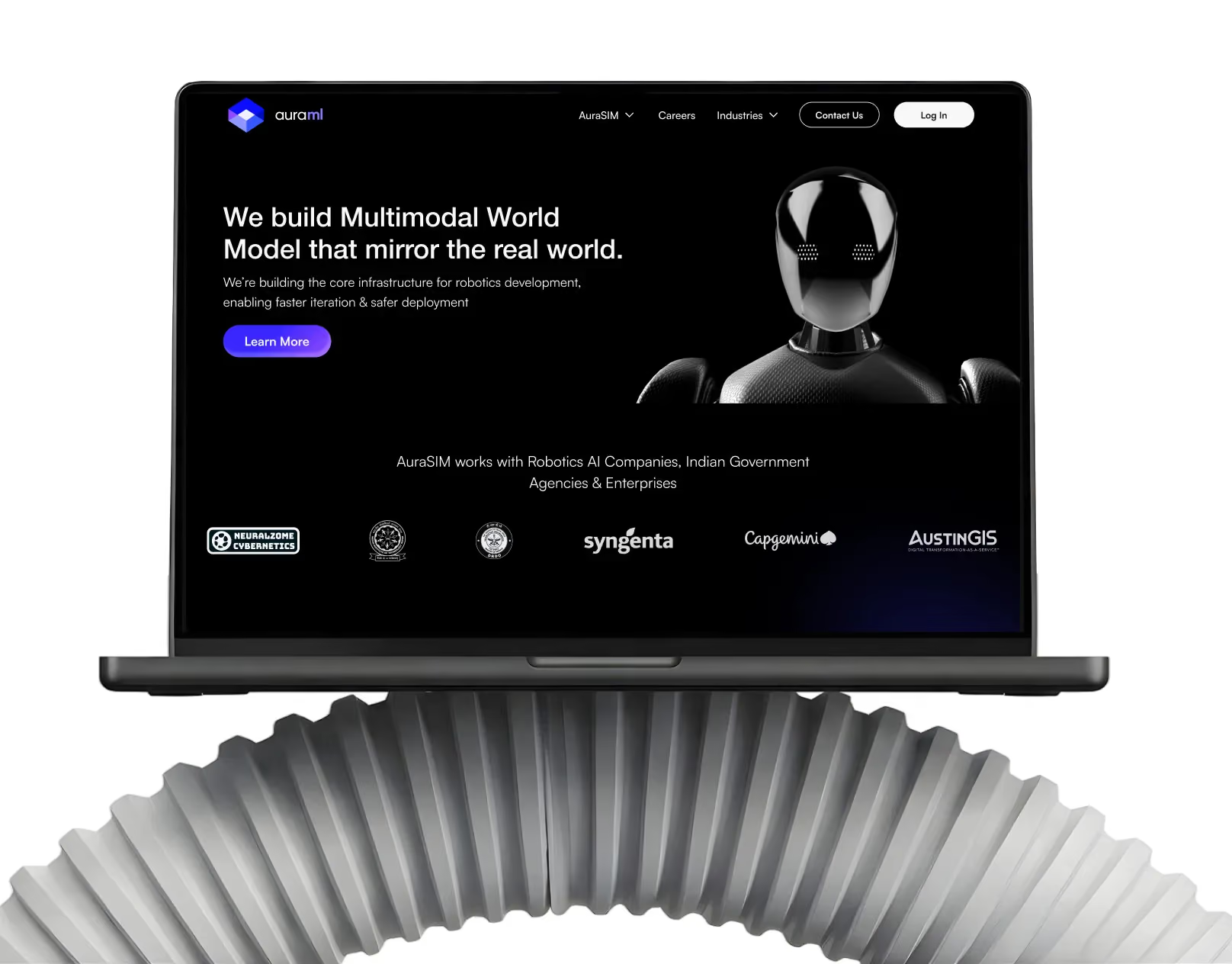
How Suplex helped AuraSIM shift from a simulation tool to the brand that makes physical AI feel ready for the real world.

Tea Culture of the World
How Suplex made 120 teas from across the world feel like a discovery rather than a decision.

Great Lakes
How Suplex built a full stack website for a Midwest tequila brand with a real production story.
Why Suplex?
World Class Aesthetics
.webp)
Profitable E-Commerce
.webp)
Build A Brand
.webp)
Build Your D2C Business The Right Way
Build It With Suplex.


