Conversion Rate Optimisation

Conversion Rate Optimisation in E-Commerce Growth
If your store is converting at 1.5 percent and the industry average for your category is 3 percent, you have not got a traffic problem. You have got a conversion problem. And sending more traffic at it will not fix it. It will just make the problem more expensive.
The maths here is worth sitting with for a moment. A D2C store doing 50,000 monthly visitors at 1.2 percent conversion rate makes 600 sales. At 2 percent it makes 1,000. That is 400 additional orders from the same traffic, with no extra ad spend. At any realistic average order value, the revenue difference is significant. And CRO is what creates it.
At Suplex Design, our team of UX and conversion specialists approaches CRO as a commercial problem, not a design exercise. The question is not "how can we make this look better." It is "what is specifically stopping visitors from buying, and what is the fastest way to fix it."
What CRO Actually Is
Conversion rate optimisation is the process of finding the specific reasons visitors are not converting and systematically fixing them, in order of commercial impact.
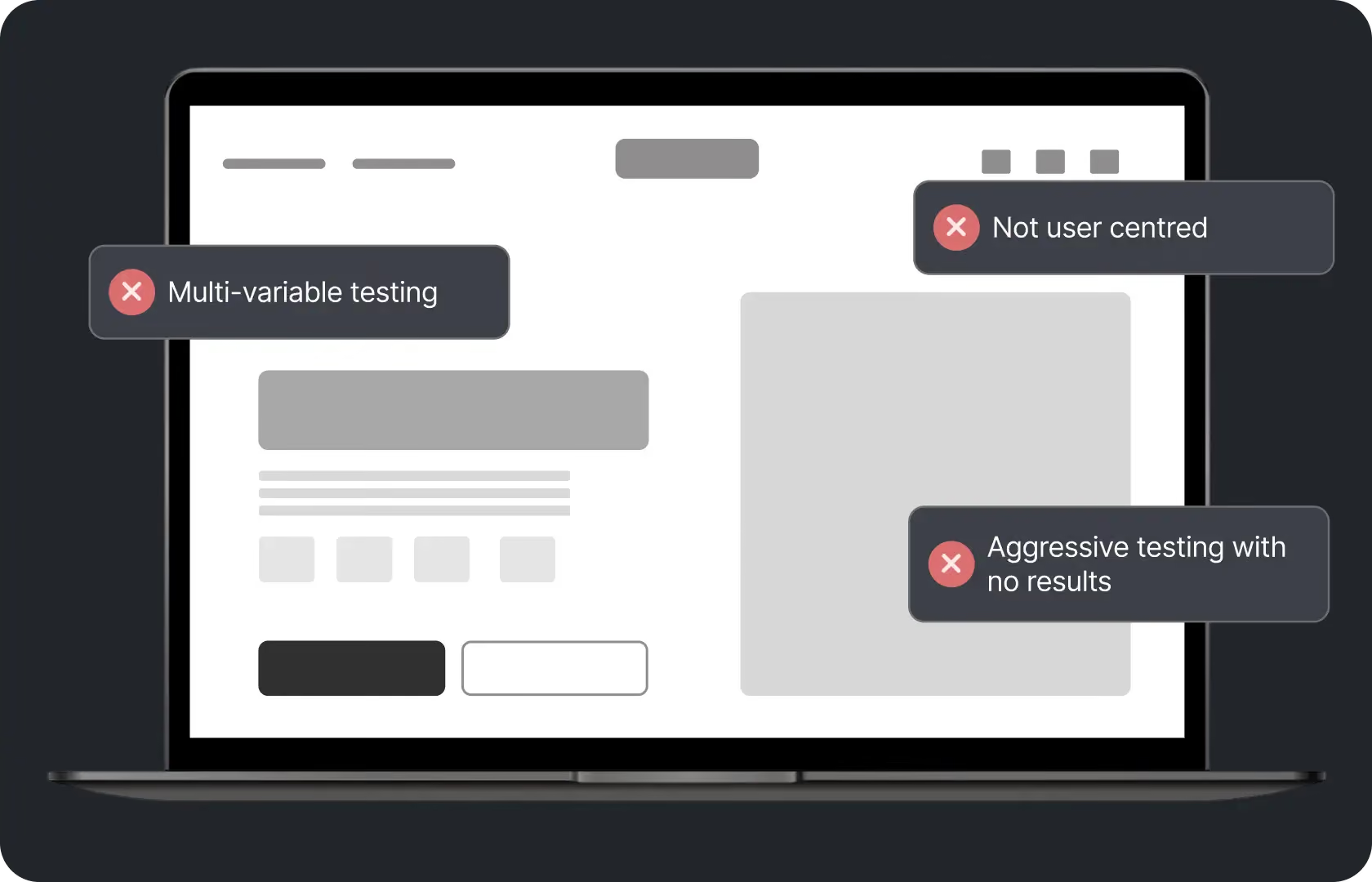
It is not the same as UX design. UX design is about how something works and feels. CRO is about whether it converts. Good UX helps. But you can have a beautifully designed store that converts poorly because the product page does not answer the right question at the right moment, or the checkout introduces friction at exactly the point where a buyer is deciding whether to commit.
It is also not the same as A/B testing. A/B testing is one tool inside a CRO process. Running tests without first diagnosing what is actually wrong is like running medical trials before taking a patient history. Sometimes you get lucky. More often you are testing the wrong hypothesis and drawing the wrong conclusions from the results.
Real CRO starts with diagnosis. Data, heatmaps, session recordings, funnel analysis, user research. Then hypotheses, ranked by expected impact. Then tests. Then implementation of what works. Then the next iteration. It is a cycle, not a project.

How Suplex Design Approaches CRO
You will find that most CRO agencies start with A/B testing. At Suplex Design, our team starts with the funnel. Where specifically are visitors dropping off? How does that drop-off rate compare to what we would expect for a store at this traffic volume and price point? What does the qualitative data say about why?
The answers to those questions determine what gets worked on first. Everything else follows.
Funnel Audit and Diagnosis
The first step is mapping where the leak is. Not estimating. Actually finding it.
We pull GA4 funnel data to understand drop-off rates at each step from landing to purchase. Product page to add-to-cart. Add-to-cart to checkout initiation. Checkout initiation to purchase. Each of these has a benchmark for stores at this traffic level and price point. Anything significantly below benchmark is a signal worth investigating.
We layer qualitative data on top of the quantitative. Hotjar or Microsoft Clarity heatmaps show where buyers are clicking, scrolling, and stopping on each page type. Session recordings show what real buyers actually do when they land on a product page, which is almost always different from what the team assumes they do. Exit surveys where they are configured tell us what buyers were thinking when they left.
This combination, quantitative funnel data plus qualitative behaviour data, is what produces hypotheses worth testing rather than guesses dressed up as strategy.
Product Page Optimisation
Product pages are where most D2C brands lose the most money. Not the homepage. Not the collection page. The product page, because that is where the buying decision actually happens.
The things that consistently move the needle on product page conversion are not surprising. Above-the-fold clarity about what the product is and who it is for. Social proof positioned where hesitation happens, not buried at the bottom. Shipping and returns information available without the buyer having to go looking for it. Product images that answer the questions a physical touchpoint would answer. Mobile layout that does not require pinching and scrolling to get the key information.
What is surprising is how often these basics are wrong. We have audited product pages for brands doing meaningful revenue where the shipping information was three scrolls down on mobile, the size guide opened in a new tab and lost the buyer, and the trust badges were in the footer where almost nobody sees them. These are not design problems. They are conversion problems with simple fixes and immediate commercial impact.
Checkout Optimisation
Checkout abandonment is where most of the money that was nearly converted disappears. The average cart abandonment rate across e-commerce sits around 70 percent. Most of that is not buyers who changed their mind. It is buyers who hit friction and decided the effort was not worth it.
On Shopify's standard checkout, the options are limited. On Shopify Plus, Checkout Extensibility opens up meaningful customisation. Our team at Suplex Design works within whatever the platform allows to reduce friction at every checkout step. Fewer form fields. Autofill enabled. Guest checkout prominently available. Delivery estimates visible before the buyer reaches the final payment screen. Progress indicators so buyers know how many steps remain.
We also review what happens after an abandoned cart. Email recovery sequences, SMS follow-ups, WhatsApp re-engagement in markets where it is relevant. These are not CRO in the traditional sense but they recover a meaningful portion of the revenue that the funnel loses, and at Suplex Design we treat them as part of the same commercial problem.
Mobile Conversion Optimisation
Over 70 percent of e-commerce traffic arrives on mobile. In India that figure is higher. In markets across Southeast Asia and the Middle East it is higher still. And yet most stores are designed primarily for desktop, with mobile treated as a responsive afterthought.
Mobile CRO is its own discipline. Tap targets that are too small to hit reliably. Navigation that requires too many interactions to reach a product. Images that load slowly on a mid-range Android. Checkout forms that pop up a keyboard and obscure the payment button. Each of these is invisible to someone reviewing the store on a laptop with a fast connection and is very visible to a buyer on a four-year-old phone with a patchy signal.
Our team tests on real devices. Not just Chrome dev tools. Because a layout that looks fine in a responsive inspector and a layout that actually works for a real buyer on a real phone are not always the same thing.
Testing and Implementation
Once hypotheses are ranked by expected impact and traffic volume, we run A/B tests using tools like Google Optimize, VWO, or Optimizely depending on the brand's platform and traffic. Each test has a defined success metric, a minimum sample size, and a fixed runtime. Tests that end early, or that are called based on gut feel before reaching statistical significance, produce misleading results and bad decisions.
When a test confirms a hypothesis, the winning variant is implemented. When it does not, the data from the failed test informs the next hypothesis. Neither outcome is wasted. The brands that see compounding CRO gains over time are the ones that run this process consistently, not the ones that run one test, declare victory or defeat, and move on.

Tools and Technology
Suplex Design uses GA4 for funnel analysis and quantitative diagnosis, Hotjar and Microsoft Clarity for heatmaps and session recordings, and Google Optimize, VWO, or Optimizely for A/B testing depending on the brand's setup and traffic volume. Qualitative research is run through user surveys and exit-intent tools where they are configured. For checkout-level improvements on Shopify Plus, we work within Checkout Extensibility and Shopify Functions.
Is CRO Right for You Right Now?
Honest answer: it depends on where you are.
CRO requires traffic to be meaningful. Running A/B tests on 5,000 monthly visitors produces results that take months to reach statistical significance, if they ever do. For most tests to produce reliable results within a reasonable timeframe, a store needs at least 20,000 to 30,000 monthly visitors and a meaningful conversion rate to start from. If traffic is below that, the better investment is probably in building the audience first.
If you have the traffic and the conversion rate is below benchmark for your category, CRO is almost certainly one of the highest-return activities available to the brand. You are already paying to acquire visitors. Getting more of them to convert is commercially more efficient than acquiring more visitors at the same conversion rate.
Common Mistakes in CRO
Most CRO programmes that fail do so for the same set of reasons.
- Running tests without enough traffic to reach statistical significance, then making permanent changes based on results that are essentially noise. A test called at 60 percent significance is a coin flip with extra steps.
- Testing the wrong things. Changing button colours and font sizes when the actual problem is that buyers do not understand what the product does or who it is for.
- Treating CRO as a one-off project rather than a continuous cycle. A single audit and one round of tests will produce some improvement. Compounding gains come from running the cycle consistently over quarters, not months.
- Optimising desktop conversion and ignoring mobile, despite the fact that the majority of traffic and a growing share of purchases happen on mobile devices.
- Not separating the diagnosis phase from the testing phase. Jumping straight to tests without first understanding where the funnel is leaking produces tests that may not be addressing the real problem.
- Measuring conversion rate as a single number rather than breaking it down by device, traffic source, product category, and new versus returning customer. These segments behave very differently and require different interventions.
Why CRO Matters for D2C Brands
Customer acquisition costs are rising. They have been rising consistently for several years and there is no structural reason to expect that to reverse. Every percentage point improvement in conversion rate increases the return on acquisition spend without requiring more spend. That is not a minor efficiency gain. At any meaningful traffic volume, it is a significant revenue number.
Talking about the compounding effect here, a 0.5 percent lift this month and another 0.3 percent next month and another 0.4 percent the month after add up to something materially different from where the brand started. Top-performing e-commerce stores do not convert at 5 percent because they got lucky. They got there by running the CRO cycle consistently over time.
For D2C brands trying to improve profitability without reducing marketing investment, CRO is usually the most direct lever available. It does not require more budget. It requires the existing traffic to be converted more effectively. And in most cases, the changes that produce the biggest lifts are not expensive to implement. They just require the diagnosis to have been done properly first.
How Suplex Design Approaches CRO for Your Brand
Every CRO engagement at Suplex Design starts with the funnel, not the test ideas. We diagnose where the conversion problem actually is before recommending anything to fix. The hypotheses come from data. The tests are ranked by expected commercial impact. And the implementation of what works is built to last, not to produce a good report.
Traffic decent but conversion not moving? Not sure which part of the funnel is the problem? Get in touch with Suplex Design and we will show you where the leak actually is.

Frequently Asked Questions
What CRO services does Suplex Design offer?
Funnel audit and quantitative diagnosis, heatmap and session recording analysis, hypothesis development and prioritisation, A/B test design and execution, checkout optimisation, mobile conversion review, and implementation of winning variants. We also run abandoned cart recovery setup as part of the same engagement, because it addresses the same commercial problem from a different angle.
How much does CRO work cost at Suplex Design?
Honestly it depends on what the store needs and the depth of the engagement. A focused audit and one round of testing typically starts from around $1,200 at Suplex Design. Ongoing CRO retainers where we run the full cycle continuously are priced separately based on the scope. We scope clearly before starting.
How much traffic does a store need before CRO makes sense?
Generally, at least 20,000 to 30,000 monthly visitors for A/B tests to reach statistical significance within a reasonable timeframe. Below that, a single audit to identify the most obvious conversion blockers can still be valuable, but ongoing testing produces results too slowly to be cost-effective. We will tell you honestly if we think your store is not yet at the right traffic level for full CRO work.
How long before we see results?
Initial signals from the first tests typically appear within four to six weeks for stores with meaningful traffic. Compounding gains, the kind that materially shift conversion rate, usually take one to three quarters of consistent work. CRO is not a one-off fix. The brands that see the biggest lifts are the ones that run the cycle continuously rather than stopping after the first round.
Do you provide ongoing CRO support after the initial engagement?
Yes, absolutely. Suplex Design offers ongoing CRO retainers for brands that want to run the cycle continuously rather than in one-off sprints. The compounding gains from consistent CRO work significantly outperform what a single engagement produces, and in our experience the brands that commit to ongoing optimisation are the ones that see conversion rate shift materially over a twelve-month period.
Let’s Make It Happen
Shopify Success Stories
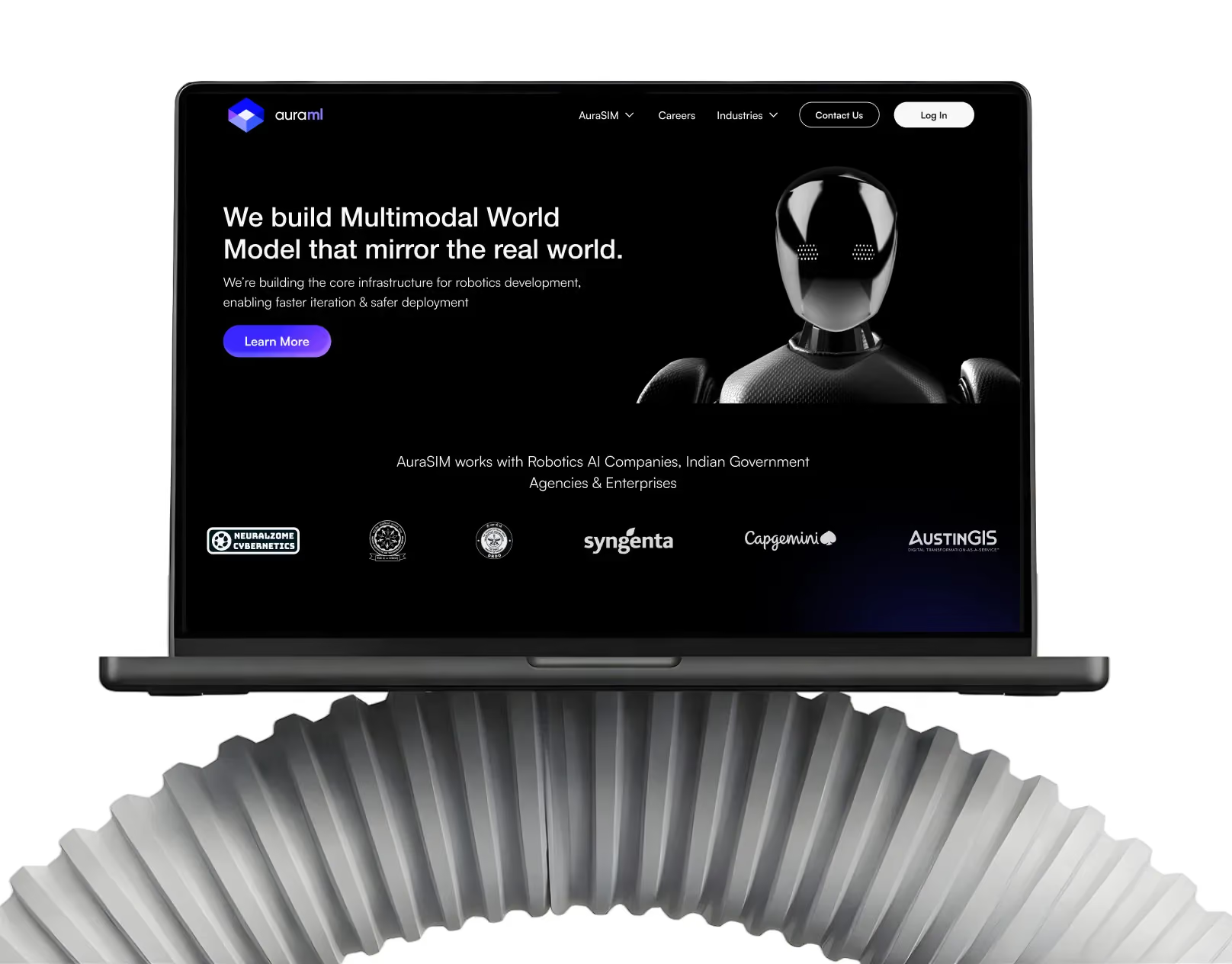
AuraML
How Suplex helped AuraSIM shift from a simulation tool to the brand that makes physical AI feel ready for the real world.

Tea Culture of the World
How Suplex made 120 teas from across the world feel like a discovery rather than a decision.

Great Lakes
How Suplex built a full stack website for a Midwest tequila brand with a real production story.
Why Suplex?
World Class Aesthetics
.webp)
Profitable E-Commerce
.webp)
Build A Brand
.webp)
Build Your D2C Business The Right Way
Build It With Suplex.


