Cosmetics Ecommerce Website Developers in the UAE: What the Build Has to Handle and How to Choose

Building a cosmetics ecommerce website involves more than setting up a product catalogue and checkout.
UAE beauty brands need accurate product data, shade and variant management, Arabic and English storefronts, local payment options and reliable delivery integrations.
As an experienced ecommerce development agency in the UAE, we share insights from our work and audits of six leading beauty brands to explain what goes into building a cosmetics store and choosing the right development partner.
What a Cosmetics Ecommerce Developer Does That a General Web Developer Does Not
A general ecommerce developer can build a store with product listings, payment options and checkout. Cosmetics stores require more attention to product data, shade variations, ingredient information and the way customers search for products.
The developer also needs to account for Arabic storefronts, marketplace integrations and the performance demands of image-heavy product pages.
The design and development work go hand in hand. A well-planned beauty ecommerce website design needs a solid technical foundation to support product discovery and a smooth shopping experience.
In our website audits, we have found recurring problems with product data, filtering, inventory management and third-party app configurations.
These issues can make products difficult to find, display incorrect information or interrupt the buying process. They are development concerns that deserve attention from the beginning of a cosmetics ecommerce project.
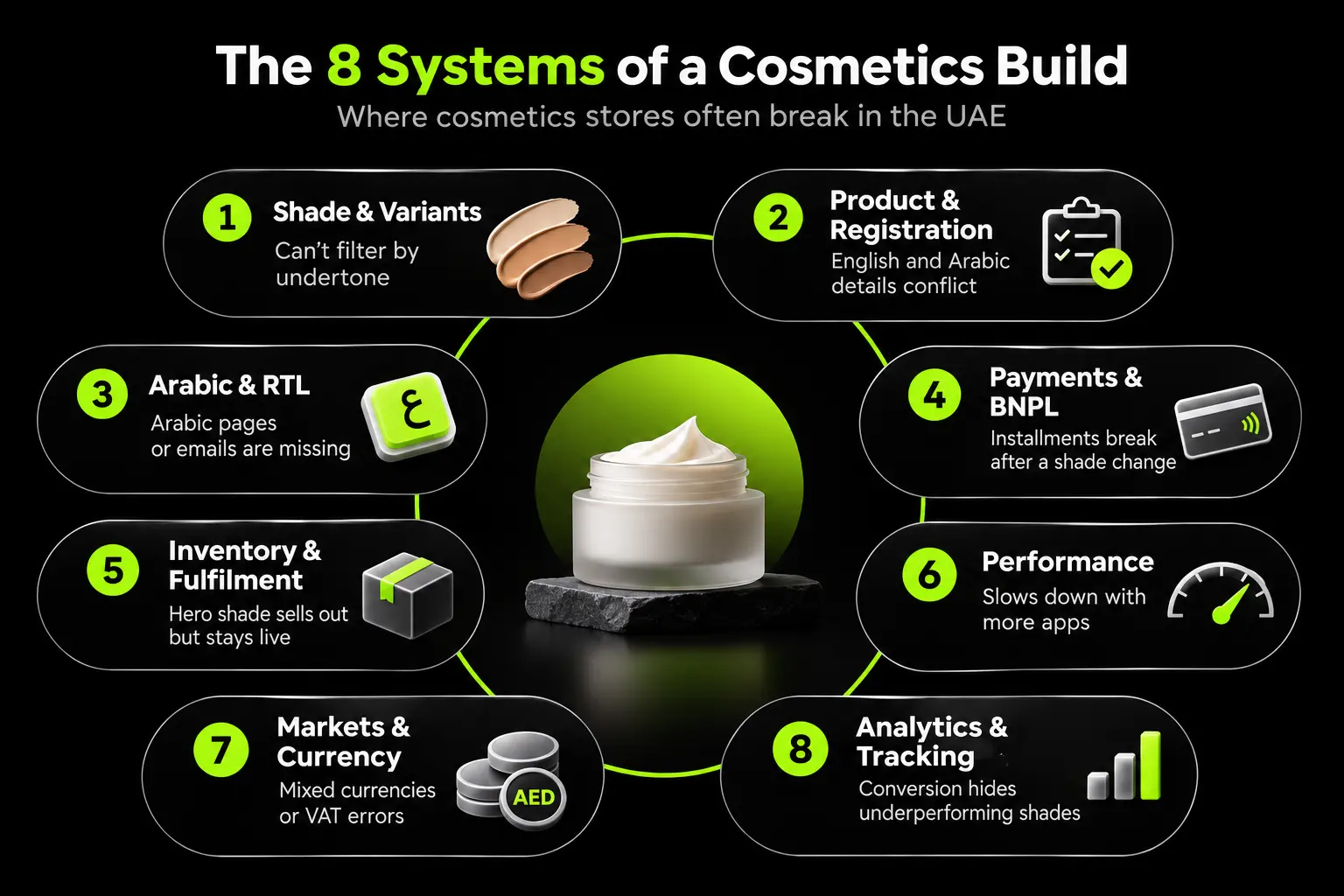
The 8 Systems a Cosmetics Ecommerce Build Must Get Right
A cosmetics ecommerce website relies on several systems working together. Product data, shade selection, inventory, payments and localisation all affect how customers shop. Problems in any of these areas can lead to incorrect information, poor user experience and lost sales.
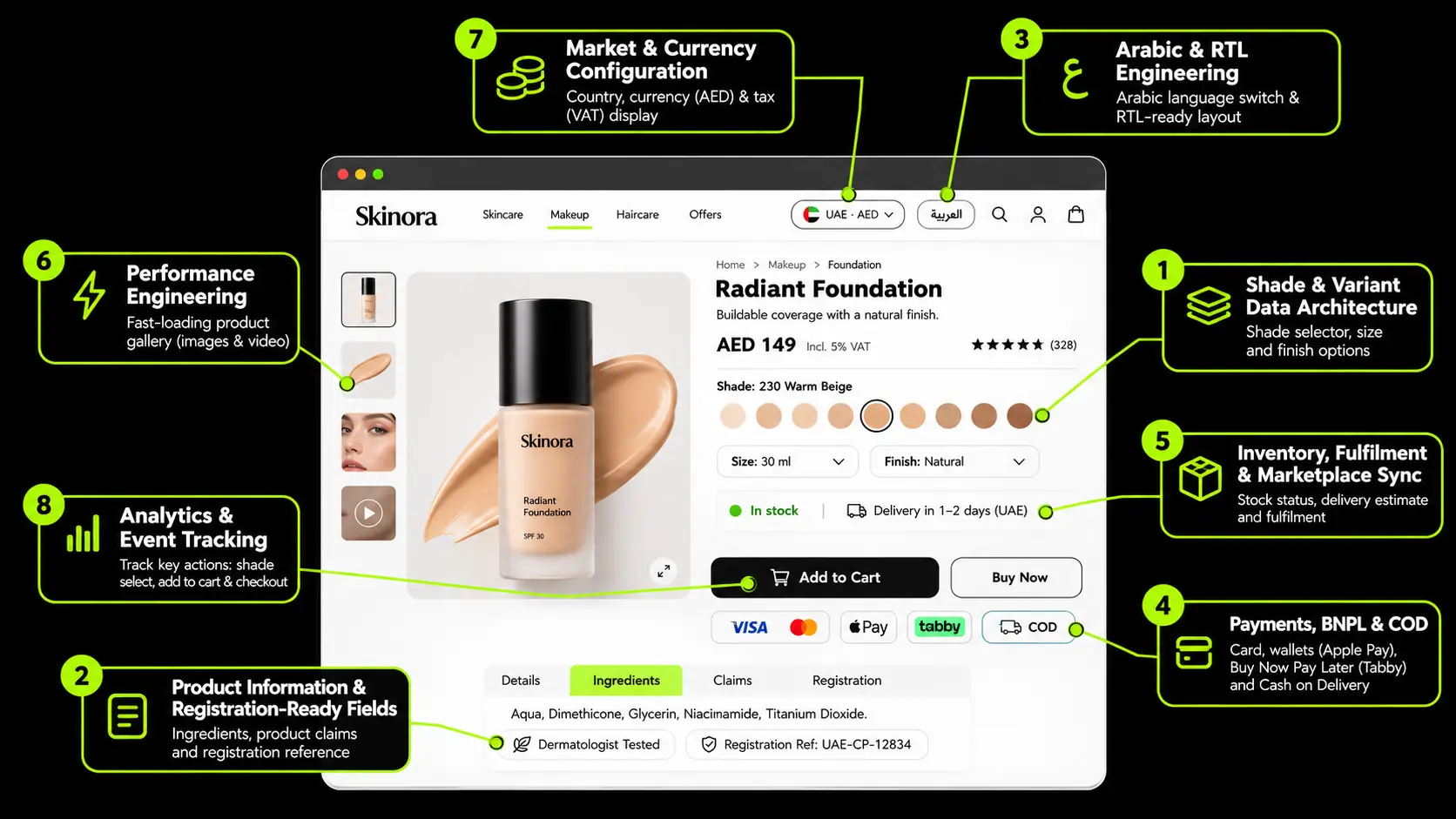
Here are eight areas UAE beauty brands should consider when planning an ecommerce build.
1. Shade and Variant Data Architecture
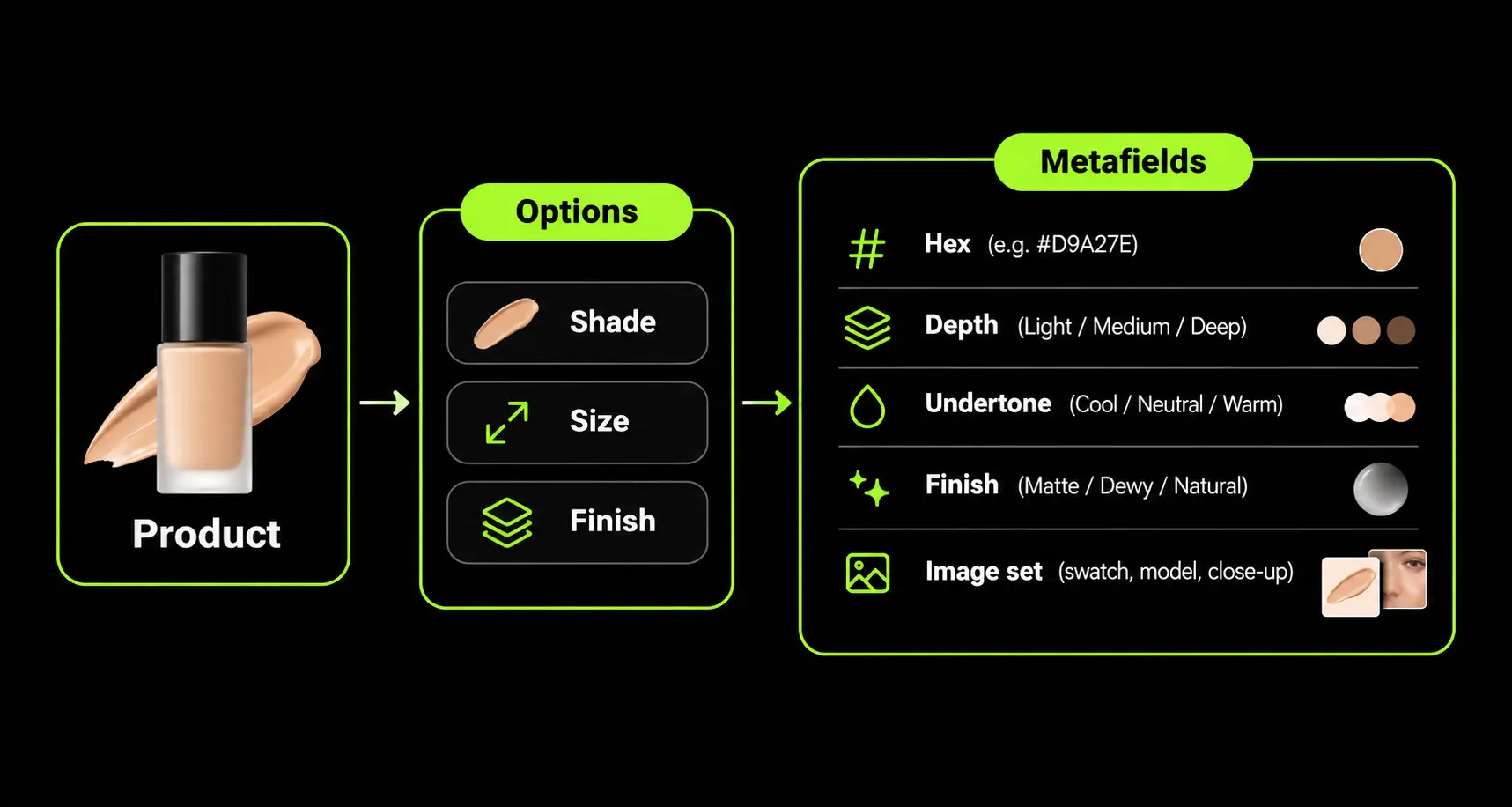
What it Involves: A structured system for managing shades, sizes, finishes, colour codes, undertones, product images and stock levels. Shopify supports up to 2,048 variants and three options per product. Each product can also hold up to 250 media items.
Where it goes wrong: A foundation range with 60 shades and three finishes has 180 possible combinations. Poor planning can make shade selection difficult and create problems with product filters, reviews and shopping feeds.
Fenty Beauty offers a useful example, with its shade swatches, depth filters and undertone information helping customers narrow down their choices.
What to ask: "Would you use product variants or combined listings for our range, and how would that affect reviews and shopping feeds?"
2. Product Information and Registration-Ready Fields
What it involves: Structured product information covering INCI ingredients, Arabic descriptions, registration references, approved claims, usage instructions and warnings. Shopify metafields can keep this information organised and consistent across product pages and sales channels.
Cosmetics sold in Dubai must meet applicable product registration requirements through Dubai Municipality's Montaji system. The website should display information consistent with the registered product details.
Where it goes wrong: English and Arabic product pages contain different ingredient information, or marketplace listings display outdated product claims.
What to ask: "Where will product ingredients, Arabic descriptions and registration details be stored, and how will they reach every sales channel?"
3. Arabic and RTL Engineering
What it involves: Proper right-to-left (RTL) support across the website, navigation, forms, checkout and third-party applications. Development should also cover Shopify Markets, Translate & Adapt, Arabic URLs, hreflang and localised emails.
Where it goes wrong: The main website switches to Arabic, but review widgets, loyalty applications and order notifications remain in English or display incorrectly.
For brands serving both language audiences, Arabic and English ecommerce development requires testing the entire shopping experience, not just translated content.
What to ask: "How will you test Arabic across the theme, checkout, third-party apps and transactional emails?"
4. Payments, BNPL and Cash on Delivery
What it involves: Integration with suitable UAE payment gateways such as Tap, Telr, PayTabs, Checkout.com and N-Genius. Brands may also consider Tabby and Tamara for instalment payments, alongside cash on delivery.
Where it goes wrong: BNPL information displays incorrect instalment amounts, COD orders lack confirmation steps, or partial refunds create inconsistencies in order records.
What to ask: "Which UAE payment gateways and BNPL providers have you integrated, and how do you test refunds and failed transactions?"
Platform selection also affects payment options and costs, particularly when comparing Shopify and WooCommerce for UAE cosmetics stores.
5. Inventory, Fulfilment and Marketplace Synchronisation
What it involves: Stock tracking by shade, back-in-stock notifications, courier and 3PL integrations, and inventory synchronisation with Noon, Amazon.ae and physical retail stores.
Where it goes wrong: A popular shade sells out, but the homepage continues promoting it without suggesting alternatives. Inventory differences between marketplaces and the website can also lead to overselling.
In our Summer Fridays audit, sold-out sections occupied a significant portion of the homepage, with some links directing visitors back to the top of the page.
What to ask: "What happens on the website when a popular shade sells out, and how will stock stay updated across sales channels?"
6. Performance Optimisation for Image-Heavy Pages
What it involves: Image compression, modern image formats, lazy loading, video optimisation, script management and Core Web Vitals testing. These are particularly important for cosmetics stores with large shade ranges and image-heavy product pages.
Where it goes wrong: Too many third-party apps, large images and videos slow down product pages, particularly on mobile devices.
Our audits recorded a B performance grade and approximately 2.5-second load time for Huda Beauty, compared with a D grade and approximately 4.49 seconds for Kayali.
What to ask: "What performance targets will you set for product pages with large shade ranges, videos and review applications?"
Performance should be considered throughout development, alongside ongoing website performance optimisation.
7. Market and Currency Configuration
What it involves: Correct AED pricing, applicable VAT, regional currency settings and shipping rules. Shopify Markets can help manage different currencies and regional storefronts across the GCC.
Where it goes wrong: During our Glow Recipe audit, we found USD and INR prices appearing on the same page for India visitors. Our Ordinary audit also found a redirect to a Find Us page without a direct online purchase option.
For UAE brands, similar configuration issues can create confusion around pricing, VAT and cross-border orders.
What to ask: "How will you test currency, pricing, VAT and shipping settings across the markets we serve?"
8. Analytics and Event Tracking
What it involves: GA4 tracking for shade selection, product quiz interactions, add-to-cart activity by variant, BNPL selection and checkout completion. Comparing Arabic and English storefront performance can also reveal differences in customer behaviour.
Where it goes wrong: The store reports overall product sales but cannot identify which shades receive the most interest or where customers abandon the buying process.
What to ask: "Which ecommerce events will be tracked at launch, and can we measure customer activity at the individual shade level?"

What Our Beauty Website Audits Reveal About Cosmetics Builds
We have audited six major beauty sites, and the engineering lessons are different from the design lessons. These are independent audits of public websites, not client work.
Here is what each one showed, with the system number it relates to.
Five of the six sites had an engineering issue flagged in our audit notes, and only Fenty Beauty had none. The issues were about performance, configuration and stock states. None of them was a visual design problem.
Types of Cosmetics Ecommerce Developers in the UAE
Not every ecommerce developer has the experience needed to build a cosmetics store. A freelancer setting up a Shopify theme may be able to launch a small catalogue but struggle with complex shade variations, Arabic storefronts or marketplace inventory.
Larger development companies can face similar challenges if most of their work involves general ecommerce projects. There are three main options to consider, depending on the size and complexity of the business.
Advertised starting prices range from a few hundred AED for basic theme setup to USD 10,000–50,000+ for complex enterprise projects. These are indicative public listings, not fixed market rates.
When comparing ecommerce development companies in Dubai, look beyond their portfolios. A company may have built several impressive online stores but have little experience with shade management, beauty product data or Arabic localisation. For a cosmetics brand, that difference can become clear once development begins.
How to Vet a Cosmetics Ecommerce Website Developer
Choosing an ecommerce developer based on design portfolios alone can be risky. A cosmetics store has specific technical requirements, so the proposal should explain how the developer plans to handle product data, shade variations, Arabic localisation, integrations and performance.
10 Technical Questions to Ask
Before signing a contract, ask the developer these questions:
- How will you manage our shades: as product variants or combined listings?
- Where will ingredient information, Arabic content and registration details be stored?
- Which apps will the store need, what are their monthly costs and how will they affect performance?
- What Core Web Vitals targets will you set for image-heavy product pages?
- How will you test Arabic across the website, third-party apps, emails and checkout?
- Which UAE payment gateways and BNPL providers have you integrated?
- What happens when a popular shade goes out of stock?
- How will you manage currency, VAT and pricing across different markets?
- Will we own the website code, theme and app accounts after handover?
- What post-launch support do you provide, and how quickly do you respond to issues?
A developer with relevant cosmetics ecommerce experience should be able to explain these decisions clearly and support their answers with examples.
What the Development Proposal Should Include
A proposal should explain exactly what the agency will deliver. Before comparing prices, check whether it covers:
- Product and shade data structure
- Third-party apps and recurring subscription costs
- UAE payment and marketplace integrations
- Arabic and English development and testing
- Website performance targets
- Mobile, desktop and browser testing
- Website ownership, documentation and handover
- Post-launch maintenance and support terms
The same attention is needed when reviewing an agency's portfolio. Attractive screenshots do not always show how well a store is built, particularly when it comes to complex catalogues and integrations. Missing technical details and unclear ownership are among the common red flags in Shopify agency portfolios.
Red Flags to Watch For
Be cautious if a developer:
🚩Plans to manage every shade through a basic dropdown.
🚩Treats Arabic localisation as something to add after launch.
🚩Cannot explain how website performance will be measured.
🚩Recommends separate apps for every feature without considering their impact.
🚩Has no relevant beauty or cosmetics ecommerce projects to show.
🚩Provides a single project price without breaking down the work.
Migration projects need the same scrutiny. Moving products and customer data to Shopify is only part of the job. Product URLs, integrations, tracking and existing functionality also need attention to avoid problems after launch.
Cost and Timeline for Cosmetics Ecommerce Development in the UAE
The cost of building a cosmetics ecommerce website depends on the size of the product catalogue and the work involved behind the scenes. Shade management, product data migration, Arabic localisation, payment gateways, marketplace connections and custom features all affect the final price.
Basic template-based websites may start from a few hundred AED, while larger custom ecommerce projects can cost USD 10,000–50,000 or more.
Lower-priced packages often exclude shade data management, Arabic testing, third-party integrations and ongoing support. Ask for a breakdown of development costs in AED, with app subscriptions and maintenance charges listed separately.
An adapted Shopify theme generally takes 6–10 weeks to complete. A custom build involving shade architecture, Arabic functionality and multiple integrations can take around 10–16 weeks.
Delays often come from incomplete product information, missing photography and registration details rather than development work itself. Having these ready before the project starts can save considerable time.
How Suplex Develops Cosmetics Ecommerce Websites for UAE Brands
Suplex is a Dubai-based ecommerce development agency located in Al Garhoud, Dubai. We work with Shopify, WordPress, Webflow and custom platforms. We are also a Shopify Partner, Meta Business Partner and Google Partner, with our founder having worked with more than 100 brands.
Our experience with beauty and product-based businesses includes:
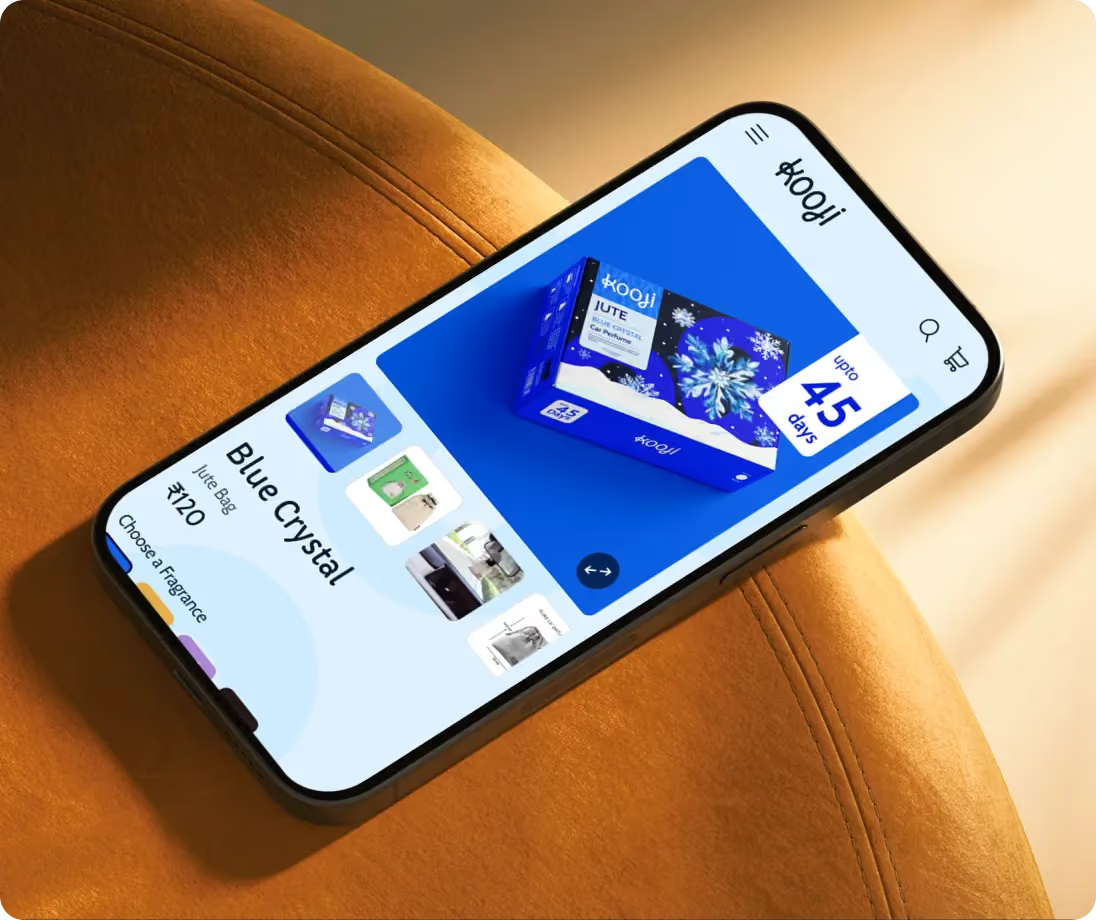
- Kooji: A premium perfume brand we built on Shopify in 2024. The project included customer personas, information architecture, wireframes and structured product information.
- Miduty: A personal care and wellness brand for which we developed a persona-led information architecture and design system.
- Great Lakes and Tea Culture of the World: Projects involving performance optimisation and product discovery, including a catalogue of 120 teas. Managing a catalogue of this size involves many of the same considerations as handling a large cosmetics shade range.
We also independently audit beauty websites, including Fenty Beauty, Huda Beauty, Kayali, Glow Recipe, Summer Fridays, The Ordinary, Rhode, e.l.f. and Kylie Cosmetics. These are reviews of publicly available websites, not client projects.
Depending on the project, our work covers:
- Shopify development and custom Shopify themes
- Shopify Plus
- Performance optimisation and Shopify audits
- Platform consultation and international ecommerce setup
- Custom web development and WordPress
A small cosmetics store with a limited catalogue may only need an adapted Shopify theme. However, a growing brand managing hundreds of shades, Arabic storefronts, marketplace connections and complex inventory needs more specialised development.
If an existing store is already functional but struggling with speed or conversions, a technical audit may be a better starting point than rebuilding the entire website.
FAQs
What Does a Cosmetics Ecommerce Website Developer Do?
A cosmetics ecommerce developer builds the systems behind an online beauty store. These include shade and variant data, product fields for ingredients and registered details, Arabic and English storefronts, payment and BNPL integrations, stock and delivery logic, and fast pages despite heavy imagery. In the UAE, they should also handle AED VAT-inclusive pricing, cash on delivery, and app features that work correctly in Arabic.
How Much Does a Cosmetics Ecommerce Website Cost to Develop in the UAE?
Advertised prices range from a few hundred dirhams for template sites to well over AED 35,000 for custom builds. Cost depends on how many shades and products you sell, Arabic localisation, integrations with couriers, ERP or marketplaces, and whether the theme is custom. Monthly app fees add recurring cost. Ask for a quote broken down by phase, with every app subscription listed.
Which Platform Is Best for Cosmetics Ecommerce in the UAE?
Shopify suits most UAE cosmetics brands because of its beauty app ecosystem, managed hosting and Shopify Markets for GCC selling. WooCommerce suits content-led brands already on WordPress or teams with in-house developers. Before choosing, check payment gateway eligibility and Arabic right-to-left support, and compare three-year costs rather than monthly subscription prices alone.
How Many Shades Can a Single Product Have on Shopify?
Shopify allows up to 2,048 variants per product, up from the previous 100 limit, across all plans. A product is still limited to three options, such as shade, size and finish. Large shade ranges also need a plan for per-shade images, Google Shopping feeds (which create one row per variant), and how shade counts display on collection pages.
Do Cosmetics Need Registration Before Launching an Online Store in Dubai?
Generally yes. Cosmetics and personal care products sold in Dubai, including through an online-only store, go through Dubai Municipality's Montaji registration system. Requirements vary by product, so confirm current rules with Dubai Municipality or a qualified adviser. Your developer should build product fields so ingredients, names and claims on the site stay consistent with registered details.
Hi, I’m Rishabh Jain
I believe great digital experiences have the power to shape perception, build trust, and move businesses forward. That belief led me to found Suplex Design Studio, a global digital design and development studio helping FMCG and D2C brands build websites and digital experiences that are strategic, thoughtful, and commercially meaningful.
I started Suplex at 25 with a clear intent, to create digital experiences that look appealing, work seamlessly, and help D2C businesses grow. By 28, the studio had scaled globally, guided by a strong foundation in integrated design that I developed during my academic journey in London, where I was honoured with the Dean’s Award.
Over the years, I’ve had the opportunity to work with 100+ brands, from Fortune 500 organisations to family-run businesses, helping them build websites, e-commerce experiences, and digital products that create clarity, credibility, and long-term value.
Our work has been recognised internationally, including the Manifest Award (2024), the Clutch Global Award (2025), and features across platforms such as The Dieline, Packaging of the World, and the World Brand Design Society.
None of this would be possible without the people behind the work. I’m deeply grateful to the Suplex team, whose commitment, creativity, and attention to detail turn ideas into meaningful digital experiences every day.
At the heart of our work is a simple philosophy, digital design should be intentional, functional, and built to create real business value. That continues to guide everything we create at Suplex.
Let’s Make It Happen
E-Commerce Success Stories








Build Your D2C Business The Right Way
Build It With Suplex.