Shopify Agency Portfolio Red Flags: What To Check Before You Hire
.avif)
Shopify Agency Portfolio Red Flags: What To Check Before You Hire
A polished Shopify agency portfolio can look impressive and still tell you very little about what the agency can actually deliver.
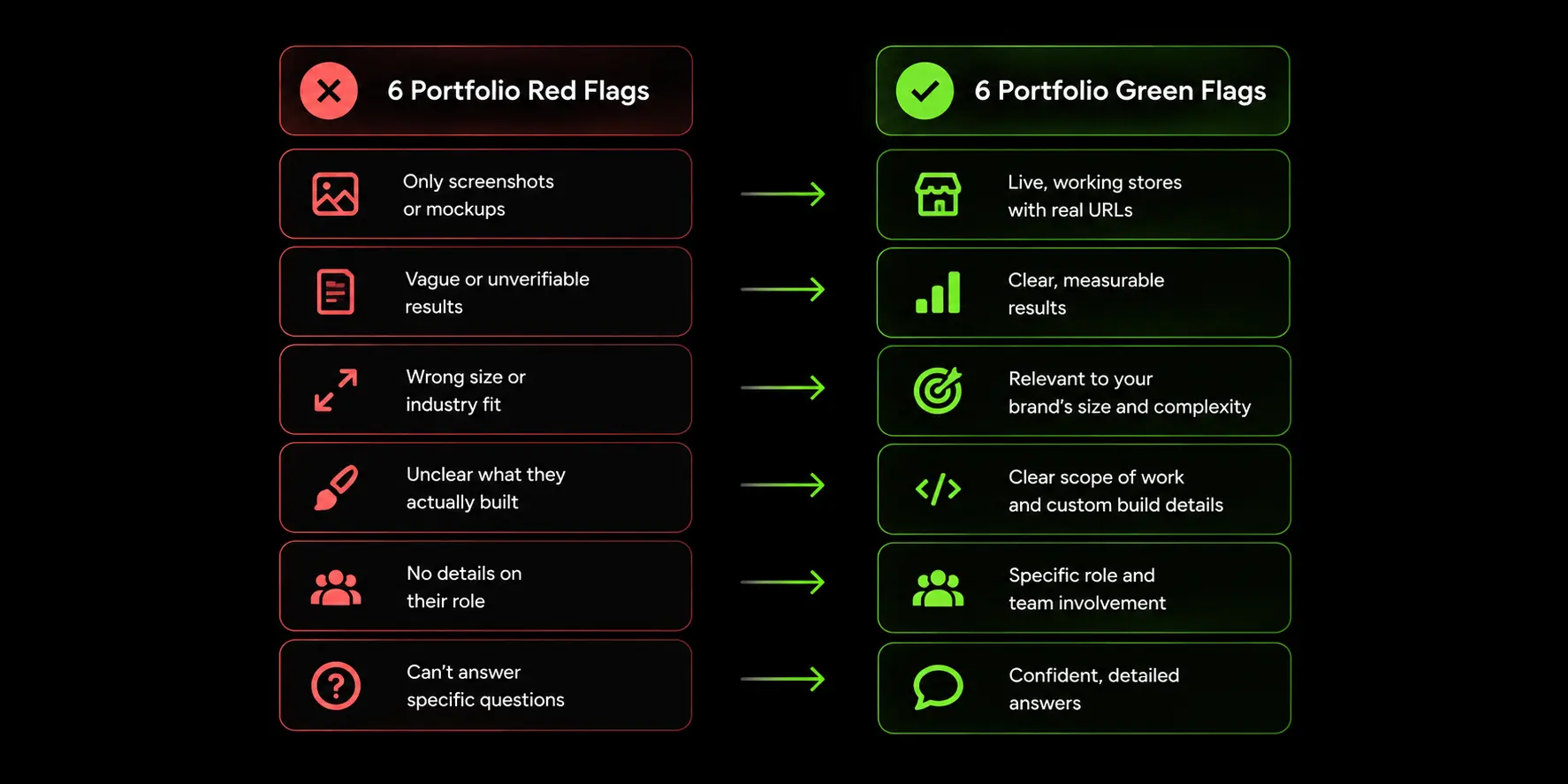
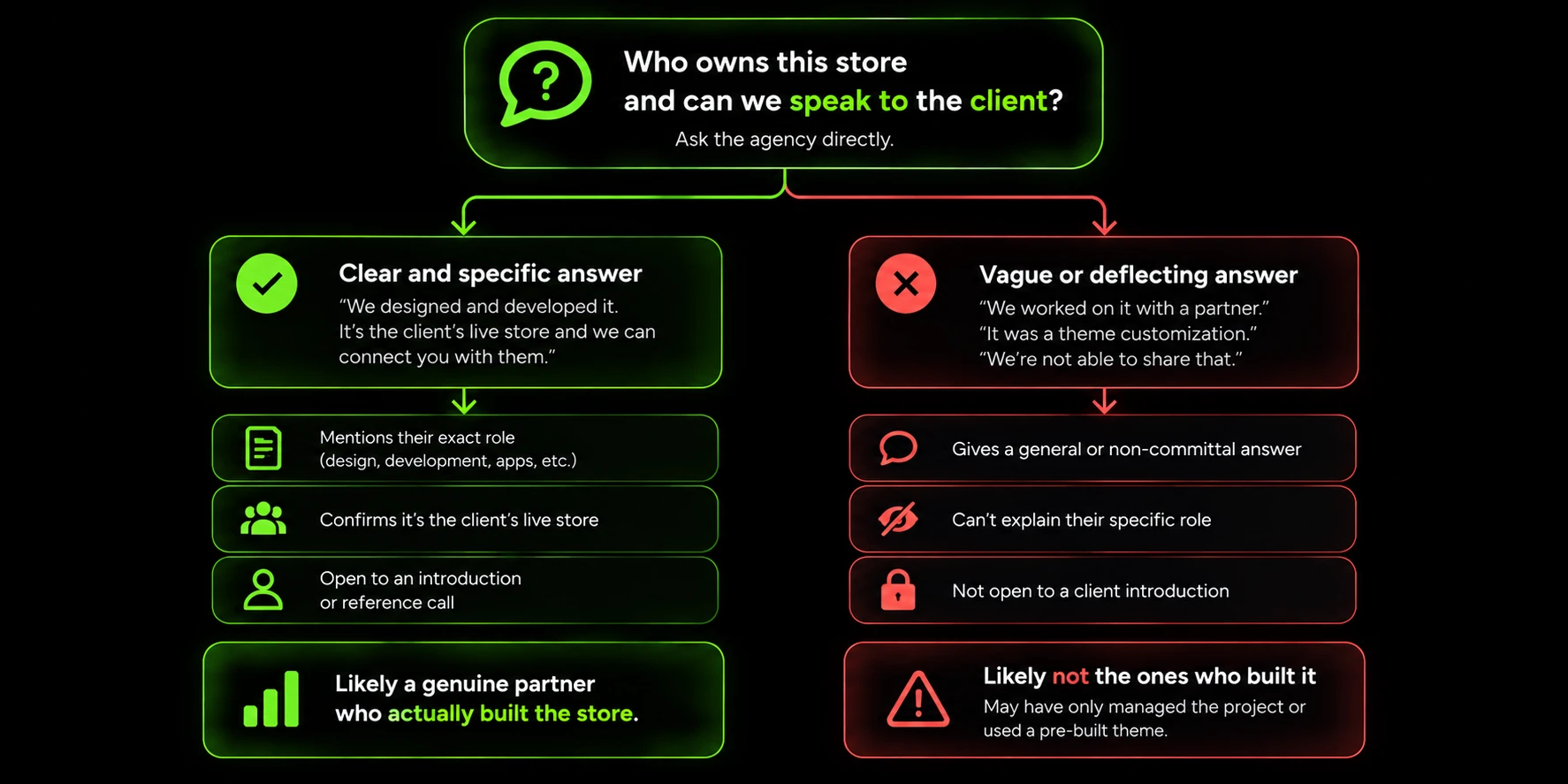
Watch for portfolios built around static screenshots or mockups instead of live, working stores; case studies that claim impressive results without showing baselines, timeframes, or verifiable outcomes; and project lists filled with brands far smaller or more complex than yours.
Be equally cautious when an agency doesn’t clearly distinguish between stores it built from the ground up and themes it simply customized. Most importantly, ask who did what.
A credible agency should be able to explain its exact role, decisions and contribution on every featured project. Strong portfolios withstand scrutiny. Weak ones are designed to avoid it.
Red Flag #1: No Links to Live, Working Stores
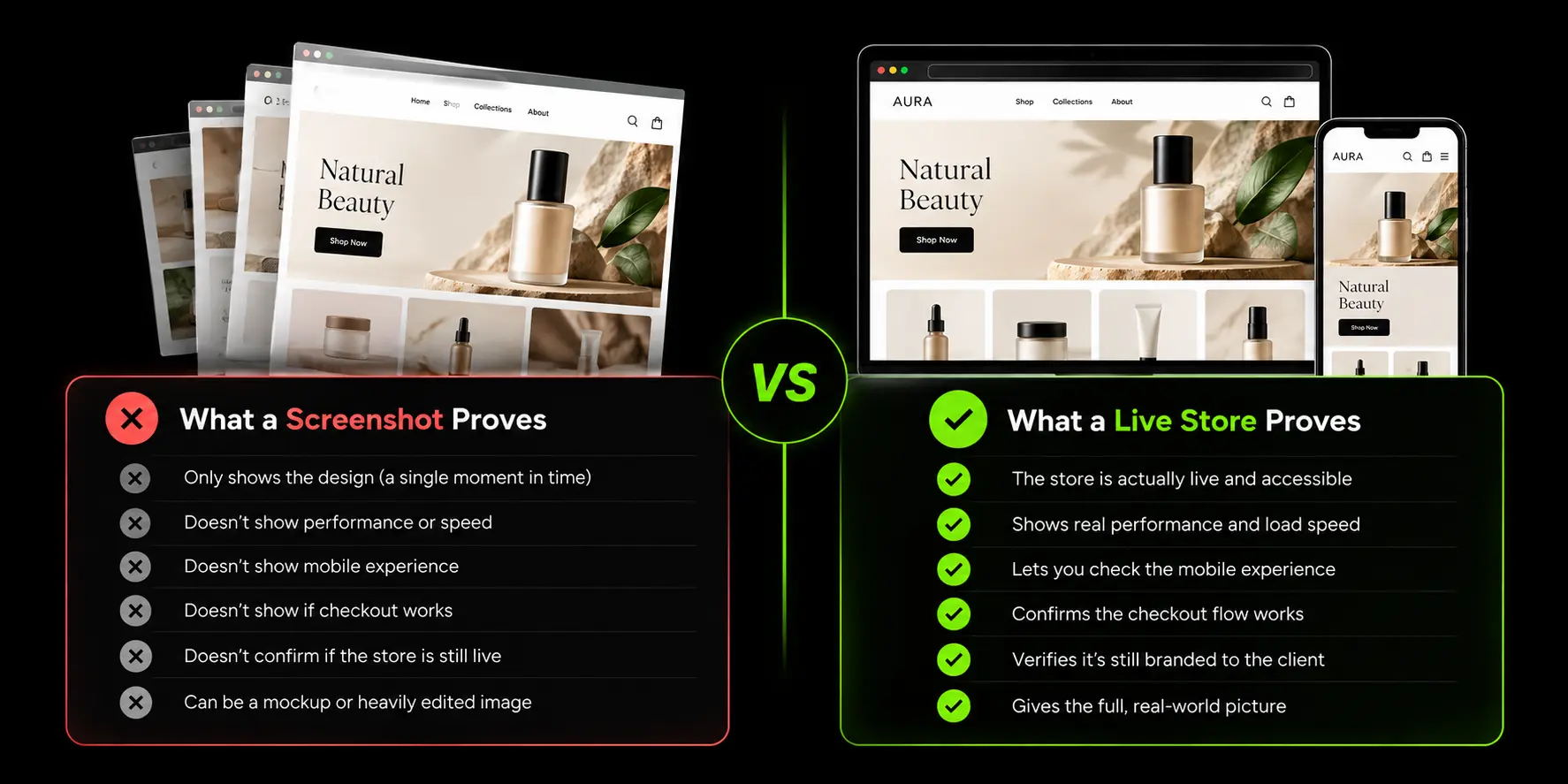
A portfolio full of screenshots can look impressive, but screenshots tell you very little about whether an agency actually delivered a working Shopify store.
Why Screenshots Are Easy to Misrepresent
A static image could show a design mockup, a project that never launched, or a store that has since been redesigned or moved to another platform.
Screenshots also hide important details such as mobile performance, checkout functionality, broken apps, and the actual customer experience.
What To Actually Do
If an agency provides live links, open the stores yourself and check:
- The site is live and loads without obvious errors
- The store is still branded to the listed client
- Product pages, add-to-cart, and checkout work
- The experience holds up on mobile
- The current store matches what the agency claims to have built
If a listed project is no longer live, that is worth asking about.
The NDA Nuance
Some agencies cannot publicly share client work because of NDAs or pre-launch restrictions. That alone is not a red flag. A legitimate agency should still be able to offer a private walkthrough, explain its role, and discuss the technical work it completed.
The concern is not the absence of a public link. It is the refusal to provide any meaningful way to verify the work.
For more questions to ask before shortlisting an agency, see our guide on questions to ask an ecommerce agency.
Red Flag #2: Vague or Unverifiable Results
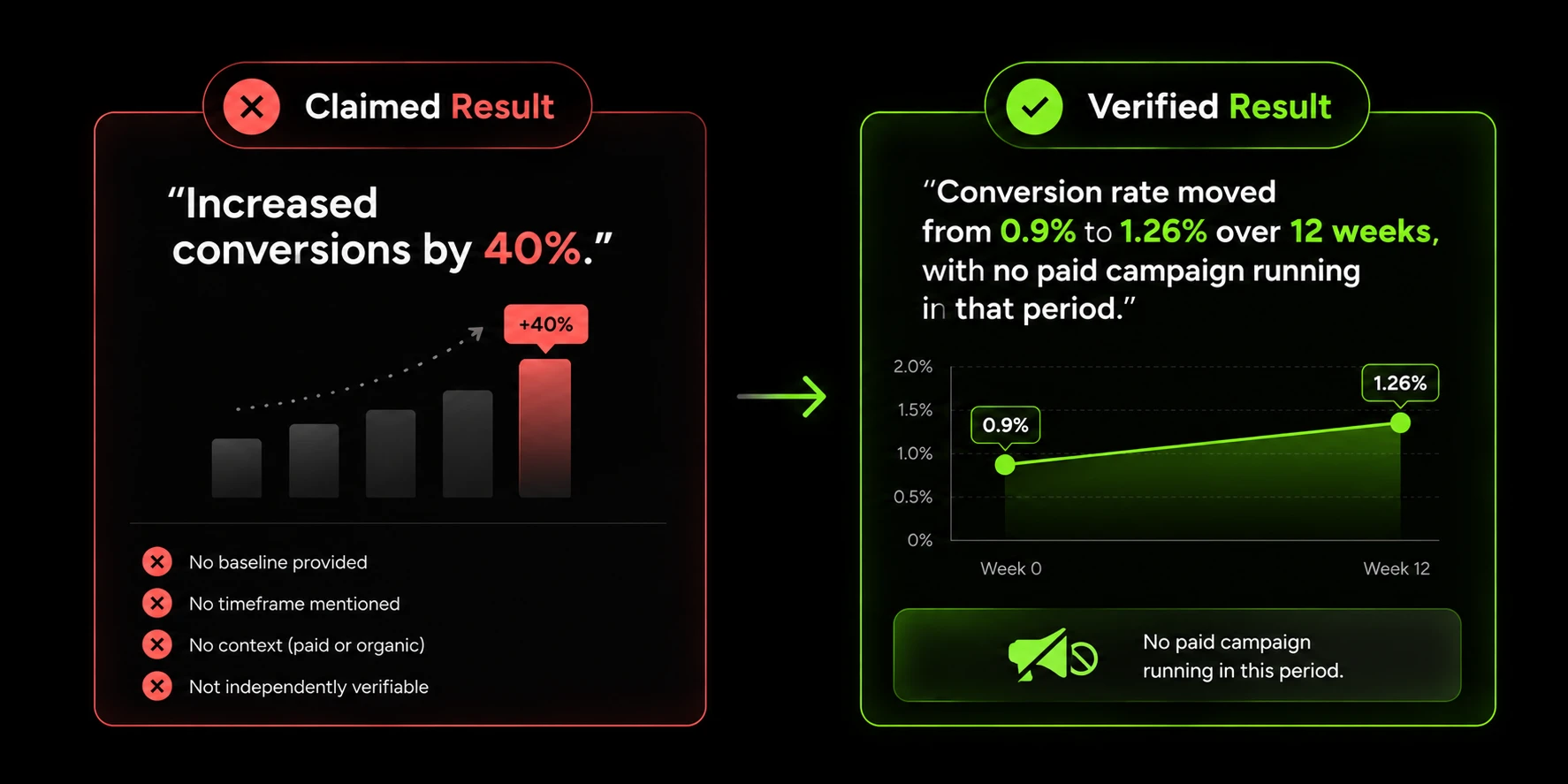
“Increased conversions,” “boosted sales,” and “improved performance” appear frequently in agency case studies, but these phrases are not meaningful evidence on their own.
A credible case study should give you enough context to understand what changed, when it changed, and how the agency contributed.
What Makes a Result Credible
Look for four key elements:
- The Baseline: What was the conversion rate, revenue, traffic, or page speed before the project?
- The Outcome: What specific number was achieved afterward?
- The Timeframe: Over how many weeks or months was the improvement measured?
- The Attribution: What other changes happened during the same period?
The last point is particularly important. If a brand redesigned its website while also increasing advertising spend, launching a major campaign, changing its pricing or entering a seasonal sales period, the agency should explain how those factors may have influenced the result.
A 40% increase in conversions sounds impressive, but it means very different things depending on whether the baseline was 1% or 8%.
Similarly, a short-term revenue spike during a major promotional period does not necessarily demonstrate a lasting improvement from the website project.
Questions to Ask About Any Claimed Result
- What was the baseline before the project started?
- Over what specific period was the result measured?
- What else changed during that period?
- How did you separate the impact of the website work from other factors?
- Is the improvement still holding up today?
- Can you share anonymized analytics or supporting data?
A credible agency should be comfortable explaining the numbers, methodology, and limitations behind its claims. It does not need to present every project as a perfect success.
In fact, explaining what did not work or what could not be measured can make a case study more useful.
If an agency repeatedly responds to specific questions with vague percentages, broad statements, or a change of subject, treat the case study as a marketing claim rather than verified evidence until you can establish what actually happened.
Red Flag #3: Portfolio Does Not Match Your Brand's Size or Complexity
A portfolio can be completely genuine and still be the wrong fit for your project. The important question is not simply whether an agency has built attractive Shopify stores, but whether it has handled projects with a similar level of complexity.
Complexity Fit Matters More Than Industry Fit
An agency with ten successful 20-SKU candle stores may be excellent at template-based ecommerce, but that experience does not necessarily translate to a 2,000-SKU beauty retailer with B2B wholesale, multiple currencies, complex integrations and custom product functionality.
Industry experience can help, but technical complexity often matters more. An agency that has built several high-catalog Shopify stores with custom features may be able to apply that experience effectively to a new industry.
The underlying challenges around product architecture, integrations, performance, merchandising, and checkout can be similar even when the products are different.
The reverse is also true. An agency may have extensive experience in your exact industry but mainly deliver simple theme customizations. That may not prepare it for a complex Shopify Plus migration or custom build.
What to Look for in the Portfolio
Compare the agency's previous projects with your own requirements:
- Catalog Size: Have they handled stores with a similar number of products and variants?
- Platform: Have they worked with the Shopify plan or architecture you require?
- Custom Functionality: Look for relevant experience with subscriptions, B2B, configurators, marketplaces, or complex product options.
- Integrations: Check whether they have worked with systems such as ERP, PIM, CRM, fulfillment, or inventory platforms.
- Markets: If you sell internationally, look for experience with multi-currency, localization, and multiple storefronts.
The goal is not to find an agency whose portfolio looks identical to your business. It is to find evidence that they have successfully handled the type and level of work your project requires. For a broader framework, see our guide on how to choose an ecommerce development partner.
Red Flag #4: Unclear Ownership of the Work
An agency can show impressive work without making it clear how much of that work its own team actually delivered.
This matters because a portfolio is supposed to help you evaluate the capabilities of the people you are considering hiring.
Subcontracted or White-Labeled Projects
Subcontracting is not inherently a problem. Agencies may use specialist developers, freelancers, or white-label partners for certain projects, and that can work perfectly well when the arrangement is transparent.
The concern is when an agency presents work substantially built by another team as evidence of its own capabilities without explaining its role.
You may assume you are hiring a team with specific technical experience when the people delivering your project have never actually handled that type of work.
How to Ask Directly
Ask: “What was your team's specific role on this project?”
A useful answer should identify what the agency actually handled, such as design, theme development, custom functionality, integrations, migration, or project management.
For example: an agency might explain that it built the storefront while the client's internal team handled the ERP integration. That gives you useful context.
Follow-Up Questions
- Who wrote the custom code?
- Who designed and developed the product page?
- What was your role in the checkout work?
- Who handled the data migration?
- Which integrations did your team implement?
- Can you explain a significant technical decision made on the project?
- Will the people who worked on this project be involved in mine?
The goal is not to avoid agencies that subcontract. It is to understand exactly whose experience you are evaluating and who will actually be responsible for delivering your store.
For more questions to ask before hiring, see our guide on questions to ask an ecommerce agency.
Red Flag #5: Heavily Templated Work Presented as Custom Design
Some agencies use the same premium theme across multiple projects, make light brand adjustments, and present each store as fully custom design.
A template itself is not a problem. The issue is whether the portfolio accurately reflects what you are paying for.
Spotting Recycled Themes
Open several portfolio projects side by side and look for patterns:
- Identical page and section structures
- The same product page layout with different colors or imagery
- Matching navigation patterns and component styles
- Similar homepage section sequences
- The same app widgets or functionality appearing in the same positions
If the logo, colors, photography, and copy change but the underlying experience remains almost identical, the agency may be relying heavily on a reusable theme rather than designing a genuinely custom storefront.
Why This Matters Even When the Theme Is Good
Using a proven Shopify theme can be a sensible choice for many brands. It can reduce development time, cost, and maintenance while still producing a polished store.
The concern is expectation and pricing. If an agency is selling a heavily customized theme as bespoke design and charging accordingly, the portfolio may give you a misleading impression of what you will receive.
Look beyond visual differences and ask how much of each project was actually customized. If your store requires a unique design system, custom product architecture, complex integrations, or functionality beyond the theme's capabilities, confirm that the agency has delivered that type of work before. For more detail, see our guide to custom Shopify themes.
Red Flag #6: No Recent Work
Shopify changes quickly, so an old portfolio is not always a reliable indicator of an agency's current capabilities.
A project completed several years ago may have been excellent at the time but still tell you little about how the agency works with today's Shopify platform.
Why Recency Matters
Recent projects can demonstrate familiarity with current Shopify architecture, themes, checkout capabilities, Markets, localization and newer platform features.
This is particularly important if your store requires functionality that has changed significantly since the agency's older projects were delivered.
Ideally, look for work completed within the last 12 to 18 months. You do not need every portfolio project to be recent, but there should be enough current work to demonstrate that the team is actively building and adapting to the platform.
What to Look For
Check whether recent projects demonstrate experience with:
- Current Shopify theme architecture
- Checkout extensibility and modern checkout customization
- Shopify Markets and multi-currency or multilingual setups
- Complex product and variant configurations
- Current payment and localization requirements
- Performance optimization across modern Shopify themes
An agency with older work is not automatically a poor choice. The important question is whether its team has continued working on current Shopify projects since those portfolio pieces were completed.
The Follow-Up Question
Ask: “What is the most recent Shopify project your team shipped and what current Shopify features or architecture did it use?”
A clear answer gives you a better view of present-day capability than a portfolio filled exclusively with older case studies.
Green Flags: What A Trustworthy Portfolio Actually Looks Like
The counterpoint to all six red flags above is worth stating plainly, since vetting should not default to pure suspicion.
A trustworthy portfolio shows live, working links you can click through yourself, or offers a direct walkthrough where NDAs prevent that.
It states results with specific numbers, a clear baseline and a defined timeframe and the agency can answer follow-up questions about that result without deflecting.
It shows a range of project sizes and complexity with honest context about which ones are the closest fit to what you need.
It is clear and specific about the agency's actual role on every listed project. And it includes work from the last 12 to 18 months, reflecting current platform knowledge rather than a snapshot of capability from years ago.
How We Present Our Work at Suplex
We believe a portfolio should make it easy to understand what we actually built, not simply showcase polished screenshots.
Live Work Wherever Possible
- We provide live store links when clients permit public sharing.
- You can explore the actual storefront, product pages, mobile experience, and functionality yourself.
- If an NDA prevents public sharing, we offer a private walkthrough instead.
- Where permitted, we can also show relevant admin or development work.
Clear Ownership of Our Work
We are specific about our role on every project.
- If we handled Shopify design and development, we say so.
- If another team handles branding or an integration, we make that clear.
- If a project involves a partner or subcontractor, we do not present their work as our internal team's direct output.
When We Cannot Show the Store
A portfolio restriction does not mean the work cannot be discussed. Where live links are unavailable, we can walk through:
- The technical architecture
- Key development decisions
- Integrations and custom functionality
- Problems we had to solve
- Our specific responsibilities
- How the final implementation was delivered
Ask Us Direct Questions
We encourage potential clients to question the portfolio rather than simply take it at face value.
Ask what we built, who worked on it, what challenges came up, and what we would do differently today. Those answers provide far more useful context than a polished case study alone.
Explore our Shopify and ecommerce services or read our guide to choosing an ecommerce development partner before starting your shortlist.
Shopify Agency Portfolio Evaluation Checklist
Use this checklist before shortlisting or speaking with a Shopify agency. The goal is to verify the portfolio rather than relying on presentation alone.
Portfolio Evidence
☐ Live links are provided for listed projects
☐ Stores load and function properly on mobile
☐ Stores are still branded to the listed clients
☐ NDA-restricted work can be shown through a private walkthrough
Results
☐ Case studies include specific baseline numbers
☐ Results include a clear timeframe
☐ Other factors affecting the result are acknowledged
☐ Supporting analytics or anonymized data can be discussed
Complexity Fit
☐ Portfolio projects match your catalog size and complexity
☐ Relevant features and integrations are represented
☐ Agency has experience with your required Shopify setup
☐ Technical complexity is comparable, even if the industry differs
Ownership
☐ Agency clearly explains its role on each project
☐ Design and development responsibilities are identified
☐ Subcontracted or partner work is disclosed
☐ Team members responsible for the work can be identified
☐ Technical questions are answered with specific examples
Design Originality
☐ Projects have visibly different layouts and structures
☐ Product page designs vary where appropriate
☐ Navigation and component patterns are not simply recycled
☐ Custom work is clearly distinguished from theme customization
Recency
☐ Recent projects were shipped within the last 12 to 18 months
☐ Recent work demonstrates current Shopify capabilities
☐ The agency can explain recent platform changes it has worked with
☐ The portfolio reflects the team you would actually hire
The best portfolio is not necessarily the largest or most visually impressive. It is one you can verify, understand, and relate directly to the requirements of your own Shopify project.
Frequently Asked Questions
What should I look for in a Shopify agency's portfolio?
Look for live, working links to real stores, not just screenshots, specific and sourced results rather than vague claims, projects similar in size or complexity to your own, and clarity about the agency's actual role on each listed project. A trustworthy portfolio holds up when you click through and ask direct questions.
Is it a red flag if a Shopify agency can't show live client links?
Not automatically. Some clients require NDAs that limit what an agency can publicly display. The red flag isn't the absence of a public link; it's an agency that can't or won't walk you through the work live on a call when asked, or that deflects when you ask to see it another way.
How do I know if an agency actually built the portfolio work they're showing?
Ask directly: "What was your team's specific role on this project, design, development, both, or a subcontracted piece of it?" A legitimate agency answers this clearly. Vague or evasive answers, or an inability to speak to technical decisions made on a listed project, suggest the work wasn't fully theirs.
Does a Shopify agency's portfolio need to match my industry?
Not necessarily. Complexity fit matters more than industry fit. An agency that's built several high-catalog, custom-feature Shopify Plus stores can likely handle a similarly complex build in a different industry. What matters more is whether their past work matches the scale and technical difficulty of what you need, not whether they've worked in your exact category before.
What does it mean if all the projects in a portfolio look the same?
It usually means the agency is applying the same theme or template repeatedly with light customization rather than doing genuine custom design work. This isn't automatically disqualifying if you only need a lightly customized template store, but it's a mismatch if you're expecting fully custom design and development.
How recent should the work in a Shopify agency's portfolio be?
Ideally within the last 12-18 months. Shopify's platform, themes, and checkout capabilities change frequently, and a portfolio that hasn't been updated in several years may not reflect the agency's current technical skill level or familiarity with newer Shopify features like Markets, regional payment rollouts, or current theme architecture.
Hi, I’m Rishabh Jain
I believe great design has the power to shape perception, build trust, and move businesses forward. That belief is what led me to found Suplex Design Studio, a global branding and packaging studio working with FMCG and D2C brands across markets.I started suplex at 25 with a clear intent, to create design that is strategic, thoughtful, and commercially meaningful. By 28, the studio had scaled globally, guided by a strong foundation in Integrated Design that I developed during my academic journey in London, where I was honoured with the Dean’s Award.
Over the years, I’ve had the opportunity to work with 100+ brands, from Fortune 500 organizations to family-run businesses, helping them build packaging and brand systems that create recall, relevance, and long-term value.
Suplex’s work has been recognized internationally, including the Manifest Award (2024), the Clutch Global Award (2025), and features on platforms such as Packaging of the World, The Dieline, and the World Brand Design Society.
None of this would be possible without the people behind the work. I’m deeply grateful to the suplex team, whose commitment, creativity, and attention to detail turn ideas into meaningful brand experiences every day.
At the heart of my work is a simple philosophy, design should be intentional, honest, and built to last, and that continues to guide everything we create at suplex.





























Let’s Make It Happen
E-Commerce Success Stories
%201.avif)






.avif)
.avif)
Build Your D2C Business The Right Way
Build It With Suplex.


