Phool
.avif)
Phool
Phool | Suplex's Verdict ⭐⭐⭐⭐½
Suplex's Website Audit for Phool at a Glance 📊
Phool was founded in 2017 by Ankit Agarwal and Prateek Kumar after Agarwal, on a visit to the ghats in his hometown of Kanpur, watched pesticide-laden temple flowers being dumped straight into the Ganga, and built what became a patented Flowercycling® process to turn that waste into charcoal-free incense instead.
Suplex Design analysed phool.co across brand identity, navigation, merchandising, review architecture and the Product Detail Page experience, and what follows is why a genuinely quantified mission story on the homepage does not yet carry all the way through to every product card or every PDP. This audit reflects the site as it stood in July 2026.
What Phool's Website Gets Exceptionally Right ✅
1. The Mission Is the Differentiator, and It Is Quantified 🌸
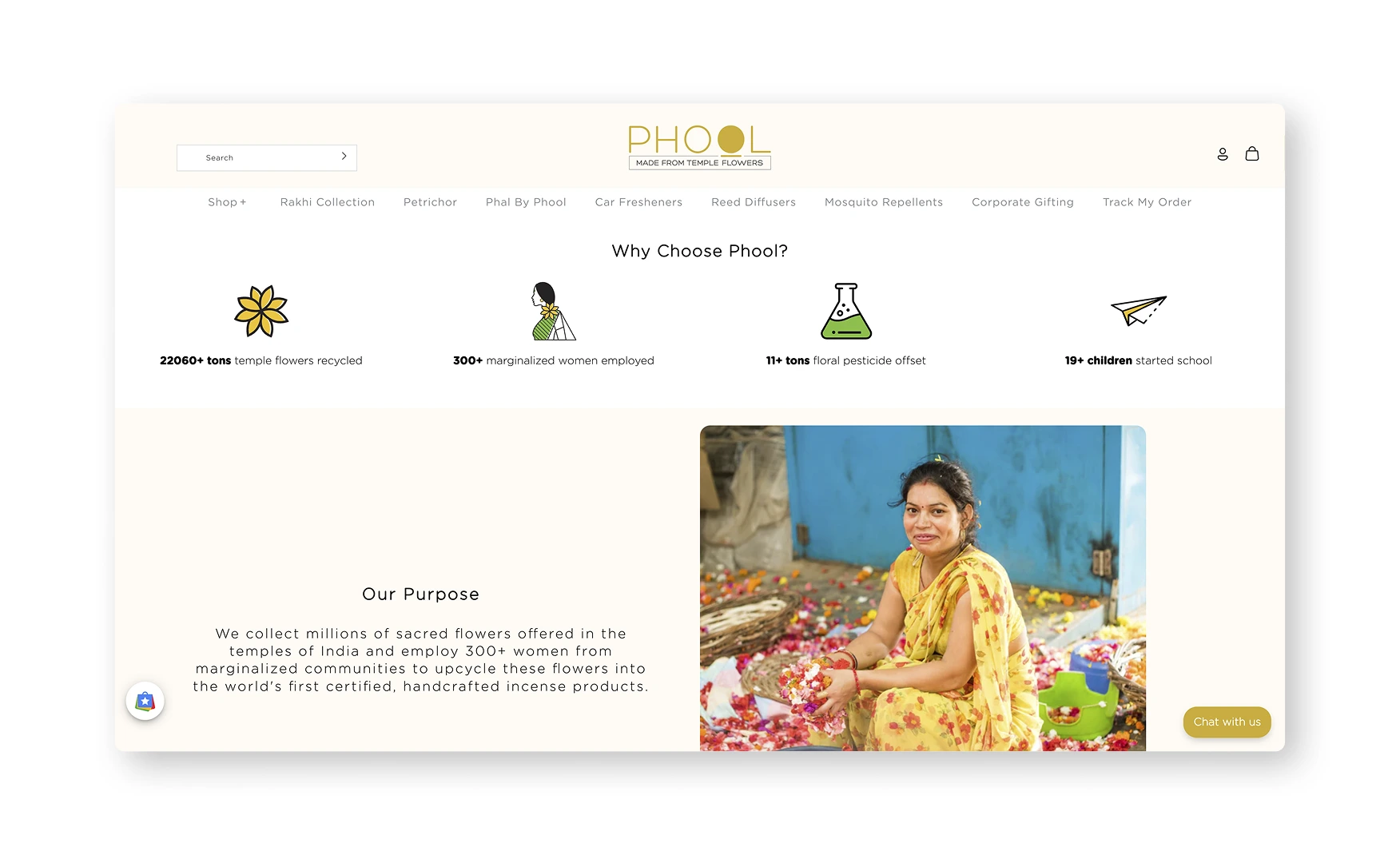
A "Why Choose Phool" strip states the impact in hard numbers rather than adjectives, 22,060-plus tons of temple flowers recycled, 300-plus marginalised women employed, 11-plus tons of floral pesticide offset from the river, and 19-plus children started in school as a result.
Putting a schooling statistic alongside a waste-diversion statistic is a deliberate choice, it signals the mission is a livelihood story as much as an environmental one, which is a harder, more specific claim than the generic sustainability language most home fragrance brands use.
2. The Full Flowercycling Process Is Illustrated, Not Just Claimed 🌼
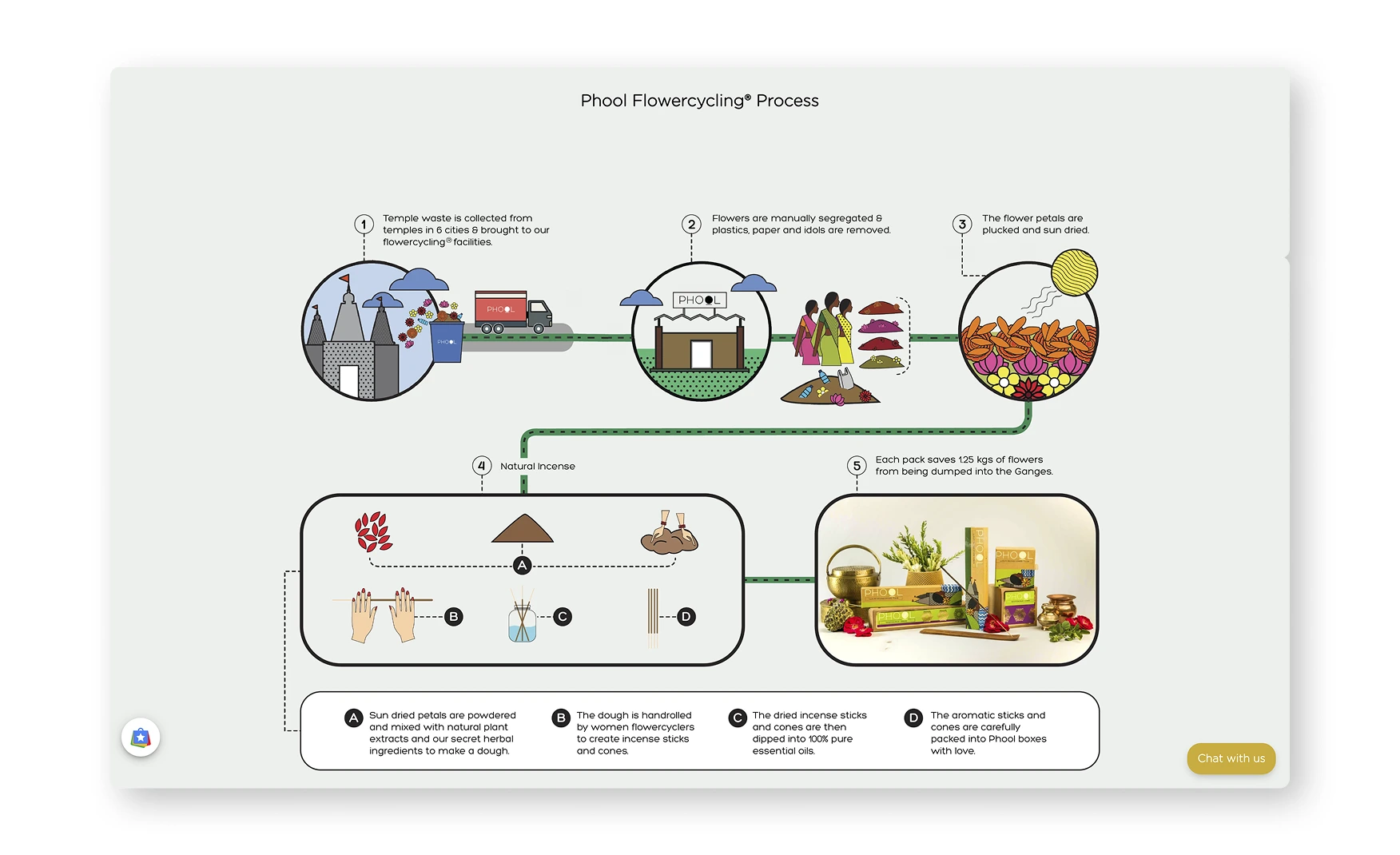
A dedicated homepage section walks through the Phool Flowercycling® process using illustration and video, temple flowers are collected, segregated by hand, sun-dried, converted into incense, and packed, before an embedded video, previously featured by Insider, explains the model in the founders' own words.
Rishabh noted the homepage photography and colour system never once feels templated, even the Add to Cart buttons carry the brand's signature golden tone, which keeps this educational section feeling like part of the same brand rather than a bolted-on explainer.
3. Merchandising Cards Carry Real, Ungated Ratings ⭐
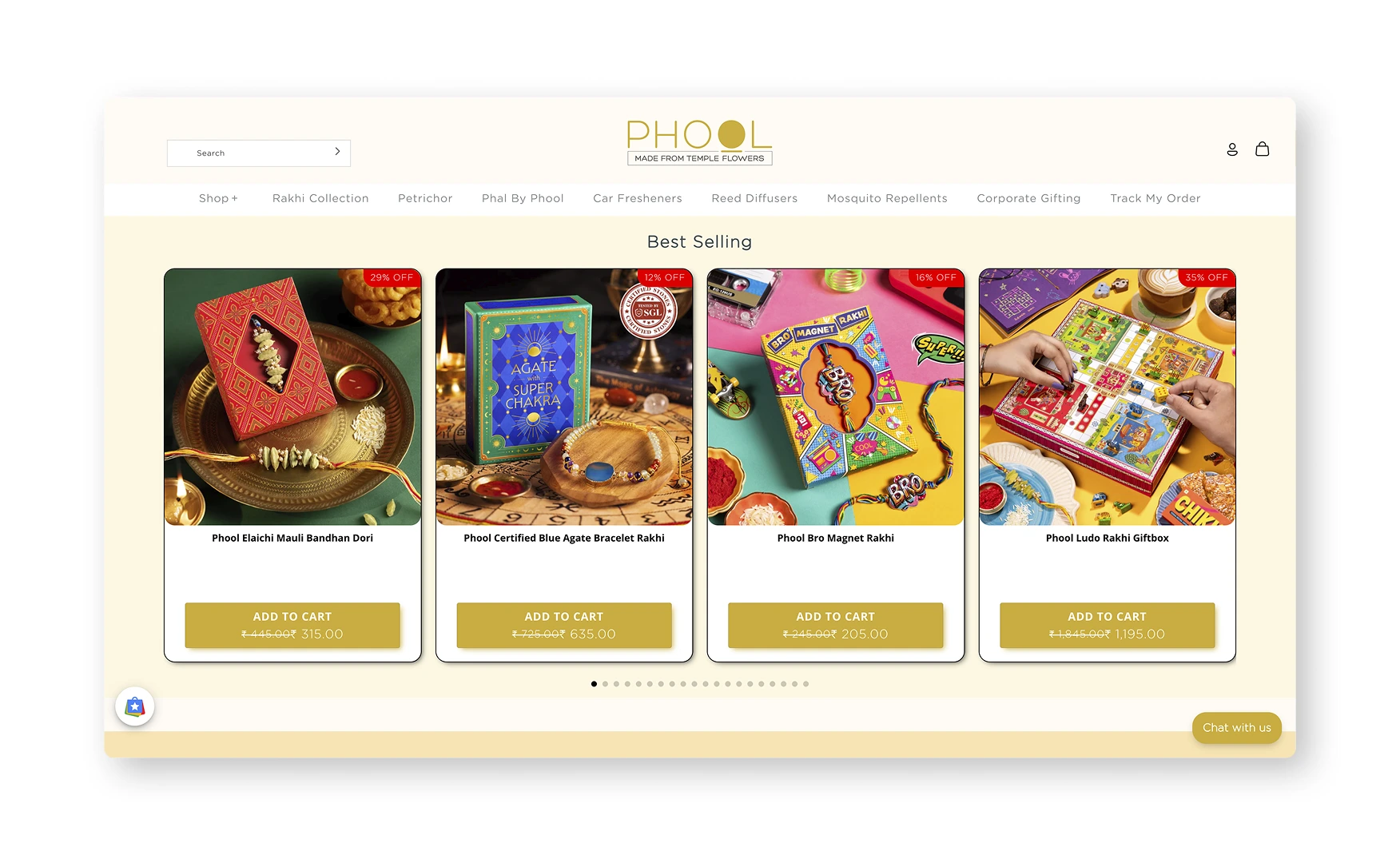
Where a product has reviews, the collection and bestseller cards show the exact rating beside the price, 4.88 on the Basant Plantable Rakhi, 5.0 on the Tangerine Noir and Basilicum car fresheners, 4.81 on the Indian Rose incense cones, 4.77 on both the KVT Sandalwood cones and the Oudh bambooless sticks.
Surfacing the specific decimal rather than rounding to a flat 4.5 or 5.0 across the board reads as more credible, since a shopper comparing two products by rating alone can actually tell them apart.
4. Certifications Do Real Work, Not Just Badge Decoration ✅
Phool holds both Fair for Life-Fairtrade and Ecocert Organic and Natural certification, and states plainly that it is India's first D2C wellness brand to hold both, a specific, checkable claim rather than a vague natural-and-safe assertion.
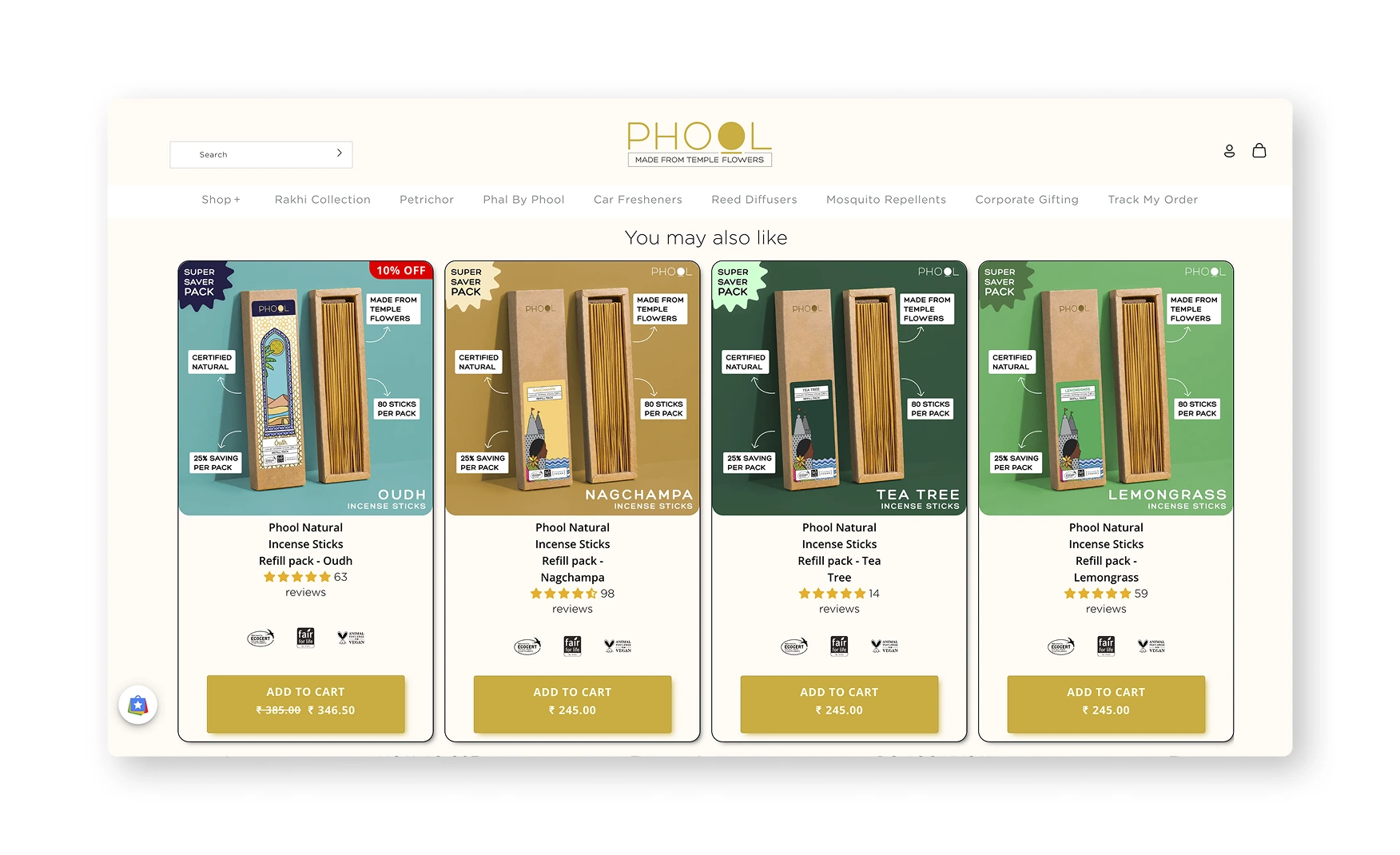
The certification badges, Ecocert Natural, Fair for Life, and Ecocert Peta, sit directly on the product cards themselves in the You May Also Like module, not buried on a separate certifications page, so the trust signal travels with the product wherever it is shown.
5. The Fragrance Range Is Photographed to Be Understood, Not Just Displayed 📸
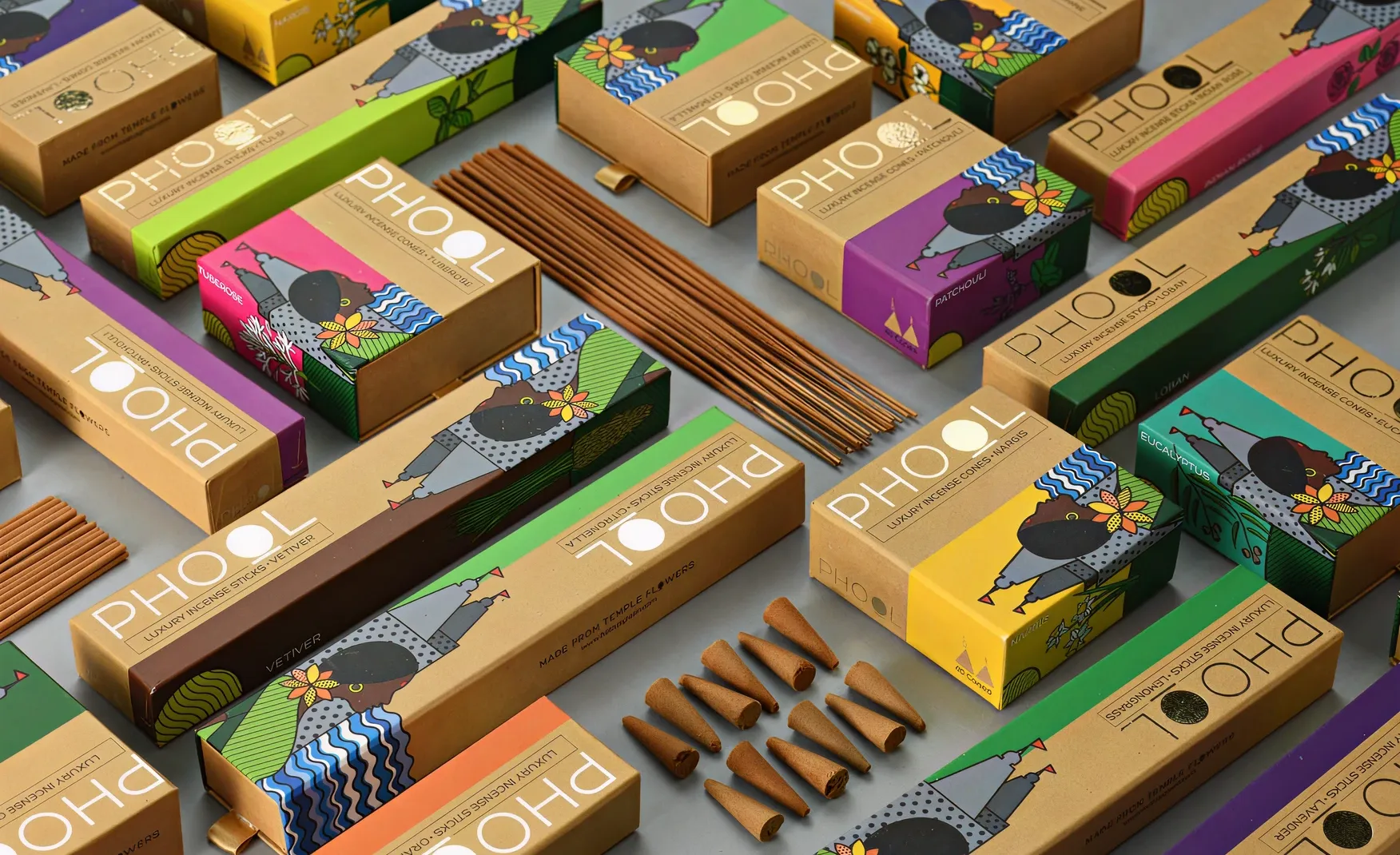
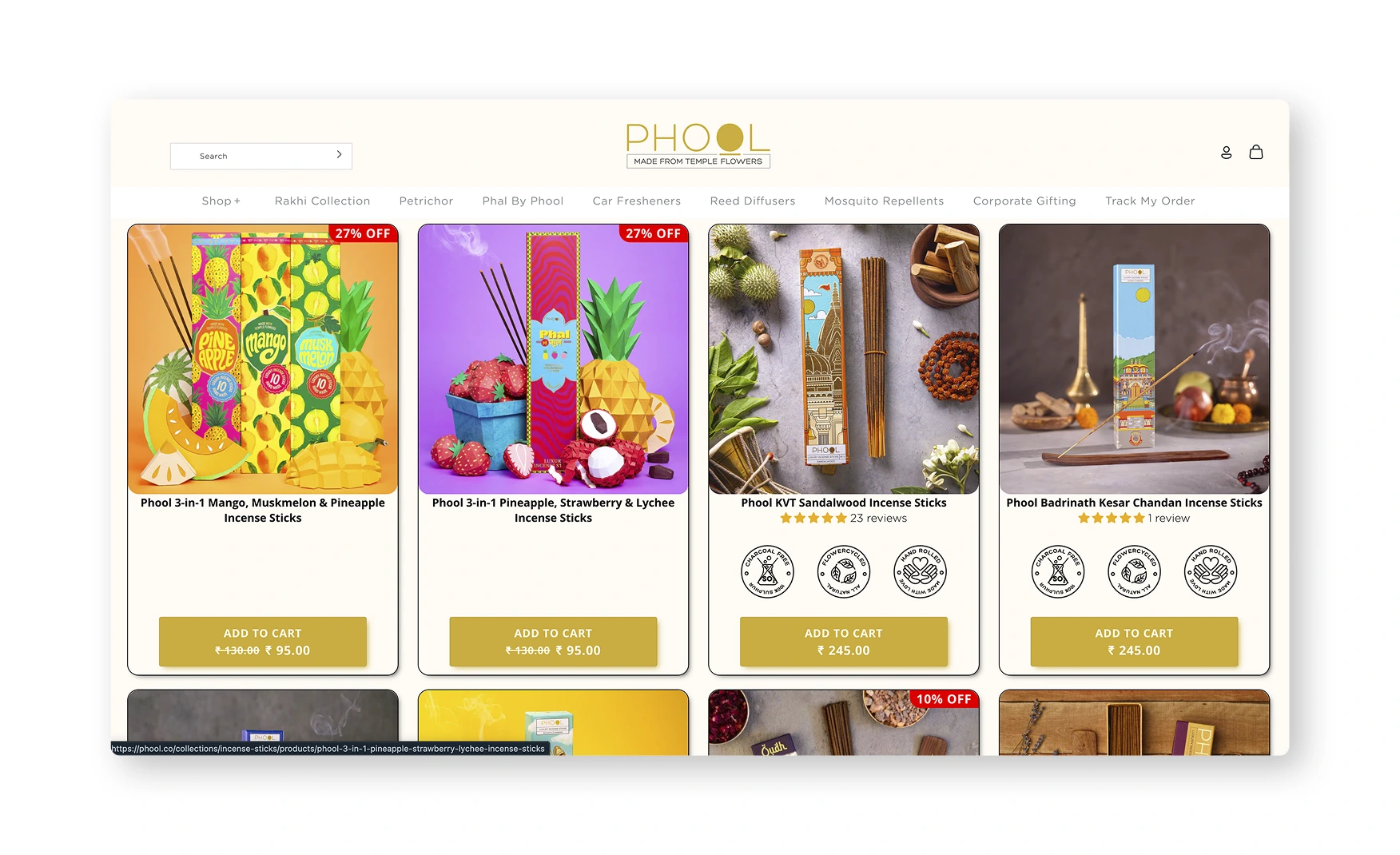
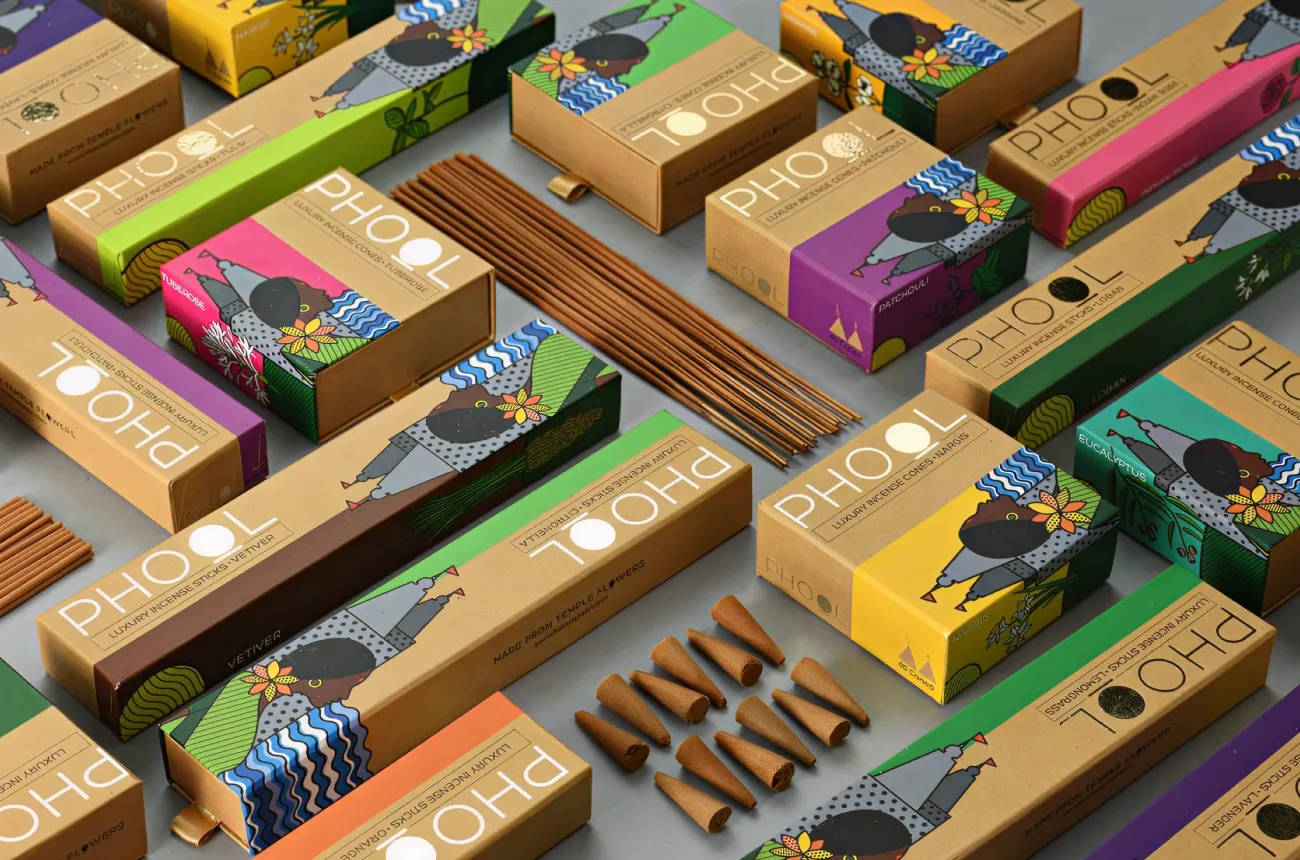
Beyond the standard sandalwood and lavender range, Phool has introduced fruit-led fragrances, a 3-in-1 Mango, Muskmelon and Pineapple incense stick and a 3-in-1 Pineapple, Strawberry and Lychee stick among them, and the product photography is styled specifically enough that a shopper can tell the mango note from the lavender note before reading a single word of copy.
This matters more for scent products than almost any other category, since a fragrance a shopper cannot smell needs its photography to do real communication work, and a plain white-background product shot does not achieve that.
Where the Phool Experience Falls Short ⚠️
1. Review Coverage Drops Off a Cliff on Newer and Seasonal SKUs 🤥
Of the seventeen products in the homepage Best Selling carousel, roughly half, the Rakhi collection items, several of the newer car fresheners and reed diffusers, and both 3-in-1 fruit incense sticks, show "No reviews" directly beside cards for the Tangerine Noir and Basilicum car fresheners at a flat 5.0 rating.
This is a sharper problem than a generic new-product gap, since it means a shopper scrolling the brand's own curated Best Selling row sees the strongest and weakest trust signals sitting side by side, which actively draws attention to the products with nothing behind them.
The legacy incense range proves Phool's review base is real and deep when a product has had time to accumulate feedback, the fix here is coverage, not credibility.
2. The Flowercycling Story Does Not Carry Onto the Product Page 📦
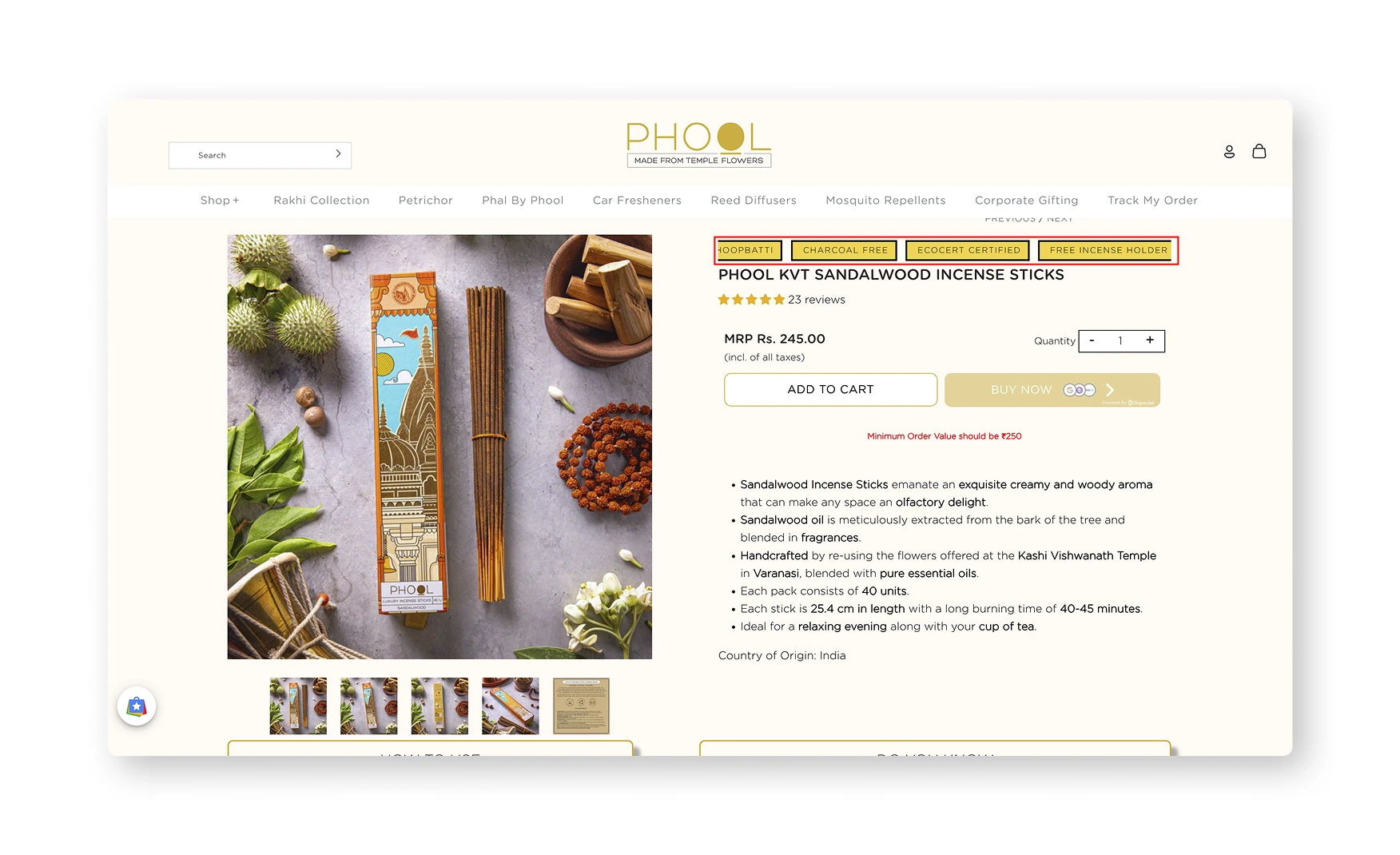
The Nagchampa incense sticks PDP, a genuine bestseller with 298 reviews, carries a product description, a how-to-use guide and a Do You Know section of scent facts, but nothing about the flower collection, segregation or hand-rolling process that the homepage spends an entire section explaining.
This is a real, confirmed gap rather than a provisional one, the same story that makes the homepage compelling, women flowercyclers, temple-waste diversion, the specific process, simply is not present at the exact moment a shopper is deciding whether Rs 165 for a pack of incense sticks is worth it.
3. Category Grid Images Skip the A+ Creative the PDP Already Has 🖼️
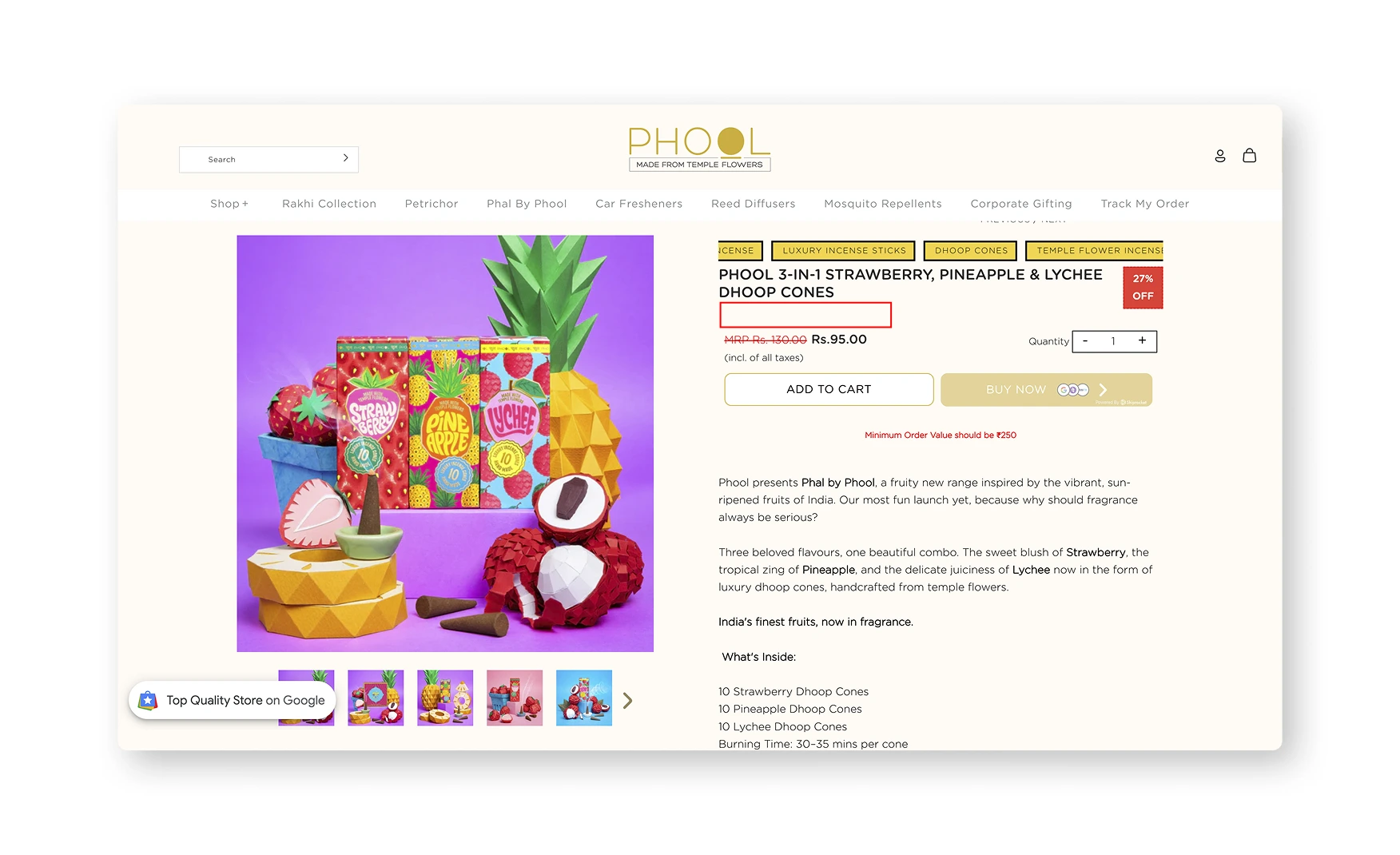
Rishabh noted the product category listing pages show only a plain product shot and a back-of-pack image, with none of the how-to-use or what's-inside visual detail that the individual product pages already carry.
Since a shopper often decides which product to open based on the category grid alone, leaving that grid's imagery thinner than the PDP it leads to is a missed chance to pull a browsing shopper in with the same visual storytelling the brand already has in hand.
What Suplex Would Fix First 💡
Priority 1 - Close the Review Gap on Newer and Seasonal SKUs 🔧
Run a seeding push, sampling, post-purchase review nudges, or early-access requests, specifically targeted at the products currently showing "No reviews" in the Best Selling carousel, starting with the fruit-led incense sticks and the newer car freshener scents.
This is the single highest-leverage fix available, since the brand's actual review base, close to 11,900 strong, is more than sufficient proof that the mechanism works. The gap is coverage on specific SKUs, not a missing review system.
Priority 2 - Carry the Flowercycling® Story Onto Every PDP 📝
Add a condensed version of the homepage's process section, the collection, segregation, sun-drying and hand-rolling journey, directly onto each Product Detail Page, ideally just above or below the Do You Know section.
A shopper who has already clicked through to a specific incense stick is exactly the person most persuadable by the impact story, and right now that story stops working the moment they leave the homepage.
Priority 3 - Bring A+ Creative Up to the Category Grid 🖼️
Extend the how-to-use and what's-inside visual treatment already built for individual PDPs into at least one supporting image per card on the category listing pages.
The brand has already produced this creative once per product, reusing a simplified version at the grid level is a production task, not a new design brief.
Final Scorecard 🏆
Suplex Verdict 📝
Phool has built the rare purpose-led homepage that actually earns the word purpose, the impact numbers are specific, the process is illustrated rather than asserted, and the certifications back real, checkable claims rather than vague sustainability language.
The review system proves itself where it has had time to work, nearly 11,900 verified reviews sitewide and a legacy incense range with hundreds of reviews and full star distributions on each core product.
What holds the site back from a clean 5 is coverage, not credibility, roughly half of the brand's own Best Selling carousel shows no reviews at all, and the Flowercycling® story that makes the homepage so persuasive simply is not present on the Product Detail Page where a purchase decision actually gets made.
Neither fix requires new infrastructure. Seed reviews on the newer SKUs and carry the existing process story down onto every PDP, and this is a 5.
Overall Rating ⭐⭐⭐⭐½ 4.5 / 5.
Suplex Design works with home, wellness and purpose-led D2C brands across India on Product Detail Page architecture, trust signal placement, and website audits. If your brand is at a similar stage to Phool and you want an honest assessment of what is holding your site back, get in touch with our team of experts at Suplex Design.
Hi, I’m Rishabh Jain
I believe great design has the power to shape perception, build trust, and move businesses forward. That belief is what led me to found Suplex Design Studio, a global branding and packaging studio working with FMCG and D2C brands across markets.I started suplex at 25 with a clear intent, to create design that is strategic, thoughtful, and commercially meaningful. By 28, the studio had scaled globally, guided by a strong foundation in Integrated Design that I developed during my academic journey in London, where I was honoured with the Dean’s Award.
Over the years, I’ve had the opportunity to work with 100+ brands, from Fortune 500 organizations to family-run businesses, helping them build packaging and brand systems that create recall, relevance, and long-term value.
Suplex’s work has been recognized internationally, including the Manifest Award (2024), the Clutch Global Award (2025), and features on platforms such as Packaging of the World, The Dieline, and the World Brand Design Society.
None of this would be possible without the people behind the work. I’m deeply grateful to the suplex team, whose commitment, creativity, and attention to detail turn ideas into meaningful brand experiences every day.
At the heart of my work is a simple philosophy, design should be intentional, honest, and built to last, and that continues to guide everything we create at suplex.






















Let’s Make It Happen
E-Commerce Success Stories

%201.avif)





.avif)
.avif)
Build Your D2C Business The Right Way
Build It With Suplex.


