Beam Organics
.avif)
Beam Organics
Beam Organics | Suplex's Verdict ⭐⭐⭐
Suplex's Website Audit for Beam Organics at a Glance 📊
Beam Organics was founded in 2018 by former professional athletes Matt Lombardi and Kevin Moran, who built the brand after burning out on the unclear labelling and unproven claims common across the supplement category, and it grew net revenue 230 percent in its first full year.
Suplex Design analysed shopbeam.com across homepage trust signals, collection grid design, Product Detail Page depth, subscription pricing mechanics and review architecture, and what follows is why the site's strongest proof stack is also its most under-used asset. This audit reflects the site as it stood in July 2026.
What Beam Organics' Website Gets Exceptionally Right ✅
1. The Homepage Hero Earns Trust Through Press, Not Just Claims 📰
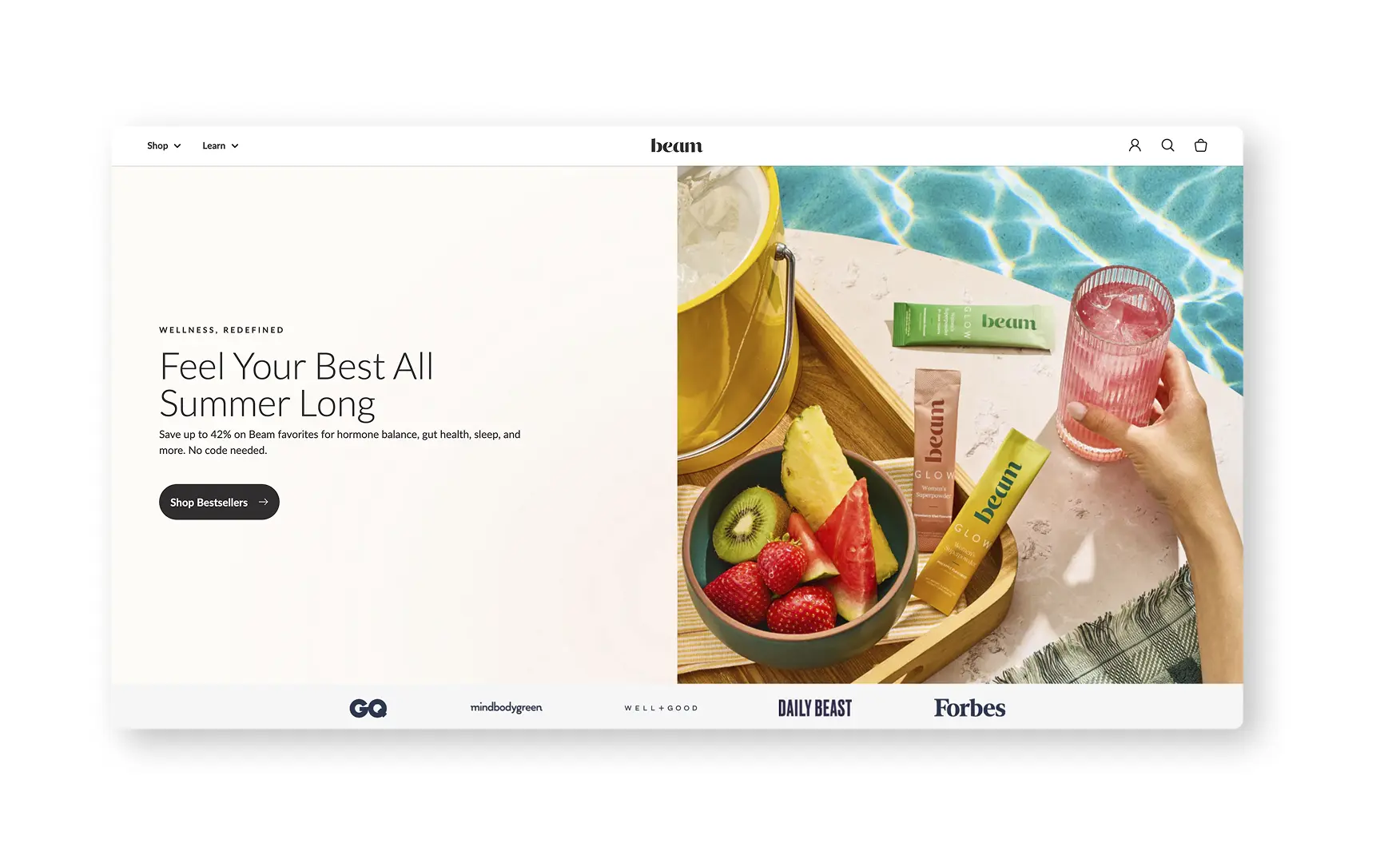
The hero opens on "Feel Your Best All Summer Long" over a single, uncluttered offer, up to 42 percent off with no code needed, and a lone Shop Bestsellers button, so a first-time visitor is never given more than one decision to make.
Directly beneath it sits a press wall naming GQ, mindbodygreen, Well+Good, Daily Beast and Forbes by logo, which is a credible, checkable trust signal to lead with rather than a vague as-seen-in banner.
The hero then bifurcates straight into the brand's three core outcomes, hormone balance, gut health and sleep, so a visitor self-sorts into the right product family before they have scrolled past the first screen.
2. The Dream PDP Rating Is Honest Because It Shows the Ugly Numbers Too ⭐
The Dream product page carries its rating and review count, currently 11,592 reviews, directly beneath the product name, ahead of the flavour selector and the price.
Rishabh's review noted the full star distribution sits on show rather than a single polished average, thousands of five-star reviews running all the way down to a real count of one-star reviews, which reads as considerably more credible than the inflated 4.9 averages common across the category.
Letting a shopper see the low end of the distribution, not just the average, is a genuine trust signal, since a rating with no visible one-star reviews is the first thing a sceptical wellness buyer distrusts.

3. The Ingredient Education Reads Like a Doctor's Note, Not a Label 💡
The Dream PDP breaks its formula into five named ingredients, Magnesium, L-Theanine, Apigenin, Reishi Mushroom and an optional Melatonin, each with its exact dose and a one-line plain-English explanation of what it does.
A Melatonin-Free flavour variant sits in the same flavour selector as the standard options, so a melatonin-averse buyer is never routed to a separate, harder-to-find product line.
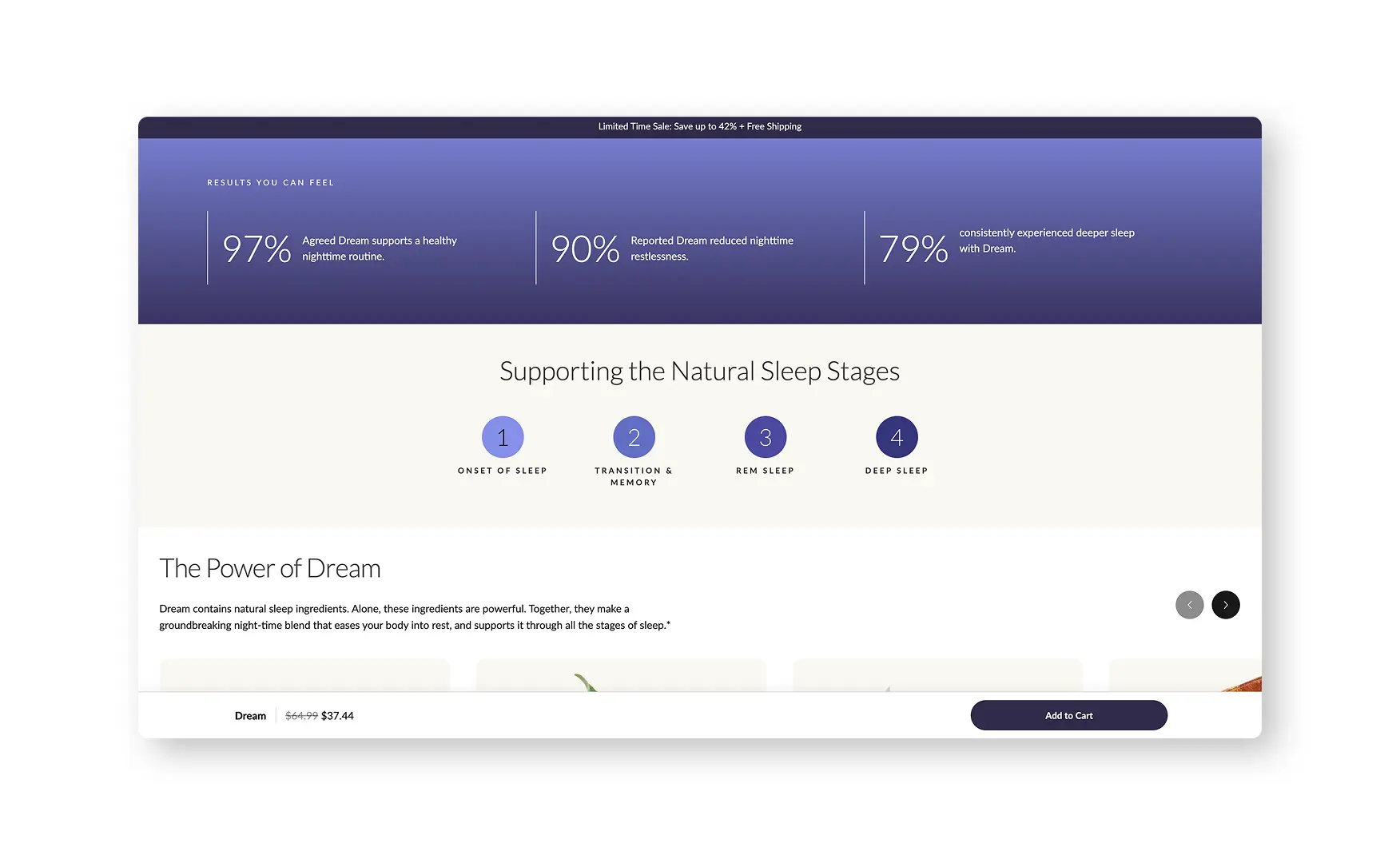
Quantified outcome stats, 97 percent agreed Dream supports a healthy nighttime routine, 90 percent reported reduced nighttime restlessness, sit alongside the ingredient breakdown, giving the page both the how and the proof it works in the same scroll.
Where Beam Organics Falls Short ⚠️
1. The Strongest Proof Is Invisible at Browse and in the Hero 📜
Despite the 20,000+ verified five-star reviews the homepage cites lower on the page, the hero fold carries no aggregate star rating, only the press wall, so a cold visitor's first impression of trust rests entirely on media logos rather than the brand's own customer base.
Every card in the collection grid shows the product, a one-line benefit, the sale price and a flavour-swatch count, but not one carries a star rating or review count, so a shopper comparing Dream against Glow or Biotic is comparing price and flavour with no social proof at all until they click in.
The irony is real, the Dream PDP itself proves the brand has nothing to hide in its reviews, full distribution included, which makes the decision to withhold that same rating everywhere upstream of the PDP a missed opportunity rather than a caution.

2. The Science Credentials Are Asserted, Not Linked 🔬
The Dream PDP states the product was "developed by a registered dietitian" and is "clinically validated by Keystone through randomized, double-blind pilot research," both as footnoted claims rather than links to a named person or a published study.
The brand's Labs page is a genuine asset, letting a customer look up their exact lot number against a third-party test report, but it answers a different question, is this batch clean, rather than the one the PDP claim raises, who is the dietitian and what did the Keystone study actually find.
For a wellness brand whose whole positioning rests on being more credible than the category, an unlinked credential claim is a small but avoidable gap between how rigorous the brand actually is and how rigorous the page makes that rigour easy to verify.

What Suplex Would Fix First 💡
Priority 1 - Surface Star Ratings on Every Collection Card 🔧
Add the existing per-product star rating and review count to every card in the collection grid, the same data already live on each individual PDP.
This is a template change, not a new data source, and it is the single fix most likely to lift click-through from browse to product page across the entire catalogue.
Priority 2 - Put an Aggregate Rating in the Hero Fold 📝
Move a single sitewide rating badge, built off the existing 20,000+ verified five-star review count, up into the hero, sitting beside or just beneath the Shop Bestsellers button.
The press wall earns trust from third parties the visitor has heard of. A visible review count earns trust from the exact community the visitor is deciding whether to join, and right now that number is buried several scrolls down.
Priority 3 - Name the Science Team or Link the Keystone Study 🔬
Either name the registered dietitian behind the formulations or link out to a summary of the Keystone clinical validation study directly from the claim itself, rather than leaving both as unlinked footnotes.
The Labs page already proves the brand is willing to show its work at the batch level. Extending that same transparency to the human and clinical credentials behind the formula closes the one gap between the brand's positioning and what the page lets a sceptical visitor verify.
Final Scorecard 🏆
Suplex Verdict 📝
Beam Organics has built one of the more honest Product Detail Pages in wellness, a rating that shows its own one-star reviews rather than hiding them, ingredient science explained in plain English with real doses, and risk removed twice over through a guarantee and HSA and FSA eligibility.
The advisory board section does real work too, trading generic celebrity strips for named, titled athletes whose quotes can actually be checked against a public record.
None of that proof travels upstream, the homepage hero leans on press logos alone and the collection grid shows price and flavour with no social proof at all, so a first-time visitor has to click into a product before they see the evidence the brand has clearly already earned.
The fixes here are placement, not invention, surface the existing ratings higher up the funnel, and name the science credentials the brand already has, and this is a 5.
Overall Rating ⭐⭐⭐3 / 5.
Suplex Design works with D2C wellness, supplement and nutrition brands across the US on Product Detail Page architecture, trust signal placement, and website audits. If your brand is at a similar stage to Beam Organics and you want an honest assessment of what is holding your site back, get in touch with our team of experts at Suplex Design.
Hi, I’m Rishabh Jain
I believe great design has the power to shape perception, build trust, and move businesses forward. That belief is what led me to found Suplex Design Studio, a global branding and packaging studio working with FMCG and D2C brands across markets.I started suplex at 25 with a clear intent, to create design that is strategic, thoughtful, and commercially meaningful. By 28, the studio had scaled globally, guided by a strong foundation in Integrated Design that I developed during my academic journey in London, where I was honoured with the Dean’s Award.
Over the years, I’ve had the opportunity to work with 100+ brands, from Fortune 500 organizations to family-run businesses, helping them build packaging and brand systems that create recall, relevance, and long-term value.
Suplex’s work has been recognized internationally, including the Manifest Award (2024), the Clutch Global Award (2025), and features on platforms such as Packaging of the World, The Dieline, and the World Brand Design Society.
None of this would be possible without the people behind the work. I’m deeply grateful to the suplex team, whose commitment, creativity, and attention to detail turn ideas into meaningful brand experiences every day.
At the heart of my work is a simple philosophy, design should be intentional, honest, and built to last, and that continues to guide everything we create at suplex.

















Let’s Make It Happen
E-Commerce Success Stories
%201.avif)






.avif)
.avif)
Build Your D2C Business The Right Way
Build It With Suplex.


