Freelance Shopify Developer vs. Agency: An Honest Guide
.avif)
Freelance Shopify Developer vs. Agency: An Honest Guide
Shopify freelancer vs agency isn't really a cost question, even though most people frame it that way.
A freelancer fits contained, well-defined work with a clear skill match. An agency fits projects with interdependent moving parts, like design, development, QA and ongoing support or specialist requirements one person rarely covers alone.
The real driver is how many distinct skills your project genuinely needs.
Why This Comparison Usually Gets Framed Wrong
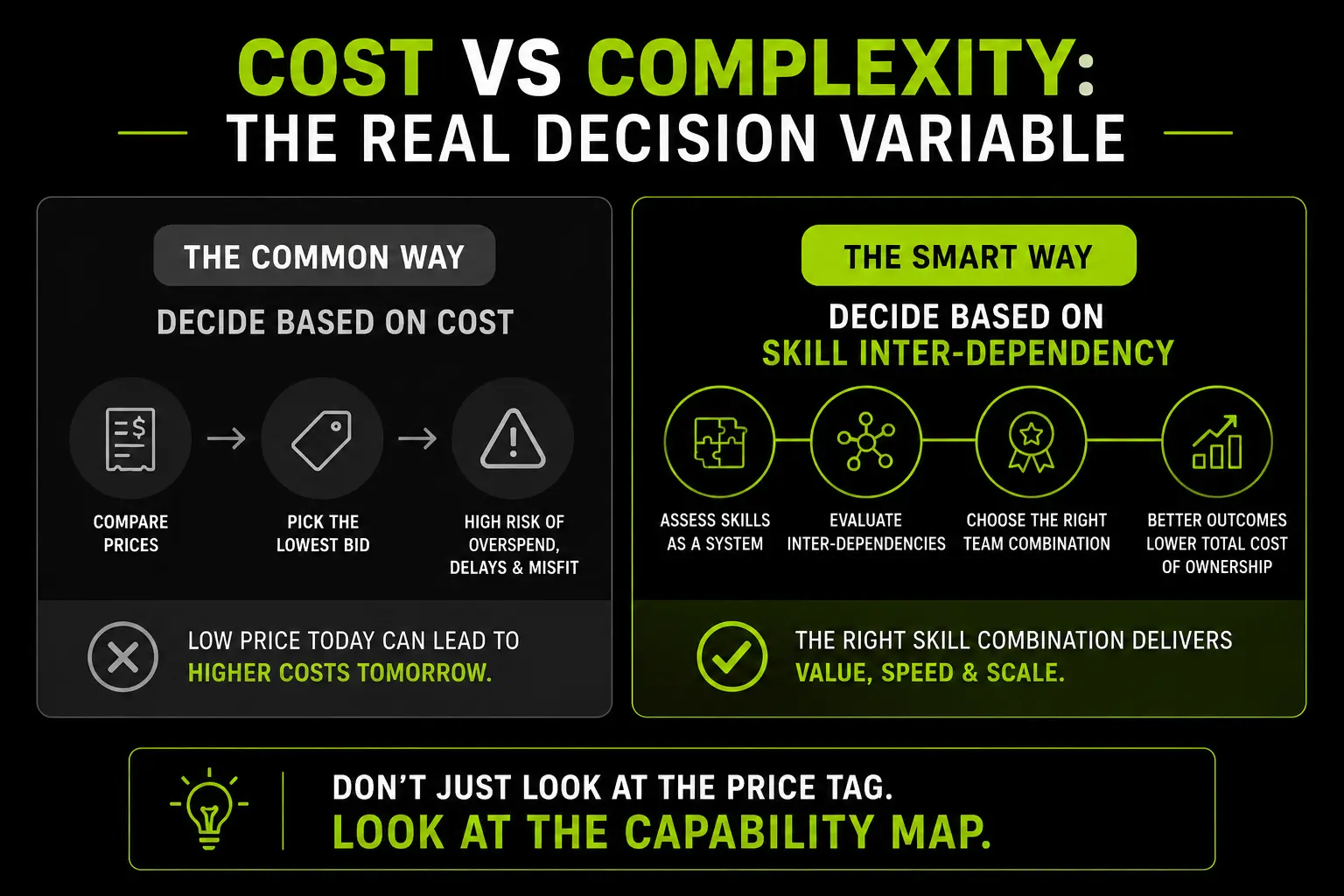
Most freelancer-vs-agency comparisons start with cost because it's easy to put hourly rates and project fees into a spreadsheet. But cost is a result of the project's requirements, not the best way to decide who should build it.
It's Not "Cheaper vs. More Expensive"
The real difference comes down to how many skills the project requires and who is responsible for coordinating them.
A freelancer usually costs less because you're paying for one person's time. An agency costs more because you're paying for a team, coordination, and project management.
So don't compare hourly rates first. Start with the work your project actually requires.
That also explains why many comparison guides feel one-sided. Agency-written content naturally tends to emphasize the risks of working with freelancers. That can undersell freelancers on projects that genuinely fit their strengths.
The better approach is simple: match the delivery model to the project.
The Actual Question: How Many Interdependent Skills Does This Project Need?
Start by listing every skill your project requires.
For example:
- 1 skill: Liquid theme editing
- 2 skills: Shopify development + basic UX
- 3+ skills: Design + development + QA + payment configuration
If the project needs one or two clearly defined skills, a freelancer is often the better fit.
If several skills need to work together, you need either one person who genuinely covers all of them which is uncommon or a team.
Count the skills first. Discuss the budget second.
When a Freelancer Is Genuinely the Better Choice
Freelancers are a strong choice when the work is contained, clearly defined, and doesn't require multiple disciplines working together.
Contained, Well-Defined Tasks
A freelancer is usually the better option when the task has:
- A clear starting point
- A defined deliverable
- One primary skill requirement
- No dependency on another specialist
Examples include:
- Rebuilding one Liquid section
- Fixing a specific bug
- Configuring one Shopify app
- Making a small performance improvement
For example, if your theme is already finished and you only need one product-page section rebuilt, an agency may add discovery, design review, project management, and formal QA to a task that doesn't require all of them.
A skilled freelancer can often complete the same work in days with much less coordination.
The rule is simple: one input, one output, one skill area = strong freelancer territory.
Once the work crosses into another discipline such as adding new photography or redesigning the UX the equation starts to change.
Budget-Constrained Early-Stage Stores With Simple Requirements
An early-stage store with a standard catalog, standard checkout, and no regional complexity usually doesn't need a multidisciplinary team.
A freelancer can launch that kind of store at a much lower cost than an agency.
Freelance Shopify development for contained work often falls around £30–£80 per hour, depending on experience and location.
For a founder testing a product before investing in a larger build, that lower entry cost can make a freelancer the practical choice.
The key is keeping the requirements simple.
A store with:
- A small product catalog
- Standard checkout
- Standard shipping
- No complex integrations
- No regional payment requirements
is a strong freelancer fit.
As the store grows, reassess the model. More products, markets, integrations, and operational complexity can change what the project needs.
You Already Have Design and Strategy Sorted
If you already have:
- Final design files
- A clear content strategy
- A defined feature list
- Approved requirements
then you mainly need development execution.
That's a straightforward case for a skilled freelancer.
This is common when a brand has already worked with an in-house designer, design studio, or strategist and only needs someone to turn the approved work into a functioning Shopify store.
In that situation, paying an agency to repeat the design or strategy phase adds cost without adding much value.
Pay for the skills you still need, not the work you've already completed.
Where Freelancers Genuinely Struggle
The same qualities that make freelancers efficient for contained work create real risk once a project's scope grows beyond one person's reasonable coverage.
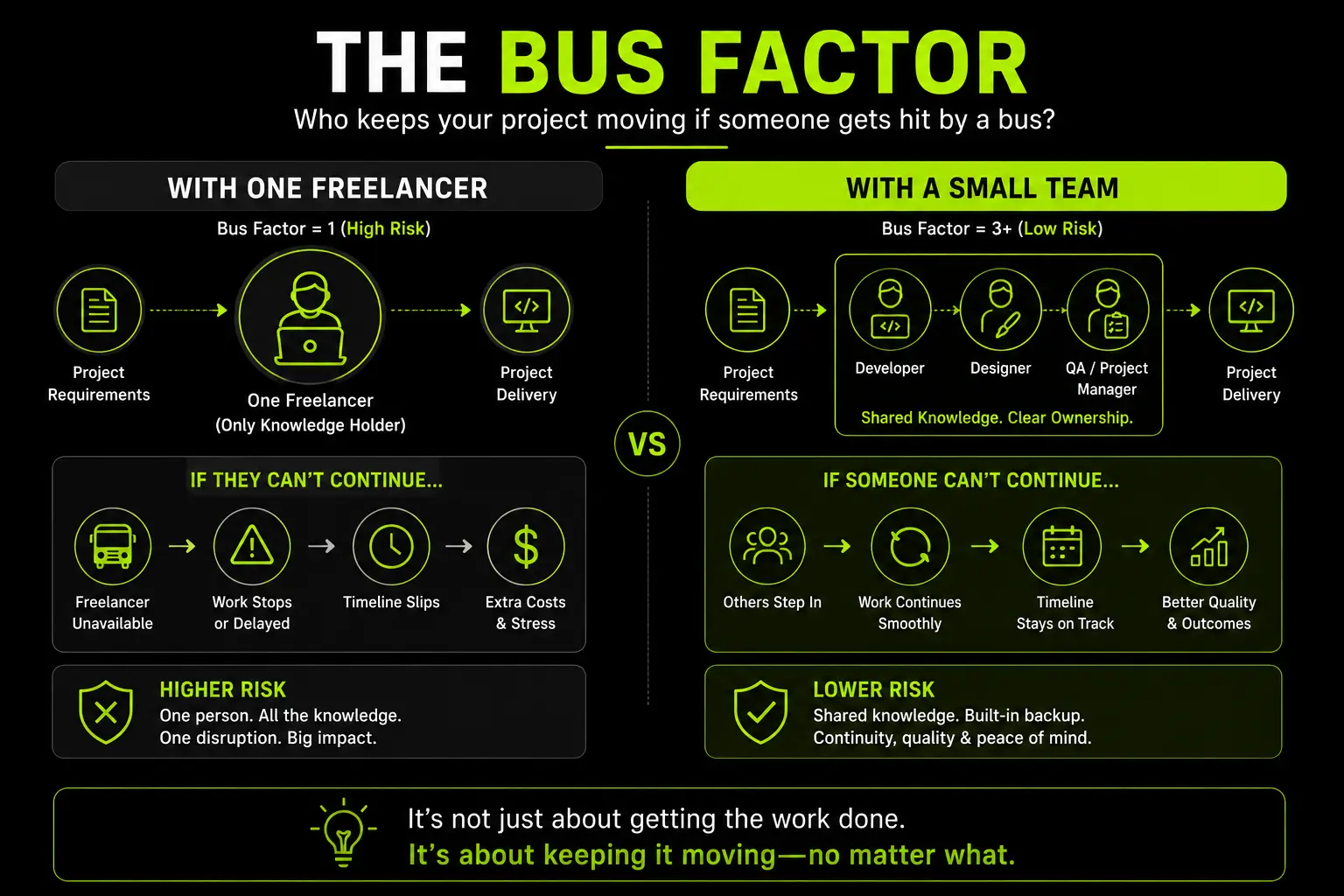
The "Bus Factor," What Happens When Your Only Developer Is Unavailable
The bus factor is a simple, blunt question: what happens to your project if your one developer becomes unavailable tomorrow, for any reason? With a freelancer, the honest answer is usually "everything stops," at least until someone else gets up to speed on unfamiliar code.
This isn't a hypothetical edge case. Freelancers take on multiple clients, travel, get sick, and sometimes simply stop responding mid-project, all of which happen at a meaningfully higher rate than a team where work is documented and shared across more than one person.
If your business depends on the store staying operational and improvable, this risk is worth weighing seriously, not dismissing as unlikely.
There's a practical mitigation worth naming here too, since the bus factor doesn't have to be a reason to rule out freelancers entirely.
Asking a freelancer to document their work as they go, keep code in a repository you control rather than their own local machine and provide a basic handover note at project completion closes most of this gap without needing to hire a full team.
It's a habit worth insisting on regardless of how confident you feel in the relationship at the start.
No Built-In QA, Design, or Project Management Layer
A freelancer is, by definition, one person covering one role. Unless you've separately hired for QA, design review, and project coordination, those functions either don't happen or fall to you, the client, to manage yourself.
This matters most at the exact moment it's easiest to skip: right before launch, when a second set of eyes checking cross-browser behavior, payment flows, and mobile layouts catches issues a single developer, deep in their own code, is prone to miss.
A freelancer without a QA process isn't being negligent. They simply don't have the structural role that catches what a solo developer's own testing tends to overlook.
If you do go the freelancer route on a project with any real complexity, it's worth budgeting separately for an independent QA pass rather than assuming the same person who built the store is best positioned to catch their own mistakes.
This isn't a knock on any individual developer's skill. It's simply how testing works better in general: a second, fresh set of eyes finds things the person closest to the code has stopped noticing.
Specialist Gaps: When One Person's Skillset Doesn't Cover the Whole Build
A generalist Shopify freelancer, however skilled at Liquid theme development, may have limited or no real experience with regional payment gateway configuration, RTL layout behavior, or multi-currency setup, simply because those are specialist areas most freelancers haven't needed to build depth in.
That's not a criticism of any individual freelancer's skill. It's a realistic acknowledgment that broad experience with themes and narrow, deep experience with regional payments rarely live in the same person, and pretending otherwise is how mismatched hires happen.
Picture a freelancer skilled in theme development but without deep GCC payment experience, building an Arabic storefront that looks correct visually but breaks at checkout, because RTL-specific form validation and a regional gateway's edge cases weren't part of their usual work.
Our Arabic ecommerce website design guide and UAE payment gateway comparison both cover just how many interdependent details sit inside what looks, from the outside, like a single "build an Arabic store" task.
The honest way to catch this before hiring is to ask direct, specific questions rather than accepting general Shopify experience as sufficient.
"Have you configured Telr or PayTabs before" is a very different question from "have you built Shopify stores before," and the answer to the second one tells you almost nothing about whether the freelancer can handle the first.
A portfolio full of standard English-language D2C stores is a reasonable signal of theme development skill. It's a weak signal for regional payment or localization depth specifically.
When an Agency Is Genuinely the Better Choice
An agency earns its higher cost when a project has enough interdependent parts that one person cannot reasonably cover them all well.
Multi-Layered Projects
If a project needs design, development, QA, and localization, those aren't four separate tasks. Each layer affects the others.
For example, a designer may create a layout that looks great but doesn't account for how Shopify Liquid handles certain components. The developer then has to compromise during implementation, creating rework that could have been avoided.
An agency reduces this risk by keeping these disciplines connected. Designers and developers review the work together, while QA tests the final implementation against the original requirements.
When multiple disciplines depend on each other, coordinated delivery becomes part of the project not overhead.
Work With Interdependent Regional Complexity
RTL layouts, multi-currency pricing, and local payment gateways can interact in ways that aren't obvious when each feature is considered separately.
For a GCC store, for example:
- Currency switching must display correctly in RTL layouts.
- Arabic checkout fields must accept input correctly.
- Payment gateways must handle the required currencies.
- Discounts and pricing logic must work across regional configurations.
Our international ecommerce considerations guide covers how these requirements connect for GCC-focused stores.
A freelancer may have deep expertise in one of these areas without having current, hands-on experience across all of them. An agency can assign specialists to each area and coordinate their work.
The problems that appear here are often small:
- A currency symbol appears on the wrong side of an RTL price.
- A discount field fails with Arabic input.
- A payment method works technically but hasn't been tested with the actual GCC gateway.
Each issue may look minor during QA. Together, they can create checkout friction and lost sales after launch.
Projects That Need More Capacity and Clear Accountability
Large projects and tight deadlines can require more coordinated work than one person can deliver without quality slipping.
An agency gives you:
- Multiple people working in parallel
- More capacity during critical phases
- A defined process for resolving issues
- A clear point of accountability
Accountability is especially important when something goes wrong. With a freelancer, resolution depends on that person's availability and other commitments. With an agency, you typically have a team and a defined process for investigating and fixing the issue.
If the project cannot afford to wait for one person's availability, team capacity becomes part of the value.
Ongoing Support and Maintenance
If your store needs continuous work after launching seasonal campaigns, performance monitoring, new features, or ongoing optimization an agency can provide a more consistent support structure.
This matters even more for brands running high-traffic sales events. Your store may need performance testing, infrastructure checks, and launch monitoring before and during a major campaign.
A team can divide that work across development, QA, and performance resources instead of relying on one developer to manage everything during a high-pressure launch.
If the store needs continuous attention after launch, evaluate the delivery model for the next 12 months, not just the initial build.
Where Agencies Genuinely Cost More Than They Need To
A fair comparison means naming where the agency model doesn't earn its cost, not just where it does. This is the section most agency-authored comparisons quietly skip, since it's easier to make the case for hiring a team than to explain when that team is the wrong call.
Simple Projects Where Agency Process Overhead Isn't Worth It
A contained, single-skill task run through a full agency process, discovery documentation, design review cycles, formal QA and project management overhead, ends up costing significantly more than the task's actual complexity justifies.
If the work genuinely is simple, that overhead is cost without a matching benefit.
This is worth saying plainly because it's easy for a founder to feel like the "safer" or "more professional" choice is always the bigger engagement, when in practice matching the tool to the job is what actually protects a budget.
A one-page landing section doesn't need a discovery phase. Paying for one anyway isn't caution. It's just an unnecessary cost.
Paying for Layers of Account Management You Don't Actually Need
Some agencies bill for account management and coordination layers that add real value on complex, multi-stakeholder projects but add cost without benefit on a small, single-decision-maker engagement.
Ask directly what you're paying for beyond development hours, and whether it matches what your specific project actually needs.
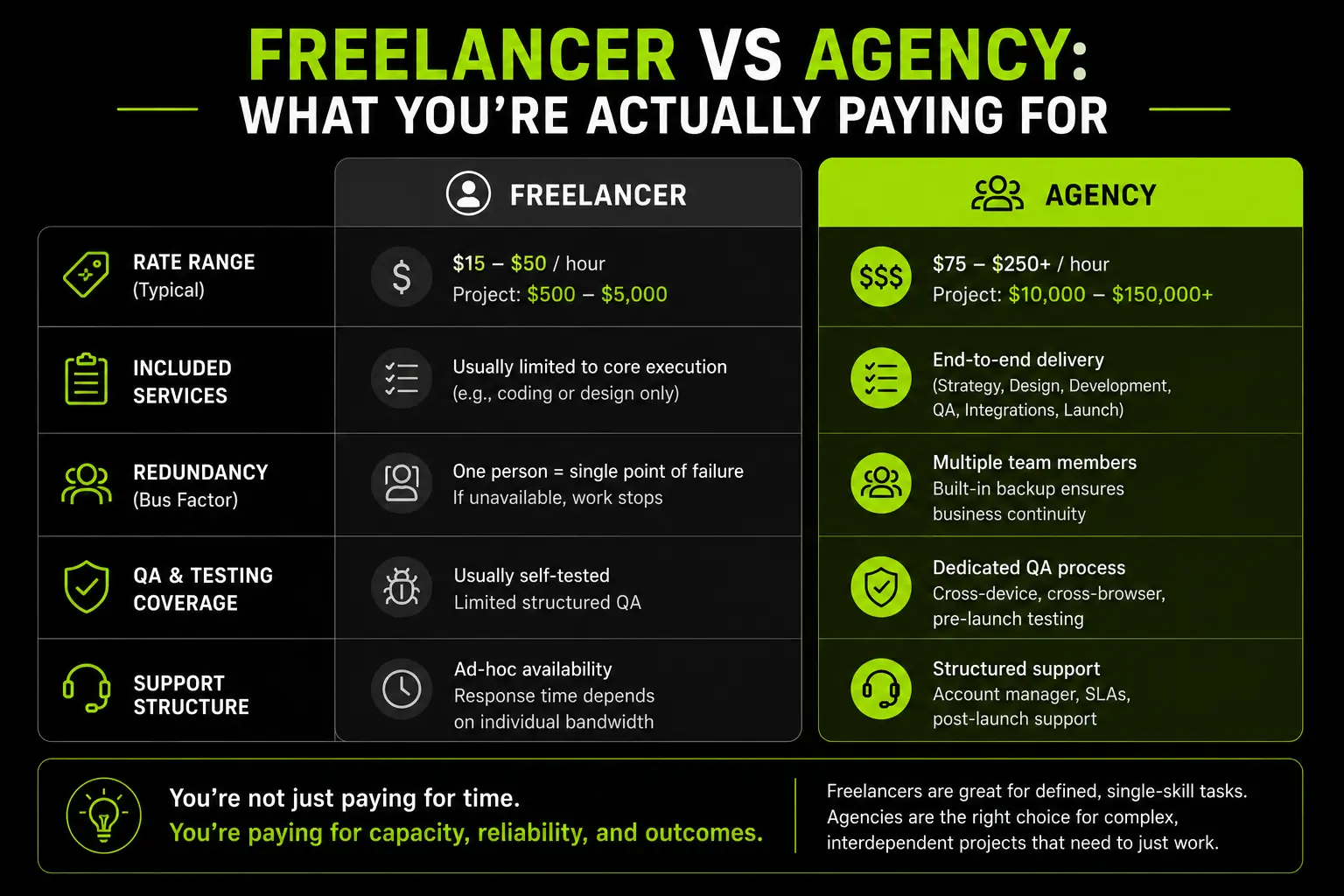
Cost Comparison: What Each Path Actually Costs
This table compares the two paths on the factors that actually matter, not just the headline hourly rate.
For a fuller picture of where agency costs come from beyond the headline hourly rate, our hidden costs of Shopify guide breaks down platform and development costs side by side.
A Simple Decision Framework
Use this framework before you decide, rather than defaulting to whichever option a recent conversation or a lower quote happens to nudge you toward.
Map Your Project's Skill Requirements Before You Decide
List every distinct skill your project genuinely needs: theme development, payment gateway configuration, RTL or localization, QA, ongoing maintenance, and anything else specific to your build.
Count how many of those are truly interdependent, meaning a change in one affects how another needs to work.
Write this list down literally, even for a project that feels simple. A founder who assumes their project is "just a theme customization" often finds, once they list requirements honestly, that it also touches a specific payment method, a discount logic change and a mobile-specific layout fix, three things rather than one. The list itself is often more revealing than any amount of deliberating over cost.
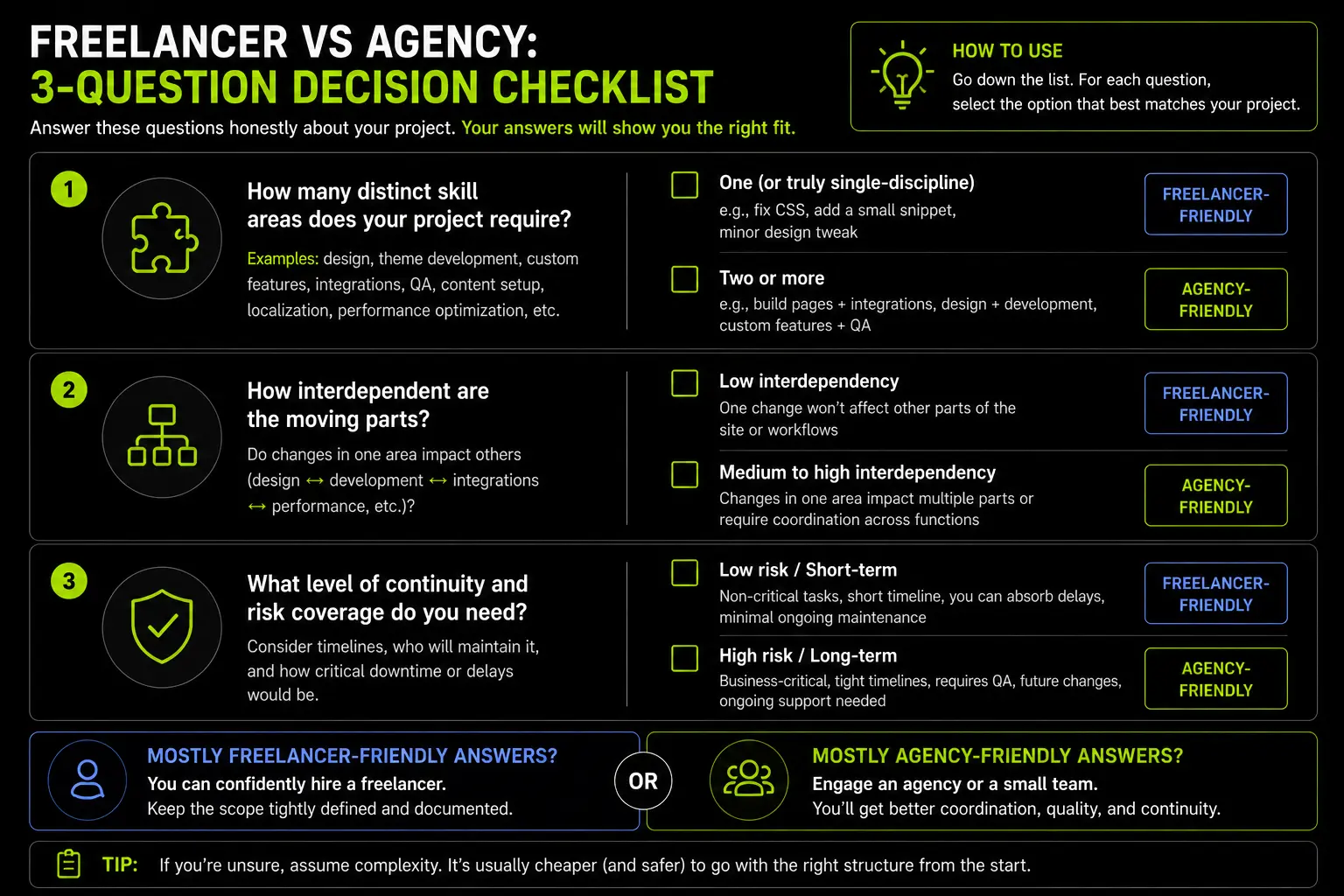
Three Questions to Ask Yourself Before Choosing Either Path
Answer these three questions honestly before committing to either option.
- Does this project touch more than one specialist skill area that need to work together correctly?
- Do I need ongoing support after launch, not just a one-time build?
- What happens to this project if my one developer becomes unavailable partway through?
Write your answers down rather than deciding purely by instinct. It's easy, mid-conversation with an enthusiastic freelancer or a persuasive agency salesperson, to talk yourself into whichever answer matches the option already in front of you.
A written answer, worked out beforehand, is a better guard against that than trusting the momentum of a good sales conversation.
One or two "no" answers points toward a freelancer being the right, cost-effective call. Multiple "yes" answers points toward an agency's structure being worth its cost.
If you're still working out your requirements at a more detailed level, our guide to briefing a Shopify agency is useful even if you end up hiring a freelancer, since a clear brief helps either path succeed.
None of these three questions has a universally right answer. A well-run early-stage store can honestly answer "no" to all three and be well served by a freelancer for years.
A brand expanding into multiple GCC markets with seasonal campaigns and regional payment complexity will almost certainly answer "yes" to at least two, and that's the signal worth taking seriously rather than working around.
How We Think About This at Suplex
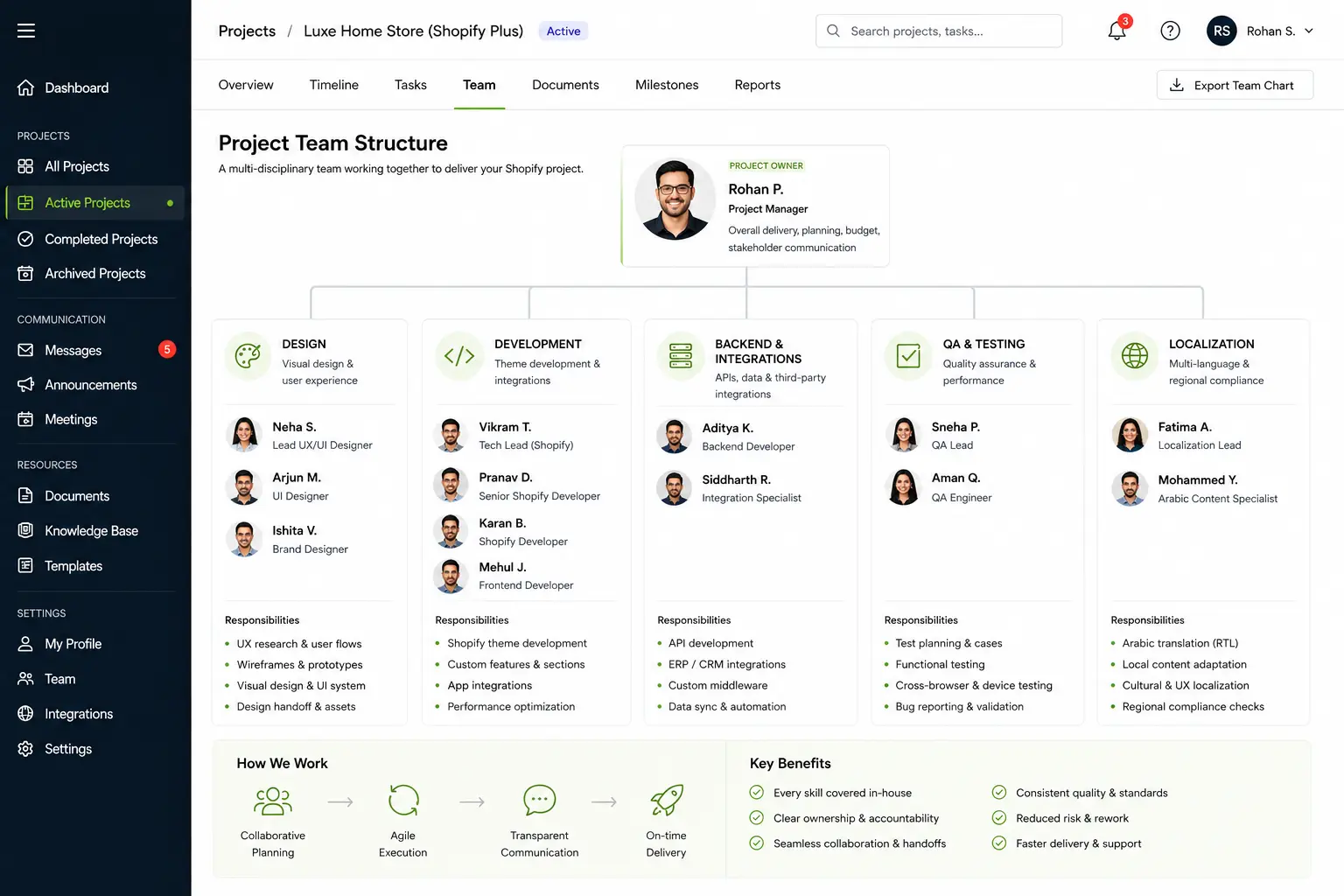
Suplex is structured as a multi-disciplinary team spanning design, development, QA, and platform and localization expertise, which is the natural fit for projects with interdependent, regionally complex requirements.
That structure is the honest reason we're positioned for the kind of project this guide describes as agency territory, not a generic claim about being better across the board.
Most of the projects that reach us are already past the point where a single freelancer would comfortably cover the scope, usually because they touch more than one of the specialist areas covered above at once.
But the framework in this guide applies just as much before someone reaches out to us as after, and we'd rather a founder work through it honestly than assume bigger is automatically better.
We'll say plainly, including to prospective clients, when a freelancer is genuinely the smarter call for smaller, contained work, since that's a more useful answer than steering every inquiry toward a bigger engagement than it needs.
If your project does touch multiple interdependent layers, our platform consultation service and ecommerce store setup process are built around exactly that kind of coordinated, accountable delivery.
Frequently Asked Questions
Is It Cheaper to Hire a Freelance Shopify Developer Than an Agency?
Usually, for the same number of billable hours. But agencies typically include QA, project management, and design coordination within that cost, which a freelancer engagement often doesn't cover unless hired separately.
When Should I Choose a Freelancer Over an Agency?
For contained, well-defined tasks, such as a specific theme customization, a single app integration, or a small fix, where the scope is narrow enough that one person's skillset reasonably covers the whole job.
What's the Biggest Risk of Hiring a Freelancer for Shopify Work?
Availability risk. If your only developer becomes unavailable mid-project or after launch, there's no built-in backup, and finding someone to pick up unfamiliar code takes time and often costs more than starting with a team would have.
Do I Need an Agency for Arabic or RTL Shopify Work?
Not strictly, but it's worth checking the freelancer's specific experience. RTL, multi-currency, and regional payment gateway work touch several interdependent skill areas that a single generalist freelancer may not fully cover.
Can a Freelancer Handle Ongoing Shopify Maintenance?
Some can, but confirm this explicitly before hiring. Many freelance engagements are structured around one-time project delivery rather than ongoing support, so mid- to long-term maintenance needs a separate conversation.
How Do I Evaluate a Shopify Freelancer's Skill Level?
Ask for a portfolio of comparable work, check whether they've handled the specific complexity your project needs, not just general Shopify experience, and confirm how they handle QA before launch.
Is a Shopify Partner Agency Automatically Better Than a Freelancer?
Not automatically. It depends on the project. Partner status signals platform experience, but the real question is whether your project's complexity genuinely needs a multi-disciplinary team or would be well served by one skilled person.
Hi, I’m Rishabh Jain
I believe great design has the power to shape perception, build trust, and move businesses forward. That belief is what led me to found Suplex Design Studio, a global branding and packaging studio working with FMCG and D2C brands across markets.I started suplex at 25 with a clear intent, to create design that is strategic, thoughtful, and commercially meaningful. By 28, the studio had scaled globally, guided by a strong foundation in Integrated Design that I developed during my academic journey in London, where I was honoured with the Dean’s Award.
Over the years, I’ve had the opportunity to work with 100+ brands, from Fortune 500 organizations to family-run businesses, helping them build packaging and brand systems that create recall, relevance, and long-term value.
Suplex’s work has been recognized internationally, including the Manifest Award (2024), the Clutch Global Award (2025), and features on platforms such as Packaging of the World, The Dieline, and the World Brand Design Society.
None of this would be possible without the people behind the work. I’m deeply grateful to the suplex team, whose commitment, creativity, and attention to detail turn ideas into meaningful brand experiences every day.
At the heart of my work is a simple philosophy, design should be intentional, honest, and built to last, and that continues to guide everything we create at suplex.





































Let’s Make It Happen
E-Commerce Success Stories
%201.avif)






.avif)

.avif)
Build Your D2C Business The Right Way
Build It With Suplex.


