How to Choose a Payment Gateway for UAE Ecommerce (2026)
.avif)
How to Choose a Payment Gateway for UAE Ecommerce (2026)
Payment gateway UAE ecommerce decisions usually start and end with one question: which provider charges the lowest fee. That question misses the bigger cost.
For most UAE Shopify merchants, silent declined transactions and checkout friction cost more than the fee percentage ever will.
Match your provider to your licensing status, your card-acceptance strength, and how you actually sell, not to whichever gateway advertises the smallest number.
What a Payment Gateway Actually Does (and Why UAE Merchants Can't Default to Shopify Payments)
Before comparing providers, it helps to know what each piece of the payment stack actually does, since "payment gateway" gets used loosely to describe three different things that each have different roles, different fees, and different failure points.
Gateway vs. Payment Processor vs. Merchant Account: the Terms People Mix Up
A payment gateway is the technical layer that captures card details at checkout and securely passes them along for authorization.
A payment processor is the infrastructure that actually moves money between the customer's bank and your merchant account, handling authorization, clearing, and settlement.
A merchant account is the account that holds your business's ability to accept card payments in the first place, usually tied to a bank or acquiring institution.
In practice, most UAE providers, Telr, PayTabs, Network International, bundle all three into a single product, so the distinction rarely matters day to day.
It matters more when you are troubleshooting a decline or negotiating rates, since a provider that only handles the gateway layer and routes processing through a third party often has less control over decline rates than one that owns the full stack, including the merchant account and processing relationship.
Shopify Payments in the UAE: What You Need to Know
For most of the past decade, Shopify Payments was unavailable to UAE merchants, so every Shopify store had to connect a third-party payment gateway.
That is beginning to change.
As of 2026, Shopify Payments is available in early access for a limited number of Shopify Plus merchants through a controlled onboarding program. It is not yet available to all businesses.
If you are on the Basic, Shopify, or Advanced plan, you will still need to connect a third-party payment gateway through Shopify.
Why This Matters
There are two important implications:
- Additional Transaction Fees: If you are not eligible for Shopify Payments, Shopify charges an extra transaction fee on top of your gateway's processing fee. This ranges from about 2% on the Basic plan to 0.5% on the Advanced plan. Many merchants overlook this cost when comparing payment gateways.
- Check Your Eligibility: If you are on Shopify Plus, confirm whether you qualify for Shopify Payments with Shopify or your Shopify Partner agency before choosing a third-party gateway. Eligibility and rollout continue to expand during 2026.
Choose a Gateway That Matches UAE Buying Behavior
The UAE is a highly digital payments market:
- High credit and debit card usage
- Widespread adoption of Apple Pay and Google Pay
- Strong growth in ecommerce spending
- Increasing demand for Buy Now, Pay Later (BNPL)
A payment gateway that supports these preferences with fast card authorization, native digital wallets, and reliable BNPL integrations can convert more shoppers than a gateway that simply processes payments.
The Real Cost of a Gateway Isn't the Percentage Fee
The transaction fee is only one part of what a payment gateway costs you.
A better comparison looks at:
- Transaction fees
- Approval/decline rates
- 3D Secure (3DS2) friction
- Wallet integration
- PCI DSS compliance burden
A gateway with a slightly higher fee can be cheaper overall if it approves more legitimate transactions and creates less checkout friction.
Why "Lowest Transaction Fee" Is the Wrong First Filter
A gateway charging 2.5% looks cheaper than one charging 2.9%.
But that comparison only works if both gateways approve roughly the same percentage of legitimate transactions.
If the cheaper gateway has weaker local bank relationships and declines more UAE-issued cards, the lost revenue can easily outweigh the 0.4 percentage-point fee saving.
The better question isn't:
Which gateway has the lowest fee?
It's:
Which gateway gives me the lowest total cost per successful transaction?
1. Decline Rates: The Hidden Cost
Decline rates can vary significantly between gateways.
One reason is the strength of the provider's relationships and integrations with UAE-issuing banks.
International-first gateways that route UAE transactions through global processing infrastructure may experience higher decline rates than providers with stronger regional integration.
This matters because a declined transaction creates a much larger cost than a small difference in processing fees:
Higher decline rate → fewer approved payments → lost revenue.
The problem is that decline-related losses rarely appear on your gateway invoice, so standard fee comparisons don't capture them.
What to Ask Your Gateway
Don't ask only for the provider's global approval rate.
Ask specifically:
"What is your typical approval rate for UAE-issued Visa and Mastercard transactions?"
The UAE-specific number is far more useful when you're evaluating a gateway for the local market.
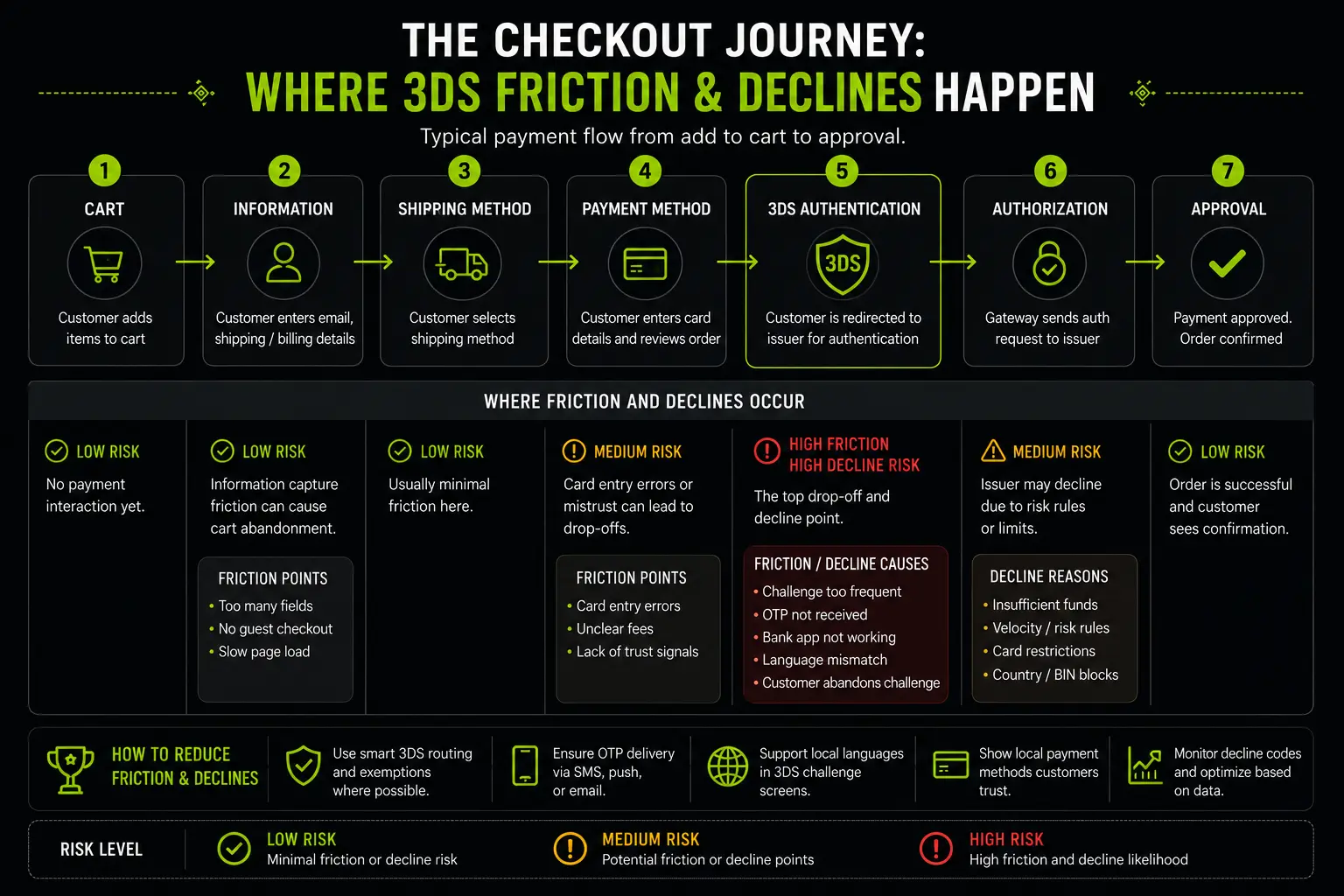
2. 3D Secure 2.0 Can Add Checkout Friction
3D Secure 2.0 (3DS2) adds an authentication step to card payments to reduce fraud.
Depending on the transaction, this might involve:
- OTP verification
- Banking app confirmation
- Biometric authentication
- Other risk-based verification
3DS2 improves payment security, but poor implementation can also increase checkout abandonment.
The Key Difference: Forced vs Risk-Based Authentication
Some gateways trigger 3DS2 broadly, adding friction even to low-risk transactions.
Others use risk-based authentication, applying additional verification only when the transaction presents higher risk.
That can create a smoother checkout for legitimate customers while maintaining fraud protection.
When evaluating a gateway, ask:
- How often is 3DS2 triggered?
- Is authentication risk-based?
- Can merchants configure authentication rules?
- What is the provider's 3DS2 success rate?
3. Wallets Can Reduce Mobile Checkout Friction
For UAE ecommerce, Apple Pay and Google Pay integration deserves more attention than a simple "supported" checkbox.
One-tap wallets can reduce:
- Manual card-data entry
- Checkout time
- Mobile friction
- Some authentication-related friction, depending on implementation
So don't just ask whether a gateway supports Apple Pay or Google Pay.
Evaluate how well the integration actually works on mobile.
The True Cost of a Payment Gateway
Think of gateway cost as:
Total Gateway Cost = Transaction Fees + Lost Revenue from Declines + Lost Revenue from Checkout Friction + Compliance/Technical Costs
This changes how you compare providers.
A gateway charging 2.9% with strong UAE approval rates and smooth 3DS2 may cost you less overall than a gateway charging 2.5% but losing legitimate transactions to declines and checkout friction.
Don't optimize for the lowest fee. Optimise for the lowest total cost per successful payment.
4. PCI DSS Compliance Isn't Optional
PCI DSS (Payment Card Industry Data Security Standard) is the baseline security standard for handling card payments.
Most reputable gateways reduce your compliance burden by hosting the card-entry fields themselves, meaning raw card numbers don't pass through your own servers.
Before choosing a provider, confirm:
- Who hosts the card-entry fields?
- Does card data touch your servers?
- What PCI DSS responsibilities remain with your business?
- Does the gateway provide the required compliance documentation?
A hosted, PCI-compliant checkout can significantly reduce your technical and compliance workload.
Don't assume the gateway handles everything. Confirm exactly where your PCI DSS responsibility begins and ends.
The Evaluation Framework: Six Criteria That Actually Matter
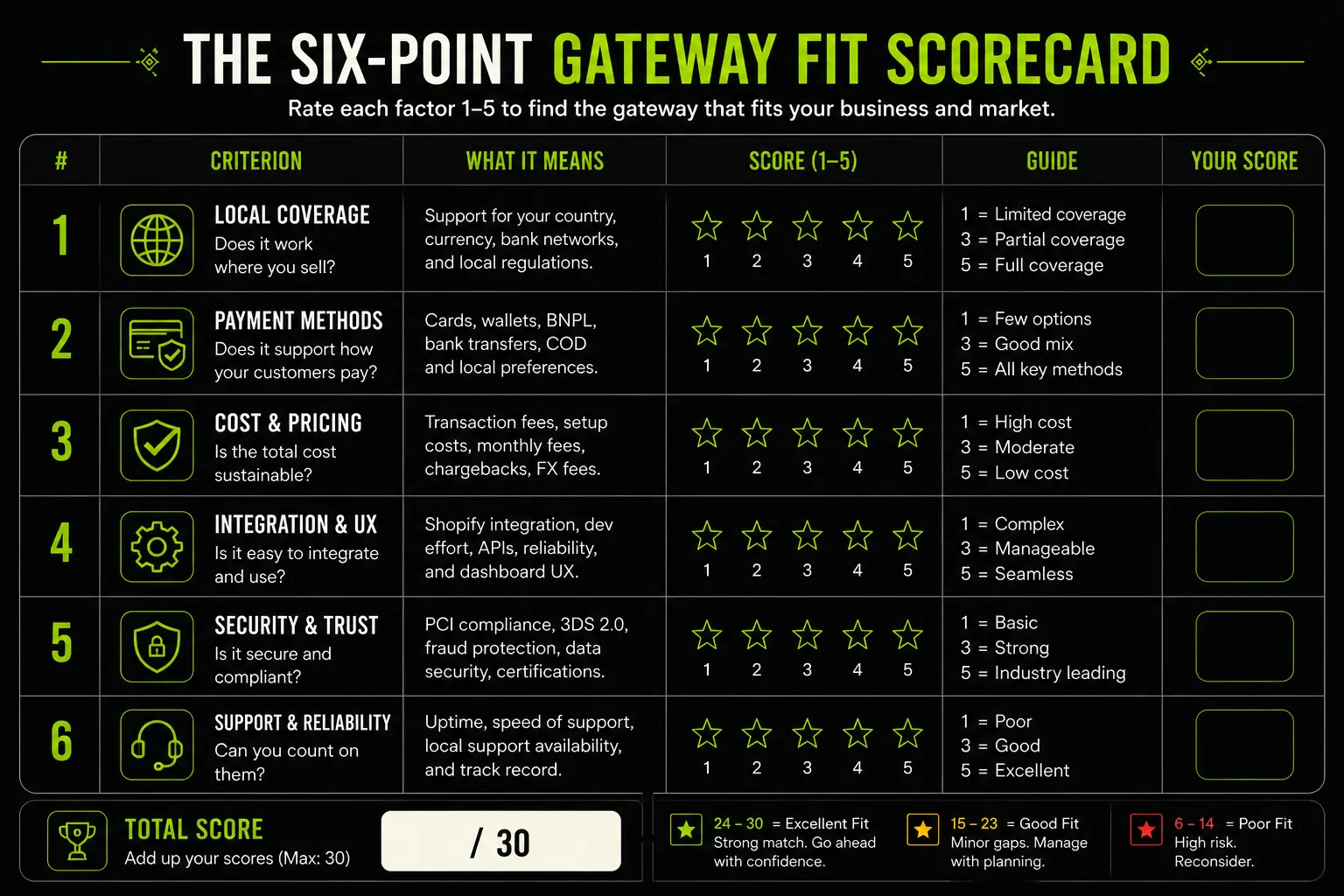
Use this scorecard directly in a vendor conversation. Rate each provider 1 to 5 on each criterion, then compare the totals against your specific business needs rather than a generic ranking.
1. Local Card Acceptance and Bank Relationships
Ask every provider you evaluate for their typical approval rate specifically on UAE-issued Visa and Mastercard transactions, not a blended global figure. A provider unwilling or unable to answer this question directly is itself a signal worth noting.
2. Licensing and Trade License Requirements
Confirm exactly what documentation is required before you can onboard: a UAE trade license, a corporate bank account, proof of business address, and in some cases additional compliance documentation depending on your product category. Some lighter fintech options require less, at the cost of more limited features.
3. Settlement Speed and Cash Flow Impact
Ask directly whether settlement runs on a T+1 (next business day) or T+3 (three business days) cycle, and whether that timeline varies by payment method. For an inventory-heavy D2C brand reordering stock regularly, the difference between funds landing the next day versus three days later has a real, compounding effect on how much working capital you need to hold at any given time.
4. BNPL and Digital Wallet Support
Confirm whether Tabby and Tamara integrate natively through the gateway or Shopify's own apps, versus requiring separate SDK-level integration work. Also confirm Apple Pay and Google Pay support explicitly, since "wallet support" is sometimes advertised loosely without confirming both are genuinely live and tested.
5. Platform Compatibility
Ask specifically how the gateway integrates with your platform, Shopify, WooCommerce, or Magento, and whether that integration is a native, supported app or requires custom development work to connect. A native integration reduces both your initial build cost and your long-term maintenance burden.
6. Regional Reach Beyond the UAE
If there is any chance you will sell into Saudi Arabia, Kuwait, or Bahrain, confirm Mada support (Saudi Arabia's national card scheme) directly, since not every UAE-focused gateway supports it, and retrofitting Mada support after launch is more disruptive than confirming it upfront.
The Six-Point Gateway Fit Scorecard
average order value and international card traffic weighs local bank relationships and 3DS friction more heavily, since a single declined high-value order is a meaningful loss.
A fashion brand with frequent, lower-value repeat purchases weighs settlement speed and BNPL integration more heavily, since cash flow and conversion at the point of a smaller, more impulsive purchase matter more to that business model.
Weight the scorecard against your own order profile rather than treating all six criteria as equally important by default.
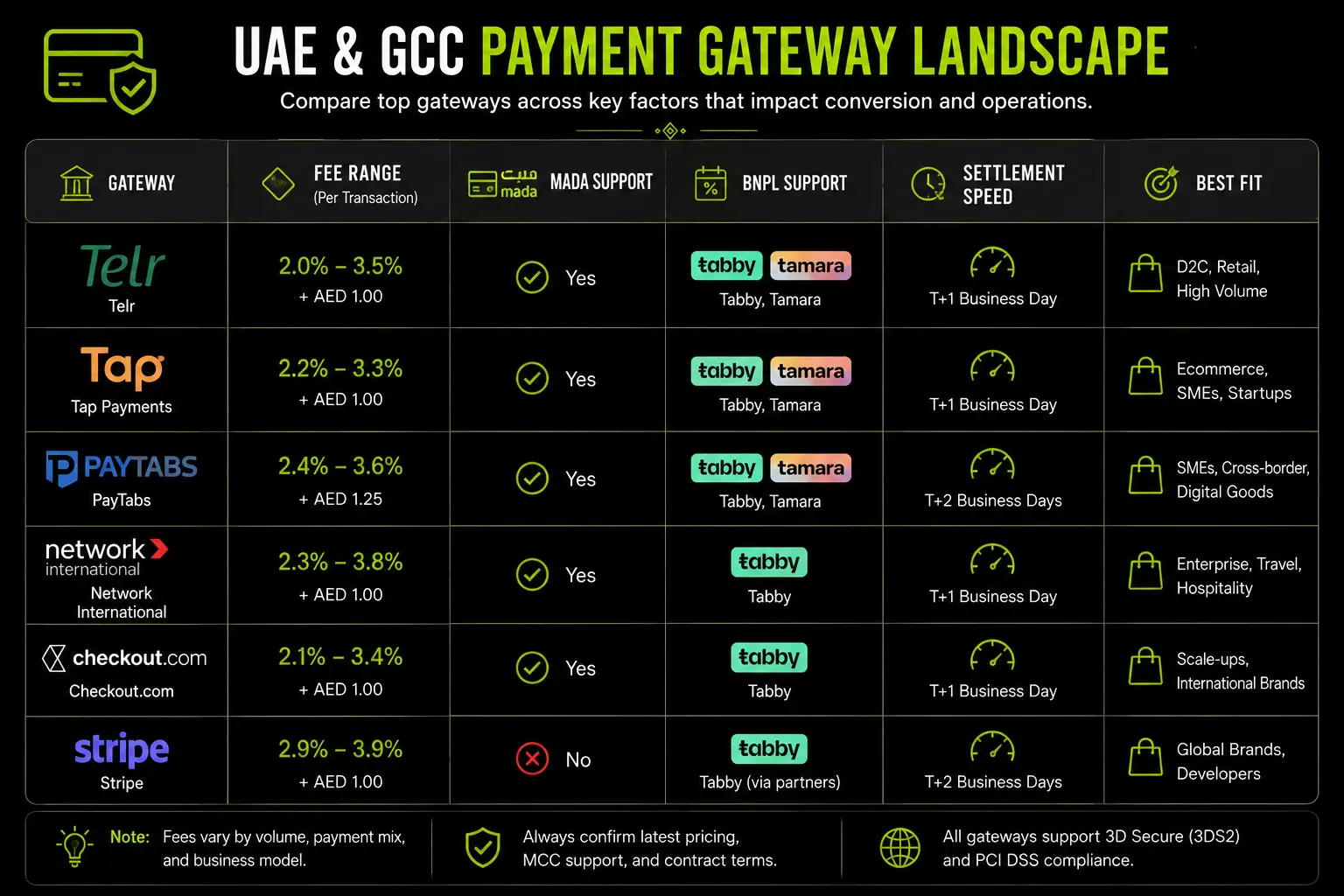
What UAE Gateways Actually Look Like Right Now
This is a landscape map, not a ranking. Each provider fits a different business profile, and the right choice depends on where you land on the Six-Point Scorecard above, not on which name appears first in a listicle.
Telr: Local Relationships and Multi-Currency Strength
Telr is a UAE-built gateway with strong local bank relationships and an Arabic-language dashboard, which makes it a common choice for merchants targeting UAE customers specifically.
It supports multi-currency processing and typically includes invoicing and reporting tools alongside core payment processing.
PayTabs: Fast Onboarding for First-Time Shopify Launches
PayTabs is widely used across the UAE and wider GCC and is often chosen for its relatively fast onboarding process, which suits first-time merchants who want to get a Shopify store live without a lengthy setup period.
Network International and Amazon Payment Services: Enterprise-Grade, Bank-Backed Trust
Network International and Amazon Payment Services (formerly known as PayFort) are bank-backed providers with deeper enterprise infrastructure.
Onboarding tends to take longer due to more thorough compliance checks, but they suit larger, higher-volume merchants who benefit from negotiated rates and enterprise-grade reliability.
Stripe and Checkout.com: Strong Global Infrastructure, Weaker Meda Support
Stripe and Checkout.com both offer strong global processing infrastructure and are well suited to brands selling internationally alongside the UAE.
Confirm Mada support directly before committing if Saudi Arabia is part of your near-term expansion plan, since global-first providers do not always support it as comprehensively as UAE-native gateways.
Ziina, Mamo and the New Local Fintech Layer
Ziina, Mamo, and similar newer fintech players offer lighter, faster onboarding aimed at individuals and smaller sellers, sometimes without the full trade license requirement that traditional gateways enforce.
They typically come with more limited features than a full merchant account gateway, making them a reasonable starting point for very early-stage sellers rather than a long-term solution for a scaling D2C brand.
Gateway Landscape Comparison
Fee ranges across these providers typically fall somewhere between roughly 2.5 and 3.5 percent per transaction plus a small fixed fee, though exact rates vary by plan, volume and negotiated terms and this space moves quickly enough that any specific number is worth confirming directly with each provider rather than treated as fixed.
Not Sure Which Gateway Actually Fits Your Store?
Suplex evaluates payment infrastructure as part of every Shopify build, using decline-rate awareness, not just fee comparison, to match a gateway to how you actually sell.
Talk to Suplex About Your UAE Payment Setup
Matching a Gateway to Your Business Stage
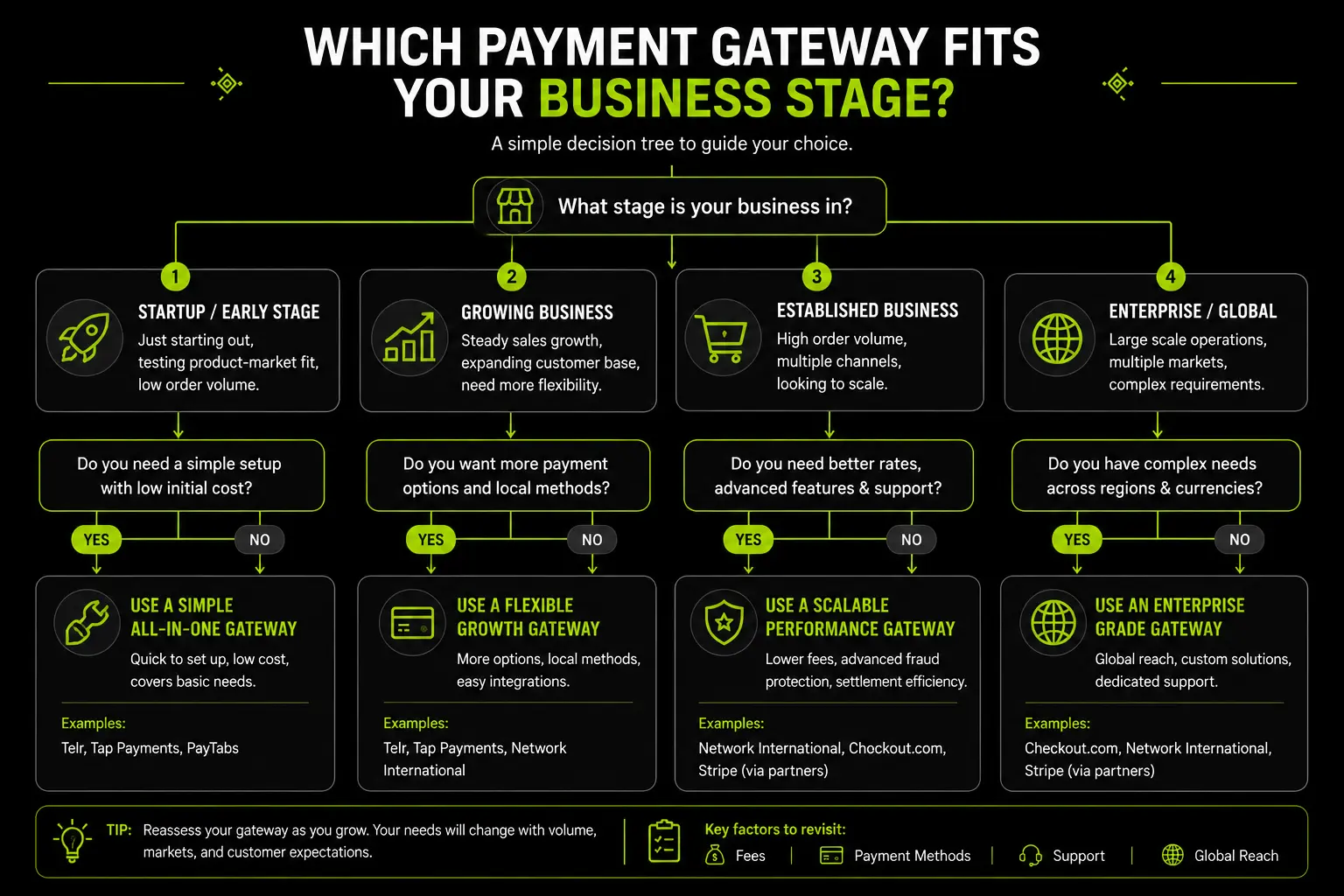
There is no single best UAE payment gateway for every business.
A pre-revenue startup has very different needs from a growing D2C brand or a multi-market GCC business.
Your gateway choice should match your current transaction volume, cash flow, and operational complexity.
1. Pre-Revenue & Early-Stage Brands
Priority: Fast onboarding + low upfront costs
At this stage, don't optimise for the lowest possible transaction fee.
You need a gateway that lets you start accepting payments quickly without lengthy enterprise onboarding or significant fixed costs.
Look for:
- Fast account approval
- Minimal setup costs
- No or low monthly fees
- Pay-as-you-go pricing
- Essential payment methods
- Simple integration
Providers such as PayTabs can be attractive at this stage because faster onboarding and lower upfront barriers can matter more than saving a few tenths of a percentage point on transaction fees.
Best Approach: Get live quickly, validate demand, then optimise your payment economics as volume grows.
2. Growing D2C Brands: AED 50K–500K/Month
Priority: Approval rates + total payment cost
Once you're processing meaningful monthly volume, declined transactions become a much bigger cost.
At this stage, don't compare gateways based only on their advertised rates.
Compare:
- UAE card approval rates
- Decline rates
- 3DS2 performance
- Apple Pay and Google Pay conversion
- Monthly fees
- Transaction fees
- Settlement times
- Support quality
Compare the Effective Blended Cost
A zero-monthly-fee plan isn't automatically cheaper.
For example:
Plan A
No monthly fee + higher transaction rate
Plan B
Monthly fee + lower transaction rate
At lower volume, Plan A may cost less. As your transaction volume increases, Plan B may produce a lower effective blended rate.
Best Approach: Run the numbers using your actual monthly GMV and transaction count rather than relying on the headline rate.
3. Scaling & Multi-Market GCC Brands
Priority: Regional infrastructure + negotiated economics
Once you're operating at a significant scale across markets such as the UAE and Saudi Arabia, payment infrastructure becomes an operational decision, not just a checkout decision.
Enterprise providers such as Network International or Amazon Payment Services can become more attractive despite longer onboarding processes.
Look for:
- Negotiated enterprise rates
- Dedicated account management
- Strong UAE and Saudi coverage
- Mada support
- Multi-currency processing and settlement
- Regional payment routing
- Higher transaction approval rates
- Robust reporting and reconciliation
- Enterprise-level support
At this stage, the value of better infrastructure and negotiated pricing can outweigh the convenience of a simple pay-as-you-go provider.
The Right Pricing Model Changes as You Scale
Your ideal pricing structure can change with your transaction volume.
Example:
An early-stage startup may choose a zero-monthly-fee plan with a slightly higher transaction rate to preserve cash flow.
An established brand processing significant monthly volume may choose a fixed monthly-fee plan because the lower transaction rate reduces its effective cost at scale.
Neither option is universally better.
Choose based on where your business is today, not where you expect it to be next year.
Setup and Integration: What the Process Actually Looks Like
Check the onboarding requirements before choosing a gateway.
A missing document or integration limitation can delay your launch by days or even weeks. Before applying, confirm these four areas:
- Business documentation
- Onboarding timeline
- Platform integration
- Multi-currency support
1. Documentation and Trade License Requirements
For a full-featured UAE merchant account, you will generally need:
- Valid UAE trade license
- Corporate bank account
- Business registration documents
- Company and owner identification documents
- Website/store details
- Required compliance information
Your trade license can come from the Department of Economic Development (DED) or a relevant free zone authority.
Can You Get a UAE Payment Gateway Without a Trade License?
For a standard commercial merchant account, expect to need a valid trade license.
Some newer fintech providers offer onboarding for individuals or small sellers with fewer documentation requirements. However, these options may have more limited features, transaction limits, or business capabilities than a full merchant gateway.
Check the gateway's eligibility requirements before starting the application.
2. Typical Onboarding Timelines
Your timeline depends on the provider type and how complete your documentation is.
Providers such as PayTabs and Telr can often be faster to onboard when your documentation is ready.
Enterprise providers such as Network International may take longer because of more detailed compliance, risk, and merchant checks.
Tip: Prepare your documents before applying. Incomplete applications are one of the easiest ways to extend the onboarding timeline.
3. Shopify, WooCommerce, and Magento Integration
Integration effort varies by platform and provider.
Shopify
Most major UAE gateways offer native Shopify integrations, allowing you to configure payments through Shopify without significant custom development.
WooCommerce
WooCommerce integrations vary more between providers. Some offer ready-made plugins, while others may require additional configuration or development.
Magento
Magento implementations can require more development, particularly for:
- Complex catalogs
- Multi-store setups
- Multi-currency checkout
- Custom checkout flows
- ERP or other backend integrations
Before choosing a gateway, confirm that its native integration supports your exact store setup.
If it doesn't, the difference between a plug-and-play integration and custom web development can materially affect your implementation cost and timeline.
For straightforward Shopify projects, this work can usually be included within the broader ecommerce store setup rather than treated as a separate development project.
4. Multi-Currency Checkout and Cross-Border Payments
If you sell outside the UAE, confirm how the gateway handles multi-currency payments and settlement before signing up.
Ask:
- Which currencies can customers pay in?
- Can shoppers see prices in their local currency?
- Which currencies can you settle in?
- What exchange rate is applied?
- Are there additional currency-conversion fees?
- Is multi-currency native or does it require another app?
- Can the gateway support GCC and international cards?
Why Local Currency Matters
If a shopper from Saudi Arabia, the UK, or India sees only AED at checkout, their card issuer may handle the currency conversion.
That can introduce:
- Unfamiliar exchange rates
- Additional conversion fees
- More uncertainty at checkout
- Potential payment friction
Showing the shopper's local currency where possible makes the final price easier to understand and can create a smoother international checkout experience.
Don't assume "multi-currency supported" means local-currency checkout is fully supported. Confirm exactly how currency display, conversion, and settlement work.
Pre-Application Checklist
Before committing to a UAE payment gateway, confirm:
- Trade license requirements
- Corporate bank account requirements
- Required compliance documents
- Expected onboarding timeline
- Shopify/WooCommerce/Magento integration
- Custom development requirements
- Supported currencies
- Settlement currencies
- Currency-conversion fees
- International card support
The best gateway isn't just the one you can activate quickly. It's the one that fits your business structure, ecommerce platform, and target markets without creating unnecessary implementation work.
How Suplex Evaluates Payment Infrastructure
Suplex approaches gateway selection using the same Six-Point Scorecard laid out above, treating decline-rate awareness as a core part of the evaluation rather than a footnote to a fee comparison.
As a certified Shopify Partner agency based in Dubai, the team works regularly with regional payment integrations including Tabby, Tamara, and Amazon Payment Services (PayFort), which means gateway selection gets evaluated against real, observed approval and integration behavior in the region, not just published rate cards.
For merchants who want to actually measure decline-rate impact after launch rather than guess at it, D2C data analytics work sets up the funnel-level tracking needed to see exactly where and why transactions are failing, segmented by gateway and payment method, so the decision can be revisited with real data rather than anecdote once the store is live.
For brands operating at a scale where Shopify Plus genuinely makes sense, gateway evaluation extends into multi-market routing and negotiated enterprise rates as part of that broader platform conversation.
Common Mistakes D2C Brands Make Choosing a UAE Gateway
Frequently Asked Questions
Is Shopify Payments available in the UAE?
Shopify Payments has entered early access in the UAE, but only for select Shopify Plus merchants under a controlled rollout, not a general release. Most UAE-based Shopify merchants on Basic, Shopify, or Advanced plans still need a third-party gateway like Telr, PayTabs, or Stripe connected through Shopify's external payment provider settings. Confirm your eligibility directly with Shopify, since this is an evolving rollout.
What's the best payment gateway for a new ecommerce business in the UAE?
It depends on volume and onboarding speed needs. PayTabs and Telr are commonly chosen for fast setup and local card support, while Stripe suits brands prioritizing global infrastructure. Match the choice to the Six-Point Scorecard, not fee percentage alone.
Can I get a UAE payment gateway without a trade license?
Most licensed gateways require a UAE trade license and local bank account for a full merchant account. Some newer fintech options, like Ziina, offer lighter onboarding for individuals and small sellers, but with more limited features than a full gateway.
Why do UAE customers' card payments get declined even with a valid card?
Gateways without strong local bank relationships often show higher decline rates on UAE-issued cards, partly due to aggressive 3D Secure fraud filters. This is a bigger hidden cost than transaction fees for many merchants.
Do I need Mada support if I only sell in the UAE?
Not for UAE-only sales. Mada is Saudi Arabia's national card scheme. If you plan to sell into Saudi Arabia now or later, confirm your gateway supports Mada directly, since not all UAE-focused providers do.
How long does it take to set up a payment gateway in the UAE?
Plug-and-play options like PayTabs can be live within days. Bank-backed enterprise gateways like Network International often take one to two weeks due to more thorough onboarding and compliance checks.
Should I use one gateway or multiple gateways for my UAE store?
Many established merchants run a primary gateway plus a backup for redundancy and to compare decline rates. For early-stage stores, one reliable gateway is usually enough. Added complexity isn't worth it until volume justifies it.
Hi, I’m Rishabh Jain
I believe great design has the power to shape perception, build trust, and move businesses forward. That belief is what led me to found Suplex Design Studio, a global branding and packaging studio working with FMCG and D2C brands across markets.I started suplex at 25 with a clear intent, to create design that is strategic, thoughtful, and commercially meaningful. By 28, the studio had scaled globally, guided by a strong foundation in Integrated Design that I developed during my academic journey in London, where I was honoured with the Dean’s Award.
Over the years, I’ve had the opportunity to work with 100+ brands, from Fortune 500 organizations to family-run businesses, helping them build packaging and brand systems that create recall, relevance, and long-term value.
Suplex’s work has been recognized internationally, including the Manifest Award (2024), the Clutch Global Award (2025), and features on platforms such as Packaging of the World, The Dieline, and the World Brand Design Society.
None of this would be possible without the people behind the work. I’m deeply grateful to the suplex team, whose commitment, creativity, and attention to detail turn ideas into meaningful brand experiences every day.
At the heart of my work is a simple philosophy, design should be intentional, honest, and built to last, and that continues to guide everything we create at suplex.






































Let’s Make It Happen
E-Commerce Success Stories
%201.avif)






.avif)

.avif)
Build Your D2C Business The Right Way
Build It With Suplex.


