Hidden Costs In Shopify: What UAE Merchants Actually Pay
.avif)
Hidden Costs In Shopify: What UAE Merchants Actually Pay
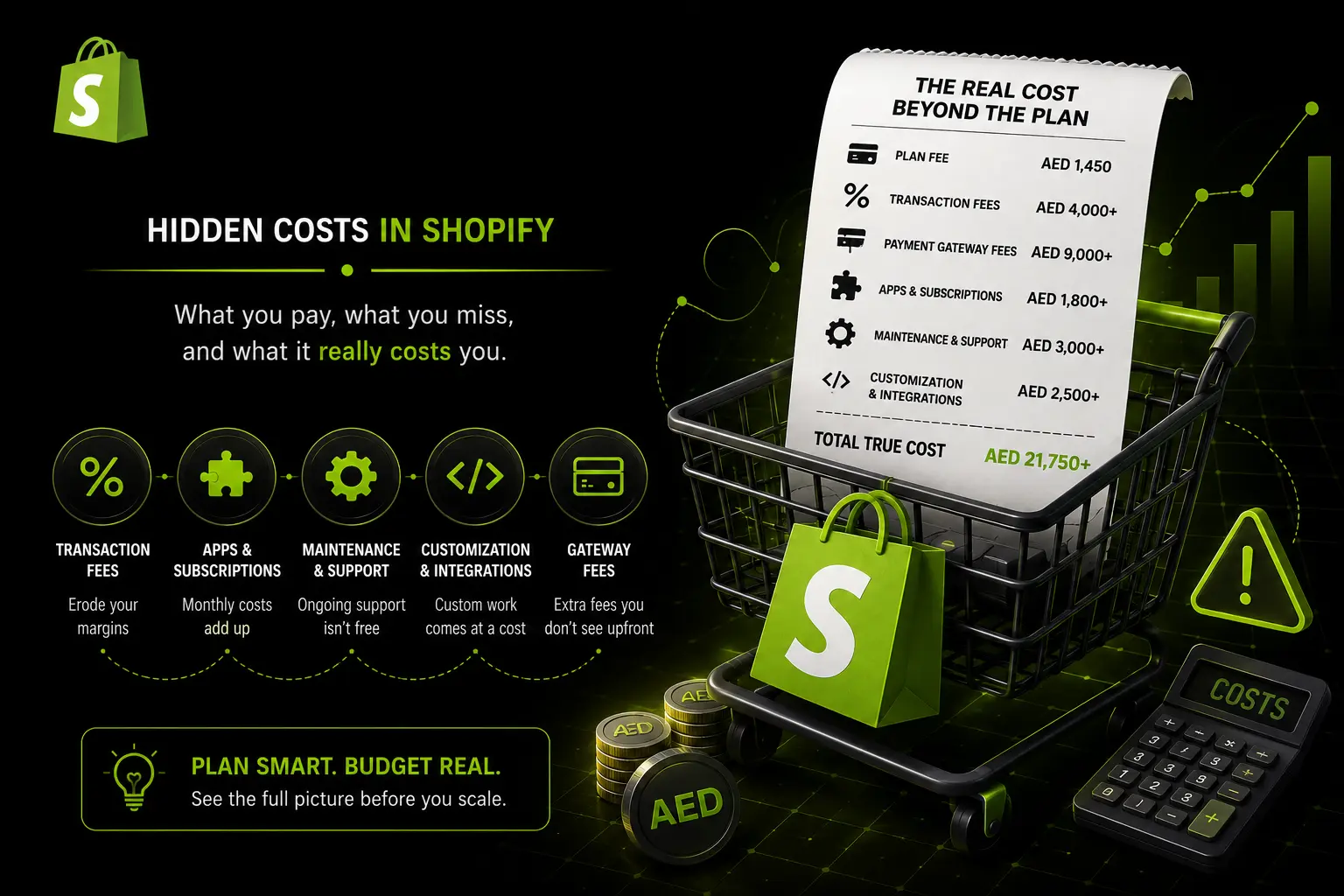
Hidden costs of Shopify rarely show up in the plan you signed up for. The advertised price, from roughly $39 to $399 a month, is usually the smallest line item in what a UAE-based store actually pays each month.
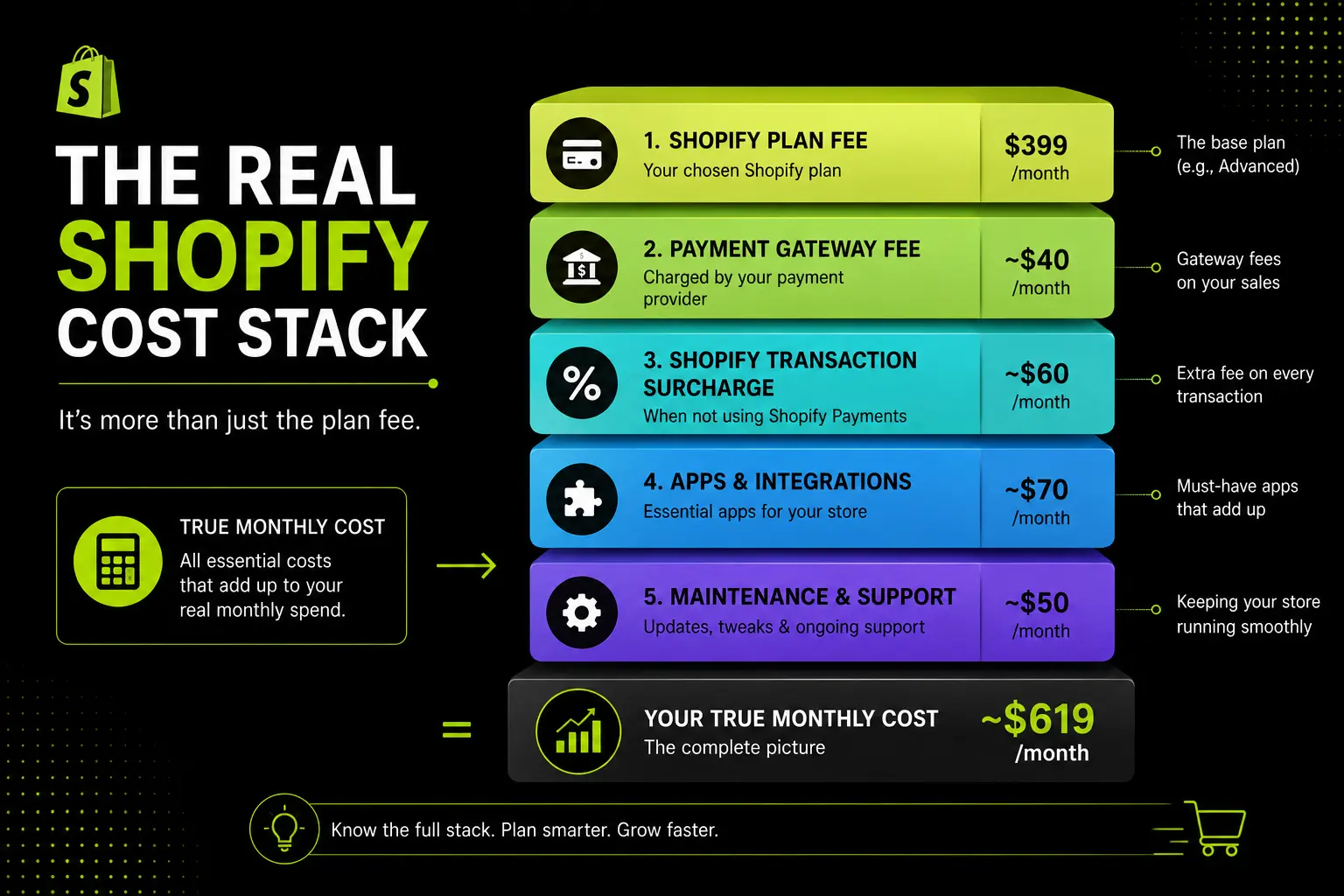
The real stack is plan fee plus gateway fee plus Shopify's third-party transaction surcharge plus apps plus custom development plus ongoing maintenance, and most comparisons only show you the first one.
For the broader picture of UAE ecommerce build costs beyond Shopify specifically, our ecommerce website development cost guide covers the full range.
This Suplex blog piece stays focused on the platform mechanics: exactly what Shopify itself adds to your monthly bill and why UAE stores pay more of it than merchants in most other markets.
Why The Advertised Shopify Price Isn't The Real Price
Every Shopify pricing page leads with the plan fee, because that is the number Shopify controls and wants you comparing against competitors.
It is also the number that tells you the least about what you will actually pay once your store is live and processing real orders.
What The Plan Fee Actually Covers
The plan fee buys you the platform itself: hosting, the admin dashboard, checkout infrastructure, basic reporting, and a set number of staff accounts.
It does not include payment processing fees, apps, a custom theme beyond the free defaults, or any ongoing development work. Think of it as rent on the building, not the cost of running the business inside it.
The Gap Between "Starting Price" And What UAE Merchants Actually Pay Monthly
For a UAE fashion store running roughly AED 50,000 a month in sales, gateway fees, Shopify's third-party transaction surcharge and a modest starter app stack alone can add close to AED 1,925 to the monthly bill, on top of whatever plan tier the store is on.
That number grows in direct proportion to sales volume, which is exactly why so many merchants feel blindsided by their first full month of invoices once the store actually starts selling at scale.
A quote or plan comparison that only shows the advertised plan price is showing you a fraction of the real number.
The Shopify Transaction Fee Surcharge: The Cost Every UAE Merchant Pays And Most Don't Expect
This is the single most GCC-specific line item on this entire list, and it directly extends the fee stack already covered in our UAE payment gateway comparison. If you have not read that piece yet, it is worth doing so before this section, since the surcharge below sits on top of whatever gateway fee you are already paying.
Why This Fee Exists
Shopify charges an additional transaction fee whenever a store processes payments through a third-party gateway instead of Shopify's own native checkout, Shopify Payments.
Shopify Payments entered early access in the UAE during 2026, according to Shopify's own help documentation, but it remains available to select merchants only, works for online sales alone and has no published rate card or general availability date at the time of writing.
In practice, this means most UAE stores today still connect a third-party gateway, such as Telr, PayTabs, or Checkout.com, which means most UAE stores still pay this surcharge by default.
If your store has been invited into the early access program, confirm your actual eligibility and rates directly in your Shopify admin under Settings, Payments, since the figures below assume the third-party path most merchants are still on.
The Real Math: Combining Gateway Fees + Shopify's Surcharge
This surcharge sits directly on top of whatever your gateway charges, so the two stack. A store paying a 3% gateway fee on the Basic plan is really paying roughly 5% total on every transaction once Shopify's surcharge is added in, not the 3% the gateway's own pricing page advertises.
How Upgrading Plans Can Actually Lower This Cost At Volume
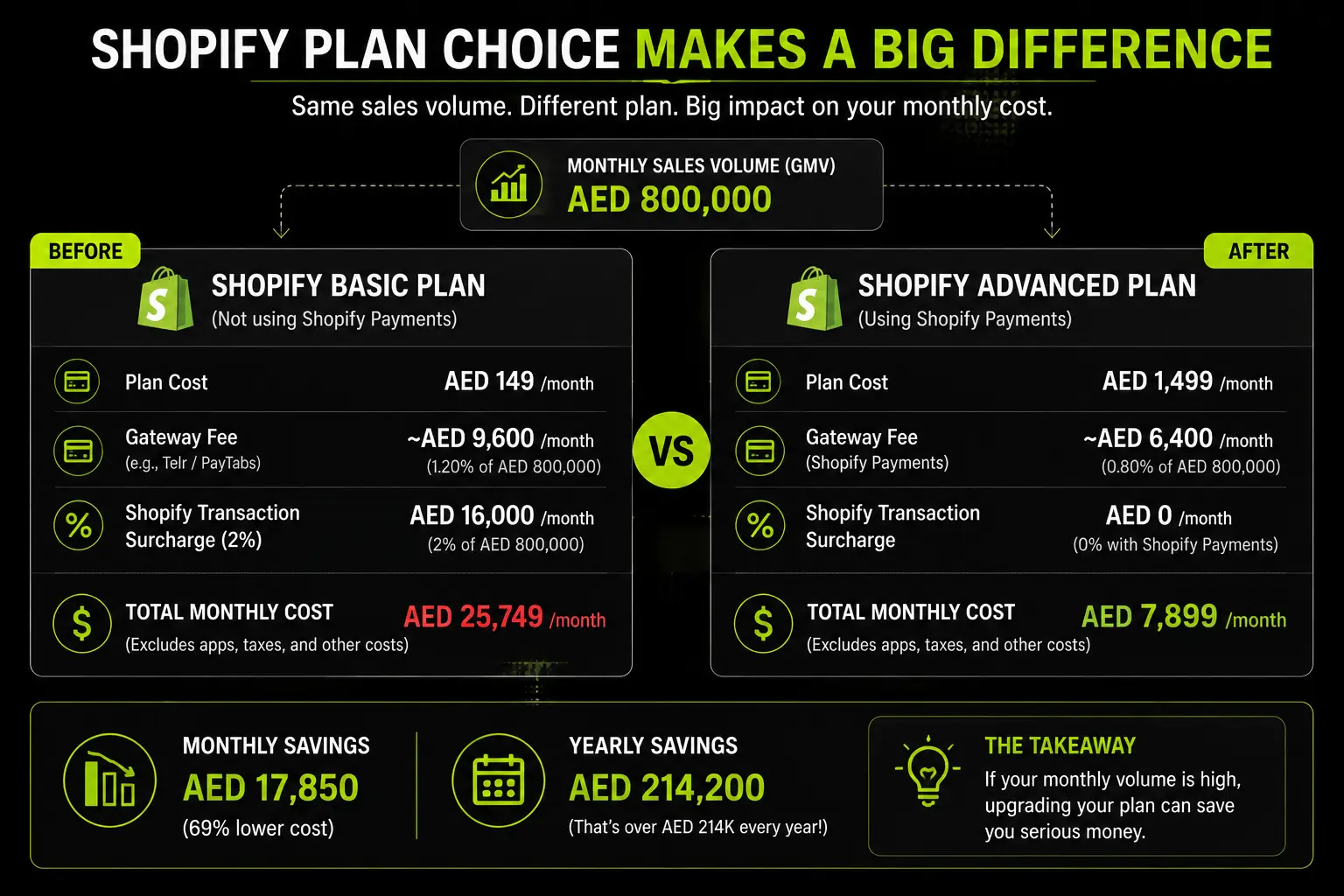
Picture a UAE merchant processing AED 800,000 a month in gateway volume on the Basic plan. At a 2% surcharge, that is AED 16,000 a month just in Shopify's transaction fee, on top of the gateway's own charge.
On the Advanced plan, that same volume at roughly 0.5% comes to about AED 4,000 a month, a saving of around AED 12,000 every month. The price difference between Basic and Advanced is a few hundred dollars a month.
At that volume, the surcharge savings recoup the higher plan cost within the first month, and every month after that is pure savings.
This is the calculation almost no merchant runs before choosing a plan tier, and it is worth running the moment your monthly gateway volume climbs into six figures in AED.
App Costs: The Subscription Stack Nobody Budgets For
Apps are where a Shopify budget quietly grows without anyone noticing until the annual spend gets reviewed. Individually, each one looks small. Stacked together, they rarely stay small for long.
Why A "Free" Shopify Theme Still Needs Apps To Function For A GCC Store
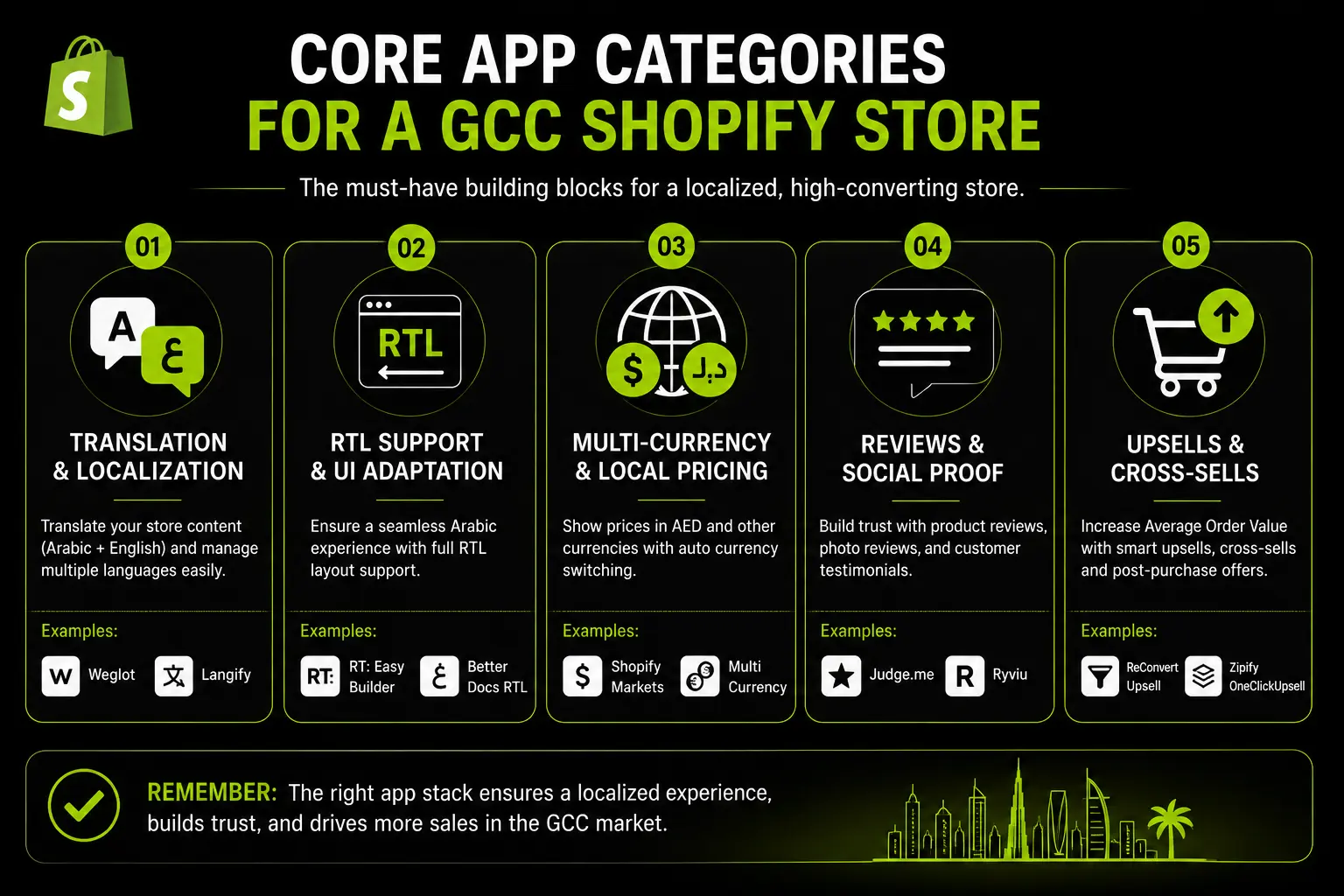
A free theme covers a working store, but not a working GCC store. Full RTL layout, Arabic typography that actually reads well, multi-currency price display and localized review widgets almost always require paid apps layered on top, since most free themes are built with a US or UK audience as the default assumption.
Budgeting $200 to $800 a year in apps just to bring a free theme up to a genuinely usable standard for an Arabic-first or multi-currency GCC audience is realistic, not pessimistic.
The Apps Most UAE Stores End Up Needing
How App Costs Compound As You Scale (Per-Order Pricing Tiers)
Several popular app categories, particularly reviews, upsells, and loyalty tools, price on a per-order or per-order-value basis once you cross a threshold, not a flat monthly fee.
A store stacking five apps at $30 to $50 a month each already runs a $150 to $250 monthly baseline before factoring in any usage-based tiers.
As order volume grows, several of those apps quietly move into higher pricing brackets, and the combined run rate can double within a year of steady growth without a single new app being added.
Theme And Development Costs: Template vs. Custom, And What Changes The Math
The theme you launch shapes both your upfront cost and how much ongoing app spend you need to reach a genuinely finished GCC storefront. Free and paid template themes solve very different problems than a custom build does.
Free And Low-Cost Themes: What They Don't Include For Arabic/RTL Stores
A free or low-cost theme handles the basics: product pages, a cart, a checkout flow. What it typically does not handle out of the box is genuine RTL mirroring across every template, Arabic typography chosen for readability rather than just technically supporting the character set, or layout adjustments for how Arabic text reshapes spacing and alignment.
Our Arabic ecommerce design guide breaks down exactly which layers a template theme leaves for you to solve separately, usually through a mix of apps and custom theme edits.
Custom Theme Development: Real Cost Ranges And What Drives Them Up
A template theme, lightly customized, typically runs around $1,500. A semi-custom build, where the core theme structure is heavily modified for brand and functional requirements, usually falls between $5,000 and $25,000.
A fully custom theme, built from scratch around a specific brand and feature set, runs from $25,000 up to $250,000 or more at the high end for complex, feature-rich enterprise builds.
Our full development cost breakdown covers what drives a project toward the higher end of each range in more detail.
Ongoing Maintenance And Update Costs After Launch
Launch is not the end of the cost curve. Theme updates, app compatibility checks after Shopify platform updates, seasonal design refreshes and bug fixes all need ongoing attention.
Most stores budget too little here, treating the launch invoice as the final cost rather than the start of a recurring maintenance line that runs for as long as the store operates.
The Costs Specific To Selling From The UAE And GCC
Selling from the UAE and across the GCC creates costs that generic Shopify pricing guides often miss. The biggest ones come from payment processing, cross-border compliance, currency conversion, and business setup.
1. Third-Party Gateway Fees
Because Shopify Payments remains limited to a small early-access group in the UAE, most stores still need a third-party payment gateway.
That means you may pay two separate transaction costs:
- Gateway processing fee: typically 2.5%–3.5%
- Shopify third-party transaction fee: typically 0.5%–2%
See our payment gateway comparison and guide to choosing a UAE payment gateway for provider-level comparisons.
2. Duty And Compliance Costs
Shopify's Managed Markets feature automates duties, taxes, and cross-border compliance in supported markets. UAE merchants do not have the same level of access when using third-party payment gateways.
If you sell into Saudi Arabia or other GCC markets, you may need:
- A dedicated tax or compliance app
- Manual duty and tax calculations
- Custom integrations
- Additional compliance support
Cost: varies based on the markets, order volume, and level of automation required. See our Shopify Markets guide for more detail.
3. Currency Conversion Markups
Multi-currency sales can introduce conversion costs even when they don't appear as a separate fee.
The markup may come from:
- Your payment gateway
- A currency conversion app
- Your payment provider's exchange rate
- Multiple conversion steps in the payment chain
Typical impact: 0.5%–2% on affected transactions.
The easiest way to spot this cost is to compare the exchange rate applied to your transactions against the mid-market rate.
4. Trade License And VAT Setup
Before you can process payments, your UAE business needs the appropriate trade license and payment-processing setup.
You may also need to account for:
- Trade license costs
- VAT registration
- VAT-compliant pricing and checkout displays
- Gateway onboarding requirements
- Accounting and tax setup
These aren't Shopify fees, but they are essential costs of launching and operating a UAE ecommerce business.
UAE/GCC Cost Breakdown
The key point: these costs compound. A UAE merchant can end up paying a gateway fee, Shopify surcharge, currency conversion cost, and compliance costs on the same international sales operation. That's why a simple “Shopify plan + apps” calculation can significantly underestimate the real cost of selling from the UAE and GCC.
One-Time vs. Recurring Costs: Building An Honest Monthly Run Rate
A list of possible fees is not a budget. This section turns everything above into two clear buckets, and then one worked example you can actually plan against.
What's One-Time
What's Recurring
A Simple Worked Example: 12-Month Total Cost For A Mid-Sized UAE Store
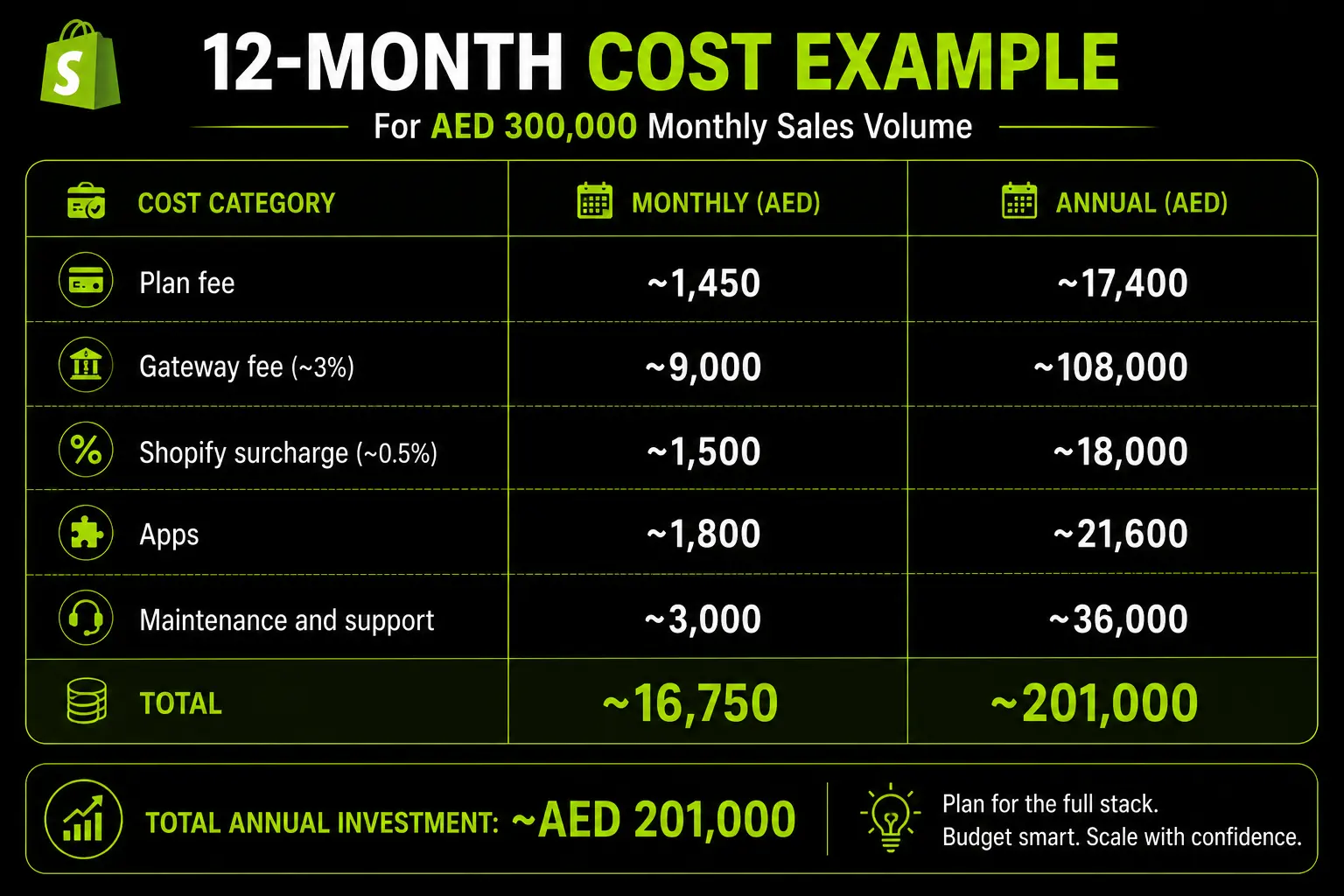
Treat every figure here as a planning range, not a quote. Your actual numbers depend on your specific gateway, app stack and maintenance arrangement.
But the structure above, plan plus gateway plus surcharge plus apps plus maintenance, is the honest way to build a monthly run rate rather than budgeting off the plan fee alone.
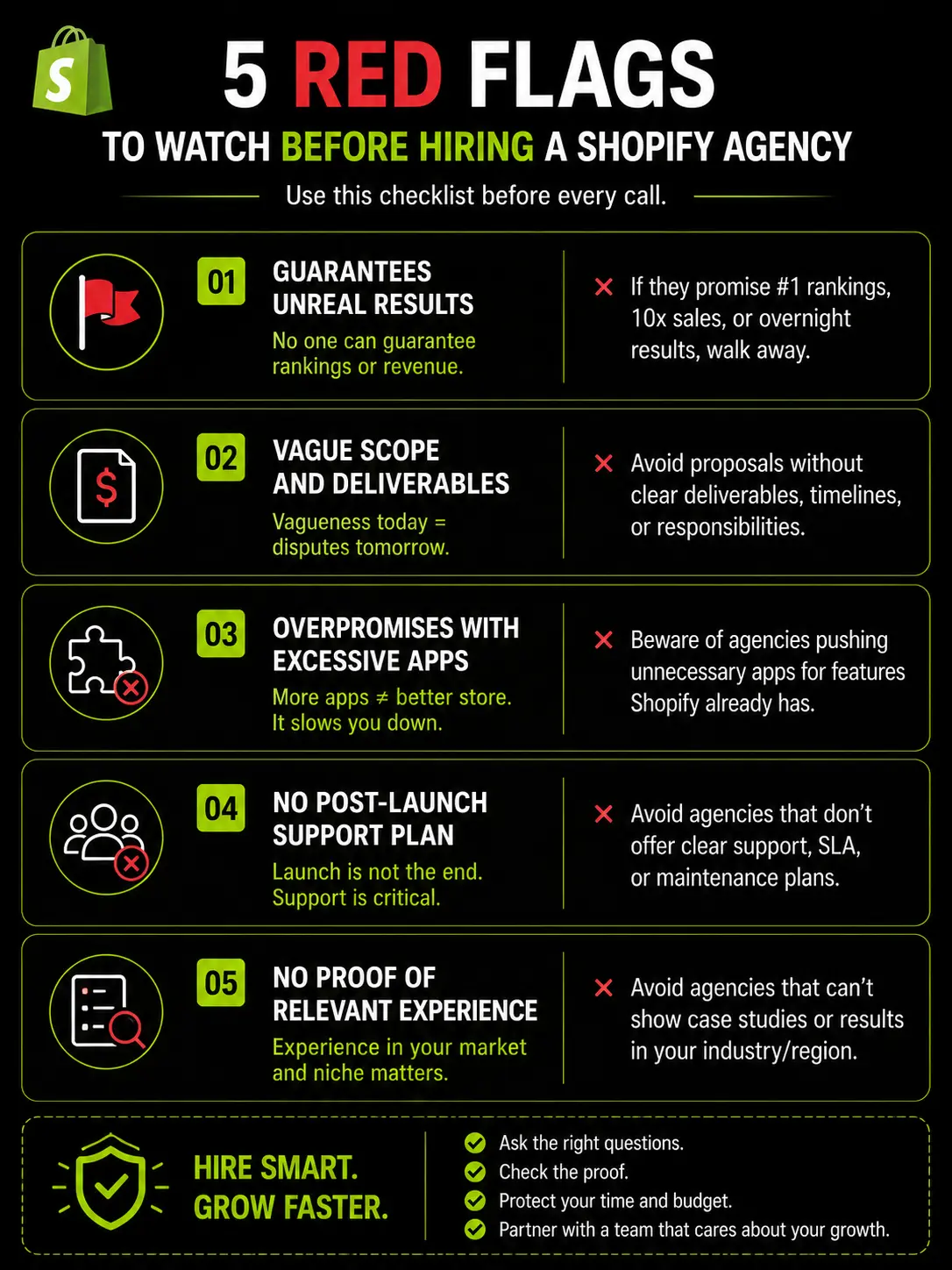
Red Flags That Signal Hidden Costs Are Coming Later
A quote or proposal that avoids these details is not necessarily dishonest, but it usually means the real number is still coming, just later than you would like.
If you want a fuller framework for what to ask before signing, our agency briefing guide and 27 questions to ask an ecommerce agency both build directly on this list.
How We Price and Scope Shopify Projects At Suplex
At Suplex, we itemize rather than bundle. Plan tier, payment gateway fees, apps, custom development, and ongoing maintenance are presented as separate line items before the project starts.
This approach is especially important for UAE and GCC projects, where regional requirements can add costs that generic Shopify estimates often miss.
Most UAE merchants need third-party payment gateways, while cross-border selling can require additional compliance handling. Arabic RTL implementation, GCC localisation, and performance optimisation can also require dedicated development work.
What We Account For Upfront
- Shopify plan and transaction fees
- Payment gateway and processing costs
- Apps and third-party services
- Custom theme and development work
- Arabic RTL and GCC localisation
- Performance optimisation
- Ongoing maintenance and support
Our ecommerce store setup service, custom Shopify themes service and performance optimisation service are scoped against this same cost structure.
The goal is simple: your first proposal should be close to your first real invoice, with fewer unexpected costs during the build.
Frequently Asked Questions
What's The Real Monthly Cost Of Running A Shopify Store In The UAE?
Beyond the plan fee, budget for gateway fees (2.5% to 3.5%), Shopify's third-party transaction surcharge (0.5% to 2%), apps ($100 to $500 or more a month depending on stack), and periodic development work. A mid-sized store often runs several times the advertised plan price once all of this is included.
Why Does Shopify Charge An Extra Fee On Top Of My Payment Gateway?
Shopify applies a surcharge, roughly 0.5% to 2% depending on plan, whenever a store uses a third-party gateway instead of Shopify Payments. Since Shopify Payments remains in limited early access in the UAE, this surcharge still applies to nearly every UAE-based store by default.
Can I Avoid The Third-Party Transaction Fee In The UAE?
Not entirely, unless your store has been accepted into Shopify's UAE early access program. For everyone else, the surcharge percentage drops significantly on higher-tier plans, so at meaningful transaction volume, upgrading plans can offset or exceed the extra plan cost through surcharge savings.
Do Free Shopify Themes Really Cost Nothing?
The theme license is free, but most UAE stores need paid apps for RTL support, currency display, translation, and other localization needs the free theme doesn't include out of the box. Factor these into the real cost, not just the theme price.
What's The Biggest Cost Most Shopify Budgets Miss?
Ongoing app subscriptions and post-launch maintenance are the most commonly underestimated. A store can look inexpensive at launch and then accumulate significant monthly app costs within the first year as features get added incrementally.
Is Shopify Plus Worth The Higher Cost For A UAE Store?
It depends on volume. Plus lowers the transaction surcharge substantially and adds enterprise features, which pays off once monthly gateway volume is high enough that the surcharge savings outweigh the plan cost difference. Worth modeling against your actual numbers before deciding.
How Do I Get An Accurate Cost Estimate Before Starting A Project?
Ask any agency to itemize plan tier, gateway fee stack, apps, development scope, and ongoing maintenance separately rather than giving one bundled number. A brief that specifies your requirements clearly, as outlined in our agency brief guide, makes accurate quoting much easier.
Hi, I’m Rishabh Jain
I believe great design has the power to shape perception, build trust, and move businesses forward. That belief is what led me to found Suplex Design Studio, a global branding and packaging studio working with FMCG and D2C brands across markets.I started suplex at 25 with a clear intent, to create design that is strategic, thoughtful, and commercially meaningful. By 28, the studio had scaled globally, guided by a strong foundation in Integrated Design that I developed during my academic journey in London, where I was honoured with the Dean’s Award.
Over the years, I’ve had the opportunity to work with 100+ brands, from Fortune 500 organizations to family-run businesses, helping them build packaging and brand systems that create recall, relevance, and long-term value.
Suplex’s work has been recognized internationally, including the Manifest Award (2024), the Clutch Global Award (2025), and features on platforms such as Packaging of the World, The Dieline, and the World Brand Design Society.
None of this would be possible without the people behind the work. I’m deeply grateful to the suplex team, whose commitment, creativity, and attention to detail turn ideas into meaningful brand experiences every day.
At the heart of my work is a simple philosophy, design should be intentional, honest, and built to last, and that continues to guide everything we create at suplex.





































Let’s Make It Happen
E-Commerce Success Stories
%201.avif)






.avif)

.avif)
Build Your D2C Business The Right Way
Build It With Suplex.


