UAE Ecommerce Payment Gateway Comparison (2026 Guide)
.avif)
UAE Ecommerce Payment Gateway Comparison (2026 Guide)
UAE ecommerce payment gateway comparison is only useful when the fees are current and the providers are clearly compared.
There is no single “best” gateway for every UAE business. The right choice depends on your business stage, transaction volume, payment needs, and growth plans.
This blog covers nine major options: Telr, PayTabs, Network International, Amazon Payment Services, Checkout.com, Stripe, Ziina, Tap Payments, Mamo and Noon Payments.
If you have not yet worked through how to choose a gateway, our guide to choosing a payment gateway for UAE ecommerce covers the decision framework. This comparison picks up where that guide ends: the actual providers, compared side by side.
The UAE Payment Gateway Landscape At A Glance
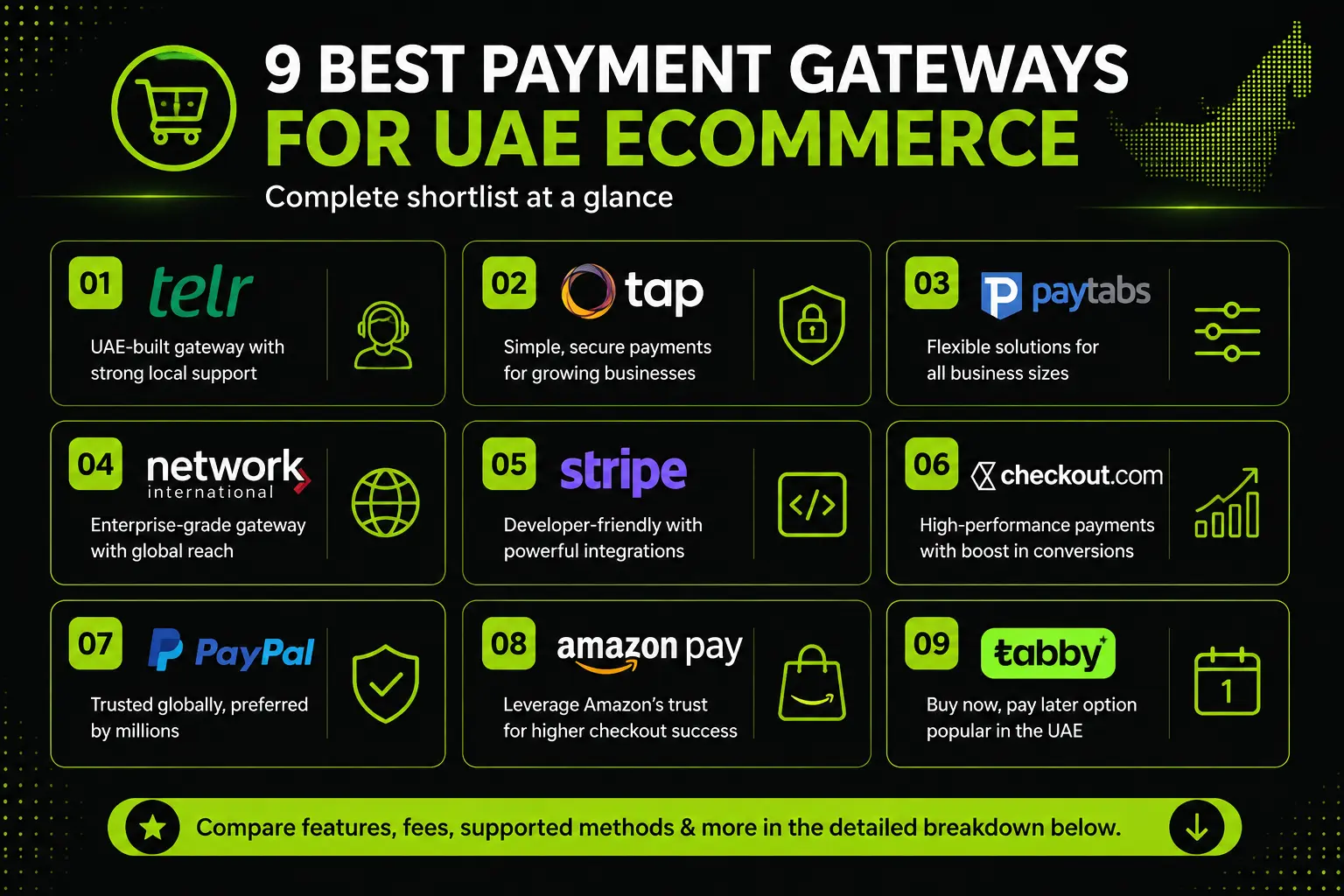
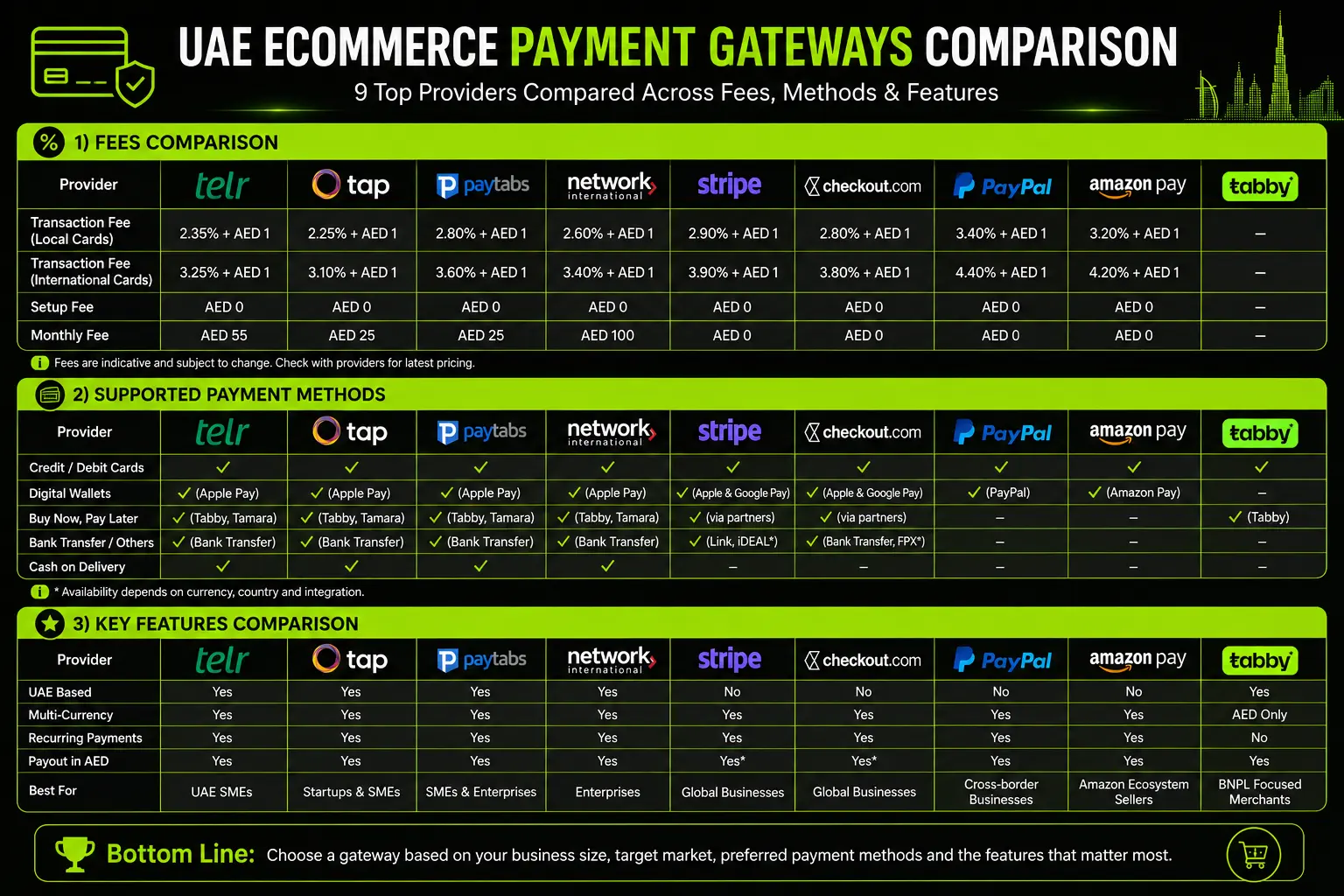
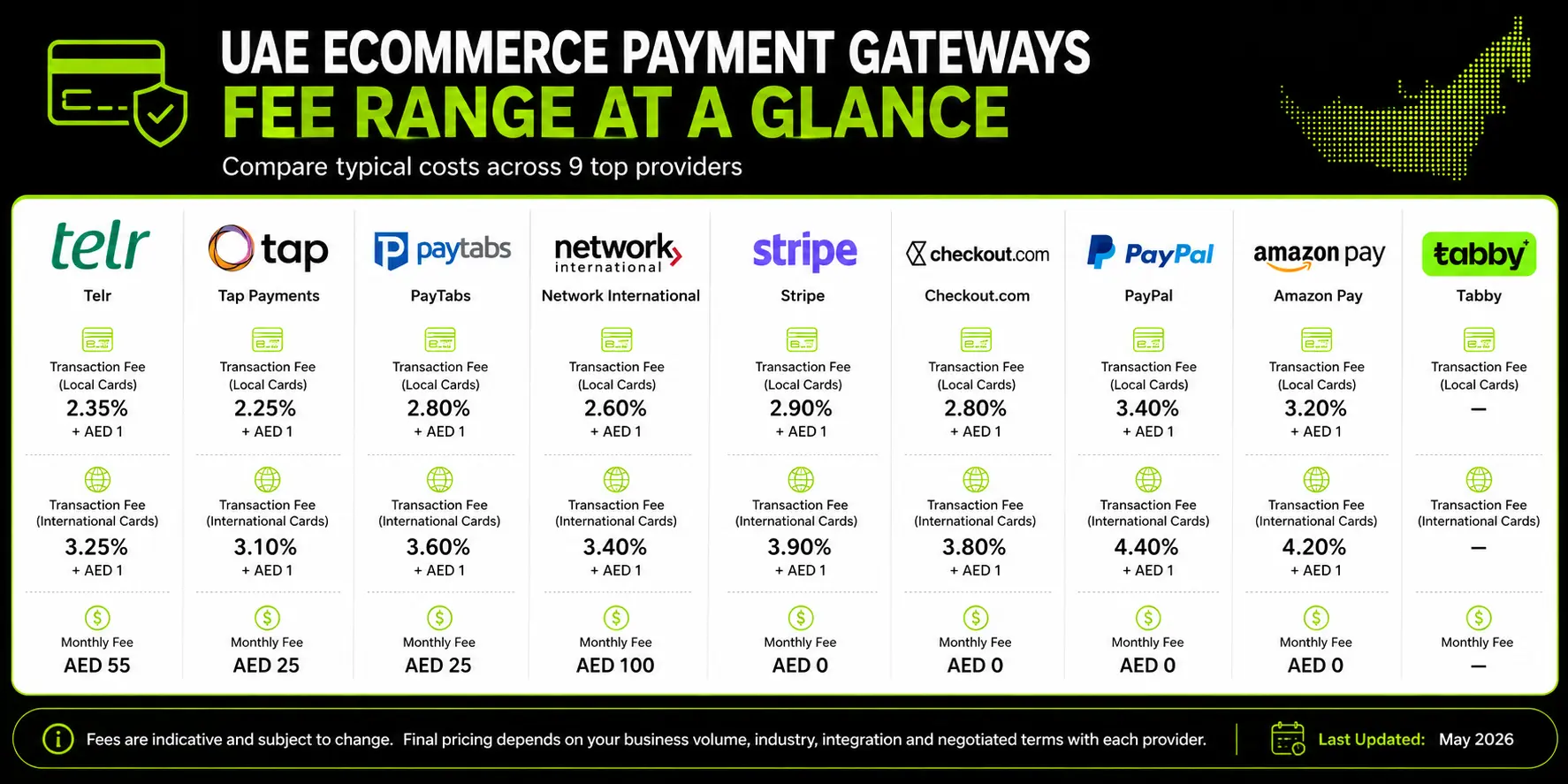
Nine providers cover most of what UAE merchants actually use today. The tables below break down fees, card support, and technical fit so you can shortlist fast.
Each provider made this list because it processes AED transactions for UAE-registered ecommerce businesses today, not because it appears on a generic global "best gateways" ranking. That distinction matters more than it sounds.
A provider that works well for a UK or US merchant can still fall short on Mada support, AED settlement, or Shopify compatibility once you actually try to use it here.
Fees and Best Fit:
Mada And BNPL Support
Settlement Speed And Shopify App
Not All "Payment Gateways" Do The Same Job
Most comparison lists treat every provider as the same type of tool. They are not. Some process transactions directly, some route across other gateways, and some are wallets first and gateways second.
Straight Gateways vs. Payment Orchestration Platforms
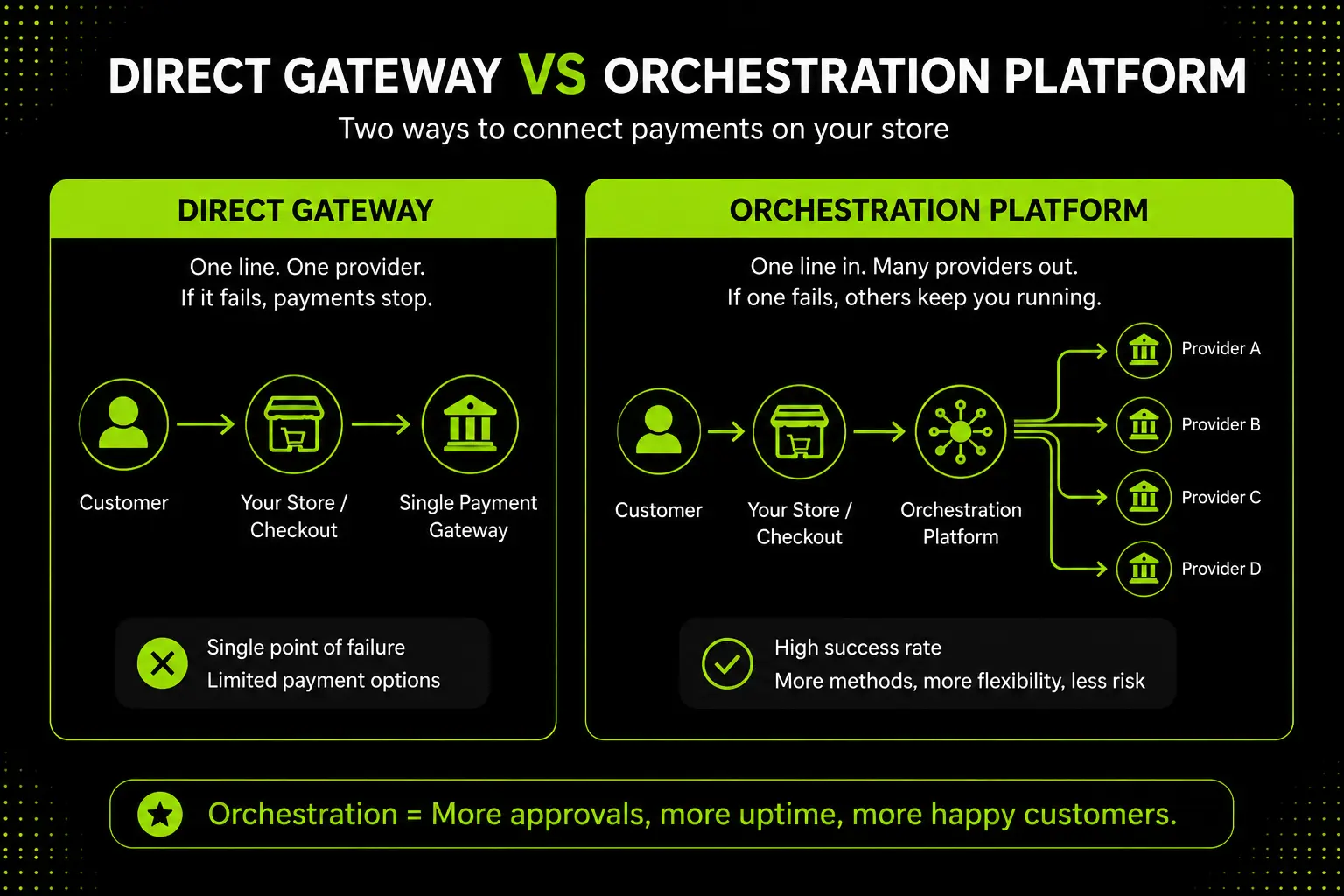
A straight gateway, like PayTabs or Telr, processes your transaction directly with one acquiring relationship behind it. Ottu works differently: it is an orchestration layer that sits on top of multiple underlying gateways and routes each transaction to whichever one is most likely to succeed.
Picture two merchants running the same product on the same platform. One integrates PayTabs directly and lives with whatever approval rate that single gateway gives them.
The other runs Ottu, which tries a second or third gateway automatically when the first one declines a card. The second merchant recovers sales the first one simply loses. Most small UAE merchants do not need this. High-volume merchants losing revenue to declines usually do.
Wallet-First Fintech vs. Full Card-Processing Gateways
Ziina and, to a lesser extent, Mamo started as consumer payment apps and added merchant tools after. That history shows up in what they are strong at: fast wallet-to-wallet transfers and simple checkout links, rather than the full card-processing stack a larger store needs.
If you are selling on Instagram or running a small direct-to-consumer catalog, that lighter setup is often enough.
If you are running a full Shopify store with recurring subscriptions, chargebacks and multi-currency pricing, a full gateway gives you more control over the details that actually cause failed payments.
What A 1% Fee Difference Actually Costs You
A single percentage point on a fee table looks small until you run it against real monthly revenue. This section puts a number on it, because the gap between "cheap" and "cheapest" only matters once you see it in AED.
Take a UAE store processing AED 500,000 in monthly card revenue, a realistic figure for an established D2C brand a year or two into trading. At a 2.5% effective rate, that store pays AED 12,500 in processing fees each month.
At 2.9%, the same revenue costs AED 14,500. That 0.4% gap works out to AED 24,000 a year, money that either sits in your account or leaves it, with no change to the customer experience either way.
Now put decline rates into the same math. If Gateway A approves 92% of attempted transactions on UAE-issued cards and Gateway B approves 88%, that 4-point gap on the same AED 500,000 in attempted volume represents roughly AED 22,000 in sales that simply never complete, every month, regardless of which gateway charges the lower fee.
This is why the fee percentage in the table above is only half the comparison. The other half, approval rate on local cards, rarely gets published anywhere and usually only shows up once you are live and pulling your own transaction reports.
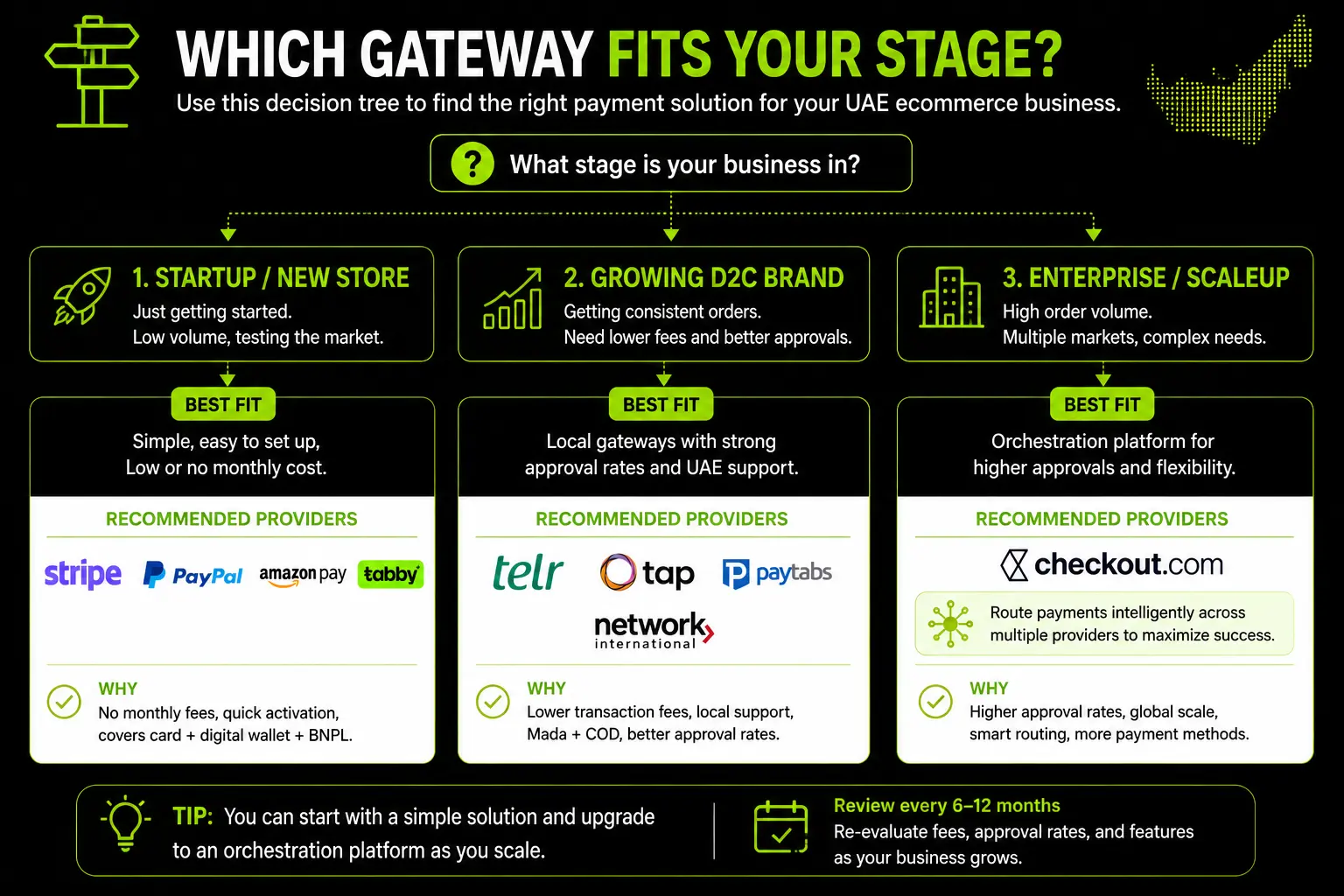
How To Read This Comparison For Your Business Stage
The tables above tell you what each gateway does. This section tells you which rows to actually pay attention to, based on where your business sits today.
Startup / Fast Launch Priority
Look at PayTabs or Stripe first. Neither charges a monthly fee, so your cost stays proportional to sales while you validate the business.
Skip enterprise-negotiated options like Network International at this stage. Their advantage only shows up at volume you probably do not have yet.
Growing D2C Brand Balancing Cost And Reliability
Telr's tiered monthly plans usually beat pay-as-you-go pricing once you clear a few hundred transactions a month.
Check your actual transaction count against Telr's published tiers before switching, since the fixed fee only pays for itself past a certain volume.
Enterprise / High-Volume Merchant Prioritizing Approval Rate
At this stage, the headline fee percentage matters less than your decline rate on UAE-issued cards. Network International, Amazon Payment Services and Noon Payments all carry enterprise-grade infrastructure built for this.
If declines are already costing you sales, Ottu's orchestration approach is worth evaluating alongside a single-provider upgrade.
For the full reasoning behind this stage-by-stage breakdown, including the Six-Point Scorecard we use with clients, see our guide on choosing a UAE payment gateway.
Provider Profiles: What Each Gateway Is Actually Good At
Fee tables flatten every provider into a percentage. These short profiles cover what each one is actually built for, in plain terms.
Telr: Local Bank Relationships And Multi-Currency Depth
Telr has been operating in the UAE longer than most competitors and it shows in its bank relationships. It supports a wide range of currencies out of one dashboard, which helps merchants selling across the GCC without setting up separate accounts per market.
Onboarding typically runs faster than enterprise-tier providers, since Telr is built around SMB merchants rather than large-scale negotiated deals and its monthly-fee plans reward stores that already have consistent transaction volume rather than sporadic sales.
PayTabs: Fastest Path To A First UAE Shopify Launch
PayTabs has no setup fee and a Shopify app that installs in minutes, which makes it the default pick for merchants who want to start selling this week, not next month.
The tradeoff is a slightly higher per-transaction fee than volume-tiered competitors. KYC and merchant verification move quickly compared to bank-backed alternatives, which is exactly why so many first-time UAE Shopify launches default to it before ever comparing rates elsewhere.
Network International / Amazon Payment Services: Bank-Backed Enterprise Trust
Network International, and its related Amazon Payment Services product, come with direct bank backing that larger merchants and enterprise buyers recognize.
Pricing is negotiated rather than published, so you will need a sales conversation to get real numbers. This backing also means longer onboarding timelines and more documentation up front, a fair tradeoff for merchants who need the institutional trust that comes with a name banks and B2B buyers already know.
Checkout.com: Native AED Settlement, With A Freezone Entity Catch
Checkout.com offers native AED settlement, which sounds like a clean win until you check your entity structure.
A UAE freezone company with a USD-denominated entity can hit settlement friction here, because full native AED settlement typically requires an AED-licensed business. Confirm this with Checkout.com directly before you build your checkout around it.
Beyond the entity question, Checkout.com's rates only get genuinely competitive at higher volume, so it tends to make the most sense once a store has already outgrown its first gateway rather than as a starting point.
Stripe: Strongest Global Infrastructure, Weakest Local Card Acceptance
Stripe's documentation, developer tools, and global reach are hard to beat. Its weak point in this market is Mada, the UAE and Saudi domestic card scheme, which Stripe does not support directly.
If a meaningful share of your customers pay with Mada, that gap costs you sales at checkout. Stripe still makes sense for brands whose primary customer base sits outside the GCC, where the strength of its global infrastructure outweighs the local card gap.
Ziina, Mamo, And The Lightweight Fintech Layer
Ziina and Mamo both grew out of consumer payment apps, and both work well for social sellers and small stores that need a fast, simple checkout link rather than a full processing stack.
Mamo's built-in subscription billing is a genuine advantage for SMEs running recurring products. Neither is built for high transaction volume or complex catalog structures, so both tend to get outgrown once a store moves past a few hundred orders a month.
Noon Payments: Regional Marketplace-Grade Infrastructure
Noon Payments runs on infrastructure backed by Adyen, one of the largest payment processors globally, which gives it credibility for merchants scaling past the SMB stage.
It is a common misconception that Noon Payments only works for sellers on the Noon marketplace. It does not. It is available to any UAE merchant, including standalone Shopify and WooCommerce stores.
For brands already selling on the Noon marketplace, running Noon Payments on their own store as well can also simplify reconciliation, since both channels report through infrastructure the finance team already understands.
Gotchas This Comparison Wouldn't Show You From Fee Tables Alone
Fee percentages are the easy part to compare. These three issues cost merchants more money in practice, and none of them show up in a standard fee table.
The Freezone Entity Settlement Issue
This is the single most common surprise merchants report with Checkout.com and similar providers. If your business is registered in a UAE freezone with a USD-denominated entity, ask about settlement currency and entity requirements before you sign, not after your first payout is delayed.
Decline Rates On UAE-Issued Cards Still The Hidden Variable
Two gateways can quote nearly identical fees and still deliver very different results, because the fee percentage says nothing about how often a UAE-issued card actually gets approved.
A gateway with a slightly higher fee but a materially better approval rate on local cards often earns you more net revenue than the "cheaper" option.
Mada Support Isn't Universal
Check this before you assume it, especially if you plan to sell into Saudi Arabia. Stripe does not support Mada directly.
PayTabs, Tap Payments, Telr, and Network International do. Routing Saudi-bound traffic through a non-Mada gateway means losing a real share of Saudi customers at the payment step, quietly and without an obvious error message.
Currency Conversion Fees On Cross-Border Sales
If you sell in AED but a share of your customers pay with cards issued in USD, GBP, or another foreign currency, most gateways apply a conversion markup on top of the standard processing fee.
Ziina's extra 1.5% on non-AED transactions is one of the more clearly disclosed examples, but similar markups exist across several providers in less visible form.
If cross-border sales make up a meaningful share of your revenue, ask each provider for their exact foreign-currency markup in writing, since this cost rarely shows up in the headline fee percentage.
How We Evaluate Payment Infrastructure at Suplex
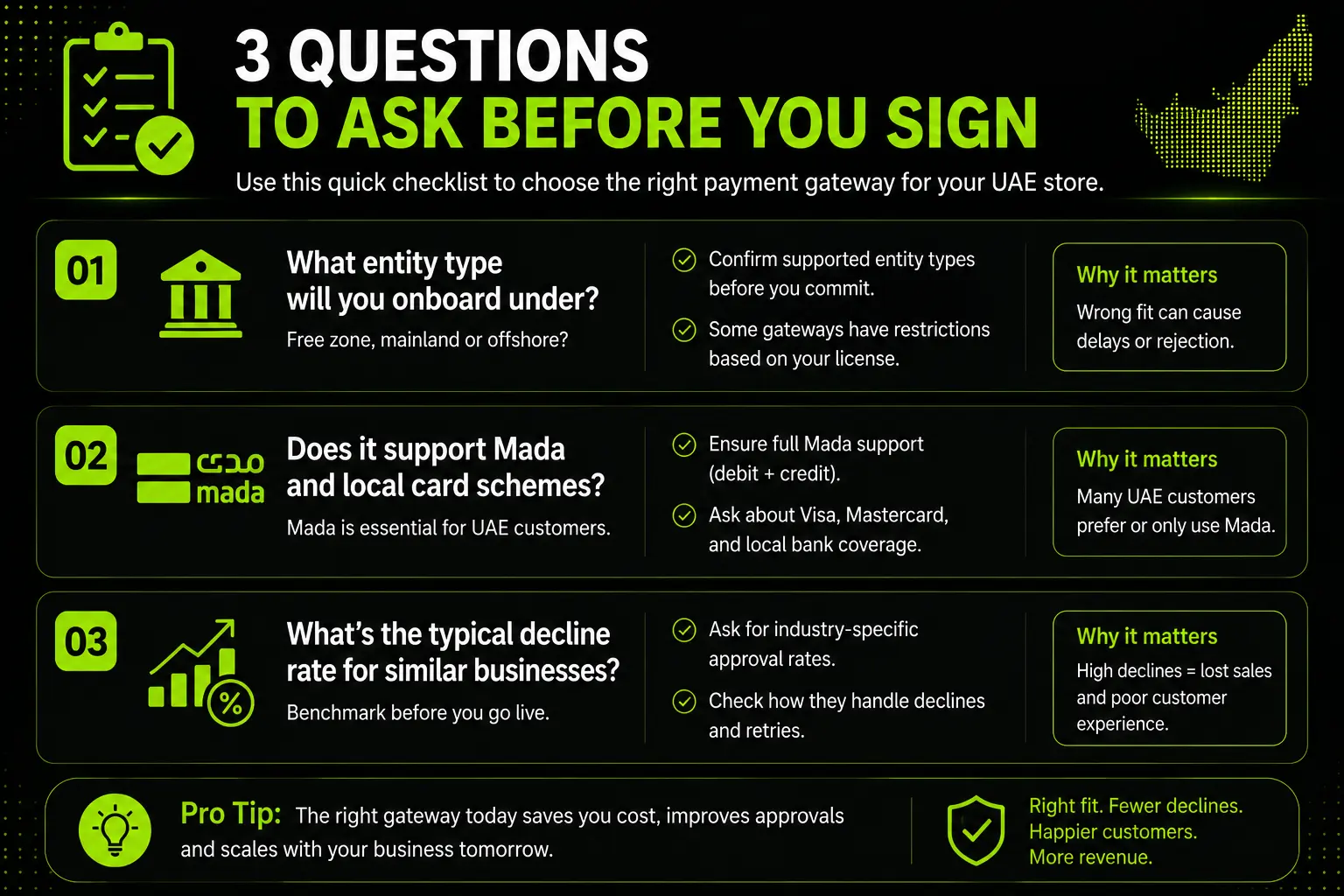
At Suplex, we do not start with “Which gateway is cheapest?” We start with the factors that actually affect your checkout setup:
- Business Entity: Free zone, mainland, or other UAE/GCC structure
- Settlement Currency: AED, USD, or multiple currencies
- Card Mix: Local vs. international cards
- Ecommerce Platform: Shopify, Shopify Plus, or custom build
- Payment Requirements: Cards, wallets, BNPL, COD, and local methods
- Transaction Volume: Current volume and expected growth
Two merchants selling the same product can need completely different payment setups.
For example, a free zone merchant with a USD entity may need a different gateway configuration than an AED-licensed mainland company.
The cheapest gateway is not always the best fit. Entity compatibility, settlement options, payment methods, and integration requirements can have a bigger impact on your total payment cost and checkout experience.
Ecommerce store setup: We handle gateway selection as part of the initial store setup, so your payment infrastructure is configured correctly from the start.
Frequently Asked Questions
Which Payment Gateway Is Cheapest For A UAE Ecommerce Store?
Cost depends on your volume and plan, not a single headline number. PayTabs and Stripe often carry no monthly fee, which suits low-volume stores. Telr's monthly-fee plans can work out cheaper once you clear a higher transaction count, despite the fixed cost. Compare your effective rate at your actual volume, not the advertised percentage.
What's The Difference Between A Payment Gateway And A Payment Orchestration Platform?
A gateway processes transactions directly through one acquiring relationship. An orchestration platform, like Ottu, routes transactions across multiple underlying gateways to improve approval rates and add redundancy. Most small UAE merchants need a single gateway, not orchestration.
Does Checkout.com Settle In AED For UAE Merchants?
Yes, but full native AED settlement typically requires an AED-licensed UAE business entity. Freezone merchants with USD-denominated entities may run into settlement friction. Confirm your entity structure with Checkout.com directly before committing.
Which UAE Payment Gateways Support Mada For Saudi Customers?
PayTabs, Tap Payments, Telr, and Network International all support Mada. Stripe does not support it directly. If you plan to sell into Saudi Arabia, route that traffic through a Mada-capable gateway.
Is Noon Payments Only For Merchants Selling On The Noon Marketplace?
No. Noon Payments works as an independent gateway available to any UAE merchant, including standalone Shopify and WooCommerce stores, separate from selling on the Noon marketplace itself.
Can I Use More Than One Payment Gateway On The Same Store?
Yes, and many established UAE merchants do this, running a primary gateway with a backup for redundancy or to compare decline rates. For early-stage stores, one reliable gateway is usually enough.
How Often Should I Re-Evaluate My Payment Gateway Choice?
Annually is reasonable for most merchants, or sooner if you notice rising decline rates, expand into new GCC markets, or change your business entity structure. Any of those can shift which provider is the better fit.
What Documents Do UAE Merchants Need To Apply For A Payment Gateway?
Most providers ask for your trade license, Emirates ID or passport of the authorized signatory, a bank account letter or IBAN confirmation, and your website URL with visible terms, refund policy, and contact details. Freezone entities sometimes need to provide additional proof of the freezone authority's approval for ecommerce activity, so confirm this with your chosen provider before you start the application to avoid delays.
Do UAE Payment Gateways Charge For Chargebacks And Refunds?
Most gateways charge a flat fee per chargeback, typically between AED 50 and AED 150, regardless of whether the dispute is resolved in the merchant's favor. Refunds initiated by the merchant are usually free, though the original processing fee on that transaction is rarely returned. Ask each provider for their exact chargeback fee and dispute-resolution timeline before signing, since this cost adds up fast for stores with high return rates.
Hi, I’m Rishabh Jain
I believe great design has the power to shape perception, build trust, and move businesses forward. That belief is what led me to found Suplex Design Studio, a global branding and packaging studio working with FMCG and D2C brands across markets.I started suplex at 25 with a clear intent, to create design that is strategic, thoughtful, and commercially meaningful. By 28, the studio had scaled globally, guided by a strong foundation in Integrated Design that I developed during my academic journey in London, where I was honoured with the Dean’s Award.
Over the years, I’ve had the opportunity to work with 100+ brands, from Fortune 500 organizations to family-run businesses, helping them build packaging and brand systems that create recall, relevance, and long-term value.
Suplex’s work has been recognized internationally, including the Manifest Award (2024), the Clutch Global Award (2025), and features on platforms such as Packaging of the World, The Dieline, and the World Brand Design Society.
None of this would be possible without the people behind the work. I’m deeply grateful to the suplex team, whose commitment, creativity, and attention to detail turn ideas into meaningful brand experiences every day.
At the heart of my work is a simple philosophy, design should be intentional, honest, and built to last, and that continues to guide everything we create at suplex.





































Let’s Make It Happen
E-Commerce Success Stories
%201.avif)






.avif)
.avif)
Build Your D2C Business The Right Way
Build It With Suplex.


