How To Brief A Shopify Agency (Template Included)
.avif)
How To Brief A Shopify Agency (Template Included)
How to brief a Shopify agency comes down to seven things, in order: business context, current state, scope and deliverables, technical and market requirements, timeline, budget and success metrics.
Most briefs do not fail from a missing section. They fail from vague scope and unstated technical constraints, like payment gateway or localization needs, that surface as expensive surprises mid-project.
If you have already shortlisted an agency and want to check you picked the right one, our guides on questions to ask an ecommerce agency and how to choose an ecommerce development partner cover that stage.
This piece picks up right after you have your agency and now you need to write the brief that gets you an accurate proposal instead of a guess.
Why Most Agency Briefs Fail Before The Project Even Starts
Most advice on this topic jumps straight to a template. That misses the real problem: a completed brief can still fail if its requirements are too vague to act on.
A rushed brief often leads to:
- Inflated Timelines: because the agency has to account for uncertainty.
- Higher Cost Estimates : because ambiguous requirements are scoped conservatively.
- Rework : when important constraints surface after the project starts.
Vague Scope vs. Specific Scope: The Line Between Direction And Micromanagement
A brief should be specific about outcomes and constraints without dictating every design decision.
For example:
Too vague: “We want a modern, clean design.”
Specific: “We want a clean, high-contrast product grid similar to how [reference site] handles category pages, but with larger imagery.”
The difference is not length. It is specificity.
- Too Vague: The agency has to guess, so the proposal becomes a guess dressed up as a quote.
- Too Specific: You limit the agency's ability to apply its expertise.
- The Right Balance: Be clear about what must be true, while leaving the agency room to determine how to achieve it.
What Happens When A Brief Skips Technical Constraints
This is where UAE and GCC brands can run into expensive problems.
For example, a brief might simply say:
“We want multi-currency support.”
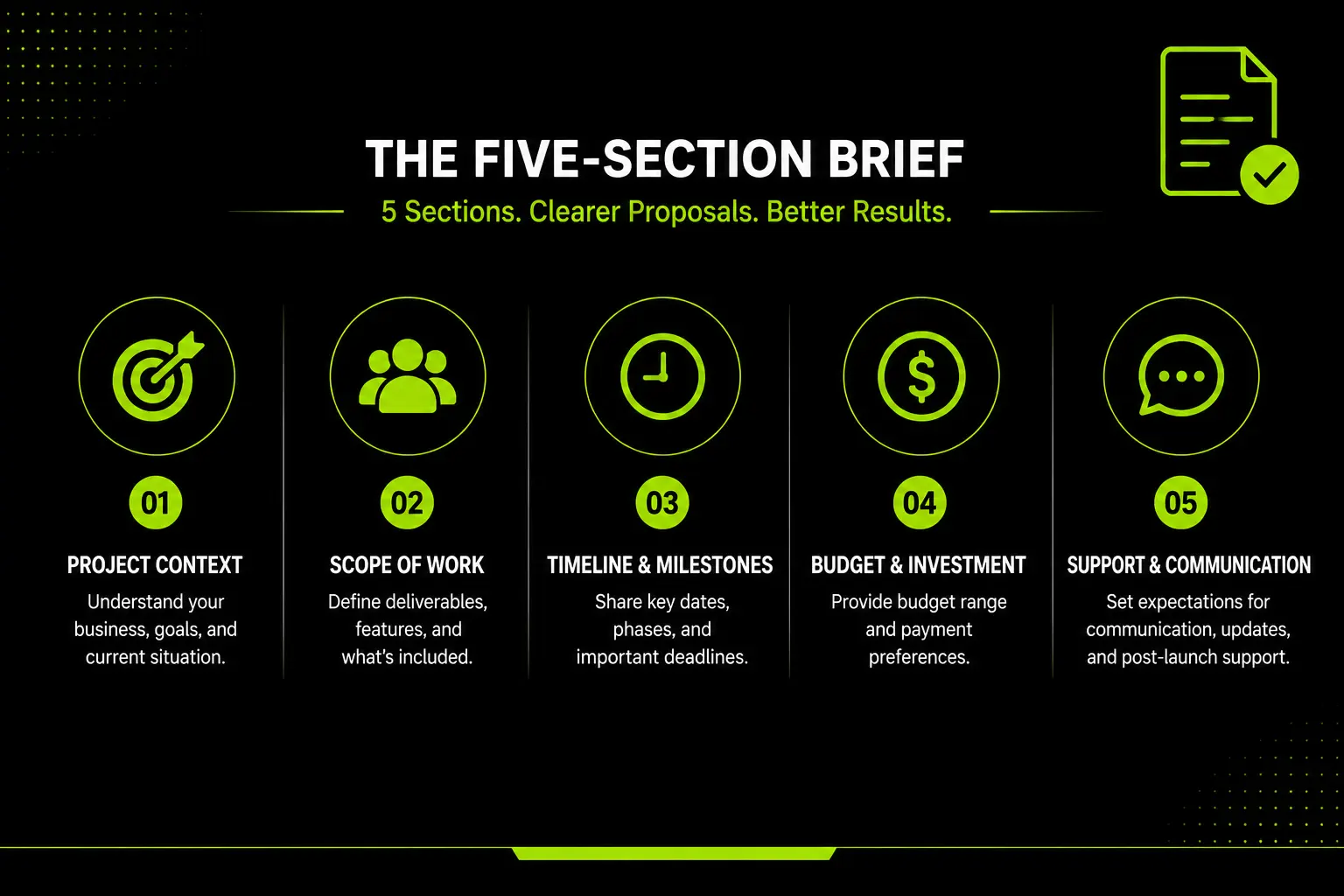
But if the brand is UAE-based and does not use Shopify Payments, that requirement has a major technical constraint.
If the agency assumes native Shopify Markets multi-currency, the issue may only surface weeks into development.
The team then has to rethink the currency setup, potentially moving to a third-party app or manual conversion workaround.
The result:
- Re-scoping
- Additional development work
- Weeks of timeline disruption
- Higher project costs
Our multi-currency setup guide explains what works and what does not under this constraint.
This is not just a technical detail. It is a scoping issue that can directly affect your budget and launch date.
The fix is simple: state important technical constraints in the brief upfront. One clear sentence can prevent weeks of rework.
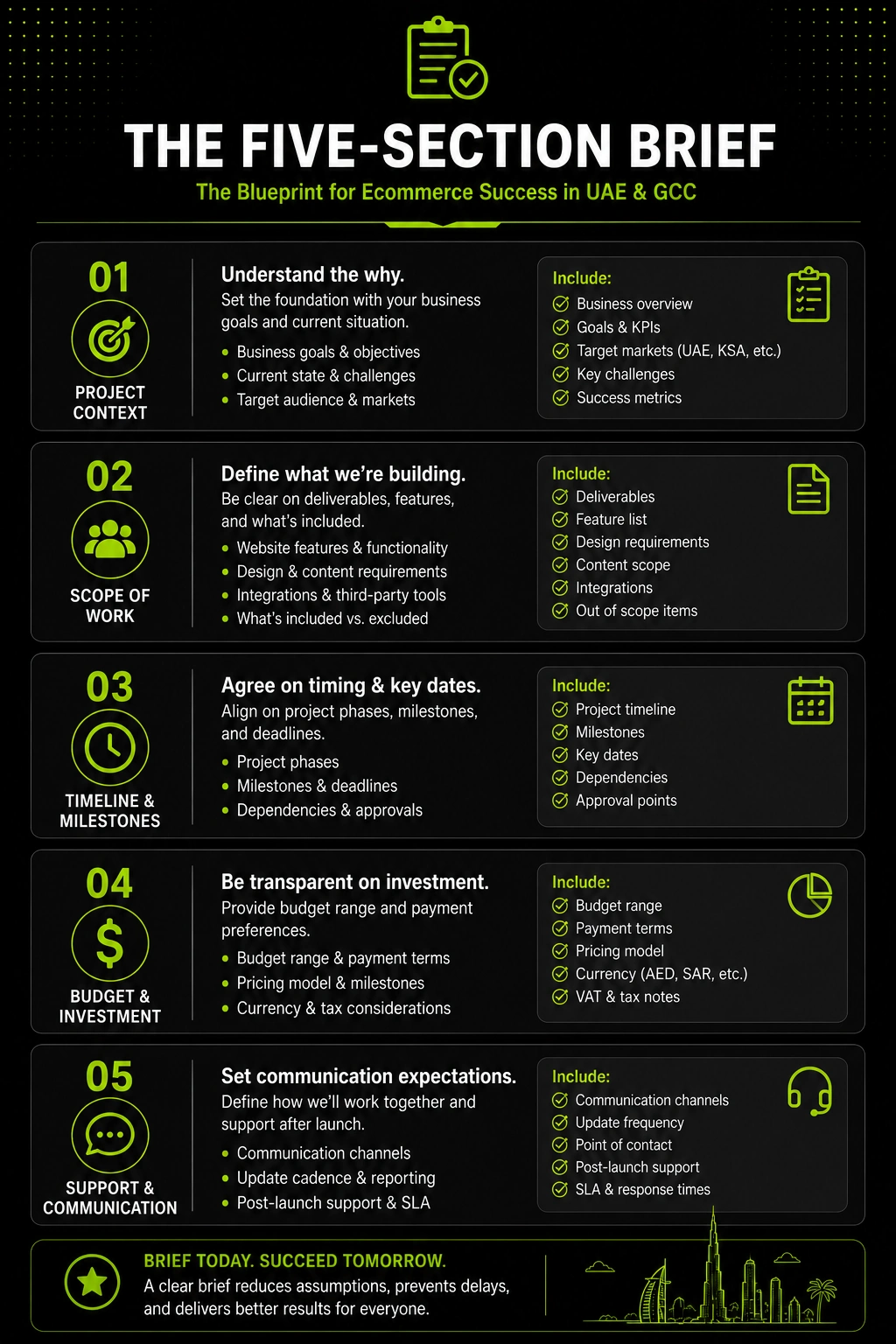
The Five Sections Every Shopify Agency Brief Needs
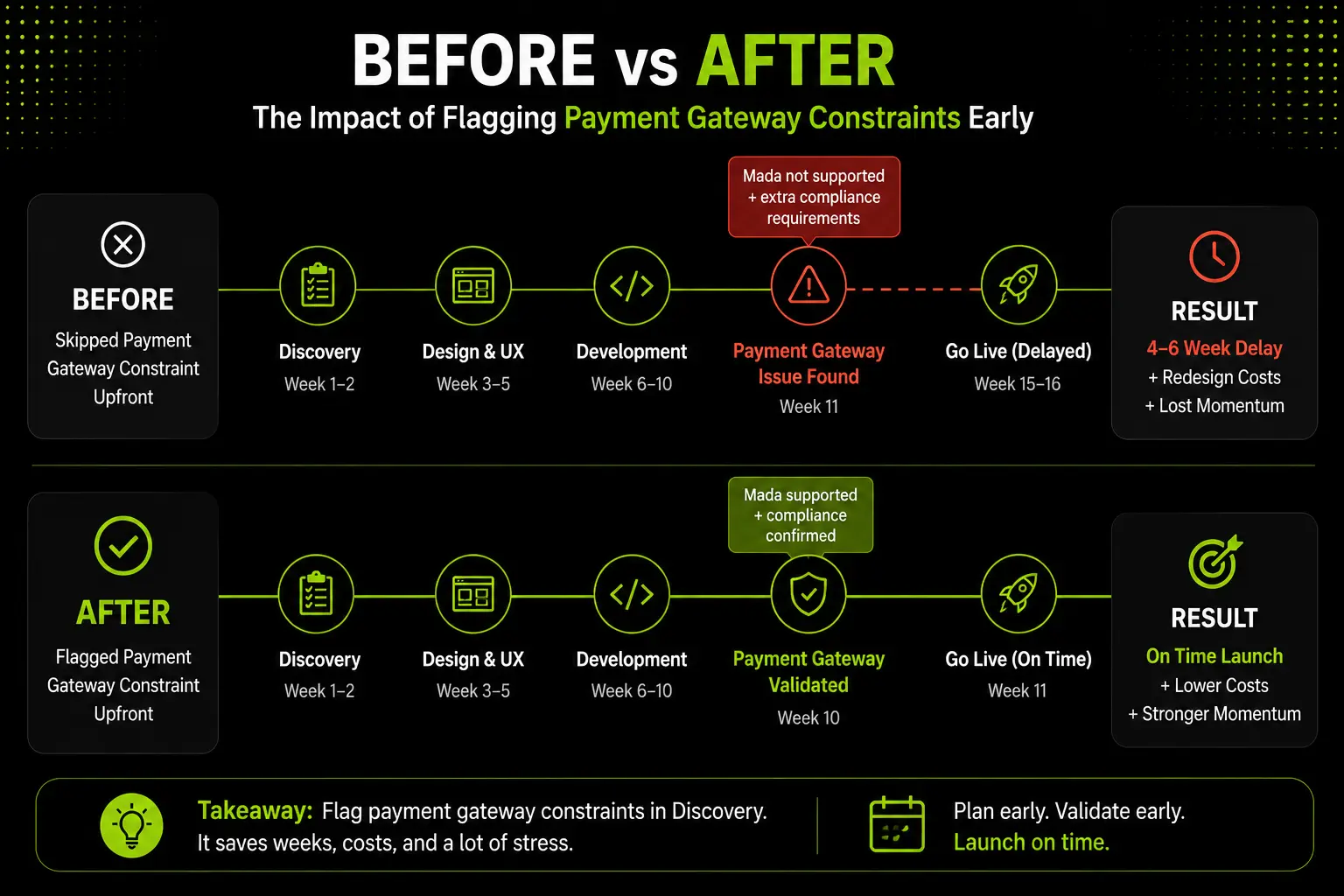
Think of this as the Five-Section Brief. It is a structure you can reuse for every future project, not just this one, and it works whether you are briefing a full-service agency or a single freelance developer.
1. Business Context: What You Sell, Who You Sell To, And Why It Matters To The Build
This section answers the "why" before any "what." What does the business sell, who buys it, and what makes the brand distinct in its category.
An agency that understands you are a premium skincare brand selling to a GCC audience that values Arabic-first browsing will make different technical and design recommendations than one that thinks you are a generic global DTC store.
This context shapes almost every decision downstream, from how the product grid gets laid out to which payment methods get top billing at checkout, so it belongs first, not buried in an appendix.
A single paragraph naming your category, your core customer, and the one or two things that make you different from the next store in that category is usually enough.
2. Current State: What Exists Today And What's Actually Wrong With It
If you have an existing site, describe the platform it runs on, what is actually broken or underperforming, and, where you have it, a snapshot of relevant analytics: conversion rate, mobile traffic share, cart abandonment rate.
This section lets the agency diagnose instead of guess. A vague complaint like "the site feels outdated" is far less useful than "our mobile conversion rate is 0.8% against a 2.1% desktop rate, and we suspect checkout friction."
The second version tells the agency exactly where to look first, rather than starting from a broad audit that could have been scoped more narrowly from day one.
If you genuinely do not have analytics access or historical data, say so plainly rather than leaving the section blank, since that gap itself is useful information for how the agency plans discovery.
3. Scope And Deliverables: What's In, What's Explicitly Out
List what the project includes, and just as importantly, what it does not. A store redesign that excludes a loyalty program integration should say so explicitly, not leave it as an assumption either side might get wrong.
This section is where scope creep gets prevented before it starts, because both sides have a written reference point to point back to when new requests come up mid-project.
4. Technical And Market Requirements: The Section Most Briefs Get Wrong
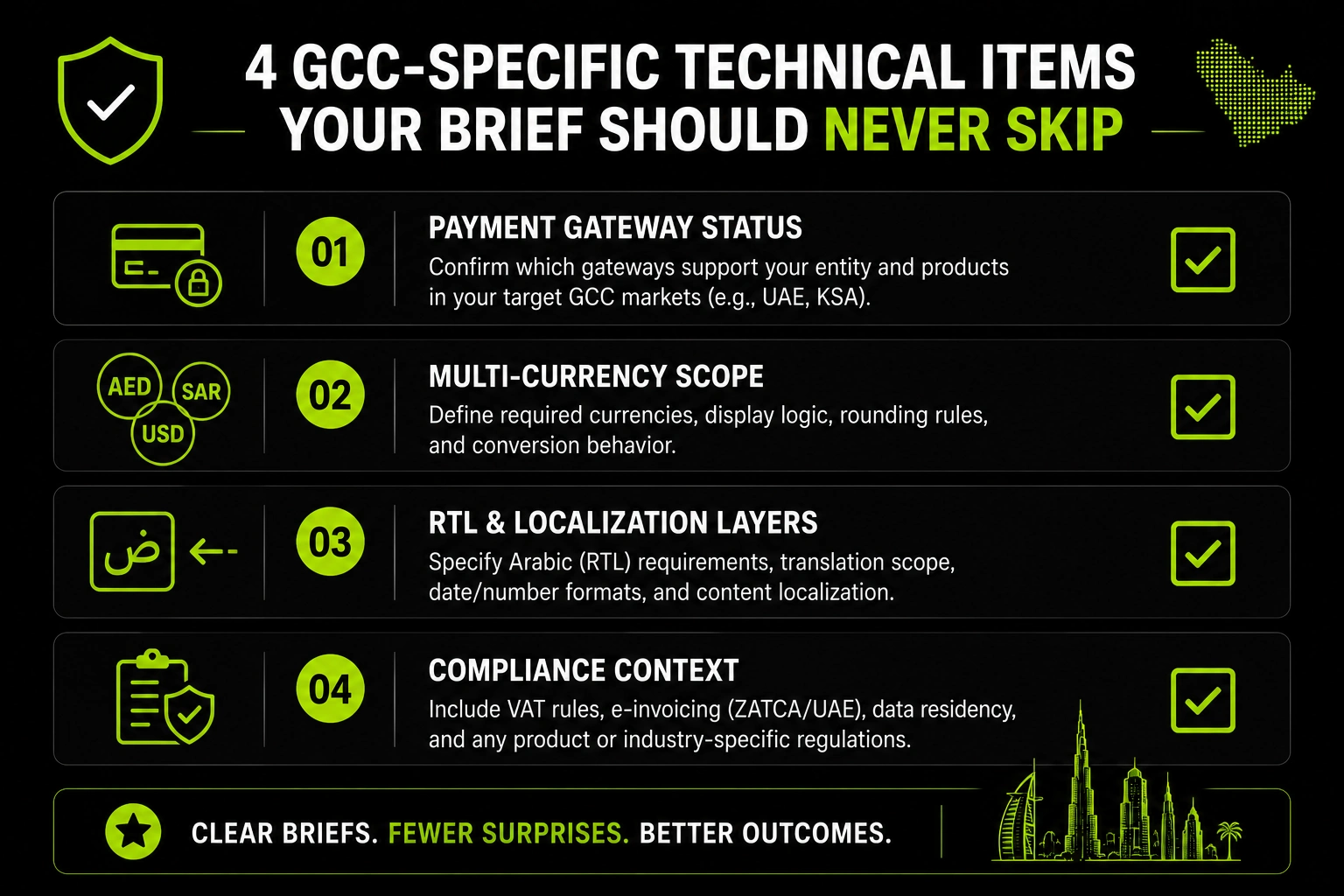
This is where payment gateway status, multi-currency and multi-market needs, localization and RTL scope, and compliance context belong.
It is also the section most briefs either skip entirely or handle in one vague line. It matters enough that it gets its own dedicated section further down this post.
5. Timeline, Budget, And Success Metrics
State your launch date and any hard external deadlines, whether that is a Ramadan campaign, a funding round announcement, or a retail partnership go-live.
Include a budget range, even an approximate one. Close with how you will measure whether the project actually delivered, whether that is a conversion rate target, a page speed benchmark, or a specific revenue goal tied to the new site.
Section Four, Expanded: Technical And Market Requirements GCC Brands Often Miss
The five-section structure above works for any Shopify project anywhere. This section is specific to what actually gets missed in UAE and GCC briefs, because these four items cause more mid-project surprises than everything else in the brief combined.
Payment Gateway And Checkout Constraints: Shopify Payments Isn't Available In The UAE
State your payment gateway status explicitly, even if it is still undecided. "Payment gateway not yet selected, but we are UAE-based, so Shopify Payments is not an option" is a complete, useful line.
It tells the agency immediately that any checkout flow assuming Shopify's native payment rail needs a different approach.
Leaving this line out is the single most common gap in briefs from this region, and it is also the cheapest one to fix. One sentence prevents a scoping error that otherwise costs weeks.
Multi-Currency And Multi-Market Scope: Native Markets vs. Workarounds
Say explicitly whether you need true multi-currency checkout, or whether displaying prices in multiple currencies with a single settlement currency is enough.
These are very different technical builds. Native Shopify Markets currency conversion assumes Shopify Payments underneath it, so a UAE merchant without that rail typically needs an app-based workaround or a defined manual-conversion approach instead.
Name which markets you are launching into now versus which ones are "maybe later," since that changes how much multi-market infrastructure is worth building on day one.
Arabic And RTL Requirements: Specify The Layer, Not Just "We Need Arabic"
This is where brief quality varies the most, and where the gap between weak and strong wording has real cost.
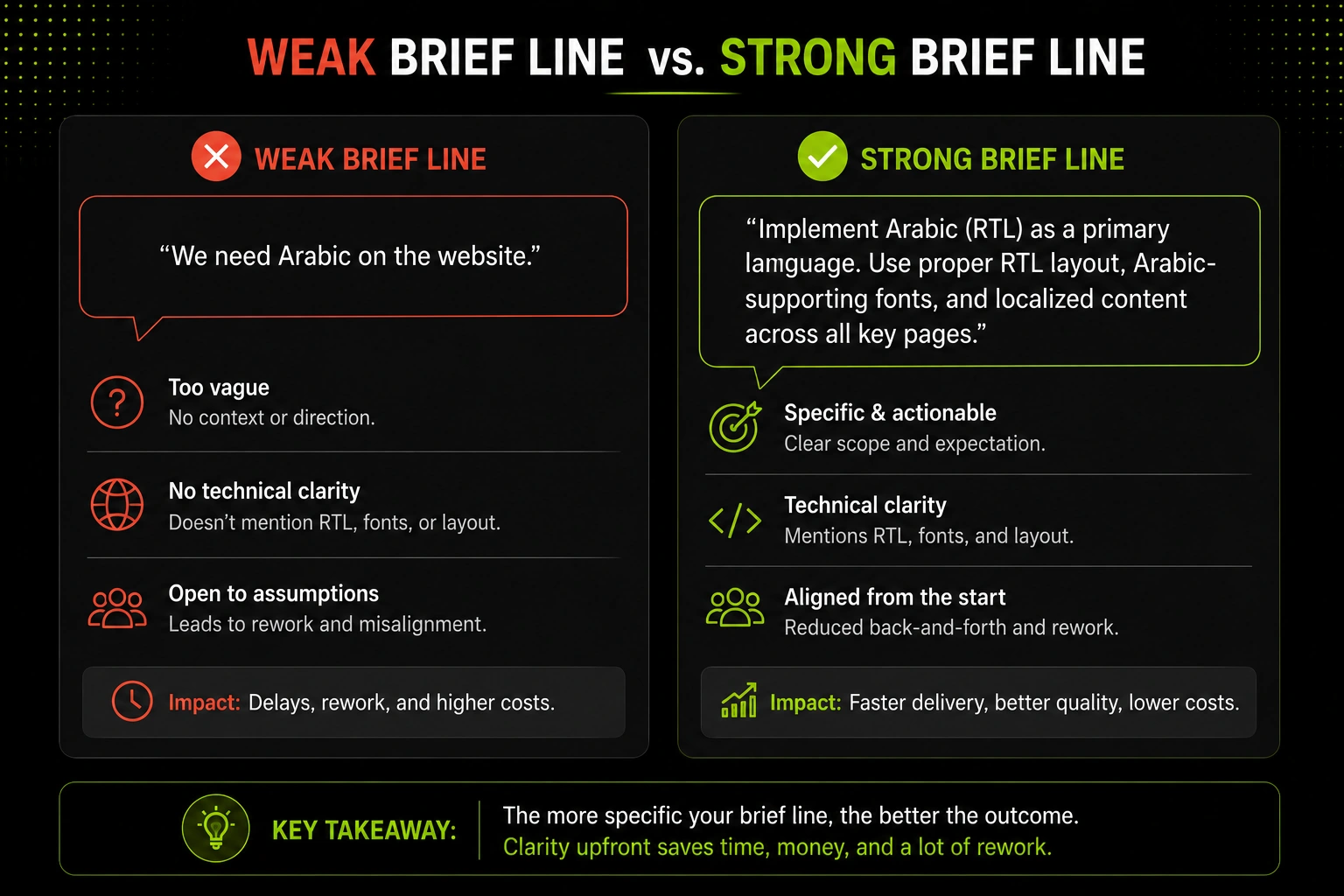
A weak brief line reads: "we need the site to work in Arabic." A strong brief line reads: "we need full RTL layout across the product listing page, product detail page, and checkout, Naskh-style Arabic typography for warmth consistent with the brand, and native-speaker QA before launch.
" The weak version leaves the agency to guess whether you mean a translated site with left-to-right layout kept intact, a fully mirrored RTL experience, or something in between. Those are three different builds with three different costs.
Our Arabic ecommerce design guide breaks down exactly which layers exist and how to specify each one, and our Middle East localization guide covers what localization means beyond language, including currency formatting, date conventions, and region-specific content.
Compliance And Regulatory Context: Trade License, VAT, Category-Specific Rules
Note your trade license type, whether you are mainland or freezone registered, since this affects payment gateway eligibility in some cases and any category-specific regulatory requirements.
A supplements or cosmetics brand, for example, often has labeling and claims restrictions that affect product page copy and structure, since certain health claims that pass review in other markets get flagged or rejected under UAE and GCC advertising rules.
VAT display requirements at checkout also vary by how your business is structured, and getting this wrong at launch usually means a rushed fix once a customer or auditor flags it. None of this needs to be exhaustive in the brief.
It needs to be present, so the agency knows to ask the right follow-up questions rather than assume a generic global setup that was never built with these rules in mind.
What To Include vs. What To Leave To The Agency's Expertise
Knowing what belongs in a brief is only half the skill. Knowing what to leave out and trusting the agency to figure out, is the other half, and it is where most first-time briefs go wrong in the opposite direction.
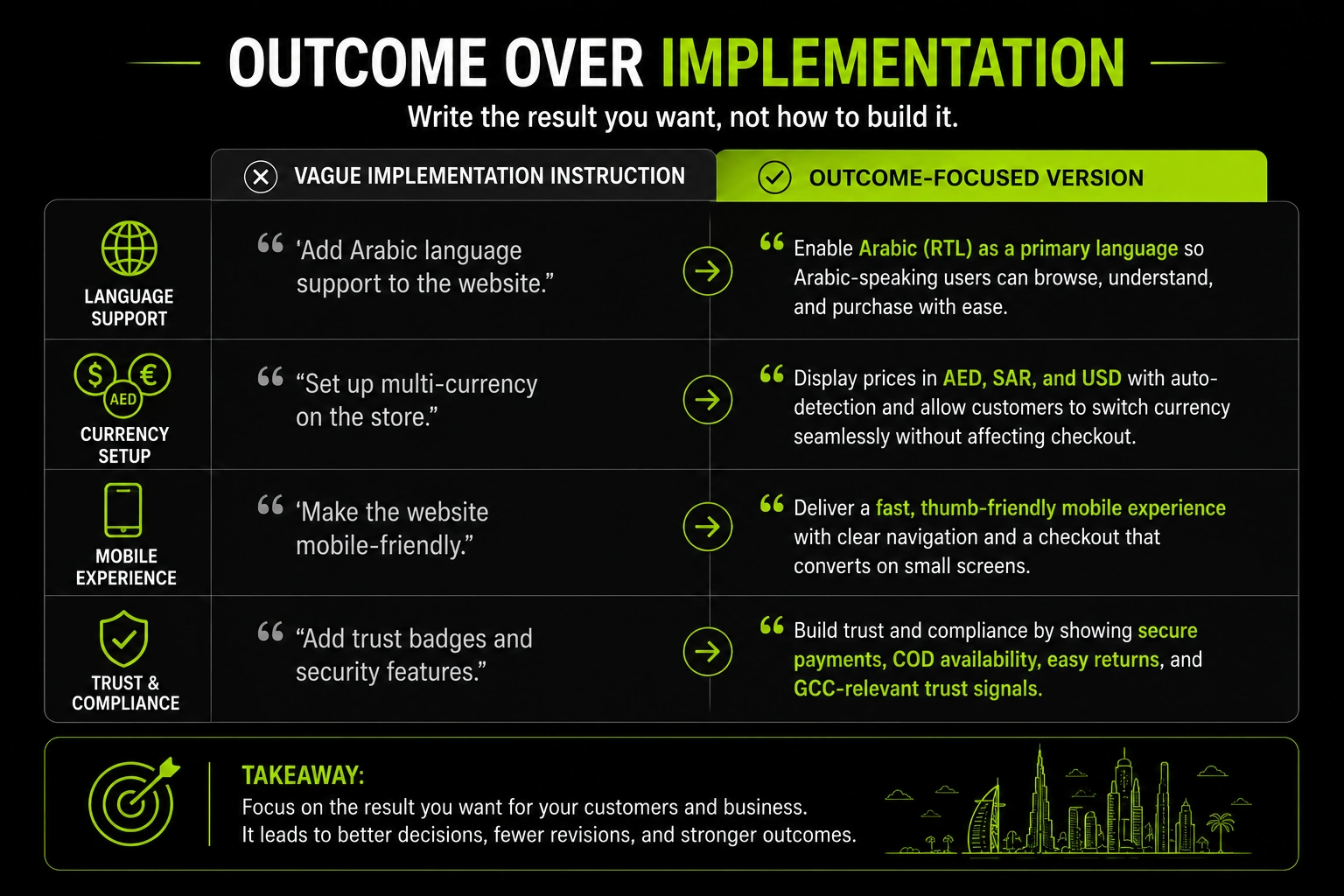
Specify Outcomes And Constraints, Not Implementation Details
State the problem you want solved, not your best guess at the solution. "Reduce checkout abandonment" is an outcome.
It tells the agency what success looks like and lets them diagnose the actual cause, whether that is a confusing shipping cost reveal, too many form fields, or a slow-loading payment step. "Add a progress bar to checkout" is an implementation detail.
It might help. It might also be irrelevant if the real problem is something else entirely, and specifying it in the brief can lock the agency into fixing the wrong thing.
When To Include Design References vs. When They Anchor The Agency Too Early
Design references are genuinely useful, but only with context attached. A link to a site with no explanation defaults to "make it look like this," which anchors the agency on the wrong details, maybe the color palette when you actually meant the layout density.
Instead, say specifically what you like: "we like this site's product photography style and how sparse the homepage feels," not just the URL.
That one added sentence per reference dramatically improves how useful the reference actually is.
Three well-annotated references beat ten unannotated ones, since the agency has to interpret every unexplained link, and each interpretation is a guess that may not match what you actually meant.
Being Specific About Non-Negotiables Without Over-Specifying Everything
Some things genuinely are non-negotiable: brand colors, a specific checkout requirement, a legal disclaimer that must appear on every product page.
State those plainly and mark them as fixed. Everything else, leave open enough for the agency to propose their own approach.
A brief that marks fifteen things as non-negotiable is really asking the agency to execute your existing plan rather than bring their expertise to the problem, which usually means you are paying for less value than you could be getting.
A useful test: if you cannot explain why something is non-negotiable in one sentence, it probably is not, and it belongs in the "nice to have" list instead of locked in as a requirement.
The Shopify Agency Brief Template (Copy-Ready Structure)
This is the section to copy directly into a document and start filling in. Each line below is a prompt, not a full answer, so treat it as a starting structure rather than a form to fill in mechanically.
Business Context
- Company, products, and target market
- Brand positioning and what makes you distinct in your category
Current State
- Existing platform, if any
- Known issues or underperforming areas
- Analytics snapshot, if available: conversion rate, mobile traffic share, cart abandonment
Project Goals
- Two to three primary outcomes, ranked by priority
Scope And Deliverables
- Explicit in-scope list
- Explicit out-of-scope list
Technical And Market Requirements
- Payment gateway status (name the gateway, or state that it is undecided and why)
- Multi-currency and multi-market needs
- Localization and RTL scope, layer by layer
- Compliance notes: trade license type, category-specific regulatory context
Design And Brand Assets
- Logo and brand guidelines
- Reference sites, each with a note on what specifically you like and why
Timeline
- Launch date
- Any hard external deadlines: campaigns, retail partnerships, seasonal dates
Budget Range
- Even an approximate range speeds up an accurate proposal
Success Metrics
- How you will measure whether the project delivered
How We Like To Receive A Brief At Suplex
A strong brief changes how fast and how accurately we can respond. When the technical requirements section names the payment gateway constraint, the multi-currency scope and the localization layers upfront, our proposal reflects the real project instead of a generic estimate that gets revised twice before work even starts.
This is also where a brief connects directly to the discovery work we do. Our platform consultation service exists partly because some brands know their goals but not yet their technical requirements and that is a completely reasonable place to start from, as long as the brief says so honestly rather than guessing.
For projects where the design direction still needs shaping before a full build starts, our wireframing service often follows directly from a well-scoped brief, turning the outcomes and constraints you named into a structure the whole team can react to before a single pixel of final design gets built.
In practice, the brands that arrive with the clearest technical requirements section are almost always the ones whose first proposal needs the fewest revisions, because there is less guessing to correct once real conversations start.
Common Briefing Mistakes That Cause Scope Creep
Every mistake below shows up repeatedly across real Shopify projects, and every one of them is preventable with one or two added sentences in the brief.
Frequently Asked Questions
What's The Difference Between A Brief And An RFP?
An RFP, or request for proposal, is typically longer, more formal, and sent to multiple agencies to compare bids. A brief is a working document, often shared after shortlisting, that gives one agency, or a short list, the context needed to scope and propose accurately.
How Long Should A Shopify Agency Brief Be?
Long enough to cover business context, scope, and technical requirements clearly, usually two to four pages. Longer is not automatically better if it is padded with generic detail. A focused brief that flags real constraints beats a lengthy one that buries them.
Should I Include A Budget In My Brief?
Yes, even a range. Agencies scope more accurately and propose realistic options when they know the budget context upfront, rather than guessing and either over-scoping or under-scoping the proposal.
What If I Don't Know All The Technical Requirements Yet?
State what you know and flag what's unclear. For example: "payment gateway not yet selected, but we're UAE-based, so Shopify Payments isn't an option." An honest gap is more useful to an agency than a confident guess that turns out wrong.
Do I Need Design References In My Brief?
They help, but explain why you like each reference, not just the link. "We like this site's product photography style" is useful. A list of URLs with no context often anchors the agency on the wrong details.
How Specific Should The Brief Be About Localization Needs?
Specific enough to name the layers involved, such as RTL layout, typography, payment localization, and dialect, rather than a general statement like "we need it localized." Vague localization requests are one of the most common sources of rework in this market specifically.
Who Should Be Responsible For Writing The Brief Internally?
Ideally one person with the authority to make decisions and consolidate input from stakeholders across marketing, operations, and leadership, rather than a document assembled by committee with no single owner. Unclear ownership during briefing usually predicts unclear approvals later.
Hi, I’m Rishabh Jain
I believe great design has the power to shape perception, build trust, and move businesses forward. That belief is what led me to found Suplex Design Studio, a global branding and packaging studio working with FMCG and D2C brands across markets.I started suplex at 25 with a clear intent, to create design that is strategic, thoughtful, and commercially meaningful. By 28, the studio had scaled globally, guided by a strong foundation in Integrated Design that I developed during my academic journey in London, where I was honoured with the Dean’s Award.
Over the years, I’ve had the opportunity to work with 100+ brands, from Fortune 500 organizations to family-run businesses, helping them build packaging and brand systems that create recall, relevance, and long-term value.
Suplex’s work has been recognized internationally, including the Manifest Award (2024), the Clutch Global Award (2025), and features on platforms such as Packaging of the World, The Dieline, and the World Brand Design Society.
None of this would be possible without the people behind the work. I’m deeply grateful to the suplex team, whose commitment, creativity, and attention to detail turn ideas into meaningful brand experiences every day.
At the heart of my work is a simple philosophy, design should be intentional, honest, and built to last, and that continues to guide everything we create at suplex.






























Let’s Make It Happen
E-Commerce Success Stories
%201.avif)






.avif)
.avif)
Build Your D2C Business The Right Way
Build It With Suplex.


