D2C Website Localization for the Middle East: The Complete Guide
.avif)
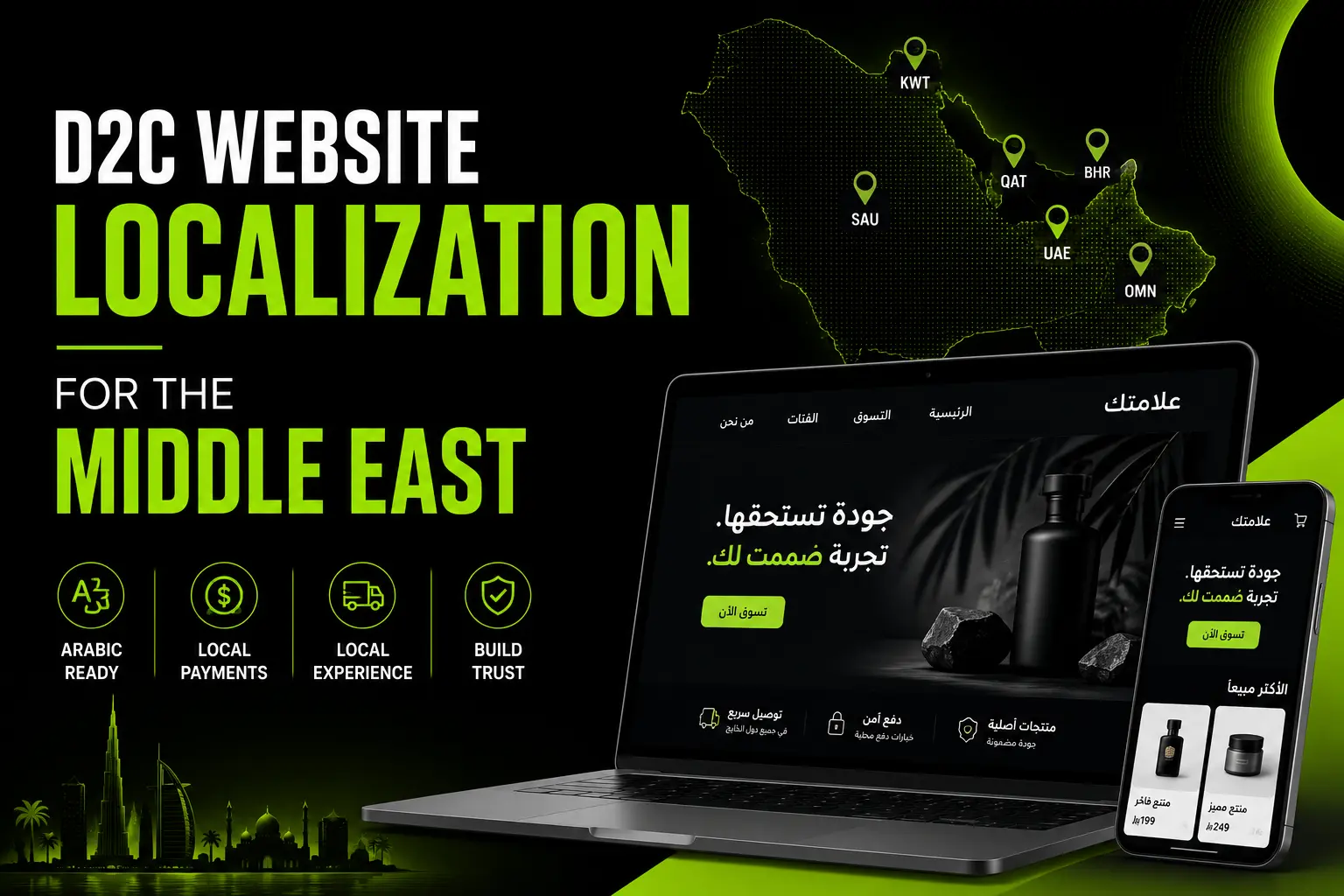
D2C Website Localization for the Middle East: The Complete Guide
Website localization for the Middle East is more than translating your website into Arabic. You need to adapt your store to how GCC shoppers browse, compare, pay and buy.
If you only translate your content, you will lose conversions because your website does not match local shopping expectations.
In this Suplex blog, get the regional experience right before you translate a single word.
What Localization Actually Means for a D2C Brand (Not a Translation Agency)
Most agencies selling "localization" are selling translation with a CSS flip. That gets you a site that reads in Arabic and looks broken the moment a customer tries to check out.
For a D2C brand, localization touches layout, payment methods, imagery, tone, and legal compliance, and each layer affects your conversion rate independently.
Translation vs. Localization vs. Transcreation: Where D2C Brands Get It Wrong
These three terms get used interchangeably, and that confusion costs money. Translation swaps words. Localization adapts structure, currency and functionality to the market.
Transcreation rebuilds the message so the brand voice survives the move into a new language and culture.
Use this as a self-scoring diagnostic. Score your current store from 1 (not done) to 3 (fully done) across each row.
CSA Research's long-running "Can't Read, Won't Buy" studies have repeatedly found that a majority of online shoppers prefer to buy in their own language and skip sites that are not available in it.
That preference does not disappear because the layout mirrors correctly. It compounds with every other localization gap on the page.
Why the "Translate + Flip CSS" Model Fails Conversion, Not Just Aesthetics
Setting direction: rtl in your stylesheet does not localize a store. It repositions elements without checking whether they still make sense in that position.
Icons that implied "next" now point the wrong way. Price fields misalign with currency symbols. Form inputs accept text in the wrong direction.
None of this shows up in a design review. All of it shows up in your checkout abandonment data.
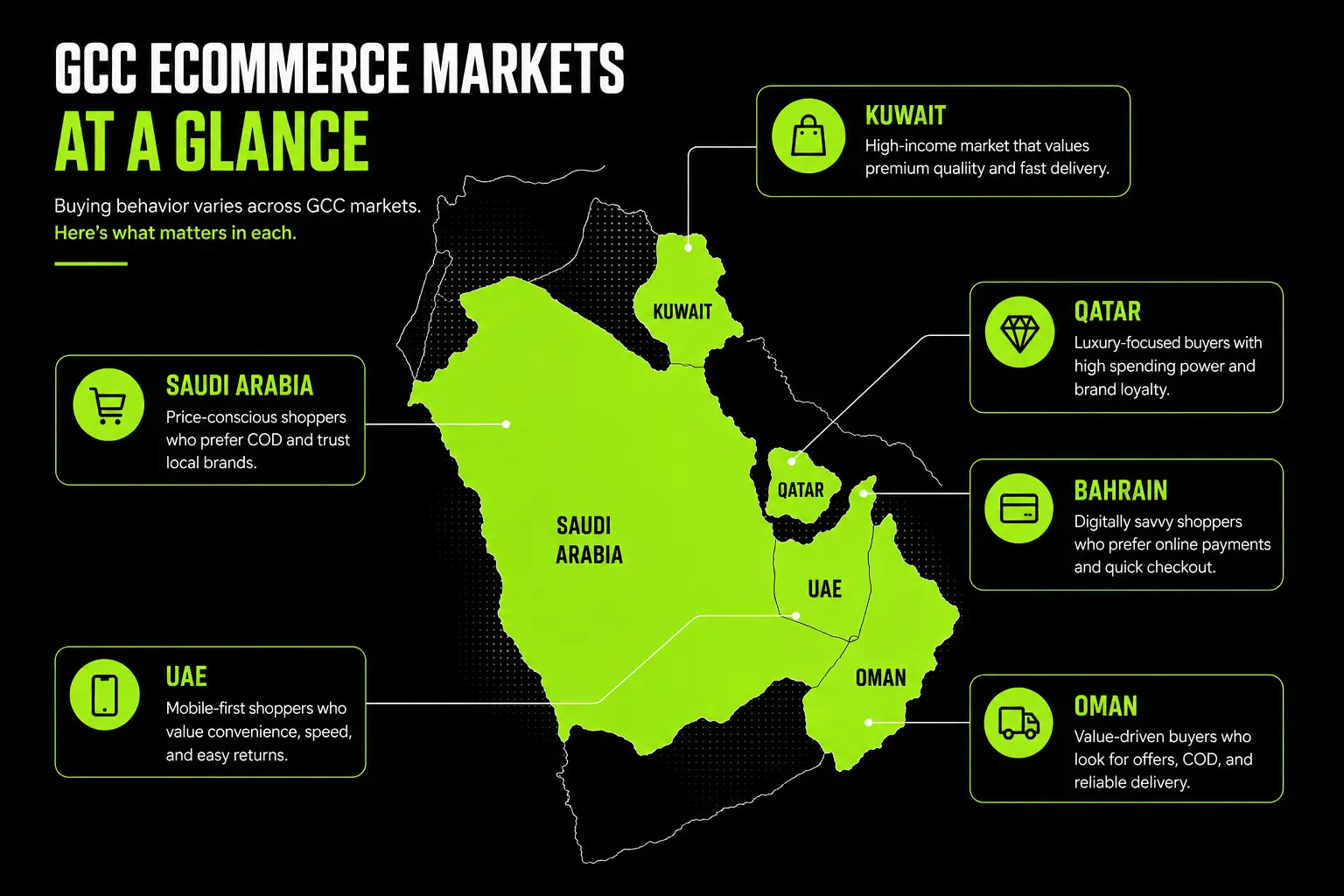
The Middle East Isn't One Market: Map It Before You Localize
"Middle East" is a geography term, not a buyer persona. Treating the GCC, the Levant and North Africa as one audience is the single biggest strategic mistake we see D2C brands make when they expand into the region, and it is the gap every competing guide leaves wide open.
GCC vs. Levant vs. Egypt and North Africa: Different Budgets, Different Behavior
The GCC (UAE, Saudi Arabia, Kuwait, Qatar, Bahrain, Oman) has higher average order values, higher smartphone penetration, and faster-growing BNPL adoption than the wider Levant or North Africa.
Egypt has a much larger population but a lower per-capita online spend. A brand launching a premium skincare line should prioritize GCC traffic first.
A brand selling everyday FMCG products needs a wider MENA footprint to hit volume.
Modern Standard Arabic vs. Gulf, Egyptian and Levantine Dialect: What to Actually Use
Modern Standard Arabic (MSA) is the safe default for formal content, legal pages, and SEO metadata, because it is understood across the region and it is what search engines index most reliably.
Product copy and marketing messaging often perform better in a warmer, Gulf-dialect-influenced tone, especially for UAE and Saudi audiences who expect brand voice to sound less formal than a government notice.
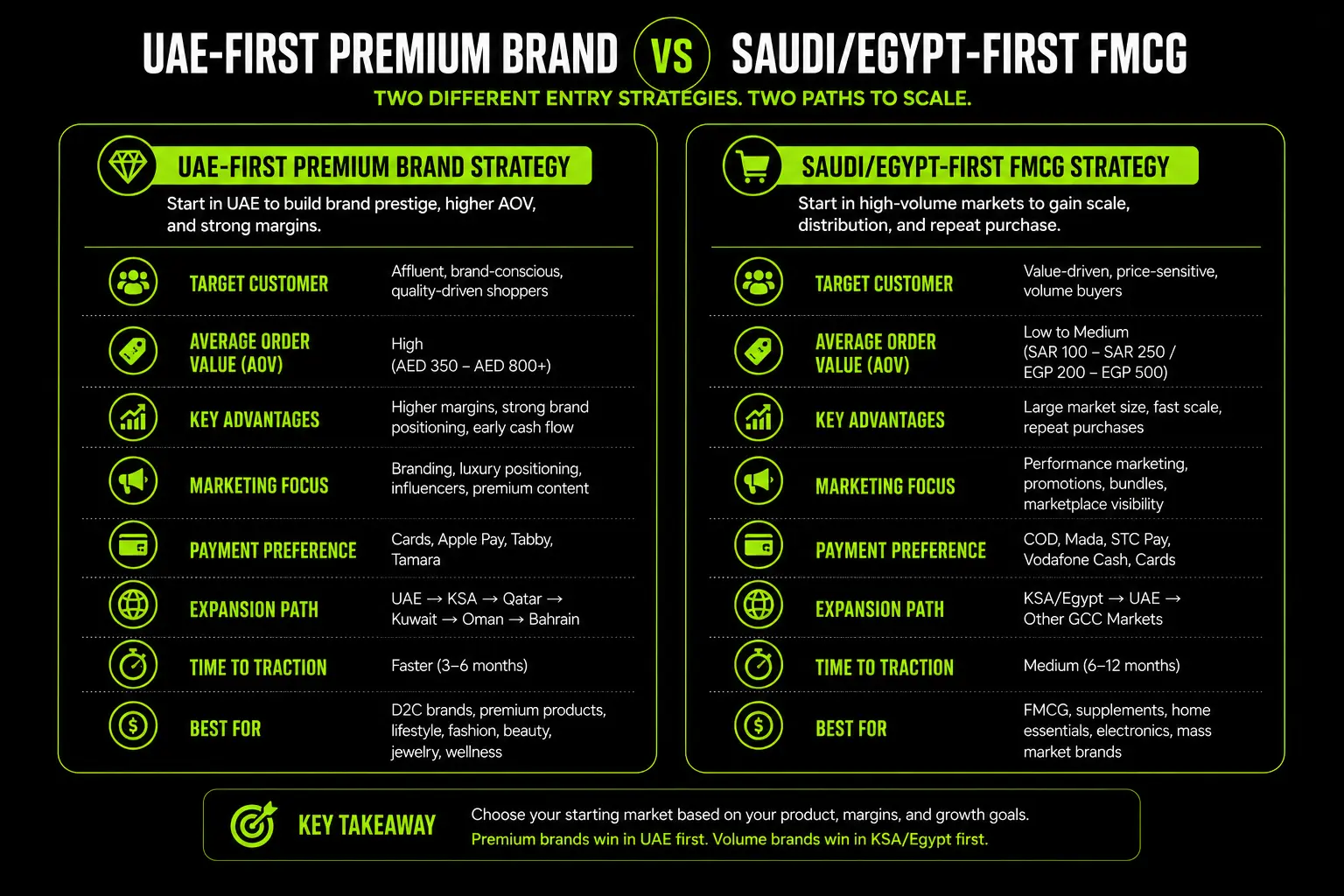
Saudi Arabia vs. UAE: Two Very Different D2C Entry Points
The UAE has the highest digital payment penetration in the region and a large expat population that shops in English and Arabic side by side.
Saudi Arabia has a larger population and faster ecommerce growth rate, but a more conservative content and compliance environment. A luxury skincare brand often prioritizes Dubai and Riyadh first, where premium spend concentrates.
An FMCG brand usually needs wider Saudi and Egyptian coverage to hit volume targets. Which market you launch in first should shape your platform choice too.
Suplex has written separately about choosing between Shopify and regional platforms like Salla or Zid, since the right platform depends on where your customers actually are.
Arabic RTL: What Actually Needs to Change Beyond direction: rtl
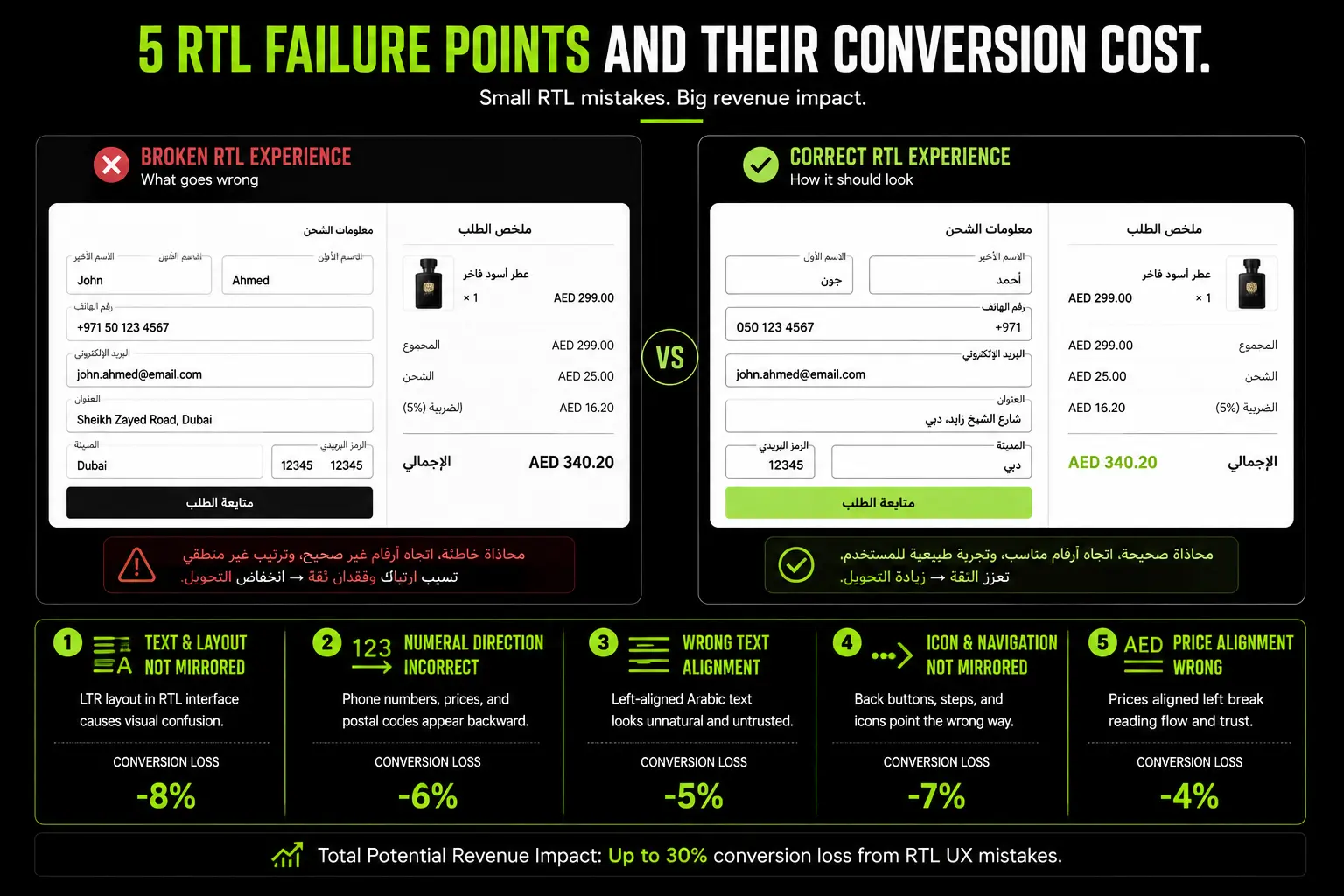
Every competing article covers RTL at the surface level: flip the layout, mirror the icons, done. That advice ignores where RTL actually breaks for D2C stores, which is at checkout, where a single misaligned field can cost you the sale.
Layout Mirroring: Navigation, Product Grids, Forms, Icons
Navigation menus, breadcrumbs, and product grids all need to mirror, not just the text direction. Icons implying directionality (arrows, "back" buttons, progress indicators) need their own RTL versions, not a horizontal flip applied automatically, because a flipped play button or flipped logo often looks broken rather than mirrored.
Typography and Font Stacks That Render Correctly at Small Sizes
Arabic script has connected letterforms that many Latin-first font stacks render poorly at small sizes on mobile.
A font that looks fine at 16px on desktop can become illegible at 12px on a phone. Test your font stack specifically on Arabic characters at the smallest size used anywhere in your checkout flow, not just on your homepage headline.
The Checkout Fields Everyone Breaks in RTL
This is where D2C brands actually lose revenue, and it is the part every generic RTL guide skips.
- Numeral Direction: Arabic script reads right to left, but numerals (prices, phone numbers, order totals) still read left to right. Mixing the two incorrectly creates numbers that display in the wrong order.
- Form Input Cursors: Text fields need to accept and display Arabic input correctly, with the cursor starting on the right, not defaulting to a Latin-input behavior that confuses the typing flow.
- Price Alignment: Currency symbols and totals need consistent placement relative to the number, tested against your actual payment gateway's rendering, not just your theme's design mockup.
Not Sure Where Your Store Is Breaking for GCC Shoppers?
A Global Aesthetic Audit checks your layout, RTL rendering, and checkout flow against how Gulf shoppers actually browse and buy, before you spend on a full rebuild.
Payments and Checkout Localization for the GCC
This is where translation-focused competitors go quiet entirely. Payment localization is not a technical footnote. It is often the single biggest lever on your GCC conversion rate, bigger than language.
Why Cash on Delivery Still Dominates
Cash on delivery (COD) remains a significant share of GCC ecommerce transactions, driven by lingering trust concerns around online card payments and a strong cultural preference to inspect goods before paying.
A localized store treats COD as a first-class checkout option, displayed with the same prominence as card payment, not buried at the bottom of a payment list.
Integrating Tabby and Tamara (BNPL) Without Slowing Checkout
Buy now, pay later has grown fast across the UAE and Saudi Arabia, with Tabby and Tamara as the two dominant regional providers.
Both integrate directly with Shopify, but a poor implementation adds extra steps or redirect delays that hurt conversion more than the payment option helps it.
Test the full flow on a real mobile connection before launch, not just on staging over WiFi.
Local Payment Gateways vs. Global Defaults
Global payment defaults like Stripe do not always support every regional card network or local bank transfer method GCC shoppers expect.
Regional gateways often clear faster for local cards and reduce failed transaction rates. This is a checkout decision and it belongs in the same conversation as your broader conversion rate optimisation strategy, not treated as a separate technical task handed to a developer late in the build.
Cultural and Content Localization Beyond the Language Layer
Avoiding pork and alcohol imagery is the advice every competitor already gives you. That is table stakes, not a strategy.
The deeper work is transcreating your actual brand voice so it survives the move into Arabic.
Imagery, Color, and Symbolism That Travels, and What Doesn't
Beyond the obvious category-sensitive imagery, color carries different associations across the region.
Test your product photography and lifestyle imagery with someone who actually shops in the target market, not just with a translator checking for compliance.
Tone of Voice: Transcreating Brand Personality, Not Translating Copy
A playful, casual DTC headline translated word for word into Arabic often reads as either overly formal or slightly odd, because the tone that works in English does not map directly onto Arabic sentence structure.
Transcreation means rewriting the headline to hit the same emotional note in the target language, even if the literal words change completely.
A skincare brand's English headline "Glow that doesn't quit" needs an Arabic equivalent built around a comparable feeling of lasting radiance, not a literal translation of "quit."
Ramadan and Seasonal Commerce Planning
Ramadan and Eid drive some of the highest-traffic ecommerce periods in the GCC calendar, with shifted browsing hours and different gifting behavior than Western holiday seasons.
Plan your seasonal content, promotions, and inventory around the Islamic calendar as a primary planning input, not an afterthought layered onto your existing Q4 marketing calendar.
Compliance and Trust Signals D2C Brands Miss in the GCC
Zero competing articles in this space cover compliance in any depth. That gap costs brands real money when they discover requirements after launch instead of before.
MOHAP and Dubai Municipality Requirements for Regulated Categories
Products in categories like cosmetics, supplements, and food often require registration or approval through the UAE Ministry of Health and Prevention (MOHAP) or Dubai Municipality before they can be legally sold or marketed to UAE consumers.
This applies to product claims on your website, not only to the physical product.
ZATCA Phase 2 E-Invoicing for Saudi Transactions
Saudi Arabia's Zakat, Tax and Customs Authority (ZATCA) requires Phase 2 e-invoicing integration for businesses operating in the Kingdom, which affects how your checkout and order confirmation systems generate and store invoices.
This is a backend integration requirement, and it needs to be scoped during your platform build, not retrofitted after launch.
VAT Display and Local Business Registration Signals
GCC shoppers expect to see VAT-inclusive pricing and clear business registration information before they trust a checkout with their card details.
Missing these signals reads as a red flag to a first-time buyer evaluating whether your store is legitimate.
This section is general guidance based on current public information, not legal advice. Confirm current requirements with local counsel before launch, since compliance rules in the region change and vary by product category.
WhatsApp Commerce and Channel-Specific Localization
Western D2C funnels are built around email and SMS. GCC shopping behavior runs heavily through WhatsApp and a localized store needs to account for that from the start.
Why WhatsApp Is a Storefront Extension, Not Just Support
GCC shoppers frequently use WhatsApp to ask product questions before purchase, confirm order details after checkout and track delivery status, treating it as an extension of the store rather than a separate support channel.
A brand that only offers email support is invisible to a large share of its potential customers.
Designing for How GCC Shoppers Actually Discover and Buy
Product discovery in the region often starts on Instagram or TikTok and moves into a WhatsApp conversation before it ever reaches your website checkout.
Your localization strategy needs to account for that path, including how your product pages and order confirmations read when shared as a WhatsApp link, not only how they look on a desktop browser.
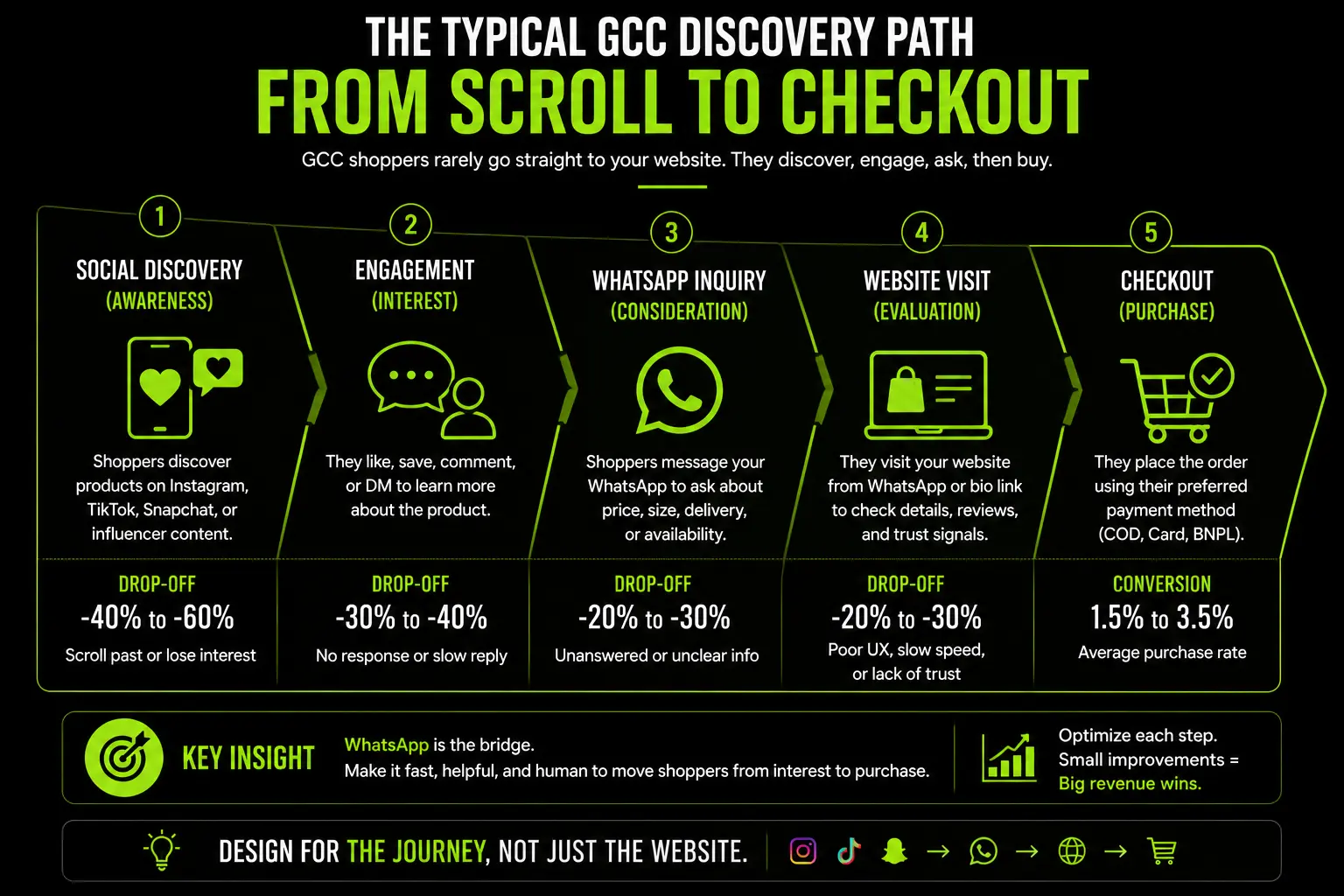
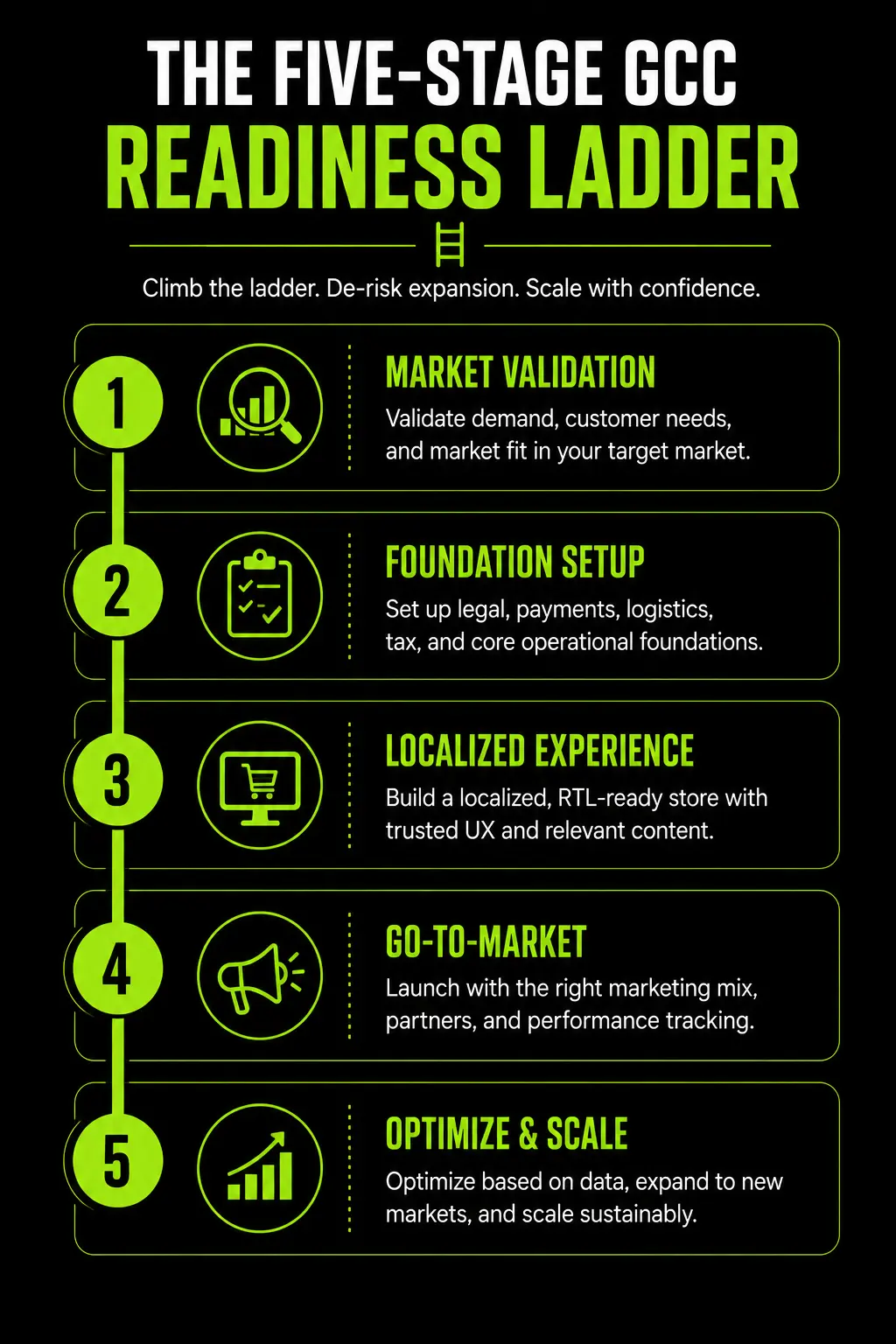
A Framework for Sequencing Localization: The Readiness Ladder
Most brands do not need to localize everything at once. They need to know what stage they are at and what the next stage costs. Use this five-stage ladder to self-assess your current store before committing budget to a rebuild.
- Translated: Text swapped into Arabic, structure unchanged.
- Structurally Localized: RTL layout, checkout, and local payment methods fixed.
- Culturally Localized: Tone, imagery, and seasonal planning addressed.
- Compliant: MOHAP, ZATCA, and VAT display requirements met.
- Native: WhatsApp integration, dialect nuance, and local trust signals fully in place.
Most D2C brands entering the GCC for the first time should aim to launch at stage 2 or 3, then move toward stage 5 over the following two quarters as data comes in on where customers are actually dropping off.
How Suplex Approaches D2C Localization
Localization is not a standalone translation task at Suplex. It is part of the same UX and conversion work that goes into every store build, because a beautifully translated page that breaks at checkout still loses the sale.
On the Celesti build, a luxury and lifestyle brand, the work centered on a design system built around trust, calm, and premium positioning, the same qualities that matter most when a first-time GCC buyer is deciding whether to trust a new store with their payment details.
On Miduty, a D2C nutraceutical brand, the focus was structuring a high-volume, repeat-purchase Shopify store for conversion and lifetime value, the same operational discipline that GCC checkout localization depends on.
Suplex is a Dubai-based Shopify Partner, which means the team evaluates a brand's Readiness Ladder stage as the first step, not the last.
That assessment usually starts with a Global Aesthetic Audit to identify where the current store breaks for a Gulf audience, followed by International E-Commerce Setup work to build or rebuild the store structure, and ongoing Conversion Rate Optimisation once the store is live and generating real GCC traffic data.
What Localization Costs and What It Returns
None of the competing guides in this space address budget. Decision-makers comparing agencies need this to make a real call.
Budget Ranges by Readiness Stage
Exact cost depends heavily on catalog size, number of payment integrations, and whether you are rebuilding an existing store or launching a new one.
Use this table to scope conversations with agencies rather than as a fixed quote.
What ROI Actually Looks Like in Month 1 to 6
The earliest measurable return usually comes from checkout completion rate, not overall traffic.
A store that fixes RTL checkout bugs and adds COD or BNPL typically sees the completion rate move before top-of-funnel traffic grows meaningfully, because the fix removes friction for shoppers who were already trying to buy.
Track checkout completion rate and average order value by payment method separately during the first two quarters, since these numbers reveal whether the localization work is paying for itself.
Common Localization Mistakes D2C Brands Make in the Middle East
Frequently Asked Questions
Is website localization the same as translation?
No. Translation converts text. Localization adapts layout, payments, imagery, tone, and compliance to fit how a specific market actually shops. For the GCC, skipping the non-text layers is the more common and more costly mistake.
Do I need separate sites for Saudi Arabia and the UAE?
Not always, but you need separate strategies. Currency, payment gateway priority, VAT display, and compliance requirements differ. A shared Arabic storefront with market-specific checkout and pricing logic usually works for D2C brands starting out.
What's the biggest technical mistake in Arabic RTL design?
Assuming direction: rtl fixes everything. Checkout forms, numeral alignment, icon direction, and third-party app widgets frequently break and go untested, quietly costing conversions at the exact point of purchase.
Should I use Modern Standard Arabic or a local dialect?
Modern Standard Arabic works for formal content and SEO. Product copy and marketing often perform better with warmer, dialect-influenced tone, particularly Gulf Arabic for UAE and Saudi audiences.
How important is cash on delivery for GCC ecommerce? Very. COD still accounts for a significant share of GCC transactions. A localized site needs COD as a first-class checkout option, not a fallback, alongside BNPL providers like Tabby and Tamara.
What compliance rules apply to ecommerce in the UAE and Saudi Arabia?
Requirements vary by category and country: MOHAP and Dubai Municipality rules for regulated products in the UAE, and ZATCA Phase 2 e-invoicing for Saudi transactions. Confirm current requirements with local counsel before launch.
How long does proper D2C localization take?
A structurally and culturally localized storefront typically takes 6 to 10 weeks depending on catalog size and payment integrations. Full native-level localization, including compliance and channel work, often extends across the first two quarters post-launch.
Hi, I’m Rishabh Jain
I believe great design has the power to shape perception, build trust, and move businesses forward. That belief is what led me to found Suplex Design Studio, a global branding and packaging studio working with FMCG and D2C brands across markets.I started suplex at 25 with a clear intent, to create design that is strategic, thoughtful, and commercially meaningful. By 28, the studio had scaled globally, guided by a strong foundation in Integrated Design that I developed during my academic journey in London, where I was honoured with the Dean’s Award.
Over the years, I’ve had the opportunity to work with 100+ brands, from Fortune 500 organizations to family-run businesses, helping them build packaging and brand systems that create recall, relevance, and long-term value.
Suplex’s work has been recognized internationally, including the Manifest Award (2024), the Clutch Global Award (2025), and features on platforms such as Packaging of the World, The Dieline, and the World Brand Design Society.
None of this would be possible without the people behind the work. I’m deeply grateful to the suplex team, whose commitment, creativity, and attention to detail turn ideas into meaningful brand experiences every day.
At the heart of my work is a simple philosophy, design should be intentional, honest, and built to last, and that continues to guide everything we create at suplex.























Let’s Make It Happen
E-Commerce Success Stories
%201.avif)






.avif)
.avif)
Build Your D2C Business The Right Way
Build It With Suplex.


