Shopify Vs Salla: Which Platform Fits Your GCC Store In 2026
.avif)
Shopify Vs Salla: Which Platform Fits Your GCC Store In 2026
Shopify vs Salla comes down to more than language support. Salla is a Saudi-native, Arabic-first ecommerce platform built with local payment, shipping and tax compliance out of the box.
Shopify is a global platform with a much larger app ecosystem and deeper design flexibility. The real decision factor most comparisons skip: which market you're actually building for first.
This Suplex guide grounds the comparison in accurate, specific facts first, then covers the marketing infrastructure layer that determines whether either platform's tracking data can actually be trusted once real ad spend is behind it.
Shopify Vs Salla: The Core Differences
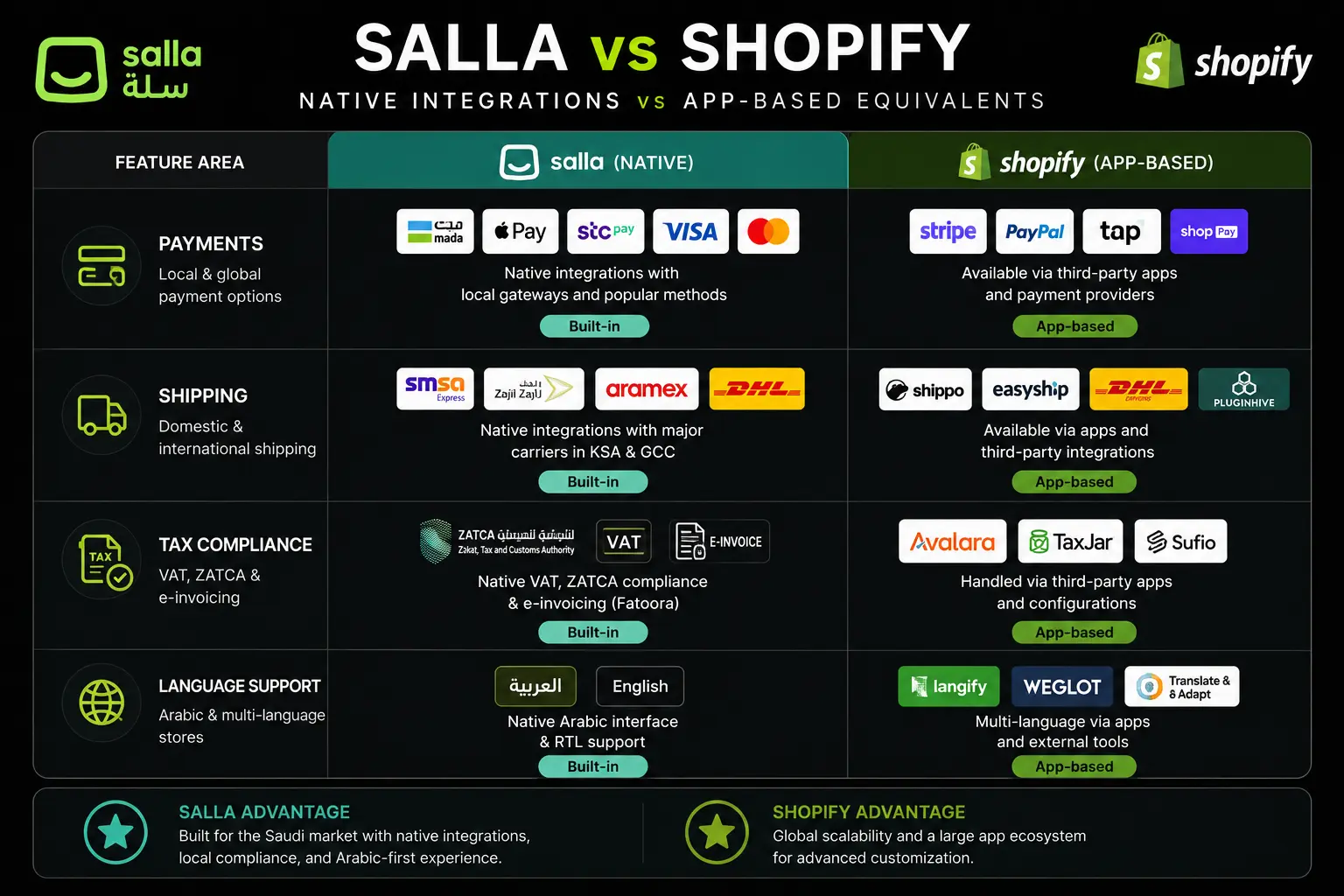
Before any strategic recommendation, get the baseline facts right. Here's what each platform actually includes out of the box, and where the real tradeoffs sit.
Local Infrastructure Built In Vs Available Through Apps
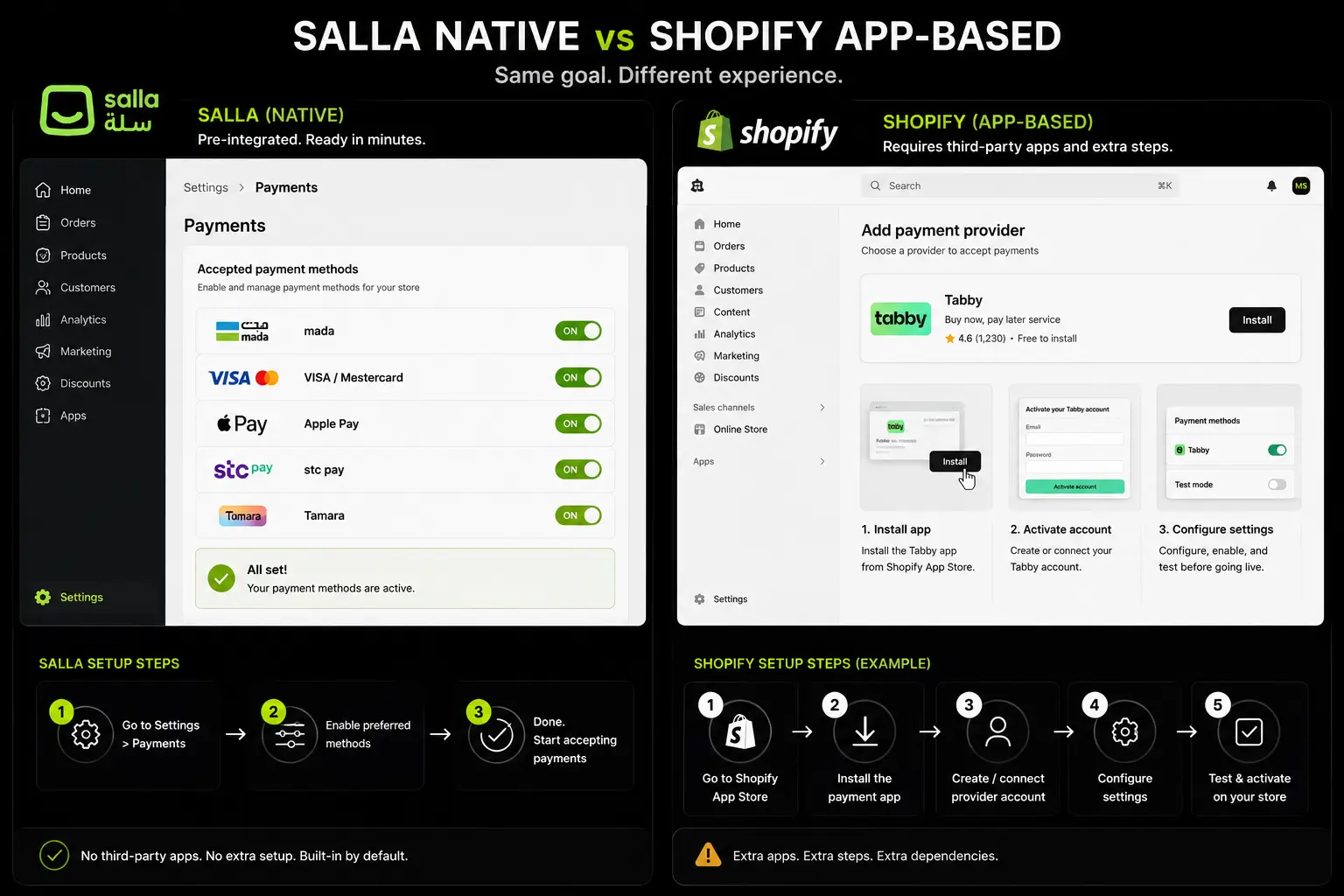
Salla's core advantage isn't that these capabilities are impossible on Shopify. It's that they're pre-integrated on Salla, versus requiring app-stacking and configuration on Shopify.
This is a real speed-to-launch advantage for a Saudi-first brand. A Salla store can go live faster because the local payment, shipping, and tax compliance layer doesn't need to be assembled piece by piece.
But that speed comes with a maintenance tradeoff to weigh honestly: Shopify's app-based approach means more setup work upfront, in exchange for more flexibility and a far larger ecosystem to draw from as the brand's needs grow beyond what any single native platform anticipated.
Cost Structure: Bundled Vs Modular
The two platforms price differently in a way that changes what "cheaper" actually means depending on a brand's specific feature needs.
Salla generally bundles more GCC-specific functionality directly into its base subscription plans, payment gateways, shipping integrations, and ZATCA compliance all sit inside the monthly fee without separate line items.
This makes the sticker price easier to evaluate upfront, what you see in the plan comparison is close to what you'll actually pay.
Shopify's pricing scales differently. The base subscription is often competitive or lower than Salla's equivalent tier, but matching Salla's native GCC functionality on Shopify usually means adding paid apps for local payment gateways, BNPL providers, and e-invoicing compliance.
Each app carries its own monthly cost, and those costs stack. A fair cost comparison between the two platforms has to include the app stack a Shopify store would need to reach feature parity with Salla's native offering, not just the base subscription fee for each.
This doesn't make one platform categorically cheaper than the other. It means the true cost only becomes clear once a brand maps its specific feature requirements against each platform's pricing model, rather than comparing headline subscription numbers in isolation.
Design And Customization Depth
Here's where honesty matters most in this comparison. Shopify's theme and app ecosystem gives meaningfully more design and functional flexibility than Salla currently offers.
This gap matters more as a brand's design ambitions grow, a fast-launching local FMCG brand may never notice it, but a fashion or beauty brand building toward a premium, editorial-quality storefront will hit Salla's design ceiling well before it hits Shopify's.
This connects directly to points covered in our comparison of platform tiers for premium and luxury brands: design flexibility isn't a cosmetic preference, it's an infrastructure requirement once a brand's positioning depends on visual differentiation rather than just functional completeness.
Shopify's headless Hydrogen framework, custom theme development, and thousands of App Store integrations give a brand room to grow into a more sophisticated storefront over years, without hitting a platform ceiling that forces a full replatform later.
Market Scope: Saudi-First Vs Gulf-Wide
This is the section most competitor comparisons skip entirely or gloss over with a vague "both support Arabic" line. It's also the single most consequential factor in this whole decision.
Salla is Saudi-native, with growing reach into the UAE and Egypt, but its strongest integrations, deepest local carrier network, and most mature merchant support all remain concentrated in Saudi Arabia specifically.
Zid, frequently compared alongside Salla in the same conversation, is reportedly Saudi-focused specifically, without the same UAE or Egypt expansion Salla has begun building toward.
A brand building UAE-first or Gulf-wide from day one faces a meaningfully different calculus than a Saudi-first brand planning to expand later.
The Saudi ecommerce market itself is substantial, commonly reported in the tens of billions of SAR annually, with strong double-digit annual growth, which is exactly why this decision matters regardless of which direction a brand chooses.
A Saudi-first brand ignoring this market size misses real opportunity. A UAE-first brand assuming Salla's Saudi-built infrastructure translates cleanly to Gulf-wide operations misjudges where that platform's actual strength currently sits.
The Marketing Infrastructure Question Nobody Else Covers
Every other comparison on this topic stops at features and payment methods. Here's the layer that actually determines whether your ad spend data can be trusted once the real budget is behind it, and it applies regardless of which platform you choose.
WhatsApp Checkout And Attribution
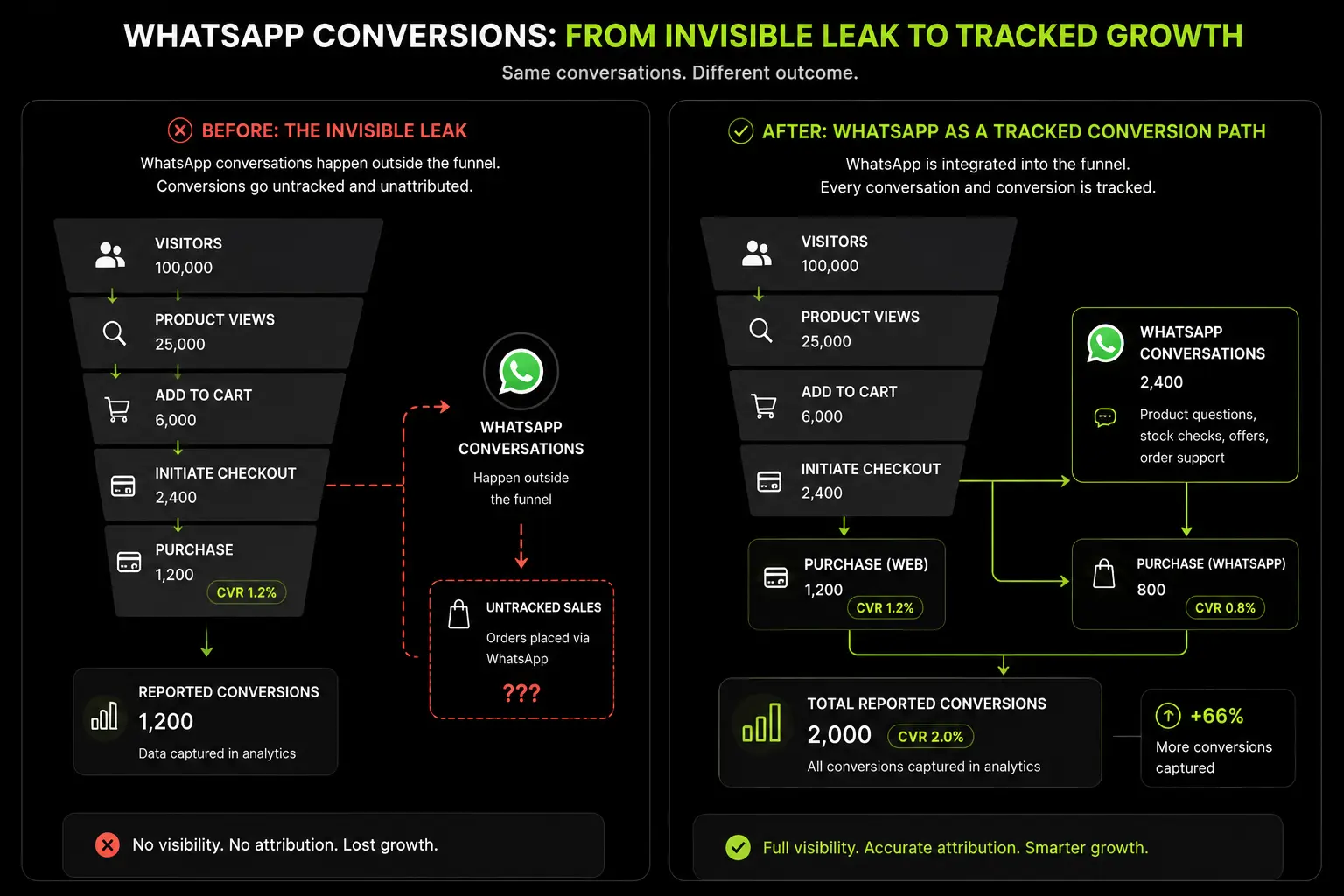
In many GCC stores, a substantial share of orders, reportedly 30% to 50% in some cases, closes through WhatsApp conversation rather than completing through the on-site checkout flow.
A customer browses the storefront, messages a question about sizing or delivery timing on WhatsApp, and completes the purchase directly in that chat thread rather than returning to click through checkout.
If a store's tracking setup, Meta Pixel, Conversions API, doesn't account for this pattern, retargeting and attribution data becomes materially inaccurate.
A brand can spend weeks "optimising" ad spend against a pixel that's structurally blind to a huge share of its actual conversions, because those conversions never triggered a purchase event on the website at all.
Here's the practical contrast worth understanding. A store that treats WhatsApp as an informal side-channel, untracked and unattributed, is quietly eroding its own paid media efficiency without realising it, campaigns get judged against incomplete data, budget gets reallocated away from channels that are actually working, and the whole optimisation loop runs on a partial picture.
A store that builds WhatsApp into the funnel and attribution model deliberately, logging WhatsApp-originated conversions back into the same reporting layer as on-site purchases, protects the accuracy of every downstream decision made from that data.
Google Shopping Feed Quality And Meta CAPI Deduplication
This matters more in the GCC context specifically than in most Western markets, for a few concrete reasons.
SAR and AED multi-currency catalogues, frequent promotional pricing swings during Ramadan, EOSS and White Friday periods and commonly stacked tracking plugins across a typical GCC Shopify or Salla setup all tend to cause duplicate conversion events firing across platforms simultaneously.
The practical result: ROAS reporting gets quietly inflated or misattributed, and a campaign that looks profitable on paper may not actually be, once the duplicate events are stripped out.
A short, practical checklist applies here regardless of which platform, Shopify, Salla, or Zid, a brand ultimately chooses:
- Accurate GTINs and live pricing in the feed: A Google Shopping feed with stale pricing or missing product identifiers gets suppressed or de-prioritised, quietly cutting off a discovery channel without any obvious error message pointing to the cause.
- A single source of truth for the Purchase event:. When both a native platform pixel and a third-party tracking app fire the same Purchase event independently, without deduplication logic between them, reported conversions inflate, sometimes significantly, and every ROAS number downstream becomes unreliable.
- Deduplication logic tested before scaling ad spend: Confirm the setup with real test transactions before committing a meaningful budget behind numbers that haven't been verified as accurate.
As a Meta and Google Partner working across Shopify and GCC-native platforms, we treat feed and CAPI setup as part of the platform decision itself, not an afterthought bolted on once ads are already live and the reporting has already been misleading a media budget for months.
Which Platform Fits Which Kind Of Brand
Feature comparisons only get a founder partway there. Here's the actual decision framework, matched to growth stage and market ambition rather than a flat "platform X is better" conclusion.
Saudi-First, Fast Local Launch, Limited Technical Resource
Salla's native local integrations meaningfully reduce setup friction and time-to-market for this profile. A brand launching primarily into the Saudi market, with a small team and no dedicated technical resource to manage app-stacking, benefits directly from Mada, STC Pay, ZATCA compliance.
All local shipping all working together without separate configuration. This is the scenario where Salla's core value proposition is strongest and most defensible.
UAE-First Or Gulf-Wide From Day One
Shopify generally offers the more consistent path here, given Salla's still-developing reach outside Saudi Arabia and Shopify's stronger multi-currency, multi-market tooling through Shopify Markets.
A brand planning to launch across UAE, KSA, Kuwait, and Bahrain simultaneously, or UAE-first with Gulf expansion planned within the first year or two, needs infrastructure built for that multi-market complexity from the start, and that's where Shopify's toolset currently has the deeper, more mature answer.
Cross-Border Ambition (GCC Plus UK/US/Wider International)
Shopify's app ecosystem and design flexibility become the deciding factor once a brand's needs extend beyond any single regional platform's core strength.
A brand with genuine ambitions beyond the Gulf, selling into the UK, US, or wider international markets alongside its GCC presence, needs a platform built for that scope from day one, rather than adding international complexity onto a platform whose strongest infrastructure was built for a single regional market.
Avoid the flat "Shopify is better" or "Salla is better" conclusion that most comparison content collapses into.
The honest answer depends entirely on which market a brand is actually building for first, and pretending there's one universally correct choice misleads more founders than it helps.
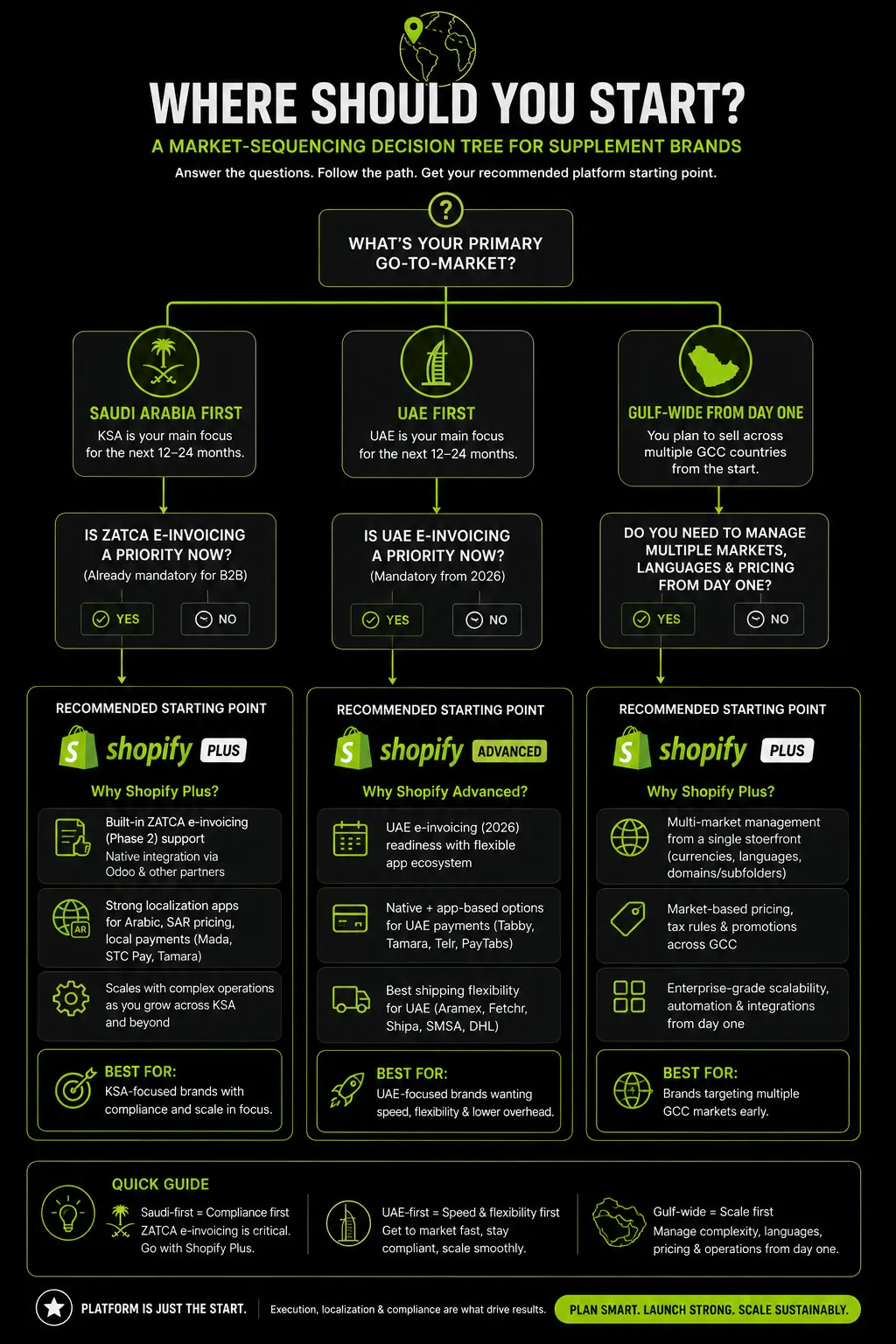
Suplex's Approach To Platform Selection In The GCC
We start with your market strategy, not a platform recommendation. The first question is whether you're launching Saudi-first, UAE-first, or across the GCC simultaneously. That decision shapes the platform.
Our Shopify Partner status doesn't mean we recommend Shopify for every brand.
- Saudi-first brands with limited technical resources often benefit from Salla's native local integrations.
- If Salla is the better fit, we'll recommend it, even though we don't build on it ourselves.
- We prioritise the right platform over selling our own services.
As a Meta and Google Partner, we also evaluate your marketing infrastructure from day one, including:
- WhatsApp attribution
- Product feed quality
- CAPI deduplication
- Conversion tracking
Ignoring these factors often creates expensive attribution problems once paid media scales. Many brands only discover inaccurate ROAS reporting six months later, when they're making significant budget decisions.
Platform selection in the GCC is as much a market-sequencing decision as a technical one. Getting the sequencing wrong usually costs far more in wasted setup time and future replatforming than fixing a few technical issues after launch.
What If You've Already Launched On The Wrong Platform For Your Market
This scenario comes up more often than either platform's own marketing acknowledges. A brand launches on Salla because it was the fastest path to a Saudi-first launch, then finds itself expanding into the UAE a year later with infrastructure that wasn't built for that expansion.
Or a brand launches on Shopify with no Saudi-specific plans, then discovers real demand in the Kingdom and has to decide whether to bolt on ZATCA compliance and Mada support through apps, or consider a parallel Salla presence for that market specifically.
Neither situation is a crisis, but both deserve a deliberate decision rather than an accidental one made under launch-timeline pressure. A few practical considerations for a brand in this position:
- Assess whether the gap is infrastructure or just configuration: Sometimes what looks like a platform limitation is actually a missing app or an unconfigured Shopify Markets setting, not a genuine platform ceiling. Confirm which case you're actually in before assuming a migration is necessary.
- Weigh a parallel setup against a full migration: For a Saudi-first brand expanding into the UAE, running a UAE-specific Shopify presence alongside an existing Salla store may be more practical than migrating the entire Saudi operation off a platform that's already working well there. The right call depends on how unified the brand experience needs to be across markets versus how much operational complexity a dual-platform setup introduces.
- Don't let sunk cost drive the decision: A brand that invested significant time building out a Salla store shouldn't feel locked into staying there for a market Salla wasn't built to serve as strongly, just because switching feels like wasted prior effort. The cost of staying on the wrong platform for a specific market usually compounds faster than the cost of a well-planned migration.
This is exactly the kind of decision that benefits from an outside, platform-agnostic assessment rather than advice from whichever platform's sales team happens to be in the room.
Choosing Between Shopify and Salla For UAE And Gulf-Wide Brands
The whole piece so far has centred on the GCC comparison broadly. Here's the focus sharpened specifically for brands whose primary or first market is the UAE rather than Saudi Arabia.
Shopify Is The More Dependable UAE Starting Point Today
For a brand whose primary or first market is the UAE rather than Saudi Arabia, Shopify is generally the more dependable starting point today.
Salla's reach into the UAE is real and growing, but it remains less mature than its Saudi presence, fewer local carrier integrations, a smaller UAE-specific merchant support base, and less battle-tested infrastructure for the specific payment and delivery patterns that define UAE ecommerce.
This isn't a permanent judgement, Salla's regional expansion is ongoing and worth reassessing over time, but as of today, a UAE-first brand choosing Salla is choosing a platform whose deepest strength lies in a different market than the one it's launching into.
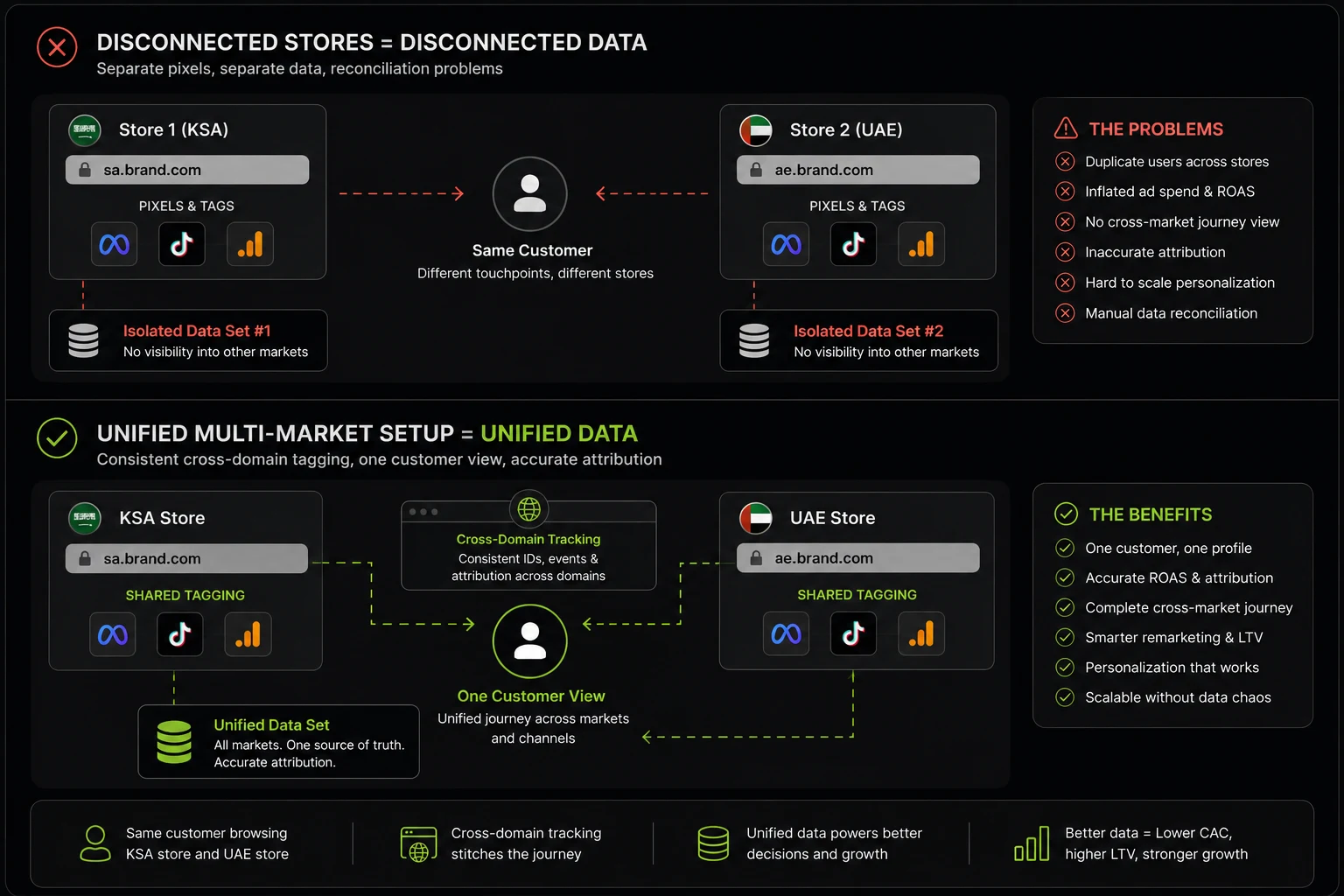
Running SAR And AED Operations Together Needs A Deliberate Tagging Strategy
Brands running simultaneous SAR (Saudi) and AED (UAE) operations need a clear, single-platform, cross-domain tagging approach rather than two disconnected stores each running two separate pixels.
This fragmented pattern, common when a brand grows organically into both markets without planning the infrastructure upfront, reportedly causes real reconciliation problems between finance and marketing teams down the line.
Revenue reported in the store doesn't cleanly match what marketing is optimising against, because the two markets were never unified under one measurement framework from the start.
COD Remains A Gulf-Wide Constant, Regardless Of Platform
COD remains a significant Gulf-wide payment preference across both platform ecosystems and it needs to be planned for consistently regardless of which platform a brand chooses, not treated as a market-specific add-on bolted onto one region and forgotten in another.
A brand running UAE and Saudi operations together needs COD handled with the same rigour in both markets, not as an afterthought that only got proper attention in whichever market launched first.
Arabic Is Table Stakes On Both Platforms Now
Arabic-English bilingual experience is genuinely table stakes on both platforms at this point in 2026. The differentiator between Shopify and Salla is no longer "which platform speaks Arabic," both do this competently now, it's "which platform supports the brand's actual growth sequencing" over the next two to three years.
Founders spending significant evaluation time comparing Arabic language quality between the two platforms are often asking the wrong question; the real gap lies in market scope and infrastructure depth, not in bilingual capability.
We've advised UAE and Gulf-wide brands on this exact decision repeatedly, combining Shopify Plus implementation with the local payment, WhatsApp commerce, and attribution considerations that matter most for this market, as a Shopify, Meta, and Google Partner based in Dubai working across the region.
Frequently Asked Questions
Is Salla like Shopify?
Broadly yes, both are hosted ecommerce platforms for building an online store. The key difference is scope and market focus: Salla is Saudi-native with pre-built local payment, shipping, and tax compliance integrations, while Shopify is a global platform with a much larger app ecosystem and greater design customisation depth.
Can Salla be used outside Saudi Arabia?
Salla's reach extends into the UAE and Egypt, but its strongest integrations and market presence remain Saudi-focused. A brand building primarily for the UAE or Gulf-wide from the start typically finds Shopify a more consistent fit today, though this is worth reassessing as Salla's regional reach continues to grow.
Does Shopify support Saudi payment methods like Mada and STC Pay?
Yes, but generally through third-party apps rather than native integration, unlike Salla and Zid where these are built in. This isn't a blocker, but it does mean additional setup and app management that a Saudi-first brand won't need to think about on a local-native platform.
Which platform is better for paid advertising and tracking accuracy?
Neither platform inherently guarantees accurate tracking, the deciding factor is proper Meta CAPI deduplication, Google Shopping feed quality, and accounting for WhatsApp-based conversions in the attribution model. This setup work matters more than the platform choice itself for GCC brands running significant paid media.
Is Shopify more expensive than Salla?
Pricing structures differ enough that a direct comparison depends on store size and feature needs. Salla often bundles more GCC-specific functionality into its base plans, while Shopify's pricing scales with added apps for equivalent local functionality. Total cost should be compared inclusive of the apps a Shopify store would need to match Salla's native features.
What is ZATCA Phase 2 and does it affect platform choice?
ZATCA Phase 2 is Saudi Arabia's e-invoicing compliance requirement. Salla and Zid generally support this natively, while Shopify merchants typically need a third-party app for compliant e-invoicing. This matters specifically for Saudi-registered businesses and is worth confirming directly with a platform or implementation partner before launch.
Should a UAE brand use Salla or Shopify?
For a UAE-first or Gulf-wide brand, Shopify is generally the more dependable choice today, given its stronger multi-currency and multi-market tooling and Salla's still-developing presence outside Saudi Arabia. This can shift brand to brand depending on specific market sequencing and channel strategy.
Hi, I’m Rishabh Jain
I believe great design has the power to shape perception, build trust, and move businesses forward. That belief is what led me to found Suplex Design Studio, a global branding and packaging studio working with FMCG and D2C brands across markets.I started suplex at 25 with a clear intent, to create design that is strategic, thoughtful, and commercially meaningful. By 28, the studio had scaled globally, guided by a strong foundation in Integrated Design that I developed during my academic journey in London, where I was honoured with the Dean’s Award.
Over the years, I’ve had the opportunity to work with 100+ brands, from Fortune 500 organizations to family-run businesses, helping them build packaging and brand systems that create recall, relevance, and long-term value.
Suplex’s work has been recognized internationally, including the Manifest Award (2024), the Clutch Global Award (2025), and features on platforms such as Packaging of the World, The Dieline, and the World Brand Design Society.
None of this would be possible without the people behind the work. I’m deeply grateful to the suplex team, whose commitment, creativity, and attention to detail turn ideas into meaningful brand experiences every day.
At the heart of my work is a simple philosophy, design should be intentional, honest, and built to last, and that continues to guide everything we create at suplex.























Let’s Make It Happen
E-Commerce Success Stories
%201.avif)






.avif)
.avif)
Build Your D2C Business The Right Way
Build It With Suplex.


