Is Shopify Suitable for B2B Ecommerce? (Honest Answer)
.avif)
Is Shopify Suitable for B2B Ecommerce? (Honest Answer)
Is Shopify Suitable for B2B Ecommerce? Shopify has become a viable platform for wholesale and B2B selling, and since April 2026, its core B2B tools are available across all paid plans rather than being limited to Shopify Plus.
That change has made older advice on Shopify B2B increasingly outdated. If you're evaluating Shopify for B2B ecommerce today, you need to separate the current capabilities from what the platform offered before 2026.
Why This Question Gets Contradictory Answers Right Now
Shopify’s B2B capabilities have changed enough that older advice can give you the wrong answer. Shopify previously positioned many of its native B2B features around Shopify Plus, which made the platform a weaker fit for businesses that needed wholesale pricing, company accounts, and buyer-specific purchasing workflows without a Plus subscription.
With Shopify expanding core B2B functionality to paid plans in April 2026, that limitation no longer applies in the same way. The real question now is whether Shopify’s native B2B features match the complexity of your wholesale operation.
The April 2026 Change That Split the Search Results in Two
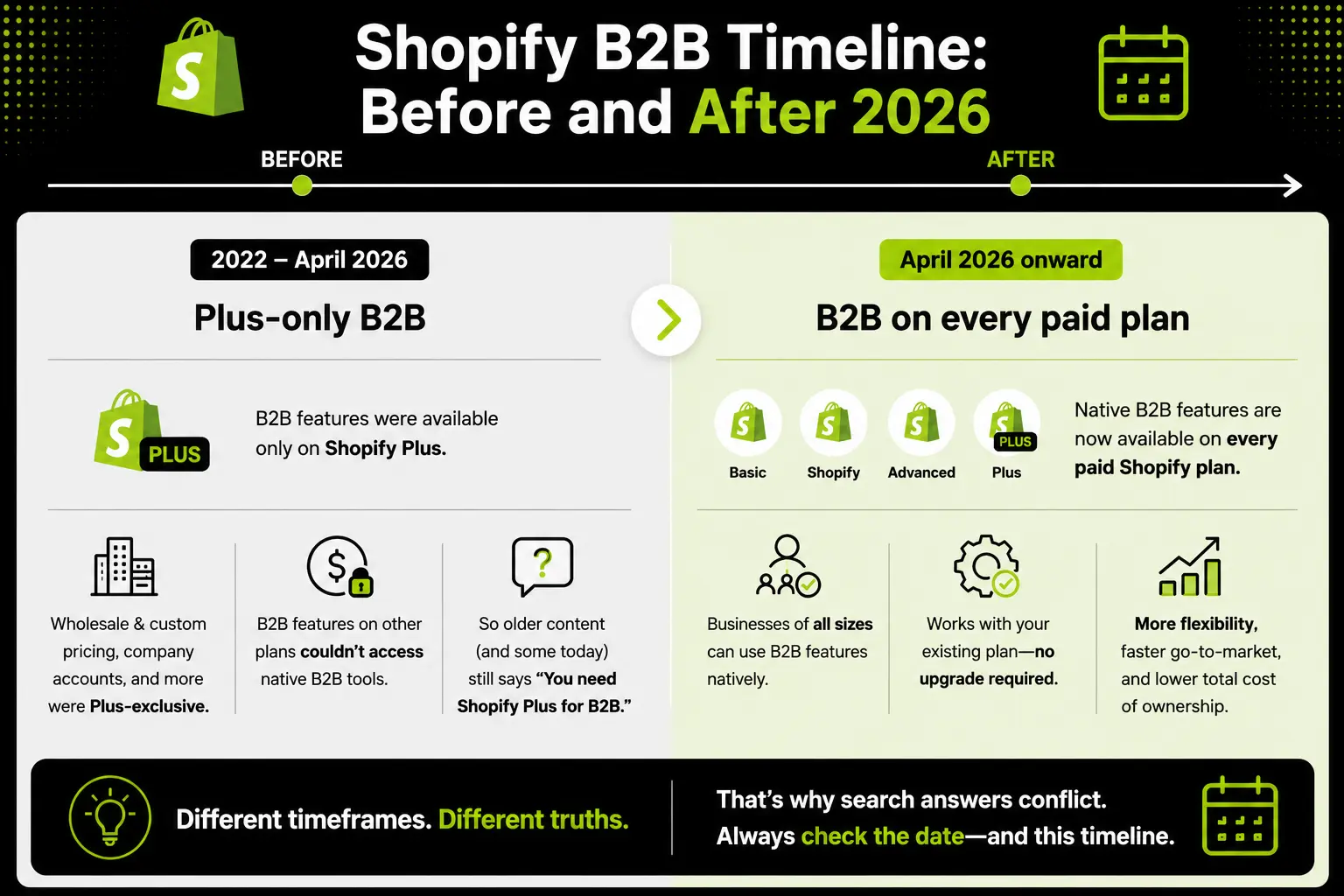
On April 2, 2026, Shopify moved its foundational B2B toolset off the Plus tier and onto every paid plan. Company profiles, custom price lists, volume pricing, net payment terms, and tax-exempt checkout stopped being a Plus perk and became a standard feature.
Before that date, running B2B on Shopify without Plus meant duct-taping apps together or accepting a clunky buyer experience.
Every article written before April 2026 that says "Shopify isn't built for B2B" was accurate when it was published. It just hasn't been updated.
How to Tell Whether the Advice You're Reading Is Already Outdated
Check the publish date first, always. If a post talks about B2B as a Plus-exclusive feature, or doesn't mention company profiles being available on Basic and Grow plans, it predates April 2026 and is describing a platform that no longer works that way.
A second tell: if the article recommends a third-party app just to get net payment terms or a company account structure, that's also outdated advice. Those two features ship natively now.
What Native Shopify B2B Actually Includes on Every Paid Plan
This is the part most competing content gets wrong, either by describing outdated Plus-only limits or by reading like a Shopify sales page. Here's what you actually get on Basic, Grow, and Advanced.
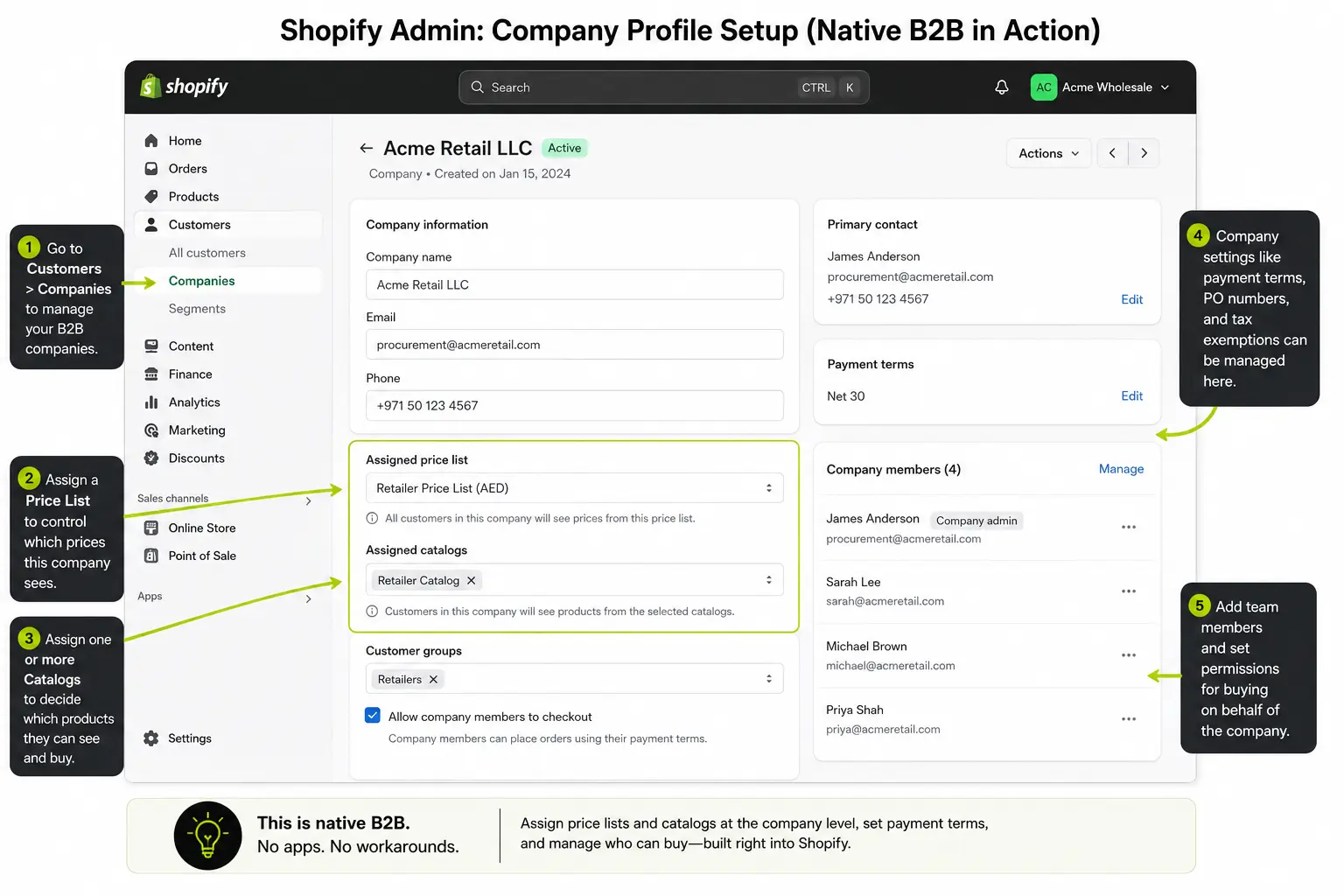
Company Profiles and Multiple Buyer Contacts Per Account
Each business buyer gets a company profile that can hold multiple individual contacts, so a purchasing manager and a warehouse lead can both order under one account with shared pricing and terms.
This replaces the old workaround of creating separate customer accounts for every employee at a client.
Custom Price Lists and Volume Discounts
You can set fixed prices per company, percentage discounts off your catalog, or quantity-based price breaks that kick in automatically at set order thresholds.
A distributor buying 500 units sees a different price than a boutique buying 20, without you touching a spreadsheet.
Net Payment Terms (Net 30 and Similar)
Business buyers can check out and pay later under agreed terms like Net 30 or Net 60, with the invoice tracked directly in Shopify's admin.
This is one of the two features (alongside company profiles) that most changed the "you need Plus for real B2B" argument.
Tax-Exempt Checkout for Resale Buyers
Verified resale or wholesale buyers can check out without sales tax applied, based on the exemption status attached to their company profile. You no longer need a manual override process or a separate tax app for this.
Up to Three B2B Catalogs
You can build up to three distinct product catalogs, each with its own pricing and publishing rules, and assign them to different company profiles. A retailer tier, a distributor tier, and a key-account tier fit comfortably within this limit.
A brand with three clean buyer tiers, say retail partner, regional distributor, and key account, sits right at the edge of the standard-plan limit without going over.
A brand layering regional pricing on top of those same three tiers usually needs a fourth catalog fast, and that's where standard plans start to strain.
Where the Limits Actually Bite on Standard Plans
Being upfront about the real constraints is what separates useful advice from a sales pitch. Here's where Basic, Grow, and Advanced plans actually fall short for B2B sellers.
The Three-Catalog Ceiling, Who Hits It and When
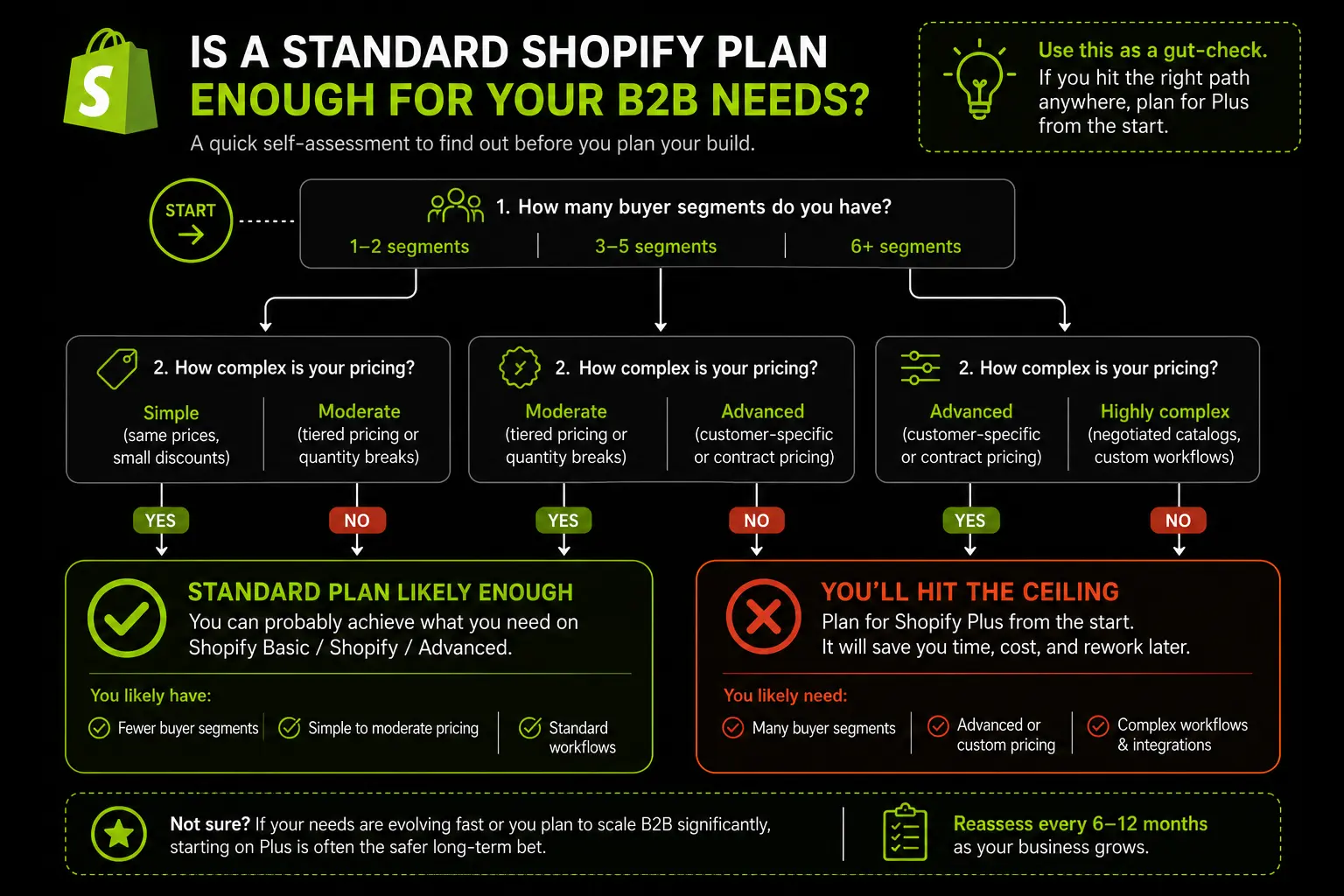
Three catalogs sounds generous until you combine buyer type with geography or negotiated rates. A brand selling to UAE distributors and UK stockists with different pricing for each already needs four catalogs at minimum. This is the single most common reason standard-plan B2B sellers upgrade.
No Wholesale Registration Form (Manual Buyer Addition Only)
Standard plans don't include a self-serve form where a new wholesale buyer can apply and get approved automatically.
You add every company profile manually from the admin, which works fine at low volume and becomes a bottleneck once inbound wholesale inquiries pick up.
No Bulk Order Form or CSV Cart Upload
Buyers can't upload a spreadsheet of SKUs and quantities to build a cart in one move. On standard plans, they add items one at a time through the regular product page, which is slow for anyone placing a 40-line repeat order.
No Customer-Tag-Based Pricing
Pricing on standard plans is tied to company profiles and catalogs, not to customer tags. If your current workaround for wholesale pricing relies on tagging customers, that approach doesn't carry over cleanly into native B2B.
B2B Catalogs Don't Work in Shopify POS
If you also sell to business buyers in person, at a trade show or through a showroom, your B2B catalog pricing won't show up at the point of sale on standard plans. Staff would need to apply wholesale pricing manually at checkout.
What's Still Shopify Plus-Only
Some B2B capability genuinely stayed behind the Plus paywall, and knowing exactly what those are makes the upgrade decision a lot clearer.
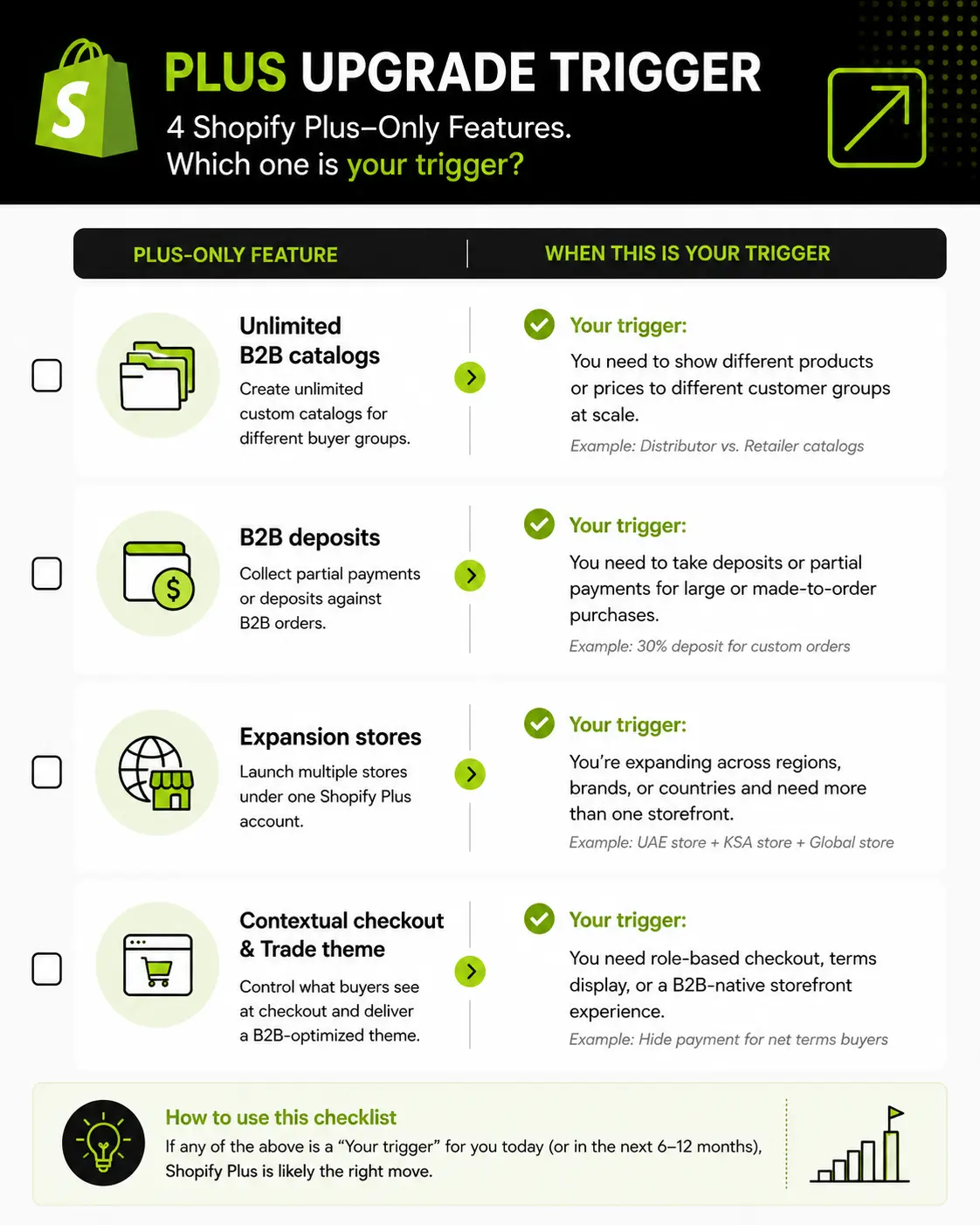
Unlimited Catalogs and Direct Catalog-to-Company Assignment
Plus removes the three-catalog cap entirely and lets you assign catalogs directly with more granular control over which company sees which pricing. This is the fix for the ceiling problem covered above.
Partial Payments and Deposits
Only Plus supports collecting a deposit at checkout with the balance due later, which matters most for custom manufacturing, made-to-order goods, or large equipment sales where full payment upfront isn't realistic.
Expansion Stores for Multi-Region or Multi-Brand Operations
Plus allows spinning up expansion stores that share back-end infrastructure but run as distinct storefronts for different regions or sub-brands. Standard plans keep you on a single storefront, which is fine until you're actively running separate B2B operations in separate markets.
Contextual Checkout Customization and the Dedicated Trade Theme
Plus gives you Shopify Functions-level control over checkout logic for B2B buyers specifically, plus access to the Trade theme built around wholesale buying patterns like quick reorder and saved carts. Standard plans use the same checkout and theme framework as your DTC storefront.
Shopify Plus carries enterprise-level pricing that sits well above standard plans, so weigh the upgrade against what these four features are actually worth to your order volume, not against Shopify's B2B feature list in general.
Filling the Gaps Without Upgrading to Plus
Before assuming Plus is the only path, it's worth pricing out what a targeted app or two can close on a standard plan.
What Third-Party B2B Apps Can (and Can't) Solve
Apps can add a wholesale registration form, bulk CSV ordering, and more flexible pricing rules on top of standard-plan Shopify. What they can't do is remove the three-catalog ceiling or add native deposit collection, since those are structural, not cosmetic.
When an App Stack Costs More Than Just Upgrading
Run the math before committing. A distributor stacking a registration app, a bulk-order app, and a pricing app to patch three separate gaps often ends up paying close to Plus-tier monthly cost anyway, while managing three vendor relationships instead of one plan.
Shopify Functions for Custom Quoting and Pricing Logic
If your only real gap is one specific pricing rule, like a quantity break that doesn't fit the standard tiers, a single custom Shopify Function or a narrowly scoped app usually closes that gap for far less than a platform upgrade.
Not Sure Whether Your B2B Setup Needs Plus or Just Better Configuration? Suplex has built and audited B2B storefronts on both standard Shopify plans and Shopify Plus for brands across the UAE and Gulf.
Book a platform consultation and we'll map your actual buyer segments against what Shopify can do before you spend a single extra dirham on the wrong tier.
Shopify B2B for GCC and Cross-Border Wholesale Sellers
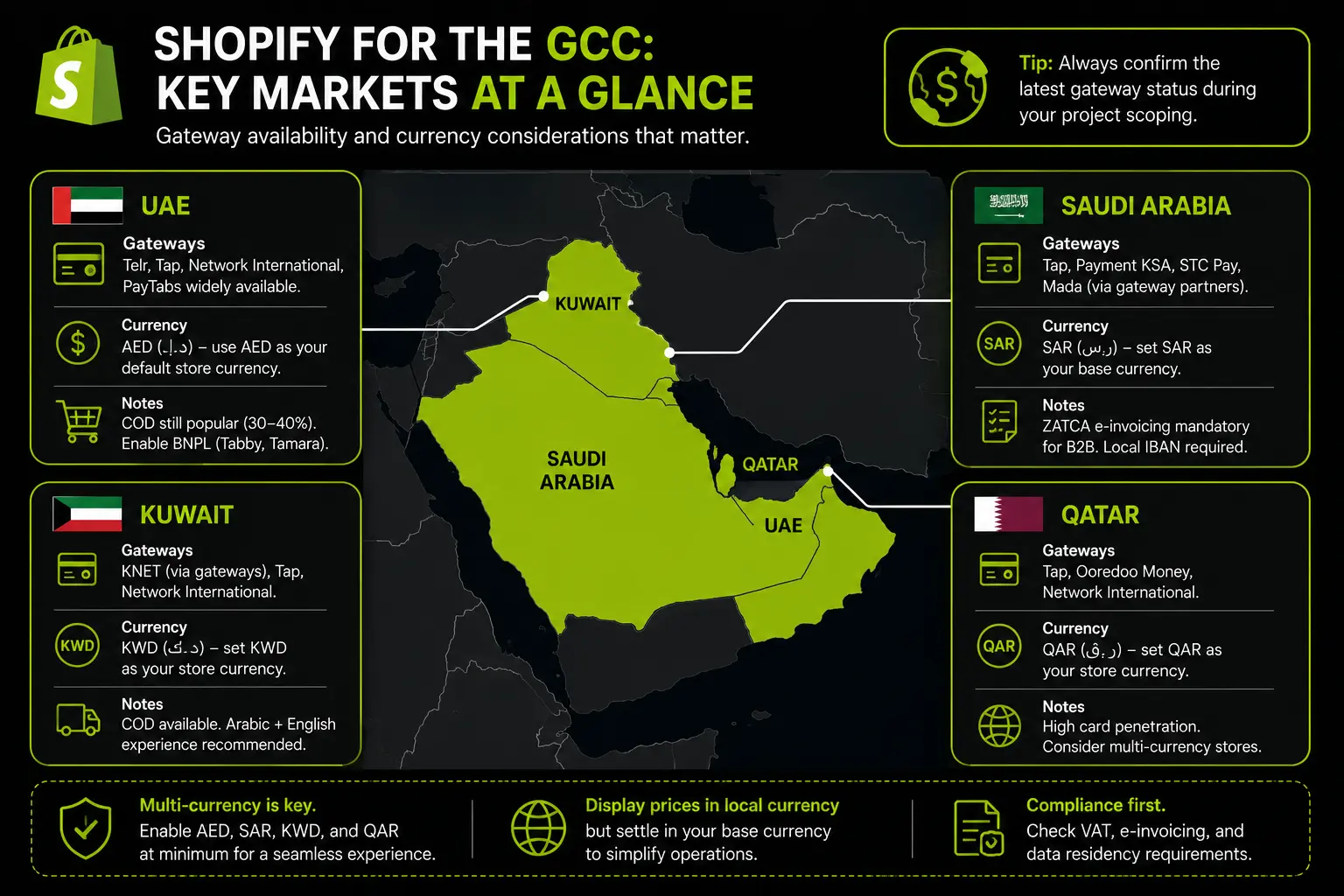
None of the competing content on this topic addresses the Gulf market specifically, which is a real gap for any brand selling wholesale into or out of the UAE.
Net Payment Terms and Company Accounts Against UAE Payment Gateway Realities
Shopify Payments doesn't operate in the UAE, so net payment terms depend entirely on whether your third-party gateway supports invoiced or delayed-payment flows for company accounts.
Confirm this with your gateway before assuming native B2B terms will work end to end. Our breakdown of UAE payment gateway options covers which providers actually handle this.
Multi-Currency B2B Pricing Across GCC Markets
Selling to buyers in the UAE, Saudi Arabia, and beyond usually means pricing in more than one currency, and B2B catalogs need to be set up correctly for each region. See our guide on setting up multi-currency on Shopify if you're building this out for the first time.
Arabic-Language B2B Buyer Portals, What's Actually Supported
Company profile pages and B2B account areas can be localized, but the depth of Arabic support varies by theme and by whether you're on the Trade theme (Plus only) or a standard theme. Our Arabic ecommerce design guide has the specifics on what renders correctly right-to-left and what doesn't yet.
How We Approach B2B Builds on Shopify at Suplex
The plan-tier decision should follow your actual buyer segmentation, not a default assumption that B2B automatically means Plus. We size this against real order data first.
At Suplex, we start every B2B engagement by mapping how many distinct buyer tiers a brand actually has, how pricing varies across them, and whether order volume justifies the deposit and expansion-store features that come with Plus.
Brands with two or three clean tiers and steady volume pricing often launch faster and cheaper on a standard plan than they expect.
For brands that outgrow the three-catalog ceiling or need multi-region expansion stores, we handle the Shopify Plus build directly, including custom Shopify theme work where the Trade theme needs adapting to a specific buyer workflow.
If you're weighing Shopify against dedicated B2B platforms or trying to figure out which plan tier actually fits your buyer base, book a call with Suplex and we'll walk through your specific catalog and pricing structure before you commit to anything.
A Simple Framework for Deciding If Standard Shopify B2B Is Enough
Match your situation against the table below before you commit to a plan tier.
Shopify vs. Dedicated B2B Platforms, When to Look Elsewhere
Shopify isn't the only option, and an honest comparison makes the eventual recommendation more credible rather than less.
Adobe Commerce (Magento): More Flexibility, More Overhead
Magento gives you deeper customization for complex B2B logic like tiered approval workflows, but it demands a dedicated dev team and ongoing hosting management that most mid-size brands don't want to carry. Our Shopify vs Magento comparison breaks down where that overhead actually shows up in cost and time.
BigCommerce: Comparable B2B Tooling, Smaller Ecosystem
BigCommerce's native B2B features are roughly on par with Shopify's, but its app ecosystem and theme marketplace are noticeably smaller, which limits how easily you can extend or customize the buyer experience later.
When a Blended DTC + B2B Store Beats a Separate Wholesale Platform
If your business sells to both consumers and wholesale buyers from the same product catalog, running both through one Shopify store keeps inventory, content, and operations in one place.
A separate dedicated B2B platform only makes sense once wholesale becomes the dominant share of revenue and needs workflows a blended store can't support.
Frequently Asked Questions
Does Shopify Support B2B Ecommerce Without Shopify Plus?
Yes, as of April 2026. Company profiles, up to three catalogs, volume pricing, and net payment terms are available on Basic, Grow, and Advanced plans. Bulk order forms, wholesale registration, and unlimited catalogs remain Plus-only.
What's the Biggest Limitation of Non-Plus Shopify B2B?
The three-catalog cap is the most common ceiling. It works for two or three simple buyer tiers but breaks down quickly with regional pricing, multiple negotiated rates, or several distinct buyer segments.
Can I Run DTC and B2B From the Same Shopify Store?
Yes. Shopify's native B2B model runs both from one store and one product catalog, with B2B buyers seeing custom pricing and terms through company profiles rather than needing a separate wholesale site.
Do I Need Shopify Plus for a Small Wholesale Operation?
Usually not. A handful of buyer tiers with straightforward volume pricing typically fits within standard-plan native B2B tools. Plus becomes necessary once catalog complexity or order volume outgrows the three-catalog limit.
Does Shopify B2B Support Partial Payments or Deposits?
No, not on standard plans, this remains Shopify Plus-only. Businesses needing deposit-based ordering, common in custom manufacturing or large equipment sales, need Plus or a third-party solution.
How Does Shopify B2B Compare to Magento or BigCommerce for Wholesale?
Shopify offers a stronger blended DTC and B2B experience with less overhead than Magento, while BigCommerce has comparable native tooling but a smaller app ecosystem. The right fit depends on existing infrastructure and customization needs.
Can UAE and GCC Businesses Use Shopify's B2B Features?
Yes, with regional considerations. Since Shopify Payments isn't available in the UAE, B2B payment flows depend on third-party gateway support for net terms and company billing, worth confirming with your gateway before committing to a plan.
Hi, I’m Rishabh Jain
I believe great design has the power to shape perception, build trust, and move businesses forward. That belief is what led me to found Suplex Design Studio, a global branding and packaging studio working with FMCG and D2C brands across markets.I started suplex at 25 with a clear intent, to create design that is strategic, thoughtful, and commercially meaningful. By 28, the studio had scaled globally, guided by a strong foundation in Integrated Design that I developed during my academic journey in London, where I was honoured with the Dean’s Award.
Over the years, I’ve had the opportunity to work with 100+ brands, from Fortune 500 organizations to family-run businesses, helping them build packaging and brand systems that create recall, relevance, and long-term value.
Suplex’s work has been recognized internationally, including the Manifest Award (2024), the Clutch Global Award (2025), and features on platforms such as Packaging of the World, The Dieline, and the World Brand Design Society.
None of this would be possible without the people behind the work. I’m deeply grateful to the suplex team, whose commitment, creativity, and attention to detail turn ideas into meaningful brand experiences every day.
At the heart of my work is a simple philosophy, design should be intentional, honest, and built to last, and that continues to guide everything we create at suplex.
































Let’s Make It Happen
E-Commerce Success Stories
%201.avif)






.avif)

.avif)
Build Your D2C Business The Right Way
Build It With Suplex.


