B2B Ecommerce Website Features: What Your Online Store Actually Needs to Convert Business Buyers
.avif)
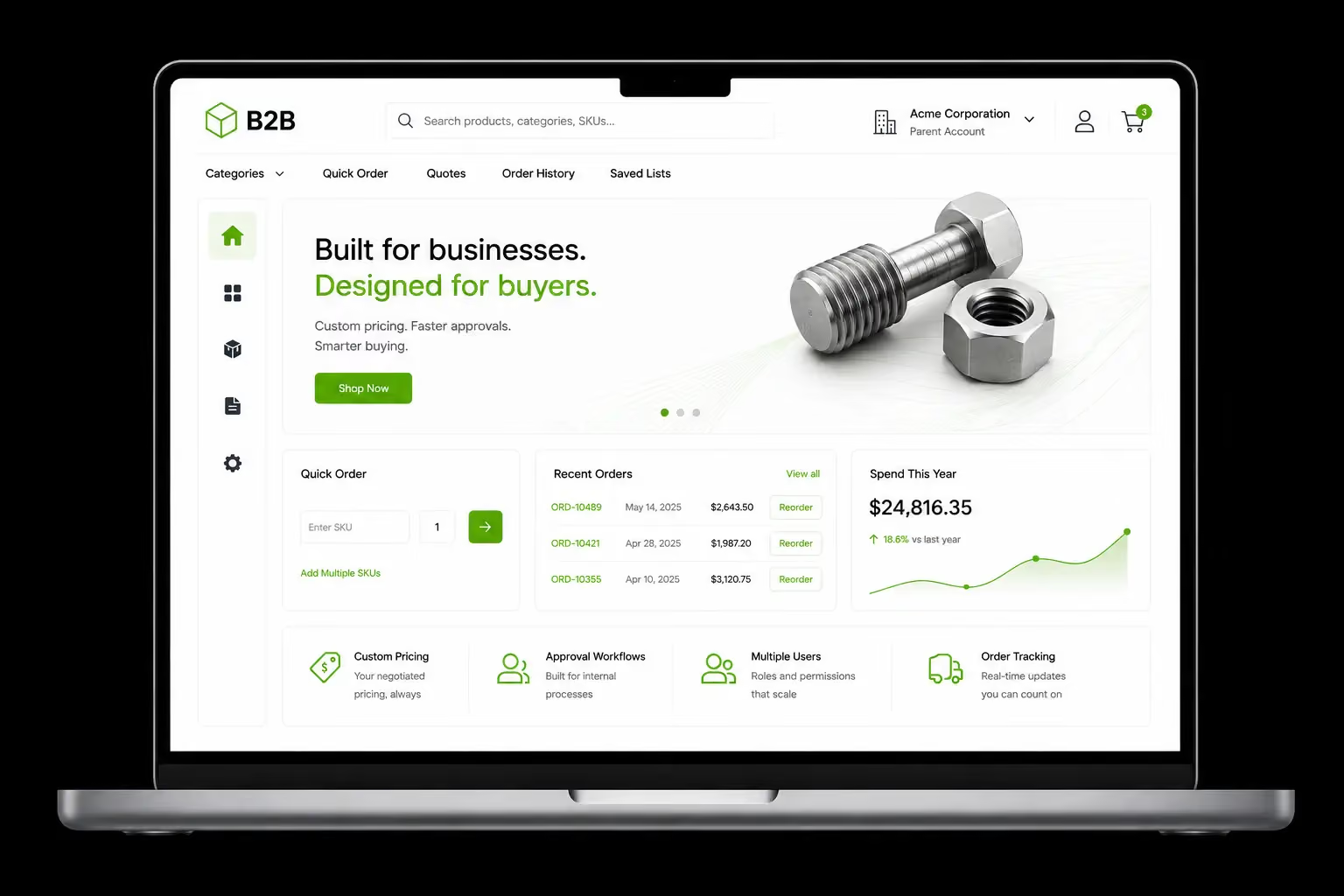
B2B Ecommerce Website Features: What Your Online Store Actually Needs to Convert Business Buyers
73% of B2B buyers now prefer digital channels over sales reps, yet most B2B ecommerce sites still mimic B2C stores with a wholesale label.
A basic product grid, cart and discount field fail to meet real buyer needs, killing conversions early.
B2B ecommerce requires account-based access, customer-specific pricing, bulk ordering, RFQ workflows, ERP integration and a self-service portal as baseline features. Everything beyond that is what drives long-term growth.
Why B2B Ecommerce Features Are a Different Problem Than B2C
Understanding why B2B requires a fundamentally different approach helps prevent one of the most common and costly mistakes in B2B ecommerce: building a consumer store and calling it wholesale.
The B2B Buyer Is Not a Consumer: They Are a Procurement Decision
B2B buyers are professionals making decisions under constraints like budgets, approvals, and compliance. They reorder frequently at negotiated prices, so the website must prioritise speed and efficiency over browsing.
The buying cycle is longer and involves multiple stakeholders. At the same time, modern buyers expect smooth, consumer-grade UX alongside enterprise functionality. If that is missing, they fall back to email, WhatsApp, or calls.
With most B2B interactions moving online, platforms must be built for procurement, not inspiration. Sites like Grainger succeed by focusing on fast search, account-level ordering, and operational efficiency rather than visual appeal.
The Two-Tier Feature Problem: Table Stakes vs. Strategic Advantage
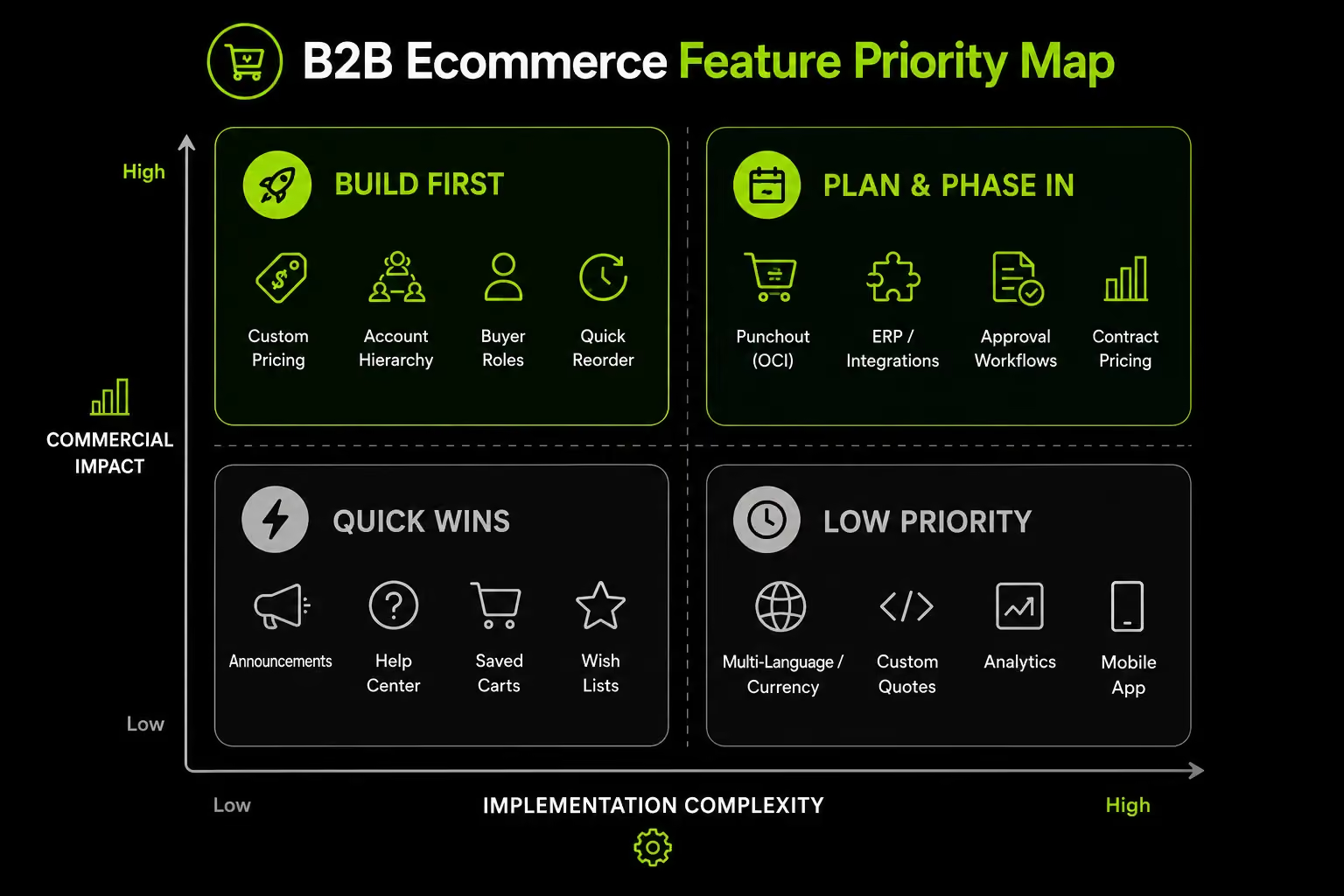
Most B2B ecommerce guides list 20+ features without telling you which ones matter first. Before any platform is selected or development scoped, features need to be evaluated across two tiers:
Build the table stakes first. Layer in differentiators as your digital buyer volume and budget justify the investment.
Launching with everything simultaneously is how B2B ecommerce projects go over budget, over timeline, and under-perform at launch because the fundamentals were not right.
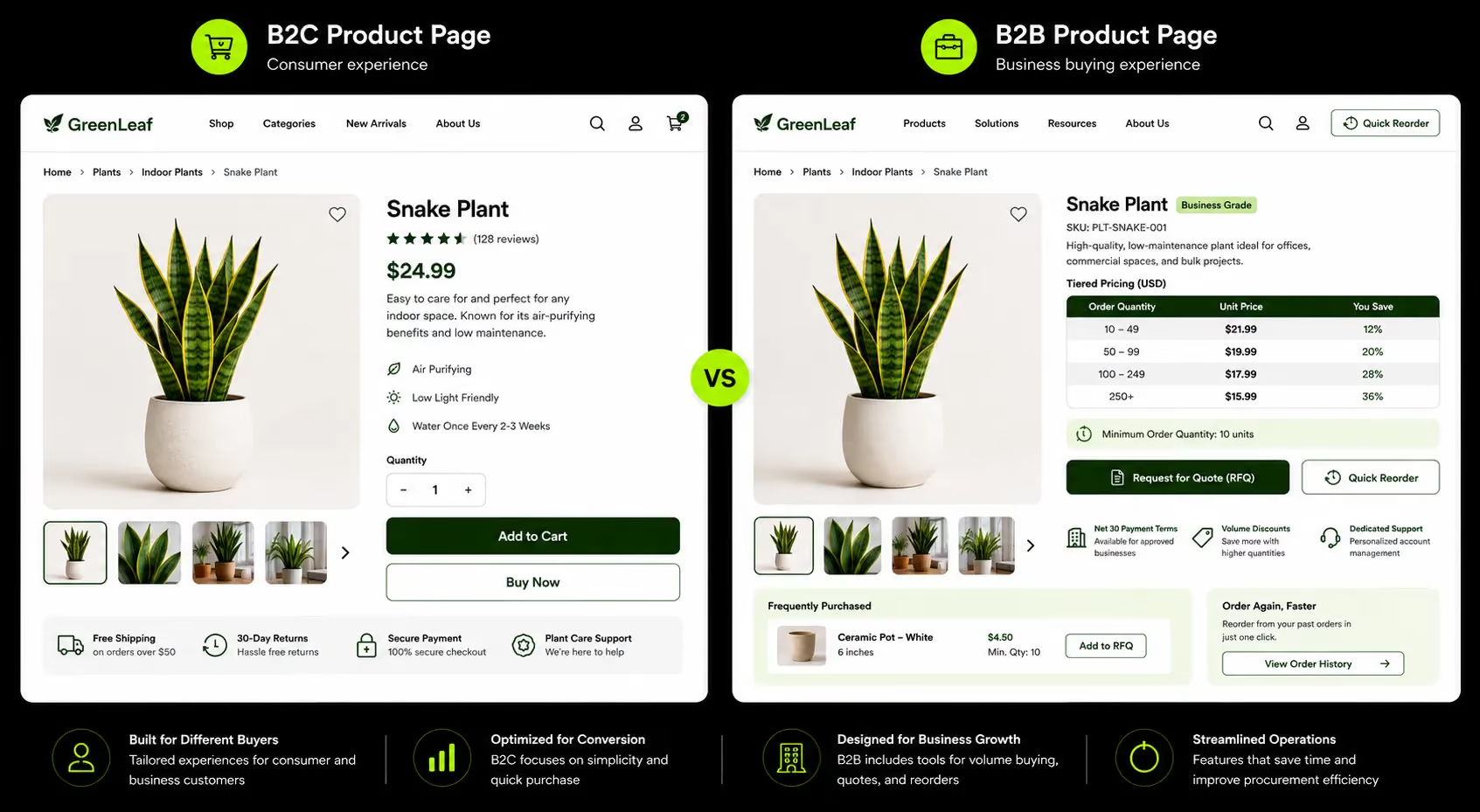
10 Core Features Every B2B Ecommerce Website Needs
These are the table stakes. A B2B store without all ten of these is either losing deals to competitors who have them or pushing buyers back into offline ordering channels.
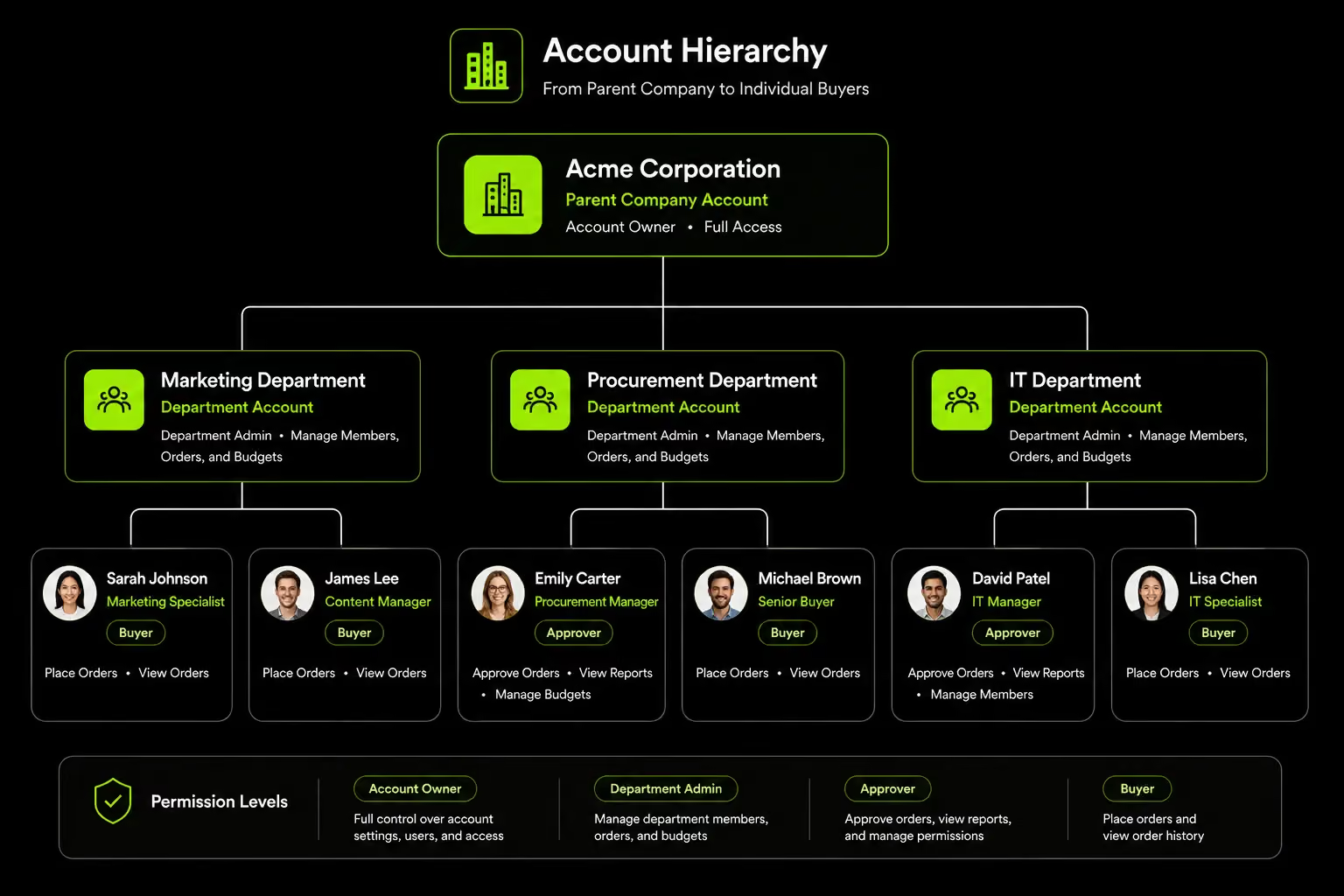
1. Account-Based Access and Company Account Hierarchy
A B2B buyer does not shop as an individual. They shop as a representative of a company and their company may have multiple departments, multiple buyers and internal approval requirements.
Account-based access is the architecture that makes the rest of B2B ecommerce possible. Without it, a procurement manager cannot delegate ordering authority to a junior buyer without sharing credentials.
A finance team cannot see consolidated order history across departments. A company with 12 buyers across three offices has 12 individual accounts with no connection between them.
What good implementation looks like:
- Parent company account with child sub-accounts per department or location
- Role-based permissions: view-only, order-only, approve orders, account admin
- Spend limits per user or per role with automatic enforcement
- Centralized invoice and order history per company not per individual login accessible to the account admin
2. Custom and Tiered Pricing Per Customer or Segment
This is the most cited reason B2B companies fail at ecommerce. When every buyer sees the same price a small retailer and a major distributor on the same page with the same number both lose confidence.
The distributor knows their negotiated rate is better and wonders whether the site is accurate. The small retailer sees a price that may not actually be available to them. Both bounce.
Tiered pricing is not just about fairness. It is about reflecting the actual commercial relationships your business has built offline and bringing them into the digital channel.
What good implementation looks like:
- Login-gated pricing, no price displayed before authentication
- Tiered pricing by volume: MOQ brackets (1 – 49 units, 50 – 199 units, 200+)
- Customer-segment pricing: Gold, Silver, Standard account tiers with different rate cards
- Contract-specific fixed pricing synced directly from ERP for key accounts
What poor execution looks like: A Dubai-based FMCG wholesaler launches a Shopify store with a flat price list applied to all customers. Their top ten distributors who receive 25% better pricing through their offline agreements abandon the portal and continue ordering by WhatsApp.
The site records negligible orders for 18 months. The problem is not the platform. It is that the platform was not configured to reflect the actual commercial reality of the business.
Companies using account-based pricing in their ecommerce experience up to 30% higher reorder rates than those using undifferentiated pricing (Forrester B2B Commerce Survey, 2024).
3. Request for Quote (RFQ) and Quote-to-Order Workflow
Not all B2B transactions can be priced upfront. New customer relationships, complex orders with specific delivery requirements, high-value deals with negotiated terms all of these need a structured negotiation layer before a price is confirmed.
Without an RFQ workflow built into the platform, the buyer calls your sales team. That is where ecommerce loses its efficiency argument entirely.
What good implementation looks like:
- Buyer submits an RFQ with product specifications, quantities, delivery date, and any special requirements from within the portal
- Quote is routed to the correct sales or pricing team with notification
- Negotiated quote is returned inside the portal not via email
- One-click quote acceptance converts directly to a live pending order
- Complete quote history visible to both buyer and sales team
At Suplex, we have built RFQ workflows for clients across manufacturing and distribution in the Gulf. The most consistent mistake we see is routing quotes back via email.
It breaks the digital flow and pushes buyers into exactly the offline channel you are trying to replace. Keep the entire quote-to-order cycle inside the platform. Every external handoff is a potential dropout point.
4. Bulk Ordering and Quick Order Tools
A procurement manager placing an order for a hotel supply chain does not want to navigate 47 product pages. They know exactly what they want and in what quantity. The job of the B2B ecommerce site is to get out of their way.
What good implementation looks like:
- Quick Order Pad: enter SKU and quantity directly, add all to cart in one action
- CSV or spreadsheet upload for orders built externally
- Saved order templates for recurring weekly or monthly purchases
- One-click reorder from order history with editable quantity before confirmation
Grainger has made bulk ordering their primary UX paradigm. Their search bar functions as a direct quick-order interface: enter a part number, get the result, add to cart, done.
The friction between "I know what I want" and "it is in my cart" is near zero. That is the benchmark for B2B ordering UX.
5. Flexible Payment Options and Net Payment Terms
B2B buyers rarely pay by credit card at checkout. They operate on invoice cycles with payment terms negotiated as part of the supplier relationship.
A B2B ecommerce site that offers card-only checkout is not built for business buyers regardless of how well-designed everything else is.
What good implementation looks like:
- Pay by Purchase Order with PO number captured at checkout
- Net terms (30, 60, or 90 days) with per-account credit limits
- Invoice generation and download from the buyer portal
- Multi-currency support critical for any UAE or Gulf B2B operation
- Bank transfer workflows for large orders
For Gulf B2B specifically: many buyers operate on Letter of Credit or post-dated cheques for high-value transactions.
A platform that cannot accommodate these mechanisms creates an immediate barrier to adoption among exactly the enterprise buyers you most want to digitise. Currency support across AED, SAR, KWD, and USD is a baseline requirement not a premium feature for any GCC B2B play.
6. Self-Service Buyer Portal
Every call to your sales or support team about order status, invoice queries or shipment tracking costs money. A self-service portal that lets buyers handle these themselves reduces that overhead while simultaneously improving the buyer experience.
Most modern procurement managers, particularly Millennials and Gen Z buyers who now represent the majority of B2B purchasing roles, actively prefer not to contact a sales rep for routine account management.
What good implementation looks like:
- Full order history with one-click reorder and editable quantities
- Invoice download and payment status visible per invoice
- Real-time shipment tracking linked per order
- Account management: billing address updates, approved user management, spend limit visibility
- Notification preferences for order confirmation, dispatch, and delivery
Businesses with functioning self-service portals report a 30 – 40% reduction in customer service contacts related to order status (Salesforce Commerce Cloud research, 2024).
That reduction translates directly into lower operational cost and faster response times for the queries that actually require human attention.
7. Advanced Catalog and Product Information Management
A B2B product catalog is not a list of products with a photo and a description. It is a technical reference that buyers use to make procurement decisions.
They need dimensions, certifications, lead times, compatibility specifications, safety data sheets, and compliance documentation not marketing copy.
What good implementation looks like:
- Customer-specific or segment-specific catalog visibility a buyer only sees the products relevant to their account or category
- Product-level data sheet and PDF downloads accessible from the product page
- Technical attribute filtering filter by specification, not just category
- Variant and configuration support for complex or customizable products
- Real-time inventory visibility per SKU buyers need to know if stock is available before committing to a delivery timeline
8. ERP and CRM System Integration
Without ERP integration, your ecommerce platform is showing buyers prices and inventory information that may be hours or days out of date.
A buyer places an order for 500 units at a price that was superseded by a new contract negotiated last week.
Your warehouse picks the order, then discovers the product is out of stock. Both scenarios destroy trust and trust in B2B is the hardest thing to rebuild once lost.
What good implementation looks like:
- Real-time inventory sync from ERP to storefront stock levels accurate to the minute
- Customer-specific pricing pulled directly from ERP for key accounts
- Order confirmations and status updates synced back to ERP automatically
- CRM-connected account pages buyers see their credit status, assigned sales representative contact, and relationship history
ERP integration is where B2B ecommerce projects most commonly stall, go over budget, or get descoped. The platform may support it technically but the implementation requires careful mapping of data structures between two systems that were not designed to communicate with each other.
We have managed projects where ERP integration alone consumed 40% of total development time and budget. Plan for it correctly at the scoping stage, not after you have already committed to a fixed-price contract that excluded it.
9. Mobile-First Design for Field Sales and Buyers
In the Gulf market, mobile commerce is the default, not a secondary channel. A procurement manager visiting a supplier's warehouse is checking stock availability and placing reorders from their phone.
A field sales rep is placing customer orders from a site visit. A retail buyer at a trade fair is requesting a quote on their handset. If the mobile experience is slow, cluttered, or difficult to navigate for bulk ordering, all of these buyers default back to WhatsApp or phone calls.
What good implementation looks like:
- Fast-loading, lightweight mobile pages Core Web Vitals passing on mobile, not just desktop
- Bulk ordering tools adapted for touch interfaces not just a desktop quick order pad shrunken to mobile width
- Touch-optimized account management and invoice access
- Progressive Web App (PWA) capability for field sales reps who need offline access to catalogs and order history
10. Approval Workflows and Purchase Order Management
Most medium-to-large B2B buyers have internal procurement policies. Purchase orders above a defined value need manager sign-off before they are confirmed.
If your platform does not accommodate this, buyers build workarounds email approval chains, manual hold processes that undermine the efficiency case for the digital channel and create audit trail gaps for their finance teams.
What good implementation looks like:
- Configurable approval thresholds per account orders above AED 50,000 require manager sign-off, for example
- Email notifications to designated approvers with full order detail
- In-portal approver view no requirement to log into the main buyer account
- Orders held in pending status automatically until approval is given or rejected
- Full approval history retained for procurement audit purposes
Features That Separate Good B2B Stores from Great Ones
Once the table stakes are solid, these features create the commercial differentiation that drives loyalty, reduces churn, and increases lifetime value per account.
AI-Powered Reordering and Predictive Replenishment
The most commercially valuable application of AI in B2B ecommerce is not a chatbot. It is predicting when a buyer is about to run out of stock and surfacing that before they notice the problem themselves.
A platform that surfaces "You typically reorder Product X every six weeks it has been five weeks since your last order" creates genuine operational value for the buyer. It reduces the risk of stockouts on their end.
It drives reorders you might not have received otherwise. And it signals that your platform understands their business, which is the foundation of a sticky supplier relationship.
The commercial extension of this is predictive replenishment, the platform automatically generating a draft order based on purchase patterns, which the buyer simply reviews and approves.
The interaction time drops from 15 minutes to 30 seconds. For a buyer managing relationships with 40 suppliers, that efficiency difference determines who stays on the preferred vendor list.
Personalised Dashboards and Account-Level Analytics
A buyer's portal dashboard should reflect their account, their most-ordered products, their monthly spend trend, upcoming contract renewal dates, their assigned sales representative and open quotes awaiting review. Not a generic welcome screen.
When the portal functions as a business intelligence interface rather than just an order placement tool, buyers spend more time in it.
They trust it more. They rely on it. And reliance is the behavioural foundation of long-term supplier loyalty. The account that becomes operationally embedded in a buyer's workflow is the account that survives procurement reviews.
Multi-Storefront and Multi-Region Support
For Gulf-headquartered B2B brands operating across UAE, Saudi Arabia, Kuwait and Egypt, running separate platforms per market creates inconsistent buyer experiences, duplicated development cost, and fragmented data.
A single-platform multi-storefront architecture with one backend, market-specific storefronts solves all three problems.
Arabic-language storefront support, right-to-left interface design, and local payment gateway integration are specific requirements for GCC B2B that many internationally designed platforms still handle poorly.
Any platform selection for a Gulf B2B operation should be evaluated against these requirements explicitly not assumed.
Punchout Catalog Integration for Enterprise Procurement
Enterprise buyers, government entities, hotel chains, large corporations, healthcare networks are often required by internal policy to purchase through their own procurement software: SAP Ariba, Coupa, Jaggaer.
Punchout integration allows a buyer to access your catalog from within their own procurement system, build an order, and transmit it back to your platform without ever leaving their environment.
Without punchout integration, you are invisible to these buyers. They cannot add you as a vendor regardless of your pricing or product quality, because your catalog is not compatible with their procurement workflow.
In the UAE, government procurement increasingly runs on centralized digital procurement infrastructure. B2B vendors with public sector clients or aspirations need to treat punchout readiness as a strategic priority not a future consideration.
How We Approach B2B Ecommerce Development at Suplex
Our starting point is buyer behaviour, not platform selection. Before recommending technology or features, we map how customers discover, evaluate, get approval, place orders and reorder. The technology follows that process, not the other way around.
We have built B2B ecommerce experiences across FMCG, food and beverage, health and wellness, and specialty retail. A consistent pattern is that buyers only shift from phone or WhatsApp to digital when the experience genuinely makes their job easier.
The most common mistake in B2B ecommerce is treating it as a technology project instead of a buyer experience problem. A platform can support every feature, but without alignment to real workflows, it will still convert poorly.
Our process includes auditing existing ordering workflows to identify friction and remove it. We prioritise features based on commercial impact, focusing on what is essential versus what truly differentiates.
For UAE and Gulf clients, this also includes Arabic storefronts, multi-currency, PDPL compliance, and regional payment integrations from the outset.
We also offer structured B2B platform consultations before any development begins.
B2B Ecommerce Features by Platform: Shopify, Shopify Plus, and Custom Development
Platform choice determines which features you can implement natively, which require apps, and which require custom development. Here is an honest assessment of each tier.
Shopify B2B: Standard and Plus
Shopify's native B2B capabilities have expanded significantly. As of 2026, both standard and Plus plans include:
- Company accounts with multi-user access and role-based permissions
- Customer-specific pricing and payment terms
- Net payment terms (30/60/90 days) natively
- Draft orders for sales-assisted purchasing
- B2B-specific checkout experience
Shopify Plus adds custom checkout logic via Shopify Functions, Launchpad for campaign and sale management, dedicated merchant support, and multi-storefront capability via the Shopify Organisation.
The honest limitation: complex ERP integrations that require real-time bidirectional data sync typically need middleware or custom app development on top of the Shopify platform.
Punchout catalog integration is not native on any Shopify tier. It requires specialist app development. For straightforward B2B operations with standard feature requirements, Shopify Plus is the fastest and most cost-effective path.
When Custom Development Is the Right Answer
Custom development becomes necessary when:
- ERP integration requirements exceed what available app connectors can reliably handle particularly for real-time, bidirectional inventory and pricing sync with enterprise ERP systems
- Punchout catalog integration with SAP Ariba, Coupa, or Jaggaer is a requirement for serving enterprise or government buyers
- Catalog complexity involves highly specific product configuration logic, multi-level attribute inheritance, or dynamic pricing rules that no off-the-shelf app handles cleanly
- Approval workflow logic is sufficiently specific to your buyer segment that configuring a generic app creates more workarounds than it solves
- The cumulative workarounds required on an off-the-shelf platform exceed the cost of building the right architecture from the start
Platform Feature Comparison
B2B Ecommerce UX Principles: What the Interface Must Get Right
Features determine what a B2B site can do. UX determines whether buyers actually use it. The most feature-complete B2B platform with a confusing interface will lose to a simpler platform that is fast and obvious.
The Buyer Should Never Have to Think
B2B UX is not about visual elegance. It is about task completion speed. Procurement managers are time-constrained professionals. Every additional click, every confusing label, every search that returns irrelevant results costs them patience.
And patience is the currency you spend every time unnecessary friction appears in the buying process.
Navigation should be built around task completion not product discovery. The primary actions should be immediately accessible: Place an Order, View Invoices, Get a Quote, Track Shipment.
Search must function with SKU codes, part numbers and catalog references, not just product names written the way your marketing team wrote them. Smart defaults should remember shipping addresses, payment methods and typical quantities.
The platform should feel like it knows the buyer's workflow because it should have been designed around that workflow from the start.
Security and Compliance Requirements
B2B platforms handle sensitive commercial data pricing agreements, order volumes, company financial information, and buyer contact data. The security and compliance requirements are more stringent than B2C:
- PCI-DSS compliance for any card payment processing
- Role-based access controls ensuring buyers only see what their permission level allows
- Two-factor authentication available for high-value accounts or admin roles
- Audit trails for all procurement-relevant actions who placed what order, who approved it, when
- UAE PDPL (Personal Data Protection Law) compliance for any data collected through the buyer portal privacy policies alone are not sufficient; data handling architecture needs to comply
The UAE Personal Data Protection Law applies to B2B buyer data. Businesses collecting buyer information through ecommerce portals need compliant data handling infrastructure built into the platform, not bolted on after a compliance audit surfaces the gap.
Performance and Load Speed
A B2B catalog with 5,000 SKUs that takes four seconds to filter is a catalog buyers will stop using.
Search and filtering performance on large catalogs is a distinct engineering challenge from homepage load speed and it is the performance dimension that matters most for B2B buyer experience.
- Faceted search with attribute-level filtering, not just category filtering
- Lazy loading for large product grids to prevent catalog pages from triggering slow LCP scores
- Core Web Vitals LCP, CLS, INP matter for B2B SEO and buyer experience equally
- Database query optimisation for catalog searches that span thousands of products with complex attribute combinations
A B2B site that passes Core Web Vitals on the homepage but fails on the catalog search page has optimised the wrong page. The catalog is where buyers spend their time.
Frequently Asked Questions
What are the most important features of a B2B ecommerce website?
The most critical features are account-based access with multi-user roles, custom and tiered pricing per customer, bulk ordering tools, RFQ workflow, ERP integration, a self-service buyer portal, and flexible payment options including net terms. These form the non-negotiable baseline. Features like AI-powered reordering and punchout catalog integration add strategic value as buyer volume and complexity scale.
How is a B2B ecommerce website different from B2C?
B2B ecommerce serves business buyers under procurement constraints, not individual consumers making personal purchases. The platform requires login-gated pricing, company account hierarchies, multi-stakeholder approval workflows, bulk ordering, net payment terms, and ERP integration. B2C prioritises visual merchandising, fast single-session checkout, and impulse conversion. A B2B site is an operational procurement tool, not a storefront.
Can Shopify handle B2B ecommerce features?
Yes. Shopify and Shopify Plus both offer native B2B features including company accounts, customer-specific pricing, net payment terms, and draft orders. Shopify Plus adds custom checkout, multi-storefront support, and advanced automation. Complex requirements punchout catalog integration and deep real-time ERP synchronisation typically require custom app development on top of the Shopify platform.
What is an RFQ in B2B ecommerce?
RFQ stands for Request for Quote. It is a workflow where a business buyer submits a request specifying what they want to buy, the quantity, and any special requirements. The seller reviews and returns a negotiated price inside the platform. The buyer accepts the quote, which converts directly into a live order all within the ecommerce platform, without email or phone involvement.
Do B2B buyers really need a self-service portal?
Yes. Modern B2B buyers, particularly Millennial and Gen Z procurement managers expect self-service access to order history, invoices, shipment tracking, and reordering without contacting a sales representative. Businesses with functional self-service portals report a 30 – 40% reduction in customer service contacts. It reduces operational overhead while improving buyer satisfaction simultaneously.
What B2B ecommerce features are most important for the UAE and Gulf market?
Multi-currency support (AED, SAR, KWD, USD), Arabic-language RTL storefront capability, regional payment methods including bank transfer and LC support, and compliance with the UAE Personal Data Protection Law are essential. For brands serving enterprise or government clients, punchout catalog integration with centralized procurement systems is increasingly important across the GCC as digital procurement infrastructure matures.
How long does it take to build a B2B ecommerce website with all these features?
A Shopify Plus B2B build with standard features company account management, custom pricing, RFQ workflow, and self-service portal typically takes 8 to 16 weeks depending on ERP integration complexity. Custom development builds with punchout integration, complex approval logic, or bespoke catalog architecture run 4 to 9 months. ERP integration consistently accounts for 30 – 40% of total build time. Budget and scope it accordingly from day one.
Hi, I’m Rishabh Jain
I believe great digital experiences have the power to shape perception, build trust, and move businesses forward. That belief led me to found Suplex Design Studio, a global digital design and development studio helping FMCG and D2C brands build websites and digital experiences that are strategic, thoughtful, and commercially meaningful.
I started Suplex at 25 with a clear intent, to create digital experiences that look appealing, work seamlessly, and help D2C businesses grow. By 28, the studio had scaled globally, guided by a strong foundation in integrated design that I developed during my academic journey in London, where I was honoured with the Dean’s Award.
Over the years, I’ve had the opportunity to work with 100+ brands, from Fortune 500 organisations to family-run businesses, helping them build websites, e-commerce experiences, and digital products that create clarity, credibility, and long-term value.
Our work has been recognised internationally, including the Manifest Award (2024), the Clutch Global Award (2025), and features across platforms such as The Dieline, Packaging of the World, and the World Brand Design Society.
None of this would be possible without the people behind the work. I’m deeply grateful to the Suplex team, whose commitment, creativity, and attention to detail turn ideas into meaningful digital experiences every day.
At the heart of our work is a simple philosophy, digital design should be intentional, functional, and built to create real business value. That continues to guide everything we create at Suplex.




































Let’s Make It Happen
E-Commerce Success Stories
%201.avif)






.avif)

.avif)
Build Your D2C Business The Right Way
Build It With Suplex.


