Best Ecommerce Software for Your Online Store (2026): Platform Guide for D2C & Growing Brands
.avif)
Best Ecommerce Software for Your Online Store (2026): Platform Guide for D2C & Growing Brands
The best ecommerce platform depends on your scale, growth plans and technical requirements. Shopify is ideal for fast-growing D2C brands, WooCommerce offers greater flexibility and SEO control, while BigCommerce and custom solutions suit more complex operations.
Platform choice is more than a software decision. It affects scalability, costs, and long-term growth.
This blog compares the leading options based on flexibility, scalability, ownership cost, and suitability for UAE and Gulf ecommerce businesses.
What Is Ecommerce Software And Why the Category Is Misleading
The phrase "ecommerce software" covers three fundamentally different architectural approaches.
Most buyers choose a platform before understanding which architecture they are committing to and then hit structural limitations 12 to 18 months in that could have been anticipated. This section is worth reading before any platform is evaluated.
SaaS vs. Self-Hosted vs. Headless: The Three Architecture Types
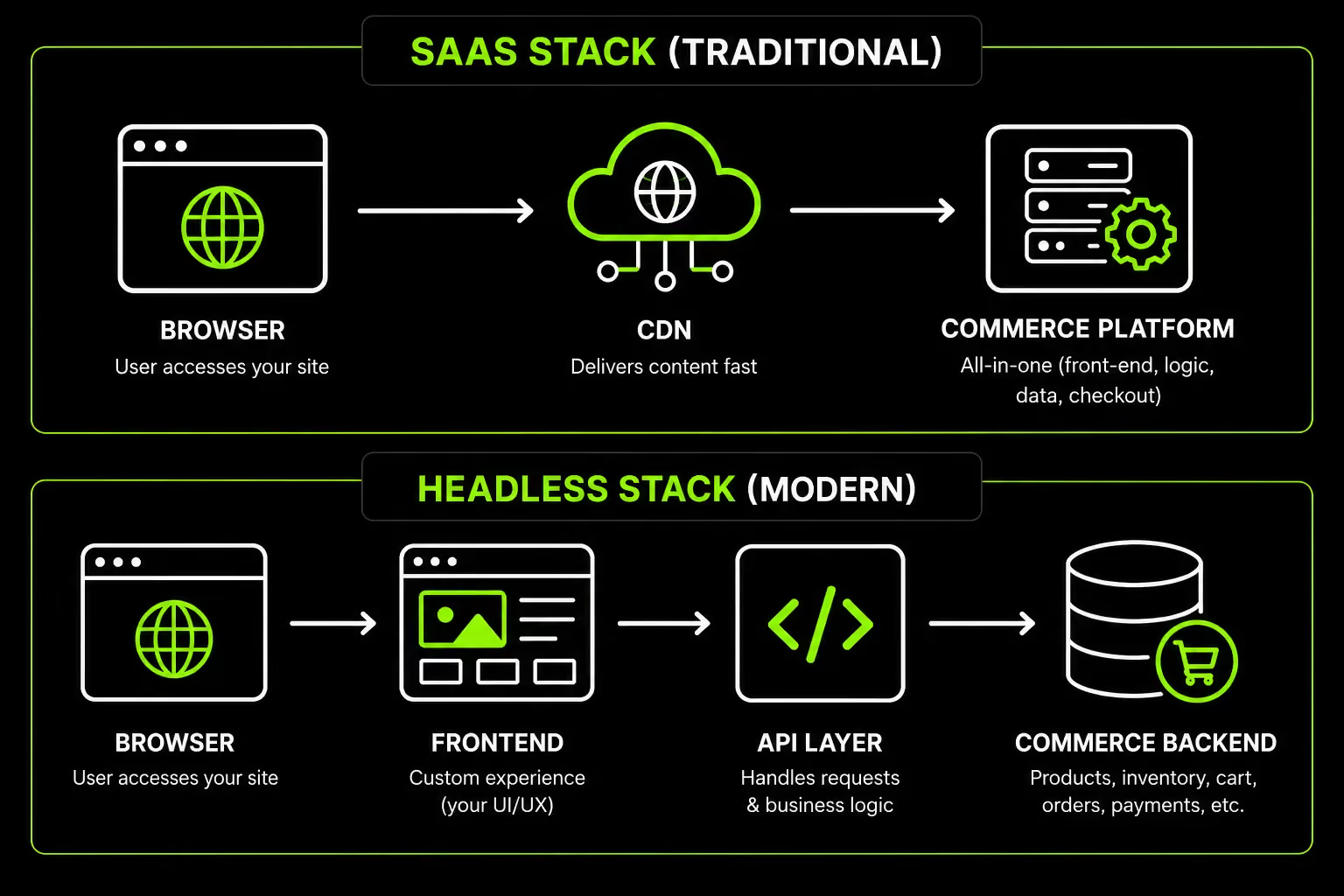
SaaS platforms are hosted and maintained by the vendor. Uptime, security patches, and infrastructure management are included in the subscription. The trade-off is working within the platform's architecture rather than owning it which matters when you need custom checkout logic, deep ERP integration, or server-side control.
Self-hosted platforms give complete control over every layer of the stack. You configure the server, manage security, choose hosting, and maintain the software. The flexibility ceiling is effectively unlimited. So is the cost and maintenance responsibility.
Headless commerce decouples the frontend presentation layer from the commerce backend entirely. A React or Next.js frontend communicates with a Shopify or BigCommerce backend via APIs. The result is maximum design control and performance potential at a development cost that makes it appropriate only when specific UX requirements cannot be met by any SaaS platform.
The Four Dimensions That Actually Define Platform Fit
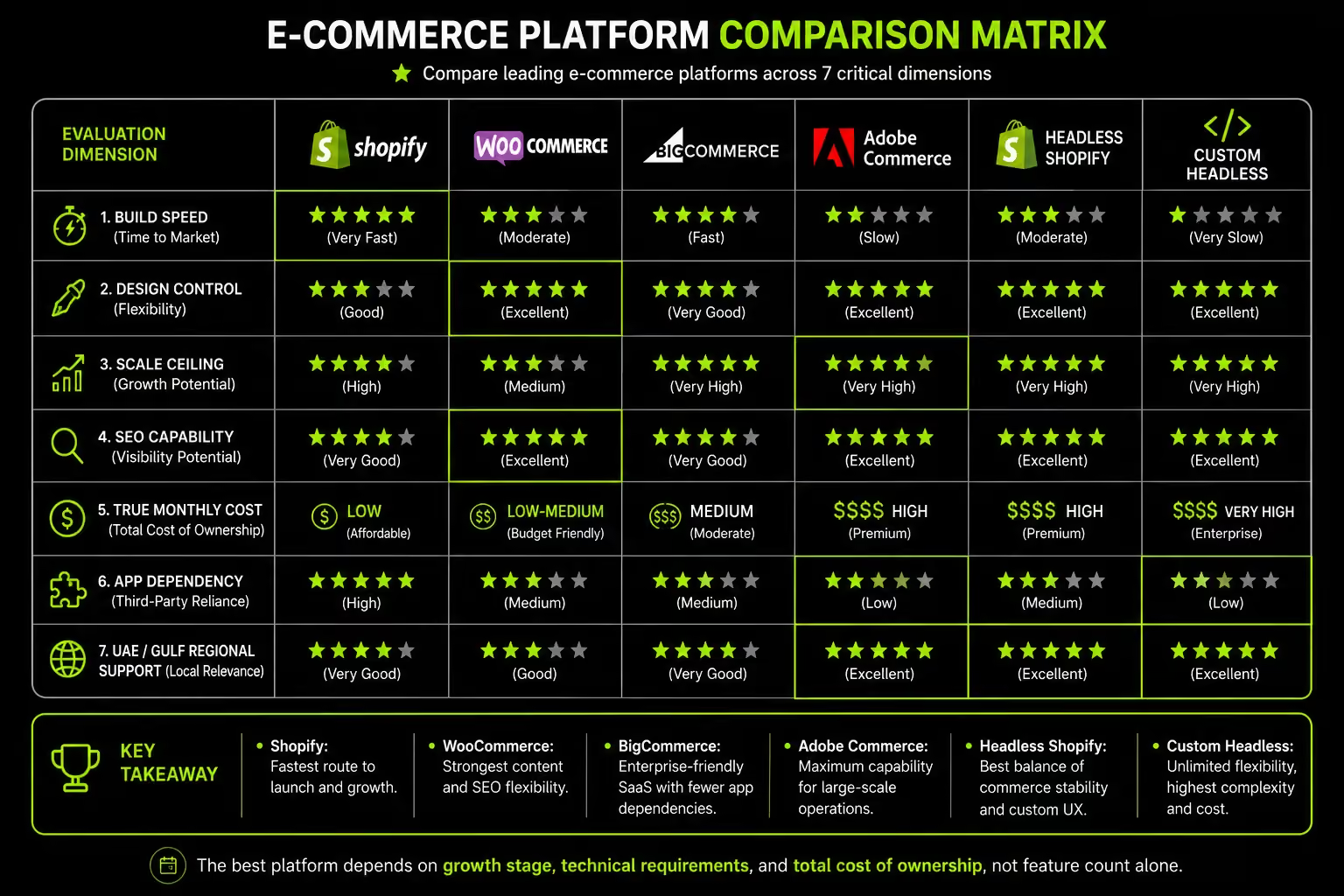
Price gets treated as the primary evaluation criterion because it is the most visible number. It is rarely the most important one. The four dimensions that actually determine whether a platform fits:
Build Speed: How fast can you launch a production-ready store? This affects time-to-revenue and the total cost of the launch itself.
Design Flexibility: Can you execute your brand vision without permanent developer dependency? A platform requiring a developer for routine content updates is an operational liability at scale.
Scale Ceiling: Where does the platform get expensive, structurally constrained, or operationally difficult as SKU count, traffic volume, and revenue grow?
Ownership and Portability: Can you migrate to a different platform when requirements change without destroying SEO equity, losing customer data, or rebuilding everything? Platform lock-in has a real cost that only becomes visible when you want to leave.
The real cost question in any platform evaluation is not "what does this cost today?" It is "what does this platform cost at 3x my current revenue?" because the answer is almost always different, and sometimes very different.
The 6 Best Ecommerce Software Platforms in 2026: Evaluated on What Matters
Each platform below is assessed on who it genuinely serves, what its non-obvious limitations are, and when you should not use it. Competitor guides list features. This section covers who each platform fails, which is the information buyers actually need before committing.
Shopify: Best for Speed, Ecosystem, and D2C Scale
Shopify powers over 5.6 million active stores globally and is the most practical starting point for most D2C and FMCG brands.
The combination of the fastest path from brief to live store, Shop Pay's industry-benchmark one-click checkout conversion performance, and an 8,000+ app ecosystem makes it the default recommendation for brands that need to launch, test, and iterate.
Shopify Plus unlocks custom checkout logic through Shopify Functions, native B2B features, multi-storefront capability via Shopify Organisation, and dedicated merchant support.
The upgrade trigger for most brands arrives when GMV consistently exceeds $1M/year, app costs have stacked into a material monthly expense, and checkout customisation requirements exceed what the standard plan supports.
What most guides do not tell you: Shopify's app ecosystem is its greatest strength and its most underreported cost driver.
A store running 12 apps at an average of $40/month is spending $480/month on subscriptions before the platform fee and transaction costs. Transaction fees of 2% on non-Shopify Payments add up significantly at volume.
URL structure limitations Shopify enforces /products/ and /collections/ prefixes constrain advanced SEO architecture for brands where subdirectory or subfolder URL organisation matters.
When Shopify is the wrong choice: Brands with highly complex product configuration requirements bespoke manufacturing, custom bundle logic, configurable variants beyond Shopify's native product structure regularly hit the platform's flexibility ceiling.
At that point they are maintaining expensive custom app workarounds or preparing for a migration.
WooCommerce: Best for SEO Control and WordPress-Native Brands
WooCommerce is the most installed ecommerce solution in the world by volume, because WordPress powers 43% of the internet and WooCommerce converts WordPress sites into functioning stores. The core plugin is free. The production store is not.
The genuine commercial advantage is SEO control. Full URL structure ownership, server-side rendering control, complete schema markup flexibility, and the full Yoast or Rank Math ecosystem give technically competent teams more organic search leverage than any SaaS platform provides.
For content-led brands that build acquisition through organic search ingredient guides, comparison articles, educational content the WordPress content infrastructure compounds over time in ways Shopify's built-in blog cannot match.
What the "free" label actually costs: Managed WooCommerce hosting runs $50 – $500/month. Security, SSL, and monitoring add $100 – $300/year.
Premium plugins for reviews, subscriptions and advanced shipping cost $500 – $2,000/year.
Developer hours for routine maintenance and plugin conflict resolution run $200 – $1,000/month.
A mid-size WooCommerce store rarely costs less than $400/month in total operational cost before any development work is considered.
When WooCommerce is the wrong choice: WooCommerce on shared hosting fails Core Web Vitals almost universally.
The platform can outperform Shopify on raw speed metrics when properly engineered but it requires dedicated managed hosting, Redis object caching, image CDN configuration and active plugin auditing to maintain it.
Brands with 10,000+ SKUs or high-traffic spikes hit performance degradation without the infrastructure investment that costs materially more than equivalent Shopify plans.
BigCommerce: Best for High-Volume Sellers Who Have Outgrown Shopify
BigCommerce is the platform most commonly evaluated by brands experiencing Shopify's scale limitations.
No transaction fees on any plan, native B2B features, multi-storefront support and a more complete native feature set that reduces app dependency these structural advantages compound at higher revenue levels.
The SEO architecture is stronger than Shopify's out of the box: full URL control, AMP support, and more configurable canonical tag management. Headless adoption is high among BigCommerce users.
The platform is well-architected for API-first frontend decoupling, making it a common backend choice for brands building custom Next.js storefronts.
The honest limitation: BigCommerce's app ecosystem is materially smaller than Shopify's. Non-technical teams find the admin learning curve steeper than Shopify's.
The 50-products-per-page cap on lower plans creates catalog display constraints before reaching a plan tier that removes them.
The right evaluation trigger: When GMV is consistently above $500,000/year, Shopify app costs are above $800/month and features you need require expensive custom development on Shopify that BigCommerce includes, natively a structured BigCommerce evaluation is worth the time.
Webflow Ecommerce: Best for Design-Led Brands with Limited SKU Complexity
Webflow gives brand teams unmatched visual control pixel-perfect frontend execution without touching code.
For brand-forward stores where the visual experience is the primary differentiator and the product range is curated and limited, it produces a quality of frontend presentation that no Shopify theme matches out of the box.
The honest positioning: Webflow is not a full-scale ecommerce platform. The 500 SKU cap on lower plans, limited payment gateway options, no native subscription commerce, and the absence of operational features a growing D2C store needs make it unsuitable for high-volume operations.
Its strongest application is a hybrid architecture: Webflow for brand storytelling and editorial content, Shopify as the commerce backend with a custom-integrated cart.
UAE luxury lifestyle brands using this split architecture get the editorial experience Webflow enables and the checkout reliability and payment gateway support Shopify provides.
Adobe Commerce (Magento): Best for Enterprise with Custom Requirements
Adobe Commerce is the highest-ceiling ecommerce platform available. Maximum customisation, no structural ceiling on complexity and the strongest native B2B feature set in the market make it the right choice for enterprises whose requirements genuinely exceed what any SaaS platform can deliver.
The total cost of ownership is the primary evaluation criterion. Adobe Commerce licensing starts at $22,000/year.
Managed cloud hosting, a dedicated development team or agency partnership, extension costs and security maintenance regularly push total annual costs above $100,000 for complex deployments. This is not a platform you self-manage, it requires dedicated technical resources.
When the investment is justified: GCC-based FMCG groups running multiple regional brands under a single backend.
B2B distributors with complex tiered pricing and custom catalog logic. Enterprise retailers whose ERP integration requirements cannot be met by app-based SaaS connectors.
When your store requirements genuinely cannot be met by any SaaS platform and the switching cost later would exceed the build cost now.
Wix Ecommerce: Best for Early-Stage Stores Prioritising Simplicity
Wix is the fastest path from zero to live for non-technical founders. The AI-assisted site builder, built-in email marketing and no-code customisation make it a viable validation tool for brands testing product-market fit before committing to a scalable platform.
The platform trap to name directly: Wix migration is harder than migration from any other major platform. Export options are more limited.
URL structures are less cleanly portable. Brands that build a genuine business on Wix and need to migrate to Shopify or WooCommerce face a more disruptive rebuild than from any comparable platform.
Most brands hit the Wix ceiling somewhere between $200,000 and $500,000 in annual GMV at which point the combination of SEO limitations, app constraints and migration difficulty makes the platform choice expensive to exit. Use Wix to validate product-market fit. Not to build a scalable brand.
The True Cost of Ecommerce Software: What Most Comparisons Do Not Tell You
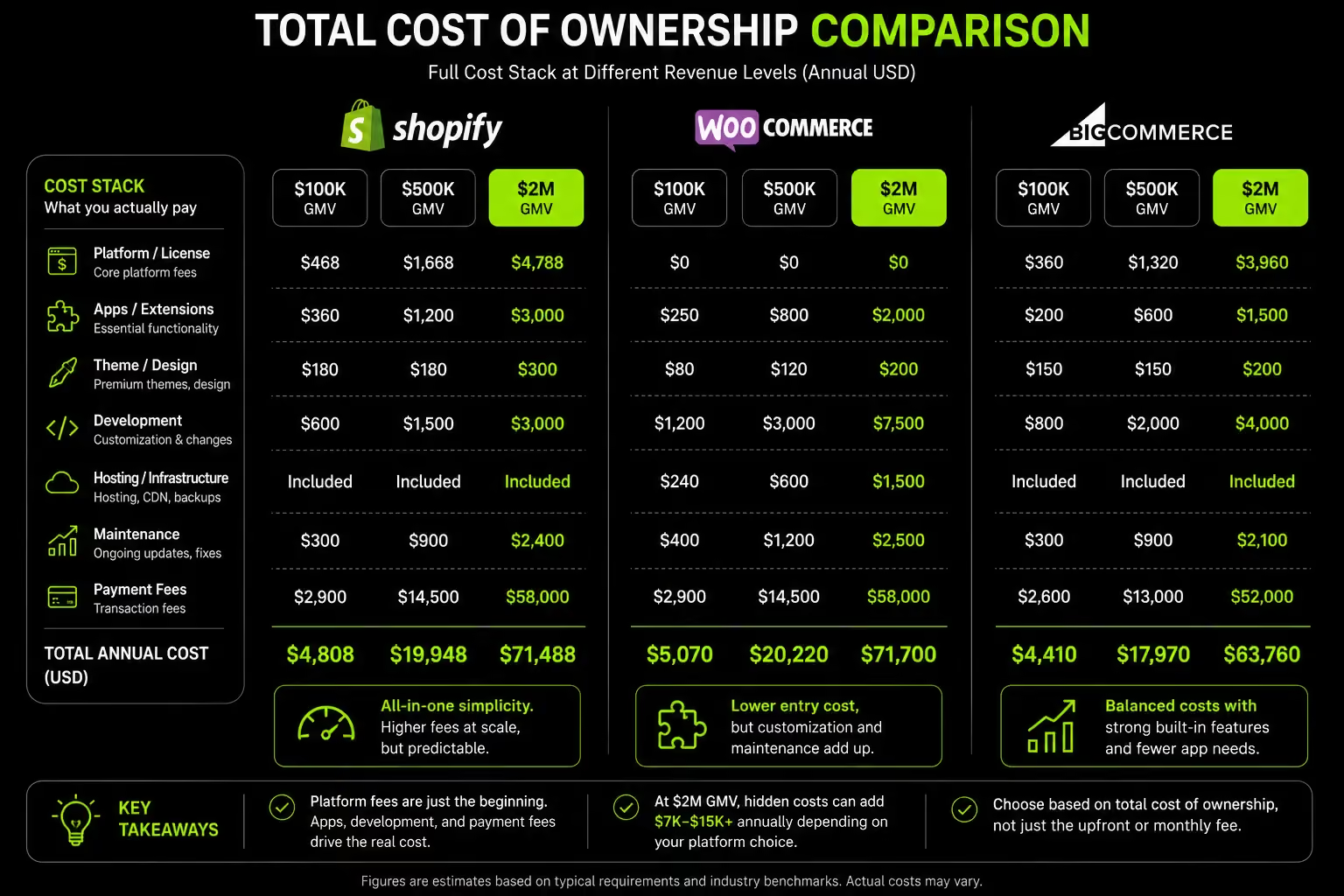
Subscription cost is the most visible number in any platform comparison. It is rarely the largest cost. Transaction fees, app stacks, developer hours and migration expenses are where the real budget accumulates and they are systematically absent from most platform guides.
The full cost stack for any ecommerce platform includes seven layers:
- Subscription or licence cost what you see on the pricing page
- Transaction fees what you forget until the invoice arrives
- App and plugin ecosystem what stacks up over 12 months
- Theme and design cost one-time but significant
- Development and customisation ongoing, not project-based
- Hosting and infrastructure included in SaaS, your cost on self-hosted
- Migration cost the cost of getting the platform decision wrong
Shopify True Cost at Three Revenue Stages
WooCommerce True Cost: Why "Free" Is Expensive
The average ecommerce business runs 12 apps or plugins each adding $10 – $200/month. At a conservative average of $40/month across 12 apps, that is $480/month in subscriptions that do not appear on the platform's pricing page and rarely appear in agency quotes at the briefing stage.
Ecommerce Software in the UAE and Gulf: What Changes Regionally
Platform selection in the UAE involves compliance, payment infrastructure, and language requirements that US-focused platform reviews do not cover.
This is a complete content gap in every major platform comparison article in the current SERP.
For brands operating in or targeting the Gulf, these regional considerations frequently determine platform fit more directly than any feature comparison.
Regional Payment Gateway Compatibility
Not all ecommerce platforms integrate with UAE payment gateways equally. Before any platform decision is finalised, verify native support for the gateways your buyers use:
- Checkout.com: Compatible with Shopify, WooCommerce, and BigCommerce. Strong documentation and developer support for Gulf market deployments.
- Telr: Compatible with Shopify and WooCommerce. One of the most widely used UAE gateways for SME ecommerce operations.
- PayTabs: Compatible with WooCommerce, Magento, and BigCommerce. Strong for Saudi Arabia and UAE cross-border selling.
- Network International: Primarily enterprise and custom integrations. Requires technical implementation beyond standard plugins.
- Tabby and Tamara (BNPL): Available through the Shopify app ecosystem and WooCommerce plugins. BNPL adoption among UAE consumers is rising rapidly its absence at checkout creates abandonment among buyers who have made it a preferred payment method.
A platform that does not support your primary market's payment gateways creates checkout abandonment at the moment purchase intent is highest. Evaluate gateway compatibility before platform architecture, not after.
Arabic Language and RTL Support
Arabic language support on an ecommerce platform is not text translation. It requires right-to-left layout implementation, Arabic font rendering, mirrored navigation flow, form field adaptation and checkout sequence reversal. The quality of this implementation varies significantly between platforms.
Shopify supports Arabic with RTL-compatible themes. Compatibility varies at the theme level to verify RTL implementation for any specific theme before committing to a build. For UAE brands targeting both Arabic and English audiences, Shopify is the most reliable starting point. The RTL implementation is cleaner and the Gulf payment gateway ecosystem is stronger than on any comparable platform.
WooCommerce has full RTL support with correct theme selection. WordPress's multilingual ecosystem (WPML, TranslatePress) is mature and well-documented.
Webflow requires manual RTL implementation; it is not a configuration option. Budget additional development time for any Webflow build targeting Arabic-speaking customers.
VAT Compliance and UAE Tax Requirements
UAE VAT at 5% has applied since 2018. Ecommerce businesses must apply it correctly across product types, shipping charges, and for GCC cross-border operations in different tax jurisdictions.
Getting this wrong creates compliance exposure and operational problems that are more expensive to fix post-launch than to configure correctly at build.
Shopify has built-in tax settings with UAE VAT configuration available natively.
WooCommerce requires explicit tax plugin configuration WooCommerce Tax or manual rate table setup.
BigCommerce has native tax tools with Gulf market configuration support.
Cross-Border Selling Across the GCC
Saudi Arabia, Kuwait, and Bahrain have different customs thresholds, consumer payment preferences, and platform adoption patterns. Brands targeting the full GCC market need multi-currency, multi-language, and often multi-storefront capability.
Shopify Plus's multi-store architecture and BigCommerce's multi-storefront feature are both significantly simpler to manage than running separate WooCommerce installations per market.
If your brand targets UAE and KSA simultaneously with distinct localised experiences, these platform features reduce operational overhead materially compared to maintaining parallel self-hosted deployments with separate admin, separate app stacks and separate maintenance cycles.
How to Choose the Right Ecommerce Platform: The 3-Stage Decision Filter
Generic "how to choose" guidance produces the wrong answer for specific businesses because it applies universal criteria to situations that are not universal.
The framework below filters the decision sequentially and does not reach a recommendation until the previous stage is resolved.
Stage 1: Match Your Business Model
- Pure D2C (own brand, own fulfilment): Shopify or BigCommerce
- Content-led brand (SEO-driven organic acquisition): WooCommerce
- Design-led or luxury brand: Webflow with Shopify backend, or Shopify with a custom theme
- Multi-brand or enterprise operations: Adobe Commerce / Magento
- Early validation stage: Shopify Basic or Wix
Stage 2: Pressure-Test at 3x Scale
Before committing, model the cost and operational implications at three times your current revenue:
- What does this platform cost at 3x current GMV including apps, transactions, and hosting?
- What breaks first: checkout performance, inventory management, app stack costs, or team capacity to manage it?
- Can your team operate this platform without a permanent developer hire, or does scale require ongoing agency retainer costs?
Stage 3: Evaluate the Switching Cost
Platform decisions feel permanent because migration is expensive. Understanding the switching cost before committing gives a clearer picture of actual risk:
- How hard is it to migrate off this platform in 24 months if your requirements change?
- What data do you own and can export cleanly product data, customer records, order history?
- How portable is your SEO equity? Can URL structures be preserved and redirected without ranking loss?
Red Flags Before Committing to Any Platform
❗ No native integration with your primary market's payment gateways
❗ A theme marketplace with fewer than 50 quality options limits brand differentiation at launch and at scale
❗ Transaction fees on non-native payment gateways that are not disclosed on the pricing page
❗ Slow mobile checkout in demo testing test the checkout on a mid-range device on 4G before any build commitment
❗ Limited URL structure control that will constrain SEO architecture as organic traffic becomes a meaningful acquisition channel
What We Have Learned Building Ecommerce Stores Across Platforms
We have built and launched stores on Shopify, WooCommerce, Webflow, and custom headless architectures across D2C beauty, health and wellness, FMCG, food and beverage, and B2B categories.
The pattern is consistent: brands that chose a platform for budget reasons are the ones we are rebuilding 18 months later.
The most expensive ecommerce mistake we see is choosing a platform based on a demo rather than based on post-launch operations.
The demo always looks good. Day 90 operations managing product updates, running promotional campaigns under peak traffic, maintaining integrations after a plugin update, training a new team member on the CMS is where platform fit becomes visible. By that point, switching is costly.
For UAE brands targeting both Arabic and English audiences, Shopify is the most reliable starting point we have encountered.
The RTL implementation is cleaner, the payment gateway support for Telr and Checkout.com is solid out of the box, and the operational overhead for a bilingual store is lower than on any self-hosted alternative.
We run a platform audit before any build engagement begins. It prevents the wrong architecture being locked in before a single page is designed and it consistently surfaces requirements that would have caused a rebuild 12 months later if discovered after development started.
When We Recommend Shopify
D2C brands launching their first owned channel, particularly those migrating from marketplace dependency on Amazon or Noon.
FMCG brands that need to be live within 4 – 8 weeks. Any brand where Shop Pay's one-click checkout conversion advantage represents a meaningful commercial benefit over building checkout from scratch.
When We Recommend WooCommerce
Brands already running a WordPress site with significant content infrastructure, blog archives, SEO-ranked editorial pages that would lose organic equity in a platform migration.
Brands where content-driven SEO is the primary customer acquisition strategy and technical control over URL structure, schema markup, and server-side rendering is commercially valuable at their current stage.
When We Recommend a Custom Build
Complex product configuration that no SaaS platform handles cleanly personalised products, bespoke manufacturing, variant logic that exceeds Shopify's native product structure.
Unique checkout flows that require business logic no platform can accommodate through apps or configuration. Enterprise brands with existing ERP or CRM infrastructure that requires a deeply integrated, API-first architecture rather than app-connector workarounds.
If you are evaluating a platform decision for a new build or a migration, a platform consultation with Suplex starts with your operational requirements and growth trajectory before any platform is recommended.
Platform Features That Drive Ecommerce Performance in 2026
Feature lists without commercial context are spec sheets. Each element below is evaluated for its direct impact on revenue, not its presence on a features table.
Checkout Performance: The Most Underrated Feature in Platform Selection
Checkout is where conversions are won or lost. Baymard Institute puts average cart abandonment at 70%, the majority attributable to checkout UX failures. The commercially relevant checkout evaluation criteria:
- Native one-click checkout Shop Pay on Shopify is the industry conversion benchmark
- Guest checkout as a primary option, not buried below account creation prompts
- Mobile checkout speed tested on 4G, not office Wi-Fi
- Local payment method support: BNPL, Apple Pay, Google Pay, and regional cards
- Shipping cost transparency before the final checkout step surprise costs are one of the top abandonment triggers
A platform with a technically superior feature set but a slower or more friction-heavy checkout will convert less than a simpler platform with an optimised payment flow. Test the checkout on a real device before any platform commitment.
Mobile-First Architecture
In the UAE and Gulf, mobile commerce accounts for 70%+ of online shopping sessions. Platform evaluation should include mobile Core Web Vitals scores under real production conditions with products loaded, apps running, and real media uploaded, not the demo store performance.
A critical distinction most guides miss: platform architecture does not determine mobile performance. Theme choice and configuration do.
A Shopify store with a poorly optimised theme and 15 apps performs worse on mobile than a well-configured WooCommerce installation on managed hosting. The platform provides the foundation. What is built on it determines performance.
AI-Native Features in Ecommerce Platforms
AI capabilities are table stakes in 2026. The commercially useful distinction is between features that save real operational time and features that are marketing surface:
- Shopify Magic: AI-generated product descriptions, AI image background editing, and Sidekick AI assistant for store management queries. Product description generation saves meaningful content production time for large catalogs.
- Wix ADI: Full store generation from a brief. Valid for validation; not a substitute for properly designed information architecture.
- BigCommerce: AI-powered search and merchandising that improves product discovery on large catalogs.
- WooCommerce: No native AI features entirely plugin-dependent.
AI-generated product copy saves hours at scale. AI-generated site structure saves nothing if the information architecture was wrong to begin with.
SEO Architecture by Platform
Inventory and Order Management Depth
For FMCG brands specifically: batch tracking, expiry date management, and fulfilment centre integration are operational requirements, not optional features.
Shopify has strong native inventory management with well-supported 3PL integrations.
WooCommerce requires plugins for advanced inventory batch tracking and expiry management that are not native.
BigCommerce provides native advanced inventory management without SKU volume caps on higher plans.
Adobe Commerce has the strongest inventory flexibility for complex SKU structures, multi-warehouse operations, and enterprise-level product attribute management.
Frequently Asked Questions
What is the most popular ecommerce software?
Shopify is the world's most widely used ecommerce software, powering over 5.6 million active stores globally. It leads on ease of use, app ecosystem depth, and checkout conversion performance. WooCommerce is the most installed ecommerce plugin overall due to WordPress's market share. For enterprise operations, Adobe Commerce (Magento) and BigCommerce are the primary alternatives at scale.
What is the best ecommerce platform for a D2C brand launching in the UAE?
For most D2C brands in the UAE, Shopify is the most practical starting point. It integrates with key regional payment gateways (Checkout.com, Telr, Tabby, Tamara), has solid Arabic RTL theme support, and offers the fastest path to a production-ready store. Shopify Plus becomes relevant when GMV exceeds $1M/year or when multi-storefront capability is needed for GCC regional expansion.
What is the difference between ecommerce software and an ecommerce website builder?
Ecommerce software refers to the full technology stack powering an online store product management, checkout, payment processing, inventory, and order fulfilment. An ecommerce website builder refers specifically to the frontend tool used to design and publish the storefront. Many platforms (Shopify, Wix, Webflow) combine both. Others (WooCommerce, Magento) separate the two layers, requiring separate configuration of each.
How much does ecommerce software cost per month?
Entry-level SaaS platforms start at $29 – $39/month. True monthly costs including apps, payment processing fees, hosting for self-hosted platforms, and themes typically run $200 – $500/month for growing stores and $2,000 – $5,000/month at Shopify Plus or enterprise scale. WooCommerce has no monthly software fee but requires $400 – $1,500/month in hosting, plugins, and developer maintenance. Neither category is accurately represented by its headline subscription price.
Is Shopify better than WooCommerce for an online store?
For most businesses, yes Shopify is easier to launch, maintain, and scale without technical resources. WooCommerce is better for brands already on WordPress, those prioritising full SEO control, or those with content-driven acquisition strategies where WordPress's content infrastructure compounds over time. The real differentiator is long-term operational cost: Shopify's app dependency increases costs over time; WooCommerce's hosting and developer dependency does the same. Neither is universally superior.
Can I switch ecommerce platforms later without losing data?
Yes, but it requires careful planning. Product data, customer records, and order history can be migrated using tools like Matrixify for Shopify or custom export scripts. SEO equity URL structure, backlink history, and ranking signals is the most fragile element. Improper redirect implementation during migration causes measurable organic traffic loss that takes months to recover. Switching from Wix is harder than switching from Shopify or WooCommerce due to more limited export options.
What ecommerce platform do large brands use?
Large D2C brands commonly use Shopify Plus (Gymshark, Allbirds, Fashion Nova), BigCommerce (Skullcandy, Black Diamond), or custom headless builds. Enterprise FMCG and retail groups often use Adobe Commerce (Magento) or SAP Commerce Cloud integrated with ERP systems. In the UAE and Gulf, Shopify Plus is increasingly the platform of choice for scaling D2C brands, while enterprise retailers tend toward custom solutions integrated with local ERP infrastructure.
Hi, I’m Rishabh Jain
I believe great digital experiences have the power to shape perception, build trust, and move businesses forward. That belief led me to found Suplex Design Studio, a global digital design and development studio helping FMCG and D2C brands build websites and digital experiences that are strategic, thoughtful, and commercially meaningful.
I started Suplex at 25 with a clear intent, to create digital experiences that look appealing, work seamlessly, and help D2C businesses grow. By 28, the studio had scaled globally, guided by a strong foundation in integrated design that I developed during my academic journey in London, where I was honoured with the Dean’s Award.
Over the years, I’ve had the opportunity to work with 100+ brands, from Fortune 500 organisations to family-run businesses, helping them build websites, e-commerce experiences, and digital products that create clarity, credibility, and long-term value.
Our work has been recognised internationally, including the Manifest Award (2024), the Clutch Global Award (2025), and features across platforms such as The Dieline, Packaging of the World, and the World Brand Design Society.
None of this would be possible without the people behind the work. I’m deeply grateful to the Suplex team, whose commitment, creativity, and attention to detail turn ideas into meaningful digital experiences every day.
At the heart of our work is a simple philosophy, digital design should be intentional, functional, and built to create real business value. That continues to guide everything we create at Suplex.




































Let’s Make It Happen
E-Commerce Success Stories
%201.avif)






.avif)

.avif)
Build Your D2C Business The Right Way
Build It With Suplex.


