Ecommerce Trust Building Design Elements: What Works, Where It Goes and Why
.webp)
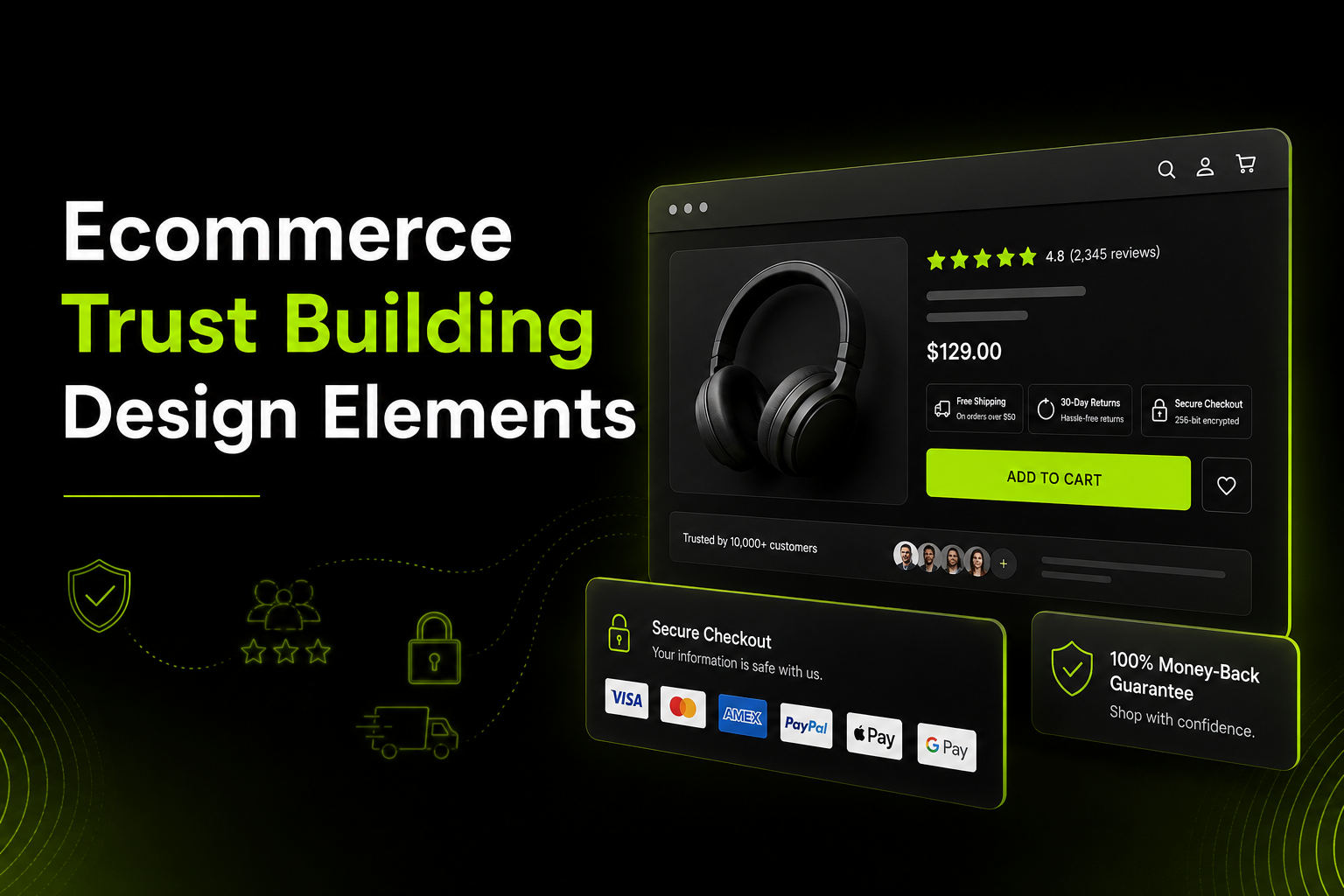
Ecommerce Trust Building Design Elements: What Works, Where It Goes and Why
Ecommerce trust building design elements are not decorations. Baymard Institute's meta-analysis across 50+ studies places the global average cart abandonment rate at 70.19%.
And confirms that a 35.26% conversion rate improvement is achievable through better checkout design and trust elements alone.
That represents $260 billion in recoverable revenue in the US and EU annually. The trust problem is not a brand problem. It is an architecture problem.
Most ecommerce stores treat trust signals as decoration footer badges, hidden return policies, or generic "secure checkout" labels.
In reality, trust signals only work when they appear exactly where customers hesitate. The right signal at the right moment increases confidence; the same information elsewhere has little impact on conversions.
This guide focuses on trust signal placement as much as the signals themselves.
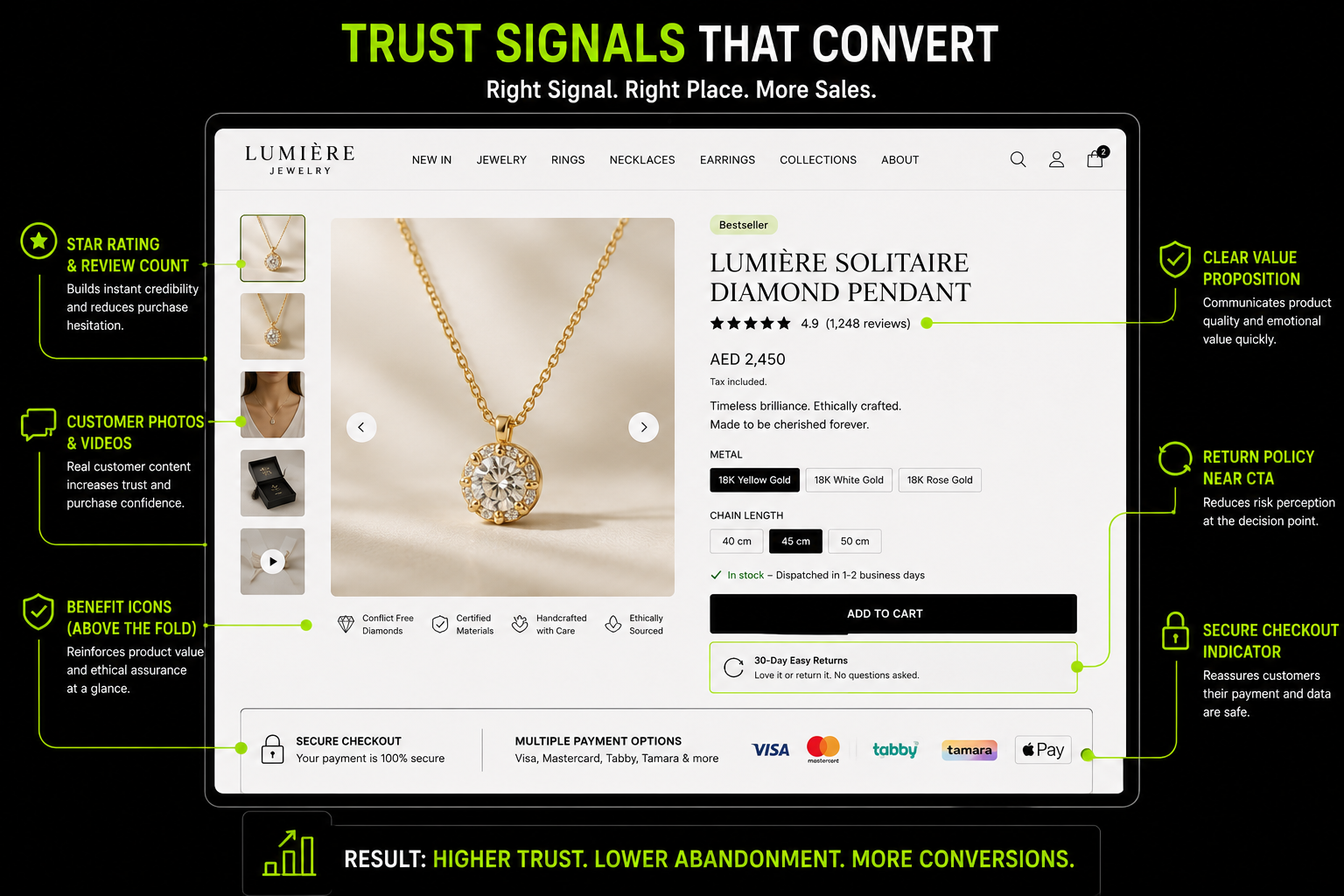
Why Trust Signals Fail: The Problem Most Ecommerce Stores Have
Trust signal failures are almost never about the signal itself. They are about misidentifying which doubt the signal is meant to address and where in the journey that doubt arises.
Trust Is Doubt Reduction, Not Decoration
A customer who does not trust a store is experiencing one of four distinct purchase anxieties, not a general feeling of distrust.
- Anxiety 1: "Is this a real, legitimate business?" (brand credibility doubt)
- Anxiety 2: "Is the product actually what I think it is?" (product quality doubt)
- Anxiety 3: "What happens if something goes wrong?" (transaction risk doubt)
- Anxiety 4: "Is my payment information safe?" (security doubt)
Different customer doubts require different trust signals. A security badge won't address concerns about product quality, just as reviews won't reassure someone worried about payment security or business legitimacy.
Trust signals fail when stores display every badge and testimonial indiscriminately instead of matching the right reassurance to the customer's specific concern at that stage of the buying journey.
The Trust Inflation Problem
Research has documented a commercially significant phenomenon: over-proliferation of trust signals actively undermines trust.
A store displaying 20 security badges, 8 award logos, 4 "safe shopping" icons, and a "100% secure guarantee" banner is not communicating confidence.
It is communicating desperation. Customers interpret excessive trust signals as evidence of insecurity, the digital equivalent of a shop owner who protests too much about their merchandise being genuine.
Specific trust signal pitfalls to avoid:
- Displaying a "Best of 2019" award in 2026 outdated authority claims signal stagnation, not achievement
- Generic testimonials attributed to "John S." with no photo, company, or specifics
- Badge clutter at checkout 8+ trust icons create visual noise that reduces focus on the CTA
- Security seals from unrecognised organisations unknown badge logos produce no trust signal and sometimes create mild suspicion
The optimal approach is curated placement of the most credible signal for each specific anxiety, at the exact point the anxiety is likely to arise. Quality over quantity, without exception.
Suplex's conversion rate optimisation service starts with identifying which anxieties are active on a given store and whether the current trust architecture is addressing them at the right moments.
The Trust Architecture Framework: A Journey-Stage Model
The most commercially useful way to think about trust signals is not by type but by the journey stage at which each one is needed. Suplex's PPCT Framework maps trust signal deployment to the four stages of the customer journey.
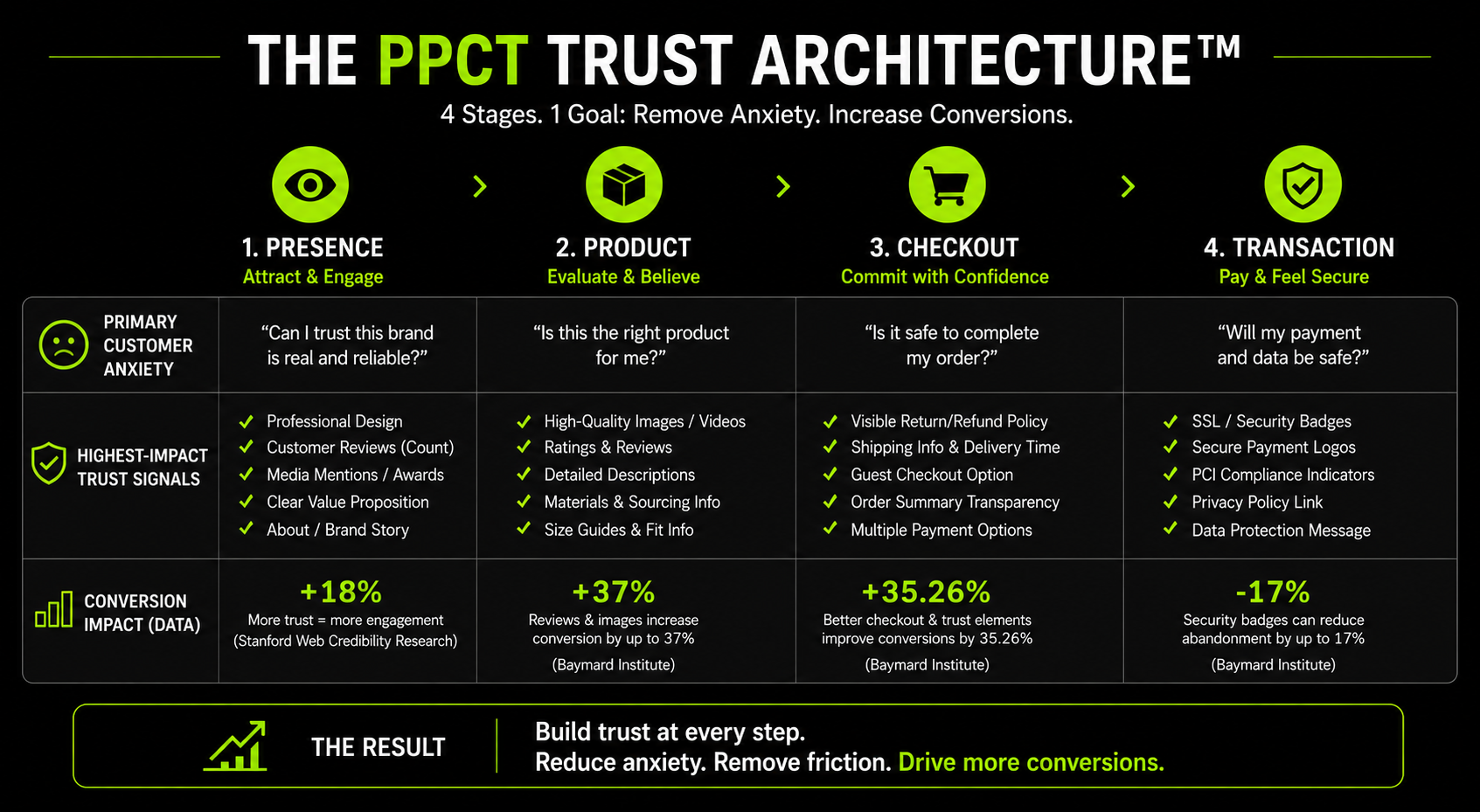
The PPCT Framework (Suplex Framework)
Trust signals should be deployed across four journey stages. Each stage addresses a different cluster of customer anxieties.
Deploying checkout-stage signals at the brand entry stage, or product-stage signals at checkout, reduces the effectiveness of both.
Stage P: Presence (Homepage / Landing Page / First Visit):
Anxiety addressed: "Is this a real, legitimate business?"
The first visit is a credibility assessment. The customer is asking consciously or not whether this brand deserves their attention before they even evaluate the product. Trust signals here are brand-level signals.
Required at Stage P:
- Professional, current visual design (first impressions form in 50 milliseconds)
- Visible contact information phone number or WhatsApp, email, and physical address in the header or immediately accessible
- Press and media logos ("As Seen In") third-party brand validation from recognised publications
- Visible aggregate review count and star rating at brand level, not just product level
- Social following or community signal, where present and significant
What not to do at Stage P: lead with security badges and payment icons. These belong at checkout. Displaying payment security before the customer has decided to buy creates the impression the brand is more focused on taking their money than on their product.
Conversion data for Stage P:
- Professional team or founder photos: +33% trust score
- Media mentions and press logos: +12–18% credibility
- Physical address and phone number: +35% trust score
Stage P: Product Page: Anxiety addressed: "Is the product actually what I think it is?"
The product page is where product-specific doubt is highest. The customer has moved from brand evaluation to product evaluation. Trust signals here are product-level signals.
Required at Stage P (Product):
- Star rating and total review count immediately below the product title not below the fold
- Minimum 10 reviews before prominent display; below 10, collection mode only
- Photo and video reviews from real customers UGC photography outperforms brand photography for trust among new visitors
- Detailed product specifications and materials clarity reduces doubt more than any badge
- Delivery date estimate with an actual date range, not "3–7 business days"
- Return policy statement adjacent to or below the CTA visible before the purchase decision is made
Conversion data for Stage P (Product):
- Customer reviews: +270% revenue lift vs zero reviews; +380% for high-priced products
- Visible return policy: -17% cart abandonment
- Reviews with photos: higher conversion than text-only reviews
Stage C: Checkout Anxiety addressed: "What happens if something goes wrong?" and "Is my payment information safe?"
Checkout is where transaction risk anxiety peaks. The customer has decided to buy. Their doubt is now about whether the transaction itself is safe and what recourse they have if the product disappoints.
Required at Stage C:
- Security badge immediately below the payment form (not in the footer, not beside cart items below the payment input)
- Payment method logos (Visa, Mastercard, Apple Pay, PayPal, local preferred methods)
- Money-back guarantee prominently displayed
- SSL padlock visibility
- Order summary with all costs shown 48% of abandonment is unexpected costs
- Guest checkout clearly visible and default
Conversion data for Stage C:
- Security badges at checkout: +22–42% checkout conversion
- Money-back guarantee: +21% conversion
- Trust badges and clear return policies: -28% cart abandonment
- Guest checkout availability: directly affects the 24% of shoppers who abandon when forced to create an account
Stage T: Transaction and Post-Purchase:
Anxiety addressed: "Did I make the right decision?" and "Will I actually receive what I ordered?"
The transaction stage confirmation page, post-purchase email, delivery updates is where post-purchase anxiety in its early form arises. Trust signals here are reassurance signals, not conversion signals.
Required at Stage T:
- Immediate, clear order confirmation with order number and full summary
- Specific delivery date confirmation, not a range
- Proactive tracking link or delivery updates via email or SMS
- Return mechanism reminder knowing returns are easy reduces post-purchase anxiety even for customers who never return anything
- Community invitation welcome to brand loyalty programme, post-purchase content relevant to the purchase
For stores that want to map their current trust signals against this framework, Suplex's user flow design service and information architecture service both structure this as part of the design audit process.
Trust Signal Type 1: Social Proof (Reviews, Ratings, UGC)
Social proof is the highest-impact individual trust element category in ecommerce. The conversion data is not marginal, it is structural. Getting placement wrong wastes the signal entirely.
Reviews: The Single Highest-Impact Trust Element
The data is unambiguous: purchase likelihood for a product with 5 reviews is 270% greater than for a product with zero reviews.
For high-priced products, that lift reaches 380%. Shoppers who engage with ratings and reviews on product pages convert at 108.6% higher rates than those who do not.
Three specific mistakes most stores make with reviews:
Wrong: Reviews Only At The Bottom Of The Product Page:
A customer who decides whether to buy in the first 30 seconds of a product page visit does not scroll to the bottom before making that decision.
Review count and star rating belong immediately below the product title before the description, before the price, before the variant selector.
This placement is not a design preference. It is the position where the social proof signal meets the highest-uncertainty moment in the customer's evaluation.
Wrong: Showing Only The Best Reviews:
A product with 50 reviews at 4.8 stars converts better than one with 50 reviews at a perfect 5.0. Perfect scores are suspicious.
A curated selection of only 5-star reviews is visibly curated. Mixed ratings between 4.2 and 4.7 convert better than 5.0 by appearing authentic. Display reviews across the rating range and let the aggregate speak.
Wrong: Undifferentiated Review Content:
A beauty brand's reviews are not equally relevant to every customer. A review from someone with oily skin is more credible to an oily-skin customer than a dry-skin review.
Filterable reviews by verified purchase, skin type, use case and rating give customers self-relevant social proof that converts, rather than generic social proof that only informs.
The review volume problem is real: zero reviews is a conversion barrier, and one to nine reviews is only marginally better than zero.
Brands launching new products need a review acquisition strategy from day one post-purchase review request emails 3–5 days after confirmed delivery, incentivised photo submission and imported reviews from other channels where possible.
UGC Social Proof With Identity
User-generated content (UGC) does more than written reviews. Reviews answer, "Does this product work?" UGC answers, "Will this product work for someone like me?"
It shows how a foundation looks on different skin tones, how clothing fits different body types, or the visible results of a supplement, something product photography alone cannot demonstrate.
The most effective placement for UGC is within the product image gallery above the fold, alongside brand photography.
Keeping photo reviews visible on the main product page builds trust far more effectively than hiding them in separate tabs or below written reviews.
Real-Time and Dynamic Social Proof
Real-time social proof such as "47 people are viewing this," "12 sold in the last 24 hours," or "Only 3 left in stock" creates both urgency and trust.
When based on real data, these elements can increase conversions by around 15%.
Accuracy is essential. Fake urgency is quickly recognised by shoppers, damaging trust and repeat purchases. Only display dynamic social proof when the underlying data is genuine.
Suplex's D2C data analytics service provides the underlying data infrastructure needed to surface real-time social proof accurately.
See also: Average ecommerce conversion rate by industry for category-level context on what conversion improvement from social proof looks like in practice.
Trust Signal Type 2: Security and Payment Signals
Payment anxiety is the second-highest source of checkout abandonment after unexpected costs. The issue with security signals is almost never the signal itself; it is where it is placed.
Where Security Signals Actually Work
Placing SSL badges, payment logos, or "Secure Checkout" messages in the header or footer is a common mistake.
Security concerns peak when customers enter their payment details, so these trust signals should appear next to the payment form or checkout CTA.
Recognition matters too. Trusted badges from Norton, McAfee, Trusted Shops, or Trustpilot build confidence, while unfamiliar badges often have little impact or even create suspicion.
For Shopify stores, the built-in Shopify Secure Checkout badge is especially effective because most shoppers already recognise Shopify's checkout experience, making it more credible than many third-party security seals.
Payment Method Logos: Trust Through Familiarity
Payment logos such as Visa, Mastercard, American Express, PayPal, Apple Pay, Google Pay, and Shop Pay build trust through familiarity.
Customers recognise these brands and feel more confident completing their purchase.
The best placement is directly below the payment form as a compact row of accepted payment methods.
Avoid placing them on the homepage unless payment availability is a common customer concern.
For UAE and Gulf markets, prominently displaying Cash on Delivery (COD) on product pages and at checkout is an important trust signal because many shoppers expect it.
For full context on ecommerce design decisions that support these trust signals, see Suplex's guides on ecommerce website UX best practices and features of a high-converting ecommerce website.
Trust Signal Type 3: Policy Transparency
Return policy and shipping transparency are not customer service features. They are pre-purchase conversion elements and the majority of stores deploy them in places that make them invisible to the customer at the moment they matter.
Return Policy as a Pre-Purchase Signal
67% of shoppers check return policies before buying. Hiding yours in the footer or a separate page reduces its impact.
Instead, place a clear summary beside the Add to Cart button, such as: "Free returns within 30 days. No questions asked." This addresses purchase hesitation at the moment it matters most, while the full policy page can provide the details.
A visible return policy can reduce cart abandonment by up to 17%.
Shipping Transparency: A High-Impact Conversion Driver
Unexpected shipping costs cause 48% of cart abandonment, making shipping transparency one of ecommerce's highest-ROI trust signals.
Display shipping costs or free shipping thresholds directly on the product page, such as "Free shipping over AED 150" or "Standard delivery: AED 15, arrives Thursday." \
If exact pricing isn't possible, provide a shipping estimate tool instead of "Calculated at checkout." This simple theme update reduces uncertainty and can deliver measurable conversion improvements without rebuilding the store.
Trust Signal Type 4: Brand Credibility Signals
Brand credibility signals address the first and most fundamental purchase anxiety: "Is this a real, legitimate business?"
They belong at the Presence stage before the product evaluation has even begun.
Contact Information: A Simple Trust Signal
Visible contact details reassure customers they're buying from a real business. Display a phone number, email address and physical location where they're easy to find not hidden in the footer.
For UAE stores, a .ae domain, UAE phone number, and local address or PO Box further strengthen trust by demonstrating a genuine local presence.
Press, Media and Third-Party Authority
"As Seen In" press logo sections are among the most visually credible trust elements available to established brands.
Media logos from recognised publications transfer their authority to the brand through association. The implementation requirements for this to work:
- Only display media that is genuine and verifiable
- Link logos to actual articles or press pages with quotes and summaries
- Update press logos annually a 2019 award displayed in 2026 signals stagnation
- Match the publications to your target audience's recognition Forbes carries authority with one audience; Vogue with another
Founder Story and Brand Transparency
For newer brands, founder transparency is one of the strongest trust signals. A genuine founder photo, brand story, and behind-the-scenes content reassure customers they're buying from real people.
In the UAE, authentic founder-led content often builds more trust than polished brand campaigns, making it a powerful conversion tool.
Suplex's brand building for ecommerce service covers how to structure founder story content as a conversion element, not just a brand exercise.
Trust Signal Type 5: Certifications and Category-Specific Signals
Generic trust badges are category-agnostic. The most conversion-impactful trust signals are category-specific.
they address the specific doubt a customer in that product category has about that type of product.
Category-Specific Trust Signals
Different product categories require different trust signals. The most effective trust elements address the customer's biggest purchase concern, not just website security.
- Health & Supplements: Display recognised certifications such as Informed Sport, NSF Certified for Sport, GMP, and Halal alongside the supplement facts panel. Customers want assurance that the product is safe, tested, and contains what it claims.
- Beauty & Skincare: Certifications like Dermatologist Tested, Leaping Bunny, PETA, Vegan, and Halal help reduce concerns about skin safety, ingredients, and ethical standards, making them more effective than generic security badges.
- Fashion: Highlight sustainability certifications such as GOTS, Fairtrade, and B Corp where they align with your brand values. For Gulf modest fashion brands, clear coverage information and modest product imagery also serve as powerful trust signals.
- Children's Products: Display CE, BPA-Free, Non-Toxic, and age-appropriate safety certifications prominently on product pages. Parents are highly risk-conscious, and recognised safety certifications provide strong reassurance before purchase.
Relevance Is the Key Variable
The most important principle in certification display: show only what your specific customer segment recognises and values.
A B-Corp badge converts buyers motivated by sustainability and has zero impact on price-sensitive buyers.
A Halal certification is essential for Gulf market brands and irrelevant for brands with no presence in Muslim-majority markets.
Displaying unrecognised certifications or certifications irrelevant to your customer segment adds visual clutter without adding trust and as the trust inflation research confirms, clutter erodes rather than builds confidence.
Trust Signal Placement : The Full Page Audit
This section maps every trust element to its optimal location. It is designed to be used as an implementation checklist without reading the full guide.
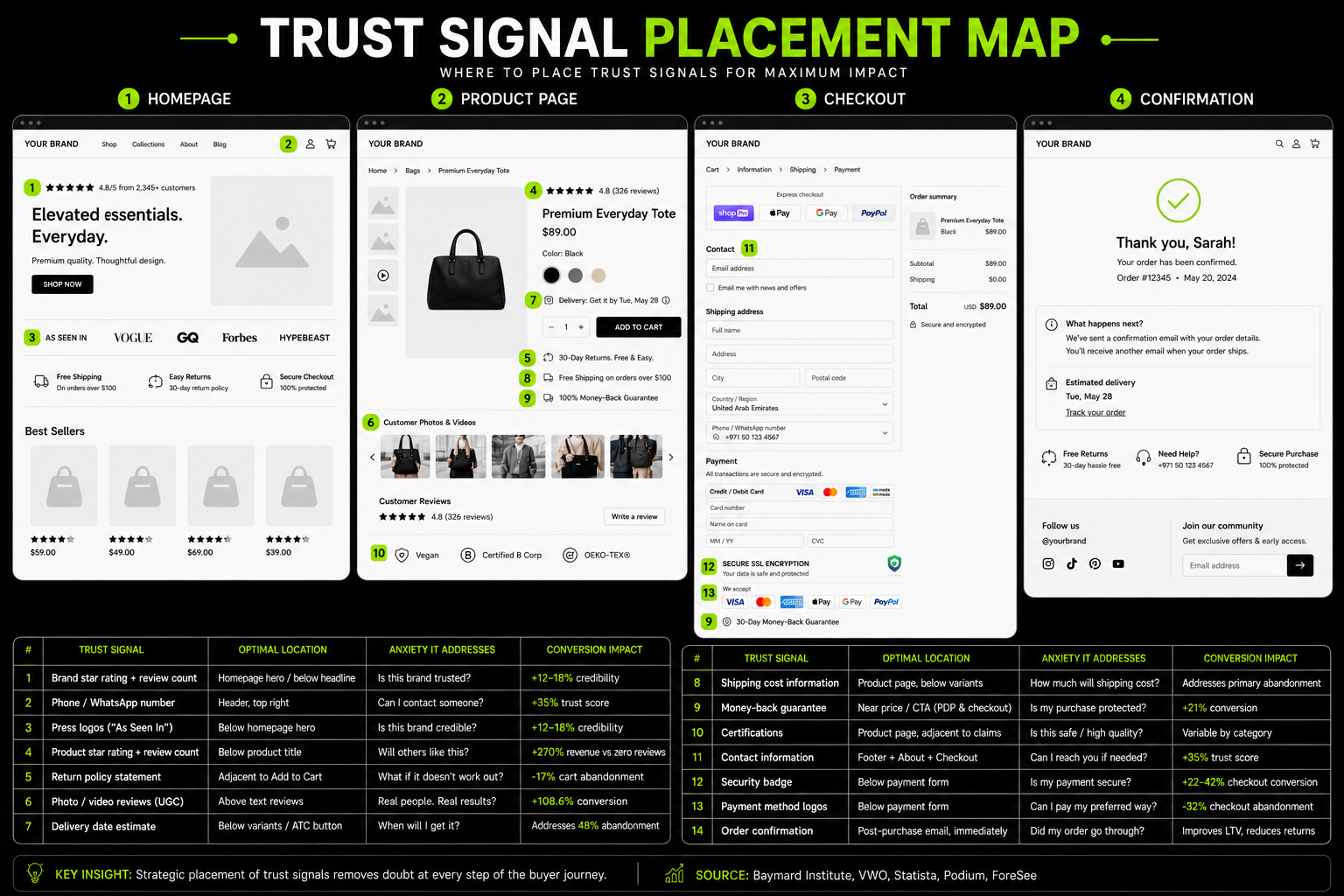
The most common finding in Shopify trust audits: the trust information exists in the store but in the wrong location.
A 30-day return policy buried in the footer. 450 verified reviews below the product description fold. COD availability visible only at checkout.
Repositioning existing trust elements to the positions in this table consistently produces measurable conversion improvement within the first week of change without adding a single new trust signal.
Measuring Trust Signal Performance
Trust signals that are not measured are not optimised. These are the specific metrics that reveal where trust signal architecture is working and where it is not.
What to Track
- Add-to-Cart Rate: A low add-to-cart rate (below 3.5%) despite healthy traffic often indicates a product page trust issue, such as weak reviews, unclear product information, or insufficient social proof. Improving these elements and tracking ATC rate changes helps identify which trust signals are driving better conversions.
- Cart-to-Checkout Rate: A cart-to-checkout rate below 65% usually signals a cart page trust issue, such as poor return policy visibility, unexpected shipping costs, or weak brand credibility. Adding clear return policy messaging and transparent shipping costs to the cart page, then tracking the results, helps identify which changes improve conversions.
- Checkout Completion Rate: A checkout completion rate below 45% (Shopify average) often indicates a checkout trust issue, such as weak payment security signals, unexpected final costs, or the absence of guest checkout. Strengthening these elements can improve checkout completion and reduce abandonment.
- Heatmaps & Session Recordings: Tools like Hotjar and Microsoft Clarity reveal whether visitors actually see and engage with your trust signals. If reviews or trust badges receive little attention, the issue is often placement rather than quality. Moving them higher on the page can significantly improve their impact.
- A/B Testing Trust Signal Placement: Test the same trust signal in different positions—for example, a return policy in the footer versus beside the Add to Cart button. Trust signal placement often has a bigger impact than the signal itself, and stores with moderate traffic typically reach statistically significant results within 2–3 weeks.
For the analytics infrastructure to track these metrics at funnel level, Suplex's D2C data analytics service sets up the segmented funnel tracking that makes trust signal optimisation testable rather than anecdotal.
UAE and Gulf Market Trust Signals: What Changes
This section is absent from every competing piece on ecommerce trust. UAE consumer trust behaviour differs from Western markets in specific, commercially important ways and most stores targeting the Gulf are missing three to five of the signals that matter most to this audience.
Here's a shorter version that keeps the key points:
What UAE Consumers Need to See Before They Buy
- Physical UAE Presence: Display a .ae domain, UAE address, phone number, and trade licence to demonstrate local credibility. Without them, many shoppers perceive the brand as foreign.
- Cash on Delivery (COD): COD is a trust signal as much as a payment method. Show its availability on the product page, not just at checkout, to reduce purchase hesitation.
- WhatsApp Business: A WhatsApp Business button lets shoppers quickly ask about sizing, delivery, or product suitability. Fast responses build confidence and improve conversions.
- Arabic Language Support: Offering product pages, customer support, and policies in Arabic signals commitment to the local market and builds trust with Arabic-speaking customers.
- Halal Certification: For supplements, beauty, food, and personal care products, display Halal certification prominently near the product title. It's an important purchase factor for many Gulf consumers.
- Google Reviews: Strong Google ratings and reviews in Arabic and English build credibility before customers even visit your website, helping warm up first-time visitors.
For the full technical architecture of UAE-specific trust signals implemented at the store level, see Suplex's international ecommerce setup service and the guide on what a Shopify expert in Dubai actually does which covers payment, compliance, and trust architecture as part of the UAE Shopify technical stack.
How We Approach Trust Architecture at Suplex
At Suplex, trust architecture is one of the first areas we assess in every Shopify audit. The most common issue isn't missing trust signals, it's poor placement.
Return policies hidden in the footer, reviews buried below the fold, and COD revealed only at checkout all reduce conversions.
Our audit maps every trust element, identifies the customer concern it addresses, and ensures it appears at the right stage of the buying journey.
Most fixes are simple layout and configuration changes, not costly redesigns, and their impact is often measurable within days.
For UAE brands, we consistently find three missing trust signals: a visible UAE trade licence number, COD messaging on product pages, and WhatsApp Business for pre-purchase support.
These improvements regularly deliver measurable conversion gains across Gulf ecommerce stores.
Relevant Case Studies:
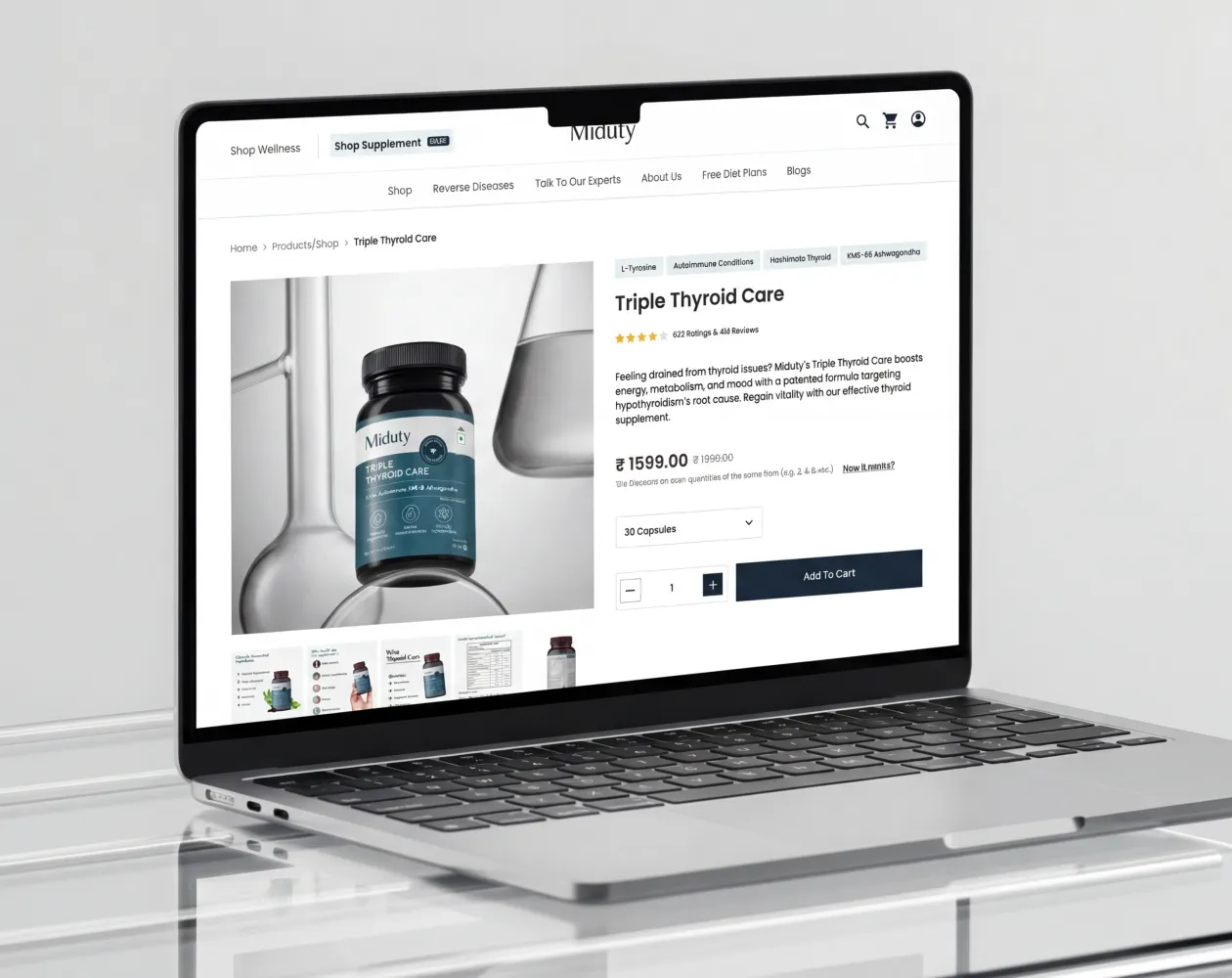
- Miduty D2C supplement brand; category certification display, supplement testing badges, ingredient transparency as trust signals, review architecture
- Loomsona fashion brand UAE; Arabic trust signals, UAE-specific credibility elements, modest fashion trust signals
- Gelatin Labs supplement brand; Halal certification display, ingredient transparency, health category trust architecture
- The Daily Bean food and FMCG; product quality trust signals and UAE local business credibility elements
- Bigtoe D2C product brand; product page trust signal architecture and review integration
If you want to know which trust elements on your current store are in the wrong place, which are missing entirely, and what the conversion impact of fixing them is, Suplex's Shopify audit starts with the trust architecture before anything else.
Frequently Asked Questions
What are ecommerce trust building design elements?
Ecommerce trust building design elements are visual and content components that reduce purchase anxiety throughout the buying journey. The most effective include customer reviews, security badges, return policy summaries near the CTA, transparent shipping costs, payment method logos, product certifications, and visible contact information.
Where should trust badges be placed on an ecommerce website?
Trust badge placement should match the customer concern it addresses. Place security badges at checkout, return policy summaries beside the Add to Cart button, reviews below the product title, and press logos beneath the homepage hero. Even credible trust signals lose their conversion impact when placed in the wrong location.
How much do trust signals improve ecommerce conversion rates?
Trust signals can improve ecommerce conversion rates by 15–42%, depending on their type and placement. Customer reviews can increase revenue by 270%, security badges reduce checkout abandonment by up to 32%, visible return policies reduce abandonment by 17%, money-back guarantees lift conversions by 21%, and visible contact information increases trust by 35%. Better checkout design and trust elements alone can improve conversions by up to 35.26%.
Can too many trust signals hurt conversion rates?
Yes. Overusing trust badges can reduce credibility, a phenomenon often called "trust inflation." Filling a page with badges, awards, and security icons creates visual clutter and can make a brand appear less trustworthy. The best approach is to display a few highly relevant trust signals at the point where each customer concern arises. Quality, relevance, and placement consistently outperform quantity.
What trust signals are most important for a new ecommerce store with few reviews?
For stores with few or no reviews, focus on trust signals you can control: visible contact information, a clear money-back guarantee, high-quality original product photography, and an authentic founder or About Us page with real team photos. At the same time, implement a review collection strategy and aim for at least 10 reviews per product to establish meaningful social proof.
Hi, I’m Rishabh Jain
I believe great design has the power to shape perception, build trust, and move businesses forward. That belief is what led me to found Suplex Design Studio, a global branding and packaging studio working with FMCG and D2C brands across markets.I started suplex at 25 with a clear intent, to create design that is strategic, thoughtful, and commercially meaningful. By 28, the studio had scaled globally, guided by a strong foundation in Integrated Design that I developed during my academic journey in London, where I was honoured with the Dean’s Award.
Over the years, I’ve had the opportunity to work with 100+ brands, from Fortune 500 organizations to family-run businesses, helping them build packaging and brand systems that create recall, relevance, and long-term value.
Suplex’s work has been recognized internationally, including the Manifest Award (2024), the Clutch Global Award (2025), and features on platforms such as Packaging of the World, The Dieline, and the World Brand Design Society.
None of this would be possible without the people behind the work. I’m deeply grateful to the suplex team, whose commitment, creativity, and attention to detail turn ideas into meaningful brand experiences every day.
At the heart of my work is a simple philosophy, design should be intentional, honest, and built to last, and that continues to guide everything we create at suplex.










Let’s Make It Happen
E-Commerce Success Stories

%201.webp)




.webp)
.webp)
Build Your D2C Business The Right Way
Build It With Suplex.


