Headless Commerce vs Traditional Ecommerce: When Each Actually Makes Sense (2026)
.avif)
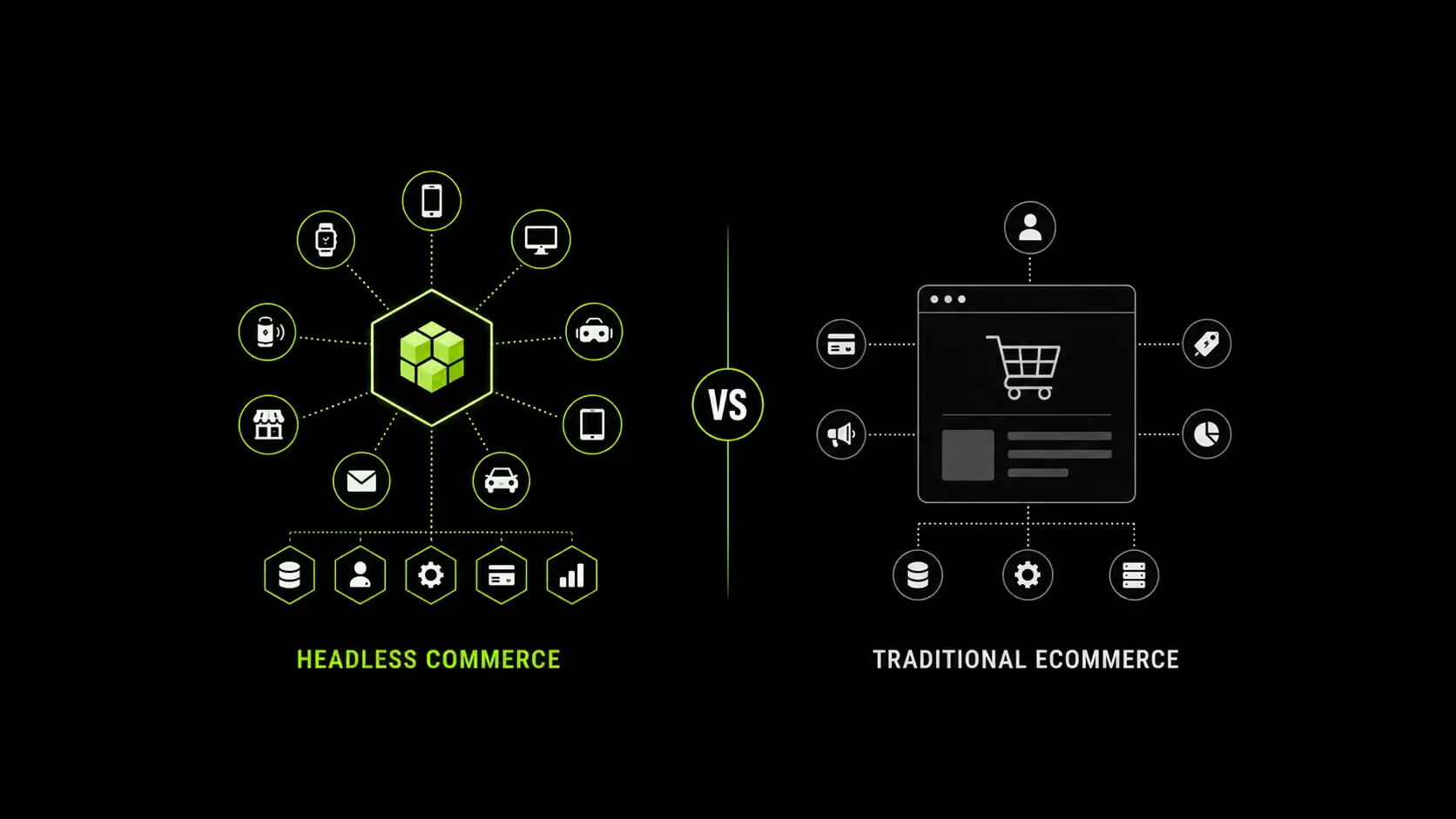
Headless Commerce vs Traditional Ecommerce: When Each Actually Makes Sense (2026)
Headless commerce vs traditional ecommerce is a decision most guides get wrong because most guides are written by vendors selling headless builds or platforms selling headless subscriptions.
This one is not. We build both architectures. We have recommended traditional Shopify to brands that came to us asking for headless. We have built Hydrogen stores where it was the unambiguous right call.
The real question is never which architecture is more technically impressive. It is which one solves your specific constraint at your current scale.
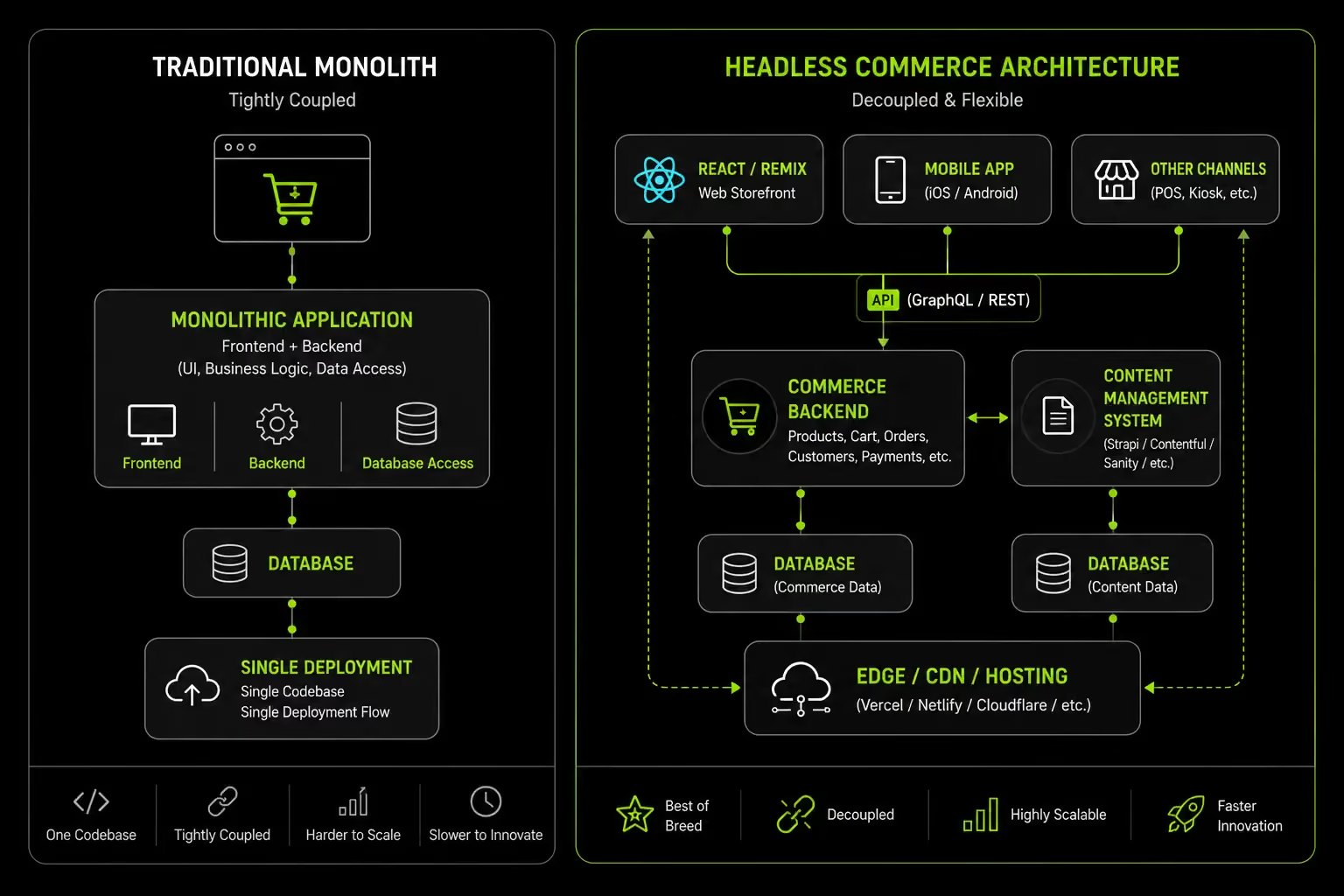
What Headless Commerce Actually Means Defined Precisely
Before evaluating which architecture is right, the definition needs to be precise. Most guides use "headless" loosely in ways that conflate architecture with outcomes.
Here is what it actually means technically and what changes operationally when you adopt it.
The Architecture in Plain Terms
In a traditional (monolithic) ecommerce store, the frontend that the customer sees and interacts with and the backend where products, orders, inventory and payment logic live are tightly coupled within a single system.
Shopify's Liquid theme engine, WooCommerce on WordPress, and Magento in standard deployment all follow this model.
You customise the frontend through the platform's templating language and native tools. Fast to launch. Constrained by what the platform allows at the frontend layer.
Headless commerce: is an ecommerce architecture where the customer-facing frontend is completely decoupled from the backend commerce engine managing products, inventory, pricing, and checkout.
The two communicate exclusively via APIs. This gives brands full control over the frontend on any channel web, native mobile app, kiosk, voice while the backend handles commerce logic independently.
In headless, the frontend is a separate application built in React, Next.js, Remix, or Shopify's own Hydrogen framework that fetches data from the backend via APIs.
The two components communicate; they do not share a codebase. That distinction has significant implications for cost, development resource, performance, and operational complexity.
What Actually Changes When You Go Headless
The table reveals the core tension directly. Headless trades platform convenience for frontend freedom. That trade only makes commercial sense when frontend constraints are a real, measurable problem not a theoretical one.
Suplex's custom web development service covers both architectures. The recommendation always starts with the constraint, not the architecture.
How Headless Shopify Works Hydrogen, Oxygen, and the Storefront API
Shopify offers two distinct paths to headless. Understanding both is necessary before evaluating which one fits your situation.
Shopify's Headless Stack in 2026
Path 1: Hydrogen and Oxygen the recommended Shopify-native headless stack
Hydrogen is Shopify's official React/Remix framework for headless storefronts. Oxygen is Shopify's global edge hosting network for Hydrogen included free with all paid Shopify plans.
Oxygen runs on 300+ Cloudflare edge nodes globally, delivering 50–150ms TTFB regardless of where the customer is located.
Hydrogen handles routing, data fetching via Shopify's Storefront API, streaming server-side rendering via React 18 Suspense boundaries and native cart management.
Oxygen handles deployment, edge rendering, and CDN distribution. Together they form the most integrated path for a headless Shopify build with fewer integration edge cases than a custom stack and native access to Shopify's commerce engine.
Path 2: Storefront API with a custom framework
Shopify's Storefront API exposes products, collections, cart, and customer data via GraphQL. Any frontend Next.js, custom React, Nuxt, SvelteKit can consume this API directly.
This gives maximum framework flexibility but requires managing your own hosting infrastructure and loses several Shopify-native optimisations baked into Oxygen.
The Real Performance Numbers March 2026 Data
These figures are from CrUX data across 1,800+ stores, March 2026:
Three Things Most Headless Commerce Vendors Don't Tell You
Before committing to a headless build, it's worth understanding a few realities that are often overlooked in vendor sales pitches.
1. The performance gap is smaller than the marketing suggests.
A well-implemented headless store averages about 0.6 seconds faster LCP than a well-optimised traditional Shopify store. That can matter at scale, but it rarely justifies a six-figure rebuild on its own.
2. Speed matters, but returns diminish.
Faster sites generally convert better. However, once a store is already performing well, further speed gains often deliver smaller commercial returns—especially for brands below $10M in revenue.
3. Headless does not guarantee performance.
Poorly implemented headless stores can be slower than the Liquid themes they replace. Performance depends on architecture, code quality, and optimisation—not on going headless alone.
For many Shopify stores, targeted performance optimization can resolve the majority of Core Web Vitals issues without the cost and complexity of a full architectural rebuild.
Our performance optimisation service resolves most Liquid performance problems for $5K–$20K, not $150K.
The Real Costs of Going Headless What Most Proposals Leave Out
This is the section most headless proposals do not show you. No competing guide provides a complete, honest total cost of ownership picture. These are real 2025–2026 market figures.
Build Costs Real 2025–2026 Market Ranges
Add Shopify Plus at $2,300/month on top most production headless builds require Plus for API rate limits, Checkout Extensibility and Shopify Functions access.
That is an additional $27,600/year before any development work.
The Hidden Costs Most Proposals Omit
These line items appear in almost no headless proposal. They surface 6–12 months into the engagement.
1. Headless CMS licence: $5,000–$30,000/year
A traditional Shopify store uses Shopify's built-in CMS for product descriptions, blog posts, and landing pages included in the platform cost.
Headless breaks that dependency. You now need a separate headless CMS: Contentful, Storyblok, or Sanity. Budget $5K–$30K/year depending on seats and traffic volume, before any setup or integration work.
2. Ongoing development maintenance: $8,000–$40,000/month
React, Remix, and Hydrogen ship major versions annually. Each upgrade requires development time $5K–$20K per major version or accumulates as technical debt.
Shopify also deprecates Storefront API versions on a 12-month cycle, requiring frontend updates each time. On a traditional Shopify store, platform updates are automatic. On headless, they are engineering tickets.
3. Developer turnover risk
React and Remix engineers cost $120K–$180K/year and are among the most mobile roles in the market. Losing the headless developer mid-project or mid-maintenance cycle stalls development for months.
Traditional Shopify Liquid developers are far more widely available, cheaper to replace, and faster to onboard.
4. Feature parity lag
Every new Shopify feature native B2B updates, Checkout Extensibility improvements, new analytics integrations ships to Liquid-based stores automatically. Headless merchants receive platform features when their development team has capacity to integrate them.
This lag compounds over time and creates a growing gap between what the platform offers and what the headless store can do.
5. Shopify App Store fragmentation
The Shopify App Store has 8,000+ apps that integrate natively with Liquid. Many do not support headless out of the box.
Every required app becomes a custom engineering task rather than a one-click install. The operational simplicity of "install and activate" disappears entirely.
The 3-year total cost of ownership comparison between a well-maintained traditional Shopify Plus store and a headless build consistently favours traditional by 3–5x.
Unless the headless store's performance and conversion improvements generate enough incremental revenue to close that gap, the investment does not make commercial sense. Calculating this before committing is not optional, it is the decision.

When Headless Commerce Is Genuinely the Right Choice
This section is deliberately positioned after the cost section. The investment needs to be understood before evaluating whether it is justified. These are the six specific triggers that make headless the commercially correct choice.
The 6 Triggers That Actually Justify Headless
Trigger 1: Your Frontend Is a Confirmed Revenue Constraint
The threshold is specific. You have identified a measurable conversion problem or a brand experience gap that your traditional architecture cannot solve and you have quantified the revenue cost.
Not "we want better performance." Something like: "our product configurator introduces 400ms of render lag on mobile, and our add-to-cart rate for that product line is 40% below the desktop baseline."
That is an architectural constraint worth engineering around. General dissatisfaction with Liquid's flexibility is not.
Trigger 2: Omnichannel Is a Core Business Requirement
You need to serve the same product catalogue and cart logic across a web store, a native mobile app, an in-store kiosk, and potentially a voice interface simultaneously, from a single backend.
A headless API-first backend is the only architecture that makes this genuinely manageable at scale. A traditional platform makes it extremely expensive or technically impossible.
Trigger 3: Your Marketing Team Is Blocked by Developer Dependency
Campaign landing pages, content updates, and A/B test variants require engineering involvement every time.
A headless setup with a capable CMS (Contentful, Storyblok, or Sanity) gives the marketing team full autonomy over content and experience while engineering retains control over commerce logic.
This is frequently a more compelling business case than the performance argument and the one most often overlooked in architecture evaluations.
Trigger 4: Scale Creates Traffic Spikes That Stress Standard Infrastructure
You run flash sales to hundreds of thousands of concurrent users. You process 5,000+ transactions per hour at peak. Traffic spikes cause measurable degradation on standard Shopify infrastructure.
Hydrogen on Oxygen's edge-rendered architecture, with server rendering across 300+ global Cloudflare nodes, handles these scenarios with sub-150ms TTFB that traditional CDN-fronted Liquid stores cannot consistently match at these volumes.
Trigger 5: International Multi-Market Operations Require Frontend Differentiation
Different storefronts for different regions each with localised language, pricing, tax logic, payment methods, and content experience become exponentially more manageable in headless.
The frontend renders market-specific experiences; the backend handles commerce logic centrally.
Managing this at scale in traditional Shopify requires multiple expansion stores, each with separate theme maintenance and no shared component architecture.
Trigger 6: A Native Mobile App Is a Commercial Priority
A dedicated iOS or Android ecommerce app cannot be built on Liquid. If a genuine native mobile experience, not a web app in a browser wrapper is a strategic priority, headless architecture with Shopify's Storefront API is the required technical foundation.
Suplex built the Kimi Cafe iOS and Android app in Dubai specifically because the brand needed a native experience the traditional web stack could not deliver. For brands with similar requirements, headless is not an option, it is a prerequisite.
For high-growth D2C brands in the UAE targeting simultaneous web, native mobile app, and WhatsApp Commerce channels, headless becomes commercially relevant at an earlier growth stage than for comparable single-channel Western brands.
The multi-channel consumer expectation in the Gulf is high. Dedicated mobile experiences, Arabic RTL layout handling, and WhatsApp-native commerce flows are category-leader expectations in the region.
Brands with these specific requirements should evaluate headless earlier in their growth trajectory than revenue thresholds alone would suggest. For multi-GCC operations, our international ecommerce setup service covers the full architecture evaluation.
When Traditional Ecommerce Is the Smarter Choice
This section does not appear in any competing guide in this SERP. That is because most competing guides are written by agencies and platforms with a financial interest in headless.
The honest case for staying traditional is the most commercially useful section in this post and for most brands reading it, the most relevant.
The Honest Case for Staying Traditional
Revenue is Below $2M–$5M Annually:
The ROI maths on a $150K headless build require substantial, measurable conversion improvement to close.
A well-designed, performance-optimised Liquid store on Shopify Advanced or Shopify Plus will consistently outperform headless on ROI, time-to-market, and operational simplicity at this revenue level.
The $150K in headless investment almost always produces better commercial outcomes when redirected to product, marketing, and retention infrastructure instead.
You Do Not Have an in-House Development Team:
Headless requires ongoing React/Remix development capability either in-house or via a retained agency at $8K–$40K/month.
A brand with no internal engineering capacity faces continuous maintenance costs with no ability to course-correct independently.
Traditional Shopify is fully maintainable by a skilled Shopify developer or a small agency partner at a fraction of that cost.
Speed to Market Matters More Than Frontend Flexibility:
A traditional Shopify store launches in weeks. A properly executed headless build takes 3–6 months minimum and that timeline extends when integrations and custom features were not fully inventoried in discovery. In competitive markets, being live and iterating 3 months earlier is worth more than most architectural advantages.
Your Performance Problem is Solvable Without Headless:
A traditional Shopify store underperforming on Core Web Vitals is almost always fixable through image optimisation, app stack audit, code minification, lazy loading and theme refinement for $5K–$20K, not $150K+.
The correct first question is not "should we go headless?" It is "what specifically is causing the performance problem, and what is the cheapest fix?" Our ecommerce website audit checklist is a useful starting point for that diagnosis.
Your Ops Team Needs Self-Service Content Control:
This is counterintuitive: traditional Shopify frequently gives non-technical users more self-service capability than headless implementations.
Shopify's native section editor, CMS, and metafield system are purpose-built for operators. A headless CMS has a learning curve that reduces operational agility for lean teams who need to move fast on campaigns and content particularly in fast-moving D2C brands.
The "Decapitated Monolith" Problem
One of the biggest misconceptions in ecommerce is that going headless automatically delivers better performance, flexibility, and agility. It doesn't.
Headless removes frontend constraints, but it does not solve problems related to development resources, content operations, integrations, or product strategy.
Without a clear roadmap, brands often end up with a more complex and expensive storefront that delivers little additional value.
A common failure pattern is poor implementation. We've seen headless stores where even static content was rendered client-side, creating unnecessary performance overhead and slower load times than the Liquid themes they replaced.
The lesson is simple: headless is an architecture choice, not a business outcome.
Performance, flexibility, and scalability come from execution quality and ongoing investment—not from the architecture alone.
We recommend headless when a genuine architectural constraint exists and the commercial case is clear. Otherwise, a well-optimised traditional build is often the smarter investment.
Headless vs Composable Commerce The Next Layer
Most guides conflate headless and composable commerce. They are distinct architectures, with distinct cost profiles and different audiences.
Composable commerce also targets a keyword cluster $20.95 CPC that signals strong commercial intent among enterprise decision-makers.
What Composable Commerce Actually Means
Composable commerce is the next step beyond headless, separating not just the frontend but every major part of the ecommerce stack into independent services.
Built on MACH principles (Microservices, API-first, Cloud-native, Headless), it allows brands to combine best-of-breed tools for commerce, content, search, payments, loyalty, and more.
The benefit is maximum flexibility. The trade-off is significantly greater complexity, integration effort, and maintenance overhead.
For most ecommerce brands, composable commerce is overkill. It is best suited to large enterprises operating across multiple markets, channels, and business models with dedicated engineering teams.
For brands that need frontend flexibility, headless Shopify is usually sufficient. For most others, traditional Shopify remains the most practical starting point.
Headless vs Composable When Each Applies
The correct architecture is always the simplest one that solves the specific commercial constraint in front of you. Complexity is not a proxy for capability.
The Architecture Decision Framework A Practical Tool
The most useful section in this post for decision-stage readers. No other guide in this SERP provides a structured, scorable decision tool for this question.
Start With Three Questions In This Order
Question 1: What specific constraint is your current architecture creating?
Name it precisely and quantifiably. Examples of constraints that may justify headless:
- "Our product configurator introduces 400ms render lag on mobile, reducing add-to-cart rate by an estimated 15% below our desktop baseline."
- "Our marketing team requires engineering involvement to update campaign landing pages, costing an average of 3 launches per month and 2 weeks of delay per update."
- "We need a native iOS app alongside our web store, and our current architecture cannot support both from a single backend."
If you cannot name a specific, measurable constraint you do not yet have a business case for headless. Return to traditional optimisation first. Our platform consultation service is designed for exactly this evaluation.
Question 2: Can that constraint be solved on your current architecture?
Most performance problems on traditional Shopify are solvable. Image optimisation, app stack audit, code minification, lazy loading, and theme refinement resolve the majority of Core Web Vitals issues for $5K–$20K. Most content velocity problems are solvable with a page builder or better use of Shopify's section editor and metafield system.
Headless should only enter the conversation when the constraint is genuinely architectural, probably not solvable within the platform's current capabilities, not just inconvenient.
Question 3: What is the revenue case for solving that constraint through headless?
Build a conservative financial model before committing. If moving LCP from 2.0s to 1.4s generates a 5% CVR improvement and your current revenue is $3M, that is $150K in incremental annual revenue.
A headless build costs $180K plus $120K in annual maintenance and $300K in year one. The investment does not break even in year one at $3M revenue.
At $10M revenue, the same 5% CVR improvement generates $500K annually. The $300K first-year cost breaks even in under 8 months. The investment is clearly justified.
Revenue size is not the only criterion but it is the most important starting denominator for the ROI model.
The Architecture Readiness Score
Score 0 (not applicable), 1 (somewhat applies), or 2 (strongly applies) for each criterion:
Scoring interpretation:
- 12–14: Strong headless candidate. Build a detailed ROI model and proceed to scoping.
- 8–11: Headlessness may be justified. Commission a performance audit and constraint analysis first. Targeted optimization may solve the same problem at lower cost.
- 0–7: Stay on traditional architecture. Invest in performance optimisation and conversion improvement on the current stack. Revisit when revenue crosses $5M or a genuine architectural constraint emerges.
Headless Commerce in the UAE and Gulf Specific Considerations
No competing piece in this SERP addresses the Gulf market context. These are genuine, commercially specific insights for the primary audience Suplex serves.
Where Headless Makes Specific Sense in the Gulf
Arabic RTL Layout Complexity:
Standard Shopify handles Arabic through built-in language and locale settings sufficient for most stores.
But complex RTL layout logic, especially for custom UI components with bidirectional text, animation or grid interactions, is materially cleaner to build and maintain in a React-based headless frontend where direction logic is handled natively at the component level.
For brands with rich, interaction-heavy interfaces in Arabic, this is a genuine frontend constraint.
Native Mobile App Ambition:
UAE and Gulf consumers are among the most mobile-first audiences globally. Brands that want a genuine native iOS or Android shopping app not a web app in a browser wrapper require headless architecture with the Storefront API as the backend.
For category-leading brands in fashion, beauty, and FMCG in the region, a native app is a standard expectation. It is what Suplex built for Kimi Cafe in Dubai.
The brand needed a loyalty-driving native experience that the traditional web stack structurally cannot deliver.
WhatsApp Commerce Integration:
Building commerce flows within WhatsApp product browse, cart management, and checkout entirely within the messaging app requires an API-first backend.
Headless architecture provides this naturally. A monolithic Shopify store requires significantly more custom engineering to expose comparable API surface area for WhatsApp-native flows.
GCC Multi-Storefront Operations:
Brands serving UAE, KSA, Kuwait, and Bahrain simultaneously each with different VAT rules, payment methods (KNET in Kuwait, Mada in KSA, PayFort across the Gulf), currency and content localisation manage this more elegantly through a centralised headless backend serving market-specific frontends than through multiple separate Liquid stores or Shopify Markets alone at high complexity.
Where Traditional Wins in the Gulf
For brands under $2M revenue in the UAE market, traditional Shopify with market-specific optimisation Shopify Markets, Arabic language pack, regional payment gateway integration (PayTabs, Telr, or Checkout.com) delivers 95% of the commercial benefit at roughly 10% of the headless investment.
The opportunity cost matters enormously for growth-stage brands in the region. Spending $150K on architecture at $1M revenue means not spending $150K on performance marketing, inventory, brand development and customer acquisition all of which have more direct impact on revenue at that stage.
The correct entry point for most UAE D2C, FMCG, and fashion brands is a well-built traditional Shopify store optimised for Arabic bilingual experience, mobile performance, and regional payment integration.
That foundation scales comfortably to $5M–$8M before headless becomes the most commercially logical next step. Our international ecommerce setup service covers this build in full.
How We Approach This Decision at Suplex
At Suplex, we build both traditional Shopify and headless commerce solutions across the UAE, Gulf, and UK.
Our recommendation is always based on business needs not architecture trends.
We start by identifying the specific constraint, determining whether it is truly architectural, and evaluating the commercial return of solving it.
If a targeted optimisation can achieve the desired outcome, we recommend that. If a brand has outgrown what traditional Shopify can deliver, we build headless.
What we see repeatedly is that brands that adopt headless too early often increase complexity without improving business results.
The most successful headless projects share one trait: a clear, measurable limitation that traditional architecture cannot solve and a revenue model that justifies the investment.
If you're evaluating headless commerce, we begin with your goals and constraints, not a predefined solution.
We also offer architecture consultations, rapid prototyping, and performance optimisation services to help you validate the right path before committing to a full rebuild.
Book a call with our founders to discuss your ecommerce architecture strategy.
Frequently Asked Questions
What is headless commerce?
Headless commerce separates the frontend customer experience from the backend commerce engine. The two communicate via APIs, giving brands greater flexibility to create custom experiences across channels.
What is the difference between headless and traditional ecommerce?
Traditional ecommerce keeps the frontend and backend together in a single platform. Headless separates them. Traditional is cheaper, faster to launch, and easier to maintain, while headless offers greater flexibility and performance potential at a higher cost.
Is Shopify headless?
Shopify supports both traditional and headless architectures. Most merchants use Shopify's Liquid framework, while brands needing advanced frontend flexibility can build headless with Hydrogen, Oxygen, and the Storefront API.
How much does a headless ecommerce build cost?
Headless Shopify projects typically cost $80K–$600K+, depending on complexity. Ongoing maintenance can range from $8K–$40K per month. Traditional Shopify builds generally cost $5K–$50K with lower operating costs.
Is headless ecommerce faster than traditional?
Usually, yes. Headless can deliver faster page loads and better Core Web Vitals when implemented well. However, a well-optimised traditional Shopify store can often achieve similar commercial results at a much lower cost.
Hi, I’m Rishabh Jain
I believe great design has the power to shape perception, build trust, and move businesses forward. That belief is what led me to found Suplex Design Studio, a global branding and packaging studio working with FMCG and D2C brands across markets.I started suplex at 25 with a clear intent, to create design that is strategic, thoughtful, and commercially meaningful. By 28, the studio had scaled globally, guided by a strong foundation in Integrated Design that I developed during my academic journey in London, where I was honoured with the Dean’s Award.
Over the years, I’ve had the opportunity to work with 100+ brands, from Fortune 500 organizations to family-run businesses, helping them build packaging and brand systems that create recall, relevance, and long-term value.
Suplex’s work has been recognized internationally, including the Manifest Award (2024), the Clutch Global Award (2025), and features on platforms such as Packaging of the World, The Dieline, and the World Brand Design Society.
None of this would be possible without the people behind the work. I’m deeply grateful to the suplex team, whose commitment, creativity, and attention to detail turn ideas into meaningful brand experiences every day.
At the heart of my work is a simple philosophy, design should be intentional, honest, and built to last, and that continues to guide everything we create at suplex.

































Let’s Make It Happen
E-Commerce Success Stories
%201.avif)






.avif)
.avif)
Build Your D2C Business The Right Way
Build It With Suplex.


