Best Ecommerce Platform For Supplement Brands: What To Check First (2026)
.avif)

Best Ecommerce Platform For Supplement Brands: What To Check First (2026)
The best ecommerce platform for supplement brands starts with payment stability and subscription infrastructure.
Choosing the wrong platform or payment setup can expose your business to high-risk payment restrictions, causing frozen funds, disrupted transactions and lost revenue.
Why Platform Choice Is Different For Supplement Brands
A fashion brand and a supplement brand can't evaluate platforms the same way. This category carries risk that most ecommerce platform guides never mention at all.
Payment Processors Treat Supplements As High-Risk, Not Just Platforms
Here's a distinction almost every competing guide gets wrong or skips entirely: it's the payment processor, Stripe, Square, Shopify Payments, that applies the high-risk label, not the ecommerce platform itself.
This matters because it changes what the actual fix looks like. Switching platforms doesn't solve a payment processor problem. Building a resilient payment setup on whichever platform you choose does.
This risk isn't hypothetical. In 2023, Shopify required NMN supplement brands to remove products or find a new payment processor, with little advance warning. Brands that hadn't planned for this scenario faced real disruption to live revenue overnight.
The stakes are only growing. The US online vitamin and supplement market is reportedly worth around $25.6 billion in 2026 and DTC's share of supplement sales has climbed from roughly 16% in 2020 to around 29% now.
As more revenue moves through direct channels, the payment infrastructure decision matters more, not less.
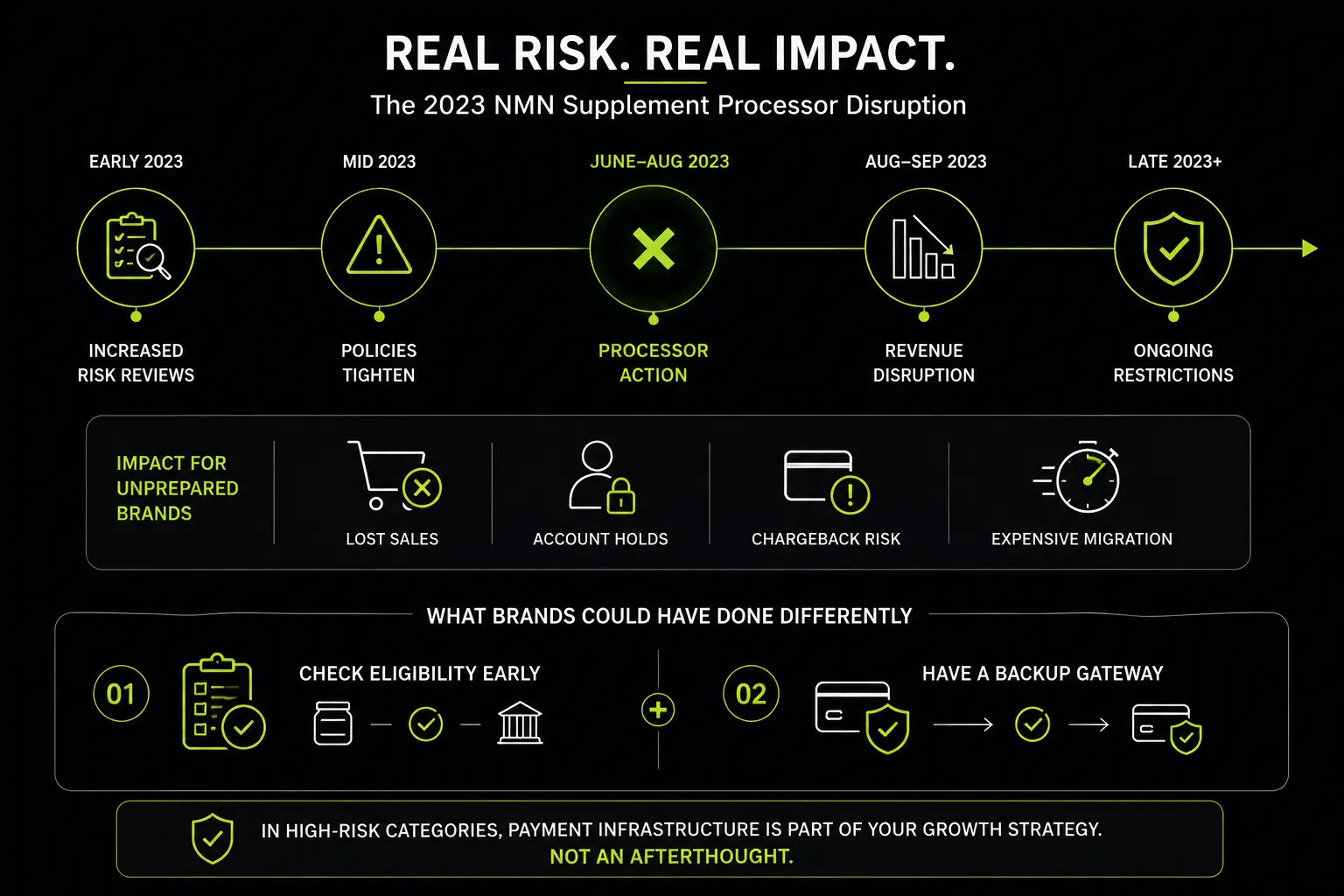
The Subscription/Replenishment Factor
Supplements sit among the highest repeat-purchase and subscription-fit categories in all of ecommerce, driven by natural replenishment cycles; a bottle of 30-day capsules simply runs out on a predictable schedule.
This means subscription billing infrastructure isn't a nice-to-have feature for this category. It's close to core functionality, unlike for a one-time-purchase fashion item where subscription mechanics would feel forced.
The Supplement Platform Checklist (Original Framework)
Four pillars determine whether a platform actually supports a supplement brand long-term, beyond how the storefront looks on day one.
Industry guidance recommends keeping chargeback ratios well below 1%, ideally closer to 0.5%. Visa's VAMP excessive-merchant threshold tightened to 1.5% as of April 2026, a concrete number worth monitoring against directly, not a vague "keep disputes low" suggestion.
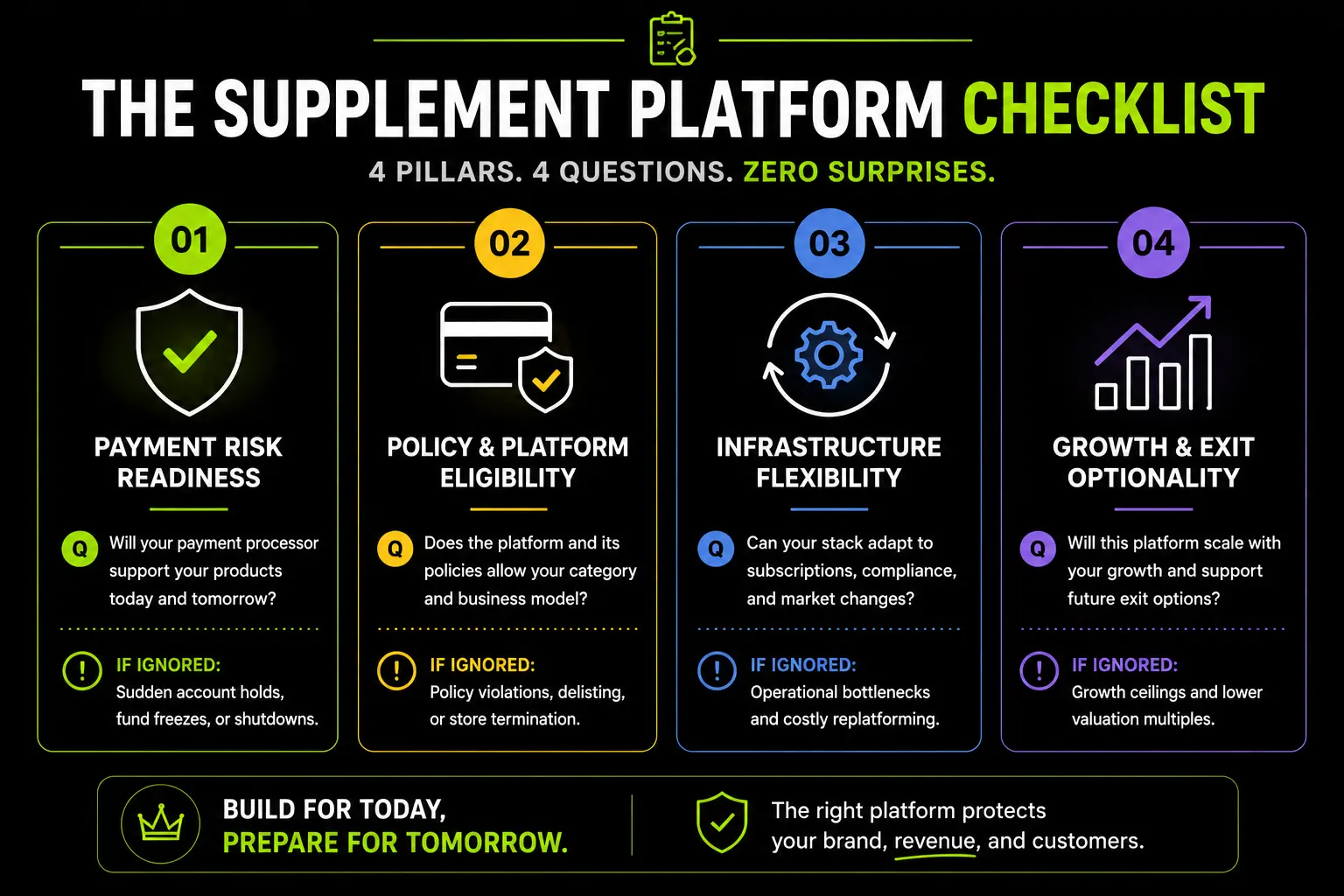
We walk supplement clients through all four of these before recommending a build. The platform that looks right in a portfolio isn't automatically the one that survives a payment processor review a year later.
Is Shopify Right For A Supplement Brand?
Shopify is the honest default answer for most supplement brands, but it comes with tradeoffs worth stating plainly rather than glossing over.
Where Shopify Works Well For Supplement Brands
Shopify's app ecosystem for subscriptions is strong, native Shopify Subscriptions, or established third-party apps like Recharge and Bold, and the platform's scalability is proven at this category's scale.
A large enough merchant base already runs supplement stores on Shopify that the operational playbook, including how to handle payment eligibility and subscription setup, is well established and documented.
Real, verifiable supplement and wellness brands operate on Shopify successfully today, demonstrating the platform can support the category at real scale.
That said, running on Shopify doesn't eliminate the payment-processor consideration covered above, it just means the risk is well understood and manageable if planned for correctly.
What To Set Up Correctly From Day One
- Confirm Shopify Payments eligibility before launch, not after: Have a backup high-risk gateway relationship in place as a contingency plan from the start, not a reaction scrambled together after a restriction notice arrives.
- Choose a subscription app carefully: Third-party subscription apps can run their own separate merchant risk review, independent of Shopify's own. That means a brand can pass Shopify Payments' review cleanly and still hit friction at the subscription-app layer if that layer wasn't vetted with the same rigour.
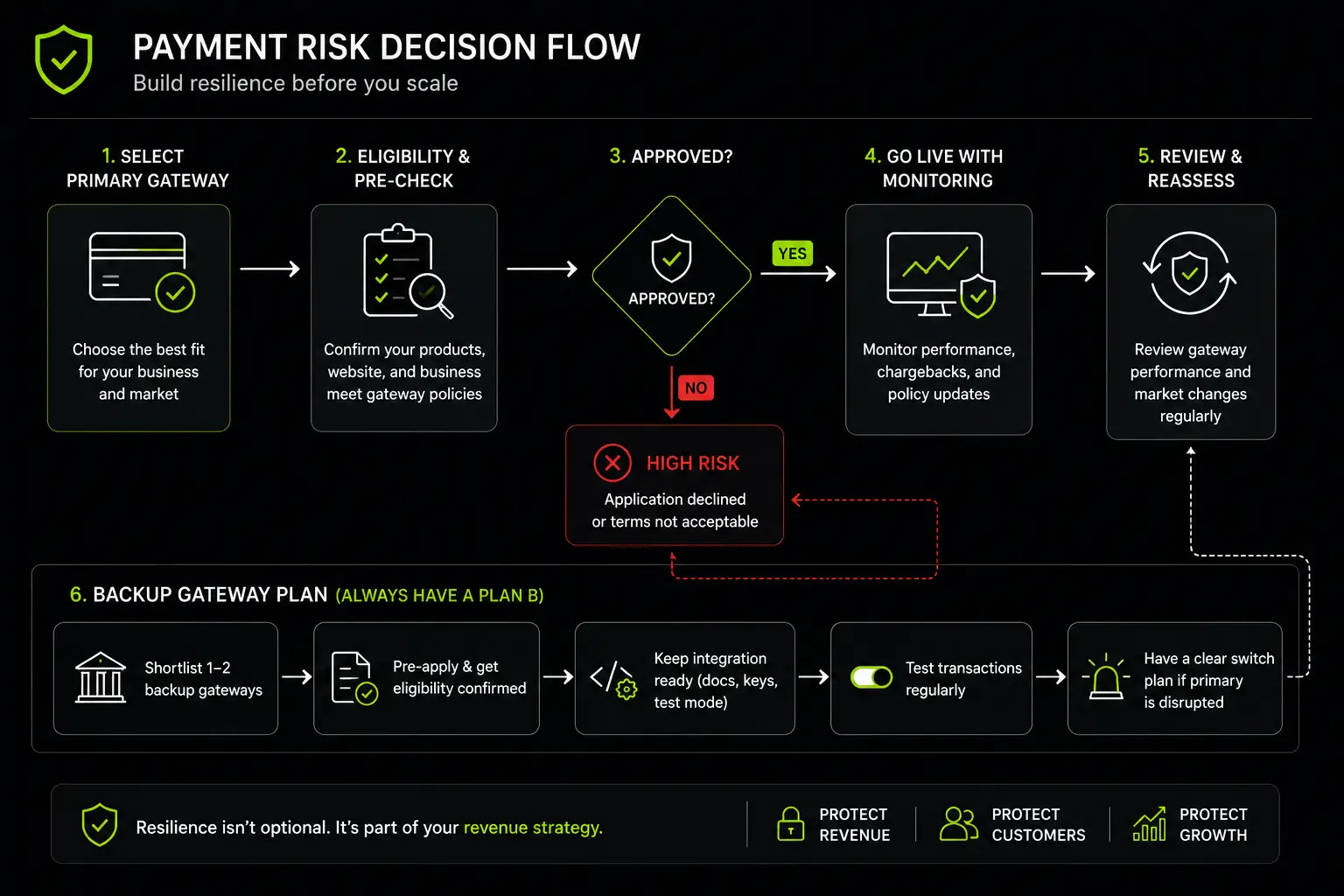
The platform decision isn't actually complete until the payment and subscription layer is planned alongside it, not treated as a follow-up task after the storefront ships.
When An Alternative Platform Might Make Sense
Brands with an existing high-risk merchant account relationship and a strong internal technical team may find a self-hosted or API-first platform gives more direct control over payment gateway choice, at the cost of more infrastructure to manage themselves.
This isn't a fixed rule against Shopify, it depends on a brand's existing payment relationships and internal technical capacity, not a category-wide mandate.
Building Compliance Into The Product Page, Not Bolting It On
Most competitor content skips this entirely, treating compliance as a legal afterthought instead of a product page design decision.
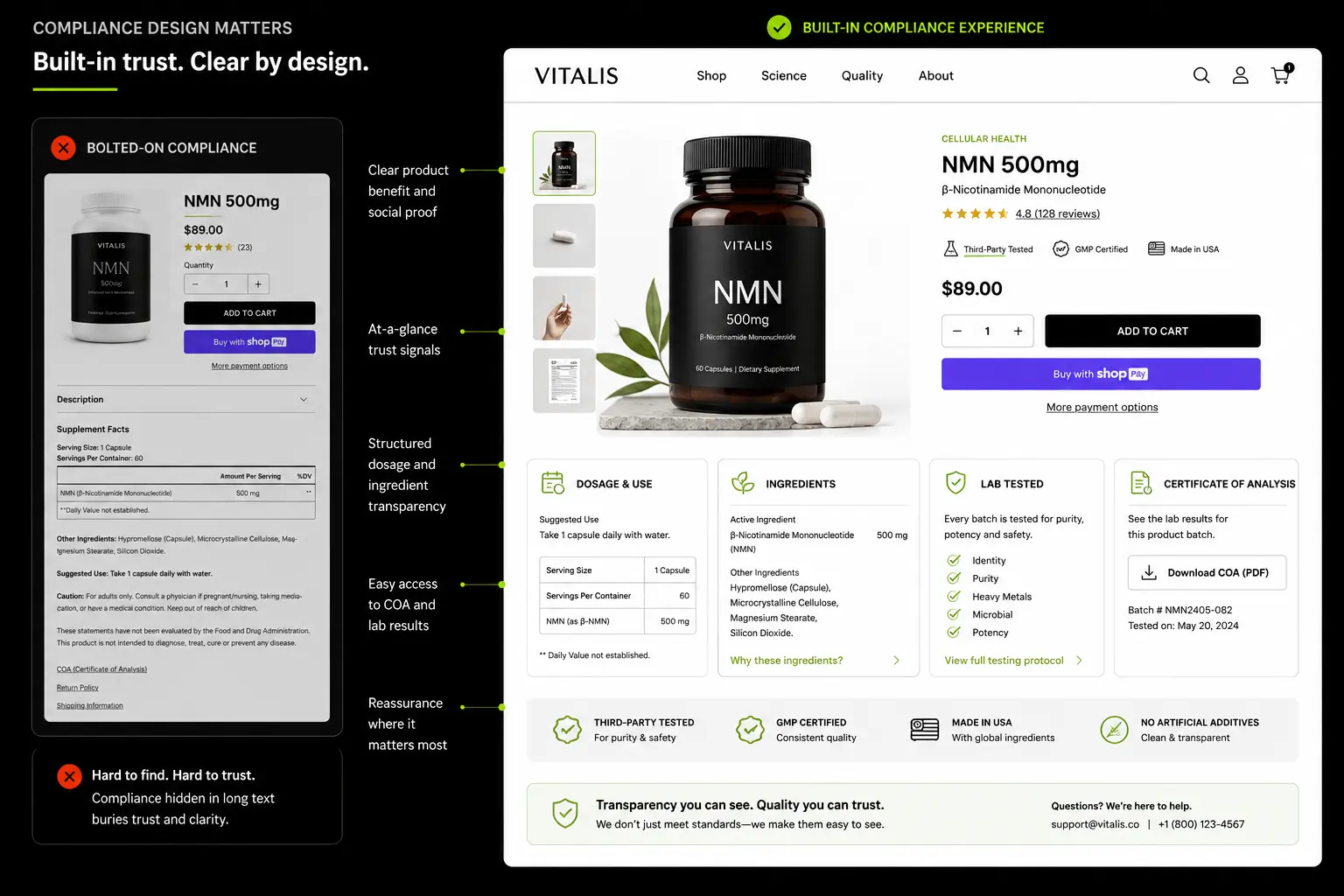
Structure product pages to carry claims disclaimers, ingredient lists, dosage information, and lab testing documentation (COA or HPLC reports where relevant) as clean, structured content, not an afterthought paragraph crammed at the bottom of the page.
This matters for two reasons. First, regulatory defensibility, structured, consistent compliance content is easier to audit and update than text buried in a generic description block.
Second, well-structured claims and lab-test information function as exactly the kind of trust signal that reduces checkout hesitation.
Extra scrutiny and trust concerns are a documented top driver of cart abandonment for regulated product categories, the same loss-aversion and trust mechanics covered in our guide to reducing Shopify cart abandonment apply here, just triggered by a shopper questioning a health claim rather than a hidden shipping cost.
Suplex's Approach To Supplement And Wellness Ecommerce Platforms
We treat platform selection for supplement brands as a payment-risk and subscription-infrastructure conversation first, design second, the reverse of how most agencies approach this brief.
Our Shopify Partner experience means we can set up a resilient payment and subscription stack correctly from day one, rather than a brand discovering gaps only after a processor review disrupts live revenue.
That includes confirming gateway eligibility early, planning a backup relationship before it's needed, and vetting the subscription app layer with the same scrutiny as the primary payment setup.
We structure product pages to carry compliance and trust content cleanly, treating it as part of conversion design, not a legal afterthought tacked onto the bottom of a description field.
A beautifully designed supplement store built on a fragile payment setup is a liability, not an asset. Durability matters more than aesthetics alone in this category, a store that looks perfect but loses its payment processor six months in has solved the wrong problem first.
Selling Supplements Online In The UAE: What To Know Before You Build
This section is informational, not legal advice, and every point below needs confirmation with a qualified regulatory specialist before launch.
Registration Is A Market-Access Requirement, Not Optional Paperwork
Health supplements sold or imported into the UAE must be registered with either the Ministry of Health and Prevention (MOHAP) or Dubai Municipality, through the Montaji or FIRS portal, depending on product classification. This needs planning before launch, not after, registration timelines don't align with a rushed go-live date.
Claims Language Is Regulated Specifically
UAE regulation prohibits disease-treatment claims on supplement labels and marketing, words like "treats," "cures," or "prevents" cross the line.
Structure/function claims, phrasing like "supports immune health," are generally permitted, but they need supporting evidence submitted during the registration process itself, not just confident copywriting.
Labelling Must Be Bilingual From The Start
Labelling requirements are bilingual, Arabic and English, and this needs to shape product page and packaging design decisions from the beginning of the build, not get retrofitted onto an English-first product page after the fact.
This is genuinely different from the generic "translate your site into Arabic" advice common in most UAE ecommerce content. Regulatory compliance for supplements is a distinct, higher-stakes requirement that needs specialist input running alongside the platform build, not a checkbox handled by a translation app.
We've built Shopify storefronts for UAE and Gulf wellness and supplement brands that account for this registration and labelling reality from the platform architecture stage onward, while directing brands to a qualified regulatory consultant for the registration process itself, as a Shopify, Meta, and Google Partner working across the region.
Frequently Asked Questions
Can you sell supplements on Shopify?
Yes. Shopify supports supplement and nutraceutical brands, but merchants should confirm eligibility with Shopify Payments before launch, since the category is classified as high-risk by most major payment processors. Having a backup payment gateway relationship in place is standard practice for supplement brands on any platform.
What is the best platform for a supplement subscription business?
Shopify works well for most supplement subscription brands, using either the native Shopify Subscriptions app or established third-party apps like Recharge.
The key evaluation criteria are subscription billing reliability and payment gateway flexibility, not just design capability, both matter more for this category than for one-time-purchase products.
Why are supplement brands considered high-risk by payment processors?
Payment processors flag the category due to above-average chargeback rates common in subscription and trial-based supplement offers, plus regulatory scrutiny around health claims. This is a payment processor classification, not necessarily a platform restriction, though it affects which payment setup a brand can rely on.
Do I need a license to sell supplements online?
Requirements vary by country and region. In the UAE, supplements must be registered with MOHAP or Dubai Municipality before sale or import. In other markets, requirements differ. Brands should confirm specific licensing and registration requirements with a regulatory specialist for each market they sell into.
What chargeback ratio should a supplement subscription business aim for?
Industry guidance generally recommends keeping chargeback ratios well below 1%, ideally closer to 0.5%, particularly for trial-based or continuity subscription offers. Card network thresholds have also tightened recently, making proactive chargeback monitoring a more urgent operational priority for this category.
Can I use Shopify Payments for a supplement store?
Often yes, but eligibility isn't guaranteed and can change. Some supplement brands have had products flagged or processors restricted with limited warning. The safer approach is confirming eligibility before launch and maintaining a backup high-risk payment gateway rather than relying solely on Shopify Payments as the only option.
What claims can I legally make on a supplement product page?
This varies significantly by market. In the UAE, disease-treatment claims are prohibited, while structure/function claims backed by evidence are generally permitted. Rules differ elsewhere. Product page compliance should be reviewed with a regulatory specialist for each market a brand sells into, not assumed from general ecommerce best practice.
Hi, I’m Rishabh Jain
I believe great design has the power to shape perception, build trust, and move businesses forward. That belief is what led me to found Suplex Design Studio, a global branding and packaging studio working with FMCG and D2C brands across markets.I started suplex at 25 with a clear intent, to create design that is strategic, thoughtful, and commercially meaningful. By 28, the studio had scaled globally, guided by a strong foundation in Integrated Design that I developed during my academic journey in London, where I was honoured with the Dean’s Award.
Over the years, I’ve had the opportunity to work with 100+ brands, from Fortune 500 organizations to family-run businesses, helping them build packaging and brand systems that create recall, relevance, and long-term value.
Suplex’s work has been recognized internationally, including the Manifest Award (2024), the Clutch Global Award (2025), and features on platforms such as Packaging of the World, The Dieline, and the World Brand Design Society.
None of this would be possible without the people behind the work. I’m deeply grateful to the suplex team, whose commitment, creativity, and attention to detail turn ideas into meaningful brand experiences every day.
At the heart of my work is a simple philosophy, design should be intentional, honest, and built to last, and that continues to guide everything we create at suplex.































Let’s Make It Happen
E-Commerce Success Stories

%201.avif)






.avif)

.avif)
Build Your D2C Business The Right Way
Build It With Suplex.


