How to Compare Shopify Agency Proposals Without Guessing
.avif)
How to Compare Shopify Agency Proposals Without Guessing
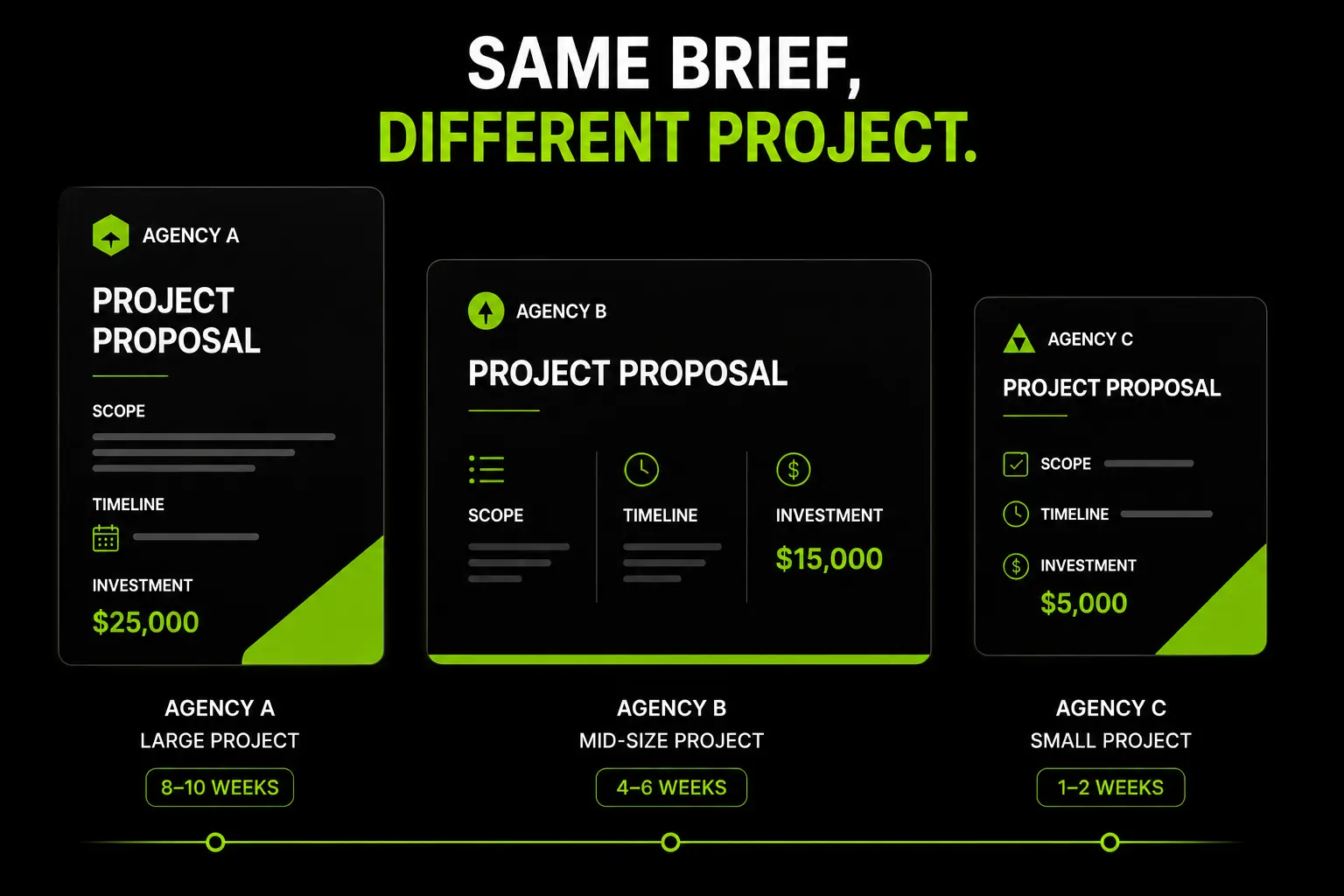
If three Shopify agencies quote three different prices for the same brief, the first thing to compare isn't the total. Three agencies can receive the same brief and propose very different projects.
Their proposals may cover different work, use different technical approaches, and involve different teams. Comparing the prices directly can give you the wrong picture. First, make sure you are comparing the same scope, deliverables and level of support.
If you have two or three proposals and the prices are far apart, that is not necessarily a red flag. In many cases, the difference comes from what each agency has included in the scope.
Why Three Proposals Rarely Compare Cleanly
A brief is never fully unambiguous. Every agency fills the gaps with its own assumptions, and those assumptions end up baked into the price without being stated anywhere in the document.
Same Brief, Different Scope Assumptions
Send the same brief for "a custom Shopify build" to three agencies and you'll likely get three different interpretations of what that means. One agency includes 15 hours of QA as a named line item. Another states no QA hours at all, assuming it's covered under general development time.
A third bundles it into an undefined "testing phase" with no hour count attached. None of these numbers are directly comparable until you ask each agency what their line actually includes.
This happens because your brief left QA scope open to interpretation, and each agency resolved that ambiguity differently based on their own delivery process, not based on what you actually need.
Why the Lowest Number Often Means the Narrowest Scope, Not the Best Value
A lower quote usually means one of two things: either the agency runs leaner and genuinely delivers for less, or the agency scoped less work into the same brief. Both look identical on a cover page. The only way to tell them apart is to open the line items and compare what's actually included against the other proposals in hand.
An agency that quotes 30 percent below the others on the exact same brief is worth a direct question before you get excited about the savings: what specifically did you exclude to hit this number?
Here’s a simple example: Three agencies quote $18,000, $24,000, and $31,000 for a mid-complexity Shopify build. It is easy to assume the $18,000 proposal is the best deal and the $31,000 proposal is overpriced.
Once scoped side by side, the $18,000 proposal turns out to exclude data migration entirely, quoting it as a separate project once the build is underway.
The $31,000 proposal includes migration, 60 days of post-launch support, and a dedicated QA engineer with a defined number of hours. The price difference looks much smaller once you account for the extra work included in that proposal.
Normalize Before You Compare: A Line-by-Line Method
Reading three proposals one after another can skew your judgment. You see the total price first, then read the details around it. Compare the proposals using the same set of criteria instead.
Build a Single Scope Grid Across All Proposals
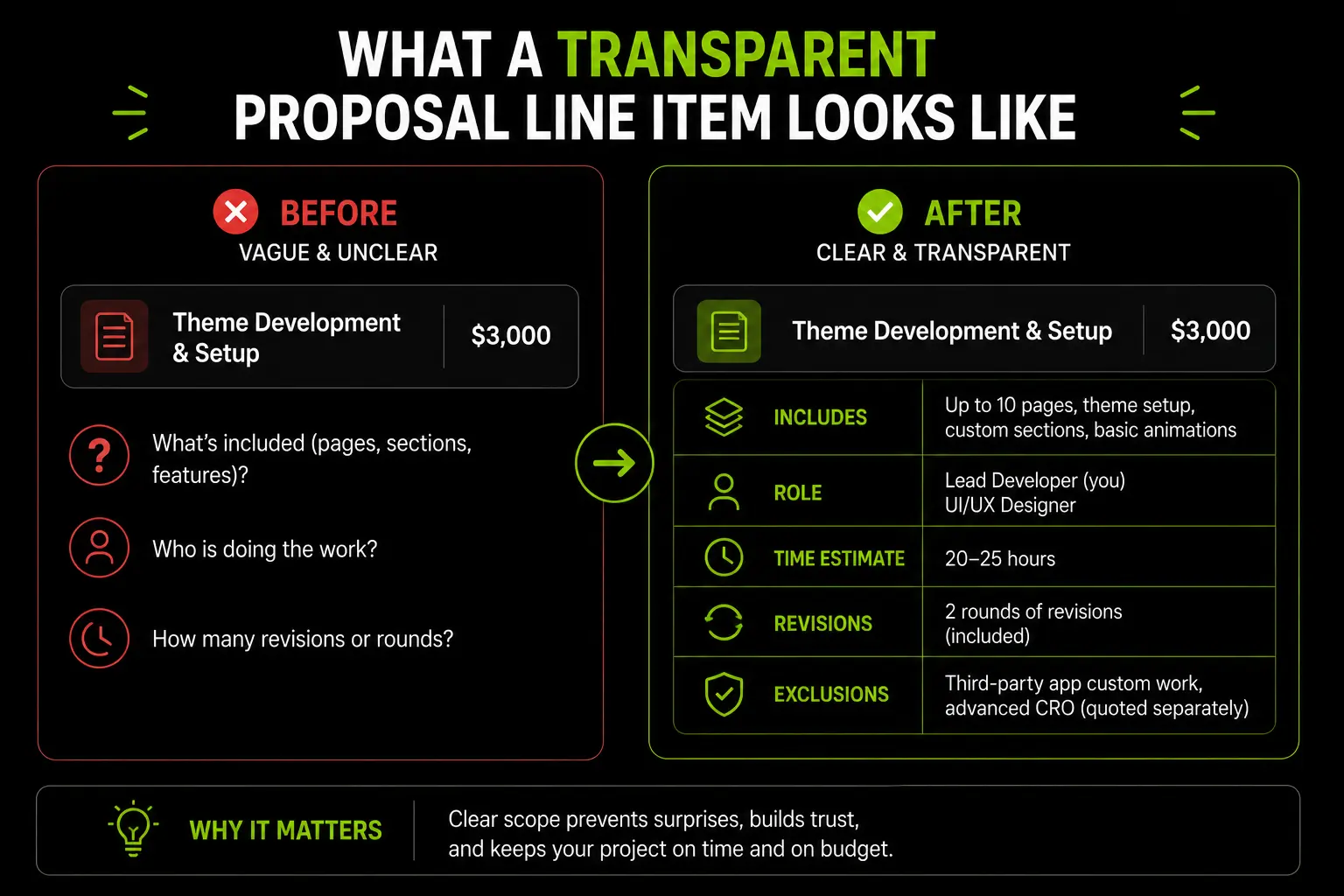
List every deliverable category down the left side: design, development, QA, data migration, localization if relevant, third-party integrations, and post-launch support. Create one column per proposal. For every cell, mark whether that proposal explicitly includes the item, explicitly excludes it, or simply doesn't mention it.
The “not stated” cells deserve the closest attention. They show where the proposal leaves details unclear. Those gaps are often where scope disputes appear later in the project.
Flag What's Explicitly Included, Explicitly Excluded, and Unstated
Once your grid is built, the unstated cells become your question list for each agency. Send these back before signing anything, not after.
An agency that answers clearly and specifically is telling you something useful about how they'll handle ambiguity mid-project too.
Convert Every Proposal to the Same Pricing Structure for Comparison
Fixed-price proposals are easy to compare numerically. Time-and-materials proposals need converting first: take the stated hourly rates and estimated hours and calculate a total for each deliverable category.
Price comparisons only make sense after you put every proposal against the same scope and list the total cost for each. Then you can see what each agency is actually offering for the money.
Run the math before you compare, not after. A time-and-materials proposal quoting 120 hours of development at $85 an hour and 40 hours of design at $70 an hour totals $12,800 before QA, project management, or contingency are added.
If a competing fixed-price proposal for the same scope comes in at $14,500, the fixed-price option isn't necessarily more expensive. It may already include the QA and PM time the time-and-materials quote left out. You can't see this until both numbers sit in the same format on the same page.
Six Dimensions Beyond Price
Price is easy to compare, but it tells you little on its own. These six areas show what each agency is actually offering for the money.
1. Proposed Technical Architecture and Why They Chose It
Two proposals recommending different approaches, one a heavily customized existing theme and one a fully custom build, aren't quoting the same project at different prices. They're proposing genuinely different technical paths with different trade-offs in speed, flexibility and long-term maintenance cost.
A strong proposal explains why its approach fits your catalog and growth plans. It should explain the reasoning behind the recommendation, not just describe what the agency plans to do.
For a store with under 200 SKUs and a single product category, a customized theme is usually the right call. It launches faster and costs less to maintain.
For a catalog with 2,000-plus SKUs across multiple categories, heavy variant logic, or plans for a headless storefront within 18 months, a custom build often costs less over a three-year horizon even though the upfront number is higher, because it avoids a second rebuild later.
If an agency recommends custom development for a 150-SKU single-category store, ask why it is needed and how it supports your growth plans.
The technical setup should fit your catalog and roadmap. It should not simply follow the agency’s usual way of working.
2. Team Composition: Who's Actually Doing the Work
"Our team will handle your project" tells you nothing. Ask for named roles: who is the lead developer, who does QA, who is your day-to-day point of contact.
A proposal that names roles, even without naming specific individuals, is telling you the agency has actually planned staffing for your project rather than writing a generic response.
3. Timeline Realism vs. Timeline Optimism
A six-to-eight-week timeline with no milestones tells you very little. A useful timeline breaks the project into phases such as discovery, design, development, QA, and launch, with an estimated duration for each.
Also check what the agency needs from your team. Content delays and slow approvals can push the launch back, so the timeline should include time for both sides.
4. Risk Allocation: Who Owns What If Something Goes Wrong
Every project runs into unexpected problems. A third-party API may behave differently than expected, a data migration may uncover damaged records, or a bug may appear during launch week.
A proposal should say what happens when this occurs. Does it trigger a change order automatically? Is a buffer already built into the price? Who absorbs the cost of fixing it if the cause was on the agency's side?
5. Post-Launch Ownership and Support Terms
Some proposals go quiet entirely on what happens after launch day. Others state a specific support window, 30 days, 60 days, with defined response times for bugs. If a proposal doesn't mention this at all, assume it means zero support after handoff and price that gap into your decision.
You usually see this gap in the first two weeks after launch, when real customers use pages that were only tested with sample data before.
A checkout edge case, a broken filter on a collection page, an email notification that fires with the wrong template, these surface in week one almost every time.
If your contract has no defined support window, fixing any of these means negotiating a new statement of work while your live store is already broken.
A stated 30-day post-launch window at a fixed hourly rate, agreed before signing, avoids that negotiation happening under pressure.
6. Communication Structure and Point of Contact
Weekly check-ins with a named project manager is a different working relationship than "we'll reach out with updates." Neither is automatically wrong, but they cost different amounts of your own time to manage, and that's worth weighing against the headline price.
GCC-Specific Scope Items Proposals Often Handle Differently
Most comparison guides leave this out. For UAE and GCC merchants, these extra costs can have a direct impact on the final project budget.
Payment Gateway Integration: Fully Scoped or Assumed?
Shopify Payments is not available in the UAE, which means every store here needs a third-party gateway integrated separately, whether that's Network International, Telr, or a similar provider, alongside popular buy-now-pay-later options like Tabby or Tamara.
A proposal written without this in mind will scope gateway integration as a standard, low-effort task. It isn't, in this market. Confirm the proposal names your actual intended gateway and scopes the integration work at the API level, not just a plugin install.
This distinction changes the actual price of the project. A plugin-level gateway connection, the kind common in markets where Shopify Payments works natively, can take a few hours.
A UAE-specific integration connecting a local processor alongside a buy-now-pay-later option at the API level, with proper error handling and reconciliation, is closer to a week of dedicated development time. A proposal quoting the first number for the second job will run over budget the moment gateway testing actually starts.
RTL and Localization: Included, Add On, or Missing Entirely?
Arabic RTL support involves changes to the layout, forms, icons, and text on your store. Check how each proposal handles this work. Some agencies include it in the main project, while others charge extra for it.
Some proposals do not mention RTL support at all. That is a reason to ask about the agency’s experience with Arabic-language stores and exactly what RTL work is included in the project.
Multi-Currency and Markets Setup: Native Assumption vs. Workaround-Aware
Shopify Markets handles currency, language, and market-specific URLs from a single store, but VAT handling, e-invoicing requirements and duty calculation across GCC countries still need additional setup beyond the default configuration.
A proposal that assumes Shopify Markets alone solves this is scoping less than what full compliance actually requires.
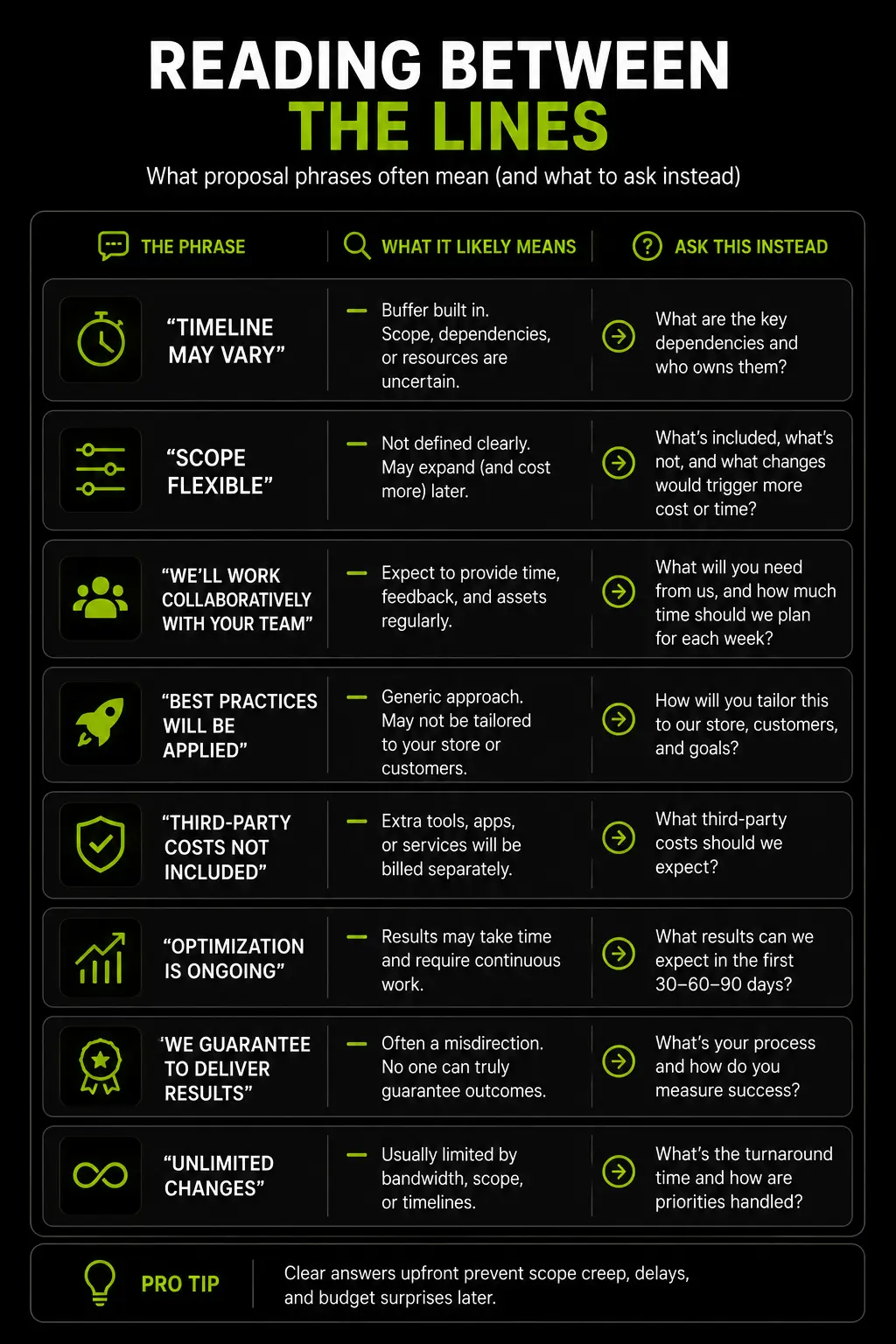
What Proposal Language Can Tell You
Certain phrases in a proposal can point to missing details or hidden costs. Knowing what they mean helps you spot problems without questioning every line item separately.
How Suplex Structures Proposals
Suplex treats proposal transparency as standard practice, not a differentiator to advertise. Every proposal includes an explicit scope grid, named team roles for the project, and stated assumptions for anything the brief left open, so a client isn't left guessing what a line item actually covers.
This matters most at the platform decision stage. A platform consultation walks through catalog complexity, integration requirements, and growth trajectory before recommending an architecture, rather than defaulting to whichever build type is easiest to quote.
For merchants who already know they're building on Shopify and need the store itself scoped and built, the same transparency applies to e-commerce store setup: what's included in the base setup, what counts as custom development and where UAE-specific requirements like Arabic RTL and local payment gateways sit in the scope, stated upfront rather than surfacing mid-project.
If you're currently comparing proposals and one of them came from Suplex, the scope grid method in this piece is the exact process you can use to check it against the others fairly.
Frequently Asked Questions
Why Do Shopify Agency Proposals Vary So Much in Price for the Same Project?
Because agencies interpret ambiguous scope differently, not just because they charge different rates. A lower price often means narrower scope or unstated assumptions, not necessarily better value. Normalize the scope before comparing price.
What's the Best Way to Compare Multiple Agency Proposals Fairly?
Build a single scope grid listing every deliverable category across all proposals, marking what each explicitly includes, excludes, or leaves unclear. This turns an apples-to-oranges comparison into something you can actually evaluate side by side.
Should I Choose the Agency with the Most Detailed Proposal?
Usually a good signal, but verifying the detail reflects real scoping rather than template padding. A detailed proposal that directly addresses your specific brief items is more meaningful than a long generic one.
What Questions Should I Ask If a Proposal Seems Vague?
Ask directly what's included in any broad line item, like "QA" or "testing phase," what happens if requirements change mid-project, and who specifically will be working on the account, by name or role.
Is a Fixed-Price or Time-and-Materials Proposal Easier to Compare?
Fixed-price is easier to compare numerically, but confirms what triggers a change order in each. Time-and-materials proposals need converting to an estimated total based on stated hours and rates before you can compare them meaningfully.
Do Proposals Need to Address Payment Gateway and Localization Work Explicitly for UAE Stores?
Yes, and many don't by default. Confirm the proposal accounts for Shopify Payments not being available in the UAE and scopes multi-currency, RTL, and gateway integration work accordingly, rather than assuming standard defaults that don't apply here.
How Many Agency Proposals Should I Get Before Deciding?
Two to three is usually enough. More than that adds comparison overhead without meaningfully improving the decision, especially once you're normalizing scope across proposals rather than just comparing headline prices.
Hi, I’m Rishabh Jain
I believe great digital experiences have the power to shape perception, build trust, and move businesses forward. That belief led me to found Suplex Design Studio, a global digital design and development studio helping FMCG and D2C brands build websites and digital experiences that are strategic, thoughtful, and commercially meaningful.
I started Suplex at 25 with a clear intent, to create digital experiences that look appealing, work seamlessly, and help D2C businesses grow. By 28, the studio had scaled globally, guided by a strong foundation in integrated design that I developed during my academic journey in London, where I was honoured with the Dean’s Award.
Over the years, I’ve had the opportunity to work with 100+ brands, from Fortune 500 organisations to family-run businesses, helping them build websites, e-commerce experiences, and digital products that create clarity, credibility, and long-term value.
Our work has been recognised internationally, including the Manifest Award (2024), the Clutch Global Award (2025), and features across platforms such as The Dieline, Packaging of the World, and the World Brand Design Society.
None of this would be possible without the people behind the work. I’m deeply grateful to the Suplex team, whose commitment, creativity, and attention to detail turn ideas into meaningful digital experiences every day.
At the heart of our work is a simple philosophy, digital design should be intentional, functional, and built to create real business value. That continues to guide everything we create at Suplex.

































Let’s Make It Happen
E-Commerce Success Stories
%201.avif)






.avif)
.avif)
Build Your D2C Business The Right Way
Build It With Suplex.


