Ecommerce Website Redesign Checklist for UAE Brands (2026)
.avif)

Ecommerce Website Redesign Checklist for UAE Brands (2026)
An ecommerce website redesign checklist for UAE brands needs to cover more than a new design and a smoother user experience.
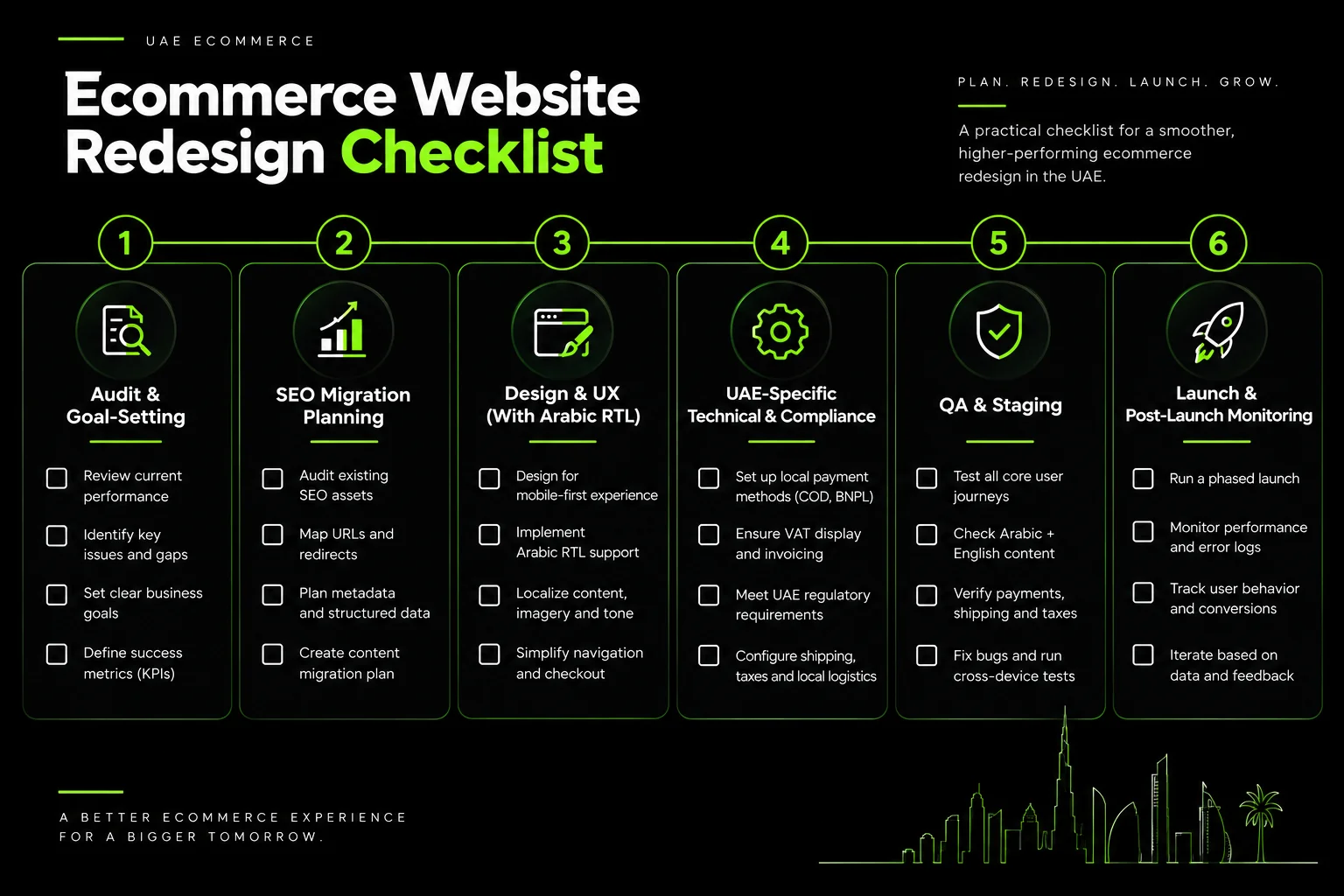
A successful redesign should move through six key phases: auditing the existing website and setting clear goals, planning SEO migration, redesigning the experience with Arabic RTL support, addressing UAE-specific technical and compliance requirements, completing thorough QA and staging checks, and launching in phases with close post-launch monitoring.
The biggest gaps in generic redesign checklists are usually found in localization and compliance. UAE shoppers expect the right language, currency, payment options, and checkout experience, while businesses also need to account for local tax, privacy, and regulatory requirements.
Missing these details can lead to broken pages, lost search rankings, checkout issues, and expensive fixes after launch. Planning them from the beginning makes the redesign more predictable and reduces the amount of post-launch rework your team has to handle.
Why A Generic Redesign Checklist Isn't Enough For A UAE Brand
Most redesign checklists are built for a market where the payment method is a credit card, the language is English, and compliance means little beyond basic data protection.
What Global Checklists Cover Well
The standard advice on auditing, goal-setting, SEO migration, and phased launches is generally sound and applies anywhere.
If you are looking for the fundamentals of redesign planning independent of region, our guide on how to plan an ecommerce website redesign covers that ground in depth.
There is no need to reinvent those fundamentals here; the gap is specifically in what comes after them.
What's Missing For VAT, Arabic RTL, And Local Payment Compliance
None of the ranking checklists, global or UAE-based, build region-specific compliance and localization steps into the checklist itself.
VAT display, local payment gateway testing, Arabic RTL QA, and COD checkout flows show up, if at all, as a passing mention rather than a checkable step with its own weight in the process.
Even the UAE-based results tend to pad out generic global advice with a couple of local cost figures rather than genuinely restructuring the checklist around what a UAE brand actually needs to check. This checklist treats them as first-class phases, not afterthoughts.
Phase 1: Audit and Goal-Setting Checklist
Skipping this phase is how redesigns end up solving the wrong problem. A brand that jumps straight into new visuals without first confirming what is actually broken in the current site often ends up with a better-looking version of the same underlying issues.
☐ Technical & Performance Audit: Check Core Web Vitals, mobile usability, and page speed on your current site before planning the new one.
☐ Conversion Funnel And Analytics Audit: Pull actual funnel data to see where customers are dropping off today, across category pages, product pages, and checkout.
☐ Content and SEO Audit: Identify what is currently ranking and which pages drive the most organic revenue, since this becomes the foundation of your redirect plan in Phase 2.
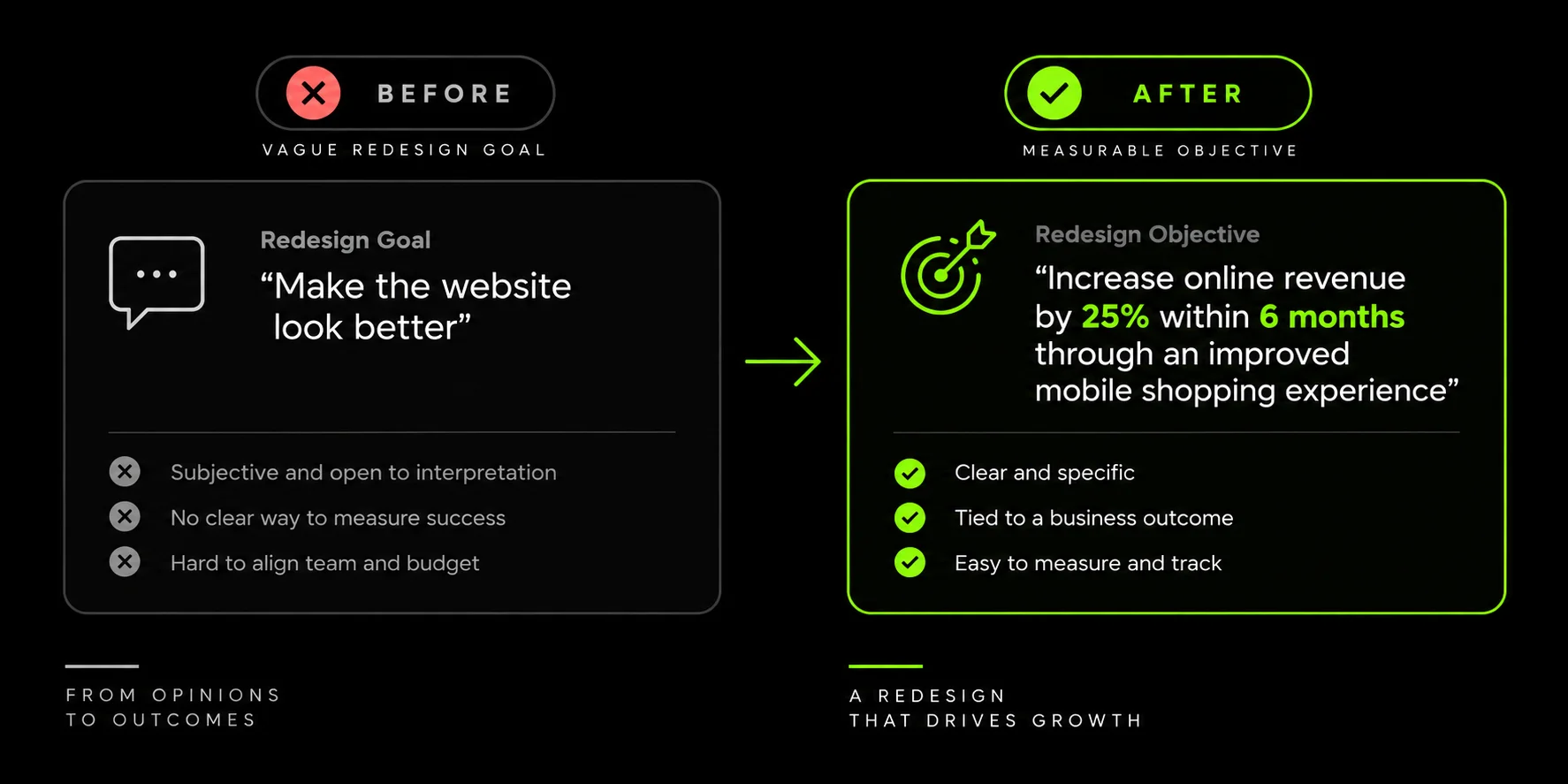
☐ Define Measurable Redesign Goals Tied to Business Outcomes: Translate vague complaints like "the site looks dated" into specific, measurable targets before scoping any work.
Phase 2: SEO Migration Checklist
This phase needs to happen before design work starts, not alongside it. Treating SEO migration as a parallel task rather than a foundational input is one of the most common reasons redesigns lose organic traffic they never needed to lose.
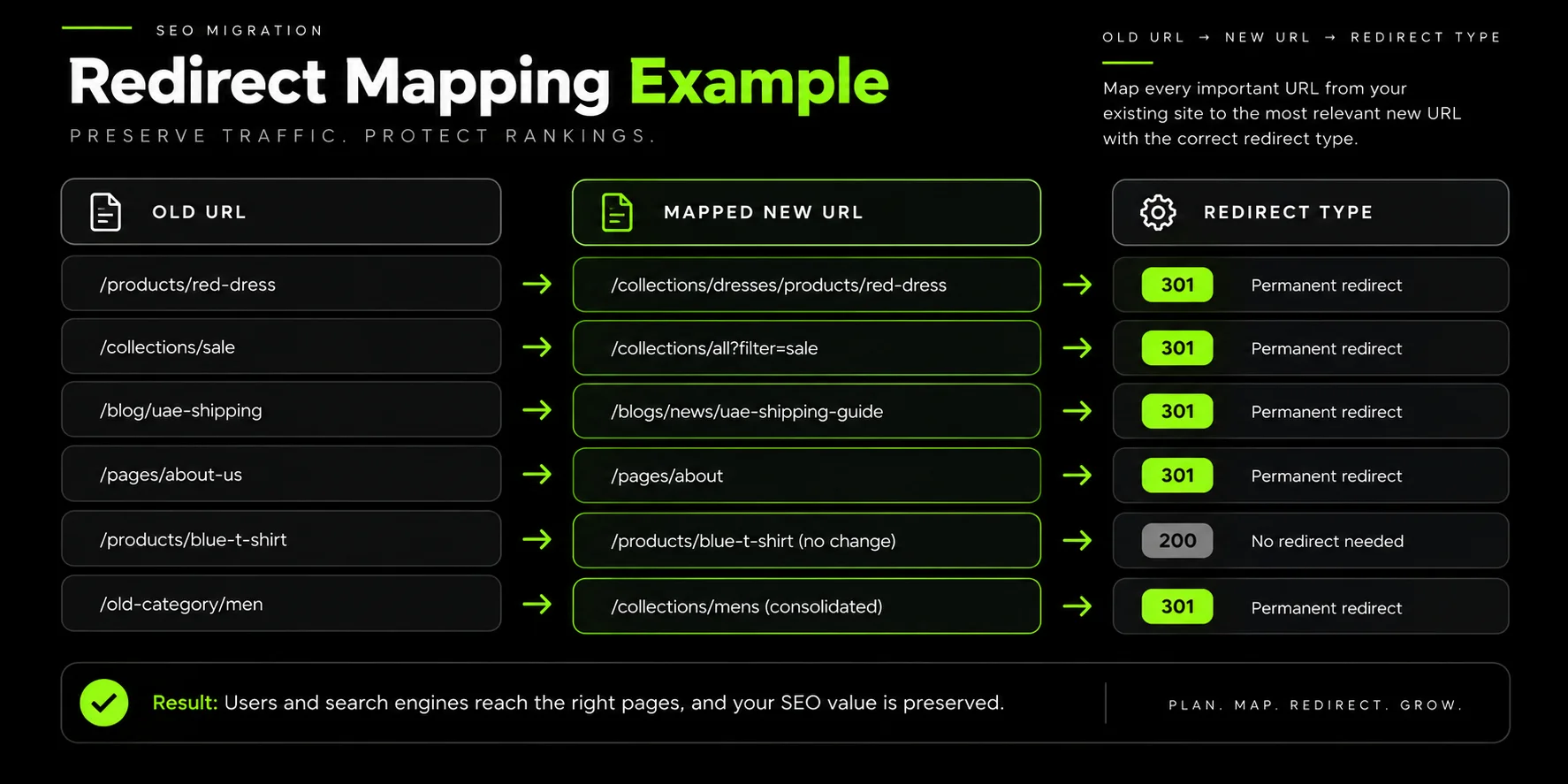
☐ URL Mapping And Redirect Matrix For The Full Catalog: Every URL that changes needs a mapped 301 redirect to its new equivalent, built from a full crawl of the existing site rather than a rough spreadsheet.
☐ Metadata, Structured Data, And Internal Link Carryover: Product schema markup, meta titles and descriptions, and internal linking structure all need to carry over or be deliberately improved, not accidentally dropped.
☐ Crawl Budget And Indexation Plan For Large Catalogs: For catalog-heavy stores, plan how search engines will prioritize crawling the new structure so they don't waste budget on pages that no longer matter.
Phase 3: Design And UX Checklist
Once the audit, goals, and SEO plan are settled, design work can start on solid ground. This is also the phase where UAE-specific requirements need to be designed in from the start rather than patched onto a template built for a different market.
☐ Information Architecture And Navigation Restructuring: Rebuild navigation around how customers actually find products, based on your Phase 1 funnel audit, rather than around how the internal team organizes inventory.
☐ Mobile-First Design And Checkout Flow: Design and test the mobile checkout flow first, given how dominant mobile traffic is across UAE ecommerce, rather than adapting a desktop-first flow after the fact.
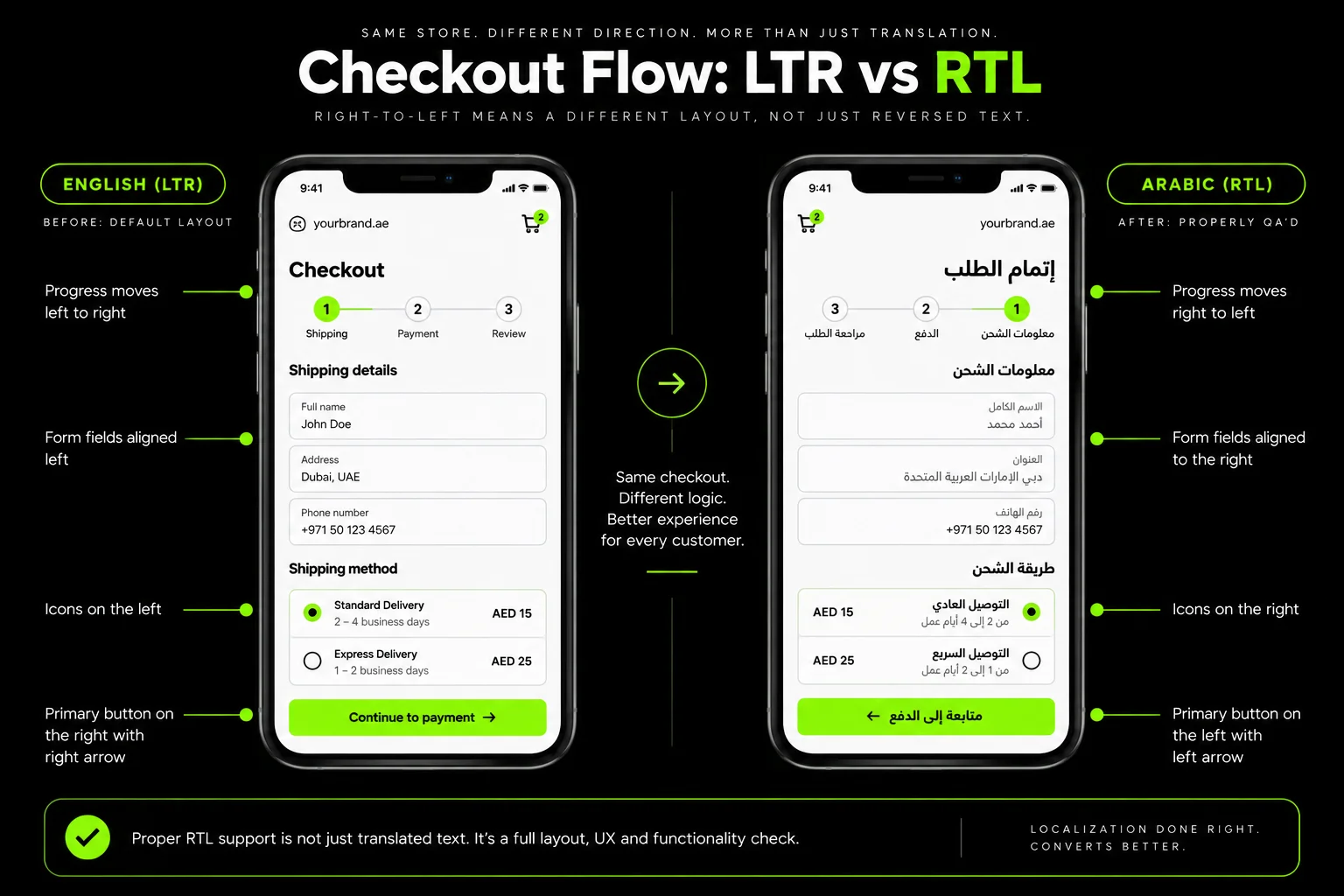
☐ Arabic RTL Layout and Typography QA: Treat this as its own QA pass, not a single line item. Arabic RTL is not a translation toggle; it changes layout logic, icon direction, form field alignment, and the entire checkout flow's visual order. A form that validates correctly in English can break silently in RTL if field order, error message placement, or icon direction were never tested specifically in Arabic.
☐ Design System and Component Consistency: Apply a consistent design system across every product template so the catalog stays maintainable and visually coherent after launch.
Want This Checklist Run Against Your Own Redesign?
Working through six phases alone is a lot to track, especially the UAE-specific compliance items most teams have never had to check before. Suplex runs exactly this checklist as our standard redesign process.
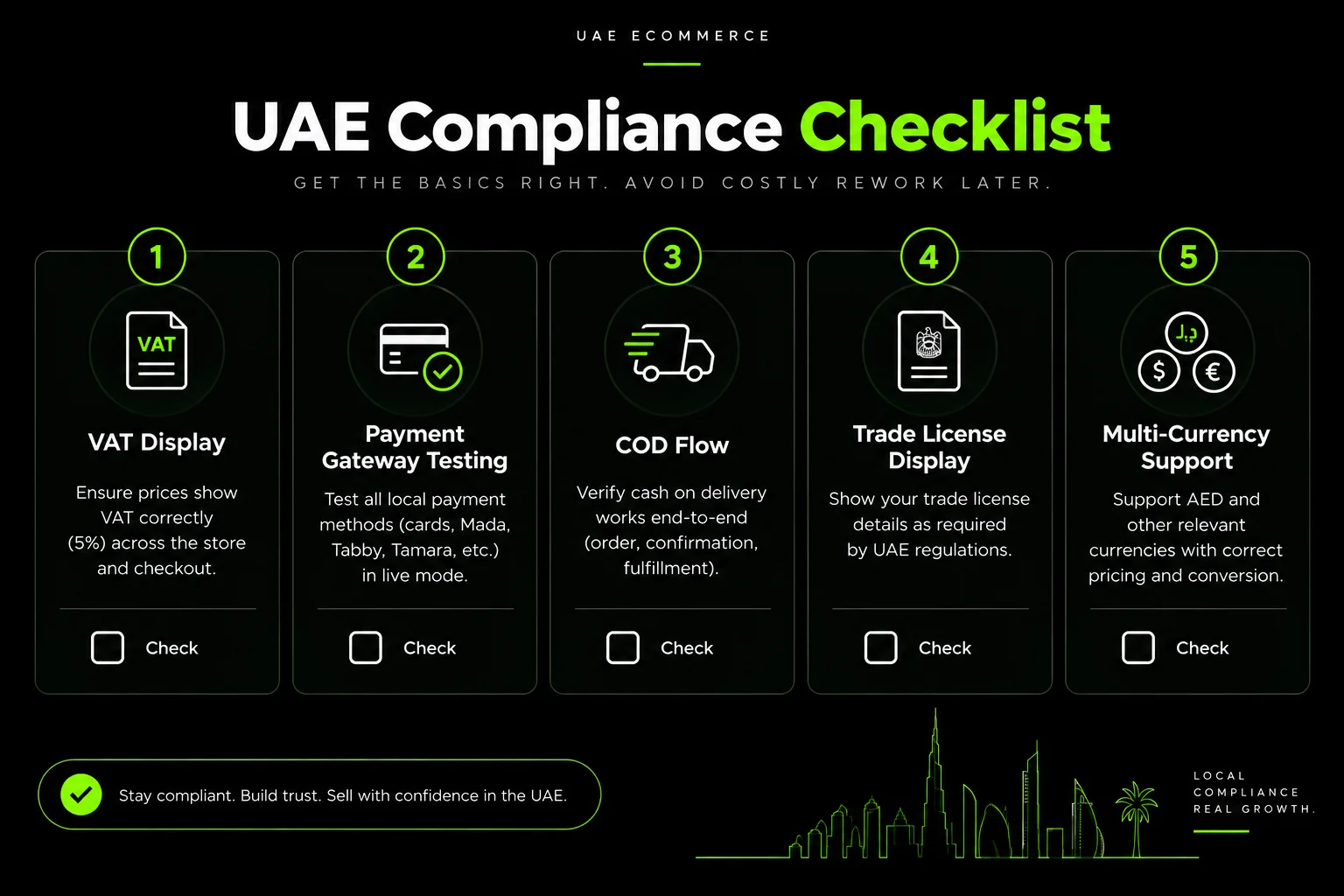
Phase 4: UAE-Specific Technical And Compliance Checklist
This is the phase no competing checklist, global or local, actually builds out as concrete steps. Most guides mention "localization" or "compliance" as a single passing line, then move on to design and launch advice that reads identically to a checklist written for a US or European market.
☐ VAT-Compliant Invoicing and Pricing Display: Prices need to display and calculate UAE VAT correctly at checkout, and invoices need to meet FTA formatting requirements, not just show a generic tax line.
☐ Local Payment Gateway Integration and Testing: Test every gateway your customers actually use, mada, Network International, Telr, PayTabs, or similar, individually rather than assuming a single integration covers them all identically. Each gateway can behave differently around currency handling, error messaging, and refund workflows, and a bug in one that goes unnoticed because testing only covered another gateway is a common source of post-launch support tickets.
☐ Cash-on-delivery Checkout Flow QA: COD remains a substantial share of UAE ecommerce transactions, so the COD flow itself, order confirmation, delivery notification, and any COD-specific fields, needs its own dedicated test pass, not a fallback assumption that it "just works" like a card payment. A customer who never receives a clear delivery-window notification on a COD order is far more likely to reject the delivery than one who paid upfront by card.
☐ Trade License and Business Registration Display Where Required: Confirm what your specific business category needs to display and where, since requirements can vary by activity type and this is easy to overlook in a pure design-focused redesign brief that treats it as a legal matter separate from the site build.
☐ Multi-Currency (AED) and GCC-Wide Currency Support Where Relevant: If you sell beyond the UAE into the wider GCC, confirm currency display and checkout logic handle each region correctly, not just AED with a currency symbol swapped in for the storefront display.
Phase 5: QA, Staging, And Pre-Launch Checklist
The redesign is not done when the design is approved. It is done when it survives testing.
☐ Cross-Device and Cross-Browser Testing: Test across the actual device and browser mix your traffic uses, pulled from analytics, given the range of devices common across the UAE's mixed expat and local customer base.
☐ Redirect and Broken-Link Testing: Run the full redirect map from Phase 2 against the live staging environment, checking for chains, loops, and any missed URL.
☐ Payment Gateway and Checkout Flow Testing: Test every supported payment method end to end on staging, including COD, before launch, not just the primary card gateway.
☐ Load Testing For Traffic Spikes: If launch coincides with a promotion or seasonal push, load test under that expected volume beforehand.
.webp)
Phase 6: Launch And Post-Launch Monitoring Checklist
A single full cutover is the highest-risk way to launch, and it is rarely necessary.
☐ Phased/Staged Rollout Plan: Roll out to a percentage of traffic or a subset of categories first, rather than switching everything at once.
☐ Rankings, Traffic and Conversion Monitoring at 30/60/90 Days: Set defined checkpoints to catch a dip early, before a temporary issue becomes a permanent one.
☐ Post-Launch Bug-Fix and Support Window: Confirm a defined warranty period, commonly 30 to 60 days, covering issues introduced by the redesign itself.
.webp)
Typical Timeline and Cost For A UAE Ecommerce Redesign
Budget around ranges, not a single number, since scope drives cost far more than which emirate you are in.
Realistic Timeline By Project Complexity
A focused redesign on an existing platform with a moderate catalog typically runs a small number of months from audit to launch.
A larger, catalog-heavy redesign with local payment gateway integration, VAT-compliant checkout, and full Arabic RTL QA generally takes meaningfully longer, since the compliance and localization phases alone need real time to execute properly.
Brands often underestimate this specifically because the compliance and localization work is less visible in a project timeline than the design phase, even though it frequently takes comparable effort to get right.
What Drives Cost In The UAE Market Specifically
Across UAE agencies, ecommerce redesigns commonly range from around AED 20,000 for a focused SME rebuild up to AED 100,000 or more for a complex, catalog-heavy build with deep integrations.
What moves a project up that range is rarely the visual design scope; it is catalog size, the number of local payment gateways integrated, the depth of Arabic RTL work, and whether the redesign includes a platform migration alongside it.
A redesign brief that budgets primarily for visual design work, without pricing in the compliance and localization phases above, tends to underestimate the total project by a wide margin.
Requesting a quote broken down by phase, audit, SEO migration, design, UAE compliance, QA, and launch, rather than a single lump-sum figure, makes it easier to see exactly where a lower quote might be cutting corners on the phases that matter most for a UAE launch.
How We Run Ecommerce Redesigns For UAE Brands
Our process at Suplex is built around this exact six-phase checklist, not as marketing language but as our actual standard process.
VAT-compliant checkout, Arabic RTL QA, and local payment gateway integration are handled as standard steps in every UAE redesign we run, not as an add-on scoped separately once a client asks.
Treating these as standard rather than optional extras also tends to change the quality of the final output, since a team that treats RTL as a footnote produces a different result than a team that has budgeted proper time for it from the start.
Our SEO migration process, covered in Phase 2 above, is built specifically to protect existing rankings through a full redesign, since this is where we see the most revenue-damaging errors in redesigns we are brought in to fix after the fact.
If you want this checklist run against your own site as a starting point, Suplex offers a redesign readiness audit built around exactly these six phases.
Frequently Asked Questions
How long does an ecommerce website redesign take in the UAE?
A focused redesign on an existing platform typically takes a small number of months from audit to launch. A larger redesign with local payment gateway integration, VAT-compliant checkout, and full Arabic RTL QA generally takes longer, since the compliance and localization phases need real time to execute properly.
How much does an ecommerce redesign cost in the UAE?
Costs commonly range from around AED 20,000 for a focused SME rebuild up to AED 100,000 or more for a complex, catalog-heavy build with deep local integrations. Catalog size, payment gateway count, and the depth of Arabic RTL work move the budget more than visual design scope alone.
What UAE-specific compliance items need to be checked during a redesign?
VAT-compliant pricing display and FTA-formatted invoicing, local payment gateway testing for each gateway individually, a dedicated cash-on-delivery checkout flow test, and trade license or business registration display where your category requires it are the core UAE-specific items most generic checklists miss entirely.
How do I make sure my redesign doesn't hurt my SEO rankings?
Build a complete URL redirect map before any design work starts, preserve or improve metadata and structured data during the transition, and launch in phases rather than a single cutover so redirect errors are caught before they affect your full traffic.
Do I need a separate checklist item for Arabic RTL support?
Yes. Arabic RTL is not a translation toggle; it changes layout logic, icon direction, form field alignment, and checkout flow order. Treating it as one line item under "localization" is how RTL-specific bugs make it to production undetected.
What payment gateways should be tested during a UAE ecommerce redesign?
Test each local gateway your customers actually use individually, commonly including mada, Network International, Telr, and PayTabs, alongside a dedicated cash-on-delivery flow test, rather than assuming a single integration covers every payment method identically.
Should I redesign in-house or hire a UAE ecommerce agency?
This depends on whether your internal team has handled UAE-specific compliance items like VAT-compliant checkout and Arabic RTL QA before. Teams without that specific experience often underestimate these phases, which is where an agency with regional experience tends to save more in avoided rework than its cost. If your team has successfully shipped these items before on a previous project, in-house may well be the more cost-effective route; if not, the learning curve on a live redesign is an expensive place to discover gaps.
Hi, I’m Rishabh Jain
I believe great design has the power to shape perception, build trust, and move businesses forward. That belief is what led me to found Suplex Design Studio, a global branding and packaging studio working with FMCG and D2C brands across markets.I started suplex at 25 with a clear intent, to create design that is strategic, thoughtful, and commercially meaningful. By 28, the studio had scaled globally, guided by a strong foundation in Integrated Design that I developed during my academic journey in London, where I was honoured with the Dean’s Award.
Over the years, I’ve had the opportunity to work with 100+ brands, from Fortune 500 organizations to family-run businesses, helping them build packaging and brand systems that create recall, relevance, and long-term value.
Suplex’s work has been recognized internationally, including the Manifest Award (2024), the Clutch Global Award (2025), and features on platforms such as Packaging of the World, The Dieline, and the World Brand Design Society.
None of this would be possible without the people behind the work. I’m deeply grateful to the suplex team, whose commitment, creativity, and attention to detail turn ideas into meaningful brand experiences every day.
At the heart of my work is a simple philosophy, design should be intentional, honest, and built to last, and that continues to guide everything we create at suplex.





































Let’s Make It Happen
E-Commerce Success Stories
%201.avif)






.avif)

.avif)
Build Your D2C Business The Right Way
Build It With Suplex.


