How AI Is Changing Ecommerce Website Design in 2026
.avif)
How AI Is Changing Ecommerce Website Design in 2026
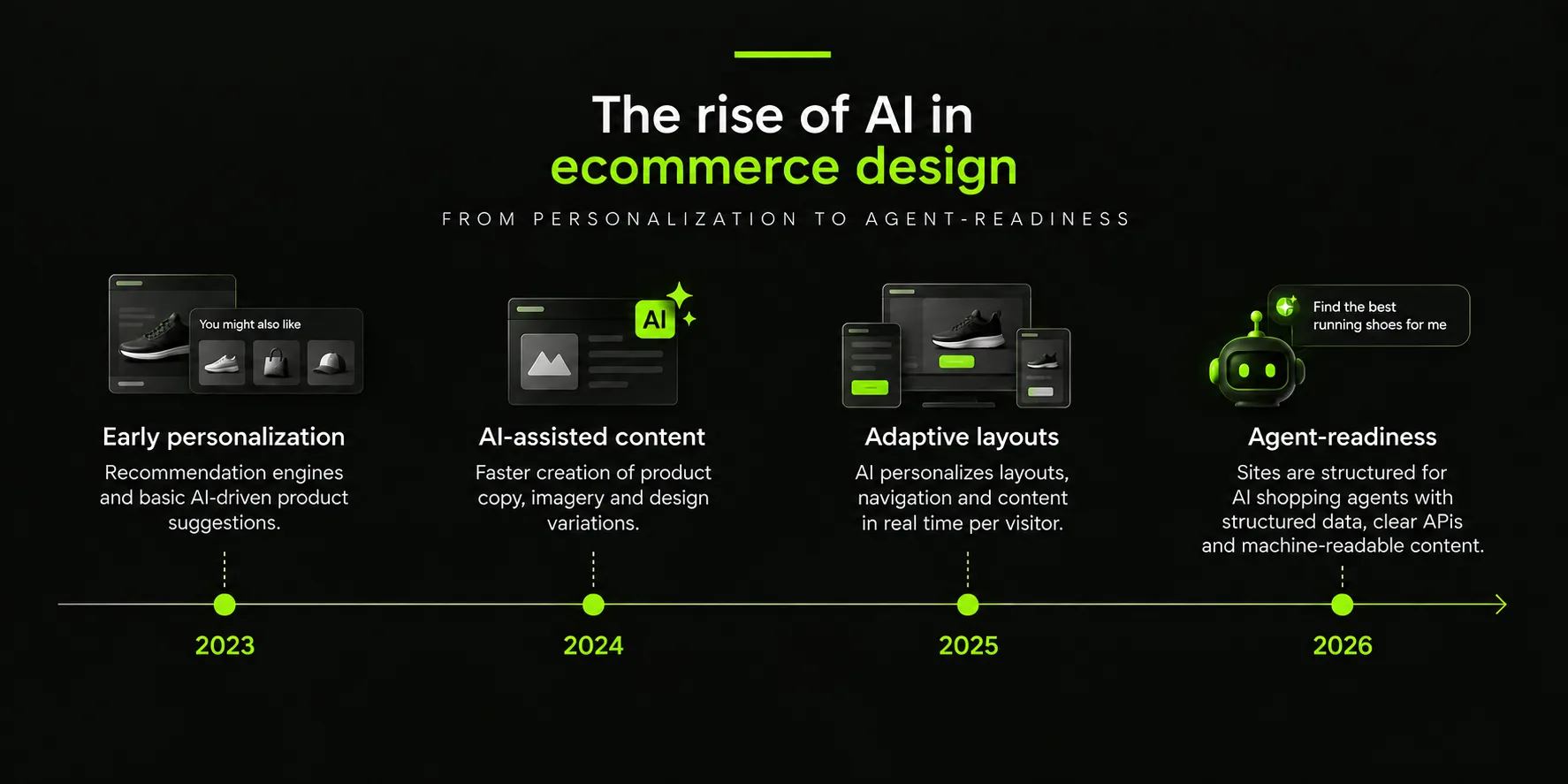
AI is changing ecommerce website design in three clear ways. Websites are becoming more personalized, with content and experiences adapting to individual visitors instead of showing everyone the same thing.
AI tools are also speeding up the process of turning designs into working websites. At the same time, ecommerce sites need to be built for AI shopping agents and AI-powered search.
Most brands are already exploring personalization and AI tools, but the third shift is still being overlooked.
Why Most “AI In Ecommerce” Content Misses The Design Angle
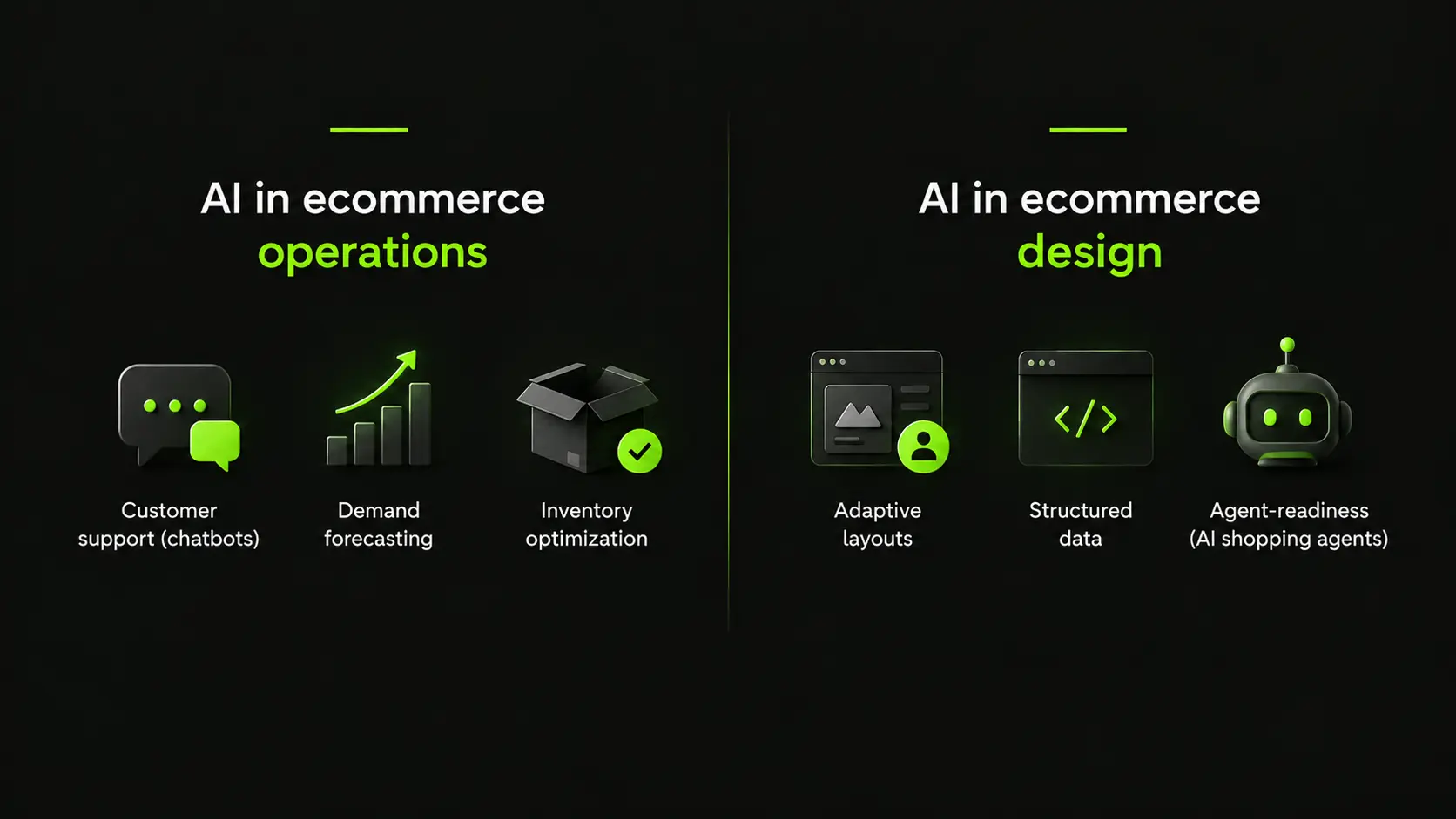
Most content about AI in ecommerce focuses on chatbots, product recommendations, demand forecasting, customer support, and ad targeting. These applications are useful, but they mostly improve how a business operates behind the scenes.
The design conversation is different. AI is starting to change what ecommerce websites actually do, how they are structured, and how content is presented to shoppers.
The Difference Between AI-Powered Operations And AI-Driven Design
AI-powered operations help businesses run more efficiently. They can improve inventory management, automate support, predict demand, and target advertising more effectively.
AI-driven design affects the website itself. It influences how pages are structured, how layouts adapt, how content changes, and how product information is presented.
The difference is important when planning a redesign. An operations roadmap might focus on automation and forecasting, while a design brief needs to address the parts of AI that affect the actual customer experience and technical foundation.
What’s Actually Changing At The Interface And Structural Level
Three changes are becoming particularly important:
- Dynamic Layouts: Pages can adapt content, products, and layouts based on individual visitors instead of showing everyone the same experience.
- Adaptive Content: Product descriptions, recommendations, offers, and other content can be generated or adjusted based on context rather than staying completely static.
- Machine-Readable Structure: Websites now need to make product data, pricing, availability, policies, and other information easy for AI search tools and shopping agents to understand.
This creates a broader design requirement.
An ecommerce website is no longer designed only for human shoppers and traditional search engines. Its underlying structure increasingly needs to work for AI systems as well.
That means AI in ecommerce design is not simply about adding an AI feature. It is about reconsidering how the interface, content, and underlying data work together.
Real-Time Personalized Layouts, Not Just Personalized Recommendations
The most visible AI feature on ecommerce sites is still the product recommendation carousel. But the bigger shift is happening beyond recommendations.
From “Recommended Products” To Adaptive Page Layouts
Traditional recommendation widgets add AI to an otherwise fixed page.
Adaptive layouts go further. AI can influence:
- Which sections appear and where they sit
- Which hero message gets shown
- Whether social proof appears above or below the fold
- Whether a category leads with bestsellers, new arrivals, or other products
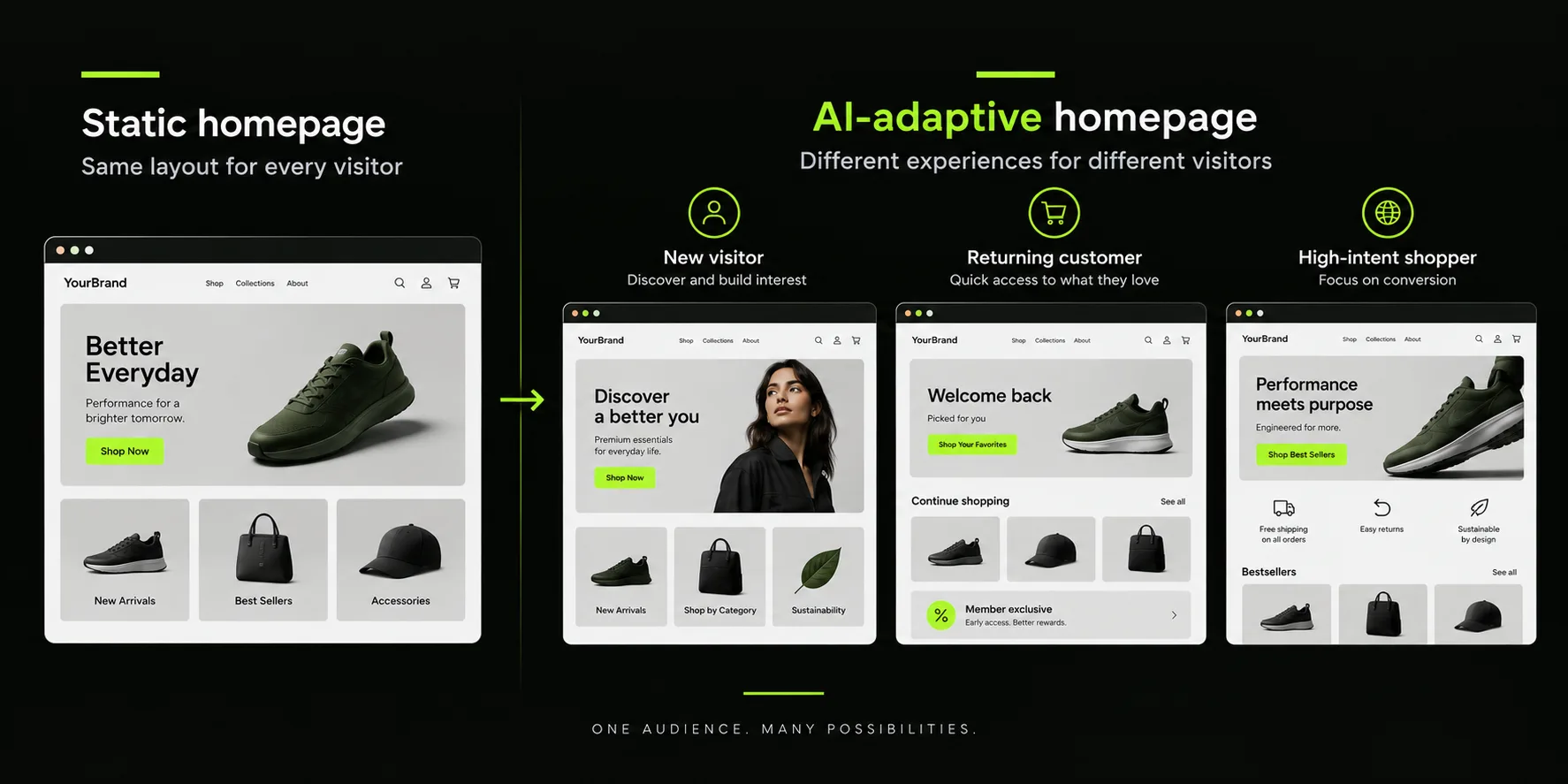
The result is a page that can change based on the individual visitor instead of showing everyone the same hierarchy.
How AI Reorders Navigation, Merchandising, And Content
A returning customer might see a faster path to categories they regularly browse. A first-time visitor might see more brand storytelling and product discovery.
For example, a skincare brand could show a returning visitor interested in anti-aging products a homepage focused on that category and related routine bundles. Someone arriving from a broader beauty search could instead see bestsellers and the brand story.
Both experiences can run from the same underlying page template.
The Design Discipline This Requires
This changes what designers are actually building. Instead of creating one finished homepage, designers need to create a system of flexible components and rules that can work across different visitor scenarios.
That means defining:
- Which components can change
- What triggers each variation
- How components can be reordered
- What happens when there is limited user data
The job moves from designing a single static screen to designing a flexible interface system that can adapt without breaking the experience.
AI-Generated And AI-Assisted Visual Content
Visual content on product pages is increasingly generated or adapted rather than shot once and reused for every visitor.
AI-Generated Product Imagery, Lifestyle Shots, And Variant Visualization
AI tools can now generate lifestyle imagery around a base product photo, visualize colour or material variants without a full reshoot, and produce contextual imagery suited to a specific customer segment or region.
This does not replace product photography entirely, but it removes the need to shoot every variant and every context manually. A furniture brand with a sofa available in twelve fabric options previously needed twelve separate lifestyle shoots, or twelve manually retouched versions of one shoot, to show each variant convincingly in a room setting.
Generating those variants from a single base shoot cuts both the production timeline and the cost of keeping the catalog visually complete as new colourways launch.
Dynamic On-Page Content Generation
Product descriptions, comparison tables, and even FAQ content can now be generated or adapted dynamically based on what a visitor has shown interest in, rather than a single static block of copy written once for every visitor regardless of intent.
A visitor comparing two similar products might see a dynamically generated comparison table highlighting the specific differences relevant to what they have already viewed, while a visitor arriving with a single clear intent sees a shorter, more direct product description instead of the same lengthy copy every visitor gets.
Where AI-Generated Content Still Needs Human Brand Oversight
Generated content without oversight drifts. Tone, factual accuracy on product claims and brand voice consistency all need a human review layer, particularly for anything making specific claims about a product.
Since an ungoverned generation pipeline can produce content that is technically plausible but factually wrong or off-brand.
Conversational And AI-Native Interface Patterns
Ecommerce search is moving beyond traditional filters and category menus. Natural-language search is making it possible for shoppers to describe what they want instead of figuring out which filters to select.
AI Search Bars And Conversational Product Discovery
Instead of clicking through multiple checkboxes, a shopper can type:
“A waterproof jacket for hiking in cold weather under $150.”
The search system can interpret the intent and match it against relevant products, attributes, prices, and availability.
This makes search feel less like navigating a database and more like having a conversation with the store.
Designing For Voice And Natural-Language Queries
This creates a design challenge that goes beyond the search interface.
Product data needs to be detailed and structured enough for the system to understand what each product actually offers.
Materials, sizes, use cases, compatibility, colours, features, and other attributes need to be captured consistently rather than buried inside product descriptions.
In other words, conversational search is partly an information architecture problem.
What This Means For Navigation And IA
Traditional category navigation is not disappearing. It will increasingly work alongside conversational search.
That means the underlying product taxonomy needs to support both:
- A clear hierarchy for people who want to browse
- A rich attribute structure for natural-language queries
A category tree designed only for click-through browsing, with important attributes buried in unstructured text, will struggle to support conversational search reliably.
The search interface may be conversational, but the product data underneath still needs to be structured, complete, and consistent.
Designing Ecommerce Sites For AI Shopping Agents: The Real 2026 Shift
This is one of the biggest changes in ecommerce design, yet it is still missing from most redesign discussions.
What AI Shopping Agents Are And How They Browse And Buy
AI shopping agents can research products, compare options, and in some cases complete purchases on behalf of customers.
Instead of visiting several stores, a customer can describe what they want and let an AI system handle much of the research.
The important change is not the exact size of the market. It is where product discovery happens.
More shopping journeys are starting inside AI interfaces rather than directly on ecommerce websites. That means being “found” increasingly depends on whether an AI system can understand your products and recommend them accurately.
Why Structured Data Now Matters Alongside Visual Design
An AI agent does not experience a product page in the same way a human shopper does. It relies heavily on structured, machine-readable information such as product attributes, schema markup, pricing, availability, and APIs.
That creates a new design consideration.
A beautiful product page can still be difficult for an AI system to understand if the underlying data is incomplete, inconsistent, or unreliable.
For years, ecommerce treated the visual layer as the product and the underlying data as supporting infrastructure. With agent-driven shopping, that relationship is changing.
The Risk Of Designing Only For Human Eyes
A website built only for visual browsing can create problems when AI agents become part of the shopping journey.
Product information buried inside images, inconsistent attributes, or unreliable inventory data can make products harder for agents to evaluate.
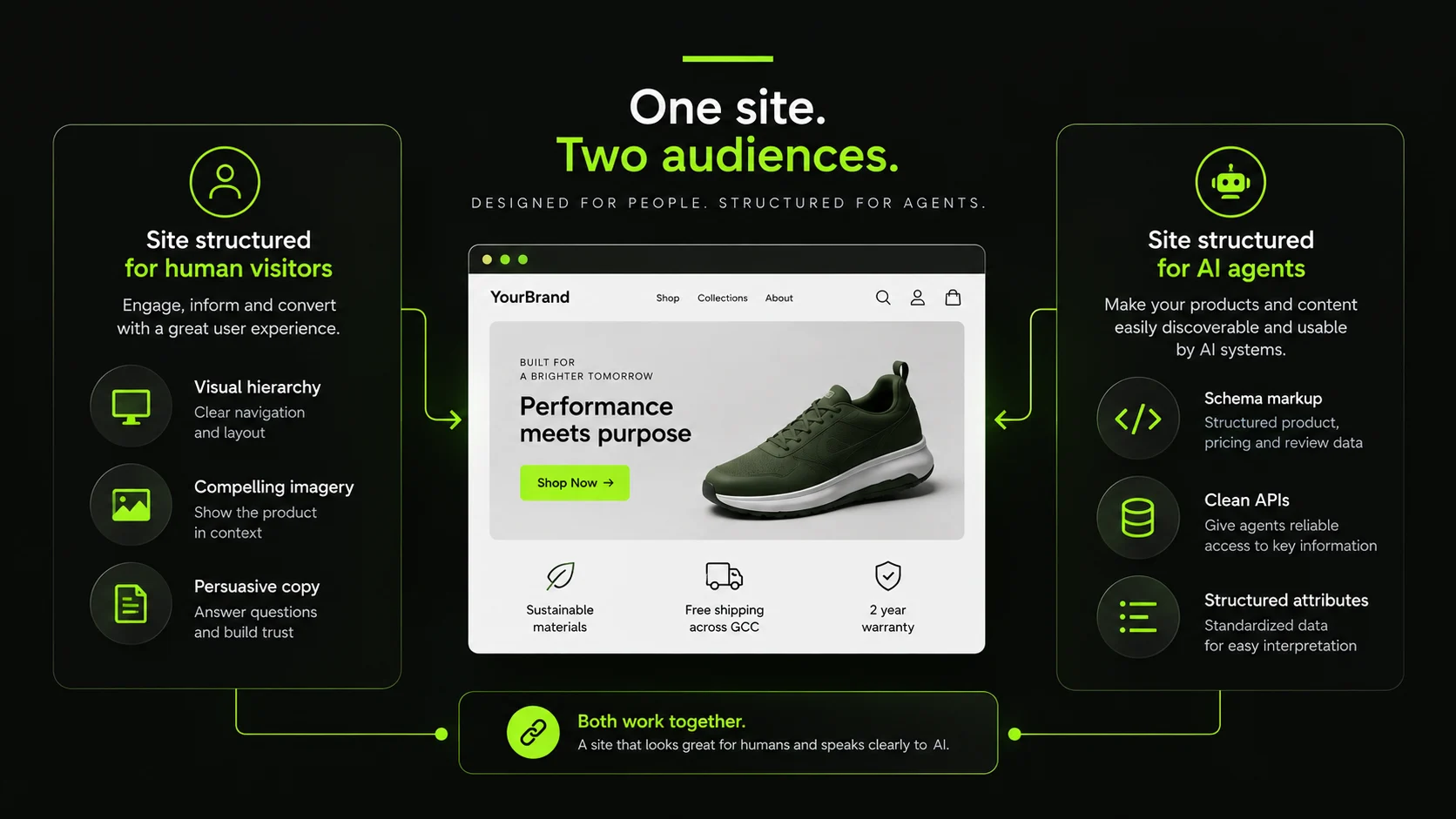
Ecommerce sites increasingly need to work for two audiences: human shoppers and AI systems.
For a redesign, that means structured data should not be left as a purely technical task. The brief should explicitly cover:
- Schema and product-data coverage
- Complete and consistent attributes
- Reliable pricing and availability
- API performance and accessibility
- Machine-readable product information
Visual design and conversion still matter. But in an agent-mediated shopping environment, how clearly the site communicates with machines can become just as important as how clearly it communicates with people.
How AI Is Changing The Design And Build Process Itself
AI is not only changing what ecommerce websites look like. It is also changing how those websites are designed, developed, tested, and launched.
AI-Assisted Wireframing, Prototyping, And Design Iteration
AI can now speed up early design work significantly.
Wireframes, layout ideas, and page variations that previously required hours of manual work can be generated and refined much faster. Designers can test several directions in one session instead of spending most of the day on a single version.
That shifts the bottleneck. The challenge is increasingly less about producing designs quickly and more about reviewing, testing, and choosing the right direction.
Faster Theme Customization And QA
AI is also helping developers with theme customization, component code, and repetitive development tasks.
QA is another area where the impact is becoming noticeable. AI-assisted testing can check pages across different browsers, screen sizes, and devices and flag potential rendering problems much faster than manual testing alone.
This can shorten development timelines while keeping the quality bar unchanged.
Where Human Strategic Judgment Still Matters
AI can produce a wireframe quickly. It cannot automatically know whether that wireframe is right for a particular brand, audience, or business model.
Important decisions still require human judgment, including:
- Brand positioning
- Information hierarchy
- Customer journey
- Conversion architecture
- What the visitor should see first
- Which design choices actually support the business goal
The key difference is simple: AI can make the production process faster, but speed does not make a design strategically correct.
The role of the designer is therefore shifting from producing every element manually to directing, evaluating, and improving what AI helps produce.
Accessibility And Inclusive Design Gains From AI
AI tooling has made a genuinely positive, underdiscussed contribution to accessibility work specifically.
AI-Assisted Accessibility Audits And Remediation
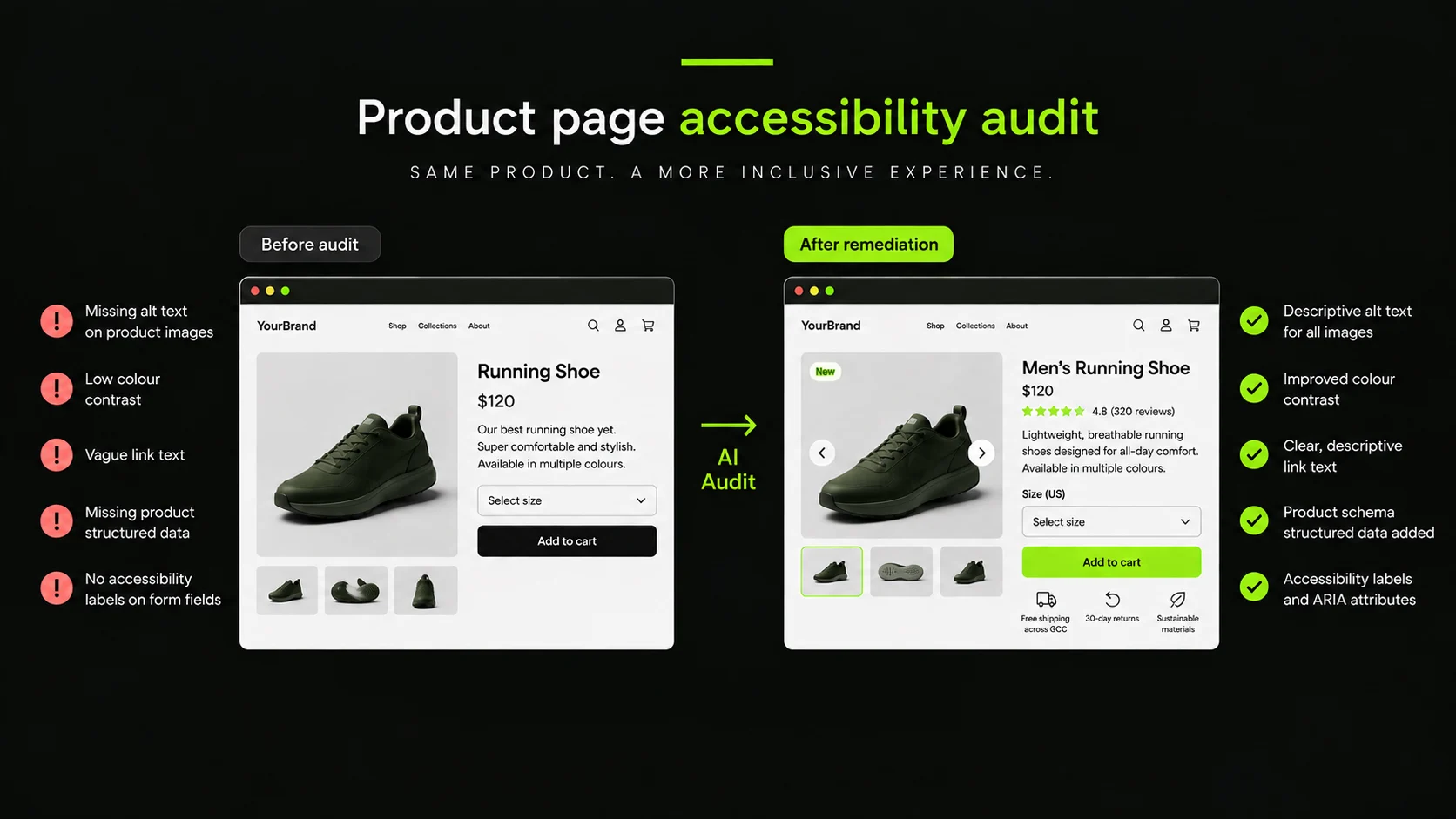
AI-powered accessibility tools can now scan a full site far faster than manual review alone, flagging contrast issues, missing alt text, and screen-reader incompatibilities at a scale that would take a human auditor far longer to cover.
For a catalog running into the thousands of product pages, a manual accessibility audit was often scoped down to a representative sample simply because auditing every page by hand was not practical within a normal project timeline.
AI-assisted scanning removes that constraint, making a full-catalog audit a realistic starting point rather than an aspiration.
Automated Alt-Text, Contrast Checking and Screen-Reader Optimization
Automated alt-text generation, real-time contrast checking during design, and screen-reader flow testing are all meaningfully faster with AI assistance, though generated alt text still benefits from a human review pass to confirm it accurately describes the product rather than producing a generic or misleading description.
The practical effect is that accessibility work, which historically got squeezed to the end of a project timeline because manual auditing was slow, can now happen continuously throughout the build rather than as a final pre-launch pass.
What This Means For Brands Planning A Redesign Or New Build In 2026
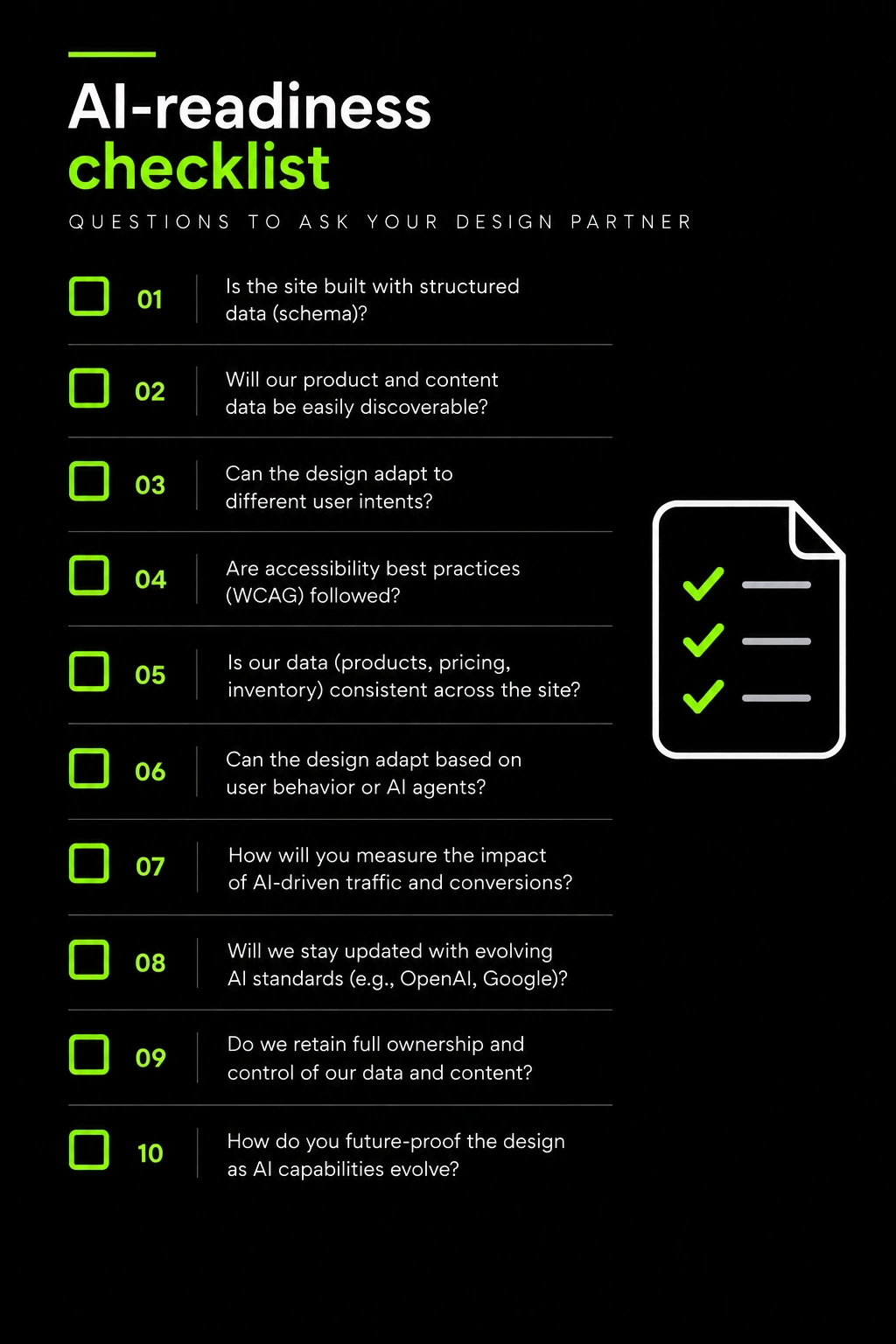
Bring these questions into the brief before design work starts, not after.
Questions To Ask A Design Partner About Their AI-Readiness
Ask specifically how they structure product data for AI agent legibility, not just visual design, whether their approach to personalization is a system of rules-driven components or a bolted-on recommendation widget and where in their process AI tooling speeds up production versus where human strategists still make the calls.
A partner who can only answer the visual-design half of these questions is likely still thinking about AI as a marketing feature rather than a structural requirement, which is a useful signal on its own before any work begins.
Balancing AI-Driven Personalization With Brand Consistency
Personalization that reorders content per visitor still needs to feel like the same brand across every variation.
This requires a defined design system with clear rules about what can and cannot change, so personalization never drifts into inconsistency that undermines trust.
In practice this means deciding upfront which elements are fixed brand anchors, logo placement, core typography, primary colour usage, and which elements are allowed to vary by visitor, such as which product category leads or which lifestyle imagery appears, so the system has clear guardrails rather than open-ended flexibility that could produce a page that no longer reads as the brand at all.
How We Approach AI-Ready Ecommerce Design
At Suplex, we start by building modular, personalization-ready design systems rather than static page templates. This gives the site room to adapt to different visitors without requiring every variation to be designed and developed from scratch.
We also design for two audiences: people and AI systems.
For human visitors, that means focusing on visual design, usability, navigation, and conversion architecture.
For AI-driven discovery and shopping agents, it means clean structured data, accurate product schema, consistent attributes, and an information architecture that machines can understand as easily as people can navigate.
Where We Use AI
We use AI tooling where it can genuinely make the process faster, particularly for:
- Wireframing and design iterations
- Theme customization and component development
- Cross-device and cross-browser QA
But we keep the important strategic decisions with our team. Brand positioning, information hierarchy, customer journeys, and conversion architecture still require experience and context that tools cannot provide on their own.
The goal is not to add AI for the sake of it. It is to build an ecommerce site that is flexible, easier to evolve, and ready for how customers will discover and shop online.
If you are planning a redesign or new ecommerce build, Suplex can help you work through what AI-readiness means for your specific site.
Frequently Asked Questions
Will AI replace ecommerce website designers?
No, though it is changing what designers spend their time on. AI tooling accelerates production work like wireframing and theme customization, but strategic decisions like brand positioning, information hierarchy, and conversion architecture still require human judgment that AI assists rather than replaces.
How is AI used in ecommerce website design specifically?
AI is used to build adaptive, personalized page layouts rather than fixed pages, generate and adapt visual and written content, accelerate the design and build process through AI-assisted tooling, and structure sites so they are legible to AI shopping agents and AI-powered search, not just human visitors.
What are AI shopping agents and how do they affect ecommerce websites?
AI shopping agents research, compare, and sometimes complete purchases on a customer's behalf based on a described intent rather than direct browsing. They affect ecommerce websites by making structured data, accurate product attributes, and reliable APIs as important as visual design, since agents parse a site differently than human visitors do.
Can AI build a full ecommerce website on its own?
AI tooling can generate a functional starting point, wireframes, basic theme customization, and boilerplate content, but a site built without human strategic input on positioning, information architecture, and conversion design typically underperforms one where those decisions were made deliberately.
How does AI personalization actually work on an ecommerce site?
Modern AI personalization goes beyond a recommended-products widget into adapting the layout itself, which sections and content appear and in what order, based on individual visitor behavior signals. This requires the site to be built as a modular system of rules-driven components rather than a set of fixed pages.
Do I need to redesign my ecommerce site to be "AI-ready"?
It depends on how far your current structured data and information architecture are from supporting machine-readable parsing. A site with thin product schema and inconsistent attribute data may need meaningful structural work, while a well-structured site may only need targeted additions rather than a full rebuild.
What should I ask a design agency about their AI capabilities?
Ask how they structure product data for AI agent legibility specifically, not just visual personalization, whether their personalization approach is a genuine rules-driven system or a single bolted-on widget, and where in their process AI tooling speeds up work versus where their strategists make the calls that actually shape the design.
Hi, I’m Rishabh Jain
I believe great design has the power to shape perception, build trust, and move businesses forward. That belief is what led me to found Suplex Design Studio, a global branding and packaging studio working with FMCG and D2C brands across markets.I started suplex at 25 with a clear intent, to create design that is strategic, thoughtful, and commercially meaningful. By 28, the studio had scaled globally, guided by a strong foundation in Integrated Design that I developed during my academic journey in London, where I was honoured with the Dean’s Award.
Over the years, I’ve had the opportunity to work with 100+ brands, from Fortune 500 organizations to family-run businesses, helping them build packaging and brand systems that create recall, relevance, and long-term value.
Suplex’s work has been recognized internationally, including the Manifest Award (2024), the Clutch Global Award (2025), and features on platforms such as Packaging of the World, The Dieline, and the World Brand Design Society.
None of this would be possible without the people behind the work. I’m deeply grateful to the suplex team, whose commitment, creativity, and attention to detail turn ideas into meaningful brand experiences every day.
At the heart of my work is a simple philosophy, design should be intentional, honest, and built to last, and that continues to guide everything we create at suplex.



































Let’s Make It Happen
E-Commerce Success Stories
%201.avif)






.avif)

.avif)
Build Your D2C Business The Right Way
Build It With Suplex.


