How To Choose The Right Ecommerce Platform (A Framework For Growing Brands)
.avif)
How To Choose The Right Ecommerce Platform (A Framework For Growing Brands)
Choosing the right ecommerce platform is about much more than comparing monthly subscription prices or picking the platform with the best-looking templates.
Your catalog size, business model, growth plans, integrations, team capabilities and long-term operating costs all matter.
The platform that works well for a new store may not be the right fit for an established brand with an existing catalog, customer base, internal team, and ambitious growth plans.
That is why platform selection should start with how your business operates today and where you expect it to go next.
Why Most Platform-Choice Guides Are Written For The Wrong Audience
Search this topic and the dominant results frame the decision around ease-of-use, template looks, and starter pricing.
That is a reasonable way to choose a platform for a first store. It is not how a growing brand should be making this decision.
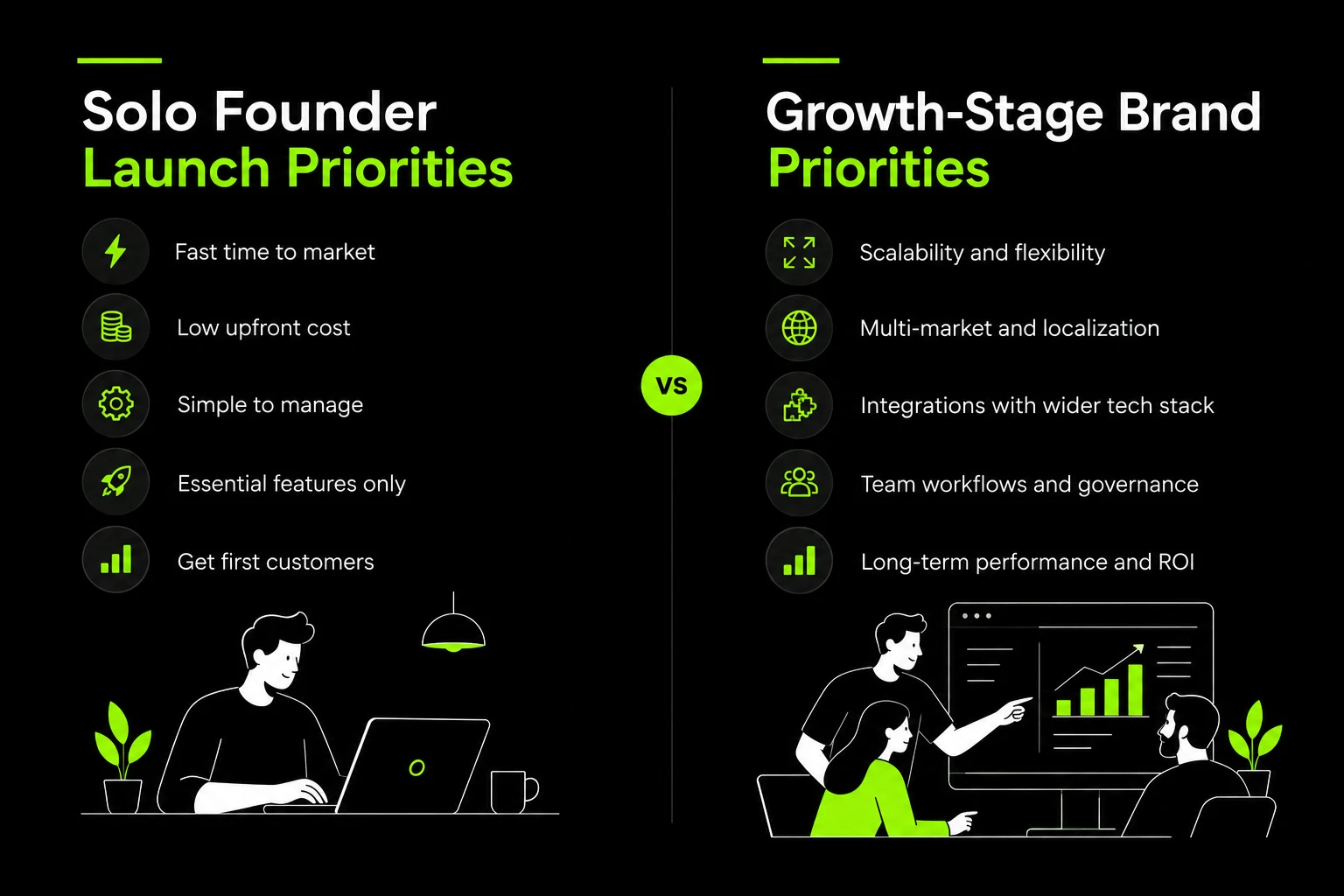
Beginner Checklists Versus Growth-Stage Decisions
A first-time founder's biggest constraint is usually getting online quickly with limited technical resources. A growing D2C or FMCG brand's biggest constraint is usually an existing catalog, an existing team, integration requirements with systems already in place and a growth target that the platform needs to support without a costly migration in eighteen months.
What Changes Once You're Past The "Just Get Online" Phase
Once a brand has real order volume, an ERP or inventory system to integrate, and a marketing stack already built around specific tools, the evaluation criteria shift entirely.
Ease-of-use still matters, but it stops being the deciding factor, and total cost of ownership, integration depth, and scalability headroom move to the top of the list.
A brand at this stage is also usually managing a small team responsible for the storefront rather than a single founder, which means platform choice affects who can make changes without a developer.
How quickly a promotion can go live, and how much of the day-to-day workload sits with internal staff versus an agency partner.
The Real Evaluation Criteria For A Growing Brand
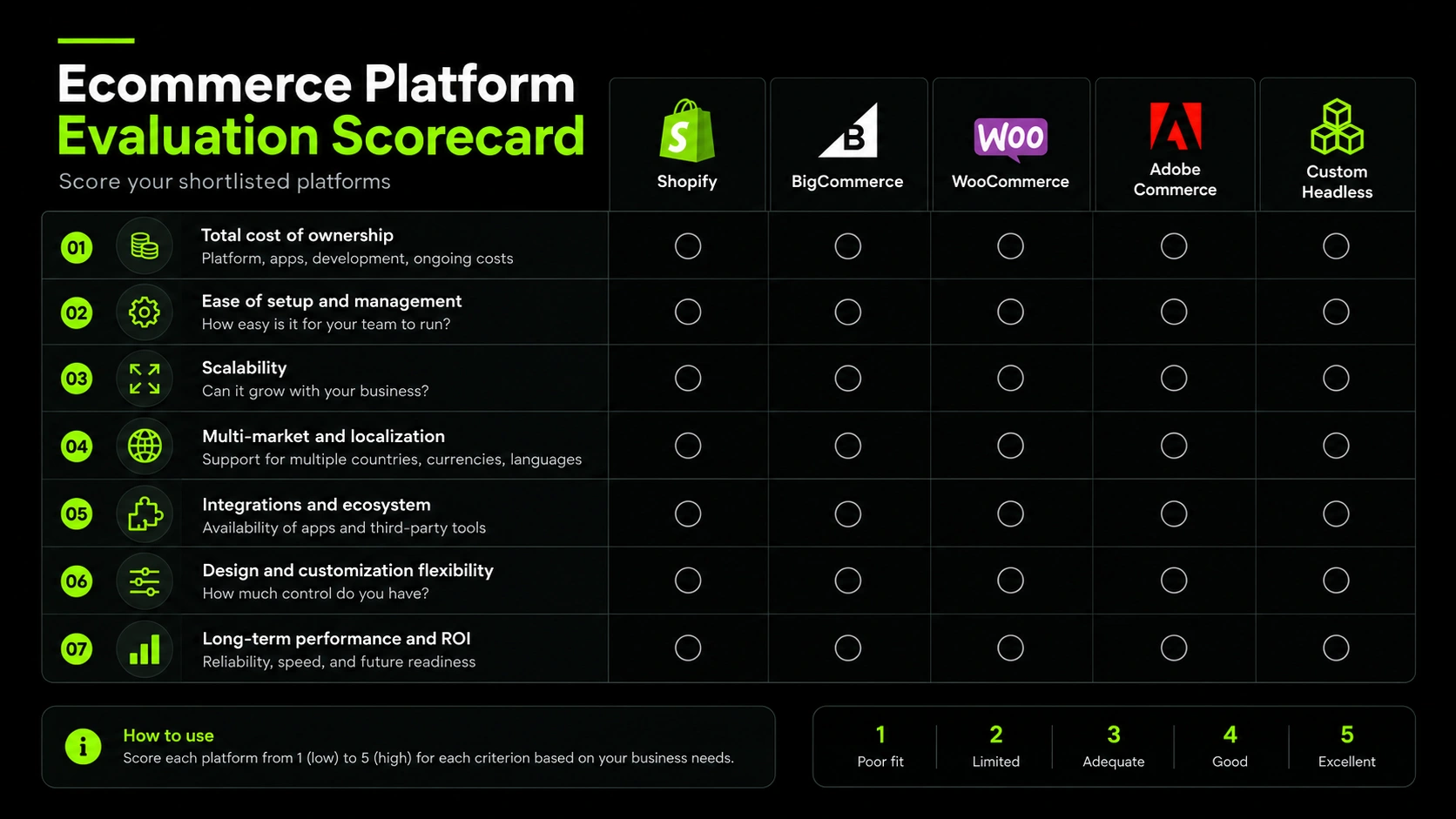
Score any platform you are considering against these seven factors before looking at price.
Total Cost Of Ownership Beyond The Subscription Fee
This is the factor most competing content skips entirely, and it is usually the biggest gap between expectation and reality. A Shopify Basic subscription advertised at a low monthly price commonly grows several times larger once payment processing fees, three to five essential apps, and basic developer support are added in.
On open-source platforms like Adobe Commerce, individual extensions can each carry their own licence fee, and a typical build relies on dozens of them, with annual renewal costs that compound over time.
Enterprise platforms shift the cost structure again, often charging a percentage of your gross merchandise value rather than a flat fee, which means the cost scales with your success in a way a flat monthly subscription does not. Budget for the fully loaded monthly cost, not the number on the pricing page.
Catalog And SKU Complexity
Variant-heavy catalogs, bundles, and subscription products each stress different platforms differently. A platform that handles a simple, low-variant catalog effortlessly can strain badly once you add complex bundling logic or a real subscription and replenishment program on top.
A brand selling apparel with size, colour and material variants across a few hundred SKUs generally fits comfortably within most platforms' native variant handling, but a brand adding a build-your-own-bundle mechanic or a heavily configurable product line often needs to check variant ceilings and bundling logic specifically before assuming any platform handles it out of the box.
Integration Ecosystem
Your platform needs to talk to your ERP, fulfillment provider, marketing stack, and any marketplaces you sell through.
Check integration depth specifically, not just whether an integration technically exists, since a thin, unreliable integration can cause more operational pain than building a custom one.
Scalability And Traffic/Order Volume Ceilings
Every platform has a ceiling somewhere, whether that is a hard technical limit or the point where cost per order starts climbing faster than revenue.
Know where that ceiling sits for your shortlisted platforms relative to your actual growth trajectory, not just your current volume.
Security, Compliance and Payment Processing
PCI compliance, data protection requirements, and payment gateway eligibility for your specific product category and region all vary by platform.
Confirm these specifically rather than assuming they are handled uniformly across every option.
Design And Development Flexibility
How much can you actually customize without fighting the platform's constraints? A SaaS platform trades some flexibility for managed infrastructure; an open-source or headless setup trades managed convenience for more control, at the cost of more development overhead.
Support, SLAs, And Partner Ecosystem Maturity
A platform with a thin partner and developer ecosystem in your region can leave you stuck when something breaks.
Check the maturity of the support and partner network available to you specifically, not just the platform's global reputation.
Platform Options, Matched To Business Stage
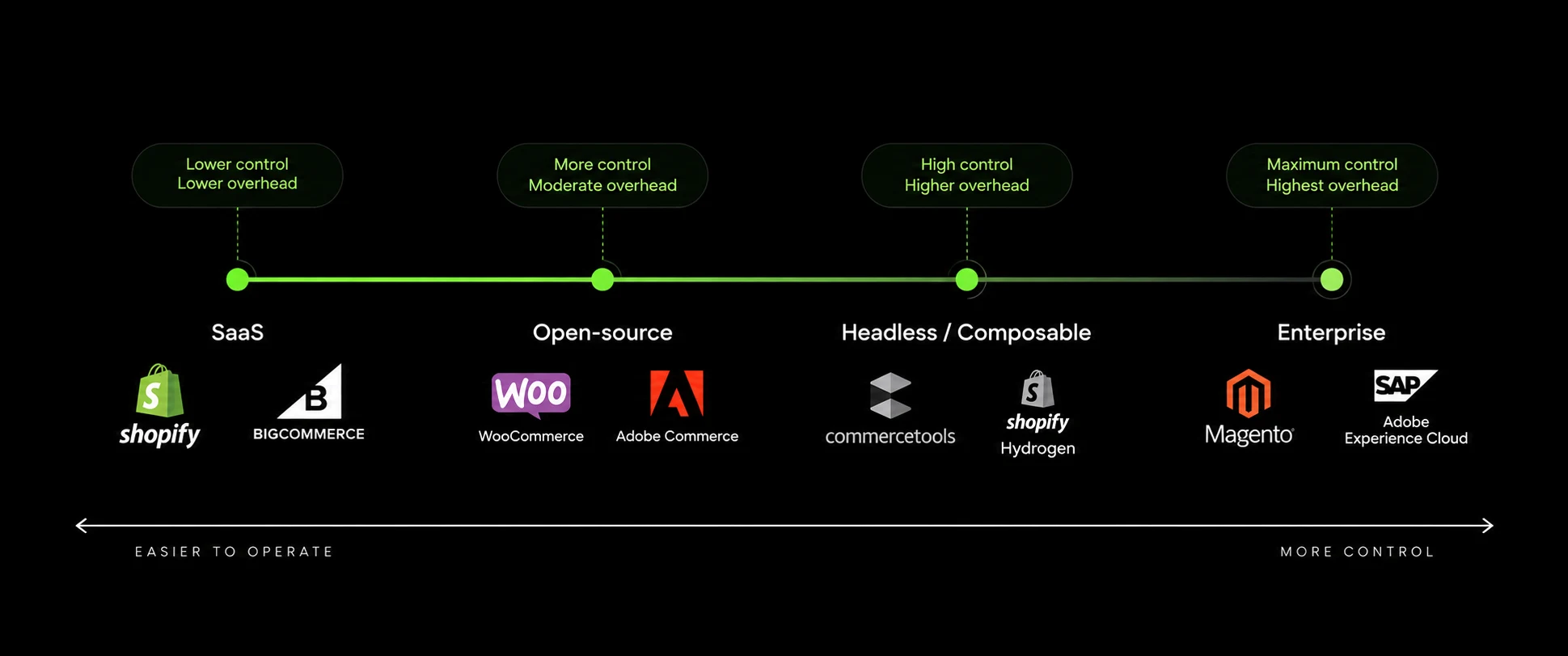
None of these options is universally "best." Each fits a different combination of catalog complexity, team capacity, and growth stage.
SaaS Platforms: Shopify and BigCommerce suit brands that want a fast launch and managed scaling, with hosting, security and core infrastructure handled by the platform.
This trades some deep customization flexibility for lower operational overhead, which is the right trade for most growing D2C brands.
Shopify Plus extends this further for brands outgrowing standard plans, adding checkout customization, native B2B functionality, and higher API limits without requiring a full platform switch.
Open-Source Platforms: WooCommerce and Adobe Commerce (Magento) give more control over hosting, customization and data, at the cost of owning more of the maintenance burden yourself.
This suits brands with the technical team, or the budget for one, to manage that overhead in exchange for the flexibility it buys.
WooCommerce tends to suit brands that already run WordPress for content and want commerce layered on top of that existing infrastructure; Adobe Commerce tends to suit brands with complex catalog or B2B requirements that justify a heavier, more customizable platform.
Headless And Composable Commerce: Headless setups decouple the frontend from the commerce backend, giving full design and channel flexibility at scale.
This is rarely the right starting point; it is usually where a brand ends up once it has outgrown what a standard platform's theme system can deliver and has the engineering resources to support a custom frontend.
Enterprise Platforms: Salesforce Commerce Cloud suits high-complexity, high-volume operations, typically multi-region, multi-brand enterprises with dedicated technical teams.
It is rarely justified for a brand still establishing product-market fit, and the cost difference versus a SaaS or open-source platform is substantial.
The Cost Of Choosing Wrong: Migration Risk And Switching Cost
Most competing content treats platform choice as low-risk and easily changed later. It is not.
What A Platform Migration Actually Costs
A migration involves catalog and customer data transfer, order history migration, a full SEO redirect mapping exercise to preserve search rankings, a theme rebuild, and re-configuring every integration and app you relied on.
A simple platform-to-platform migration can run into the low thousands of dollars; a complex enterprise migration with ERP integration can run into six figures.
Time and SEO risk compound the direct cost, since a poorly executed migration can cost you organic traffic and revenue for months afterward, independent of the direct project cost.
The indirect cost is often larger than the invoice: a two to three month migration project typically means two to three months where the team's attention is split between running the business and managing the switch, which is its own real cost even when the migration itself goes smoothly.
Signs You've Outgrown Your Current Platform
Recurring app conflicts, a development team that regularly says a feature is not possible on your current platform, hitting hard technical ceilings on catalog size or API rate limits or cost per order climbing faster than your revenue are all signs the platform itself, not your execution, has become the constraint.
Why "Cheap And Fast Now" Can Be Expensive Later
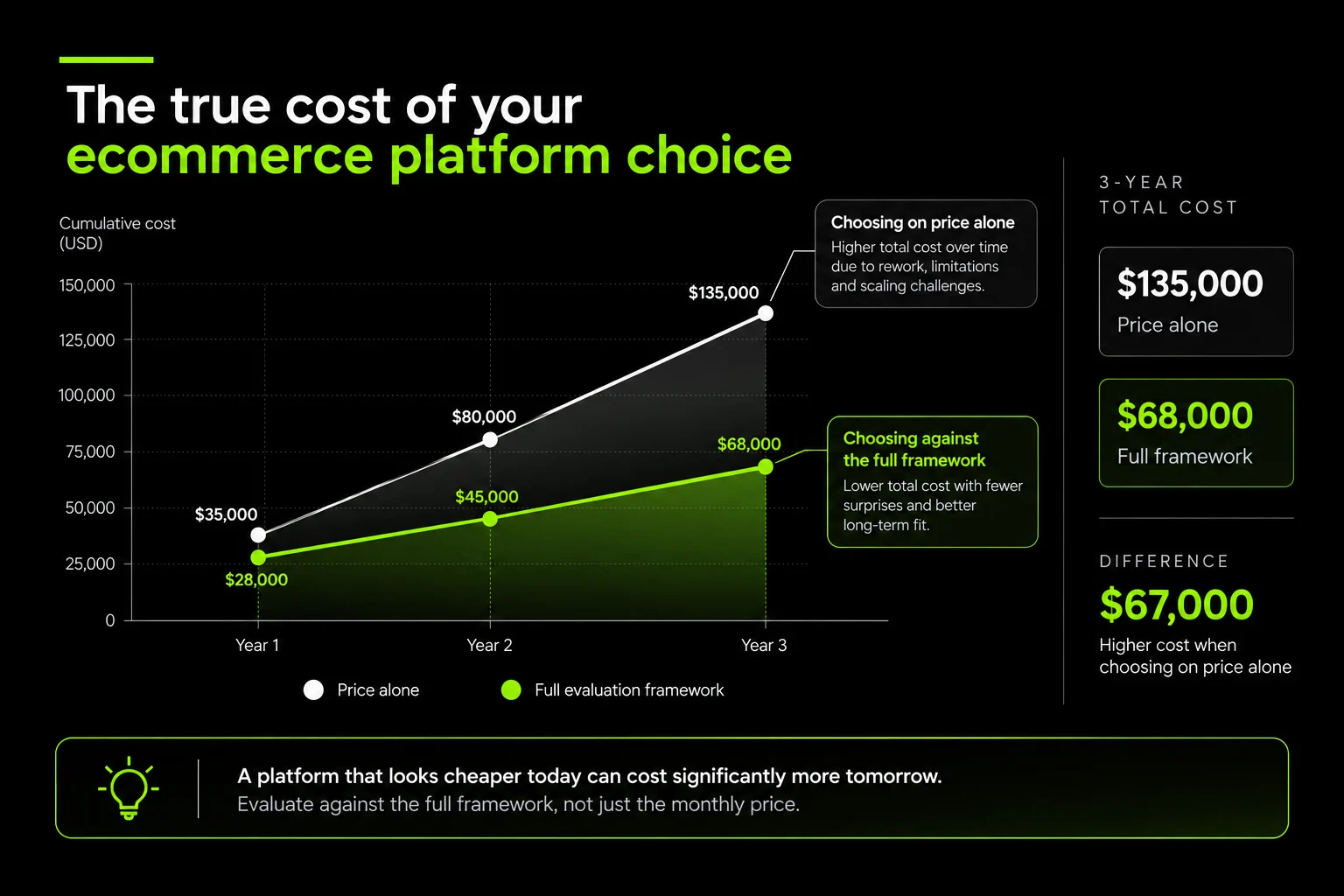
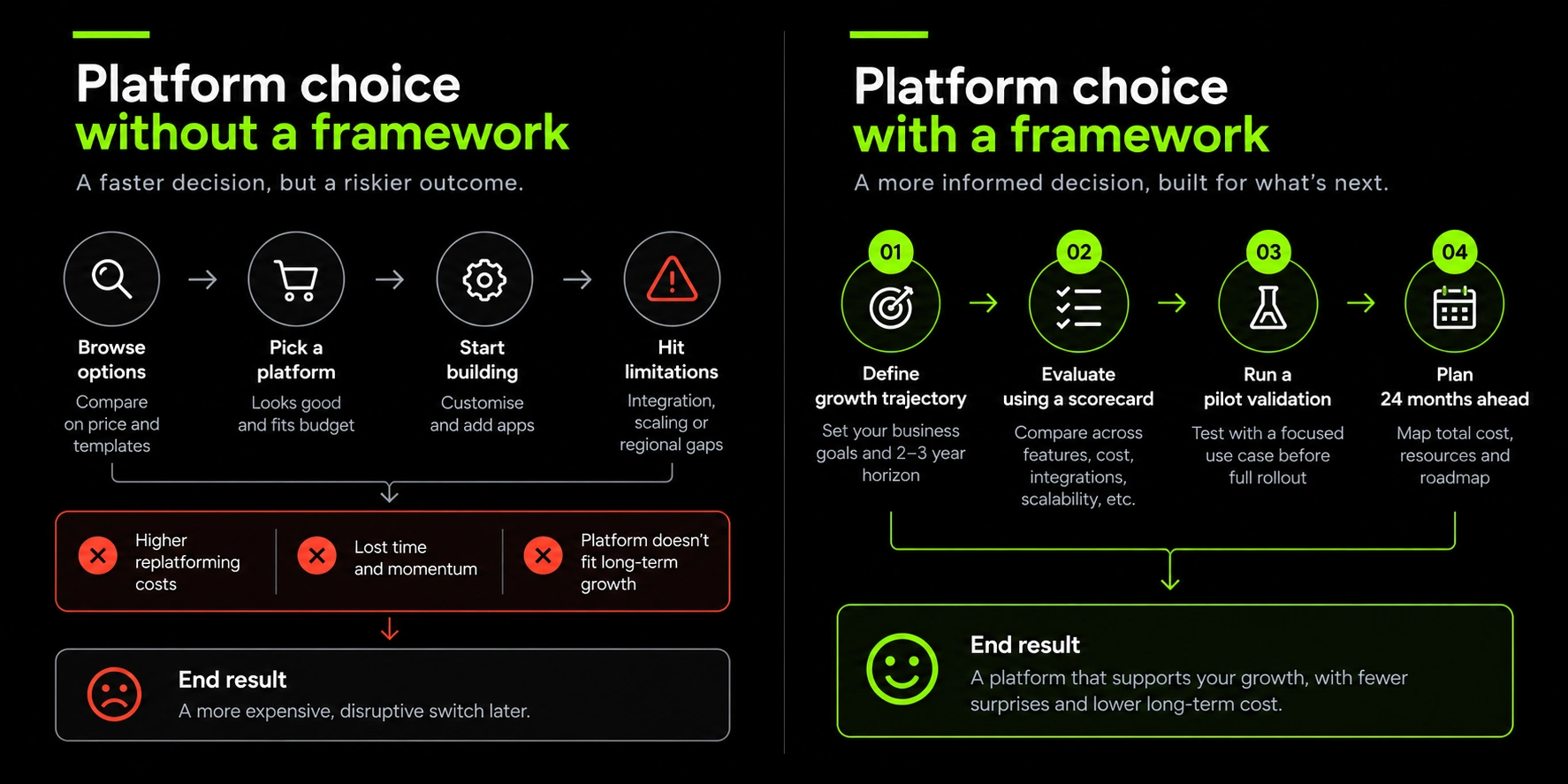
A brand that chooses the cheapest platform to launch quickly, without checking whether it will hold up at three times current order volume, often ends up paying for that decision twice: once in ongoing operational friction and again in the cost of migrating once the platform genuinely cannot keep up.
The platform that looks like the safe, low-cost choice today is not automatically the safe choice for where the business is headed.
Regional Considerations For UAE And GCC Brands
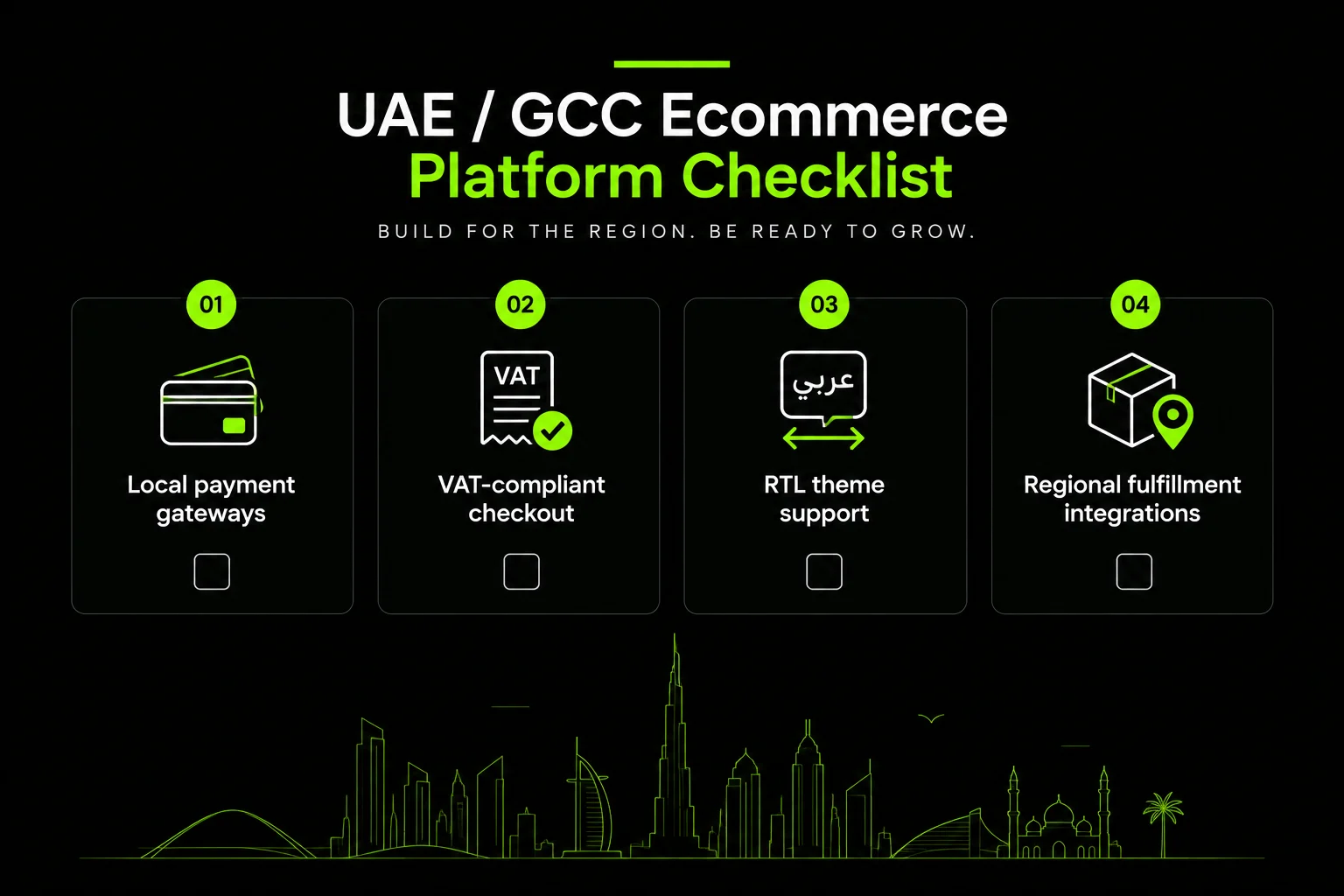
Choosing an ecommerce platform for the UAE or wider GCC involves a few regional details that can easily get missed.
A platform may work well in the US or Europe but still create problems with local payments, currencies, VAT, Arabic storefronts, or delivery integrations.
These are worth checking before the platform is selected, especially if you are planning to sell across more than one GCC market.
Local Payment Gateway And Multi-Currency Support
Start with payments. The gateways available to UAE and GCC merchants are not always the same as those commonly used in other markets. Customer preferences can also vary between countries.
If you already have a preferred payment provider, make sure it works with the platform and supports the markets you plan to enter.
Multi-currency needs a closer look as well. Displaying a price in AED, SAR, or KWD is not the same as processing the order in that currency.
Look at how the platform handles currency conversion, refunds, rounding, and settlement, rather than judging the feature by the currency selector alone.
VAT Compliance And Arabic/RTL Storefront Capability
VAT should be tested through the actual buying journey. Check how it is calculated and displayed on product pages, checkout, invoices, and order records.
Arabic support is another area where a simple translation solution may not be enough. An Arabic storefront needs proper right-to-left (RTL) support across the interface.
Navigation, filters, product information, forms, cart, and mobile layouts all need to work naturally in RTL.
The theme plays a big part here. If RTL support has to be fixed element by element after development starts, it can add unnecessary development and maintenance work.
Fulfillment And Logistics Integrations For The Gulf Market
Logistics can be just as important as payments. A platform might advertise a large integration ecosystem but still have limited support for the delivery and fulfillment providers you actually want to use in the GCC.
When comparing platforms, look at your actual operational requirements:
- Payment gateways and local payment methods
- AED, SAR, KWD and other required currencies
- VAT calculation and display
- Arabic and RTL support
- Shipping and last-mile delivery
- Fulfillment and warehouse connections
- Tracking and returns
- Cash-on-delivery workflows, where relevant
The aim is not to pick the platform with the longest feature list. It is to make sure the platform fits how your store will actually sell and operate in the UAE and GCC.
A Practical Decision Framework
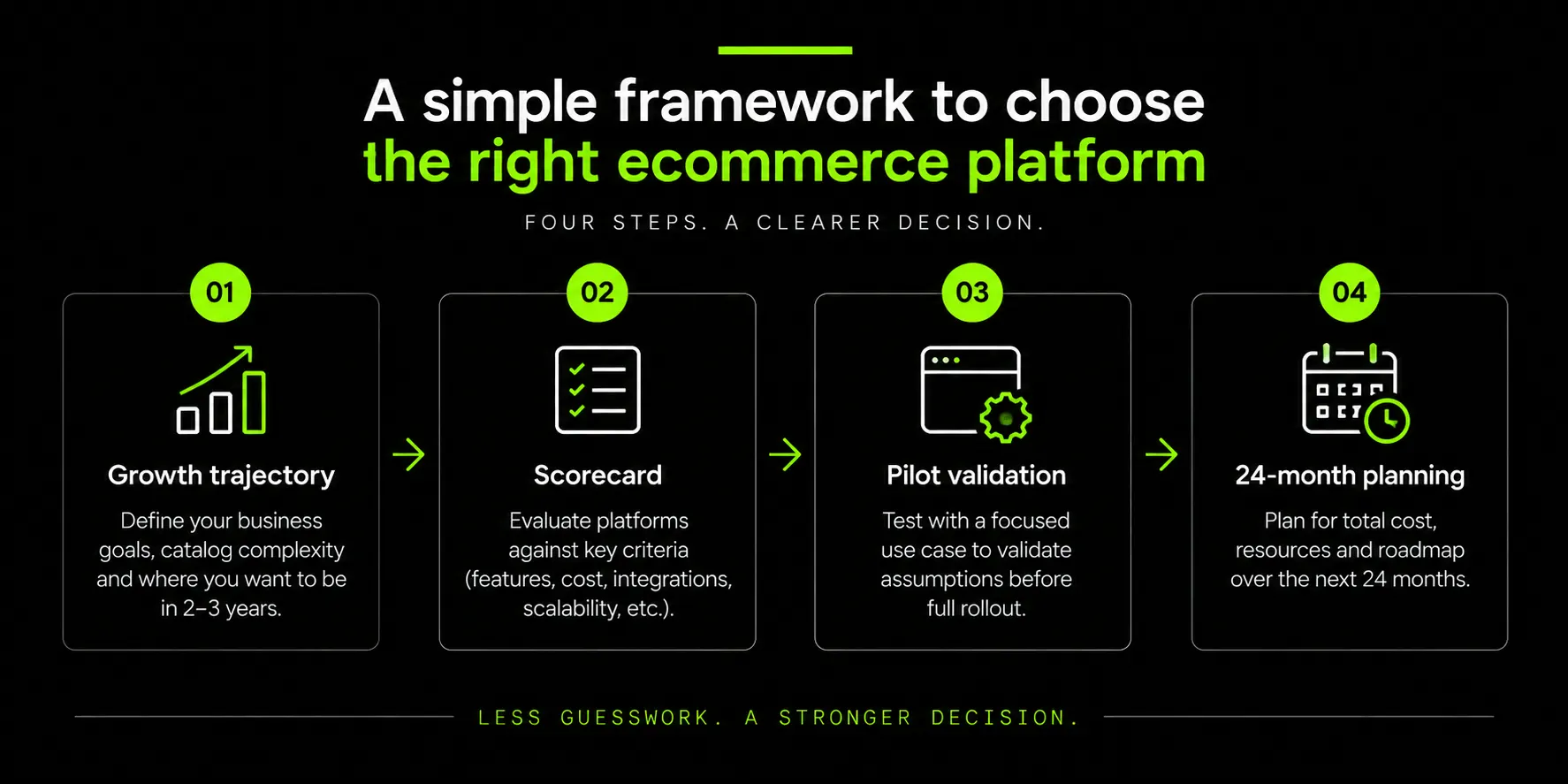
Work through these four steps in order.
Step 1: Define Your Three-Year Growth Trajectory
Score platforms against where your catalog, order volume, and team are headed over the next three years, not just today's needs.
A platform that fits your business now but caps out well before your growth target creates a migration problem you are choosing on day one.
Step 2: Score Shortlisted Platforms Against The Weighted Scorecard
Run two or three shortlisted platforms through the seven-factor scorecard above, weighting each factor by how much it actually matters for your specific business.
Total cost of ownership and catalog complexity typically deserve more weight than design flexibility for most growing D2C brands, but weigh it against your own priorities rather than a generic default.
Involve whoever actually manages the storefront day-to-day in this scoring exercise, not just the decision-maker approving the budget, since operational friction that a hands-on team member would flag immediately is easy to miss when scoring purely on paper.
Step 3: Pilot Or Validate Before Full Commitment
Where possible, build a sandbox or trial version of your catalog on your top choice before fully committing, particularly for anything with complex variant structures, bundles, or subscription logic.
This surface platform-specific friction is far cheaper than discovering it after a full build and launch.
Step 4: Plan For The Platform You'll Need In 24 Months
Choose based on where the business will be in two years, not just where it is now. A brand launching at a hundred SKUs but planning to reach a thousand within two years should weigh catalog scalability heavily even if the platform feels like overkill today.
An Illustrative Contrast
A brand that chose its platform purely on the lowest advertised monthly price launched quickly and cheaply, then hit catalog and integration limits within eighteen months, forcing a migration that cost more in total than choosing a slightly more expensive platform upfront would have.
A brand that scored its options against the full framework, weighting catalog complexity and three-year growth trajectory appropriately, paid a bit more at launch but avoided that migration entirely, reaching the same order volume on the platform it started with.
How We Help Brands Choose And Build On The Right Platform
At Suplex, we start with the business, not a platform. We look at your catalogue, growth plans, operational requirements, and the integrations your store needs before making a recommendation.
The approach is platform-agnostic. If Shopify can handle your requirements without unnecessary complexity, we will recommend it rather than pushing a headless build.
If your catalogue, integrations, or business model needs more flexibility, we will assess options such as Adobe Commerce or a composable setup.
We have worked with Shopify, Shopify Plus, and headless commerce for D2C and FMCG brands across the UAE, GCC and international markets. That experience has shown us how costly the wrong platform decision can become as a store grows.
Whether you are planning a new ecommerce build or your current store is starting to hit its limits, Suplex offers a platform-fit consultation to help you assess the options before committing.
Frequently Asked Questions
Which ecommerce platform is best for a growing D2C brand?
There is no universal answer; it depends on catalog complexity, growth trajectory, and integration needs. Most growing D2C brands with moderate catalog complexity and standard integration needs do well on Shopify or Shopify Plus, while brands with heavier customization or catalog complexity may need an open-source or headless approach instead.
How much does it really cost to run an ecommerce platform beyond the subscription fee?
Factor in payment processing fees, essential third-party apps or extensions, developer support, and eventual migration cost. A platform advertised at a low monthly subscription commonly costs several times that once these are added, so request a fully loaded cost estimate rather than budgeting around the sticker price.
When should a brand consider headless commerce instead of a standard platform?
Once you need full design and channel flexibility at a scale that a standard platform's theme system cannot deliver, and you have the engineering resources to maintain a custom frontend. This is rarely the right starting point for a brand's first platform choice.
How do I know if I've outgrown my current ecommerce platform?
Recurring app conflicts, a development team regularly hitting hard platform limits, rising cost per order relative to revenue, and hard technical ceilings on catalog size or API limits are all signs the platform itself has become the constraint rather than your execution.
Is Shopify or WooCommerce better for a scaling business?
Shopify suits brands that want managed infrastructure and faster scaling with less internal technical overhead. WooCommerce suits brands that want more control over hosting and customization and have the technical capacity, internal or through a partner, to manage that additional overhead.
How risky is switching ecommerce platforms once you're established?
Genuinely risky if not planned carefully. A migration carries real cost in development hours, catalog and data transfer, and SEO risk from redirect mapping errors, and a poorly executed one can cost organic traffic and revenue for months. Treat platform choice as a decision with real switching costs, not a low-risk experiment.
What ecommerce platform works best for brands selling in the UAE and GCC?
The right platform depends on your catalog and growth needs as much as region, but confirm any shortlisted platform supports local payment gateways, VAT-compliant checkout, and genuine Arabic/RTL storefront capability before deciding, since these vary meaningfully between platforms and are easy to underestimate until you are mid-build.
Hi, I’m Rishabh Jain
I believe great design has the power to shape perception, build trust, and move businesses forward. That belief is what led me to found Suplex Design Studio, a global branding and packaging studio working with FMCG and D2C brands across markets.I started suplex at 25 with a clear intent, to create design that is strategic, thoughtful, and commercially meaningful. By 28, the studio had scaled globally, guided by a strong foundation in Integrated Design that I developed during my academic journey in London, where I was honoured with the Dean’s Award.
Over the years, I’ve had the opportunity to work with 100+ brands, from Fortune 500 organizations to family-run businesses, helping them build packaging and brand systems that create recall, relevance, and long-term value.
Suplex’s work has been recognized internationally, including the Manifest Award (2024), the Clutch Global Award (2025), and features on platforms such as Packaging of the World, The Dieline, and the World Brand Design Society.
None of this would be possible without the people behind the work. I’m deeply grateful to the suplex team, whose commitment, creativity, and attention to detail turn ideas into meaningful brand experiences every day.
At the heart of my work is a simple philosophy, design should be intentional, honest, and built to last, and that continues to guide everything we create at suplex.





































Let’s Make It Happen
E-Commerce Success Stories
%201.avif)






.avif)

.avif)
Build Your D2C Business The Right Way
Build It With Suplex.


