Multi-Store Shopify Setup For Global Brands: The Complete Strategic Guide
.avif)
Multi-Store Shopify Setup For Global Brands: The Complete Strategic Guide
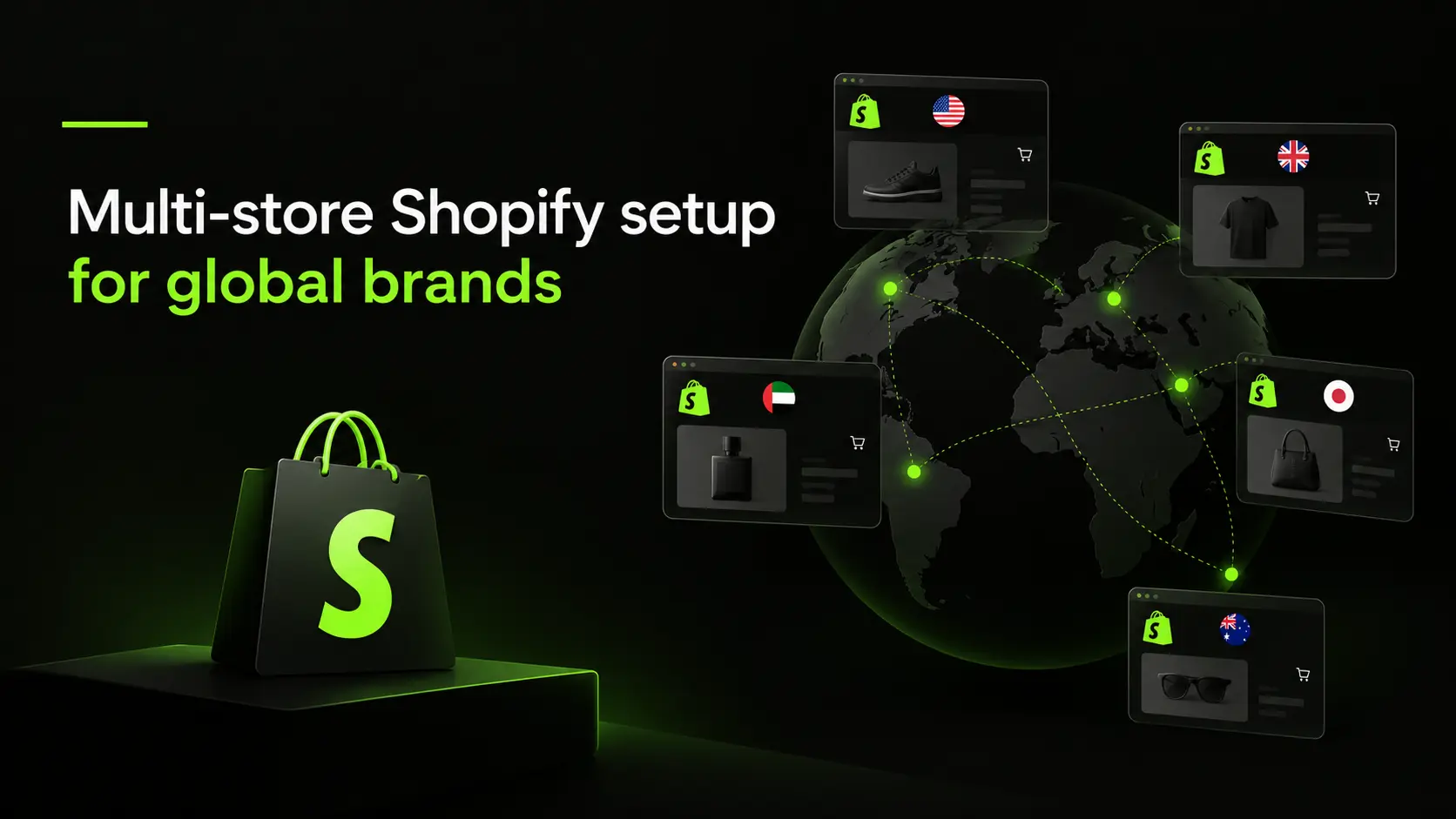
Multi-store Shopify setup for global brands is a structural choice between three distinct approaches: Shopify Markets, true Expansion Stores available under Shopify Plus and headless commerce.
Each approach has different implications for operations, SEO, scalability, flexibility, and cost. Yet many experts focus on how to create additional stores without addressing the more important question: do you actually need multiple stores in the first place?
Before investing in a complex multi-store architecture, brands should evaluate their markets, operational needs, customer experience and long-term growth strategy.
Why "Multi-Store Setup" Is a Strategic Decision, Not Just a Technical One
Searching for a Shopify multi-store setup usually brings up configuration tutorials: how to create stores, connect domains, manage themes, and configure markets.
Those steps matter, but they address the technical execution rather than the more important decision that should come first: do you actually need multiple stores?
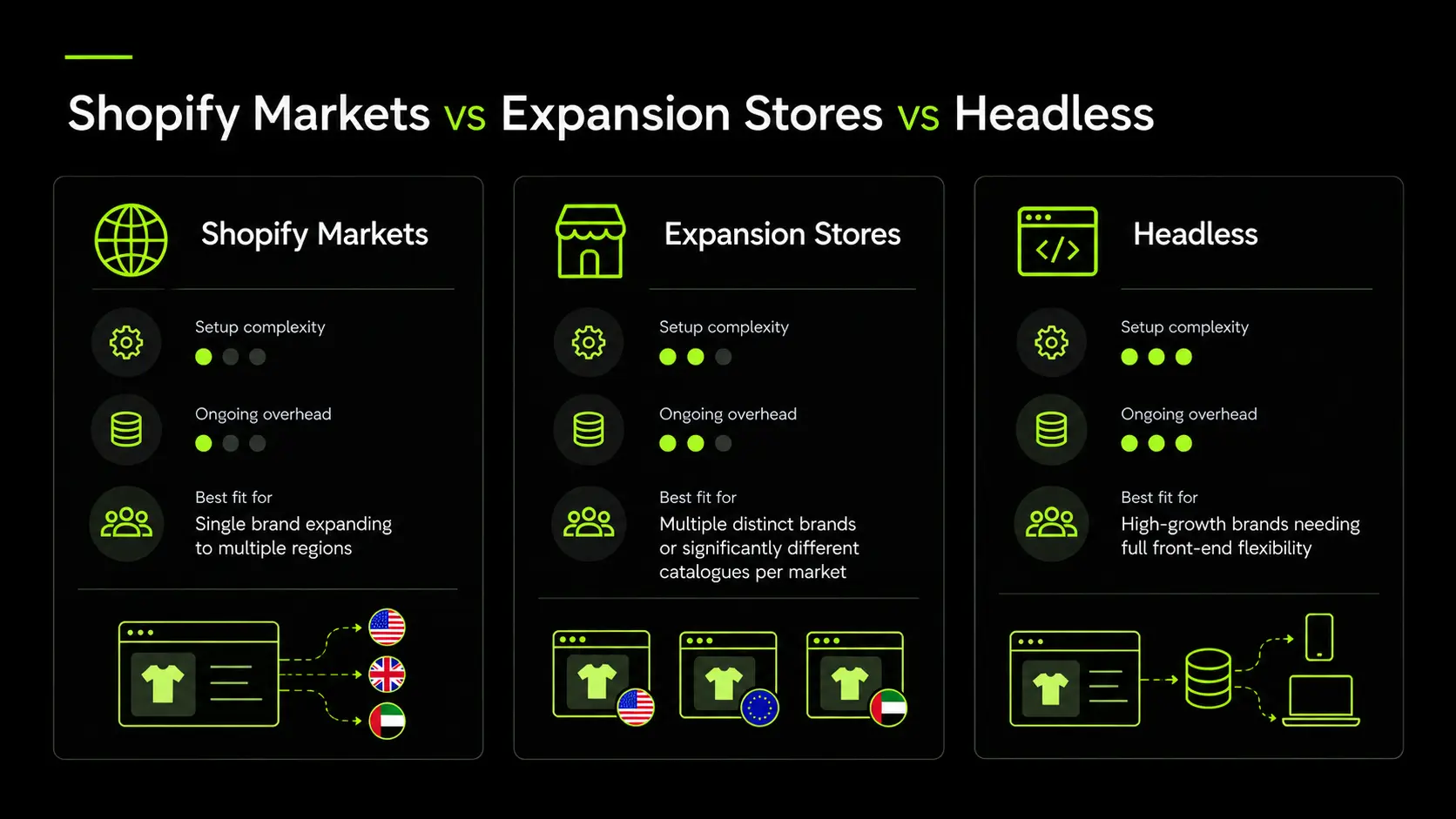
The Three Real Options
For global brands, there are three fundamentally different approaches to Shopify expansion.
Shopify Markets: allows a single store to serve multiple countries or regions with localized currencies, languages, domains, and region-specific pricing.
For brands selling essentially the same products across markets, this can provide international reach without introducing another storefront to manage.
Expansion Stores: available through Shopify Plus, create genuinely separate storefronts within the same organization.
Each store can have its own catalog, theme, pricing structure, products, and operational configuration where required.
This provides greater market-level control, but it also introduces additional operational complexity.
Headless Commerce: takes a different approach by separating the frontend experience from Shopify's commerce backend.
This gives brands greater control over how regional storefronts are designed and managed, and can support highly customized experiences across markets.
However, it also introduces additional development, infrastructure, and maintenance requirements.
Why Most Guides Skip the Decision
Most Shopify multi-store guides move directly into setup because they assume the business has already established that multiple stores are necessary. That assumption can create unnecessary complexity.
For example, a brand selling the same catalog internationally, with differences primarily in currency, language, pricing and domain structure, may be able to achieve its requirements through Shopify Markets.
Creating separate Expansion Stores in this situation can mean managing additional catalogs, themes, apps, integrations, and operational processes without solving a genuine business problem.
The right architecture therefore depends on how different your markets actually are. Before creating another Shopify store, evaluate catalog differences, pricing rules, localization requirements, SEO structure, operational ownership and the level of independence each market requires. The technical setup should follow that decision.
Shopify Markets Versus Multiple Stores Versus Headless: The Decision Framework
The right approach depends on how different your regions actually need to be from each other, not on how big or ambitious the expansion plan sounds.
When A Single Store With Shopify Markets Is Enough
If your catalog, promotions, and brand experience are largely the same across regions, and the main differences are currency, language, and local pricing, Shopify Markets handles this inside a single store.
You get one admin, one set of apps, one theme to maintain, and localized checkout experiences layered on top.
When You Need True Expansion Stores
If different regions need genuinely different catalogs, independent promotional calendars, separate teams managing day-to-day operations, or a completely different brand experience, for example a B2B storefront alongside a D2C one, a single store with regional layers starts to strain.
Expansion Stores under Shopify Plus give each region its own store while keeping them under one organization for billing and oversight.
When Headless Commerce Is The Right Call
If you are operating at a scale where you need a fully unified experience across many storefronts, with shared components, centralized content operations, and engineering resources to maintain a custom frontend, headless becomes worth the investment.
This is rarely the starting point for a brand's first international expansion; it is usually where a brand ends up after outgrowing Expansion Stores.
Catalog Overlap, Pricing Complexity, And Team Structure As The Deciding Factors
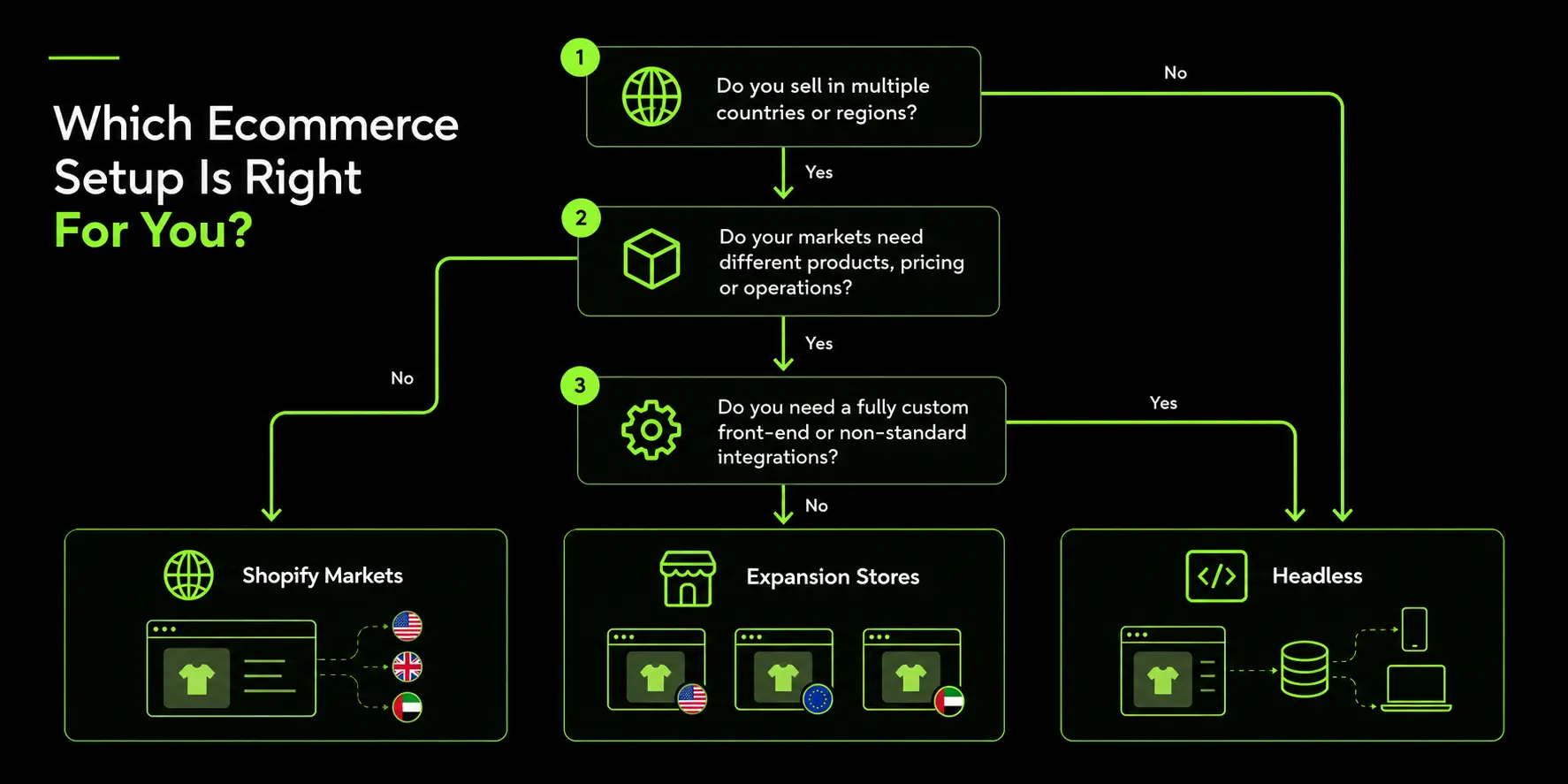
Three questions settle most of this decision. How much does your catalog actually differ by region? How independent does pricing and promotion need to be? And is each region run by a separate local team, or one central team managing everything?
A brand with high catalog overlap, simple regional pricing, and one central team almost always fits Shopify Markets. A brand with low catalog overlap, independent regional promotions, and separate regional teams almost always needs Expansion Stores or headless.
How Shopify Plus Expansion Stores Actually Work
The mechanics matter once you have decided Expansion Stores are the right fit.
Store Limits, Organization Structure, And Admin Access
Shopify Plus includes up to nine Expansion Stores in addition to your main store, for a total of ten storefronts under one Plus organization, at no extra licence cost up to that limit.
Requesting a store beyond your contracted limit typically creates a trial store rather than a full one, with an additional fee to convert it, so confirm your specific contract terms before assuming you have unlimited headroom.
Each store can have its own admin users, or share access across a centralized team, depending on how you structure permissions.
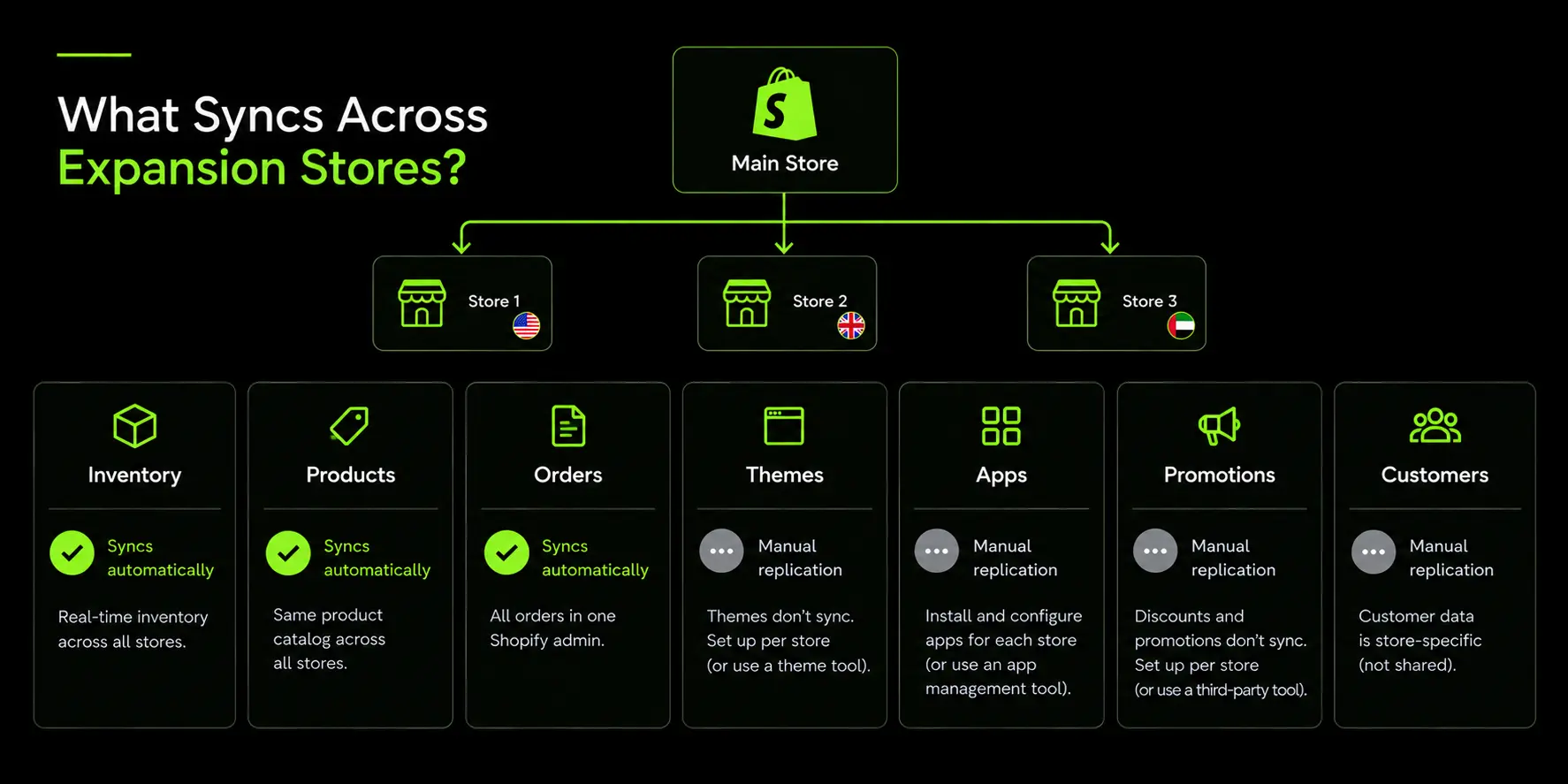
What's Shared Versus Independent Across Expansion Stores
Apps, themes, and inventory are not automatically shared between Expansion Stores.
Each store needs its own app installations and billing, its own theme (though a theme can be duplicated from an existing store during setup) and its own inventory tracking unless you connect them through an inventory management layer.
Nothing about Expansion Stores gives you automatic synchronization; that has to be built or configured separately.
Typical Use Cases
Expansion Stores commonly serve regional brands expanding into genuinely distinct markets, a B2B storefront running alongside a consumer-facing one, or a multi-brand portfolio where each brand needs its own catalog and identity under shared organizational oversight.
The Operational Reality Of Running Multiple Stores
The complexity of a multi-store Shopify setup rarely appears during development. It becomes visible after launch, when teams have to maintain multiple storefronts, synchronize inventory, manage updates, and coordinate regional operations.
These ongoing requirements can become a significant part of the total cost of running multiple stores.
Inventory Sync Across Storefronts
When two stores sell the same products, inventory needs to stay synchronized.
Without a connected inventory layer:
- Both stores may show the same product as available.
- Stock levels can become inconsistent.
- Orders can exceed actual inventory.
- Overselling becomes a real operational risk.
At scale, brands typically need an appropriate Shopify inventory-sharing configuration where supported, or a third-party inventory management system to synchronize stock across stores and sales channels.
App And Theme Update Overhead
Every additional store creates another layer of maintenance.
Apps may need to be:
- Installed separately
- Configured separately
- Paid for separately
- Tested after updates
The same applies to themes, customizations, promotions, and bug fixes.
A change that takes minutes to implement in one store can require significantly more testing and deployment work across several stores.
This is one of the hidden costs of multi-store Shopify setups. It often does not appear in the initial project budget because the expense emerges gradually through ongoing maintenance.
Team Structure And Governance
Multiple stores also require clear ownership.
A centralized team can maintain consistency across branding, technology, merchandising, and processes. However, it can become a bottleneck as the number of markets grows.
Regional teams can move faster and respond better to local requirements, but they need clear governance to prevent individual stores from drifting away from the core brand.
As store count increases, standardized processes, documentation, deployment workflows, and governance become increasingly important.
The key point: multi-store architecture is an operating-model decision.
The SEO Risk Most Guides Don't Address: Duplicate Content Across Regional Stores
This is the section where most competing content on this topic goes quiet.
Why Near-Identical Regional Storefronts Create Duplicate Content Risk
Two regional stores selling largely the same catalog, with largely the same product descriptions, look like duplicate content to search engines unless you actively signal otherwise.
Left unaddressed, this can mean your own stores compete against each other in search results rather than each ranking cleanly in its own region.
hreflang, Canonical Strategy and Domain Structure
The hreflang attribute tells search engines which regional or language version of a page to show to which audience and it needs to be implemented correctly across every equivalent page pair, not just the homepage.
A clear canonical strategy, deciding which version of near-duplicate content is the authoritative one where full duplication cannot be avoided, works alongside hreflang rather than replacing it.
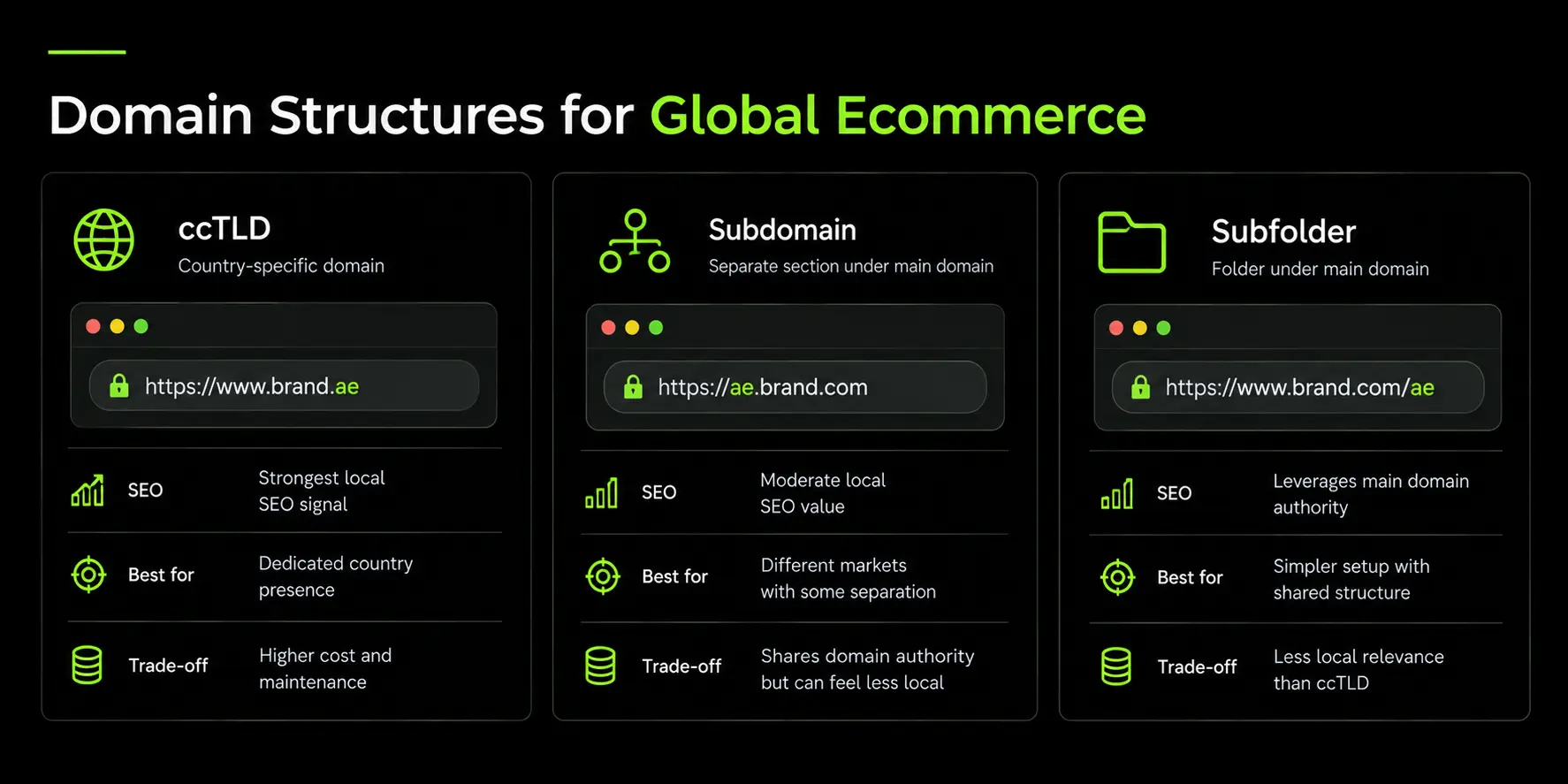
Country-Code Domains Versus Subdomains Versus Subfolders
The domain structure you choose for each regional store affects how clearly search engines separate them, and how much authority each one can build independently.
None of these is universally correct. A brand with genuinely separate legal entities per country often leans toward ccTLDs.
A brand centralizing SEO authority under one domain while still serving distinct regional experiences often leans toward subfolders. This decision should be made before launch, not retrofitted once regional stores are already indexed.
Localization Beyond Language: Currency, Payments and Compliance Per Region
Language is the most visible part of localization, but it is rarely the most complex.
For a multi-region Shopify setup, localization also affects payments, currencies, taxes, checkout, and the overall customer experience.
Multi-Currency And Local Payment Gateways
Showing prices in local currency is only the starting point.
The checkout also needs to support payment methods that customers in each market recognize, trust, and can actually use.
Depending on the region, this may require:
- Local payment gateways
- Regional card networks
- Buy Now, Pay Later options
- Local wallet integrations
- Region-specific settlement requirements
A currency selector alone does not create a localized payment experience.
Tax And VAT Compliance
Every market can introduce different tax and VAT requirements.
Your Shopify setup needs to account for:
- Local tax rates
- VAT registration requirements
- Tax-inclusive or tax-exclusive pricing
- Correct tax calculation at checkout
- Region-specific invoices and documentation
Applying one global tax configuration across every market can create compliance and pricing problems as the business expands.
Localizing For The UAE And GCC
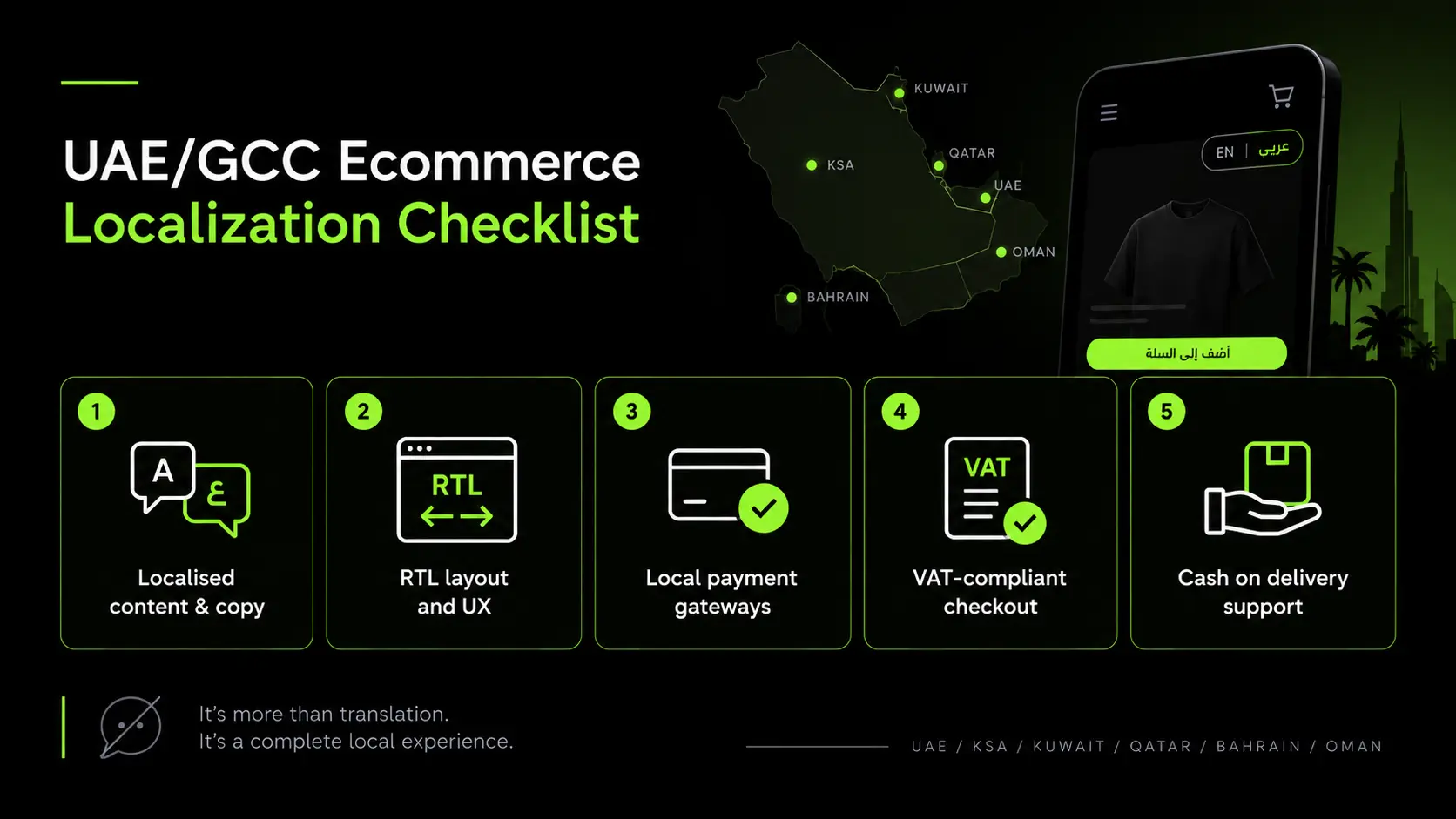
For brands entering the UAE and wider GCC, localization goes well beyond translating the storefront into Arabic.
The customer experience may need to account for:
- Right-to-left (RTL) layouts at the theme level
- Cash on delivery (COD) alongside card payments
- Local and regional payment gateways
- Arabic and English content
- Region-specific pricing and currencies
- Local tax and compliance requirements
The GCC should also not be treated as a single market. Saudi Arabia, UAE, Kuwait, Qatar, Bahrain, and Oman have different customer behaviors, payment preferences, and operational requirements.
That means a storefront that works well in one GCC market may still need meaningful changes before expanding into another.
The key takeaway: localization is an operational layer. The more markets you enter, the more important it becomes to design currencies, payments, compliance, and UX into the architecture from the beginning.
A Practical Rollout Plan For Launching A Multi-Store Setup
Sequence matters more than speed here.
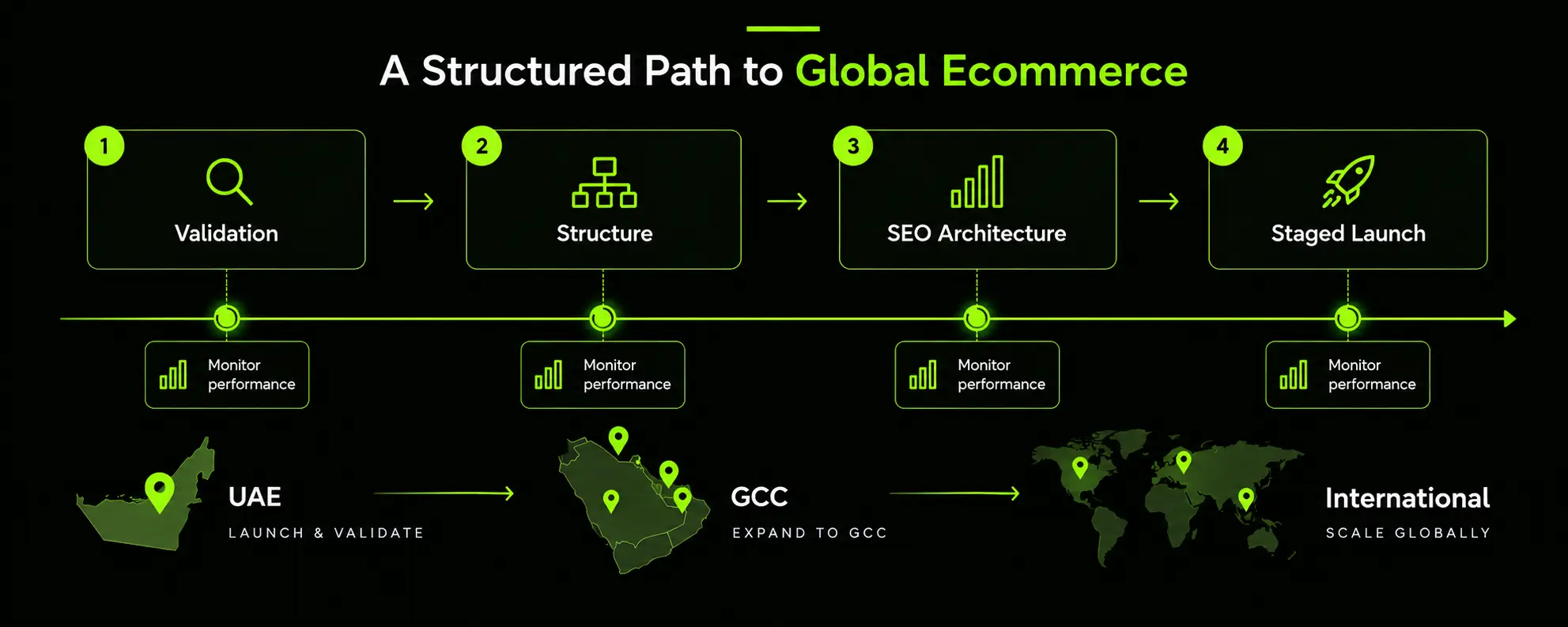
Phase 1: Validate The Decision
Run your actual catalog overlap, pricing independence, and team structure through the framework above before building anything. This phase is cheap; reversing a wrong structural decision after launch is not.
Phase 2: Structure Inventory, Catalog, And Pricing Logic
Decide how inventory will sync, or intentionally not sync, across stores, and build the catalog and pricing structure to match before any store goes live.
Phase 3: Build SEO Architecture Before Launch
Domain structure, hreflang implementation, and canonical strategy need to be in place before a new regional store is indexed, not patched in afterward once search engines have already formed an opinion about the content.
Phase 4: Staged Regional Rollout And Monitoring
Launch one region at a time where possible, monitoring rankings, traffic, and conversion for each new store before adding the next.
This mirrors the phased approach that protects revenue during any major structural change, and it applies just as much to adding a new regional store as it does to a full site redesign.
An Illustrative Scenario
A brand starting with a single UAE store, selling largely the same catalog it plans to sell regionally, typically fits Shopify Markets first, adding Saudi Arabia and the wider GCC through region-specific pricing and currency rather than new stores.
If that same brand later wants a distinct catalog and dedicated local promotions for, say, a European market with different product-market fit, that specific expansion is where Expansion Stores start to make sense, layered on top of the Markets setup already serving the GCC.
Headless only enters the picture once the brand is running enough distinct storefronts that a shared, centrally managed frontend becomes worth the engineering investment.
How We Architect Multi-Store And Global Shopify Setups
At Suplex, we start with the business decision before the technical build. We first assess whether Shopify Markets, Expansion Stores, or headless commerce makes sense based on:
- Catalog overlap across markets
- Pricing and merchandising independence
- Regional operational requirements
- Team structure and ownership
- SEO and domain strategy
Only then do we recommend the architecture. If Shopify Markets can solve the problem, we will say so.
We would rather recommend a simpler setup that meets the brand’s requirements than sell a more expensive Expansion Store architecture that creates unnecessary operational overhead.
For brands that genuinely need multiple stores, we then build the structure around long-term scalability rather than treating each regional storefront as an isolated project.
SEO architecture is established before regional stores go live, not retrofitted afterward.
This includes:
- Domain and subdomain strategy
- URL architecture
- Hreflang implementation
- Regional content structure
- Redirect planning
- Canonicalization
- International search visibility
Getting these decisions right early helps prevent regional storefronts from competing with one another or creating avoidable indexing and migration issues.
We have supported brands expanding from a single UAE storefront into wider GCC and international markets.
That experience informs the framework above: start with the business requirements, choose the simplest architecture that can support them, and build the operational and SEO foundations before adding more markets.
If you are evaluating your own international expansion, Suplex's global expansion services can help you work through the catalog, team, localization, and SEO requirements before committing to a multi-store structure.
Frequently Asked Questions
Can you have multiple stores under one Shopify account?
Yes, through Shopify Plus Expansion Stores, which create genuinely separate storefronts under one organization for billing and oversight. Standard Shopify plans do not support true multi-store setups in this way; they rely on Shopify Markets to serve multiple regions from a single store instead.
What's the difference between Shopify Markets and multiple stores?
Shopify Markets extends one store to handle multiple currencies, languages, and region-specific pricing without creating separate storefronts. Multiple stores, via Expansion Stores, create genuinely independent storefronts with their own catalogs, themes, and admin, suited to regions that need to differ more substantially from each other.
How many stores can you run under Shopify Plus?
Shopify Plus includes up to nine Expansion Stores in addition to your main store, for a total of ten, included at no extra licence cost up to that limit. Requesting more than your contracted limit generally requires an additional fee, so confirm the specifics with Shopify or your Plus contract directly.
Does running multiple Shopify stores hurt SEO?
Not inherently, but near-identical regional storefronts create real duplicate content risk if hreflang, canonical strategy, and domain structure are not handled correctly. Planned properly before launch, multiple stores can rank cleanly in their respective regions rather than competing against each other.
Is Shopify Plus required to run multiple stores?
Yes, for genuine Expansion Stores. Standard Shopify plans can simulate some multi-region functionality through Shopify Markets within a single store, but true independent multi-store setups require Shopify Plus.
Should a global brand use one store or separate regional stores?
It depends on catalog overlap, pricing independence, and team structure rather than brand size alone. A brand with high catalog overlap and centralized management usually fits one store with Shopify Markets; a brand needing genuinely distinct regional catalogs or operations usually needs separate Expansion Stores.
How much does it cost to set up and maintain multiple Shopify stores?
Beyond the Shopify Plus licence fee, which includes Expansion Stores up to the plan limit at no extra cost, ongoing costs come from duplicated app subscriptions per store, development time to keep themes and features in sync, and the SEO architecture work needed to launch each region cleanly. Request a scope based on your specific store count and catalog complexity rather than a generic estimate.
Hi, I’m Rishabh Jain
I believe great design has the power to shape perception, build trust, and move businesses forward. That belief is what led me to found Suplex Design Studio, a global branding and packaging studio working with FMCG and D2C brands across markets.I started suplex at 25 with a clear intent, to create design that is strategic, thoughtful, and commercially meaningful. By 28, the studio had scaled globally, guided by a strong foundation in Integrated Design that I developed during my academic journey in London, where I was honoured with the Dean’s Award.
Over the years, I’ve had the opportunity to work with 100+ brands, from Fortune 500 organizations to family-run businesses, helping them build packaging and brand systems that create recall, relevance, and long-term value.
Suplex’s work has been recognized internationally, including the Manifest Award (2024), the Clutch Global Award (2025), and features on platforms such as Packaging of the World, The Dieline, and the World Brand Design Society.
None of this would be possible without the people behind the work. I’m deeply grateful to the suplex team, whose commitment, creativity, and attention to detail turn ideas into meaningful brand experiences every day.
At the heart of my work is a simple philosophy, design should be intentional, honest, and built to last, and that continues to guide everything we create at suplex.




































Let’s Make It Happen
E-Commerce Success Stories
%201.avif)






.avif)
.avif)
Build Your D2C Business The Right Way
Build It With Suplex.


