Odoo Vs Shopify For UAE Ecommerce Brands: Which One (Or Both) Do You Need?
.avif)
Odoo Vs Shopify For UAE Ecommerce Brands: Which One (Or Both) Do You Need?
ecommerce platform.
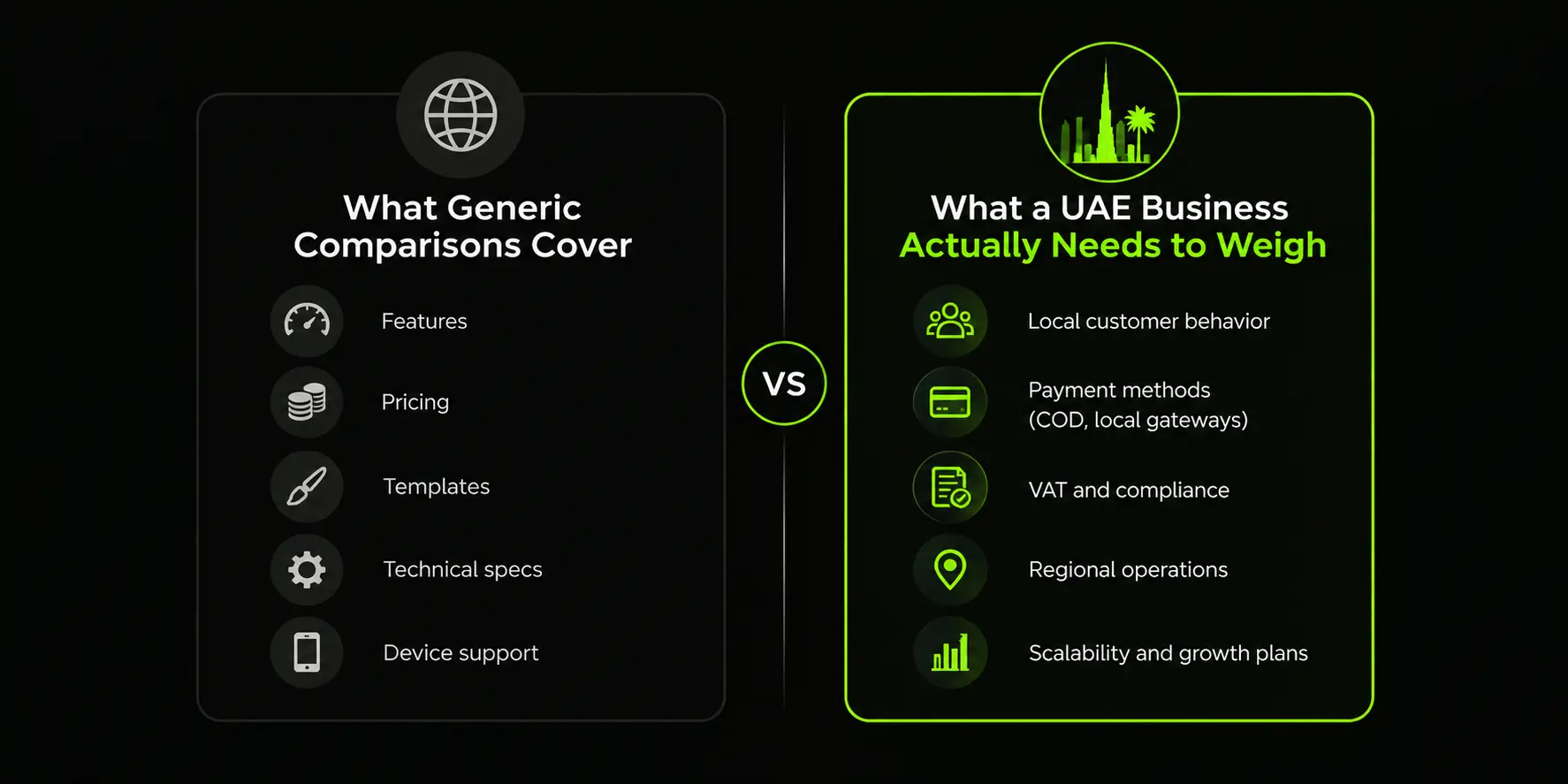
None of the ranking guides are written for a UAE business, where VAT and FTA compliance, Arabic accounting needs, and multi-branch trading structures make this decision genuinely different.
The real answer most UAE SMEs land on is not either/or, many run Odoo as the ERP and accounting backbone, often specifically for FTA-compliant VAT invoicing, and Shopify as the customer-facing storefront, connected together.
Why The "Odoo Vs Shopify" Framing Misses How UAE Businesses Actually Operate
Search this comparison and every result, Odoo's own page, Reddit threads, and the usual agency roundups, presents it as a strict choice.
What The Standard Either/Or Comparison Gets Right
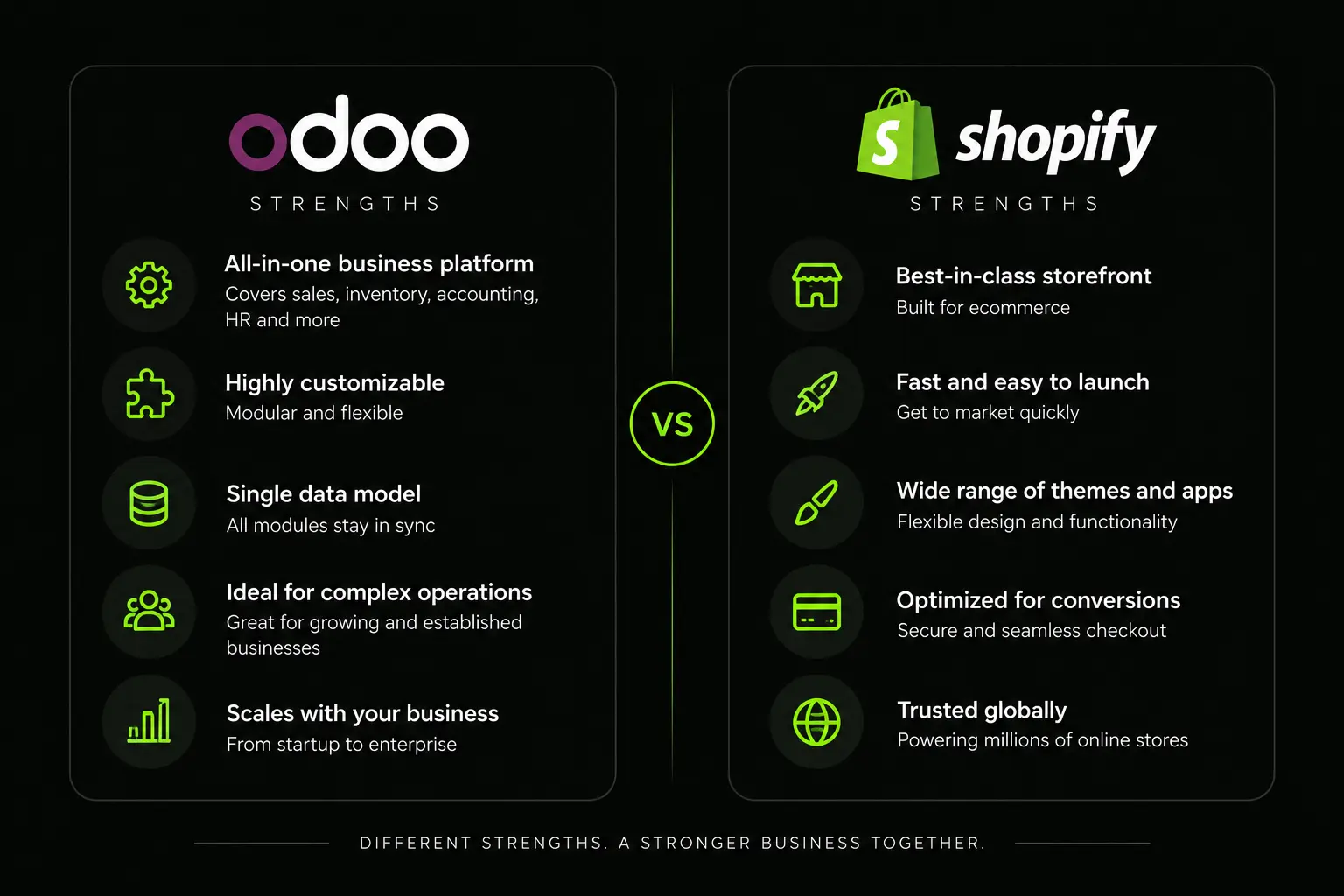
The core technical distinction is real and worth understanding: Odoo is a modular ERP suite that happens to include an ecommerce module, while Shopify is a dedicated ecommerce platform built specifically for the storefront experience.
Getting this fundamental difference right is where most existing comparisons stop, and it is a reasonable starting point, just not a complete answer for a business operating under UAE-specific regulatory and operational requirements.
The UAE-Specific Reality: VAT Compliance, Trading Licenses, And Multi-Branch Operations
A UAE business evaluating this decision is also weighing FTA-compliant VAT invoicing, the accounting complexity of operating across multiple trade licenses or branches and increasingly, the shift toward mandatory e-invoicing under the UAE's new Peppol-based framework.
None of the ranking comparisons address any of this, which means a UAE SME reading the standard advice gets a technically accurate but practically incomplete picture of what actually matters for their decision.
Odoo Vs Shopify: The Core Differences
Understanding what each platform is actually built to do clarifies most of the rest of the decision.
What Each Platform Is Actually Built To Do
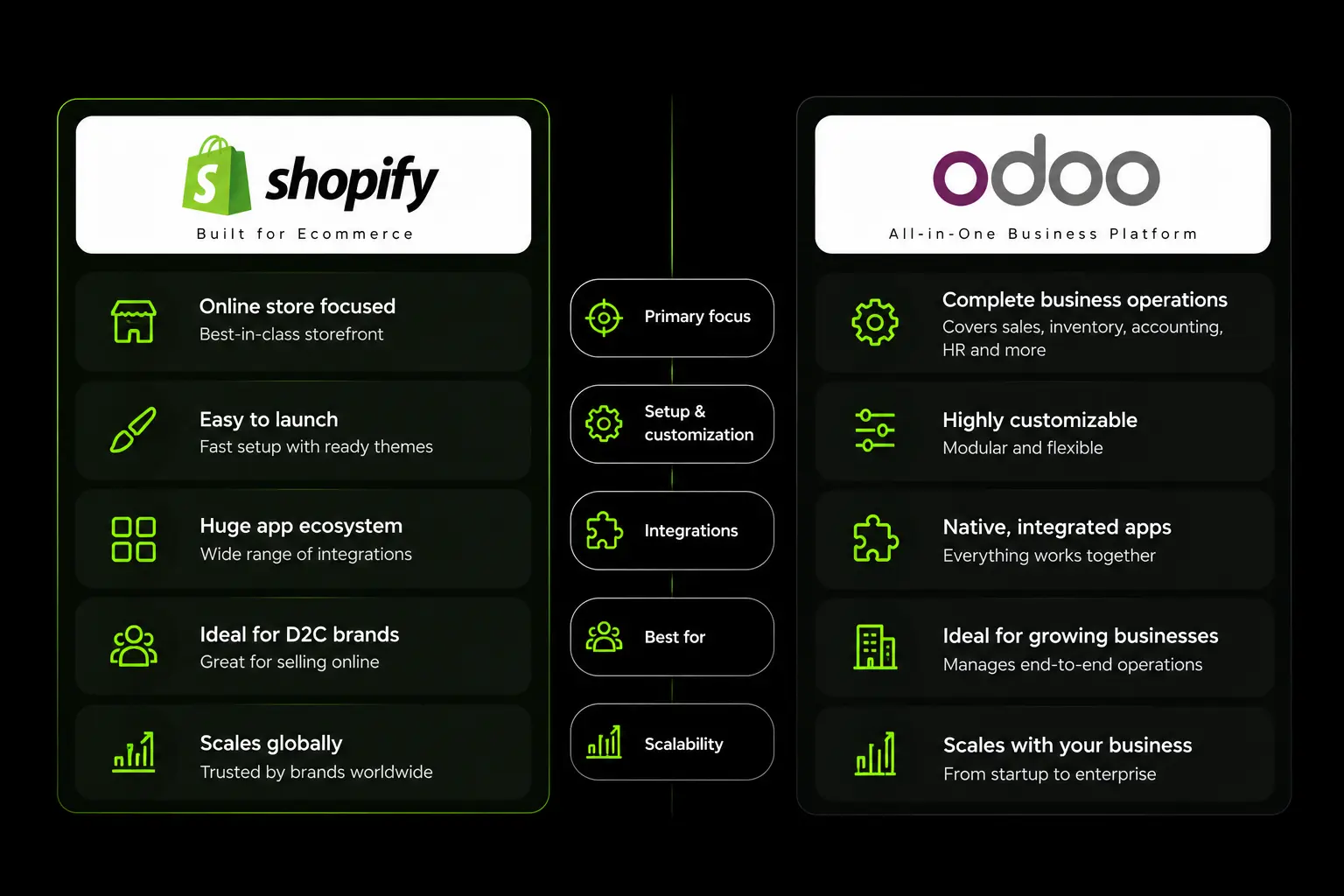
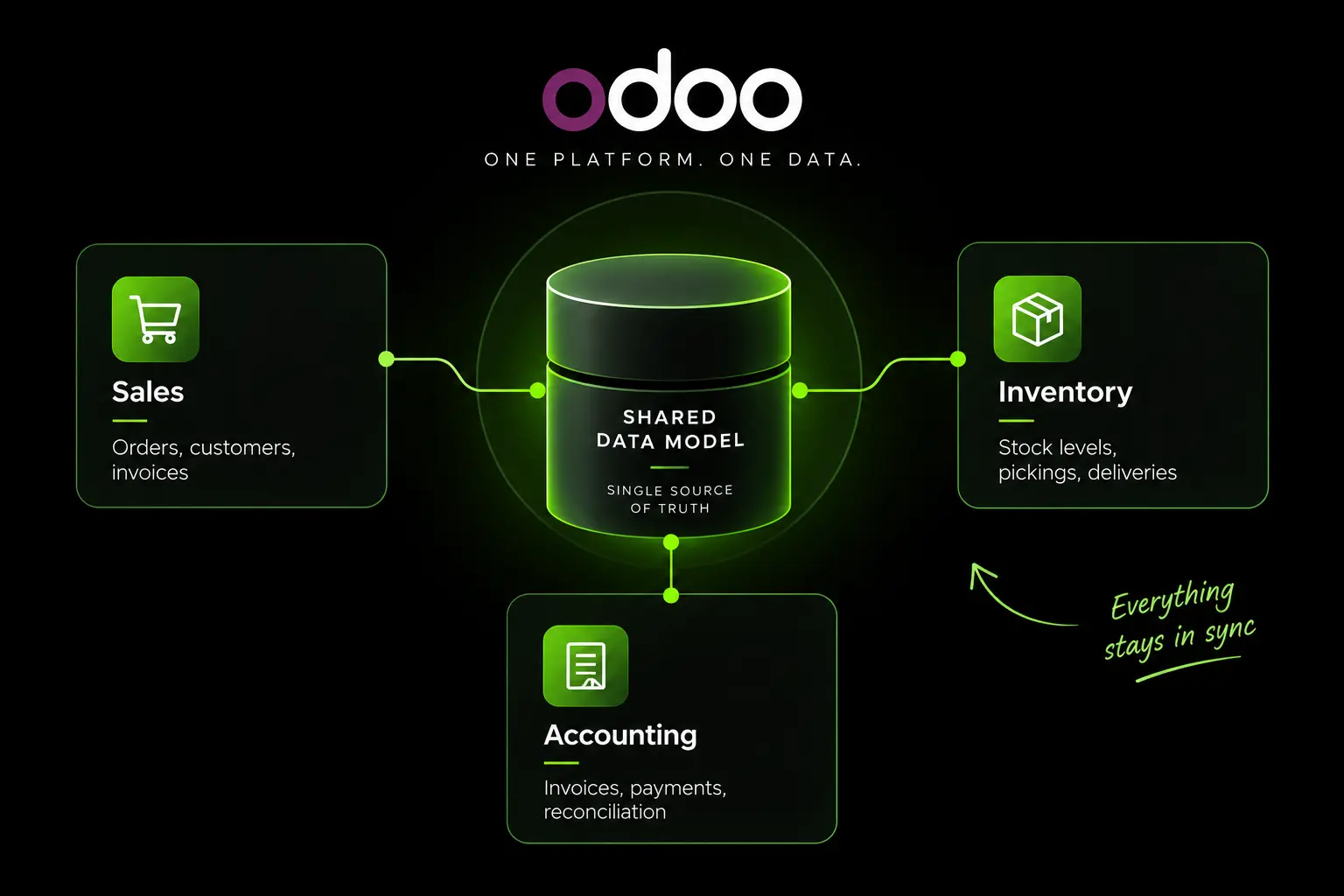
Odoo is an all-in-one business management suite: accounting, inventory, CRM, HR, manufacturing, and an ecommerce module, all built on a shared data model so information flows between modules without separate integrations.
Shopify is purpose-built for one thing: a fast, conversion-optimized online storefront, with everything else, accounting, inventory depth, operations, handled through third-party apps or external systems.
The distinction is closer to choosing between a full business operating system and a specialized best-in-class tool for one specific job than it is a straightforward "which is the better ecommerce platform" comparison, which is exactly why so many UAE businesses end up needing pieces of both.
Ease Of Use And Setup Time
Shopify is designed for non-technical users to launch quickly, with a polished admin interface and a guided setup flow.
Odoo has a steeper learning curve, reflecting its broader scope; configuring modules correctly, particularly accounting and inventory, generally requires more technical involvement or a specialized implementation partner.
A founder can reasonably launch a basic Shopify store solo over a weekend; a properly configured Odoo accounting and inventory setup, done correctly for UAE VAT compliance, is rarely a solo weekend project even for a technically capable founder.
Pricing Structure
Shopify runs on a fixed monthly subscription plus app costs, straightforward to estimate upfront. Odoo's pricing is modular and can be self-hosted or cloud-hosted, with cost scaling by the number of apps and users rather than a flat platform fee, which can make total cost harder to predict without a proper implementation scope.
A business using only Odoo's accounting and inventory modules pays a different price than one running the full suite across sales, HR, and manufacturing, which means an accurate Odoo cost comparison needs a real scoping exercise rather than a generic "Odoo versus Shopify pricing" table.
Ecommerce Storefront Capability Head-To-Head
Shopify's storefront capability, theme ecosystem, app marketplace for merchandising and personalization, and conversion-focused design, is built specifically for this purpose and it shows.
Odoo's ecommerce module is functional and genuinely useful for a business that wants everything in one system, but it is not designed with the same storefront-first focus, and this shows in template flexibility and the depth of ecommerce-specific apps available.
A brand competing on visual design and conversion rate against dedicated D2C competitors will generally find Shopify's theme ecosystem and merchandising tools give it a real edge that Odoo's more utilitarian storefront was never built to match.
Integration Ecosystem And Third-Party Apps
Shopify's app ecosystem is significantly larger and more mature for ecommerce-specific needs: marketing, reviews, subscriptions, personalization.
Odoo's ecosystem is broader in scope, since it covers entire business operations, but shallower specifically for ecommerce storefront features compared to Shopify's dedicated marketplace.
Where Odoo Wins For A UAE Business
Odoo's real advantage for a UAE business rarely starts with ecommerce. It starts with compliance and operations.
FTA-Compliant VAT Invoicing And UAE Accounting Requirements
This is the factor entirely absent from every competing comparison, and it is often the actual reason a UAE SME chooses Odoo in the first place.
The UAE is rolling out mandatory e-invoicing on a phased basis, built on the Peppol five-corner model using the PINT AE invoice format, with real-time reporting obligations to the Federal Tax Authority and a five-year invoice archiving requirement.
Odoo's accounting module, particularly localized versions built for the UAE market, is designed to handle VAT calculation, Tax Registration Number requirements, and the structured invoicing this framework demands.
Shopify has no native equivalent; VAT-compliant, FTA-ready invoicing on Shopify alone generally means bolting on a third-party accounting app, and not all of them are built to handle UAE-specific e-invoicing requirements correctly.
As the mandate moves from phased rollout to full enforcement, a business relying on a generic, non-UAE-specific accounting app risks discovering a compliance gap only once the FTA actually checks for it, which is a considerably more expensive time to find out than during initial platform selection.
Multi-Branch, Multi-Company and Trading License Structures
A UAE business operating across multiple branches, multiple trade licenses, or a group structure with several related companies benefits from Odoo's native multi-company functionality, which lets inventory, accounting and reporting stay properly separated or consolidated as needed within one system.
Shopify has no equivalent structure; running multiple trading entities on Shopify generally means either multiple separate stores or workarounds that were never designed for this specific operational complexity.
A holding structure with, for example, a general trading license entity handling wholesale and a separate retail-licensed entity handling the consumer storefront can keep both sets of books, inventory and VAT reporting correctly separated within Odoo's multi-company setup in a way that would require significant custom workarounds to replicate on Shopify alone.
Native Inventory, Procurement and Operations Integration
Odoo's inventory, purchasing, and manufacturing modules share the same underlying data as accounting and sales, so a stock movement, a purchase order, and an invoice all stay connected without a separate integration layer.
For a business with real supply chain or procurement complexity beyond a simple sell-and-ship ecommerce flow, this native integration is a genuine operational advantage over stitching together a storefront platform and a separate inventory system.
A business importing goods, managing supplier purchase orders, and tracking landed cost across multiple warehouses gets this whole chain reflected accurately in real time within Odoo, where the equivalent on a Shopify-plus-apps stack usually means several disconnected systems each holding a partial view of the same operational reality.
When A Business Genuinely Needs One System For Everything
If a business's core need is a single system managing accounting, inventory, HR, and sales together, not just an online storefront, Odoo's all-in-one design directly addresses that need in a way no combination of Shopify plus third-party apps fully replicates.
Where Shopify Wins For A UAE Ecommerce Brand
Shopify's advantage is just as real, and it sits specifically where Odoo is weakest.
Storefront Design, Speed and Conversion-Focused UX
Shopify's theme ecosystem and checkout flow are built by a company whose entire business is ecommerce conversion.
For a brand where the online storefront experience is the primary driver of revenue, this purpose-built focus consistently outperforms a general-purpose ERP's ecommerce module.
App Ecosystem For Marketing, Personalization and Merchandising
Shopify's App Store offers mature, ecommerce-specific tools for reviews, loyalty, personalization, and merchandising that plug directly into the storefront experience.
Odoo's ecosystem, while broad, does not match this depth specifically for storefront-facing features, since its app strength lies in operational and business-management categories rather than customer-facing marketing tools.
Faster Time-To-Launch For A D2C Or FMCG Brand
A brand prioritizing speed to market, particularly one validating a new product line or entering the UAE market for the first time, generally launches faster on Shopify than attempting to configure Odoo's ecommerce module to the same storefront standard.
This speed advantage compounds for a brand that needs to iterate quickly on merchandising and campaigns once live, since Shopify's app ecosystem and theme flexibility make ongoing iteration faster than reconfiguring Odoo's more operationally-focused ecommerce module for the same changes.
Shopify Plus For Growth-Stage Brands Needing B2B/Wholesale On The Storefront Side
For a brand that has outgrown standard Shopify and needs checkout customization, native B2B functionality, or multi-region expansion stores, Shopify Plus extends the storefront-side capability considerably, covered in more depth in our comparison of Shopify versus Shopify Plus, without requiring a move to a full ERP-based ecommerce approach.
The Option Most Guides Skip: Running Both, Connected
"Odoo Shopify connector" shows up in Google's own related searches for this topic, confirming real demand, yet no ranking comparison page frames this hybrid setup as a legitimate recommendation rather than a footnote.
How The Odoo-Shopify Connector Works
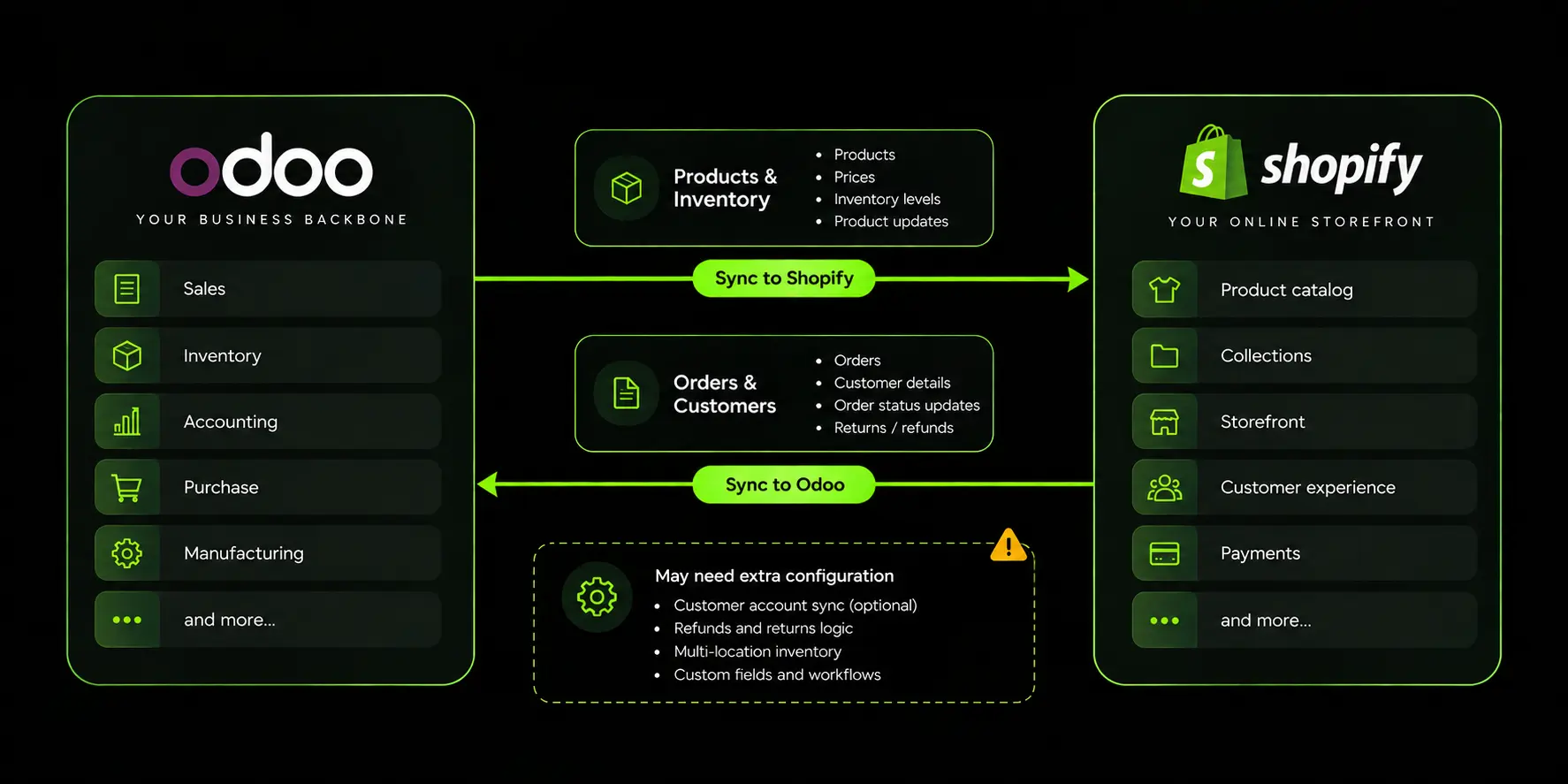
A connector syncs data between the two systems: products and inventory created or updated in Odoo push to the Shopify storefront and orders placed on Shopify flow back into Odoo for fulfillment, accounting, and VAT-compliant invoicing.
This lets a business run its accounting and operations in Odoo while giving customers the storefront experience Shopify is built for, without manually re-entering data between the two systems.
Several connector options exist, ranging from official or well-maintained third-party apps to fully custom integrations built through each platform's API and the right choice depends on how much customization your specific pricing, promotion, and multi-branch logic actually needs beyond what an off-the-shelf connector handles.
What Syncs Automatically And What Doesn't
Product data, inventory levels, and order information are the core data types most Odoo-Shopify connectors handle well out of the box.
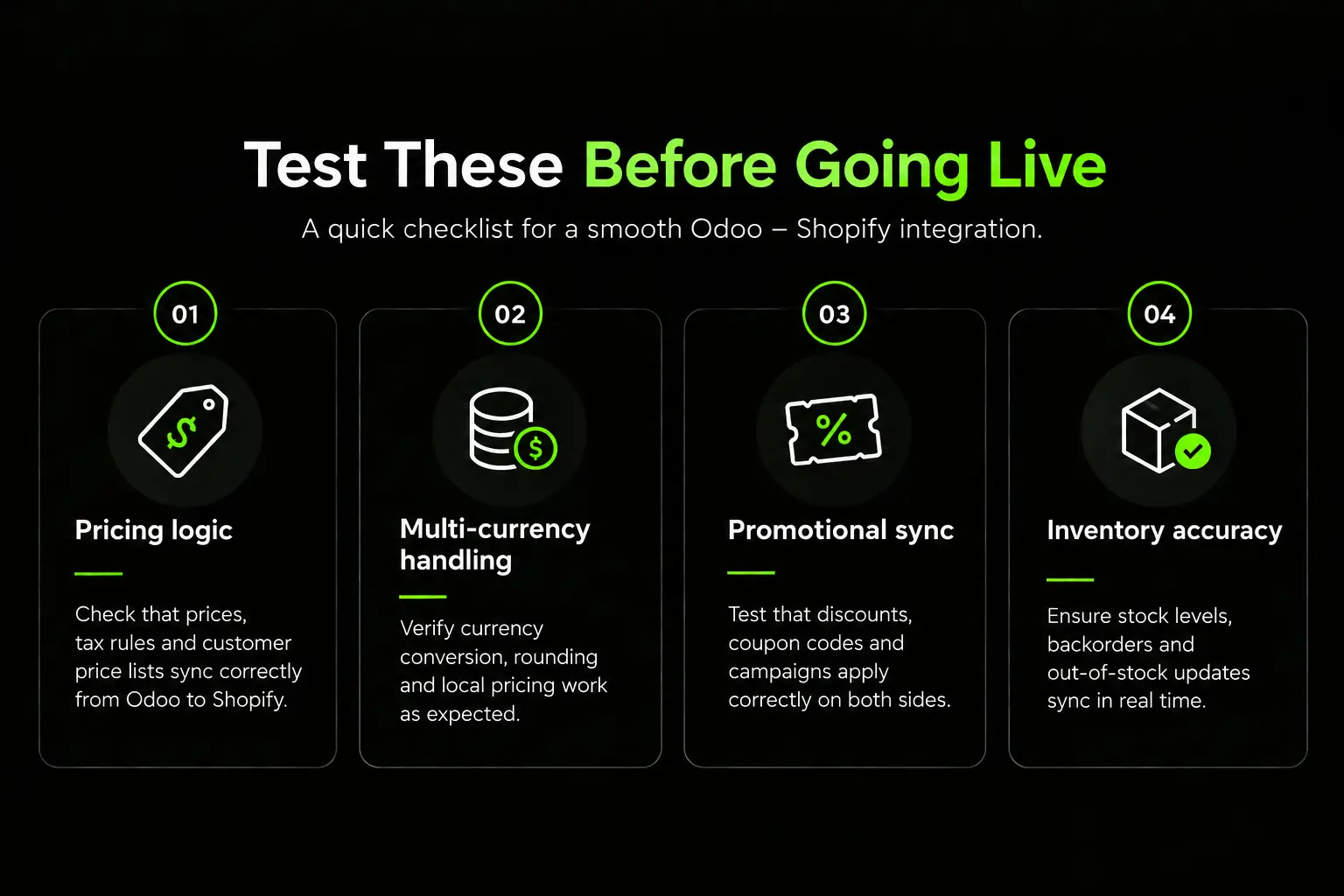
What does not always sync automatically, and needs specific configuration or a more robust connector, includes complex pricing rules, multi-currency logic if selling beyond the UAE, and certain promotional or discount structures that exist differently in each system's data model.
Assuming full automatic sync without testing these specifically is a common source of post-launch data mismatches.
A tiered wholesale pricing structure that works correctly inside Odoo's B2B logic, for instance, does not automatically translate one-to-one into Shopify's discount and pricing rule system without deliberate mapping work during setup.
When This Hybrid Setup Makes More Sense Than Picking One
A UAE trading business handling VAT-compliant B2B invoicing, multi-branch inventory, and procurement through Odoo, while also running a growing D2C storefront that needs Shopify's conversion-focused design and app ecosystem, is the clearest case for this hybrid approach.
Neither platform alone fully serves both needs as well as the two connected, and this is precisely the setup most competing comparisons never seriously present as an option.
The businesses that benefit most tend to share a pattern: real back-office complexity that predates the ecommerce ambition, layered with a genuine need to compete on storefront experience against brands that launched Shopify-first from day one.
A Practical Decision Framework For UAE Businesses
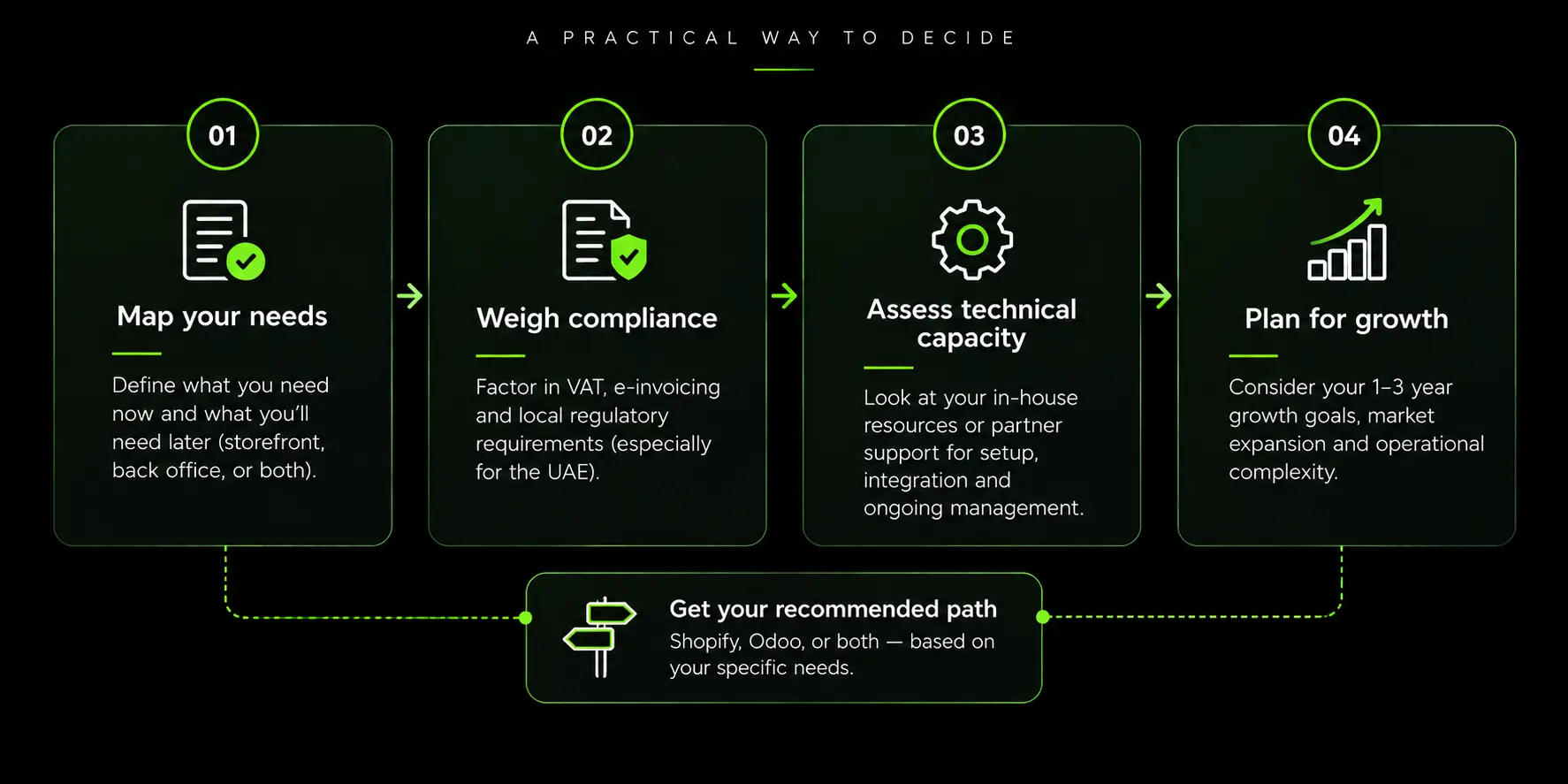
Work through these four steps before committing to a platform, or a connected setup.
Step 1: Map What You Actually Need
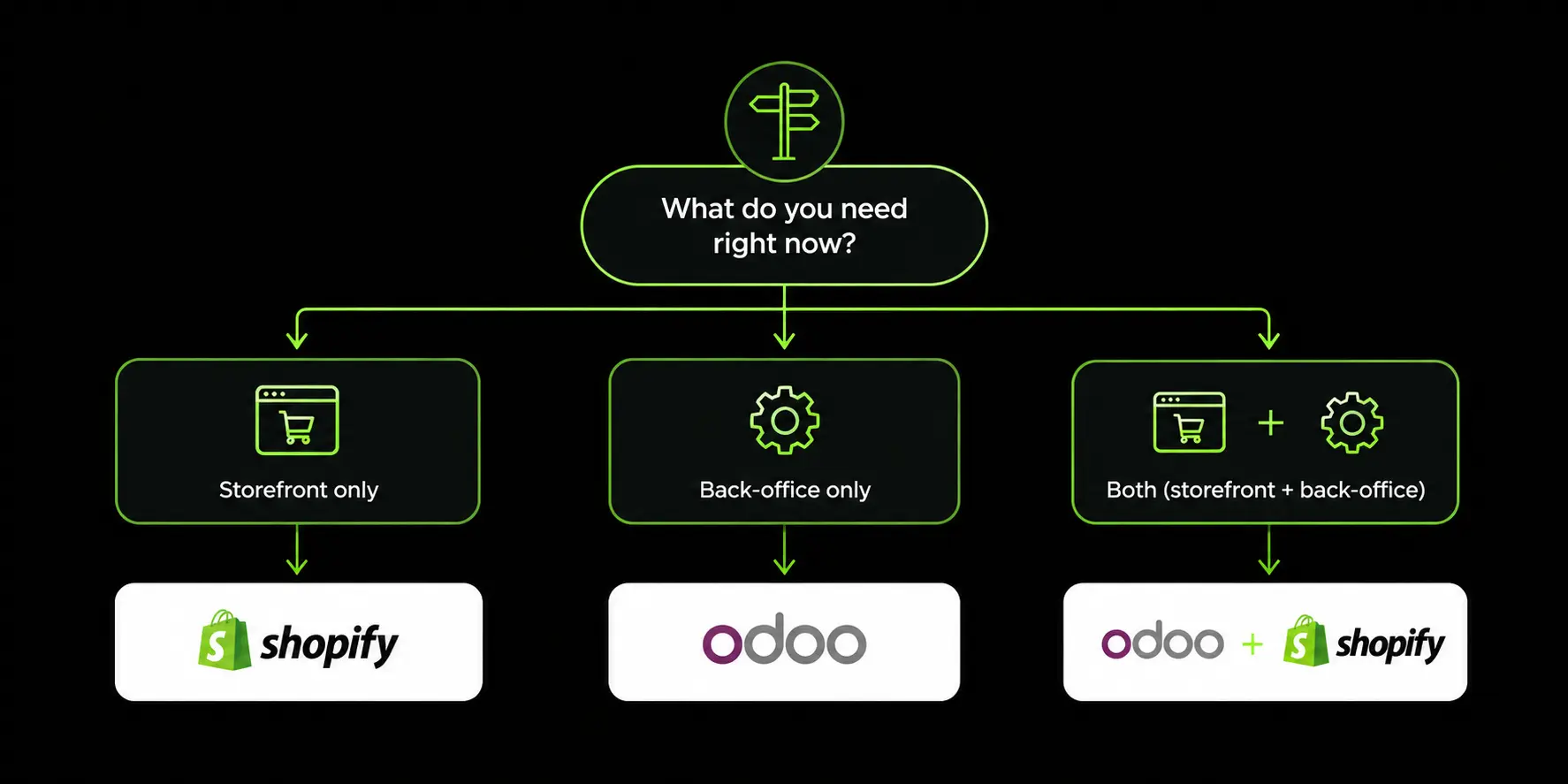
List separately what you need from a storefront (design, conversion, app ecosystem) and what you need from back-office operations (accounting, inventory, multi-branch management, VAT compliance).
A business that only needs one side of this list has a much simpler decision than one that genuinely needs both.
Step 2: Weigh VAT/Compliance Requirements Against Setup Complexity
If FTA-compliant VAT invoicing and the incoming e-invoicing mandate are a core requirement, weigh Odoo's native handling of this against the setup complexity of implementing Odoo properly or the setup complexity of finding and configuring a third-party accounting app on Shopify that handles UAE requirements correctly.
Step 3: Consider Your Team's Technical Capacity
Odoo has a steeper learning curve and generally benefits from a specialized implementation partner, particularly for accounting and multi-branch configuration.
If your team, or your agency partner, does not have specific Odoo implementation experience, factor that learning curve into your timeline and budget honestly, since a poorly configured Odoo accounting setup can create compliance risk that outweighs whatever time was saved skipping proper implementation support.
Step 4: Plan For Growth
Consider whether your current choice will still fit in two years. A business starting simple on Shopify alone may outgrow that setup once VAT complexity or multi-branch operations become real, at which point adding Odoo as a connected back-office system, rather than trying to force those needs onto Shopify apps, becomes the more sustainable path.
Conversely, a business that started on Odoo purely for its accounting strength but is now scaling a D2C storefront ambition well beyond what Odoo's ecommerce module comfortably supports should weigh adding Shopify on the front end rather than continuing to stretch Odoo past its storefront-design strengths.
An Illustrative Example
A UAE trading business selling both B2B to regional retailers and D2C to consumers needs FTA-compliant VAT invoicing across both channels, inventory tracking across two warehouses under separate trade licenses, and a storefront that can compete on design and conversion with newer D2C-focused brands.
Running Odoo alone would mean settling for a weaker storefront experience than the brand's D2C ambitions need. Running Shopify alone would mean bolting on accounting apps that were never built for UAE-specific multi-branch VAT complexity.
Running both, Odoo handling accounting, inventory, and VAT compliance, Shopify handling the storefront, connected through an integration, lets each system do what it is actually built for.
The business ends up with cleaner books, correctly separated multi-branch reporting, and a storefront that competes properly on design, rather than compromising on either side to keep everything inside a single platform.
Common Mistakes UAE Businesses Make In This Decision
A handful of patterns show up repeatedly in UAE businesses that get this decision wrong.
Choosing Odoo For Ecommerce When The Storefront Experience Suffers
A business that picks Odoo primarily for its accounting and operations strength, then tries to make its ecommerce module carry the full storefront experience, often ends up with a weaker customer-facing site than competitors running Shopify, even though the back-office logic was the right call.
This mismatch is usually discovered only once conversion rates lag category benchmarks, at which point the business faces the added cost of layering Shopify on top rather than having planned for it from the start.
Choosing Shopify Alone And Bolting On Accounting Apps That Don't Handle UAE VAT Properly
A business that picks Shopify for the storefront experience, then assumes any generic accounting app will handle UAE VAT and the incoming e-invoicing requirements correctly, can end up with compliance gaps that surface only once the FTA's reporting requirements are actually enforced against their specific setup.
Many popular accounting apps in Shopify's app store were built primarily for US or European tax regimes, and confirming genuine UAE VAT and e-invoicing support, rather than a generic "supports VAT" claim, is a step worth doing carefully before relying on any specific app for compliance.
Underestimating The Integration Work Needed To Connect The Two Properly
A business that decides on the hybrid path but treats the Odoo-Shopify connector as a simple plug-and-play install, without testing pricing logic, multi-currency handling, and promotional sync specifically, often discovers data mismatches only after they have already caused a customer-facing problem, a wrong price or an out-of-sync inventory count reaching a live order.
How We Help UAE Brands Get This Decision Right
Our approach at Suplex starts with assessing whether a brand genuinely needs a storefront platform, an ERP, or both connected together, based on actual VAT compliance needs, operational complexity and storefront ambitions, rather than defaulting to whichever platform we happen to build most often.
We have built and integrated Shopify storefronts for UAE brands running Odoo, or other ERPs, on the back end and a meaningful part of that work is getting the architecture right from the start so a brand does not face a costly rebuild once VAT complexity or multi-branch operations outgrow whatever they started with.
This includes helping brands navigate the incoming e-invoicing requirements without treating compliance as an afterthought bolted onto a storefront project after the fact.
If you are weighing this decision for your own business, Suplex offers a platform architecture consultation to work through what you actually need before you commit to a platform, or a connected setup.
Odoo vs Shopify for UAE Ecommerce Brands: Which Platform Is Right for You
This is not always an either/or decision. Many UAE businesses get the best outcome running Odoo and Shopify together, each doing what it is actually built for: Odoo handling accounting, inventory, multi-branch operations, and FTA-compliant VAT invoicing, Shopify handling the storefront design, conversion, and app ecosystem that drives sales.
Map what you actually need, weigh your VAT and compliance requirements honestly against setup complexity, and consider your team's technical capacity before committing to a single-platform answer. For a growing number of UAE brands, the right answer is not Odoo versus Shopify.
It is Odoo and Shopify, connected correctly from the start, with the specific decision framework above giving you a structured way to work out which path, or which combination, actually fits your business rather than defaulting to whichever platform a generic comparison happens to favor.
Frequently Asked Questions
Is Odoo or Shopify better for a UAE small business?
It depends on what the business actually needs. If the priority is a fast, polished storefront, Shopify is the better fit. If the priority is integrated back-office operations, accounting, inventory, and UAE VAT compliance, across the whole business, Odoo is the better fit. Many UAE SMEs use both, connected, rather than choosing one exclusively.
Can Odoo handle UAE VAT and FTA e-invoicing requirements?
Yes, particularly with a UAE-localized Odoo accounting configuration, which is designed to handle VAT calculation, Tax Registration Number requirements, and the structured invoicing the UAE's incoming Peppol-based e-invoicing framework requires. Confirm the specific localization and implementation partner has current experience with the UAE's phased e-invoicing rollout, since requirements and timelines continue to be clarified as the mandate moves toward full enforcement.
Can I connect Odoo and Shopify together?
Yes, through a connector that syncs products, inventory, and orders between the two systems. Core data types generally sync well out of the box, while more complex pricing rules, multi-currency logic, and promotional structures often need specific configuration or testing to sync correctly.
Is Shopify or Odoo cheaper to run long-term?
This depends on scope more than platform. Shopify's subscription-plus-apps model is easier to estimate upfront; Odoo's modular, scales-with-usage pricing can be harder to predict without a proper implementation scope, but may cost less than running Shopify plus multiple third-party apps trying to replicate Odoo's native back-office functionality.
Does Shopify have proper accounting for UAE VAT compliance?
Not natively. Shopify handles VAT calculation and display at checkout reasonably well, but full UAE VAT compliance, particularly for the incoming e-invoicing mandate, generally requires a dedicated accounting system or app, and not all generic accounting apps are built to handle UAE-specific requirements correctly.
Which is easier to set up, Odoo or Shopify?
Shopify is generally faster and easier to set up, designed for non-technical users to launch a storefront quickly. Odoo has a steeper learning curve reflecting its broader scope, and proper configuration, particularly for accounting and multi-branch operations, typically benefits from a specialized implementation partner.
Should a growing UAE brand use Odoo's ecommerce module instead of Shopify?
Generally not if the storefront experience and conversion-focused design are a priority, since Odoo's ecommerce module is not built with the same storefront-first focus as Shopify. A growing brand with real back-office complexity is usually better served running Odoo for operations and Shopify for the storefront, connected together, than trying to make one system do both jobs equally well.
Hi, I’m Rishabh Jain
I believe great design has the power to shape perception, build trust, and move businesses forward. That belief is what led me to found Suplex Design Studio, a global branding and packaging studio working with FMCG and D2C brands across markets.I started suplex at 25 with a clear intent, to create design that is strategic, thoughtful, and commercially meaningful. By 28, the studio had scaled globally, guided by a strong foundation in Integrated Design that I developed during my academic journey in London, where I was honoured with the Dean’s Award.
Over the years, I’ve had the opportunity to work with 100+ brands, from Fortune 500 organizations to family-run businesses, helping them build packaging and brand systems that create recall, relevance, and long-term value.
Suplex’s work has been recognized internationally, including the Manifest Award (2024), the Clutch Global Award (2025), and features on platforms such as Packaging of the World, The Dieline, and the World Brand Design Society.
None of this would be possible without the people behind the work. I’m deeply grateful to the suplex team, whose commitment, creativity, and attention to detail turn ideas into meaningful brand experiences every day.
At the heart of my work is a simple philosophy, design should be intentional, honest, and built to last, and that continues to guide everything we create at suplex.




































Let’s Make It Happen
E-Commerce Success Stories
%201.avif)






.avif)

.avif)
Build Your D2C Business The Right Way
Build It With Suplex.


