Shopify vs. Custom Ecommerce Development: Which Is Right for Your Business?
.avif)
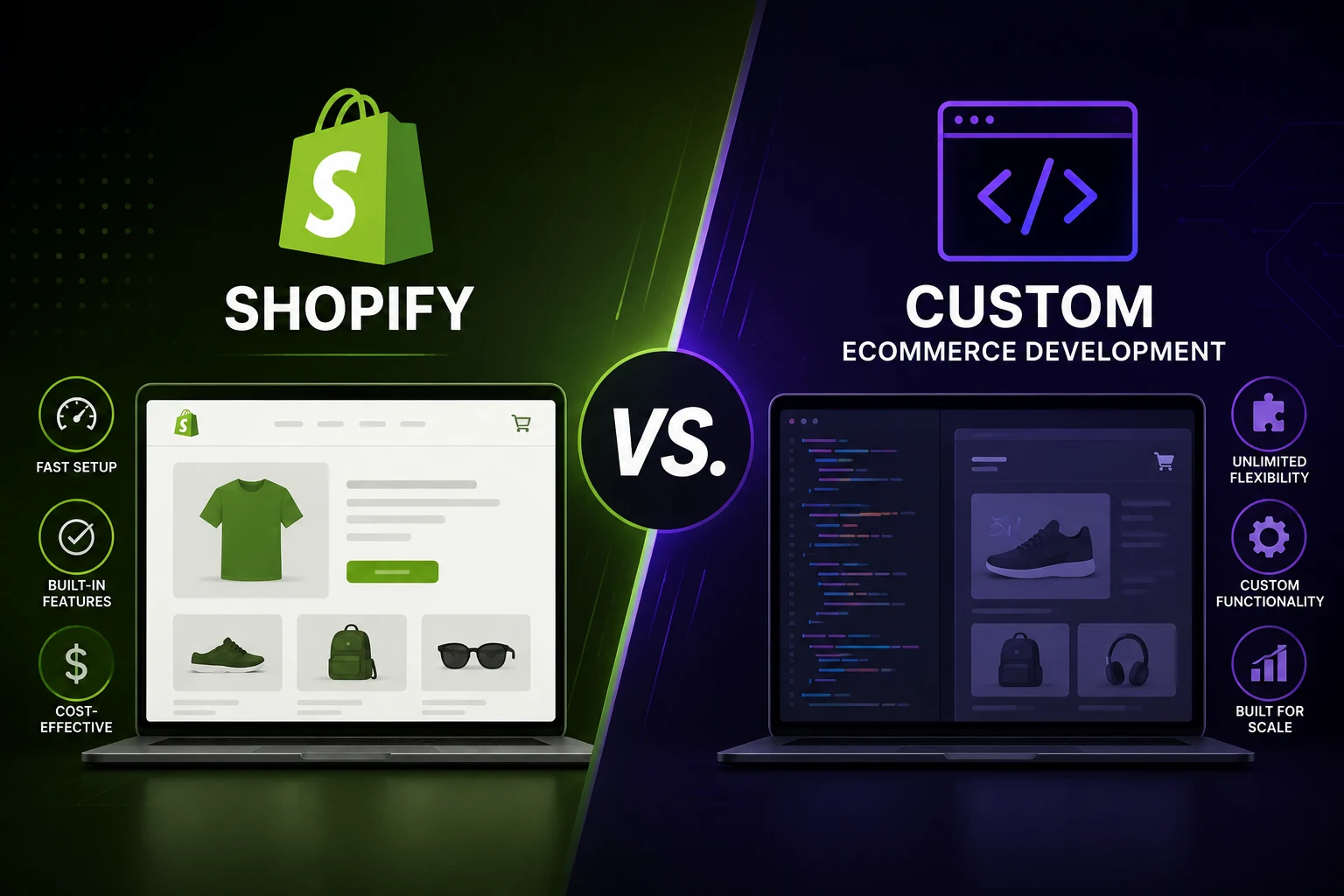
Shopify vs. Custom Ecommerce Development: Which Is Right for Your Business?
Shopify and custom ecommerce development solve different problems. Shopify gives you core commerce features such as checkout, inventory, payments, and order management without having to build them yourself.
Fully custom development means building all of that from scratch. A third path, headless, where Shopify runs the back office and a custom frontend handles the customer experience, solves many of the reasons people consider "custom" in the first place.
Many comparisons frame the choice as Shopify or a fully custom ecommerce site. That leaves out a third option: keep Shopify for commerce and build custom features around it.
Why This Is Usually Framed as a Binary (and Shouldn't Be)
Most comparison articles reduce the choice to two options because they are easier to explain. In practice, “custom” can mean many things, from a custom theme to a completely custom ecommerce platform.
What "Custom Ecommerce" Actually Means: It's Rarely All or Nothing
When a founder says they want custom ecommerce, they usually mean one of three different things: a fully custom-coded theme within Shopify, a custom frontend experience with Shopify handling commerce in the background, or genuinely custom infrastructure built outside any platform.
These requests are often treated as the same thing, but they require very different amounts of work and can lead to very different costs.
The confusion often starts with one platform limitation. A founder may find that the checkout cannot be changed in the way they want and conclude that they need custom ecommerce development.
In some cases, the actual need is Shopify Plus’s Checkout Extensibility, which allows specific checkout changes without replacing Shopify.
Start by defining the exact limitation. Once you know what Shopify cannot handle, you can compare the cost and effort of solving that specific problem with the alternatives.
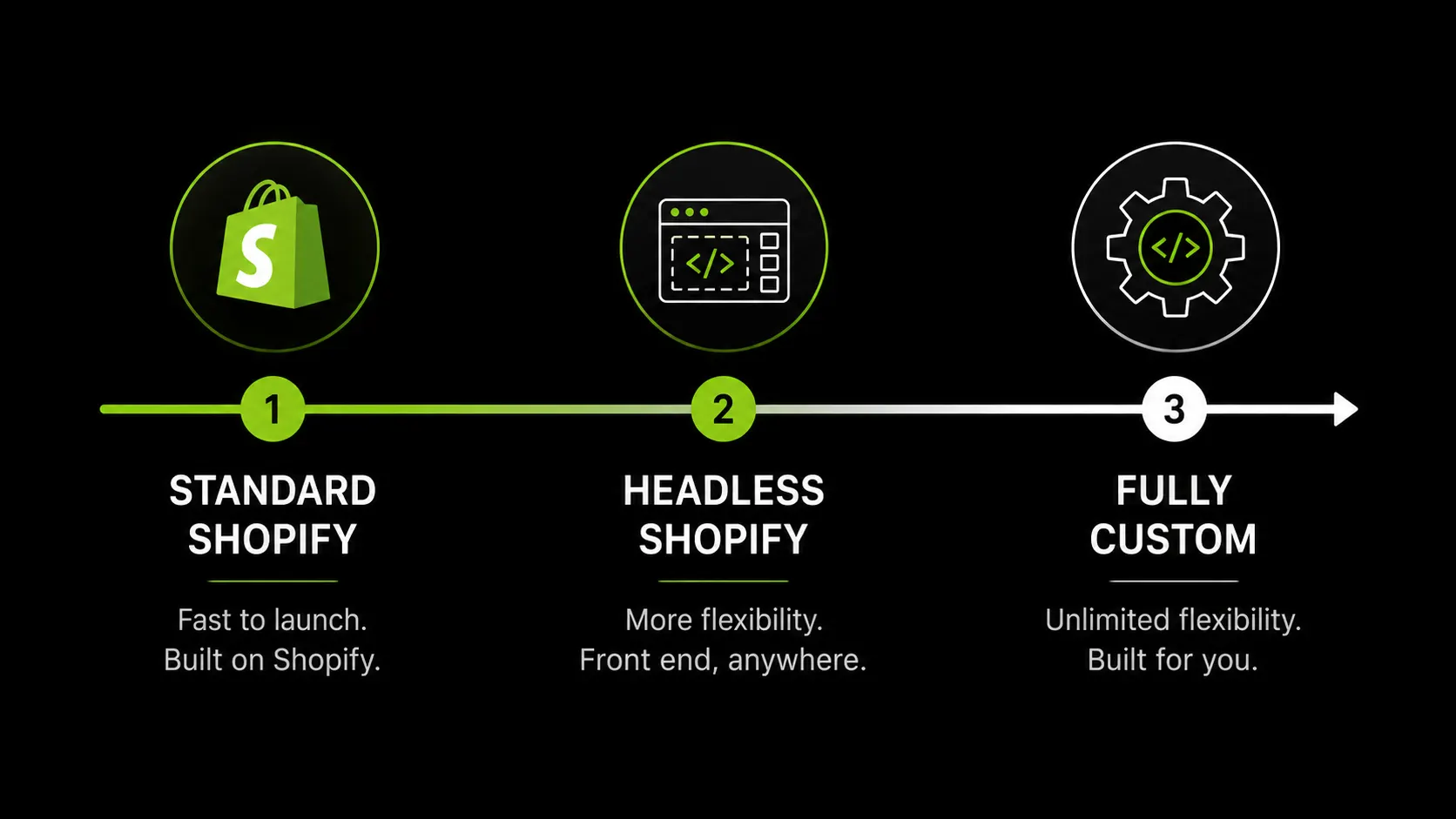
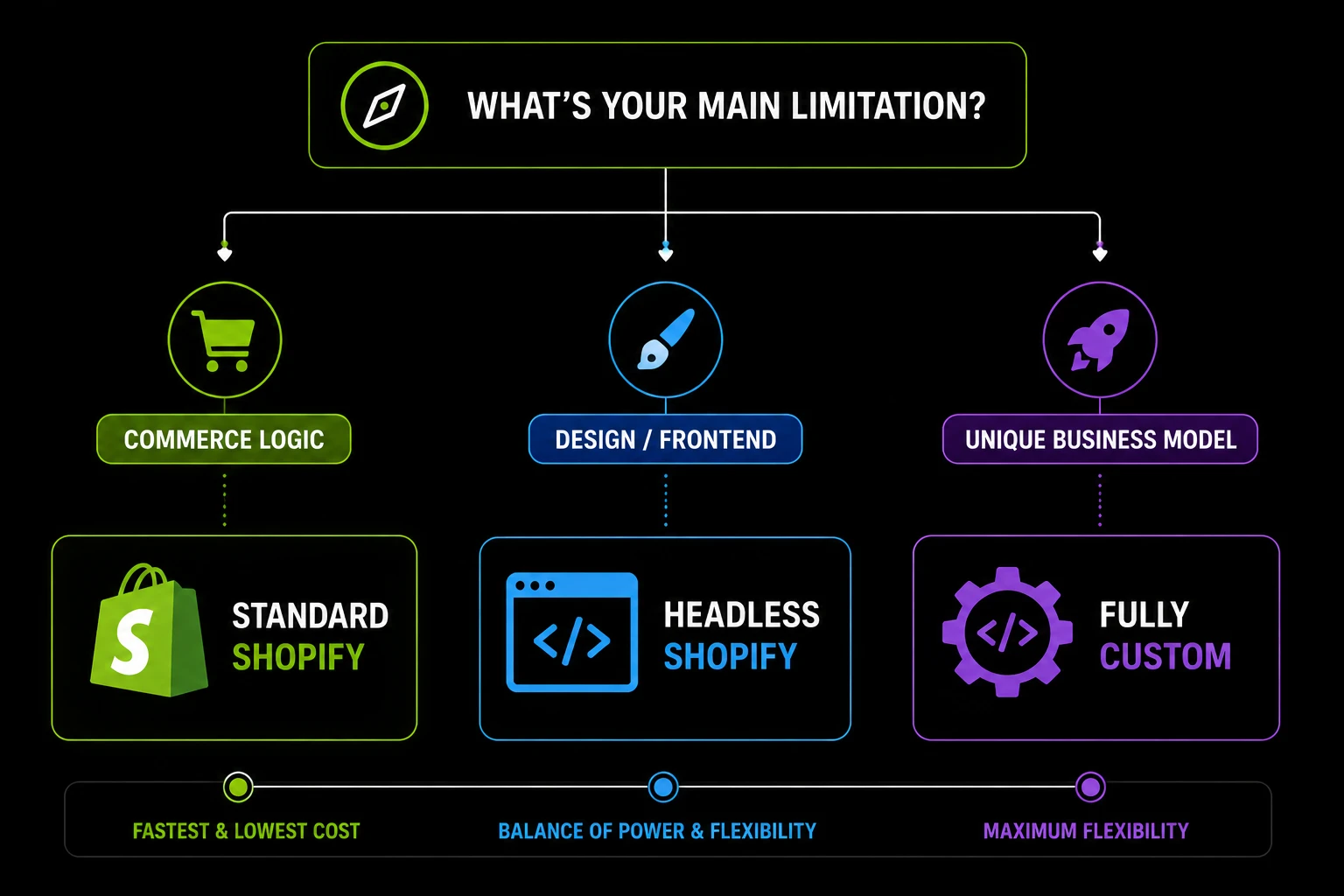
The Real Spectrum: Shopify to Headless Shopify to Fully Custom
Think of the choice as three options rather than two. Standard Shopify gives you a fast, managed setup with some limits. Fully custom development gives you complete control, but your team takes on the responsibility for building and maintaining the platform.
Headless Shopify sits between the two. It gives you more control over the storefront while keeping Shopify for the commerce systems underneath.
Standard Shopify: What You Get Out of the Box
Before comparing alternatives, it's worth being precise about what standard Shopify actually includes, since most of the value here is invisible until you consider building it yourself.
Commerce Infrastructure You Don't Have to Build
Checkout, payment processing, PCI compliance, inventory tracking, tax calculation, and order management all come functional on day one.
Checkout, payments, and order handling carry serious security and compliance risks when built from scratch. Shopify already manages these systems across a large number of stores, so you do not have to build and maintain that infrastructure yourself.
Think about what you would have to build and maintain yourself. If you handle card payments directly, PCI DSS requirements can involve security reviews, penetration testing, and ongoing compliance records. Shopify handles much of this payment infrastructure for you.
Shopify's infrastructure carries this compliance burden for every store on the platform. A standard Shopify store inherits that protection automatically.
With a custom build, your team has to set up and maintain the payment security and compliance requirements from the ground up, even if the developers are highly experienced.
Theme-Based Customization: How Far It Actually Goes
Shopify themes, whether off-the-shelf or custom-built in Liquid, cover a genuinely wide range of design and functionality needs. Custom sections, dynamic product pages, and tailored checkout messaging are all achievable without leaving the platform.
This is a different category of "custom" than replacing the platform entirely, and it's often enough on its own.
Where Standard Shopify Genuinely Hits a Wall
Checkout customization on plans below Shopify Plus is largely locked, a real constraint for stores with specific conversion needs at the payment step. Content-heavy brands producing significant editorial volume alongside product pages often find Shopify's content architecture more limiting than a CMS-first platform.
These specific mismatches are covered in more depth in our guide on the situations where Shopify genuinely isn't the right fit, and headless is often the answer to several of them rather than a reason to abandon the platform.
Headless Shopify: The Option Most Comparisons Skip
This middle option solves many of the problems that lead businesses to consider a full custom build. If Shopify’s design limitations are frustrating you, this is the option to examine closely.
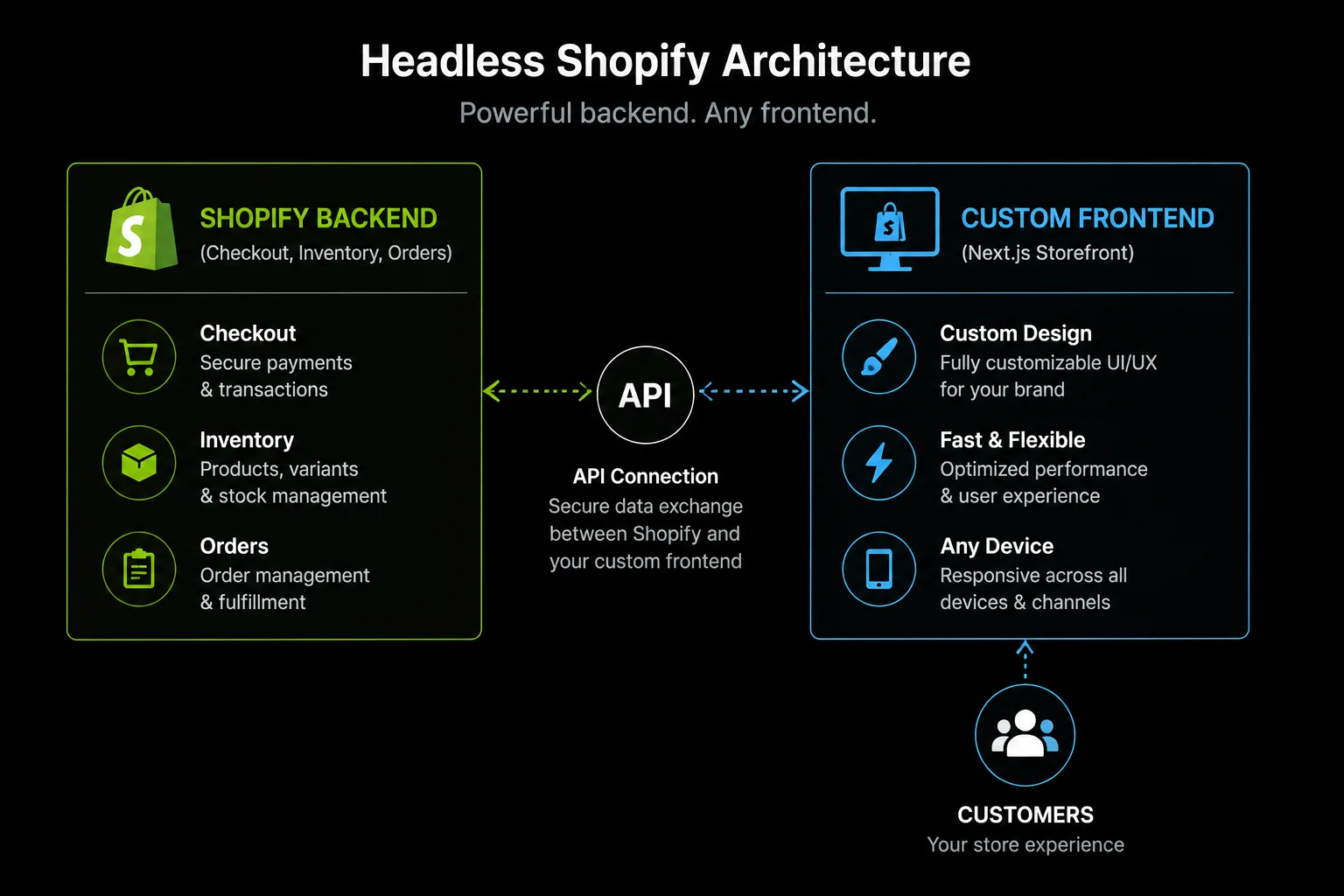
How It Works: Shopify as Back Office, Custom Frontend for the Experience
In a headless setup, Shopify continues to manage products, inventory, orders, and checkout through its Admin API and Storefront API.
A separate, custom-built frontend, commonly built in Next.js, handles everything the customer actually sees and interacts with. The two communicate through APIs rather than through Shopify's native theme rendering.
What Headless Actually Solves
The main benefit is greater design freedom. A custom frontend gives you more control over layouts, animations, and page structures than a standard Shopify theme.
Performance can improve as well. A purpose-built frontend gives developers more control over what loads on each page, which can reduce the extra code and scripts that often come with a theme and multiple apps.
A custom frontend also makes it easier to combine content and commerce. Editorial pages can use the same design system as product pages, so the content feels like part of the store instead of a separate layer.
What It Doesn't Solve
Headless does not replace Shopify’s backend. You still use Shopify for inventory and checkout. On Shopify Plus, you can also use Checkout Extensibility for supported checkout customizations.
In the UAE, where Shopify Payments is unavailable, you also need to account for Shopify’s transaction fees when using a third-party payment provider.
Going headless changes how your storefront is built. It does not change Shopify’s backend or solve checkout limitations. Consider those limitations before taking on the extra development and maintenance work that headless requires.
Realistic Cost and Team Requirements for a Headless Build
A headless build requires front-end developers comfortable with a JavaScript framework and API integration, not just Liquid theme development.
Expect a meaningfully higher upfront development cost than a standard Shopify build, often two to three times as much depending on design complexity, plus an ongoing maintenance burden that a standard theme doesn't carry, since you're now maintaining a custom application in addition to keeping it synced with Shopify's backend.
The trade-off is straightforward. You get more control over the storefront, but your team also takes on more development and maintenance work.
Here’s a concrete example, a DTC skincare brand publishes new editorial content every week alongside its product catalog. Its content needs eventually outgrew what the standard Shopify theme could handle, so the brand started considering a headless setup.
Rather than abandoning Shopify's checkout and inventory management, which were working fine, the brand moved to a headless setup: Shopify stayed the commerce engine, and a custom Next.js frontend took over the storefront and editorial experience.
The result kept Shopify’s checkout and inventory systems in place while solving the real problem: the storefront could not support the brand’s content needs.
Fully Custom Ecommerce: What You're Actually Signing Up For
This option appears frequently in comparison articles, but it is not the right choice for every business. Here are the main reasons to consider it and the problems that come with it.
Building Commerce Infrastructure From Scratch
Checkout, payment gateway integration, PCI DSS compliance, inventory syncing, tax calculation across jurisdictions, fraud detection, and order management all become your responsibility to build and maintain. None of this is a weekend project. Each one is a genuine engineering discipline that Shopify has already solved at a scale no individual custom build will match on day one.
Genuine Advantages: Total Control, No Platform Fees, No Feature Ceilings
There are valid reasons to choose this approach. You avoid Shopify subscription costs and transaction fees, and your team has full control over which features you build and when you add them.
You also get full control over data models, checkout logic, and integrations. That can matter when your business model requires workflows that existing ecommerce platforms cannot support.
Take a marketplace connecting hundreds of independent vendors, each with their own payout schedule, commission structure, and inventory feed. Shopify's model assumes a single merchant selling their own inventory.
Forcing a multi-vendor marketplace into that structure means fighting the platform's core assumptions at every step, often ending up more expensive in app subscriptions and workarounds than building the transaction logic correctly from the start would have cost.
The Real Cost: Team, Timeline, Ongoing Maintenance, and Security Burden
This is where the cost of custom development becomes clear. A fully custom ecommerce platform needs a team that can handle backend and frontend development, security and infrastructure. One developer is unlikely to cover all of those areas well.
Timeline typically runs several times longer than a comparable Shopify build. Ongoing maintenance is continuous and technical: security patching, uptime monitoring, PCI compliance renewal, and infrastructure scaling all become permanent line items on your team's workload, not one-time setup tasks.
Who Actually Needs This
Fewer businesses need a fully custom platform than you might expect. It can make sense for complex marketplaces with multiple vendors, unusual transaction models such as subscription-and-usage billing, advanced product configurators, or B2B workflows with custom approval steps.
It can also make sense when a company’s internal systems need integrations that existing ecommerce platforms cannot support.
Wanting a completely unique design is rarely enough reason to build a custom ecommerce platform. Headless Shopify can provide much more control over the storefront without taking on the full cost and risk of building the platform yourself.
A common mistake is choosing a fully custom platform mainly for design freedom. Months later, the business is also dealing with PCI compliance, security updates, and infrastructure uptime. Those responsibilities require time and people that may never have been included in the original plan.
The design freedom was real. So was the extra work required to run the platform. That operational work was often missing from the original plan.
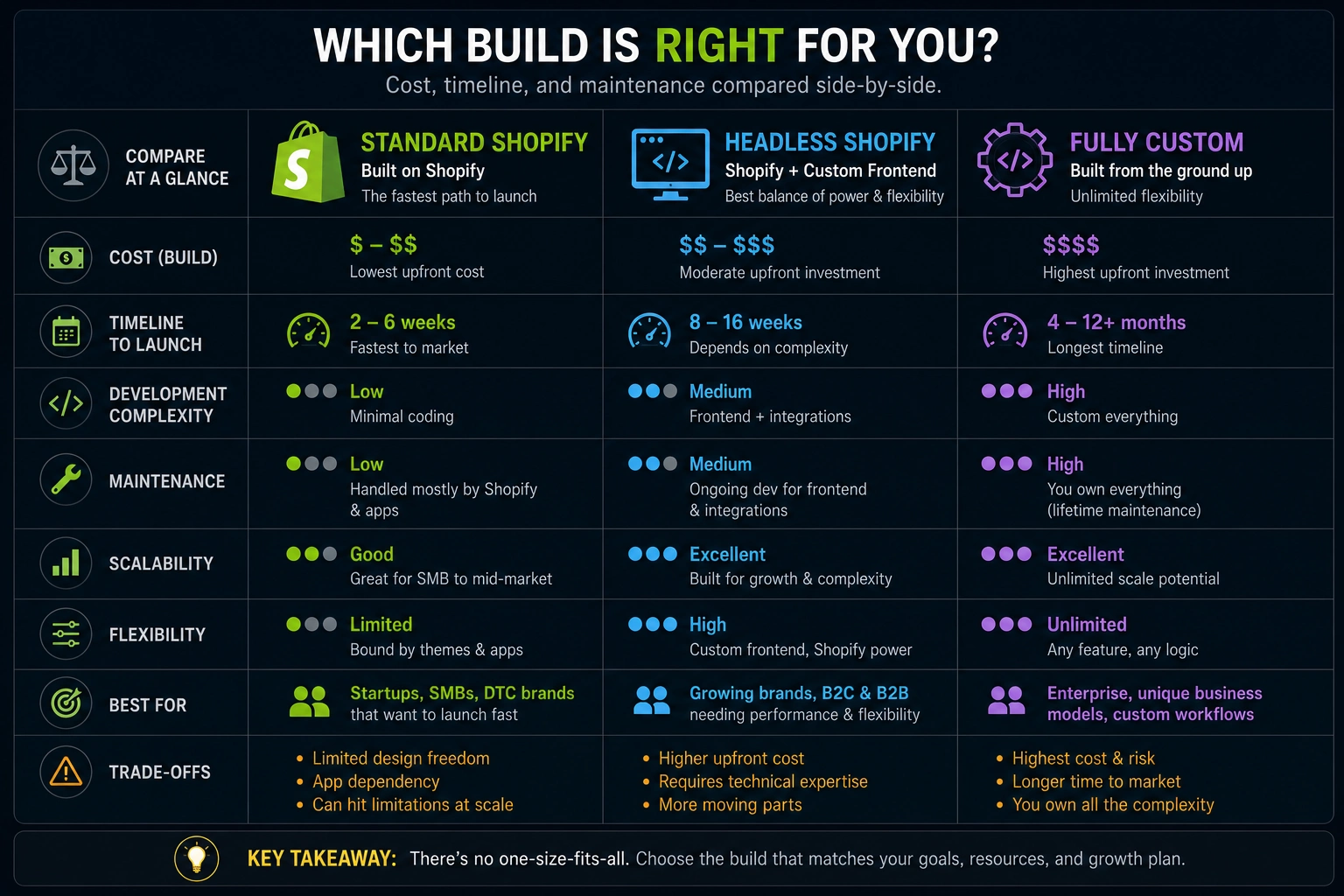
Cost and Timeline Comparison Across All Three Paths
Seeing all three options side by side, rather than as a binary, is the clearest way to understand what you're actually trading off at each point on the spectrum.
A Simple Framework for Choosing
Most businesses can narrow down the right option by answering one question: where exactly is the limitation in your current setup?
Start With Standard Shopify Unless You Have a Specific Reason Not To
This should be the default choice for most ecommerce businesses. It is fast to launch, well supported, and works for most standard ecommerce models.
Move further along the spectrum only when you can point to a specific limitation that Shopify cannot handle. “Custom” is not automatically better. The extra development and maintenance work needs a clear reason behind it.
Choose Headless If the Problem Is Design or Content, Not Commerce Logic
If your frustration is with what the storefront looks like, how content and product pages blend, or page performance under a heavy theme, headless solves this directly while keeping the commerce infrastructure that already works.
Choose Fully Custom Only If Your Business Model Genuinely Requires It
If your transaction logic, marketplace structure, or integration depth genuinely doesn't fit any platform's API, fully custom is the correct answer.
Make sure the limitation is real before committing to a fully custom platform. It is usually the most expensive option to build and the most demanding to maintain.
How Suplex Approaches This Decision
Suplex starts with the simplest option that solves the business problem. It does not recommend custom development unless there is a clear reason for it.
A platform consultation starts by finding the actual limitation: commerce logic, design and content, or a requirement that Shopify cannot support. The recommended architecture follows from that assessment.
For stores that work well with standard Shopify, e-commerce store setup covers the build without adding unnecessary complexity.
If the main problem is the storefront design or content experience, Suplex can build a custom frontend while Shopify handles the backend. The proposal explains the headless setup, along with its development and maintenance costs.
Fully custom ecommerce builds are an option when the business model requires them. In those cases, Suplex also explains the engineering and operational work involved.
The goal is simple: choose the setup that fits the business and solves the actual problem.
Ready to Figure Out Where You Actually Sit on This Spectrum? The wrong choice here is expensive to reverse. A short consultation can confirm whether your situation calls for standard Shopify, headless, or fully custom before you commit a budget to any of them. Talk to Suplex About Your Build
Frequently Asked Questions
Is Custom Ecommerce Development Always Better Than Shopify?
No. Custom development offers more control but comes with significantly more cost, maintenance burden, and security responsibility. Most businesses are better served by Shopify or a headless Shopify setup unless their business model genuinely requires full custom infrastructure.
What Is Headless Shopify, and When Does It Make Sense?
Headless Shopify keeps Shopify's backend, including checkout, inventory, and payments, while replacing the storefront with a custom-built frontend. It makes sense when the limitation is design or content flexibility, not core commerce functionality.
How Much More Does Custom Ecommerce Development Cost Than Shopify?
Significantly more, often several times a comparable Shopify build, since you're building and maintaining commerce infrastructure that Shopify provides out of the box, including checkout, payment processing, and security compliance.
Do I Lose Shopify's App Ecosystem If I Go Headless?
Partially. Backend-related apps, like inventory and order management, generally still work, but frontend-facing apps built for standard Shopify themes often need custom integration or replacement in a headless setup.
Can I Switch From Shopify to Custom Later If I Outgrow It?
Yes, though migration effort varies with catalog size and complexity. Many brands find headless Shopify meets their growth needs without requiring a full platform switch, which is worth evaluating before committing to fully custom development.
Who Should Actually Choose Fully Custom Ecommerce Development?
Businesses with commerce logic that genuinely doesn't fit existing platforms, complex marketplaces, unusual transaction models, or deep proprietary system integrations. Design preference alone is rarely a strong enough reason.
Does Custom Ecommerce Development Mean I Own Everything Outright?
Yes, assuming your contract confirms it, which is one of its genuine advantages: full ownership of the codebase and infrastructure, with no platform dependency or transaction fees, in exchange for full responsibility for maintaining it.
Hi, I’m Rishabh Jain
I believe great digital experiences have the power to shape perception, build trust, and move businesses forward. That belief led me to found Suplex Design Studio, a global digital design and development studio helping FMCG and D2C brands build websites and digital experiences that are strategic, thoughtful, and commercially meaningful.
I started Suplex at 25 with a clear intent, to create digital experiences that look appealing, work seamlessly, and help D2C businesses grow. By 28, the studio had scaled globally, guided by a strong foundation in integrated design that I developed during my academic journey in London, where I was honoured with the Dean’s Award.
Over the years, I’ve had the opportunity to work with 100+ brands, from Fortune 500 organisations to family-run businesses, helping them build websites, e-commerce experiences, and digital products that create clarity, credibility, and long-term value.
Our work has been recognised internationally, including the Manifest Award (2024), the Clutch Global Award (2025), and features across platforms such as The Dieline, Packaging of the World, and the World Brand Design Society.
None of this would be possible without the people behind the work. I’m deeply grateful to the Suplex team, whose commitment, creativity, and attention to detail turn ideas into meaningful digital experiences every day.
At the heart of our work is a simple philosophy, digital design should be intentional, functional, and built to create real business value. That continues to guide everything we create at Suplex.



































Let’s Make It Happen
E-Commerce Success Stories
%201.avif)






.avif)

.avif)
Build Your D2C Business The Right Way
Build It With Suplex.


