Shopify vs Shopify Plus: A Real Decision Framework (Not Just a Feature List)
.avif)
Shopify vs Shopify Plus: A Real Decision Framework (Not Just a Feature List)
Shopify vs Shopify Plus is usually answered with the same repeated feature table and Shopify's own generic revenue threshold, neither of which tells a specific brand whether the upgrade actually pays off.
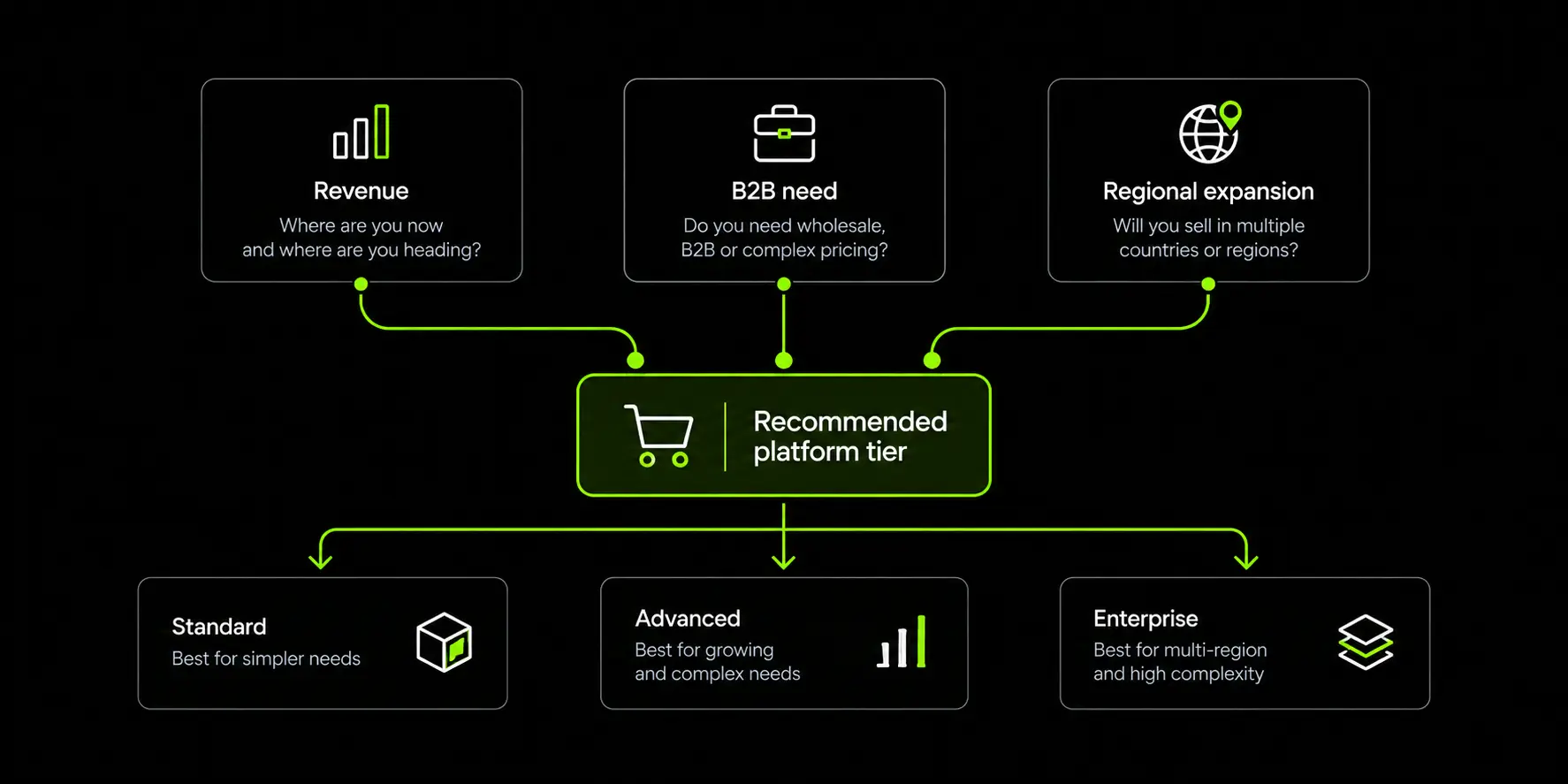
Standard Shopify plans suit most brands up to roughly $1 to $2 million in annual revenue with straightforward B2C needs.
Plus becomes worth its cost when a brand needs native B2B functionality, checkout customization, multiple expansion stores or when transaction fee savings at high volume offset the subscription jump.
The right way to decide is a breakeven calculation specific to your numbers, not a revenue guess.
Why The Standard Shopify Vs Shopify Plus Comparison Falls Short
Search this comparison and you will find the same article structure repeated across a dozen domains.
The Same Feature Table, Repeated Across Every Ranking Article
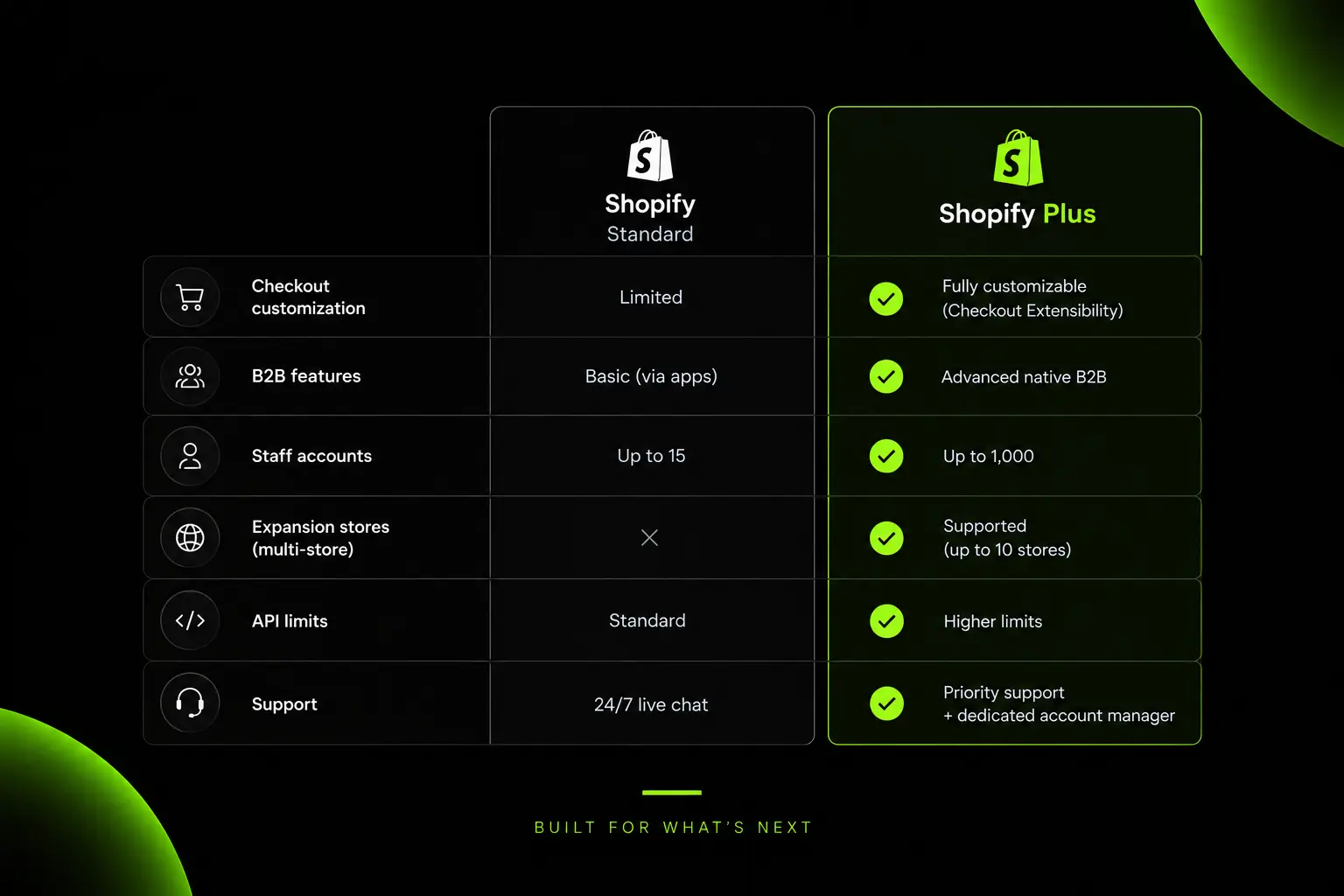
Checkout customization, staff accounts, B2B, expansion stores. Every top-ranking result lists the same four or five differences in roughly the same order, because they are working from the same public feature comparison Shopify itself publishes. None of them go further than the list.
Why A Generic Revenue Threshold Doesn't Tell You If The Upgrade Pays Off
Shopify's own marketing commonly cites a revenue range somewhere around $800,000 to $1 million in annual sales as the point to consider Plus.
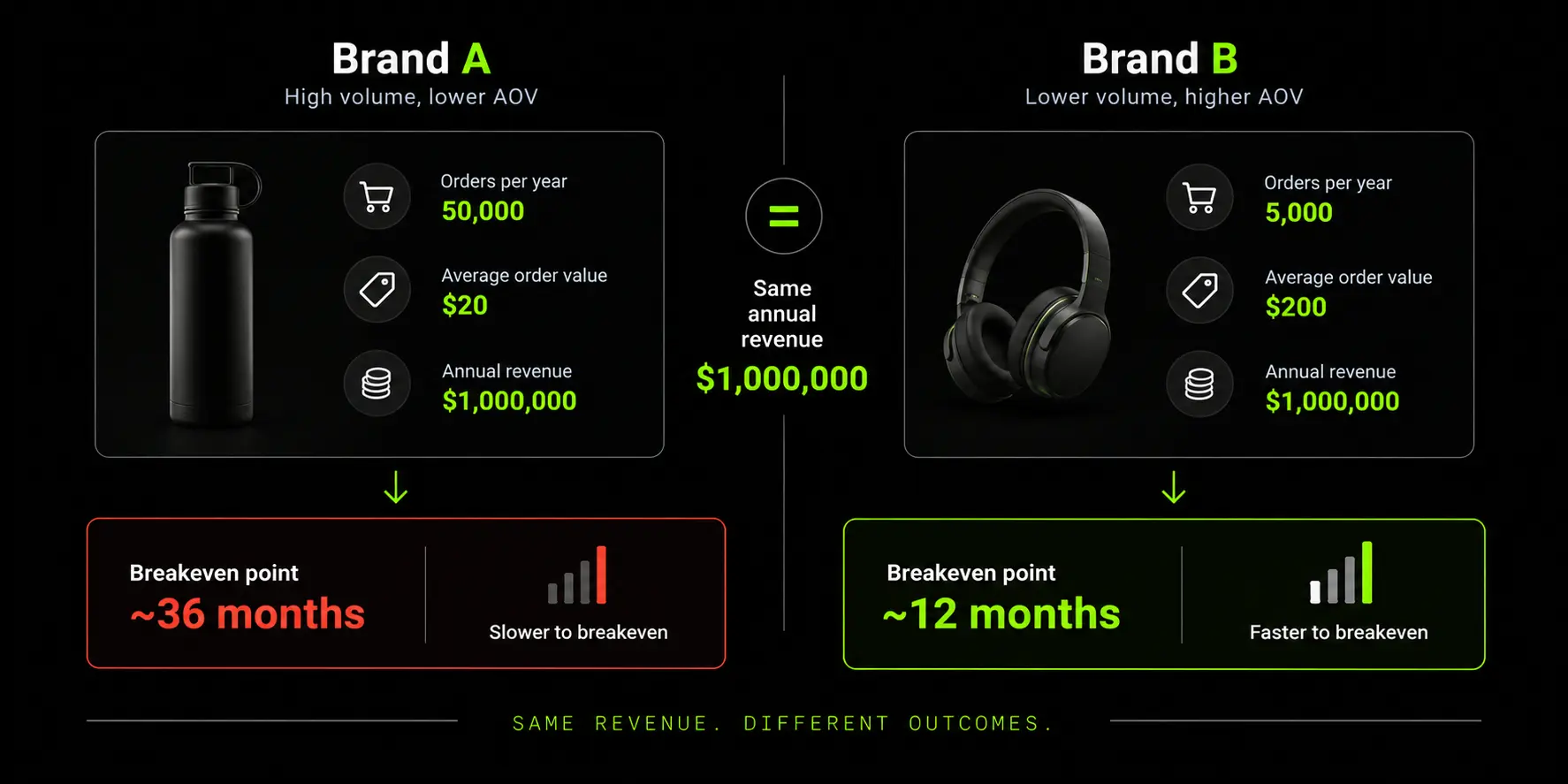
That number is a rough average across wildly different businesses. A brand with thin margins and high transaction volume reaches breakeven on transaction fee savings alone at a very different revenue point than a brand with a high average order value and lower volume.
Revenue is a proxy for the real variable, which is your actual fee spend and feature needs, not a number to plan around directly.
Two brands at identical annual revenue, one selling a high volume of low-priced items and the other a lower volume of premium products, can land on opposite sides of the breakeven line even though the headline number Shopify's marketing points to looks the same for both.
Shopify Vs Shopify Plus: The Real Feature Differences
Here is what actually changes, beyond the headline list most comparisons stop at.
Pricing Structure
Standard Shopify runs on fixed monthly plans: Basic, Grow, and Advanced, each with a set subscription fee and a corresponding payment processing rate.
Plus starts from a higher fixed subscription, commonly cited around $2,300 a month on a three-year term or $2,500 a month on a one-year term and above a certain monthly sales volume, typically once you pass roughly $1 million in monthly GMV, that fee structure shifts to include a variable percentage of revenue on top, generally cited in the range of 0.25% to 0.40% depending on contract term, capped at a set monthly amount.
This variable component is a genuinely important detail that flat "Plus costs $2,300/month" comparisons leave out.
Checkout Customization And Checkout Extensibility
Standard plans allow light checkout styling. Plus unlocks full checkout extensibility, custom fields, validation rules, one-click upsells, and branded checkout flows built through Shopify Functions.
This is consistently cited as the single most common reason brands actually upgrade, more than the fee savings.
A brand needing to add a gift-wrapping option with conditional logic, a loyalty points redemption field, or a custom shipping method selector at checkout will find these are Plus-only capabilities on Shopify's current checkout architecture, not something a standard-plan app can fully replicate.
B2B And Wholesale Capabilities
Shopify has expanded native B2B functionality onto standard plans over the past cycle, up to a limited number of catalogs.
Plus still offers unlimited catalogs and more advanced B2B features, which matters for brands running a genuinely large or complex wholesale operation alongside D2C.
Staff Accounts, Permissions and Admin Structure
Advanced caps staff accounts at a meaningful but finite number; Plus offers unlimited staff accounts.
For a brand with a large internal team or multiple agency partners needing admin access simultaneously, this can matter more in practice than it looks on a feature list.
Expansion Stores And Multi-Region/Multi-Brand Management
Standard plans cannot run true multi-store setups; Plus includes multiple Expansion Stores under one organization, commonly cited as up to nine in addition to the main store.
This is the feature that specifically matters for brands running distinct regional or multi-brand storefronts, covered in more depth in our guide to multi-store Shopify setups for global brands.
API Limits And Headless/Custom Storefront Capability
Plus offers meaningfully higher API rate limits and access to Plus-specific APIs, along with Hydrogen storefronts hosted on Oxygen for headless builds.
Standard plans can still support custom development, but at API limits that can genuinely constrain a high-traffic or highly customized build.
Automation And Dedicated Support
Shopify Flow, the platform's automation tool, is available on both tiers now, narrowing what was once a clearer Plus-only advantage.
Plus does still offer priority support and, for larger merchants, a dedicated Merchant Success Manager, which standard plans do not include.
Shopify Advanced Vs. Shopify Plus
This is the comparison almost no other article runs, and it is the one that actually matters for a mid-sized brand deciding today.
Where Shopify Advanced Now Overlaps With Plus Features
Advanced now includes meaningfully more staff accounts, stronger reporting, Shopify Flow automation, and native B2B functionality up to a catalog limit, narrowing what used to be a much wider gap between standard Shopify and Plus.
A brand that would have needed Plus for automation or basic B2B a few product cycles ago may now find Advanced genuinely sufficient.
What You Still Don't Get Without Upgrading To Plus
Full checkout extensibility remains the clearest line that still separates the tiers. Unlimited B2B catalogs, Expansion Stores, meaningfully higher API limits, and negotiated transaction rates also stay Plus-exclusive.
If none of these specifically matter to your business, Advanced may be a genuinely adequate long-term home rather than a waypoint to Plus.
Why This Narrows The Decision For Mid-Sized Brands
Most competing content treats "standard Shopify" as a single undifferentiated tier below Plus, which overstates the actual gap for a brand already running on Advanced.
The real question for a brand on Advanced is not "Shopify or Plus" in the abstract; it is which of the small number of Plus-exclusive capabilities you actually need, and whether their value clears the subscription jump.
The Real Decision: Build A Breakeven Calculation, Not A Revenue Guess
This is the core framework, and it is the piece missing from every competing comparison on this topic.
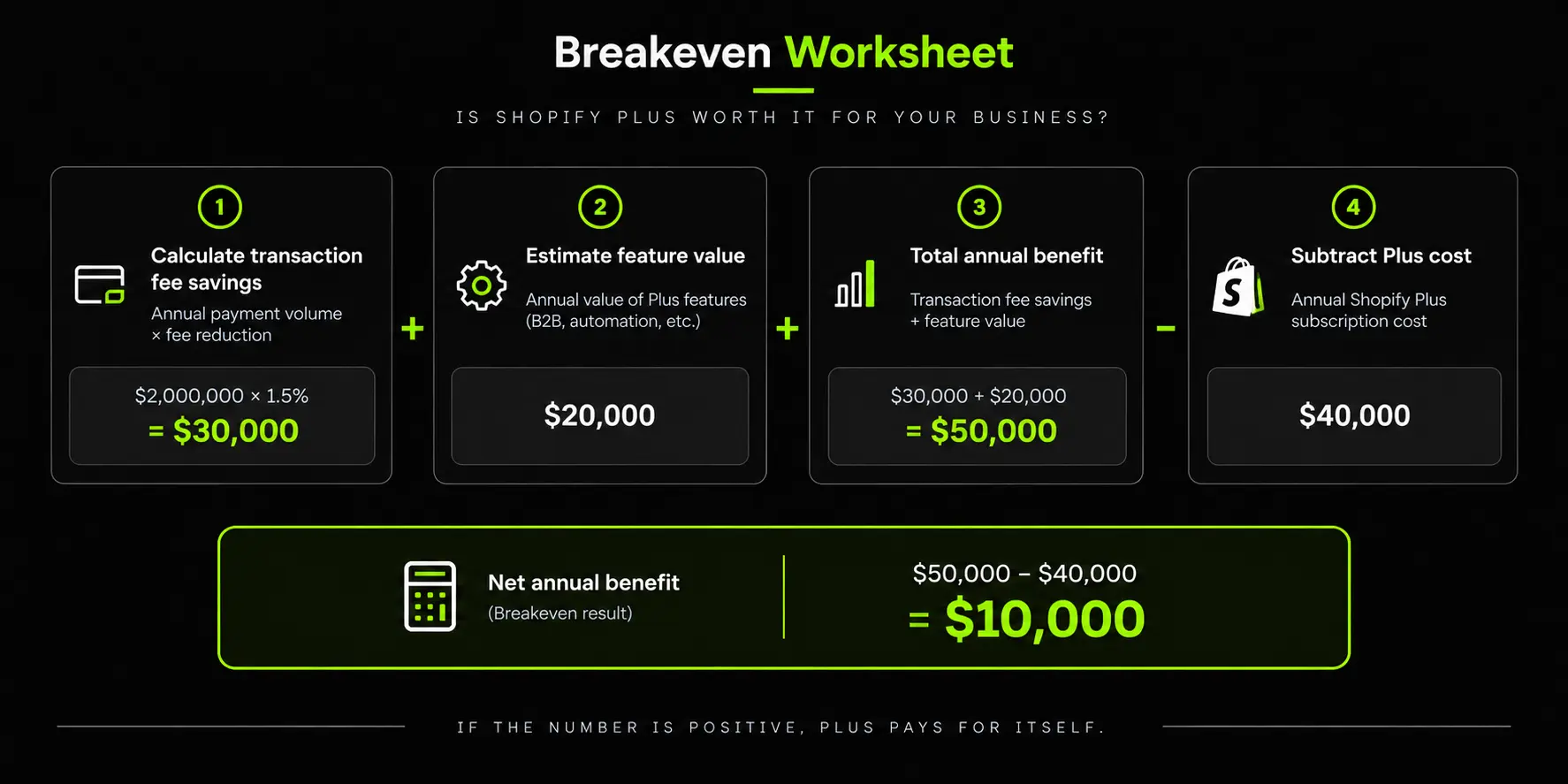
Step 1: Calculate Your Current Transaction Fee Spend
Take your current plan's Shopify Payments rate and your actual monthly sales volume to calculate what you are paying in processing fees today.
A brand on Advanced processing $150,000 a month through Shopify Payments at roughly 2.5% plus 30 cents per transaction is paying a specific, calculable dollar figure in fees each month, not an abstract percentage.
Step 2: Compare Against Plus's Reduced Fees At Your Volume
Apply Plus's lower negotiated rate, commonly a few tenths of a percentage point below Advanced, to the same sales volume, and calculate the monthly dollar savings.
On the $150,000-a-month example above, a roughly 0.3 to 0.35 percentage point rate reduction saves somewhere in the region of $450 to $525 a month in processing fees alone, before factoring in any other consideration.
Step 3: Price In The Features You'd Actually Use
If checkout extensibility, unlimited B2B catalogs, or Expansion Stores would generate measurable value, whether through higher conversion, a new wholesale revenue stream, or a new regional market, estimate that value in dollars per month and add it to the fee savings from Step 2.
This is where the calculation stops being purely mechanical and starts requiring an honest assessment of which features you would genuinely use versus which sound useful in the abstract.
Step 4: Weigh The Breakeven Point Against Your Growth Trajectory
Compare the combined monthly value from Steps 2 and 3 against Plus's subscription cost, roughly $2,300 to $2,500 a month at the entry tier.
If the combined value clears the subscription cost today, the upgrade likely pays for itself immediately. If it falls short today but your growth trajectory over the next 12 to 24 months puts you well past that point, the timing decision becomes about how much runway you want before switching, not whether to switch at all.
A Worked Example
A brand doing $1.2 million in annual revenue, averaging $100,000 a month, sitting on Shopify Advanced, wants to know if Plus pays off.
Their transaction fee savings at that volume, moving from roughly 2.5% to a negotiated Plus rate around 2.15%, come to a modest few hundred dollars a month, well short of the roughly $2,300 subscription jump on its own.
But the brand also wants to launch a wholesale channel alongside its existing D2C store, which needs checkout customization for net-terms invoicing and unlimited B2B catalogs, both Plus-exclusive.
Once that feature value is priced in against the wholesale revenue it is expected to unlock, the combined calculation clears the subscription cost well before the fee savings alone ever would.
The revenue number by itself said "not yet." The full breakeven calculation said something different.
Signs You're Actually Ready For Shopify Plus, Beyond Revenue
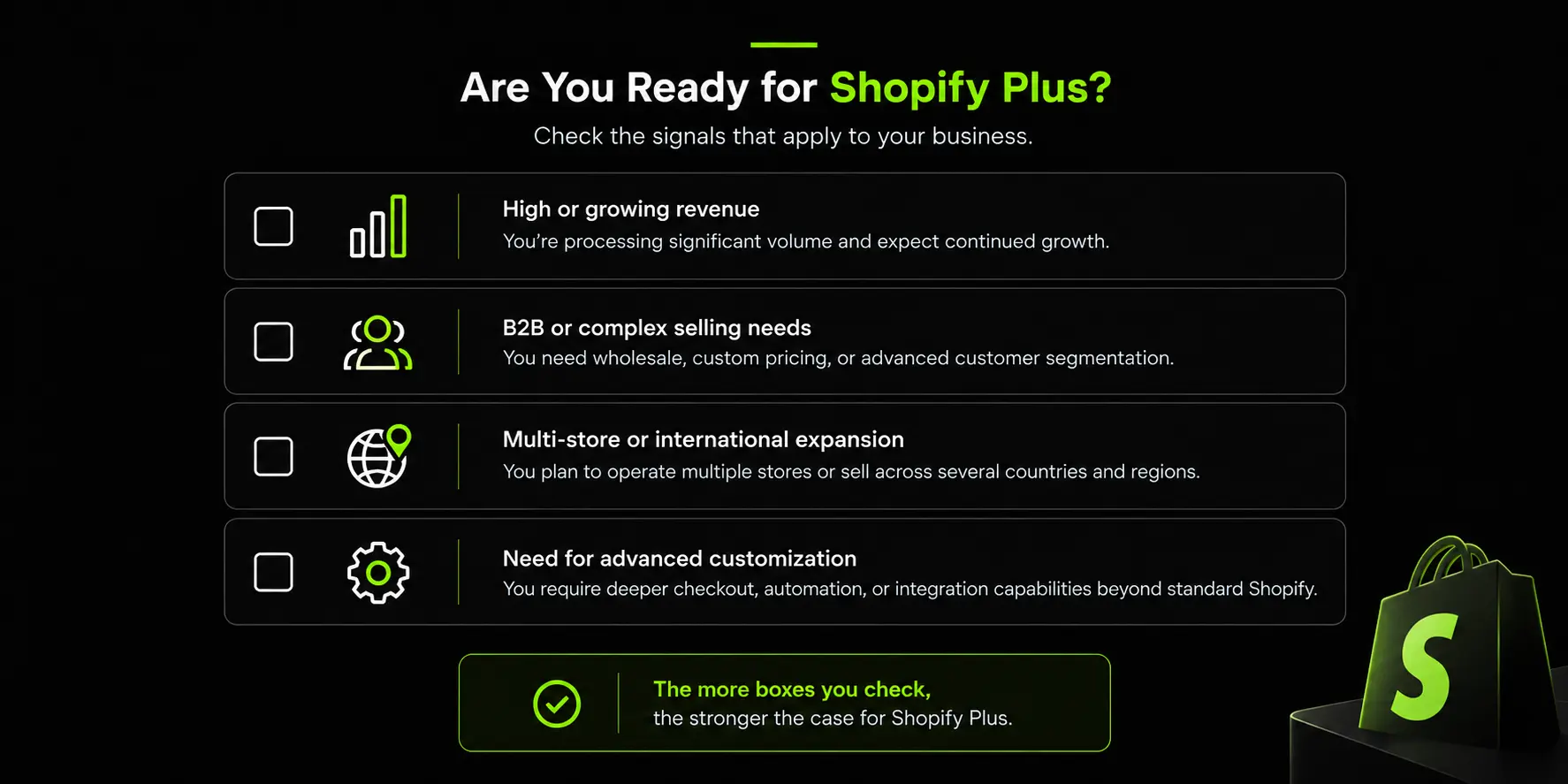
A handful of operational signals matter more than the revenue number on their own.
You Need Native Wholesale/B2B Alongside D2C
If you are running, or planning to run, a genuine wholesale channel with more catalogs or more advanced B2B functionality than Advanced's limited B2B tier supports, this alone can justify Plus independent of the transaction fee math.
You're Expanding Into Multiple Regions Or Brands
If your growth plan involves genuinely distinct regional storefronts or a multi-brand portfolio, Expansion Stores are a Plus-exclusive capability that standard plans simply cannot replicate.
You're Hitting Checkout Customization Or Automation Limits
If your team is regularly asking for checkout changes a standard plan cannot support, or hitting API rate limits on integrations that matter to daily operations, these are concrete signals independent of revenue.
Your Team Has Outgrown Standard Admin/Staff Account Limits
If you are routinely working around Advanced's staff account cap, whether through shared logins or constant admin reshuffling, that operational friction has a real, if harder to quantify, cost worth factoring into the decision.
Shopify Plus For UAE And GCC Brands: What's Different
A few considerations carry more weight for brands operating in this region specifically.
Native B2B/Wholesale Relevance For GCC Distributor And Retail Relationships
Many UAE and GCC brands run hybrid models, selling D2C while also supplying regional distributors or retail partners.
Plus's unlimited B2B catalogs and net-terms checkout support are often more directly relevant here than in markets where D2C and wholesale are more commonly kept as fully separate operations.
Multi-Currency, Multi-Region Expansion Stores For Gulf And International Growth
A brand expanding from a UAE base into the wider GCC and international markets often finds Expansion Stores directly useful once regions need genuinely distinct catalogs or promotions rather than just currency and language layered onto one store, which standard Shopify Markets already handles well on its own.
Local Payment Gateway And POS Considerations On Plus Versus Standard
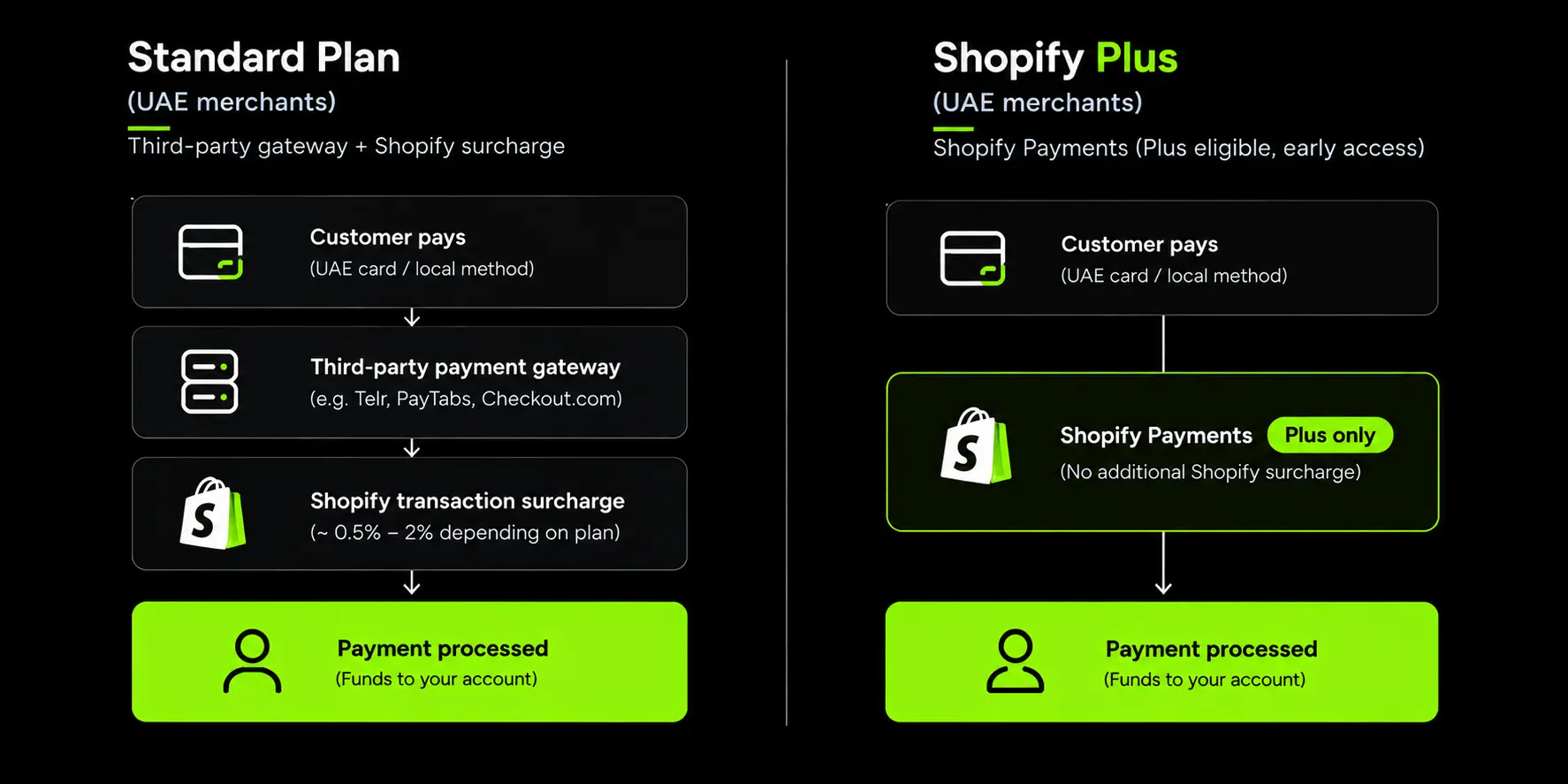
Shopify Payments availability in the UAE has been limited largely to eligible Plus merchants, while standard plans in the region generally rely on third-party gateways such as Telr, PayTabs, or Checkout.com.
This affects the transaction fee side of the breakeven calculation specifically for brands based here, since the fee comparison looks different when a third-party gateway is already part of the standard-plan cost structure.
For a UAE-based brand still on a standard plan paying a third-party gateway's rate plus Shopify's surcharge on top, part of the Plus upgrade math includes the possibility of moving onto Shopify Payments directly, which changes the fee comparison from the generic Advanced-versus-Plus numbers most articles quote toward something specific to the region's payment landscape.
What Upgrading Actually Involves
The upgrade itself is rarely as simple as a plan change in the admin panel.
Migration Considerations Even When Staying On Shopify
Even though Plus is still Shopify, moving from a standard plan often involves a theme rebuild to take advantage of checkout extensibility properly, reconfiguring apps that behave differently at the Plus tier, and, if Expansion Stores are part of the plan, structuring the new organization and store relationships correctly from the start.
Apps that worked fine on Advanced sometimes need a Plus-specific version or a different configuration entirely, and this is easy to underestimate when the upgrade is framed purely as a plan change in the billing settings.
Timeline And Typical Cost Of A Plus Upgrade Or Rebuild
A straightforward upgrade with minimal rebuild can move relatively quickly; a fuller rebuild taking advantage of checkout extensibility, B2B setup and multi-store architecture typically takes meaningfully longer and carries a development cost that should be factored into the breakeven calculation as a one-time cost against the ongoing monthly value.
Common Mistakes Brands Make When Upgrading Too Early Or Too Late
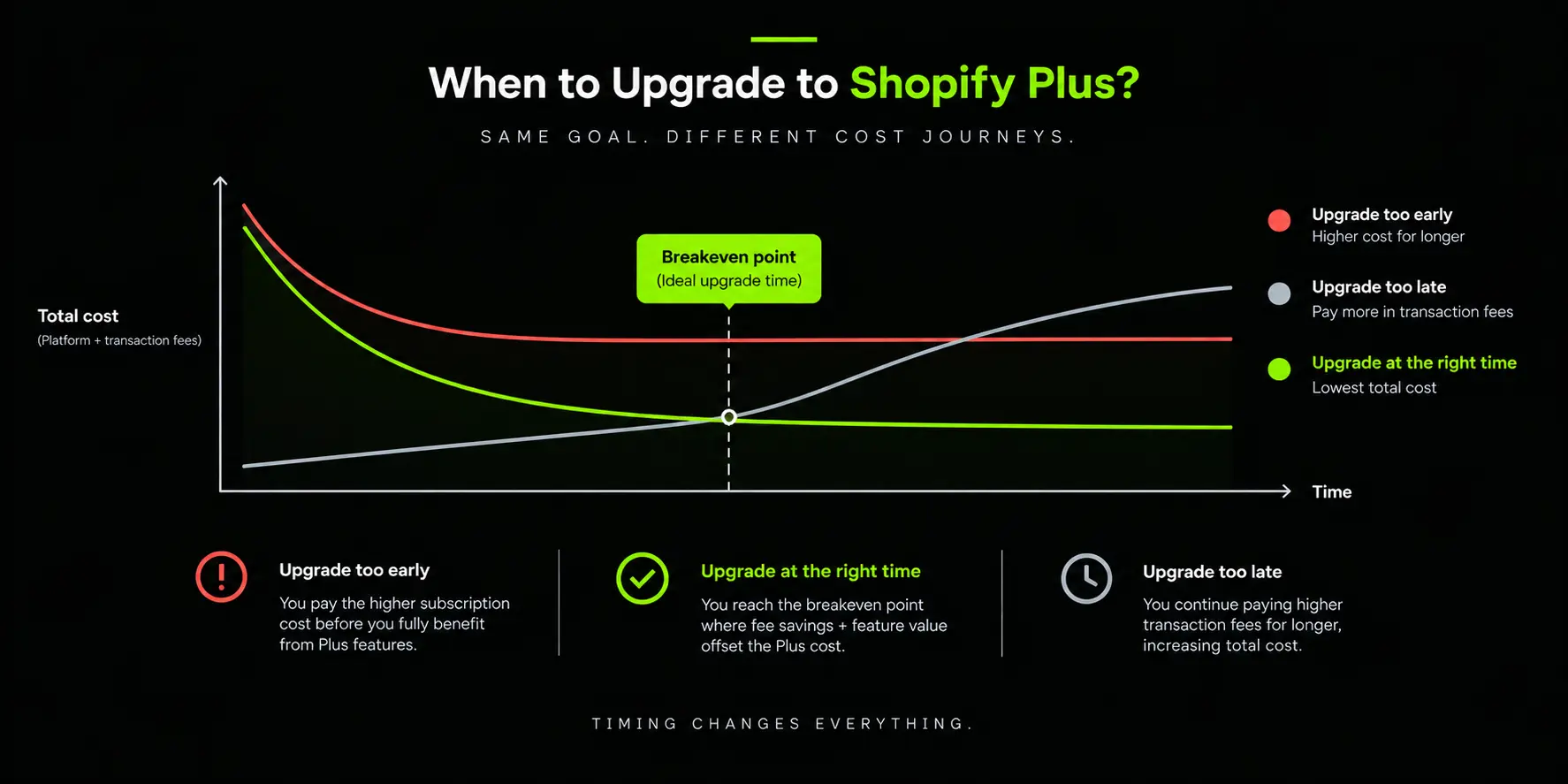
Upgrading too early means paying the Plus subscription premium for capacity and features you are not yet using, which is a pure cost with no offsetting value.
Upgrading too late means hitting real operational ceilings, checkout limitations blocking a needed customization, or B2B growth outpacing what standard plans support, before making the switch, which usually costs more in lost opportunity than the subscription premium would have.
The most common version of the "too early" mistake is a brand upgrading primarily for the lower transaction fee rate without accounting for the rebuild cost required to actually take advantage of checkout extensibility, which can erase the fee savings for a year or more before the upgrade nets out positive.
How We Help Brands Decide, And Build, On The Right Shopify Tier
Our approach at Suplex starts by running the actual breakeven numbers with a brand, transaction fee spent at current and projected volume, honest feature value and subscription cost, before recommending an upgrade either way.
We would rather tell a client Advanced genuinely covers their needs for another year than sell a Plus migration they are not ready to get value from.
We have built and migrated brands onto Shopify Plus across the UAE, the wider Gulf, and international markets, including B2B and wholesale setups that are a particularly common driver of the upgrade decision for brands in this region.
Getting the timing right matters as much as getting the platform right: we help brands avoid upgrading too early and paying for unused capacity and just as importantly, avoid waiting too long and hitting a growth ceiling that costs more than the subscription would have.
If you want to run your own numbers before committing either way, Suplex offers a Shopify Plus readiness assessment to work through the calculation.
Frequently Asked Questions
Is Shopify Plus worth the extra cost?
It depends entirely on your specific transaction volume, fee structure, and whether you would actually use Plus-exclusive features like checkout extensibility, unlimited B2B catalogs, or Expansion Stores. Run the breakeven calculation for your own numbers rather than relying on a generic revenue threshold to answer this.
What's the actual price difference between Shopify and Shopify Plus?
Standard plans range from around $39 a month for Basic up to $399 a month for Advanced, while Plus starts from roughly $2,300 to $2,500 a month depending on contract term, with a variable percentage of revenue added above a certain monthly sales volume. The processing fee rates also differ, generally in Plus's favor at scale.
What revenue level should trigger a move to Shopify Plus?
There is no single correct number. Shopify's own commonly cited range sits around $800,000 to $1 million in annual revenue, but the right trigger depends on your transaction fee spend and which Plus-exclusive features you would use, which can shift the actual breakeven point meaningfully in either direction from that figure.
Is Shopify Advanced enough, or do I need Shopify Plus?
Advanced has closed much of the historical feature gap, including basic B2B and Shopify Flow automation, so many mid-sized brands find it genuinely sufficient. The clearest remaining reasons to move to Plus are full checkout extensibility, Expansion Stores, unlimited B2B catalogs, and meaningfully higher API limits.
Does upgrading to Shopify Plus require rebuilding my store?
Not always, but a full rebuild is common if you want to take proper advantage of checkout extensibility, restructure for B2B, or set up Expansion Stores correctly. A minimal-change upgrade is possible but often leaves the most valuable Plus features underused.
What are the biggest benefits of Shopify Plus for B2B/wholesale brands?
Unlimited B2B catalogs, more advanced wholesale pricing and net-terms checkout support, and the ability to run a distinct B2B storefront through an Expansion Store alongside your D2C store are the clearest wholesale-specific advantages Plus offers over standard plans.
How long does a Shopify Plus migration typically take?
This depends heavily on scope: a straightforward plan upgrade with minimal changes can move relatively quickly, while a fuller rebuild taking advantage of checkout extensibility, B2B setup, and multi-store architecture takes meaningfully longer. Request a timeline based on your specific scope rather than a generic estimate.
Hi, I’m Rishabh Jain
I believe great design has the power to shape perception, build trust, and move businesses forward. That belief is what led me to found Suplex Design Studio, a global branding and packaging studio working with FMCG and D2C brands across markets.I started suplex at 25 with a clear intent, to create design that is strategic, thoughtful, and commercially meaningful. By 28, the studio had scaled globally, guided by a strong foundation in Integrated Design that I developed during my academic journey in London, where I was honoured with the Dean’s Award.
Over the years, I’ve had the opportunity to work with 100+ brands, from Fortune 500 organizations to family-run businesses, helping them build packaging and brand systems that create recall, relevance, and long-term value.
Suplex’s work has been recognized internationally, including the Manifest Award (2024), the Clutch Global Award (2025), and features on platforms such as Packaging of the World, The Dieline, and the World Brand Design Society.
None of this would be possible without the people behind the work. I’m deeply grateful to the suplex team, whose commitment, creativity, and attention to detail turn ideas into meaningful brand experiences every day.
At the heart of my work is a simple philosophy, design should be intentional, honest, and built to last, and that continues to guide everything we create at suplex.




































Let’s Make It Happen
E-Commerce Success Stories
%201.avif)






.avif)

.avif)
Build Your D2C Business The Right Way
Build It With Suplex.


