Shopify vs Squarespace Ecommerce: Honest Comparison for 2026
.avif)

Shopify vs Squarespace Ecommerce: Honest Comparison for 2026
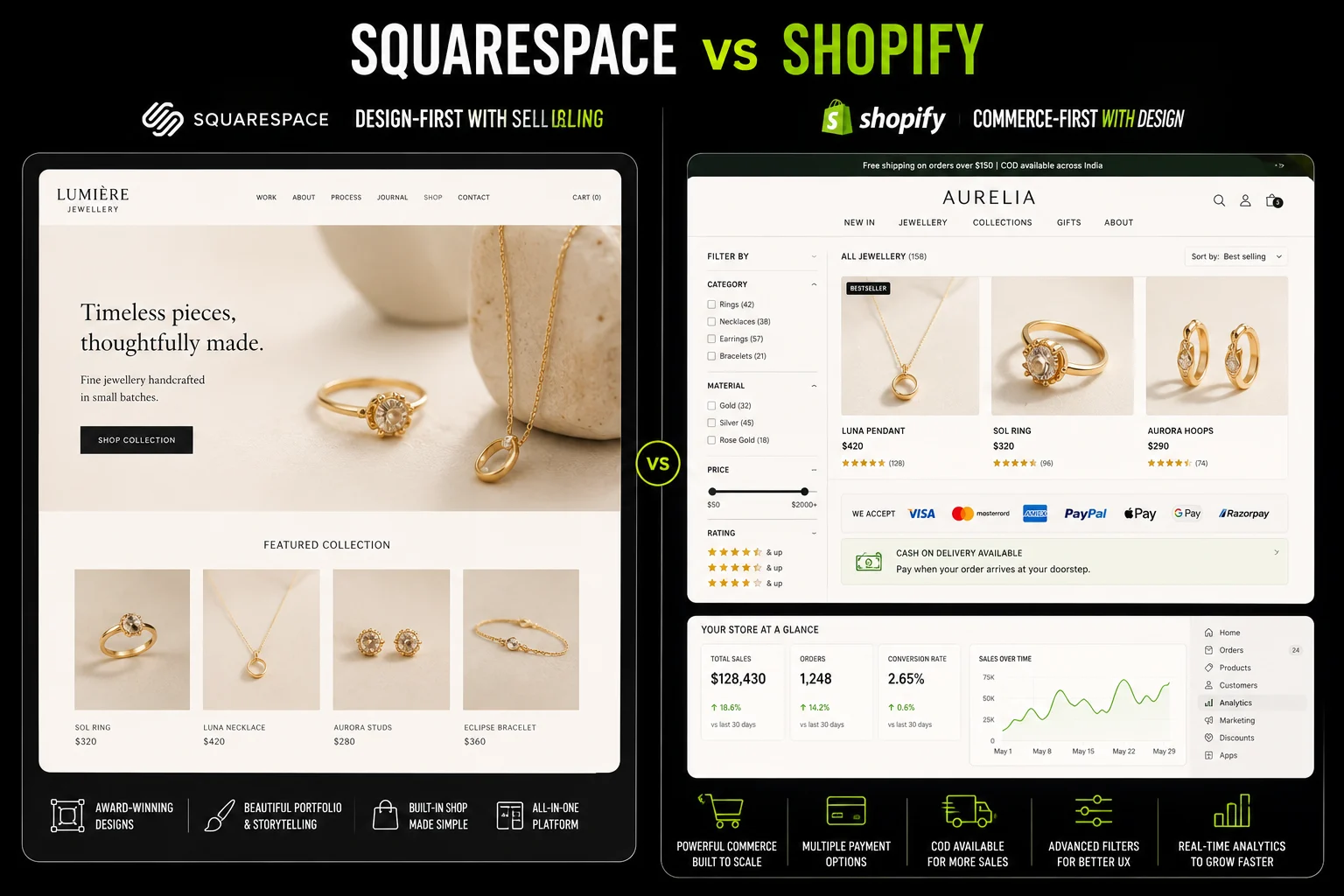
Shopify vs Squarespace comes down to a simple distinction: Shopify is an ecommerce platform with website-building features, while Squarespace is a website builder with ecommerce features.
That difference shapes everything from scalability and payments to templates and pricing. Suplex is a Shopify Partner, but we'll clearly highlight where Squarespace is the better fit.
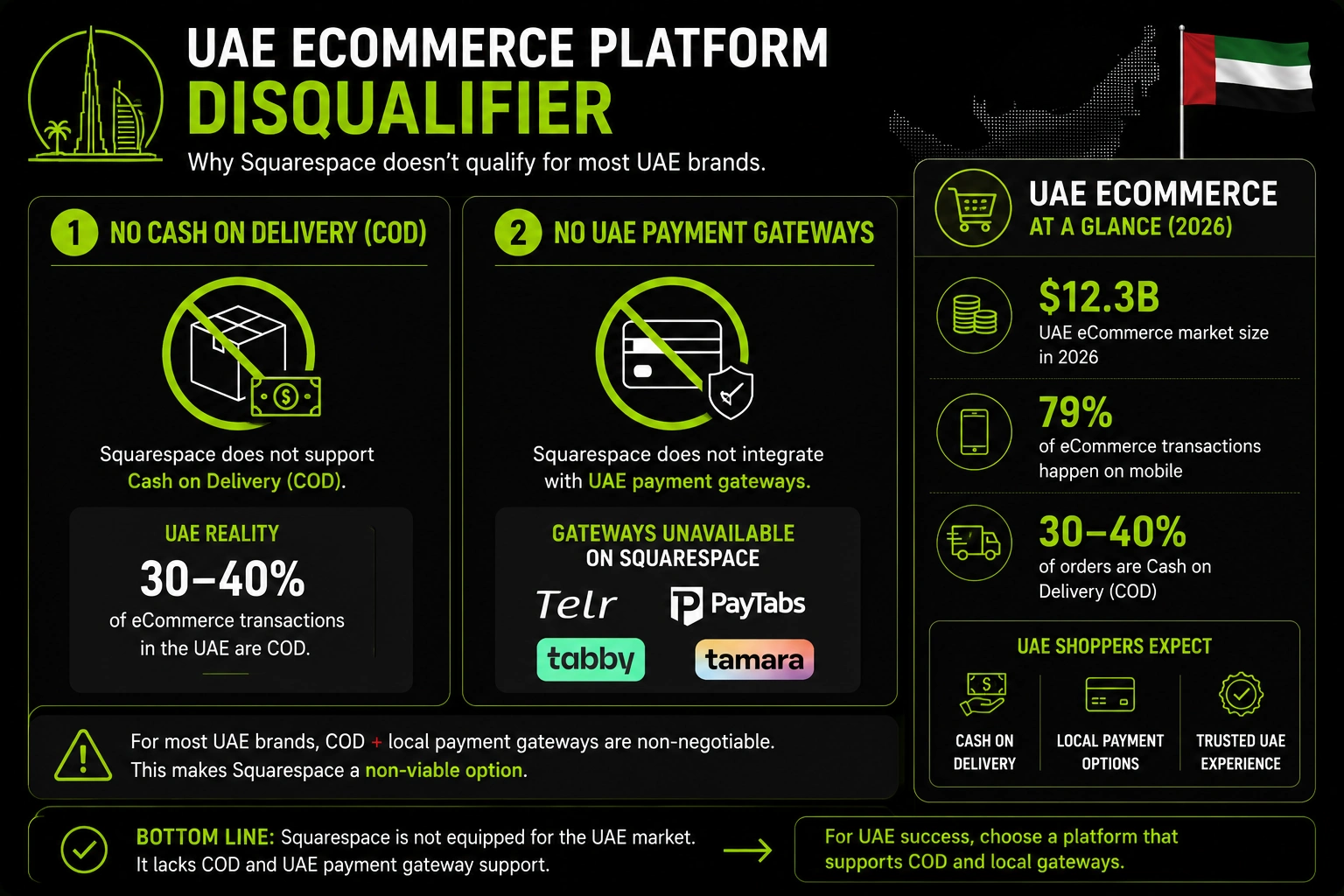
For UAE and GCC brands, one fact stands out: Squarespace doesn't support cash on delivery, making Shopify the clear choice where COD drives 30-40% of ecommerce orders.
The Core Distinction: Commerce-First vs Design-First
The philosophical difference between these platforms drives every specific feature difference discussed later.
What "Commerce-First" and "Design-First" Mean
Shopify is commerce-first. It was built to sell online, with every major feature focused on payments, checkout, inventory, analytics, and growth. Design supports the buying experience.
Squarespace is design-first. It was built to create beautiful websites with premium templates, typography, and an intuitive editor. Ecommerce was added later to support the website, not define it.
If your website showcases your brand and selling is secondary, Squarespace is an excellent fit. If ecommerce is your primary revenue channel, Shopify's deeper commerce capabilities make it the stronger long-term choice.
The Question That Determines Which Platform to Use
One question resolves this comparison for most brands:
Is ecommerce your primary business, or is it how you sell products alongside your primary business?
- "I am building a brand that sells products online" → Shopify
- "I am a service provider / creator / practitioner who also sells some products" → Squarespace or Shopify, depending on selling volume and growth ambition
- "I need a beautiful portfolio that also has a shop" → Squarespace
- "I need a shop that also looks beautiful" → Shopify
The distinction sounds trivial. Its commercial consequences are significant as the rest of this guide shows.
Pricing What You Actually Pay on Each Platform
Squarespace 2026 pricing:
Shopify 2026 Pricing:
The Transaction Fee Reality
Squarespace's apparent price advantage ($33/mo vs $39/mo at comparable plans) is real at zero sales. As selling volume grows, the transaction fee difference becomes commercially significant.
Shopify charges transaction fees on all plans when you use a third-party payment gateway 2% on Basic, 1% on Grow, 0.5% on Advanced. These fees disappear if you use Shopify Payments. Squarespace charges no transaction fees on Commerce plans.
The breakeven calculation:
- At $1,000/month in sales on Shopify Basic using a third-party gateway: $20 in transaction fees. Total cost: $39 + $20 = $59/month.
- At $1,000/month in sales on Squarespace Commerce Basic: $0 in transaction fees. Total cost: $33/month.
- At $5,000/month in sales on Shopify Basic: $100 in transaction fees. Total cost: $139/month.
- At $5,000/month on Squarespace Commerce Basic: Total cost: $33/month.
This changes dramatically when Shopify Payments is available. Shopify Payments eliminates the transaction fee entirely. Brands in countries with Shopify Payments access pay only the payment processing fee (around 2.9% + $0.30) with no additional Shopify transaction fee.
UAE-specific note: Shopify Payments UAE availability is in staged rollout as of mid-2026. UAE-based brands should verify current availability directly with Shopify.
If Shopify Payments is not available for your UAE store, the transaction fee applies on all third-party gateway transactions (Telr, PayTabs, Tap Payments). Factor this into your true platform cost calculation.
The practical recommendation: At low selling volumes (under $3,000/month), Squarespace's Commerce Basic at $33/month can be cheaper than Shopify Basic at $39/month with transaction fees.
Above $3,000–$5,000/month, the comparison depends on gateway availability and feature requirements more than plan cost.
Ecommerce Features Where the Platform Gap Actually Is
Both platforms let you sell online, but the biggest differences appear once your business starts growing. Payments, checkout flexibility, integrations, and operational tools are where Shopify consistently offers more depth than Squarespace.
Payment Gateway Support The Most Commercially Decisive Difference
Shopify supports over 100 payment gateways worldwide including all the big global players as well as local and region-specific ones. Squarespace only lets you use five payment processors: Squarespace Payments, Stripe, PayPal, Square, and Afterpay.
For brands selling in the US, UK, or major European markets where Stripe and PayPal are genuinely sufficient, Squarespace's five-gateway limit is not a practical problem.
For brands selling in markets with strong regional payment method preferences the UAE, Saudi Arabia, India, Southeast Asia, Latin America this limitation is structural and often decisive:
- UAE brands need: Telr, PayTabs, Tap Payments, Tabby (BNPL), Tamara (BNPL), Network International none available on Squarespace
- KSA brands need: Mada, STC Pay, HyperPay, Moyasar none available on Squarespace
- COD requirement: Squarespace doesn't support COD at all if your customers want to pay on delivery, Squarespace simply isn't an option
For any brand operating in the UAE or GCC, the payment gateway limitation alone disqualifies Squarespace. This is not a nuanced trade-off. It is a binary: Squarespace cannot serve the Gulf market.
Product and Catalogue Management
Shopify: Unlimited products. Unlimited collections. Up to 100 variants per product (3 options). Metafields for custom product attributes. No product cap.
Squarespace: Squarespace has a 10,000 product cap. For most small boutique brands, this is not a practical limit.
For brands planning meaningful catalogue growth, a fashion brand adding seasonal collections, an FMCG brand expanding SKU range, the ceiling arrives faster than expected.
For brands below 500 products with no aggressive growth plans, the product cap is irrelevant. For brands planning to scale, Squarespace's product limit is a migration trigger that comes at an inconvenient time.
App Ecosystem
Shopify: 8,000+ apps across every ecommerce function. Purpose-built apps for reviews (Okendo, Judge.me), loyalty (Smile, LoyaltyLion), email (Klaviyo), subscriptions (ReCharge, Skio), upsell (Rebuy), referral (Refersion), advanced reporting, and thousands of category-specific integrations.
Squarespace: A significantly smaller extension library. Core functionality is built in which reduces the need for apps for basic features.
But for advanced requirements (subscription management, sophisticated loyalty, B2B pricing, custom checkout logic), the Squarespace extension ecosystem cannot match Shopify's depth.
Honest Assessment: For basic ecommerce, Squarespace's built-in features often mean fewer apps are needed which is a simplicity and cost advantage.
For growing D2C brands that need advanced functionality, Shopify's app depth is a capability advantage that Squarespace cannot match.
Analytics and Reporting
Shopify: Comprehensive ecommerce analytics on all plans sessions, conversion rate, sales by product, customer acquisition source, returning vs new customer breakdown, cohort analysis. Custom reports available on all plans. Real-time dashboard during high-traffic events.
Squarespace: Squarespace charges a premium for more advanced reporting features if you want enhanced ecommerce analytics, you'll need to be on one of the more expensive Commerce plans. And even then, the reports are pretty basic and not remotely as informative as the Shopify analytics offering.
For brands that make data-driven decisions about product, pricing, and acquisition and that is every serious D2C brand Shopify's reporting depth is a material advantage.
Checkout Customisation
Shopify: Standard checkout customisable with branding on all plans. Checkout Extensibility for custom fields, checkout upsells, and custom payment logic. Shop Pay, Apple Pay, Google Pay natively integrated.
Squarespace: Checkout customisation limited to branding (logo, colours). No checkout extension capability.
For brands where checkout experience is a brand expression luxury brands, premium D2C brands requiring specific checkout field logic Shopify's checkout flexibility is significant.
For brands with standard checkout needs, Squarespace's checkout is perfectly functional.
Design and Templates Where Squarespace Genuinely Wins
If visual presentation is your top priority, Squarespace has the advantage. Its professionally designed templates and polished styling make it easier to create a premium-looking website without hiring a designer.
Template Quality and Visual Design
Best for design polish out of the box: Squarespace strongest default templates for portfolios and brand sites.
This is not a nuanced edge. Squarespace's template quality, typographic sophistication, and visual coherence out of the box are consistently better than Shopify's free theme options.
A Squarespace template selected by a founder with good taste and no design background will typically produce a more visually compelling result than Dawn or Debut on Shopify without additional design investment.
Squarespace's 199+ templates are all free. All have been designed with typographic and visual hierarchy principles that produce professional results.
The brand cohesion between pages is automatic and the design system propagates across the entire site.
Shopify's 13 free themes are competent but less sophisticated visually. The premium themes ($100–$500) match or exceed Squarespace's visual quality for specific use cases Prestige for luxury, Impulse for campaign-driven brands, Stiletto for editorial fashion. But the investment is required.
Our Honest Comparison: For a solo brand founder who needs a beautiful site quickly without design investment, Squarespace's template quality provides a better starting point than Shopify's free themes.
This advantage disappears when Shopify's premium themes are in play but those cost $200–$400.
Ease of Use
Both platforms are designed for non-technical users. They differ in how they approach this:
Squarespace: All-in-one design editor with drag-and-drop customisation. Template-to-live-site workflow feels cohesive. Less flexible than Shopify but less confusing because there are fewer options.
Shopify: The Online Store 2.0 section editor is intuitive for content management. The admin interface for product management, orders, and analytics is significantly more powerful than Squarespace's and consequently slightly more complex.
For non-technical founders, the learning curve on Shopify is modest but real.
Suplex’s Practical Assessment: For a founder launching their first ecommerce store and primarily managing product uploads and order fulfilment, both platforms are accessible. Squarespace feels simpler in the first week; Shopify's depth becomes an advantage once the store is established.
Content and Blogging
Squarespace started as a content and blogging platform. Its editorial features long-form blog architecture, podcast integration, video pages, portfolio sections and member-only content are more mature and feature-rich than Shopify's.
For brands where content is a primary acquisition and retention mechanism, a nutrition brand publishing wellness content alongside supplements, a fashion brand running editorial alongside product Squarespace's content architecture has genuine advantages over Shopify's blog functionality.
Shopify's blog is functional for ecommerce SEO purposes. It is not designed for editorial-first brands that produce significant non-commercial content volume.
Scalability: The Growth Ceiling That Determines Your 3-Year Platform Choice
Your platform should support not just where your business is today, but where it will be in three years. As your catalogue, markets, and operations grow, Shopify scales far more effectively than Squarespace.
What Scaling Actually Requires From a Platform
A brand that starts with 50 products and grows to 500 needs: better filtering and navigation, more sophisticated analytics, automation tools for operational efficiency, and deeper integrations with marketing platforms.
A brand that starts in one market and expands to three needs: multi-currency, multi-language, market-specific payment methods, and international SEO architecture.
At each of these growth stages, Shopify has infrastructure available. At several of these stages, Squarespace reaches its limits.
Squarespace scaling ceiling where it runs out:
- 10,000 product cap a hard ceiling; brands approaching this scale need to migrate
- No enterprise tier no equivalent to Shopify Plus; no B2B features
- 5 payment gateways cannot add regional gateways as new markets are entered
- No COD support permanently disqualified from markets where COD is material
- Limited multi-currency significantly less configurable than Shopify Markets
- No headless capability brands requiring custom frontend architecture cannot build headless on Squarespace
Shopify scaling infrastructure what is available as you grow:
- Unlimited products
- Shopify Plus at $2,300/month for enterprise-tier features
- Shopify Markets for GCC multi-currency and multi-language
- B2B native features for wholesale
- 8,000+ apps including enterprise integrations
- Hydrogen/Oxygen headless for brands requiring maximum frontend control
If you're building a business you expect to grow significantly, starting on Squarespace and migrating later costs more in time and disruption than starting on Shopify would have.
The Migration Cost Argument
If a brand launches on Squarespace and later needs Shopify's capabilities, migration is a real cost not a trivial one.
Product data must be exported and imported, URL structures change (SEO redirect mapping required), customer data must be migrated, integrations must be rebuilt.
The commercially rational calculation: if there is meaningful probability that a brand will need Shopify's capabilities within 3 years and for any brand with genuine growth ambition, this probability is high. Starting on Shopify is cheaper than starting on Squarespace and migrating later.
The Exception: if the brand is a service provider or content creator that is genuinely unlikely to scale beyond Squarespace's capabilities, starting on Squarespace is correct. There is no cost in choosing the right platform for where you are.
Shopify vs Squarespace for UAE and Gulf Market Brands The Decision Is Clear
For most UAE and GCC ecommerce brands, this isn't a close comparison. Local payment preferences and market requirements make Shopify the only practical choice for businesses that want to maximise online sales.
Why Squarespace Is Not a Viable Option for UAE Ecommerce
For UAE brands, the Shopify vs Squarespace decision is not a feature comparison exercise. It is a binary determined by two disqualifying limitations:
Limitation 1 No COD support: Squarespace doesn't support COD at all. COD still accounts for 30–40% of ecommerce transactions in the UAE and is even higher in Saudi Arabia and other GCC countries. Not offering COD means losing a substantial portion of potential customers.
A UAE ecommerce store without COD is structurally leaving 30–40% of potential transactions uncaptured.
For a brand doing AED 500,000 annually, that is AED 150,000–200,000 in unrealised revenue from a single missing feature. This is not a product catalogue or design decision. It is a market-disqualifying limitation.
Limitation 2 No UAE/GCC Payment Gateway Support: Squarespace only lets you use five payment processors: Squarespace Payments, Stripe, PayPal, Square, and Afterpay.
None of the UAE-specific payment gateways (Telr, PayTabs, Tap Payments, Network International, Tabby, Tamara) are available on Squarespace.
UAE brands on Squarespace are limited to Stripe which while available in the UAE requires careful setup and has lower regional card success rates than local gateways and PayPal, which has limited penetration among UAE consumers.
The BNPL absence is particularly commercially significant. Tabby and Tamara are used by 37%+ of UAE consumers and can increase conversion by 20–30% on orders above AED 500. Neither is available on Squarespace.
Squarespace is not a viable ecommerce platform for selling to UAE and GCC consumers. This is not a recommendation based on feature preference. It is a conclusion based on payment infrastructure that Squarespace's platform architecture cannot provide.
What Shopify Offers UAE Brands That Squarespace Cannot
- 100+ payment gateways including Telr, PayTabs, Tap Payments, Network International, and Checkout.com all with native Shopify app integrations
- COD as a native payment option configurable with fulfilment partner integration (Aramex, Fetchr)
- Tabby and Tamara BNPL both have official Shopify app integrations
- Shopify Markets for GCC multi-currency and multi-language expansion
- Arabic RTL theme support via Translation & Adapt app or Weglot; RTL-compatible premium themes
- UAE VAT configuration 5% VAT inclusive pricing, FTA-compliant invoicing
- 23,000+ UAE Shopify stores the most established ecommerce platform in the UAE market
At Suplex Design, we've built Shopify stores for brands across the UAE and GCC markets. Our experience confirms that the payment infrastructure alone makes Shopify the only viable choice for Gulf ecommerce. Book a consultation to discuss your specific requirements.
The Decision Framework: Which Platform for Which Brand
The right choice depends on your business model, growth plans, and target market. Use these guidelines to decide whether Shopify's commerce capabilities or Squarespace's design-first approach better matches your needs.
Choose Squarespace When
- You are a service provider, creator, or practitioner selling products as a secondary business: A photographer selling prints. A yoga teacher selling courses and merchandise. A consultant selling a digital product. A ceramicist selling a small collection.
- You need a beautiful website primarily and a small shop secondarily: Under 100 products, primarily domestic market, standard payment methods, no growth ambition beyond the current scale.
- You are not selling into COD-heavy markets: US, UK, Canada, Australia, Western Europe markets where card and digital wallet payments cover 95%+ of transactions.
- You have a content-first brand strategy: A brand that generates significant editorial content alongside its ecommerce.
Choose Shopify When
- Ecommerce is your primary business: Any brand where the online store is the core revenue channel D2C brand, FMCG, fashion label, supplement company, food brand.
- You are selling into the UAE, GCC, or any COD-heavy market: The payment gateway limitations and COD absence categorically disqualify Squarespace.
- You plan to grow beyond 500 products or $500K annual revenue: At this scale, Shopify's analytics depth, app ecosystem, and scalability architecture become meaningful commercial advantages.
- You need regional payment methods: Any market where the dominant payment method is not available on Squarespace's five-gateway list.
- You have or anticipate B2B wholesale requirements: Shopify Plus native B2B. Squarespace has no B2B features.
- You want to scale internationally: Shopify Markets handles multi-currency, multi-language, and market-specific checkout.
Direct Feature Comparison
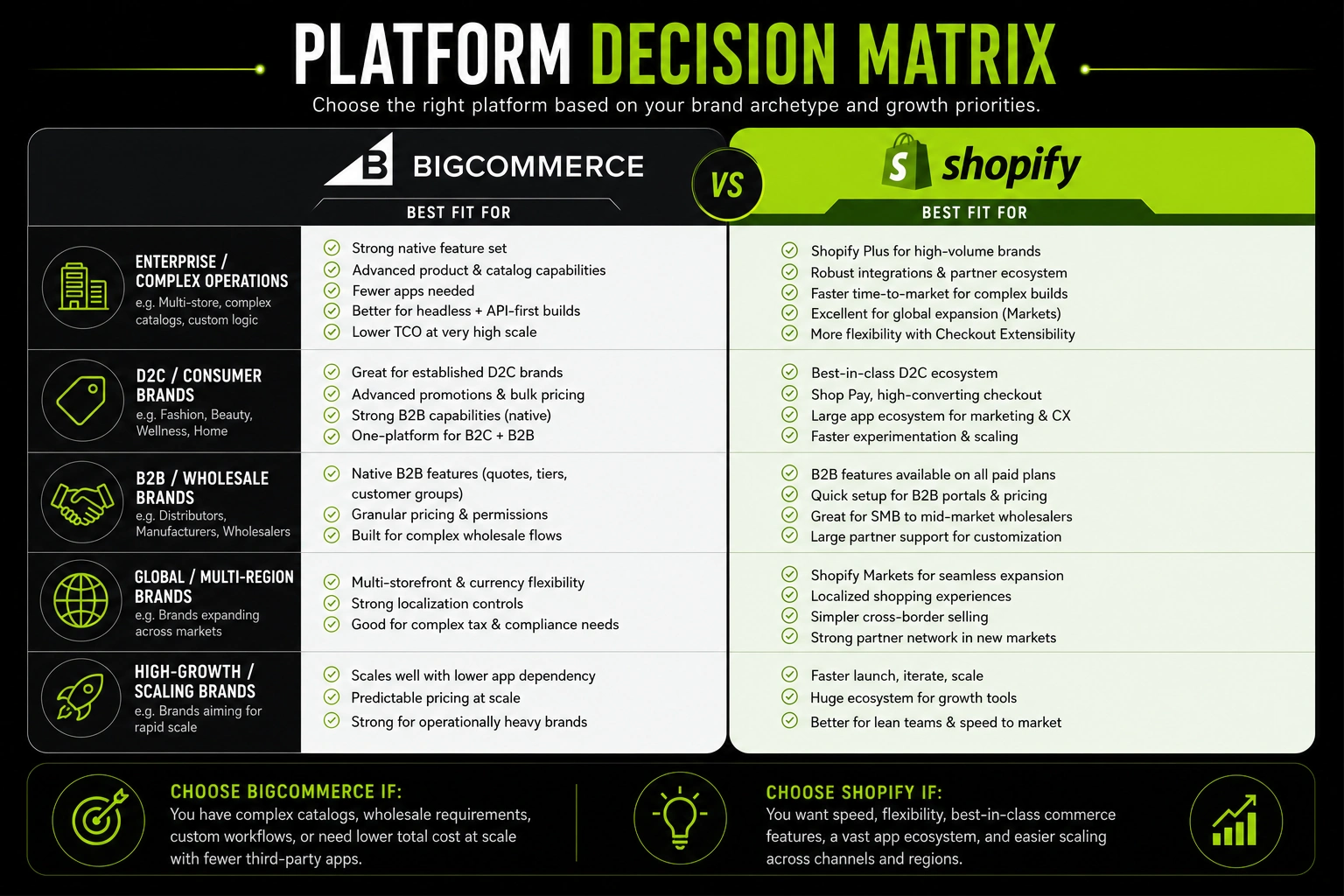
Both platforms cover the ecommerce basics, but they differ significantly in depth and flexibility. This side-by-side comparison highlights the features that matter most when choosing between Shopify and Squarespace.
Can You Migrate from Squarespace to Shopify Later?
Yes, but it's easier and less expensive to choose the right platform from the start. A Squarespace-to-Shopify migration is straightforward, but it still requires careful planning to preserve data, SEO, and customer experience.
What Squarespace-to-Shopify Migration Involves
Migration from Squarespace to Shopify is a documented, deliverable project. The scope:
- Product data migration: Squarespace exports products as a CSV. Shopify imports from CSV. Most product data migrates cleanly; metafields, custom attributes, and variant complexity require manual mapping.
- Customer data migration: Customer records migrate with basic information. Order history is more complex Shopify's order model differs from Squarespace's, and historical orders require custom mapping.
- URL redirect mapping: Every Squarespace URL (product pages, blog posts, static pages) changes to a Shopify URL structure. Without a complete 301 redirect map, organic search traffic that took months to build is lost at migration. This is the highest-risk element.
- Content migration: Blog posts, portfolio pieces, and static pages must be recreated in Shopify's CMS.
The Practical Cost: A Squarespace-to-Shopify migration for a brand with 200 products, 2 years of blog content, and an established organic search profile is a $8,000–$20,000 project. Starting on Shopify instead eliminates this future cost entirely.
The Exception: If the brand's current commercial situation is a genuine Squarespace fit service provider, design-first, under 100 products, domestic market there is no reason to start on Shopify pre-emptively. The migration cost only matters if migration becomes necessary.
Suplex's Perspective A Shopify Partner's Honest Assessment
We're a Shopify Partner, so we have a commercial relationship with Shopify. We also work with the platform every day, giving us practical experience beyond most review sites.
Our approach is simple:
- We recommend the platform that's the best commercial fit.
- We clearly point out where Squarespace is the better choice.
- We don't believe every business should use Shopify.
One Exception: UAE and GCC Ecommerce Brands.
For these markets, we consistently recommend Shopify. Squarespace's lack of cash on delivery and limited payment gateway support are commercial limitations, not minor feature trade-offs.
For Most Growing D2C Brands, Shopify offers the stronger long-term platform with better scalability, integrations, and ecosystem support, reducing the need for another migration as the business grows.
Ready to make the right choice for your brand? Book a platform consultation with our founders. We'll walk through your commercial parameters, payment requirements, and scaling plan before recommending either direction.
Frequently Asked Questions
Is Shopify better than Squarespace for ecommerce?
Shopify is better for ecommerce-primary businesses D2C brands, fashion labels, FMCG, supplement brands, and any business where selling online is the core commercial function. Squarespace is better for design-first brands with light selling requirements portfolios, service providers, creators, or practitioners who sell a small number of products alongside their main offering.
What is the main difference between Shopify and Squarespace?
Shopify is an ecommerce platform with website-building features. Squarespace is a website builder with ecommerce features. Shopify has deeper commerce capabilities: 100+ payment gateways, unlimited products, 8,000+ apps, COD support, B2B features, and enterprise scaling via Shopify Plus. Squarespace has better default template quality, simpler setup, lower starting price, and no transaction fees on Commerce plans.
Can I sell on Squarespace in the UAE?
Technically yes Squarespace accepts Stripe, which processes UAE transactions. Practically, Squarespace is unsuitable for UAE ecommerce for two reasons: it does not support COD (cash on delivery), which accounts for 30–40% of UAE transactions; and it does not support UAE-specific payment gateways (Telr, PayTabs, Tap Payments, Tabby, Tamara). Any UAE brand that needs COD or local gateway support cannot operate effectively on Squarespace.
Does Squarespace have transaction fees?
Squarespace charges no transaction fees on its Commerce Basic ($33/month) and Commerce Advanced ($65/month) plans. The Business plan charges a 3% transaction fee. Shopify charges 0.5–2% transaction fees on all plans when using a third-party payment gateway; these fees disappear entirely if Shopify Payments is available and used.
Which is easier to use, Shopify or Squarespace?
Both platforms are designed for non-technical users. Squarespace feels simpler in the first week its all-in-one editor with drag-and-drop design is more cohesive for building a website. Shopify's admin is slightly more complex because it is more powerful product management, analytics, and order operations are significantly deeper than Squarespace's. For a business where ecommerce operations are the primary task, Shopify's additional complexity is justified by its additional capability.
Can I migrate from Squarespace to Shopify?
Yes. Squarespace-to-Shopify migration is a well-documented project. Product data exports from Squarespace as a CSV and imports into Shopify. The highest-risk element is URL redirect mapping: every Squarespace URL must be 301-redirected to its Shopify equivalent to preserve organic search rankings. A migration for a mid-sized store with 200 products and established blog content typically costs $8,000–$20,000.
Does Squarespace support COD (cash on delivery)?
No. Squarespace does not support cash on delivery on any of its plans. This limitation disqualifies Squarespace for any market where COD is a significant payment method including the UAE (30–40% of transactions), Saudi Arabia, Egypt, Pakistan, and much of South and Southeast Asia. For brands selling in these markets, Shopify is the correct platform.
Hi, I’m Rishabh Jain
I believe great design has the power to shape perception, build trust, and move businesses forward. That belief is what led me to found Suplex Design Studio, a global branding and packaging studio working with FMCG and D2C brands across markets.I started suplex at 25 with a clear intent, to create design that is strategic, thoughtful, and commercially meaningful. By 28, the studio had scaled globally, guided by a strong foundation in Integrated Design that I developed during my academic journey in London, where I was honoured with the Dean’s Award.
Over the years, I’ve had the opportunity to work with 100+ brands, from Fortune 500 organizations to family-run businesses, helping them build packaging and brand systems that create recall, relevance, and long-term value.
Suplex’s work has been recognized internationally, including the Manifest Award (2024), the Clutch Global Award (2025), and features on platforms such as Packaging of the World, The Dieline, and the World Brand Design Society.
None of this would be possible without the people behind the work. I’m deeply grateful to the suplex team, whose commitment, creativity, and attention to detail turn ideas into meaningful brand experiences every day.
At the heart of my work is a simple philosophy, design should be intentional, honest, and built to last, and that continues to guide everything we create at suplex.






































Let’s Make It Happen
E-Commerce Success Stories

%201.avif)






.avif)

.avif)
Build Your D2C Business The Right Way
Build It With Suplex.


