What Is a Shopify Partner Agency? (And Do You Actually Need One?)
.avif)
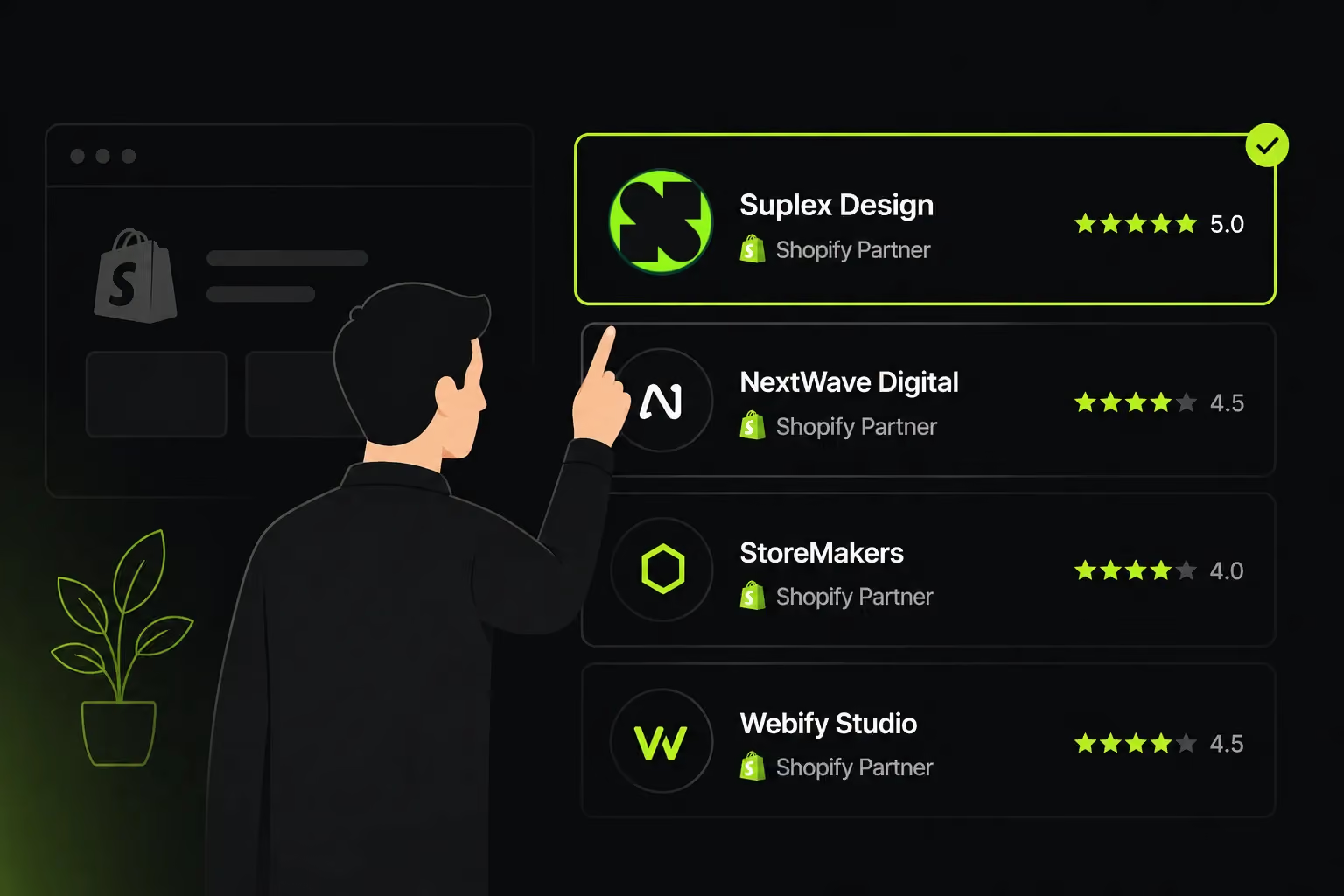
What Is a Shopify Partner Agency? (And Do You Actually Need One?)
A Shopify Partner Agency is a design and development firm that has enrolled in Shopify's official Partner Program and is certified to build, customise and grow Shopify stores for merchants.
These agencies are vetted by Shopify, have access to dedicated tools and resources unavailable to the public, and earn referral commissions when they connect merchants to the platform.
With over 100,000 partners in the Shopify network globally, the term "Shopify Partner Agency" gets used loosely. Not every agency that lists "Shopify" on its website qualifies. Knowing the difference matters before you hire one.
What Is a Shopify Partner Agency? The Official Definition
The Shopify Partner Program is free to join, which is where the confusion starts. Anyone, a solo developer, a small studio or a large agency can create a Shopify Partner account.
That account gives them access to unlimited development stores, Shopify's Partner Dashboard, educational resources and the ability to earn revenue share by referring merchants or building apps.
What separates a Shopify Partner Agency from a random web dev shop is that the agency actively operates within this program. It manages client stores, earns recurring revenue through referrals and builds expertise across Shopify's ecosystem.
The Partner Program is structured to incentivise agencies to invest in Shopify-specific skills, which generally makes them more capable on the platform than generalist developers.
How Shopify Vets and Certifies Partner Agencies
Shopify does not automatically certify every partner. Basic membership just requires account creation. Certification comes through Shopify's Academy courses and exams, which test knowledge across store setup, theme development and platform fundamentals.
Agencies that complete these earn verified credentials displayed on their Shopify Partner Directory profile.
Beyond individual certifications, Shopify evaluates partner agencies on activity metrics: revenue generated, number of active merchants referred and client reviews.
High-performing agencies get priority placement in the directory and access to dedicated partner support.
Shopify Partner vs. Shopify Plus Partner, What's the Difference
These are two distinct tiers, and conflating them is a common mistake.
A Shopify Plus Partner has been approved specifically to serve enterprise merchants on the Plus plan (which starts at around $2,300/month).
These agencies typically have deeper technical capabilities, experience with headless commerce, and a portfolio of high-revenue brands. If your store is doing under $1M/year, you likely don't need a Plus Partner, a certified standard partner will cover everything you need.
Who Can Become a Shopify Partner Agency
Any business or individual can join the Partner Program. But to function as a legitimate Shopify Partner Agency.
One capable of delivering complex builds and growing merchant stores, you need a team with experience in Liquid (Shopify's templating language), Shopify APIs, third-party app integrations and ecommerce strategy. Passing an exam does not automatically produce that. Actual project experience does.
What Does a Shopify Partner Agency Actually Do?
Shopify Partner Agencies are not just "website builders." Their scope spans the full lifecycle of an ecommerce store from the initial design to post-launch growth.
The specific services vary by agency, but here is what a capable Shopify agency should cover:
Shopify Store Design and Theme Development
Store design is about conversion, not just aesthetics. A Shopify Partner Agency should build (or customise) themes with clear product hierarchy, fast load times, mobile-first layouts and a checkout flow that minimises drop-off.
Most agencies offer two paths: customising an existing Shopify theme (faster, lower cost) or building a fully custom theme from scratch (more flexibility, higher investment).
If your current theme is slowing down your store or limiting your product presentation, this is usually the first thing a Shopify agency will address.
Custom Shopify Development and App Integration
Not everything your store needs exists as a standard Shopify feature. Custom development bridges that gap.
This includes building private apps, modifying the Shopify checkout (a Plus-only feature in some cases), integrating third-party ERPs or CRMs, or engineering complex product configurators and subscription flows.
A good Shopify development agency will advise you on whether a third-party app from the Shopify App Store is sufficient or whether custom development is actually worth the cost. That judgement matters.
Platform Migration (WooCommerce, Magento, BigCommerce to Shopify)
Migrating a live store is high-risk work. Data products, customer records, order history, URLs need to transfer without breaking SEO or disrupting sales.
A Shopify Partner Agency handles the technical migration, URL redirect mapping, SEO preservation, and post-migration QA. Done badly, a platform migration can tank organic traffic for months.
Shopify migration from WooCommerce or Magento is one of the most common services Shopify agencies handle, particularly as merchants move away from self-hosted platforms that require constant developer maintenance.
Shopify SEO, CRO and Performance Marketing
Building the store is one phase. Getting it to perform is another. Shopify SEO involves fixing technical issues specific to the platform, duplicate content from collection pages, canonical tag errors, thin product descriptions, and Core Web Vitals problems.
CRO takes a data-driven approach to improving conversion identifying where users drop off and testing changes that move the needle.
Performance marketing (paid ads on Meta, Google, TikTok) typically becomes relevant once your store is converting well organically. A Shopify agency that combines both CRO and paid media can close the gap between traffic and revenue faster than managing them separately.
Shopify Partner Agency vs. Freelancer vs. In-House : Which One Do You Need?
This is the question most decision-makers avoid asking directly. Here is a straight comparison:
There is a valid criticism floating around on forums: many "Shopify partners" are just freelancers who completed a certification. That is true.
A Shopify Partner badge alone tells you nothing about actual capability. What tells you something: a verified client portfolio, revenue results, and a team with multiple specialists not just a solo operator wearing every hat.
When a Freelancer Is the Right Choice
Freelancers work well for contained, well-defined tasks. Installing and configuring a specific app. Fixing a layout bug. Adding a new landing page template.
If you know exactly what you need, you can scope it cleanly, and you don't need ongoing collaboration, a skilled freelancer is faster and cheaper.
When to Hire a Shopify Partner Agency
Hire an agency when the scope is complex, ongoing, or strategic. Building a store from scratch, migrating from another platform, or launching into a new market these require coordinated work across design, development and often marketing.
An agency also provides continuity: if one person leaves, the project does not stop.

Why UAE and Gulf Businesses Are Choosing Shopify Partner Agencies
The GCC ecommerce market is growing at a rate that most Western markets cannot match. The UAE's ecommerce sector was valued at approximately $9.2 billion in 2023 and is projected to exceed $17 billion by 2029, according to Statista.
Saudi Arabia, Qatar, and Kuwait are seeing similar trajectories. Shopify has become the platform of choice for many direct-to-consumer brands launching and scaling across the region but running a Shopify store in the UAE is not the same as running one in the UK or the US.
There are technical, regulatory, and cultural requirements specific to this market that generalist Shopify agencies outside the region often get wrong.
Shopify for UAE Businesses Key Technical Requirements
Right-to-left (RTL) layout support is non-negotiable for Arabic-language stores. Standard Shopify themes are built left-to-right. Switching to RTL requires custom theme development adjusting text direction, navigation layout, icon placement, and checkout flow.
This is not a setting you toggle; it requires actual code.
VAT compliance for UAE merchants means price display, tax calculation at checkout, and invoice generation all need to follow FTA guidelines.
Shopify can handle UAE VAT through tax settings and compatible apps, but it needs to be set up correctly.
Local Payment Gateways and Arabic Language Support on Shopify
UAE shoppers expect local payment options. A Shopify store without these faces significantly higher cart abandonment:
- Tabby and Tamara buy now, pay later services dominant in the GCC
- PayFort (now Amazon Payment Services) one of the most widely used payment gateways in the region
- Cash on delivery (COD) still a preferred option for many UAE consumers, particularly first-time online buyers
- Apple Pay and Google Pay high adoption among UAE smartphone users
Integrating these gateways correctly, ensuring they display in both English and Arabic, and testing the full checkout flow in both languages requires someone who has done it before, not someone figuring it out on a project for the first time.
Cross-Border Ecommerce in the GCC
Many UAE-based brands sell across the GCC Saudi Arabia, Qatar, Kuwait, Bahrain, and Oman. Each market has different tax structures, shipping logistics and consumer preferences.
Shopify's multi-currency and multi-market features (available through Shopify Markets) help, but setting them up for the GCC requires market-specific configuration.
Currency display, shipping zones, localised content, and the right logistics integrations all need to be in place before you can sell cross-border at scale.
A Shopify Partner Agency with regional experience has already navigated these setups. One without it will charge you to figure it out.
How to Choose a Shopify Partner Agency: 7 Things to Check
Not every agency that calls itself a Shopify Partner is worth hiring. Here is what to verify before you sign anything.
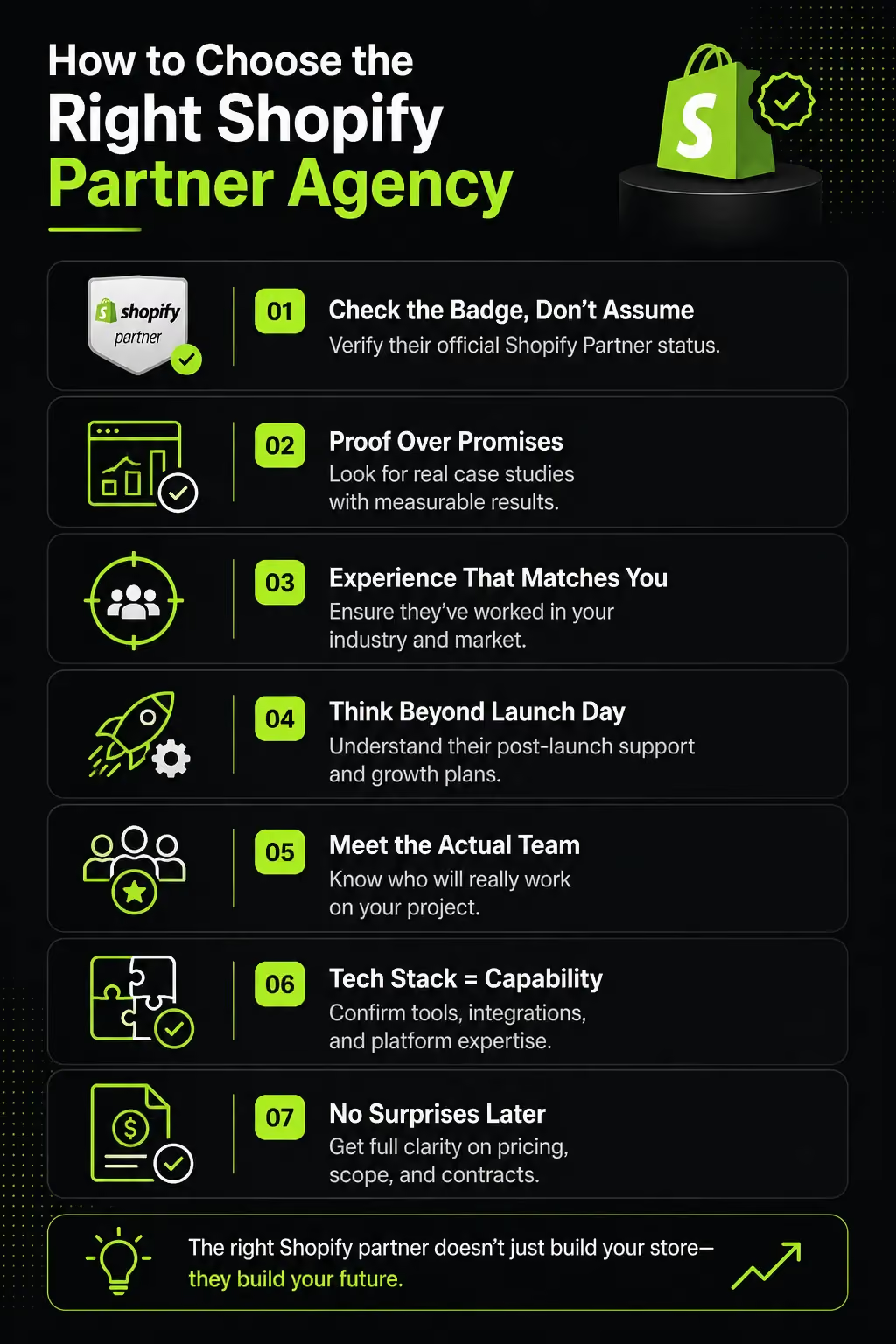
1. Verify the Shopify Partner badge directly: Go to partners.shopify.com/directory and search for the agency. If they are a legitimate partner, they will appear. Anyone can put a Shopify logo on their website; the directory is the only verification that counts.
2. Check for real, verifiable case studies: A portfolio with before/after screenshots tells you nothing on its own. Look for case studies that include measurable outcomes, conversion rate improvements, revenue growth, page speed scores, or migration results. If an agency cannot point to concrete results, that is a problem.
3. Assess industry and market experience: Has the agency built stores in your product category? Have they worked with brands in your region? Ecommerce in fashion behaves differently from ecommerce in health and wellness. Regional experience especially for UAE and GCC merchants matters for reasons already outlined above.
4. Understand what post-launch support looks like: Building the store is the start, not the end. Ask specifically: What is included post-launch? Is there a retainer option? Who is your point of contact when something breaks? Agencies that disappear after delivery are not partners, they are contractors.
5. Clarify the team structure: Who will actually work on your project? Is it the senior team members who pitched you, or junior staff you have not met? Ask to meet the people doing the work before you sign.
6. Confirm their tech stack and tool knowledge: For UAE stores specifically, ask whether they have integrated Tabby, Tamara, or PayFort before. Ask about their experience with RTL layouts and Arabic localisation. For any store, ask which analytics and testing tools they use. Vague answers to specific questions are a signal.
7. Get clarity on contracts and pricing: Scope creep is the most common source of disputes between merchants and agencies. Before signing, make sure the contract specifies exactly what is included, what constitutes out-of-scope work, how change requests are handled, and what the payment schedule looks like.
Questions to Ask Before You Sign Any Contract
- Can you show me two or three stores you've built that are similar to mine in scale or category?
- What does the project timeline look like, and what are the milestones?
- Who owns the code and design assets at the end of the project?
- How do you handle bugs or issues discovered after launch?
- What does your onboarding process look like, and how do you handle knowledge transfer?
Red Flags That Signal a Bad Shopify Agency
🚩 No verifiable client work: Testimonials on their website with no external proof
🚩 Guaranteed SEO ranking promises: No agency can guarantee specific rankings
🚩 Vague pricing with no fixed scope: This almost always leads to cost overruns
🚩 No dedicated point of contact: Unclear communication process
🚩 Pressure to sign quickly: No time given to properly review the contract
How to Verify a Shopify Partner Badge on Shopify's Directory
Go to Shopify's Partner Directory, search by agency name or location, and check whether the profile is active and complete. A legitimate profile will show the services they offer, client reviews and their partner tier.
If an agency's name does not appear in the directory, they are not a verified Shopify Partner regardless of what their website says.
How Suplex Approaches Shopify Partner Work
Suplex is a certified Shopify Partner Agency based in Dubai, UAE, working with D2C brands across the GCC and internationally.
The team covers the full build-to-growth spectrum: custom Shopify theme development, Shopify Plus store setup, platform migrations, conversion rate optimisation and regional integrations including Tabby, Tamara and PayFort.
The work is practical and commercially focused. When Miduty, an Indian nutraceuticals brand needed to grow its D2C Shopify store, Suplex built a store optimised for conversion, average order value and customer lifetime value.
For Kimi Cafe in Dubai, the team built and launched iOS and Android apps designed to drive loyalty and in-app ordering the kind of project that requires coordination across UX design, development and regional market knowledge simultaneously.
Suplex also holds Google Partner and Meta Business Partner credentials alongside the Shopify Partner badge, which means media and marketing capabilities sit in the same shop as the development and design work.
For brands that want SEO, paid acquisition and technical Shopify work handled by one team rather than three vendors, that structure cuts coordination overhead significantly.
Beyond project work, Suplex offers ongoing Shopify support performance optimisation, monthly retainers, and Shopify audits that identify where a live store is losing revenue.
If you're evaluating Shopify agencies in the region, here's what to look for in any partner including us: verified credentials, a portfolio with real measurable results, regional technical experience, and a clear post-launch support process.
FAQs
What is a Shopify Partner Agency?
A Shopify Partner Agency is a design and development firm enrolled in Shopify's official Partner Program. These agencies are certified to build, customise and scale Shopify stores.
They go through Shopify's vetting process, maintain verified credentials, and specialise in the platform rather than treating it as one of many tools they work with.
What exactly does a Shopify partner do?
A Shopify partner handles the technical and strategic work behind ecommerce stores built on Shopify. This includes store design and theme development, custom Shopify development, third-party app integration, platform migration (from WooCommerce, Magento, or BigCommerce), SEO, conversion rate optimisation, paid media, and ongoing store support and maintenance.
Is it worth hiring a Shopify Partner Agency?
Yes if you need custom development, are migrating from another platform, or are scaling a store that has outgrown template setups or freelance support.
No if you're a beginner setting up a straightforward store with standard products and no complex requirements. In that case, Shopify's own onboarding and a standard theme will get you started without agency costs.
What's the difference between a Shopify Partner and a Shopify Plus Partner Agency?
A standard Shopify Partner serves small to mid-sized merchants on Shopify's regular plans. A Shopify Plus Partner is a higher-tier designation for agencies that have demonstrated experience working with enterprise merchants on Shopify Plus stores typically doing $1M+ in annual revenue.
Plus Partners have access to advanced APIs and enterprise-grade features, like customised checkouts and multi-storefront configurations, that are unavailable on standard plans.
How do I verify if an agency is a real Shopify Partner?
Go to Shopify's Partner Directory at partners.shopify.com/directory and search for the agency by name. A legitimate Shopify Partner will have an active, verified profile showing their services, reviews and partner tier. A Shopify logo on an agency's website is not verification, only directory presence is.
Do I need a Shopify Partner Agency if I'm in the UAE or Gulf region?
For most UAE and GCC merchants, yes particularly if your store requires Arabic RTL support, local payment gateways like Tabby, Tamara, or PayFort, VAT compliance under FTA guidelines, or cross-border selling across the GCC.
These are technical requirements with regional nuances. A Shopify agency without hands-on experience in this market will spend time (your time and money) figuring out what a regionally experienced agency already knows.
Hi, I’m Rishabh Jain
I believe great design has the power to shape perception, build trust, and move businesses forward. That belief is what led me to found Suplex Design Studio, a global branding and packaging studio working with FMCG and D2C brands across markets.I started suplex at 25 with a clear intent, to create design that is strategic, thoughtful, and commercially meaningful. By 28, the studio had scaled globally, guided by a strong foundation in Integrated Design that I developed during my academic journey in London, where I was honoured with the Dean’s Award.
Over the years, I’ve had the opportunity to work with 100+ brands, from Fortune 500 organizations to family-run businesses, helping them build packaging and brand systems that create recall, relevance, and long-term value.
Suplex’s work has been recognized internationally, including the Manifest Award (2024), the Clutch Global Award (2025), and features on platforms such as Packaging of the World, The Dieline, and the World Brand Design Society.
None of this would be possible without the people behind the work. I’m deeply grateful to the suplex team, whose commitment, creativity, and attention to detail turn ideas into meaningful brand experiences every day.
At the heart of my work is a simple philosophy, design should be intentional, honest, and built to last, and that continues to guide everything we create at suplex.


























Let’s Make It Happen
E-Commerce Success Stories
%201.avif)






.avif)
.avif)
Build Your D2C Business The Right Way
Build It With Suplex.


