Best Ecommerce Development Agency in UAE: Guide for Brands That Want Revenue, Not Just a Website
.avif)

Best Ecommerce Development Agency in UAE: Guide for Brands That Want Revenue, Not Just a Website
The best ecommerce development agency in the UAE understands Arabic RTL, local payment gateways, VAT compliance and mobile-first commerce.
The right partner builds a revenue-generating ecommerce system, not just a website. Many agency rankings are self-promotional.
Rather than providing a vendor list, this blog offers a decision framework. You'll learn what separates a true ecommerce specialist from a general web agency, the key UAE-specific requirements and the questions to ask before signing a contract.
Why the UAE Ecommerce Market Demands a Specialist
The UAE ecommerce consumer is more demanding than most markets. Same-day delivery is expected. BNPL via Tabby and Tamara is standard.
Digital wallet usage hit 53% in 2024. And 79% of transactions happen on mobile. Each of those facts has a direct technical implication for how your store needs to be built.
The technical requirements that flow from this consumer profile are specific:
- Payments layer: Network International, Checkout.com, Telr, PayTabs and BNPL integration with Tabby and Tamara
- Compliance layer: 5% UAE VAT, correct display and calculation at checkout, VAT-inclusive vs VAT-exclusive logic built into cart and order systems
- Language layer: Arabic RTL support, bilingual store architecture not translated copy, but properly structured bilingual UX
- Logistics layer: API integration with Aramex, DHL Express, Fetchr, Ninja Van and same-day delivery routing logic for Dubai
- Mobile layer: Mobile-first design as the primary design output, not a desktop-adapted afterthought
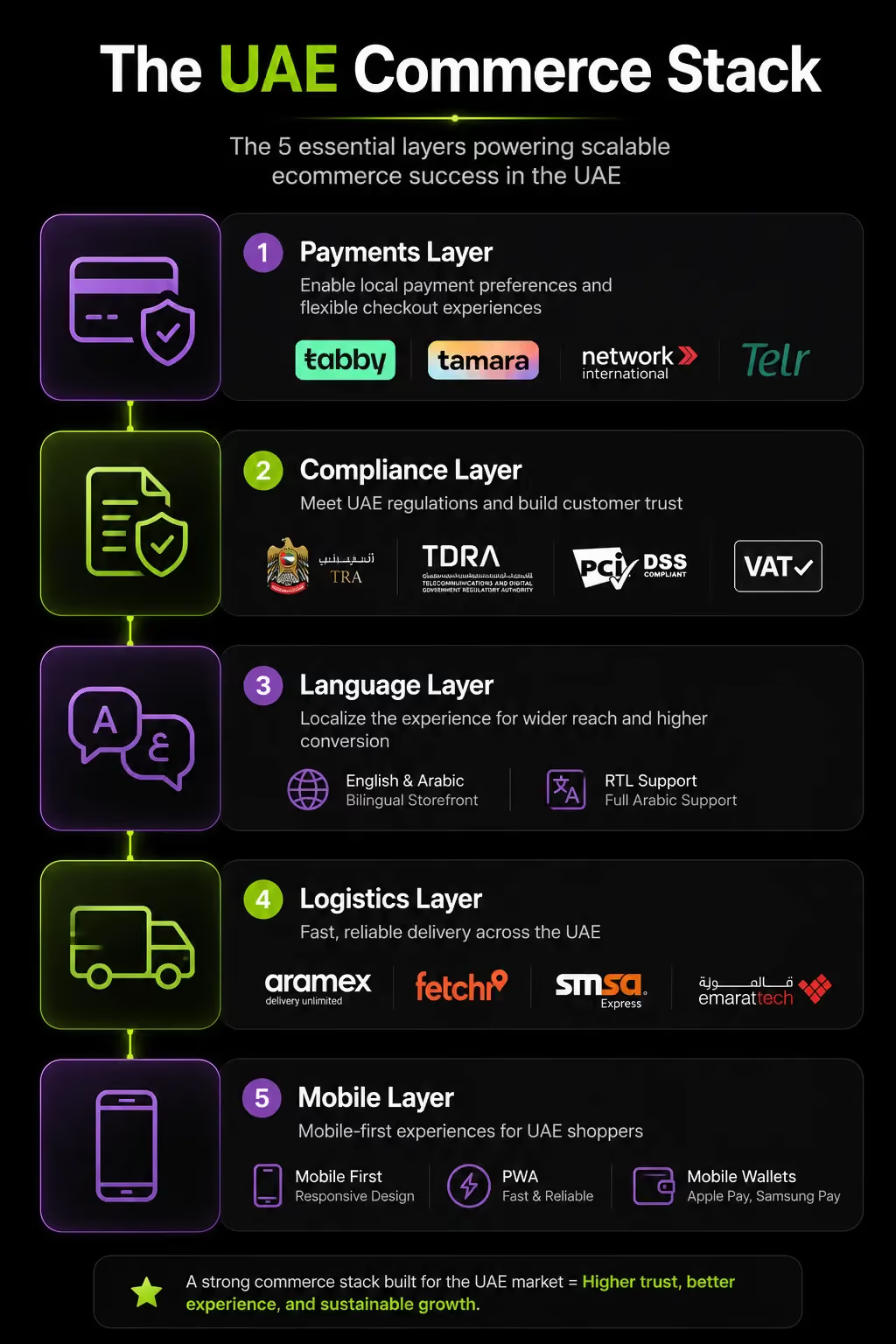
Most agencies operating in Dubai can build a website. Fewer have genuinely mapped this full commerce stack. The ones that have not will build you something that looks correct until it fails a UAE customer at checkout.
The Dubai D33 Economic Agenda is actively accelerating digital commerce adoption across the emirate. Competition in fashion, health and beauty, and FMCG is intensifying. The brands that invest in commerce-grade builds now will compound that advantage.
The ones running on generic web studio builds will face that gap when it becomes a revenue problem.
Related: International E-Commerce Setup
What Separates an Ecommerce Development Agency from a Web Design Company
This is the distinction that costs brands the most money when they get it wrong. A web design studio and an ecommerce agency both build websites. The output looks similar. The commercial result is not.
A web design studio optimizes for how the site looks. An ecommerce agency optimizes for how the site converts. Those are different briefs with different processes, different team compositions, and different outputs.
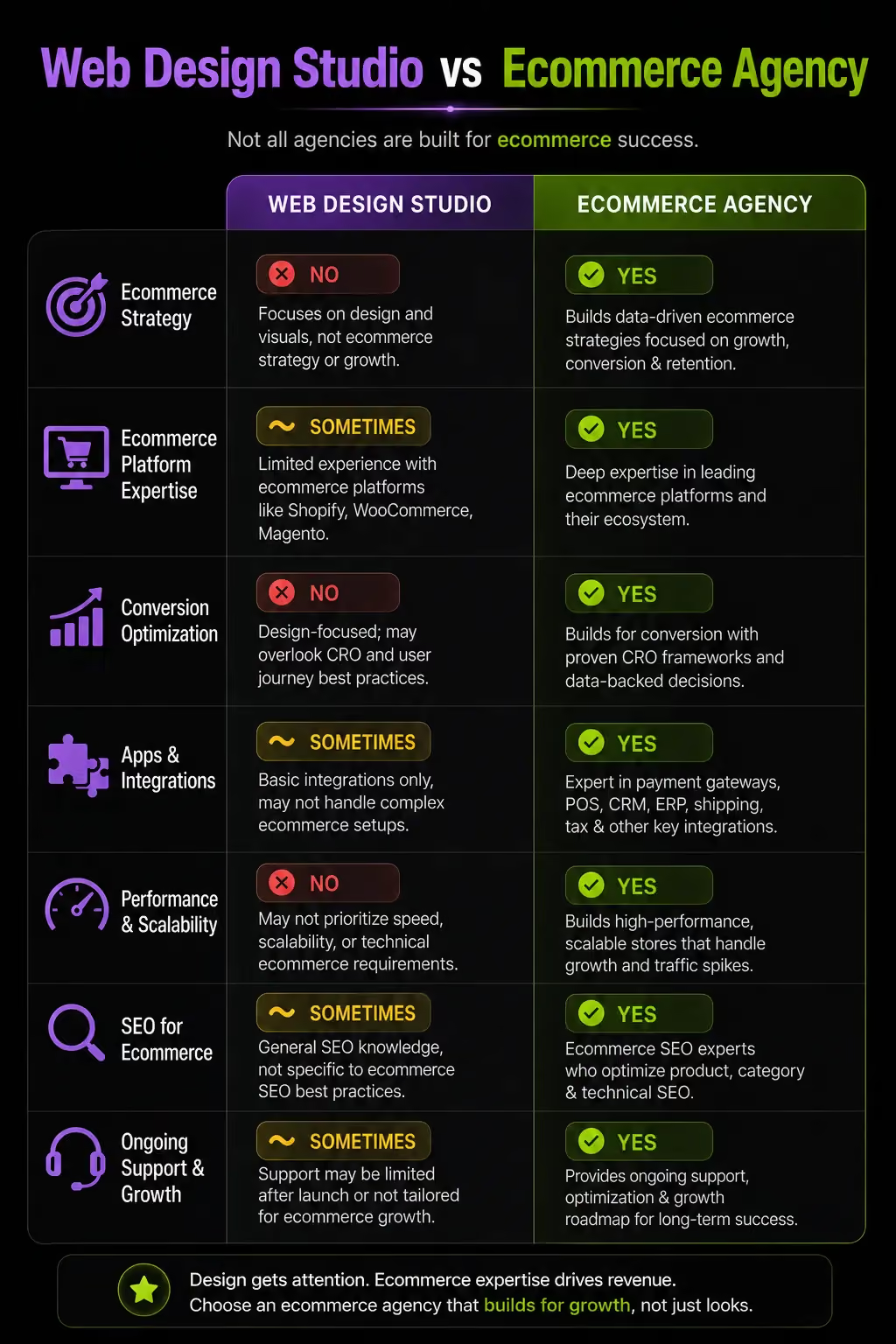
The difference is not the design quality. It is whether the agency sees a product page as a conversion tool, not a design canvas.
CTA placement, trust signals, product variants, and upsell logic drive sales, yet many generalist agencies overlook them.
A D2C supplement brand launches a polished site, but without upsells, cart recovery, or checkout optimization. Traffic arrives, sales do not. The agency built a brochure, not a store.
The Post-Launch Gap Where Most Agencies Disappear
An ecommerce store is not a one-time project. The best agencies stay involved after launch, using A/B testing, analytics, session recordings, and performance monitoring to improve conversions over time.
Others treat launch as the finish line. The site remains unchanged until something breaks and requires a fix.
Ask every agency: What does post-launch support include? If the answer focuses on maintenance and bug fixes instead of Conversion Rate Optimisation (CRO), they likely see their role as a vendor, not a growth partner.
The 7 Criteria That Define the Best Ecommerce Development Agency in UAE
The evaluation framework below is called the UAE Commerce Agency Scorecard. Apply it when shortlisting. Each criterion has a green signal of what a strong agency looks like and a red flag that signals a gap. Use both.
1. Ecommerce Platform Expertise Not Just Website Building
Platform strategy should align with business goals, not personal preference. A strong ecommerce agency can justify the right platform choice based on your business model, catalog complexity and growth plans, while knowing when custom development adds value and when it adds unnecessary cost.
✅Green flag: The agency asks about your order volume, SKU count, and international expansion plans before recommending a platform.
🚩Red flag: They say they can build on "any platform" without steering the conversation toward a recommendation. That answer means they have not thought about platform fit commercially.
Shopify powers over 4 million stores globally and is the preferred platform for growing D2C brands in the UAE. Shopify Plus handles high-volume operations at enterprise scale.
For the majority of UAE brands in fashion, health, and FMCG, one of these two is the right starting point.
2. UAE-Specific Commerce Knowledge
This is the criterion that eliminates the most agencies in the UAE market. Payment gateway integration experience, Arabic RTL capability, and VAT compliance are not optional features for a UAE ecommerce build.
They are baseline requirements. An agency that does not raise these topics proactively in the first conversation has likely not built a UAE-native store before.
✅Green flag: They ask which payment gateways you need before you mention them. They bring up VAT display logic and Arabic UX requirements unprompted.
🚩Red flag: They treat Arabic RTL as a CSS toggle. They have not integrated Tabby or Tamara before. They assume your UAE checkout is the same as any other checkout.
The bar for UAE payment knowledge is specific: API-level integration experience with Checkout.com UAE, Network International, and BNPL providers not plugin installation. There is a meaningful difference, and it shows in stability and conversion rate.
Related: International E-Commerce Setup
3. Mobile-First Design as Default, Not Afterthought
With 79% of UAE ecommerce transactions happening on mobile, mobile-first design is no longer optional. The primary design output should be the mobile experience, with desktop adapted from it.
Ask agencies how they approach mobile design. Do they prototype mobile first? Are initial design concepts shown on mobile screens?
Do they prioritize touch targets, thumb-friendly navigation, and frictionless mobile checkout flows?
✅Green flag: Their first mockups are mobile screens. They discuss mobile INP, LCP, and checkout flow on mobile as first-class concerns.
🚩Red flag: They show you a beautiful desktop design first and say mobile optimization happens in development.
4. Portfolio Depth and Vertical Relevance
A strong portfolio shows results, not just visuals. Look for conversion gains, revenue growth, and measurable performance improvements. If there are no numbers, there's no proof the work delivered business outcomes.
Industry experience matters too. Different sectors have different conversion drivers, so choose an agency with experience in your category.
✅Green flag: They share before-and-after conversion data for past clients. They can discuss how product page architecture differs between categories.
❌Red flag: Portfolio is entirely visuals. No revenue data, no performance benchmarks, no client references available.
Related: Miduty Case Study | Kooji Case Study | Gelatin Labs Case Study
5. Conversion Rate Optimization Built Into the Process
CRO should be built into the store from day one, not added later. Strong ecommerce agencies consider user flows, information architecture, and checkout optimization during the initial design phase.
Ask: “How do you incorporate CRO into the design process?” If the answer focuses only on A/B testing after launch, that's a warning sign.
✅Green flag: They talk about conversion architecture before they talk about visual design.
❌Red flag: CRO appears only in their services list, not in their described process.
6. Technical Performance Standards
53% of mobile users abandon a site that takes more than 3 seconds to load. In UAE, where mobile is the primary commerce device, a slow store is a broken store.
The agency you hire should have explicit answers to performance questions: What Core Web Vitals benchmarks do your builds typically achieve? What is your approach to image optimization, CDN configuration, lazy loading, and JavaScript management?
If they cannot answer those questions in specific terms, they are not building to a performance standard.
✅Green flag: They can state typical Lighthouse scores for recent builds and explain what they do to achieve them.
❌Red flag: "Performance optimization" appears in their service list but they cannot describe their process for it.
7. Post-Launch Support and Iteration Model
A store that launches and receives no further attention will gradually underperform relative to competitors who are iterating. Post-launch support from a serious ecommerce agency is not bug fixing.
It is a structured iteration cadence: reviewing conversion data, identifying drop-off points, running tests, and improving the store based on what real users do.
Ask specifically: Do you offer retainer-based post-launch support? What does your data review cycle look like? What tools do you use to measure performance against baseline post-launch?
✅Green flag: They describe a specific cadence for post-launch review and have retainer options structured around growth, not just maintenance.
❌Red flag: Post-launch support means a support ticket system for bug reports.
Related: D2C Data Analytics | Data Analytics Optimisation
UAE-Specific Technical Requirements Most Agencies Miss
This is the section most generic agency roundups skip entirely. UAE ecommerce has technical requirements that do not exist on a standard international build and getting them wrong costs you conversions, compliance exposure and brand trust with Arabic-speaking customers.
Arabic RTL More Than Flipping a Layout
Right-to-left layout is not a CSS setting. It is a complete rethinking of every design element on every page. Icon placement reverses. Navigation hierarchy mirrors. Number formatting rules differ.
CTA positions that work in LTR fail in RTL because the visual reading flow is different. And Arabic fonts must be selected specifically for commerce use: not all typefaces are legible at the sizes used for body copy, product descriptions, and cart summaries.
Bilingual stores Arabic and English simultaneously require a structured architecture decision, not a translated copy dropped into the same template.
The content hierarchy, navigation labels, and checkout language all need to function correctly in both directions. A Google-translated Arabic version of an English store is not a bilingual store. It is a liability.
When evaluating agencies, ask specifically: have you built bilingual Shopify stores with Arabic UX that was user-tested in Arabic? The answer to that question filters accurately.
Payment Gateway Integration in UAE
The UAE payment ecosystem is distinct from global defaults, and integration experience at the API level, not plugin installation, is what separates functional payment setups from fragile ones.
- Network International and Checkout.com UAE are the two primary enterprise-grade gateway choices for UAE merchants
- Telr and PayTabs are widely used for SME and mid-market brands
- Tabby and Tamara for BNPL now accepted by tens of thousands of UAE merchants and expected by consumers in fashion, electronics, and home categories
- Cash on delivery remains operationally relevant 71.2% of UAE retailers still offer it
- Digital wallets including Apple Pay and Google Pay are at 53% usage among UAE consumers
Each of these requires specific integration work. Tabby and Tamara widget implementation needs to be asynchronous to avoid checkout page load degradation. COD logic needs to interact correctly with order management and fulfillment workflows.
An agency that has done this before knows the edge cases. One doing it for the first time will charge you to learn them.
VAT Compliance and Cart Logic
UAE introduced 5% VAT in 2018. Every ecommerce store serving UAE customers must display and calculate VAT correctly.
VAT-inclusive versus VAT-exclusive pricing logic must be built explicitly into the cart, the checkout, and the order confirmation. VAT on shipping fees adds another layer. Cross-emirate complexities can affect tax logic further depending on your logistics setup.
This is not a plugin install. It is a checkout architecture decision that needs to be made correctly before build, not corrected after launch.
Ask any agency you evaluate: have you built VAT-compliant checkout flows for UAE merchants? Do you handle VAT on shipping? Agencies that have built in the UAE before know these questions are coming.
UAE Logistics Integration
Same-day delivery covers 90% of Dubai's urban population and is increasingly expected in Abu Dhabi and Sharjah.
For brands offering it, logistics API integration is part of the commerce build not a separate project.
Leading UAE logistics partners for ecommerce: Aramex, DHL Express, Fetchr, Quiqup, Ninja Van. Each has an API.
For brands using multiple logistics providers or 3PLs, the ecommerce platform needs to route orders correctly based on product type, destination emirate, and delivery SLA.
Per-order delivery costs run AED 15 to 25 for platforms that absorb shipping above a threshold. That cost structure needs to interact correctly with your cart logic, shipping thresholds, and free delivery rules.
Shopify vs Custom Development: What UAE Brands Should Know
This is a decision most UAE brands face during the agency briefing process. The honest answer is directional: for the majority of D2C and FMCG brands in the UAE, Shopify or Shopify Plus for higher volumes is the stronger starting point.
Custom development serves a specific set of genuine use cases and is frequently oversold to brands that do not need it.
When Shopify or Shopify Plus Is the Right Choice
Shopify is ideal for most D2C brands, combining fast deployment, reliable infrastructure, built-in mobile optimization, and easy scalability.
For UAE businesses, it reduces launch time and ongoing technical overhead. The Miduty project showed this clearly, delivering a faster launch, lower costs, and easier growth than a custom-built alternative.
When Custom Development Makes Sense
Custom development is justified in specific, well-defined scenarios:
- Complex B2B or marketplace models where buyer-seller logic, multi-vendor architecture, or custom quoting flows exist that no Shopify app covers
- Brands with deep legacy system integrations custom ERP, proprietary WMS, or bespoke pricing engines that require API architecture not achievable through Shopify's standard integration layer
- Enterprise-level brands with dedicated internal tech teams who can maintain and extend a custom codebase over time
If your brief does not include at least one of those scenarios, you probably do not need custom development.
An agency recommending it without a clear commercial justification is either padding scope or defaulting to what they know how to build.
The Platform Decision Framework
The Questions You Must Ask Before Signing Any Ecommerce Agency in UAE
Most buyers ask about price and timeline. Those are the wrong starting questions. They tell you what the project costs and when it ends, not whether the agency can deliver what you actually need. The questions below reframe the evaluation toward capability and accountability.
Questions About Capability
- Which ecommerce platforms do you specialize in, and how do you decide which to recommend for a specific brand?
- Can you show me a case study that includes conversion rate or revenue data, not just design screenshots?
- How do you handle Arabic RTL and bilingual store architecture specifically, have you user-tested Arabic UX on stores you've built?
- Which UAE payment gateways have you integrated at the API level? Can you integrate Tabby and Tamara?
- Have you built VAT-compliant checkout flows before? How do you handle VAT on shipping fees?
Questions About Process
- Walk me through your discovery and information architecture phase before design begins.
- How does CRO factor into your initial design process not as a later phase, but from the first wireframe?
- What does your mobile-first design process look like? Do you prototype mobile before desktop?
- What Core Web Vitals scores do your stores typically achieve post-launch, and what do you do to get there?
Questions About Accountability
- What does your post-launch support structure look like beyond bug fixing?
- How do you handle scope changes after design is approved?
- Can I speak to two or three clients who launched with you in the past 12 months?
- Do you offer a retainer for ongoing iteration and performance improvement after launch?
How We Approach Ecommerce Development at Suplex
Suplex is a certified Shopify Partner, Google Partner, and Meta Business Partner based in Dubai, UAE.
Our team of 40+ works exclusively in ecommerce and digital commerce not as a side service alongside social media management and printing, but as the entire focus of what we do.
We Build for Revenue, Not Just Appearance
Every engagement begins with a commerce audit to identify conversion blockers, audience behavior, and funnel weaknesses. These insights shape the store's architecture, product pages, and checkout experience.
We've delivered ecommerce solutions across health and wellness, hospitality, skincare, lifestyle, photography, and food brands in the UAE, India, and the US.
The goal is always the same: build a high-converting, mobile-first store that supports long-term growth.
Our Process: From Audit to Post-Launch Iteration
Our process follows a proven framework: Discovery, Information Architecture, UX/UI Design, Development, Optimization, Launch, and ongoing iteration.
Launch is not the finish line, it's the starting point for measuring and improving performance.
Post-launch, we monitor Core Web Vitals, conversion rates, and user behavior to identify friction points and continuously optimize the store.
This ongoing refinement is often where the greatest growth gains are achieved.
Our Shopify Partner, Google Partner, and Meta Business Partner credentials reflect the same data-driven approach we apply to every ecommerce project.
What We Do Not Do
We do not take on every project that comes through the door. Suplex works best with brands that want a strategic commerce partner.
We do not install themes and call them custom. We do not disappear after launch. And we do not recommend platforms without a commercial reason for the recommendation.
If you are evaluating ecommerce agencies in the UAE for a serious build, the process matters as much as the portfolio. Ask us the same questions listed above. We expect them.
Common Mistakes UAE Brands Make When Choosing an Ecommerce Agency
These patterns appear repeatedly in the UAE market. Knowing them before you start evaluating will save you the cost of experiencing them firsthand.
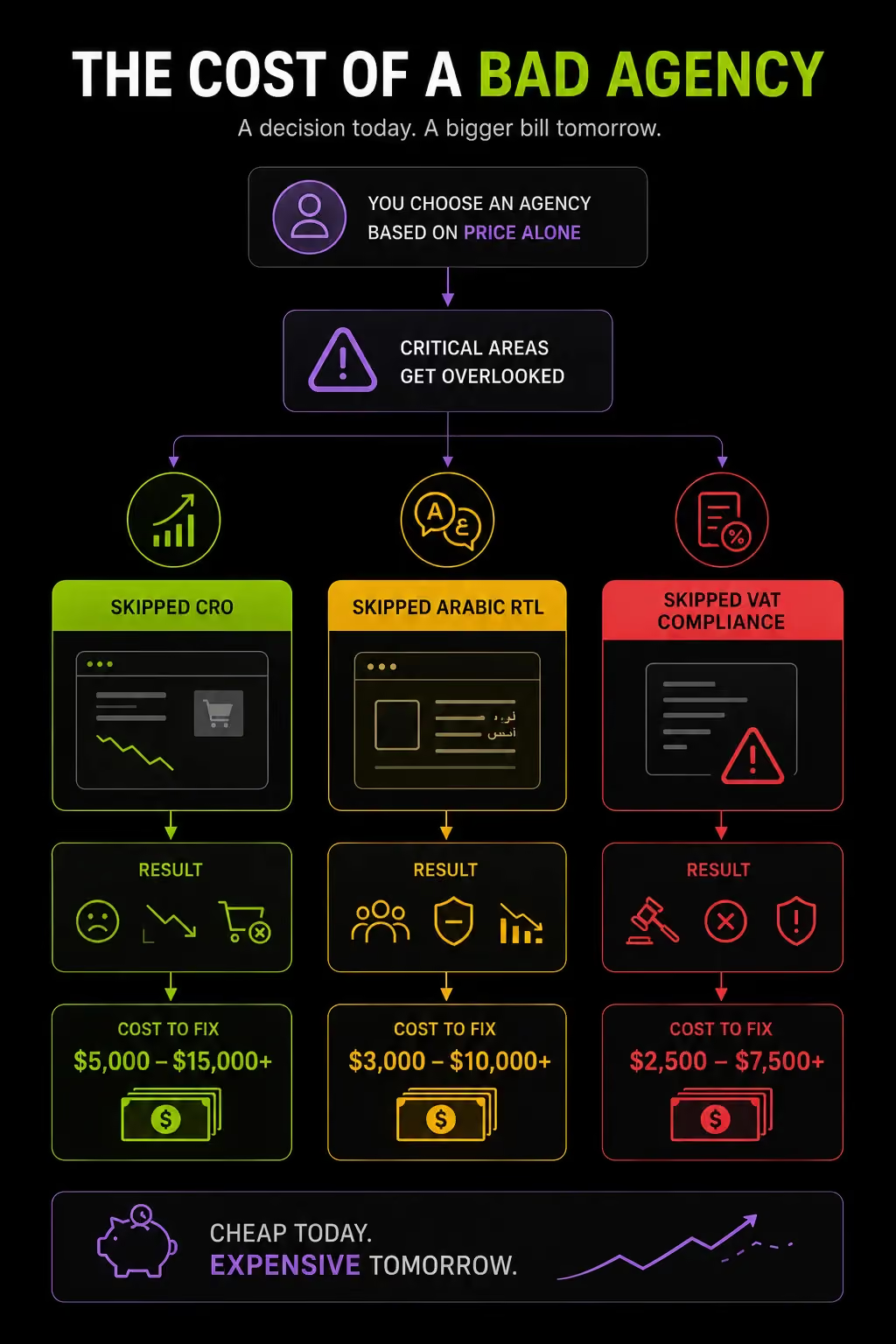
Choosing on Price, Not on Commercial Fit
The lowest quote is often the most expensive in the long run. Features like CRO, post-launch optimization, mobile performance and regional requirements are frequently excluded and cost far more to add later.
What matters is not the build cost, but the revenue it generates. Even small conversion rate improvements can deliver returns that far exceed the difference between a budget build and a strategically designed ecommerce store.
Treating the Website as a Project, Not a Platform
The best ecommerce stores are not built once and left unchanged. Launch is the starting point, not the finish line. Real user behavior, conversion data, and ongoing testing reveal opportunities for continuous improvement.
Brands and agencies that plan for iteration consistently achieve better long-term performance than those that treat ecommerce as a one-time project.
Ignoring UAE-Specific Requirements Until After Launch
VAT logic errors discovered after launch require emergency developer intervention. Payment gateway failures at checkout because the integration was not fully tested cost real sales.
Arabic layout issues surfaced by customers buttons rendering incorrectly, text overflowing containers, RTL checkout breaking and damaging brand trust in a market where 40%+ of residents are Arabic-speaking.
None of these are difficult problems to prevent. All of them are expensive to fix after the fact.
The time to ask about VAT compliance and Arabic UX capability is during agency evaluation, not during a post-launch incident.
Not Verifying Platform Expertise
Many agencies list Shopify expertise as a service without having done anything beyond installing themes from the Shopify theme store.
Verified expertise means: active Shopify Partner status visible in the Shopify Partner Directory, demonstrated API-level integration work, and custom theme development examples built in Liquid with documented client outcomes.
Ask for Shopify Partner credentials and verify them directly. A badge on a website is not verification. Directory presence is.
Ecommerce Website Cost in UAE: What to Expect in 2026
This is the question every brand has and few sources answer specifically for the UAE context.
The ranges below reflect the actual market in 2026, including local labor costs, platform licensing, and integration complexity.
Typical Ecommerce Website Development Cost in UAE
What Drives the Cost Up
- Arabic and bilingual store setup with proper RTL architecture and real-language UX testing
- Custom payment gateway integrations at the API level particularly Tabby, Tamara, and multi-gateway setups
- Complex product configurators, subscription models, or bundle logic
- Full analytics and attribution setup: GA4, Meta Pixel, TikTok Pixel, server-side tracking
- Mobile app development (iOS and Android) alongside the web store
What Drives the Cost Down and Why It Carries Risk
- Template-only builds with no custom information architecture or UX design
- Skipping the CRO and discovery phase entirely
- No post-launch retainer or support structure
- Skipping VAT compliance review and Arabic UX testing
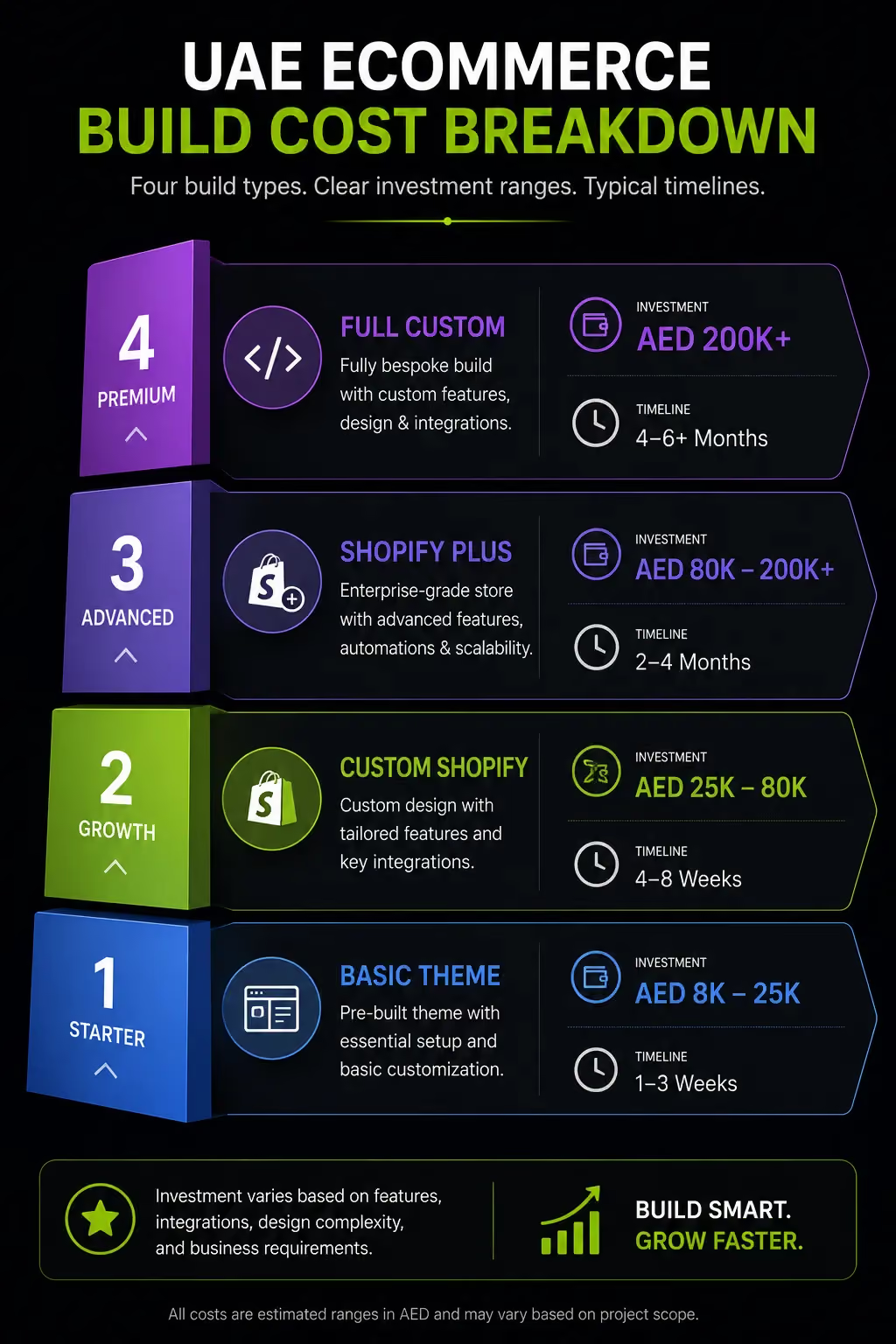
Each of those cost reductions shifts risk to post-launch. When those issues surface after the store is live and they will, the fix costs more than the saving was worth.
Related: E-Commerce Store Setup
Frequently Asked Questions
What is the best ecommerce development agency in UAE?
The best ecommerce agency specializes in ecommerce, understands UAE-specific requirements, holds verified Shopify Partner status, and can demonstrate measurable business results, not just attractive designs.
How much does ecommerce website development cost in UAE?
Costs typically range from AED 8,000 for basic Shopify stores to AED 200,000+ for enterprise-level builds. Most growing D2C brands invest between AED 25,000 and AED 80,000.
Should I use Shopify or custom development for my UAE ecommerce store?
Shopify is the best choice for most D2C brands due to faster launches, lower maintenance, and built-in scalability. Custom development is usually reserved for complex B2B, marketplace, or heavily integrated platforms.
What UAE-specific technical requirements should an ecommerce agency know?
Key requirements include Arabic RTL support, UAE VAT compliance, local payment gateway integrations, BNPL providers, and logistics integrations.
How do I evaluate an ecommerce agency's portfolio?
Focus on results, not visuals. Look for conversion improvements, revenue growth, performance metrics, and client references.
What questions should I ask an ecommerce development agency in UAE?
Ask about platform expertise, UAE integrations, CRO methodology, mobile-first design, post-launch support, and measurable client outcomes.
What is a Shopify Partner agency and why does it matter?
A Shopify Partner agency has verified platform expertise and access to Shopify resources, providing greater confidence in its technical capabilities and experience.
Hi, I’m Rishabh Jain
I believe great digital experiences have the power to shape perception, build trust, and move businesses forward. That belief led me to found Suplex Design Studio, a global digital design and development studio helping FMCG and D2C brands build websites and digital experiences that are strategic, thoughtful, and commercially meaningful.
I started Suplex at 25 with a clear intent, to create digital experiences that look appealing, work seamlessly, and help D2C businesses grow. By 28, the studio had scaled globally, guided by a strong foundation in integrated design that I developed during my academic journey in London, where I was honoured with the Dean’s Award.
Over the years, I’ve had the opportunity to work with 100+ brands, from Fortune 500 organisations to family-run businesses, helping them build websites, e-commerce experiences, and digital products that create clarity, credibility, and long-term value.
Our work has been recognised internationally, including the Manifest Award (2024), the Clutch Global Award (2025), and features across platforms such as The Dieline, Packaging of the World, and the World Brand Design Society.
None of this would be possible without the people behind the work. I’m deeply grateful to the Suplex team, whose commitment, creativity, and attention to detail turn ideas into meaningful digital experiences every day.
At the heart of our work is a simple philosophy, digital design should be intentional, functional, and built to create real business value. That continues to guide everything we create at Suplex.


































Let’s Make It Happen
E-Commerce Success Stories
%201.avif)






.avif)

.avif)
Build Your D2C Business The Right Way
Build It With Suplex.


