Bilingual Shopify Store Setup For UAE Brands: The Full Guide
.avif)
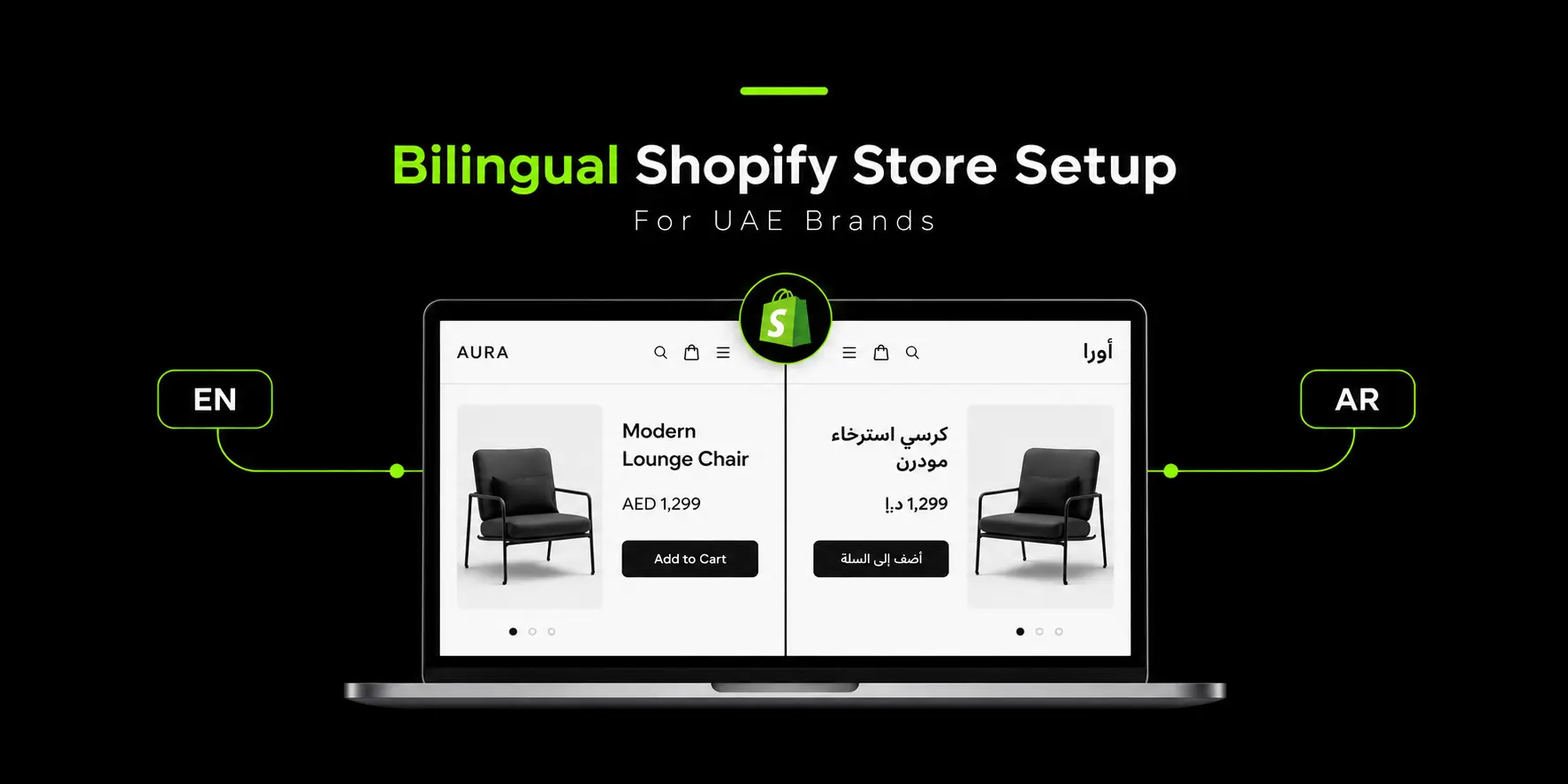
Bilingual Shopify Store Setup For UAE Brands: The Full Guide
A bilingual Shopify store for UAE customers involves more than adding Arabic to an English website. A strong setup needs accurate Arabic and English content, proper RTL design, localized SEO and a reliable process for keeping both languages updated.
Shopify tools such as Translate & Adapt can support translation, while third party apps may provide more advanced workflows.
However, translation is only one part of the process. Navigation, product pages, filters, forms, checkout elements, and other interface components must also work correctly in RTL.
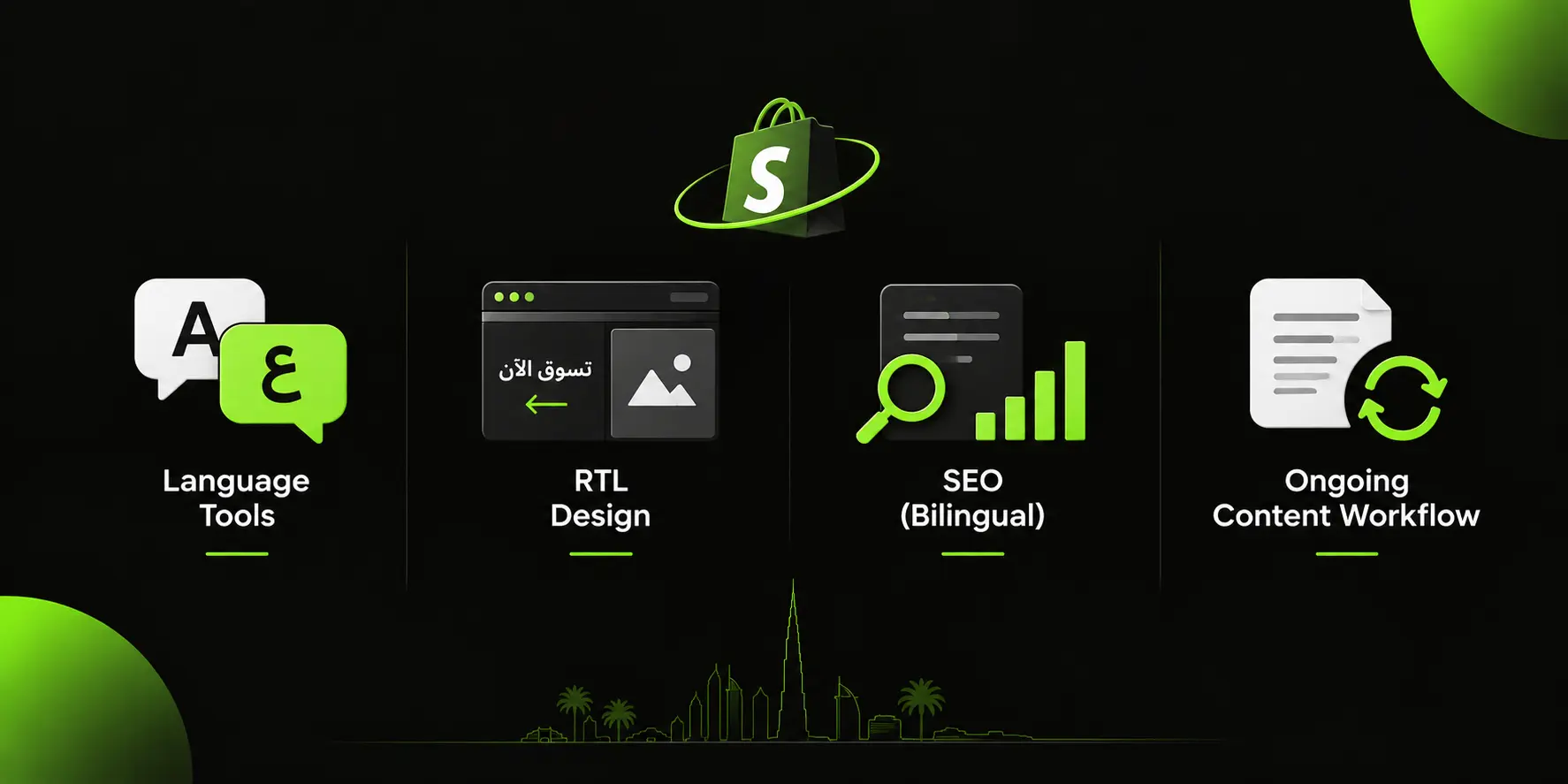
This Suplex guide covers language setup, RTL design, translation tools, Arabic SEO, localized content, and ongoing bilingual store management.
Do You Actually Need a Bilingual Store? (Quick Decision Guide)
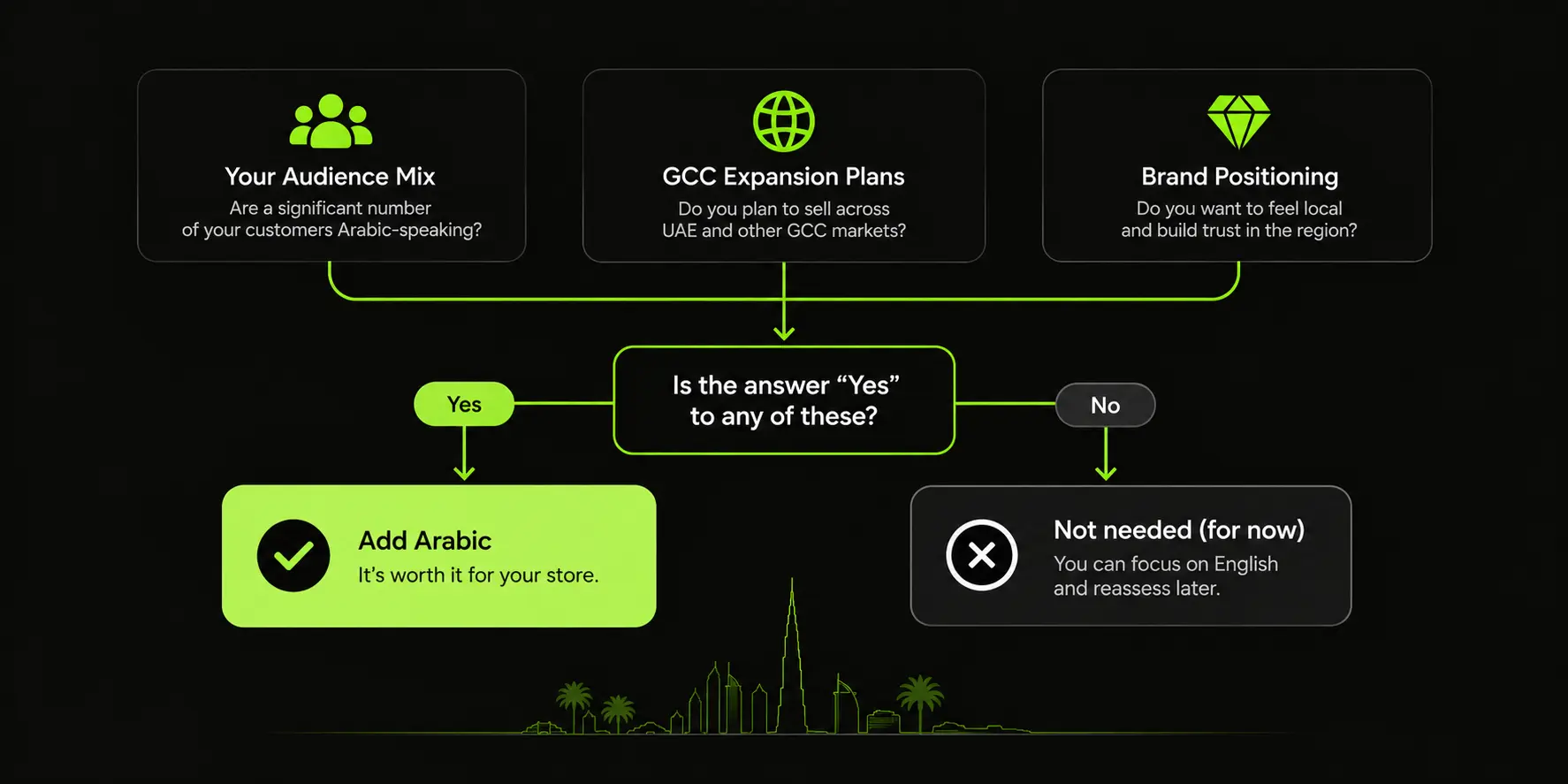
Not every UAE brand needs a bilingual Shopify store. While Arabic can improve accessibility and reach, adding a second language also creates ongoing work across product content, SEO, design, customer support, and store maintenance.
The decision should be based on your actual audience rather than the assumption that every UAE business needs Arabic.
Signals You Need Arabic
Arabic localization is worth considering if:
- Arabic-speaking customers represent a meaningful share of your traffic, sales, or enquiries
- You plan to expand into Saudi Arabia or other GCC markets
- Your Instagram, TikTok, or WhatsApp audience regularly engages in Arabic
- Your products have strong demand among Arabic-speaking shoppers
- Your analytics show visitors switching to or searching for Arabic content
Review your own data before making the decision. Traffic by country, browser language, search queries, social engagement, WhatsApp conversations, and customer feedback can provide stronger signals than general UAE market statistics.
When English-Only Is Genuinely Fine
English can be sufficient when your audience is primarily English-speaking expats, you sell B2B to corporate buyers, or your brand has an international positioning where English is part of the customer experience. It can also make sense when testing the UAE market before investing in full localization.
The goal is not simply to offer two languages. It is to maintain both properly. If Arabic is added, product pages, navigation, SEO, RTL layouts, forms, and ongoing content updates all need to be maintained consistently.
If your audience data does not justify that investment, a well-built English store may be the more practical starting point.
Setting Up Shopify's Native Language Tools
Once you have decided to add Arabic, start with Shopify’s native language tools before adding another translation app.
Adding Arabic Under Settings > Languages
In Shopify admin, go to Settings > Languages, select Add Language, choose Arabic, and publish it when your translations are ready. Shopify also lets you manage languages separately for different markets through Shopify Markets.
What Translate & Adapt Does Well
Shopify Translate & Adapt provides a straightforward starting point for bilingual stores. It supports translations for products, collections, pages, blog posts, policies and theme content, with options for automatic and manual translation.
For stores using a standard theme and relatively simple content structure, this can cover much of the basic translation work.
Where You Need Extra Review
Translation does not automatically mean the entire storefront is localized. Custom theme sections, HTML or Liquid content, app-generated elements, and some custom content may require additional translation or manual review.
Shopify itself recommends checking translations and using other methods where content is not supported directly.
This matters especially for beauty stores using ingredient tables, product recommendations, reviews, quizzes, or custom metafields. A page can appear translated while individual sections remain in English.
When to Consider a Third-Party App
For more complex stores, tools such as Weglot or Langify can provide additional translation workflow and content management features. Weglot offers glossary rules, while Langify provides features such as third-party app translations and custom content support.
For a simple catalog, start with Translate & Adapt. For heavily customized or app-dependent stores, evaluate whether a third-party solution is justified. For the wider localization framework, see our guide to Arabic ecommerce website design.
RTL Design: What Shopify's Defaults Don't Handle
Adding Arabic to Shopify does not automatically make every part of your store work correctly in right-to-left (RTL) mode. Shopify themes can support RTL, but the quality of implementation varies, particularly when a store uses custom sections or third-party apps.
Why RTL Support Varies by Theme
Shopify can handle basic text direction and alignment in supported themes, but individual themes may still require adjustments for positioning, spacing, icons, and interactive elements. Third-party apps can introduce additional RTL issues because their widgets may not follow the theme's layout rules.
Common RTL Failure Points
Pay particular attention to:
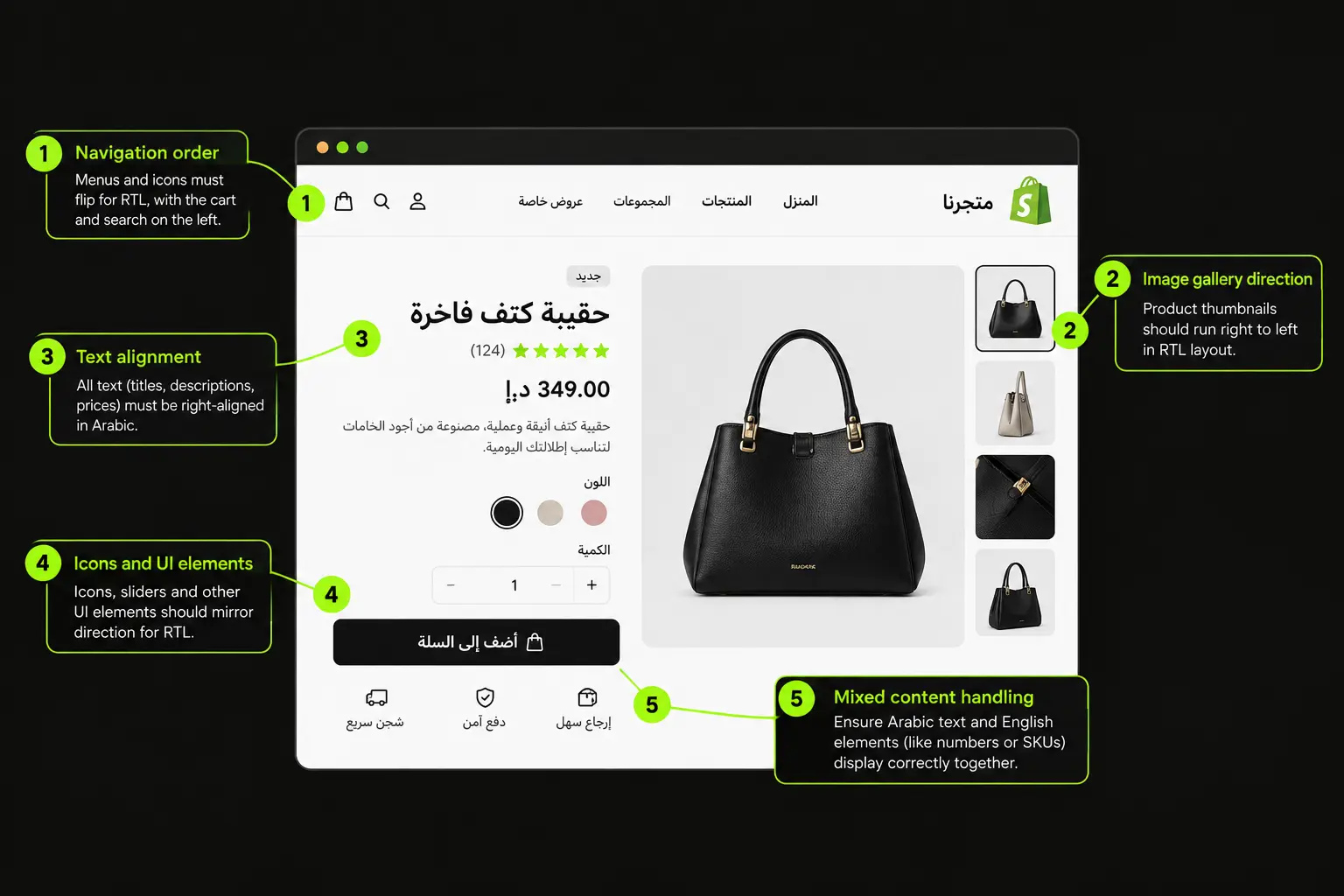
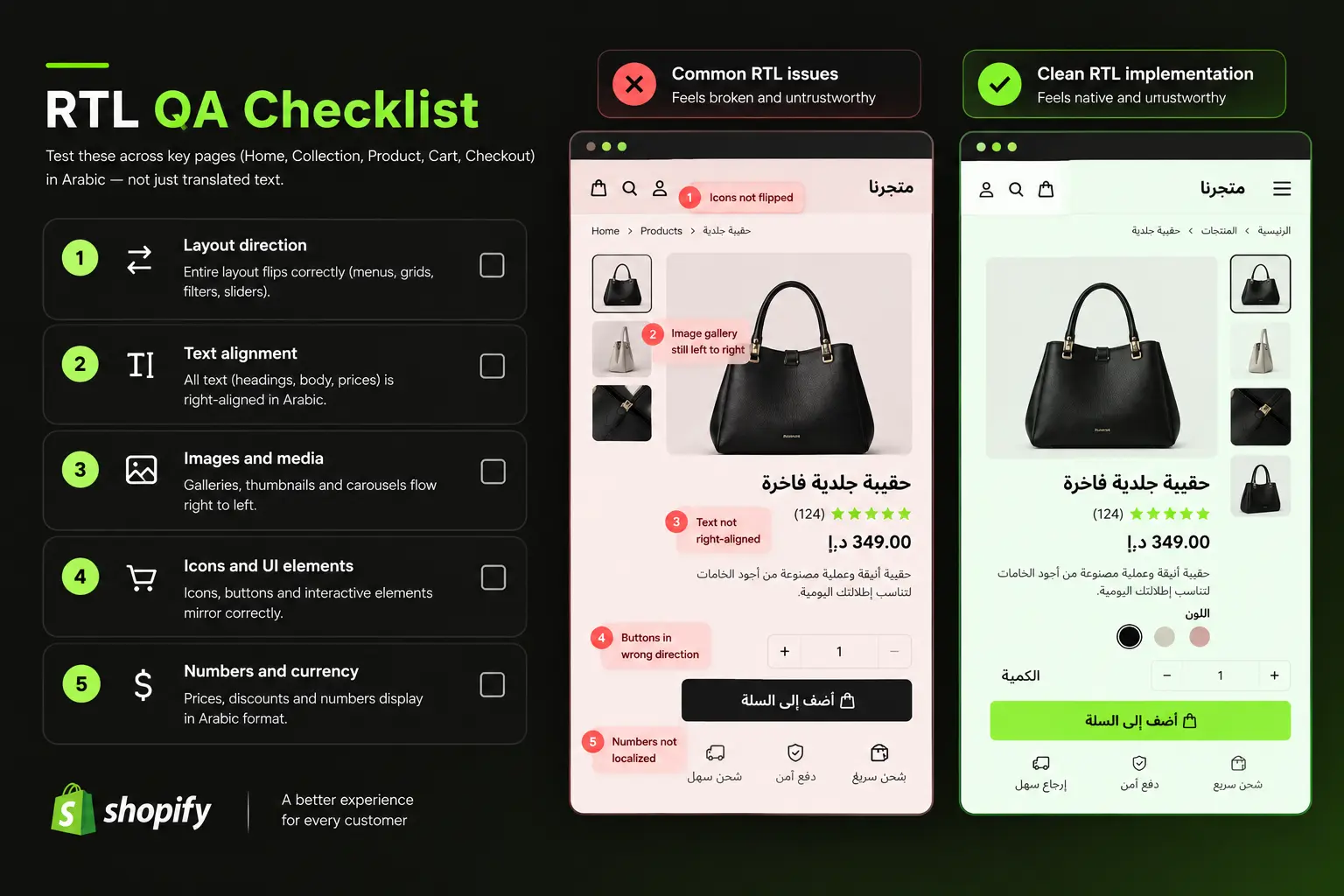
- Product Galleries: Thumbnail placement, image navigation, and next/previous controls should follow the RTL direction.
- Navigation Menus: Multi-level dropdowns and submenu indicators should open and point in the correct direction.
- Icons: Arrows, chevrons, and other directional icons may need to be mirrored.
- Prices and Product Information: Currency, pricing, labels, and product details should maintain a consistent visual hierarchy.
- Forms and Checkout: Field alignment, validation messages, buttons, and payment elements need to be tested specifically in Arabic.
- Third-Party Widgets: Reviews, quizzes, chat tools, and other app elements should be checked for RTL compatibility.
Testing RTL Properly
Do not judge RTL support by checking only the homepage. Test the complete customer journey across desktop and mobile:
- Homepage and navigation
- Collection pages and filters
- Product pages, galleries, and swatches
- Cart and checkout
- Order confirmation
- Third-party app widgets
- iOS Safari and Android Chrome
RTL QA Checklist
☐ Navigation and dropdowns mirror correctly
☐ Product galleries follow RTL direction
☐ Prices and currency display consistently
☐ Forms and validation messages align correctly
☐ Directional icons and chevrons are mirrored
☐ Product tables and specifications mirror correctly
☐ Third-party widgets work properly in Arabic
☐ Mobile RTL experience tested on real devices
For checkout-specific localization, see our guide on How to Localize Shopify Checkout for UAE Customers.
Testing RTL Properly
Switching the language and eyeballing the homepage tells you almost nothing about whether RTL actually works. Proper testing means going through every major template, homepage, collection page, product page, cart and checkout, in Arabic specifically, checking each of the failure points above individually rather than assuming a clean homepage means the rest of the site follows.
RTL QA Checklist
☐ Product image galleries navigate in the correct mirrored direction
☐ Directional icons (arrows, chevrons) flip correctly, not just text
☐ Price and currency display aligns consistently with the RTL layout
☐ Checkout form fields, validation messages, and payment icons tested specifically in Arabic
☐ Multi-level navigation menus tested at every depth, not just the top level
☐ Product tables (ingredient lists, size charts, specifications) mirror column order correctly
SEO For A Bilingual Shopify Store
Two languages means two separate SEO efforts, not one effort duplicated.
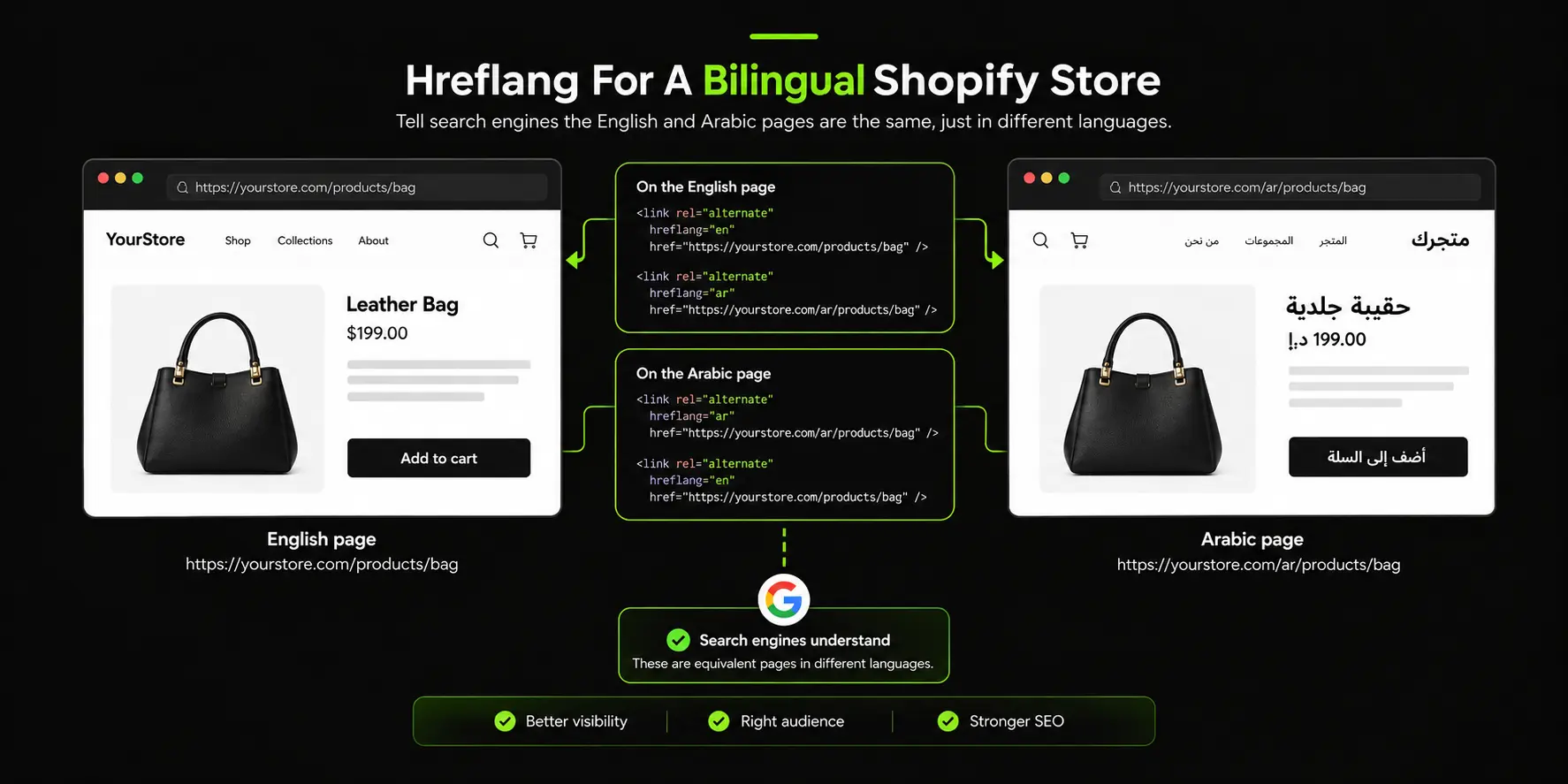
hreflang Setup For Arabic/English Pages
hreflang tags tell search engines which language version of a page to serve to which audience, and they need to be implemented correctly across every equivalent page pair, homepage to homepage, product page to product page, not just applied once at the site level.
Missing or incorrect hreflang implementation is a common reason a bilingual store's two language versions end up competing against each other in search rather than each ranking cleanly for its own audience.
Why Arabic Keyword Research Isn't Just A Translation Of English Keywords
Arabic-speaking shoppers frequently search using different phrasing and terminology than a literal translation of an English keyword would produce and search behavior in the Gulf is genuinely bilingual within the same audience, with many users switching between English and Arabic queries depending on the type of product or intent.
Treating Arabic SEO as "translate the English keyword list" misses real search volume and misrepresents how your actual Arabic-speaking audience searches.
A UAE shopper might search for a lifestyle or brand-name product in English while switching to Arabic for a more everyday, functional need, and a keyword strategy built purely on translated English terms never captures that second pattern at all.
Avoiding Duplicate-Content Issues Between Language Versions
Search engines can flag near-identical content across two language versions of a page as duplicate content if the language signals, hreflang tags, and canonical structure are not implemented correctly, which undermines the SEO value of having built the Arabic version in the first place.
Keeping A Bilingual Store Maintained, Not Just Launched
The launch is the easy part. Maintenance is where most bilingual stores quietly degrade.
Content Workflow For New Products Or Pages In Both Languages
Every new product, collection, or page added to the English version needs a corresponding Arabic update as part of the same publishing workflow, not a separate task that gets queued and often delayed.
Without a defined process, Arabic content drifts behind English by default, since English is usually the language the internal team works in day to day.
Who Should Own Arabic Content Quality
Machine translation alone is rarely sufficient for customer-facing, high-trust content: homepage messaging, key product descriptions, checkout, and policy pages.
Native review, whether an in-house Arabic speaker or a translation partner, should own quality on these specific pages even if machine translation handles lower-priority catalog content at scale.
Assigning a specific person or partner as the owner of Arabic content quality, rather than treating it as everyone's shared responsibility, is usually the difference between a bilingual store that stays consistent and one where Arabic quality slowly erodes because no single person is accountable for catching it.
Common Bilingual Store Maintenance Mistakes
The most common failure pattern is straightforward: English gets updated regularly as the business evolves and Arabic quietly falls behind, sometimes for months, until a customer or an internal review catches a stale or outdated Arabic page.
This is less a technical failure than an operational one, and it is exactly why bilingualism needs to be treated as a maintained system with clear ownership, not a project that ends at launch.
A seasonal promotion updated in English but never mirrored in Arabic, or a price change that syncs automatically while the accompanying Arabic product description still references an old offer, are the kind of small, easy-to-miss gaps that accumulate into a genuinely inconsistent bilingual experience over time.
How We Build Bilingual Shopify Stores for UAE Brands
At Suplex, we treat bilingual Shopify development as more than adding Arabic to an existing store. RTL QA is part of the build process, with every major template tested across navigation, product pages, galleries, forms, checkout, and third-party app widgets before launch.
We also choose the translation approach based on the store's actual requirements. A smaller catalog with a standard theme may work well with Shopify Translate & Adapt, while a larger catalog with custom metafields, complex product data, or app-generated content may need a more advanced translation solution.
We also help brands decide whether they genuinely need Arabic before adding the ongoing cost of maintaining another language. When Arabic is the right choice, we establish a content workflow from the start so new products, collections, and updates are translated and reviewed consistently.
If you are planning a bilingual Shopify store or want to assess your existing setup, explore our ecommerce development services.
Bilingual Shopify Setup Checklist
Use this checklist before launching or auditing a bilingual UAE Shopify store. The goal is not simply to add Arabic, but to make sure both languages work consistently across design, SEO, content, and ongoing store management.
Language Setup
☐ Confirm Arabic is justified by your audience and business plans
☐ Add Arabic under Settings > Languages
☐ Choose Translate & Adapt or a third-party translation solution based on your catalog complexity
☐ Translate theme, product, collection, page, and blog content
☐ Review metafields, custom sections, and app-generated content
☐ Manually review important Arabic translations before publishing
RTL Layout
☐ Test RTL across the homepage, collections, products, cart, and checkout
☐ Navigation and dropdown menus mirror correctly
☐ Product galleries and directional controls work correctly
☐ Prices, forms, buttons, and validation messages align properly
☐ Icons and chevrons point in the correct direction
☐ Product tables, specifications, and ingredient information mirror correctly
☐ Third-party app widgets work correctly in RTL
☐ Test mobile layouts on iOS and Android
SEO
☐ Conduct separate Arabic keyword research
☐ Write localized Arabic titles, H1s, and meta descriptions
☐ Verify hreflang implementation for equivalent language pages
☐ Check canonical URLs and duplicate-content issues
☐ Confirm translated pages are discoverable and included appropriately in the sitemap
Content Workflow
☐ Assign clear ownership for Arabic content
☐ Define an approval and quality-review process
☐ Document the workflow for translating new products and collections
☐ Establish a process for keeping Arabic content updated whenever English content changes
A bilingual store is only effective when Arabic remains accurate and maintained after launch. Build the translation and QA workflow into your ongoing Shopify operations rather than treating localization as a one-time task.
Frequently Asked Questions
Is Shopify legal and fully functional for bilingual Arabic/English stores in the UAE?
Yes. Shopify natively supports adding Arabic as a store language and includes RTL layout handling at the platform level. Full bilingual readiness still depends on your theme's RTL implementation and how your content is translated and maintained; the platform supports it, but a working bilingual store takes deliberate setup beyond just switching a language on.
What are the limitations of Shopify's Translate & Adapt app?
Translate & Adapt handles standard storefront text well but often misses content embedded in metafields, app-generated blocks, and custom theme sections. Product descriptions with embedded HTML formatting can translate inconsistently. Most stores with complex catalogs pair it with manual review or a more flexible third-party app like Weglot for full coverage.
Does every Shopify theme support RTL layout properly?
No. Shopify's platform supports RTL, but individual themes implement it with varying quality; some flip layout cleanly, others leave icons, price alignment, or navigation elements broken in Arabic. This is one of the most commonly missed steps in bilingual setups. RTL needs to be tested page-by-page, not assumed from the theme description.
Do Arabic and English pages need separate SEO treatment on Shopify?
Yes. Arabic keyword research shouldn't be a direct translation of English target keywords; search behavior and phrasing differ. You'll also need correct hreflang tags so search engines serve the right language version to the right audience, and should watch for duplicate-content issues between the two versions.
How much does a bilingual Shopify setup cost in the UAE?
Cost varies with catalog size and how much custom RTL/theme work is needed, ranging from a lighter setup using Translate & Adapt on an existing theme to a fuller custom build with dedicated RTL QA and content workflow. Get a fixed scope from whoever you work with rather than an hourly estimate, since translation and RTL QA effort is hard to predict without seeing the catalog.
Should I use machine translation or hire someone to translate my Shopify store into Arabic? Machine translation is a reasonable starting point for high volume catalogs, but customer-facing pages, homepage, key product descriptions, checkout, and policies, benefit from native review. A hybrid approach, machine translation plus native review of high-traffic pages, is the most common practical setup for UAE brands balancing cost and quality.
Hi, I’m Rishabh Jain
I believe great design has the power to shape perception, build trust, and move businesses forward. That belief is what led me to found Suplex Design Studio, a global branding and packaging studio working with FMCG and D2C brands across markets.I started suplex at 25 with a clear intent, to create design that is strategic, thoughtful, and commercially meaningful. By 28, the studio had scaled globally, guided by a strong foundation in Integrated Design that I developed during my academic journey in London, where I was honoured with the Dean’s Award.
Over the years, I’ve had the opportunity to work with 100+ brands, from Fortune 500 organizations to family-run businesses, helping them build packaging and brand systems that create recall, relevance, and long-term value.
Suplex’s work has been recognized internationally, including the Manifest Award (2024), the Clutch Global Award (2025), and features on platforms such as Packaging of the World, The Dieline, and the World Brand Design Society.
None of this would be possible without the people behind the work. I’m deeply grateful to the suplex team, whose commitment, creativity, and attention to detail turn ideas into meaningful brand experiences every day.
At the heart of my work is a simple philosophy, design should be intentional, honest, and built to last, and that continues to guide everything we create at suplex.


















Let’s Make It Happen
E-Commerce Success Stories
%201.avif)






.avif)
.avif)
Build Your D2C Business The Right Way
Build It With Suplex.


