How To Localize Shopify Checkout For UAE Customers
.avif)
How To Localize Shopify Checkout For UAE Customers
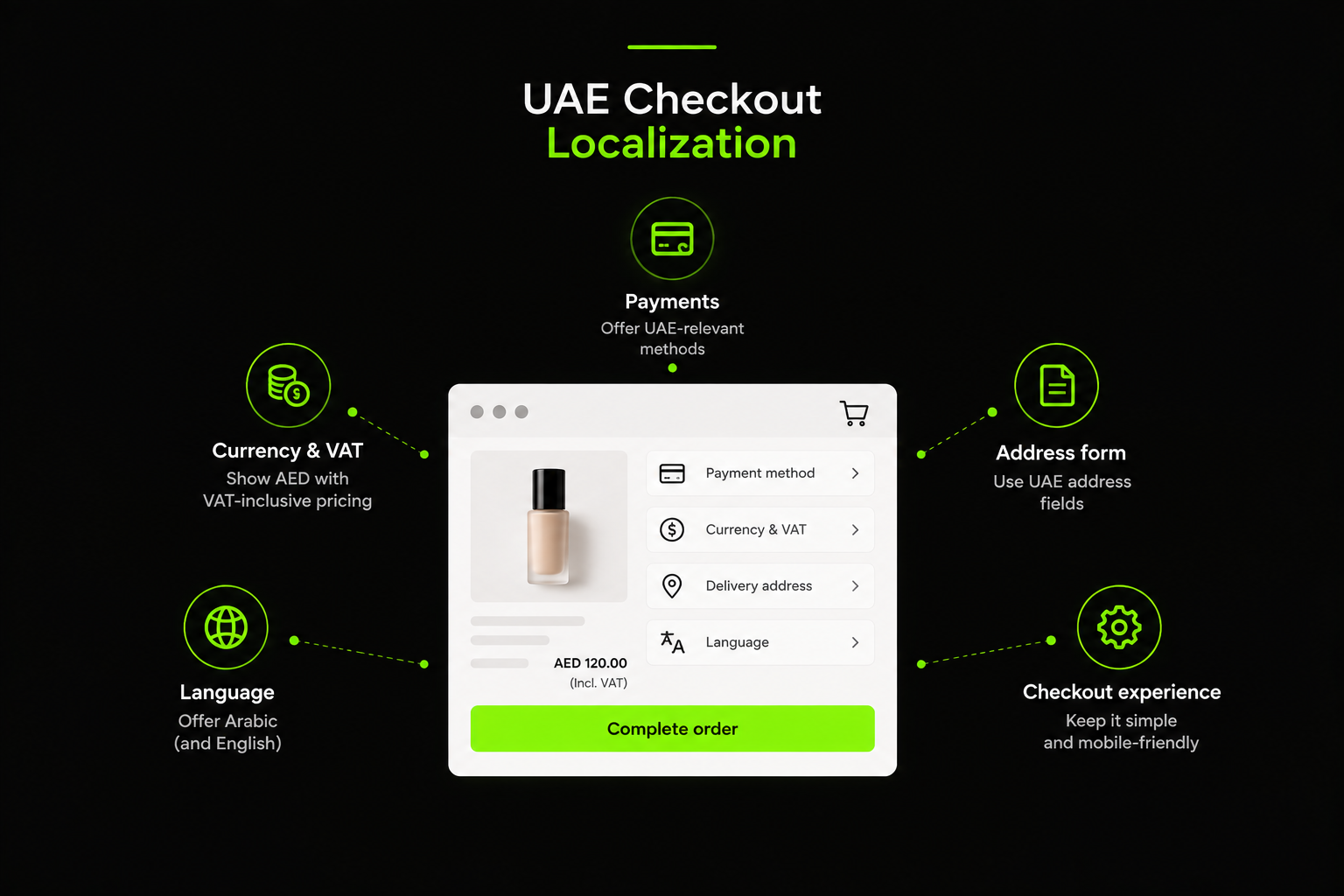
Localizing Shopify checkout for UAE customers involves more than changing your store currency to AED.
A conversion friendly checkout needs the right payment methods, accurate VAT settings, familiar address fields, mobile friendly design and Arabic support where relevant. Shopify Payments is now available to eligible UAE businesses, giving merchants another option alongside supported third party payment providers.
Your checkout should also display taxes and shipping costs clearly, minimize unnecessary form fields, and work smoothly across mobile devices.
For beauty brands in particular, a localized checkout helps create a consistent experience from product discovery through payment, while ensuring the store is aligned with UAE tax and business requirements.
Where Shopify Payments Stands For UAE Merchants
Before setting up anything, it helps to be clear on what Shopify's own payment processing does and does not currently cover in this market, since outdated advice on this point is common.
Shopify Payments Is Not Currently Available In The UAE
As of now, Shopify Payments, Shopify's own native payment processing service, is not available to merchants registered in the UAE, regardless of plan tier.
This has been a long-standing gap, and Shopify has not published a confirmed timeline for UAE availability.
If you come across content claiming Shopify Payments has launched for UAE merchants, verify it directly against Shopify's own current list of supported countries before relying on it, since this is an area where outdated or inaccurate claims circulate.
What This Means Practically For Checkout Setup
Without Shopify Payments, a UAE store needs a third-party payment gateway connected through Shopify's payment provider integrations to accept payment at all.
This is not a workaround or a downgrade; it is simply how every UAE Shopify store currently operates, and getting this gateway connection right is the actual first step in localizing checkout for this market.
Why This Matters For Checkout Localization Specifically
Because the payment processing layer already requires a deliberate, non-default setup in the UAE, checkout localization here starts from a different baseline than in a market where Shopify Payments works out of the box.
Currency, VAT display, and address fields all still need their own configuration on top of this, covered below, but the payment gateway choice is the foundation everything else sits on.
Setting Up A UAE-Localized Payment Stack
With Shopify Payments off the table, the gateway you choose and how you configure it around it does most of the localization work at checkout.
Choosing A Third-Party Gateway
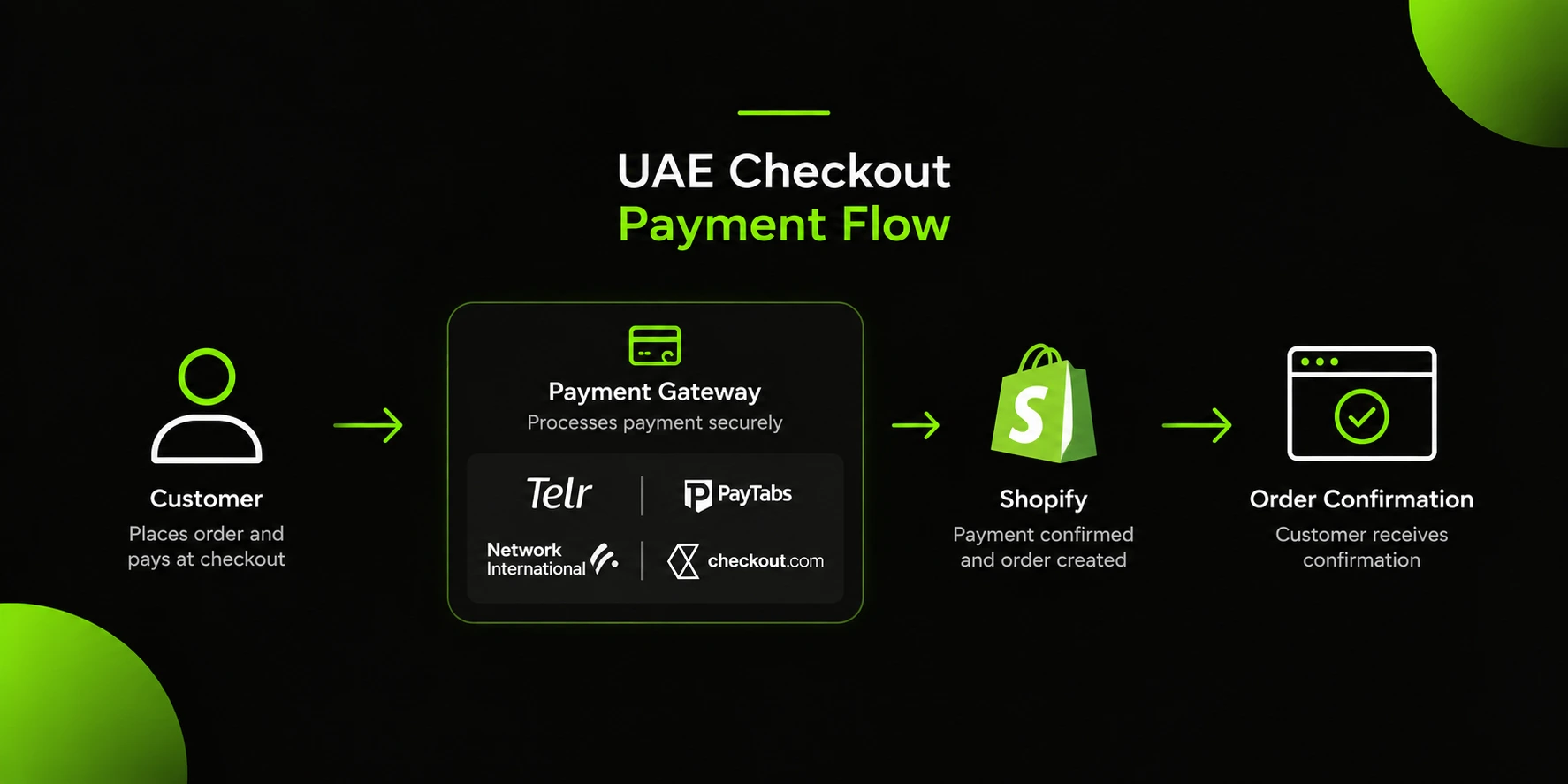
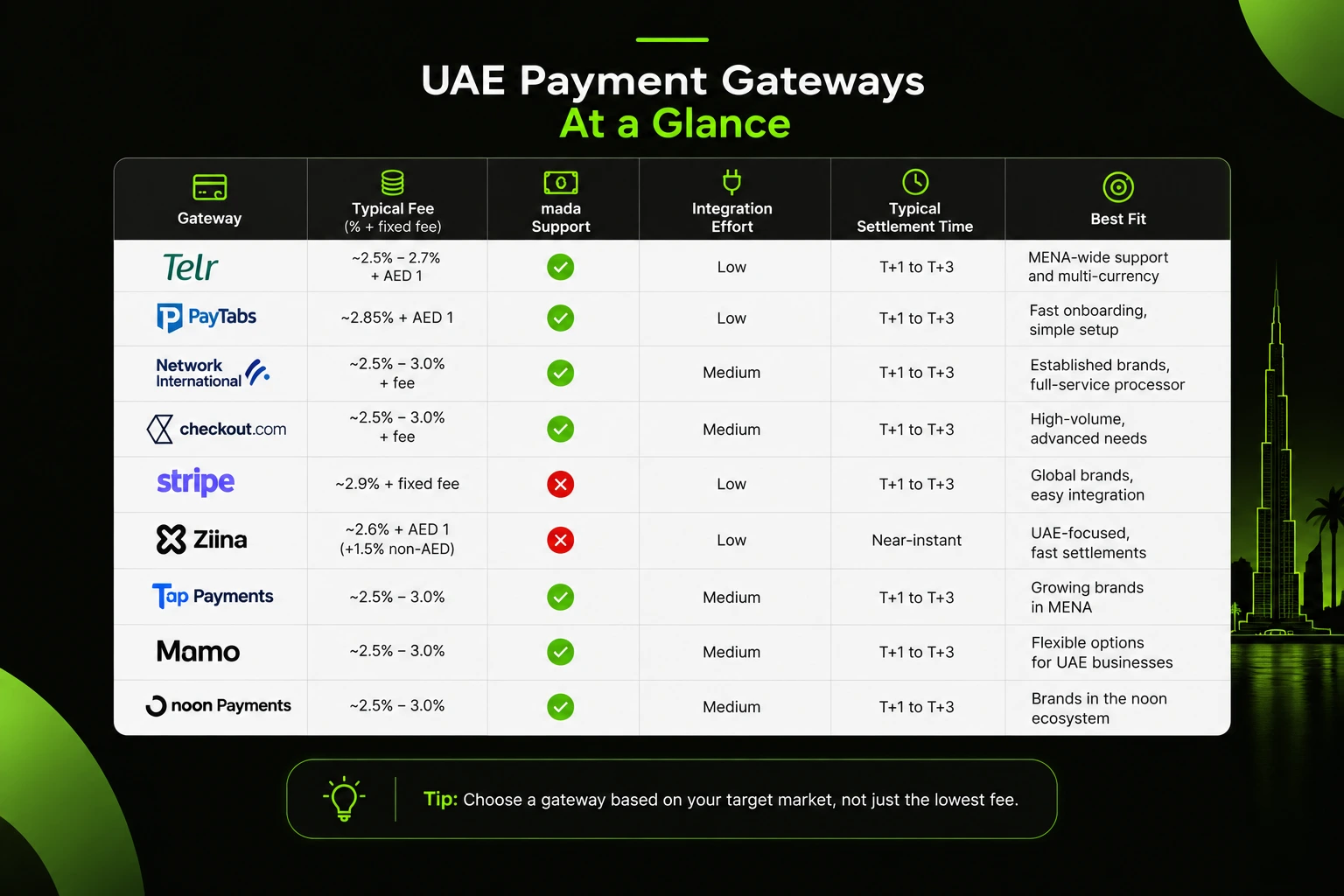
Telr, PayTabs, Network International, and Checkout.com are the most commonly used gateways for UAE Shopify stores, each supporting mada alongside international card schemes, with varying degrees of native Shopify integration versus requiring a custom-built connection.
Confirm mada support specifically before committing to a gateway, since a checkout that cannot accept mada is invisible to a meaningful share of UAE cardholders.
Some of these gateways connect through a straightforward Shopify App Store listing, while others require a purpose-built integration to Shopify's checkout, which affects both your setup timeline and your ongoing maintenance responsibility, so confirm which path applies before budgeting the integration as a same-day task.
Digital Wallets: Apple Pay And Google Pay
Mobile accounts for the large majority of UAE ecommerce traffic, and Apple Pay and Google Pay remove checkout friction specifically for mobile shoppers who do not want to manually enter card details. Configure both through your chosen gateway rather than treating them as optional extras.
Cash On Delivery And BNPL
COD still matters meaningfully for UAE ecommerce, particularly for first-time customers who have not yet built trust with a new brand, and buy-now-pay-later options like Tabby or Tamara have become a genuine expectation in several categories.
Both need to be configured as first-class checkout options, not afterthoughts bolted on once the primary card flow is working.
A COD option buried at the bottom of a payment method list, or a BNPL option that only appears after a customer has already committed to a different payment path, undersells how much these two specific methods influence whether a first-time UAE customer completes checkout at all.
Blending A Gateway Without Breaking Checkout UX
Running COD, BNPL, and a card gateway together at checkout needs careful configuration so the customer sees a clean, logical set of payment options rather than a confusing stack of redundant or poorly labeled choices.
Test the full checkout flow for every payment method combination you offer, not just the primary card path.
Currency and Price Display for UAE Checkout
Currency and price display are more than design choices for a UAE Shopify store. Customers should immediately understand what they are paying, which currency is being used, and whether VAT is included.
Setting AED as Your Default Checkout Currency
Set AED as the currency for your UAE market rather than displaying prices in USD or another foreign currency.
Shopify Markets can help manage currencies when you expand into other GCC markets, including:
- Saudi Arabia: SAR
- Qatar: QAR
- Bahrain: BHD
- Kuwait: KWD
Keep product, cart, and checkout pricing consistent. If you use automatic currency conversion, review the converted prices before launch and consider whether market specific pricing would better protect your margins.
Displaying Prices VAT-Inclusive
For VAT registered businesses, UAE consumer prices should generally be displayed inclusive of the applicable 5% VAT. Configure Shopify's tax settings accordingly and ensure your business details and Tax Registration Number are accurate.
VAT registration is mandatory when taxable supplies exceed AED 375,000, while voluntary registration is available from AED 187,500.
Your Shopify, accounting, and invoicing systems should use consistent tax information so the displayed price, checkout amount, and recorded VAT match.
Multi-Currency Considerations for GCC Expansion
When expanding into Saudi Arabia, Kuwait, Bahrain, or other GCC markets, configure each market separately. Do not assume that one currency or tax configuration works across the entire region.
Consider these market specific requirements:
- Saudi Arabia: SAR, Mada, and local payment preferences
- Kuwait: KWD and local payment methods such as KNET
- Bahrain: BHD and local payment methods such as Benefit
Shopify Markets can centralize much of this management, but payment, tax, and pricing settings should still be reviewed for each market. For more detail, see our guide on how to set up multi-currency on Shopify for UAE merchants.
Localizing The Checkout Address Form
This is the point where most competing content skips entirely in favor of payment-method talk, and it is a genuine source of checkout friction.
Why Default Shopify Address Fields Don't Fit UAE Addressing
Shopify's default checkout address fields are built around postal-code-based systems like the US or UK.
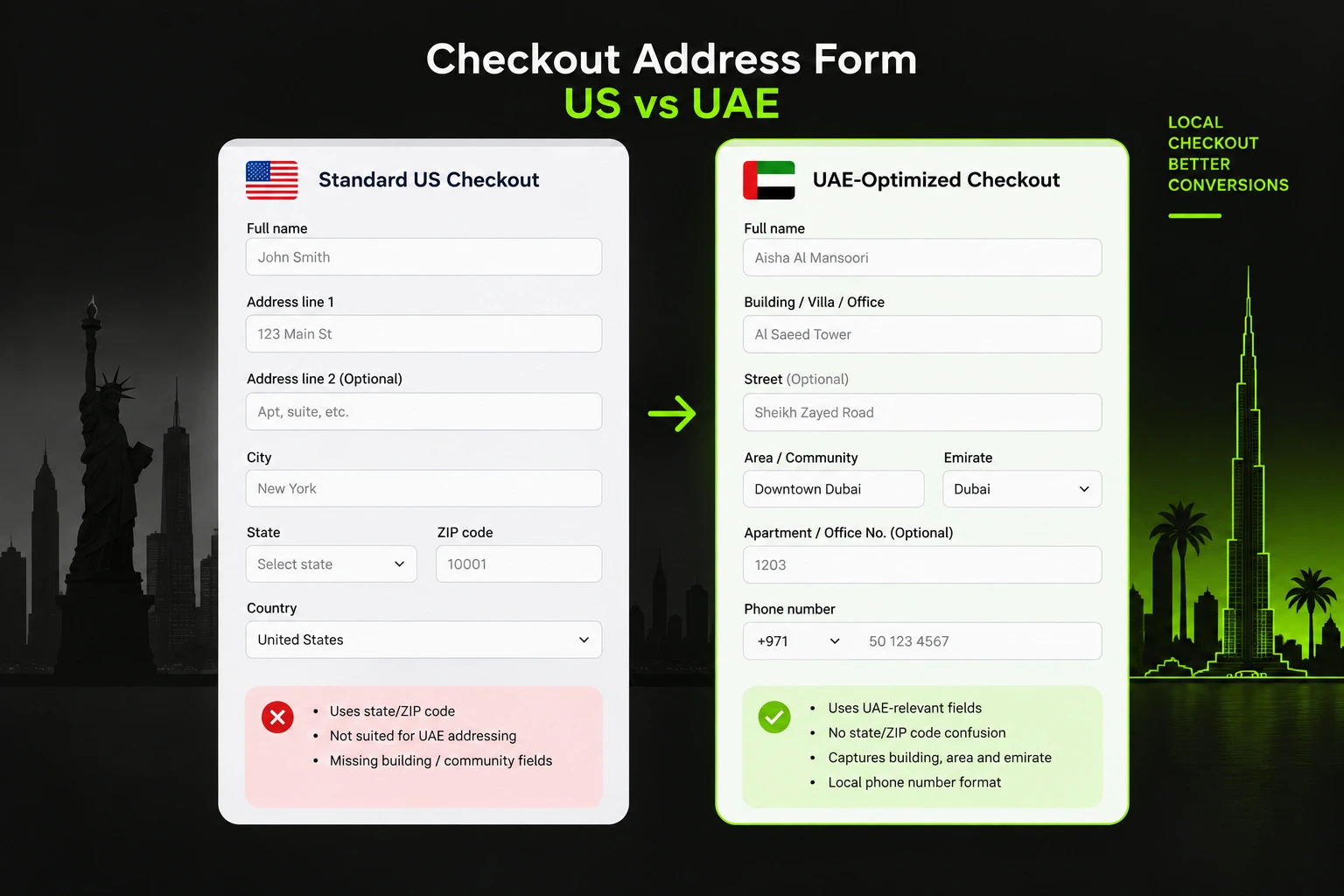
The UAE has no postal code system; addresses are built around building name or number, area, and emirate, which means a default form either forces customers through an irrelevant "postal code" field or produces addresses that don't actually help a courier find the delivery location.
Customizing Checkout Fields For How UAE Customers Actually Address Orders
Adjust the checkout form to reflect UAE addressing conventions directly: building name or number, street or area name, and emirate, with any postal code field made optional or removed rather than required.
This reduces both checkout drop-off from confused customers and failed deliveries from couriers working off inaccurate address data.
A customer forced to invent a postal code that does not exist either abandons the form in confusion or enters a placeholder value that then propagates into your fulfillment system as real address data, creating a delivery problem that surfaces later rather than at the point where it could have been avoided.
A Quick Before/After
A generic US-style form asks for street address, apartment/suite, city, state, and a required ZIP code, none of which map cleanly onto how a UAE customer would actually describe their delivery location.
A UAE-adapted form asks for building name or number, area or community name, emirate, and an optional landmark or delivery note field, matching the information a courier actually needs to find the address without forcing a customer to invent a postal code that doesn't exist.
Language And Arabic Checkout Considerations
Checkout is a high-trust, high-abandonment point in the purchase journey, which makes language choice here matter more than it might on a browsing page.
When Full Arabic Checkout Localization Is Worth It
If a meaningful share of your customer base shops in Arabic, full Arabic checkout localization is worth the investment, since forcing an Arabic-speaking shopper through an English-only checkout adds friction at exactly the point where abandonment is most costly.
If your audience is predominantly English-speaking expats or B2B buyers, it is a lower priority than getting payments and address fields right first, covered above.
RTL Considerations Specific To The Checkout Flow
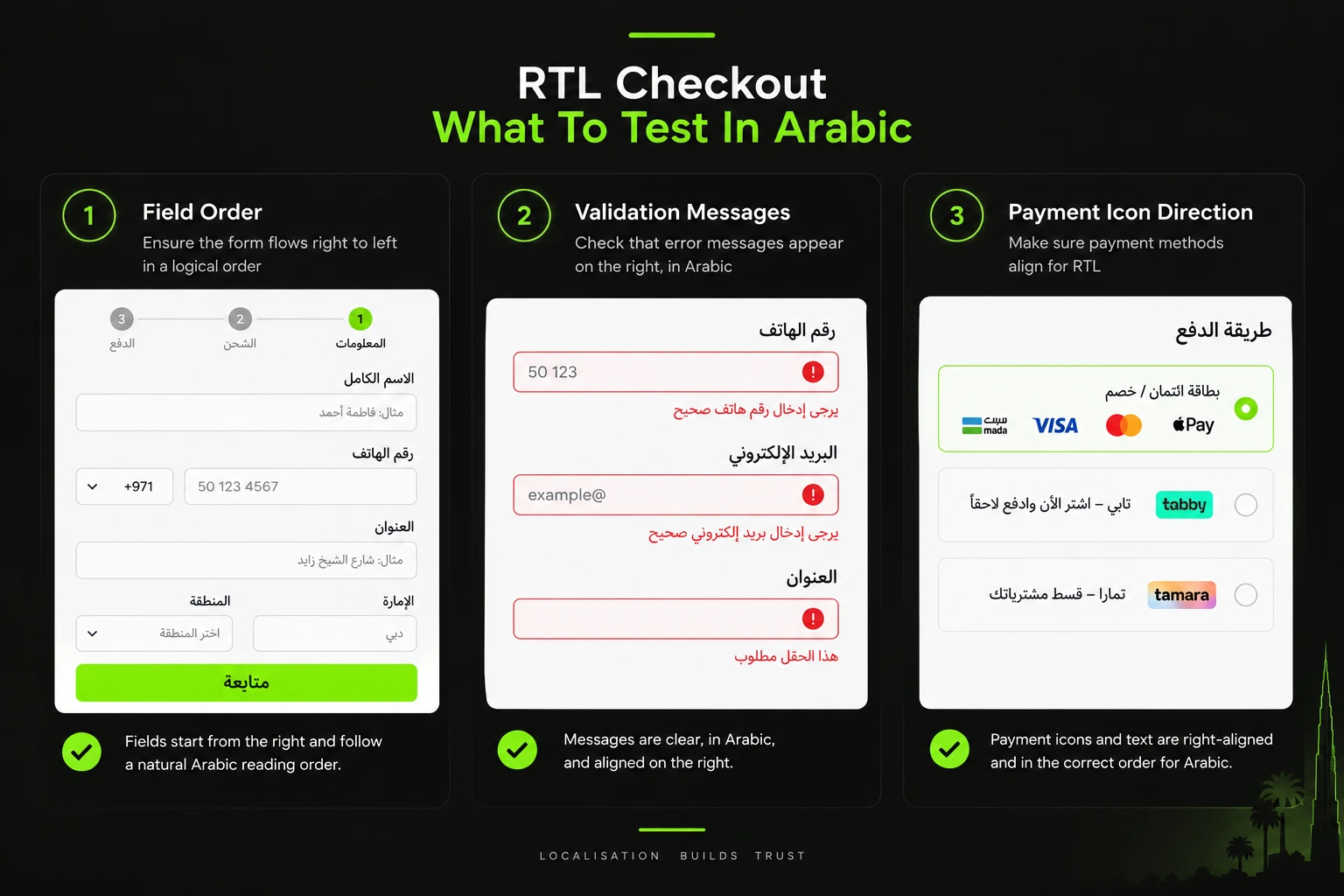
RTL checkout localization is not just flipping text direction. Field order, validation error placement, and payment method icons all need to be tested specifically in Arabic RTL rather than assumed to work correctly because the product pages already do, since checkout is a separate template with its own layout logic.
A validation error that displays correctly on an Arabic product page can still appear in the wrong position relative to its field on the checkout template if that template was never tested separately, since checkout often runs on different underlying code than the rest of the storefront.
Our guide to Arabic ecommerce website design covers RTL implementation in more depth if this is a priority for your store.
How We Localize Shopify Checkout for UAE Brands
At Suplex, we localize Shopify checkout around the brand's actual customers, products, and payment requirements rather than applying the same setup to every UAE store.
Our process typically covers:
- Payment Strategy: We assess whether the brand should use Shopify Payments, a third party gateway, or a combination of payment providers based on eligibility, plan, product category, and customer preferences.
- UAE Checkout Fields: We review address fields, phone number formats, delivery information, and other checkout details to ensure they work naturally for UAE customers.
- VAT and Pricing: We check AED currency settings, VAT-inclusive pricing, TRN details, and the connection between Shopify, invoicing, and accounting systems.
- Local Payment Methods: Where relevant, we configure options such as Apple Pay, Google Pay, COD, BNPL, and regional payment methods for GCC expansion.
- Arabic and RTL: For bilingual stores, we test Arabic checkout layouts, field alignment, validation messages, and the wider RTL experience.
- End-to-End Testing: We test successful and failed payments, refunds, mobile checkout, discounts, shipping, and order confirmation before launch.
Shopify's UAE payment capabilities continue to evolve, so we verify current eligibility and supported payment methods rather than relying on outdated assumptions. If you want to review your current setup, explore our Shopify services.
UAE Checkout Localization Checklist
Use this checklist before launching or auditing a UAE Shopify store. Work through each section systematically and test the complete checkout journey on mobile before going live.
Currency and Market Settings
☐ AED is set as the default currency for the UAE market
☐ UAE is configured correctly as a market in Shopify Markets
☐ Product, cart, and checkout prices display consistently in AED
☐ Currency rounding has been reviewed
☐ GCC expansion markets are configured separately where applicable
☐ SAR, QAR, BHD, and KWD are configured correctly for relevant markets
☐ Market specific pricing has been reviewed where automatic currency conversion is not appropriate
☐ International customers are shown the correct currency for their market
VAT and Pricing
☐ Business VAT registration status has been confirmed
☐ 5% UAE VAT is configured correctly where applicable
☐ VAT-inclusive consumer pricing is displayed correctly
☐ VAT calculations have been tested on product pages, cart, and checkout
☐ Tax Registration Number (TRN) and business details are accurate
☐ Discounts and promotional pricing have been tested with VAT calculations
☐ Shipping charges and their tax treatment have been reviewed
☐ Shopify tax settings have been checked against the business's accounting and invoicing setup
☐ Tax invoices generated after checkout contain the required business and tax information
☐ E-invoicing requirements have been reviewed where the business falls within the applicable UAE framework
Payment Methods
☐ Shopify Payments is enabled if the business is eligible
☐ Third-party payment gateway requirements have been reviewed
☐ Gateway account is approved and connected to the correct UAE business
☐ Settlement bank account details match the legal business information
☐ Visa and Mastercard payments have been tested
☐ Mada support has been confirmed when selling to Saudi Arabia
☐ Apple Pay is enabled where supported
☐ Google Pay is enabled where supported
☐ Cash on delivery is configured where relevant
☐ COD order limits or additional charges are configured if required
☐ Tabby is configured where BNPL is relevant to the target audience
☐ Tamara is configured where relevant
☐ Payment methods are clearly labeled at checkout
☐ Payment method ordering has been reviewed for mobile users
☐ Successful payment transactions have been tested
☐ Failed and declined payment scenarios have been tested
☐ Refunds and partial refunds have been tested
☐ Settlement and reconciliation have been verified before launch
UAE Address and Checkout Fields
☐ Checkout fields are relevant to UAE customers
☐ Building, villa, or apartment information can be provided
☐ Street or address information is clearly labeled
☐ Area or locality information can be entered
☐ Emirate can be selected correctly
☐ City information is handled appropriately
☐ Postal code is not unnecessarily required for UAE customers
☐ Makani number can be provided where useful
☐ Phone number field accepts UAE mobile numbers correctly
☐ International phone numbers are supported if selling across the GCC
☐ Address validation does not incorrectly reject legitimate UAE addresses
☐ The complete address form has been tested on mobile
Arabic and RTL Localization
☐ Arabic is published as a storefront language where relevant
☐ Arabic product titles have been professionally localized
☐ Arabic product descriptions have been reviewed by a native or qualified Arabic speaker
☐ Arabic checkout labels and messages are clear
☐ RTL layout has been tested on mobile and desktop
☐ Form fields align correctly in RTL
☐ Buttons and navigation elements mirror correctly
☐ Error messages display correctly in Arabic
☐ Product images and galleries behave correctly in RTL
☐ Shade selectors work correctly in both Arabic and English
☐ Ingredient information and tables mirror correctly
☐ Arabic product and collection URLs have been reviewed
☐ Arabic SEO titles, H1s, and meta descriptions are localized
☐ Arabic search terminology has been researched rather than directly translated from English
Mobile Checkout
☐ Checkout has been tested on iOS Safari
☐ Checkout has been tested on Android Chrome
☐ Product pages load quickly on mobile networks
☐ Add to cart is easy to find and use
☐ Cart summary is clear on smaller screens
☐ Payment buttons are visible without excessive scrolling
☐ Apple Pay and Google Pay work correctly on supported devices
☐ Form fields are easy to complete using a mobile keyboard
☐ Address fields do not create unnecessary friction
☐ Error messages are visible and understandable
☐ Customers can return to the cart without losing their selections
☐ Order confirmation loads correctly after payment
Shipping and Delivery
☐ UAE delivery zones are configured correctly
☐ Shipping rates are displayed accurately
☐ Free shipping thresholds work correctly
☐ Delivery estimates are visible where appropriate
☐ Emirate specific delivery rules have been tested
☐ Remote area or additional delivery charges are configured where applicable
☐ COD availability matches the relevant delivery zones
☐ International GCC shipping rules are configured separately
☐ Shipping charges are correctly reflected in the final checkout total
Final Pre-Launch Testing
Before launch, complete at least one end-to-end test for every major checkout path:
☐ Standard card payment
☐ Apple Pay payment
☐ Google Pay payment
☐ BNPL payment where enabled
☐ COD order where enabled
☐ Discount or promotional code
☐ Refund or cancellation
☐ UAE VAT calculation
☐ UAE delivery address
☐ Arabic checkout experience
☐ English checkout experience
☐ Mobile checkout
☐ Failed payment and recovery flow
☐ Order confirmation email or notification
☐ Customer invoice or receipt
☐ Shopify order record
☐ Payment gateway transaction record
☐ Accounting or invoicing system record
The final test should confirm that the amount displayed to the customer, amount actually charged, VAT recorded, payment gateway transaction, Shopify order, and accounting record all reconcile correctly. This is the point where a UAE checkout moves from simply being functional to being properly localized and operationally ready.
Frequently Asked Questions
Does Shopify Payments work in the UAE?
Not currently. Shopify Payments is not available to merchants registered in the UAE, and Shopify has not published a confirmed timeline for this change. UAE stores need a third-party gateway, commonly Telr, PayTabs, Network International, or Checkout.com, to accept payment at checkout.
Which payment gateway is best for Shopify in the UAE?
It depends on what you need to cover. Telr, PayTabs, Network International, and Checkout.com all support mada alongside international cards, with different integration paths and fee structures. Most UAE stores also need a separate COD or BNPL setup alongside their primary card gateway rather than relying on a single method for everything.
Do I need to display prices with VAT included on my Shopify checkout?
Yes. UAE regulations require consumer-facing prices to be VAT-inclusive at 5%, with your Tax Registration Number configured correctly in Shopify's tax settings. This needs to be set up deliberately; Shopify doesn't apply UAE VAT display rules automatically by default.
Can I use Shopify's default address form for UAE customers?
Not ideally. Shopify's default checkout address fields are built around postal-code-based systems like the US or UK. The UAE uses building- and area-based addressing without postal codes, so most stores customize the checkout form to reflect how UAE customers actually address orders, which reduces failed deliveries and checkout drop-off.
Is it worth adding Arabic to my Shopify checkout?
If a meaningful share of your customer base shops in Arabic, yes. Checkout is a high-trust, high-abandonment point, and forcing an Arabic-speaking shopper through an English-only checkout adds friction at the worst moment. If your audience is predominantly English-speaking expats or B2B buyers, it's a lower priority than getting payments and address fields right first.
What's the difference between Shopify Payments and Shopify Pay?
Shopify Payments is the payment processing service merchants use to accept cards and digital wallets, and it is not currently available in the UAE. Shopify Pay (Shop Pay) is the accelerated checkout experience shoppers see, which relies on having a compatible payment processor connected, so its availability in the UAE is tied to the same gateway limitations covered throughout this guide.
Hi, I’m Rishabh Jain
I believe great design has the power to shape perception, build trust, and move businesses forward. That belief is what led me to found Suplex Design Studio, a global branding and packaging studio working with FMCG and D2C brands across markets.I started suplex at 25 with a clear intent, to create design that is strategic, thoughtful, and commercially meaningful. By 28, the studio had scaled globally, guided by a strong foundation in Integrated Design that I developed during my academic journey in London, where I was honoured with the Dean’s Award.
Over the years, I’ve had the opportunity to work with 100+ brands, from Fortune 500 organizations to family-run businesses, helping them build packaging and brand systems that create recall, relevance, and long-term value.
Suplex’s work has been recognized internationally, including the Manifest Award (2024), the Clutch Global Award (2025), and features on platforms such as Packaging of the World, The Dieline, and the World Brand Design Society.
None of this would be possible without the people behind the work. I’m deeply grateful to the suplex team, whose commitment, creativity, and attention to detail turn ideas into meaningful brand experiences every day.
At the heart of my work is a simple philosophy, design should be intentional, honest, and built to last, and that continues to guide everything we create at suplex.





































Let’s Make It Happen
E-Commerce Success Stories
%201.avif)






.avif)

.avif)
Build Your D2C Business The Right Way
Build It With Suplex.


