Mobile App Vs. PWA For UAE Ecommerce Brands: Which One Actually Fits?
.avif)
Mobile App Vs. PWA For UAE Ecommerce Brands: Which One Actually Fits?
Mobile app vs PWA for UAE ecommerce brands is not just about speed, device features, or app store presence.
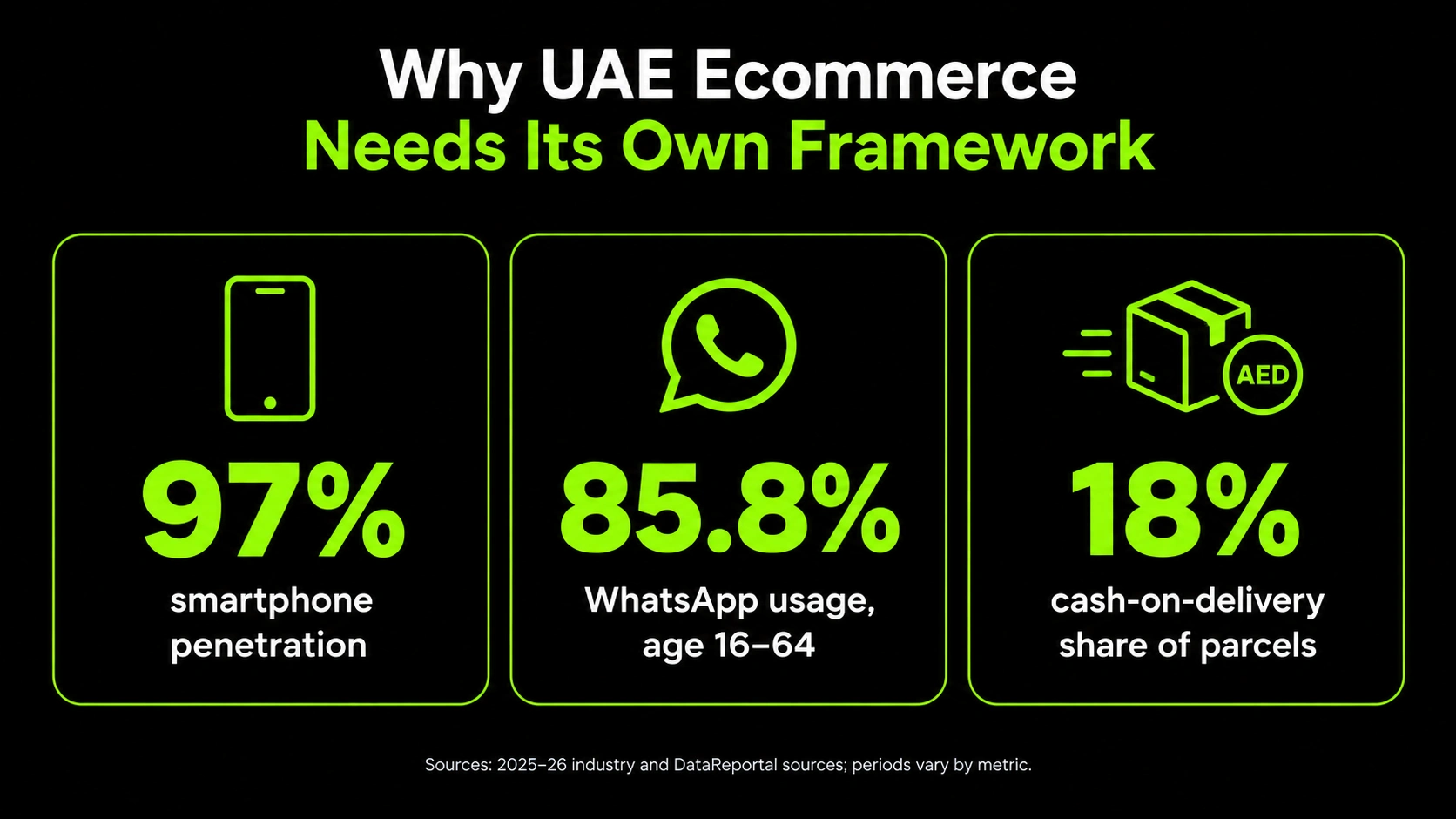
UAE and GCC shoppers are highly mobile-first and are used to shopping through apps. Cash on delivery is still important, while WhatsApp and Instagram drive a large share of ecommerce traffic.
These factors affect how you handle notifications, checkout, repeat orders, and customer engagement. For UAE brands, the choice should be based on how customers actually shop, not on a generic global comparison.
Why Generic PWA Vs. Native App Comparisons Don't Fit The UAE Market
Search this comparison and the entire top-ranking set is the same global tech breakdown, regardless of where the reader is actually building.
What Every Competing Guide Gets Right, And Where It Stops
The standard comparisons are not wrong about the technical fundamentals. Load speed, device API access, and development cost differences between a PWA and a native app are real and worth understanding.
Where they stop is the point where the decision actually gets made for a specific brand: how customers in that market discover products, how they expect to pay, and what they expect a legitimate business to have.
The Regional Factors Missing From The Global Conversation
A generic comparison written for a US or European audience assumes card-first payment, search-driven discovery and a customer base with no particular expectation about app-store presence.
None of those assumptions hold consistently in the UAE. Cash-on-delivery remains a major payment method, a large share of discovery happens on WhatsApp and Instagram rather than Google and established regional brands have built real app-store trust expectations that some customers carry into how they judge a newer brand's legitimacy.
A framework built on the wrong assumptions gives the wrong answer, even when the technical facts inside it are accurate.
PWA Vs. Native App: The Core Technical Differences
The fundamentals still matter, they just are not the whole decision.
Performance and Load Speed
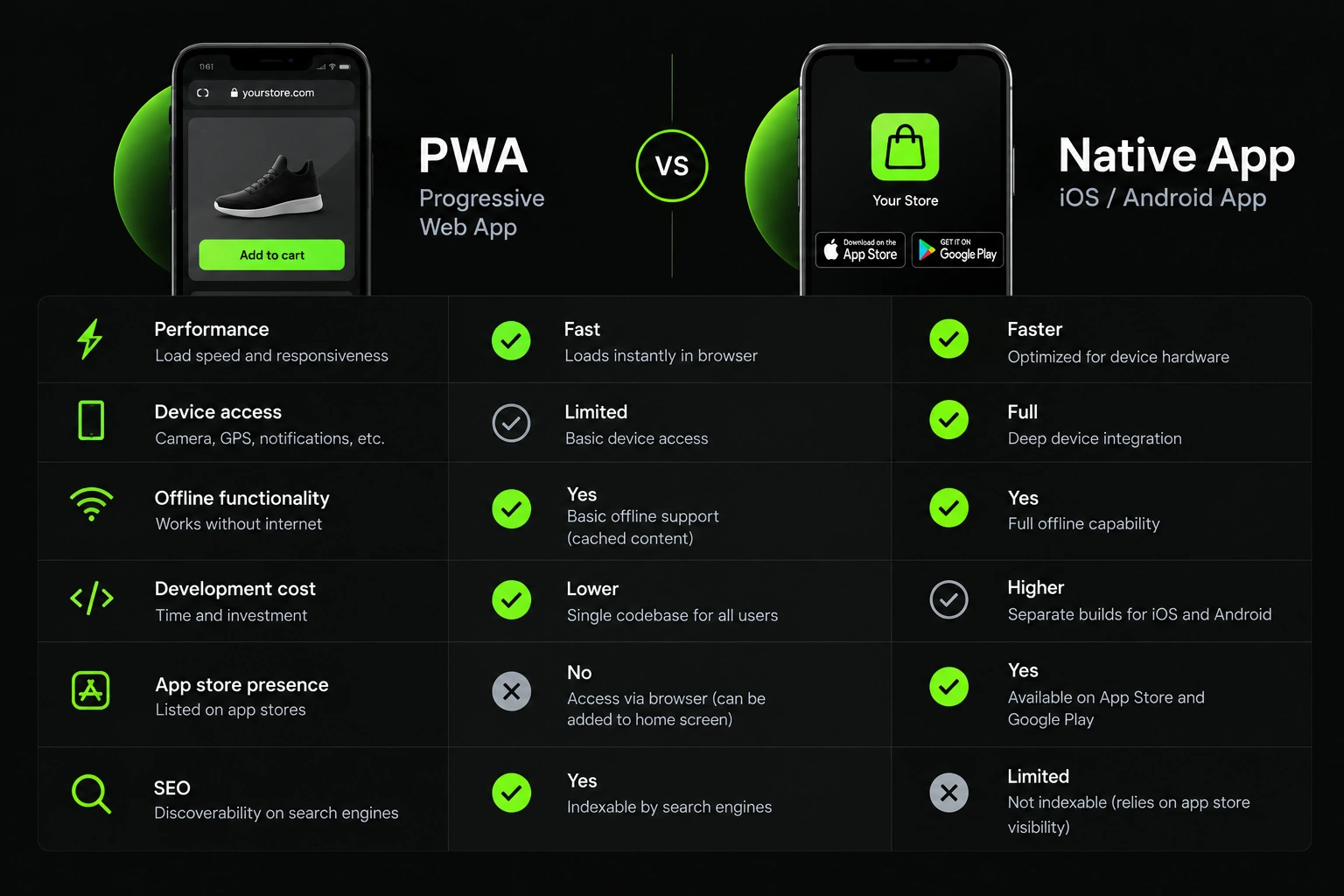
A well-built PWA can load close to instantly on repeat visits through caching, and modern PWAs perform competitively with native apps for most ecommerce use cases.
Native apps still generally hold an edge for the most graphically intensive or animation-heavy experiences, which rarely matters for a standard product catalog and checkout flow.
For a typical ecommerce PDP or category listing, the practical performance gap most customers would actually notice has narrowed to the point where it rarely decides the comparison on its own.
Device Feature Access
Native apps have deeper, more reliable access to device features: camera, biometric authentication, and background push notifications in particular.
PWAs have closed much of this gap, especially on Android, but push notification reliability specifically, covered in more depth below, still tends to favor native and this is the one technical difference with real regional weight given how central notifications are to the UAE's COD-heavy delivery experience.
Camera access for a virtual try-on feature or biometric login for faster repeat checkout are both achievable on modern PWAs, but with more implementation variability across browsers and devices than a native build offers.
Offline Functionality
Both can support offline functionality through caching, though native apps generally offer more robust offline data handling for complex interactions.
For a standard browse-and-buy ecommerce flow, PWA offline support is typically sufficient, letting a customer with an intermittent connection continue browsing previously loaded product pages even when their signal drops, which matters in a market with as much network variability as the UAE's mixed device and connectivity landscape.
Development Cost And Timeline
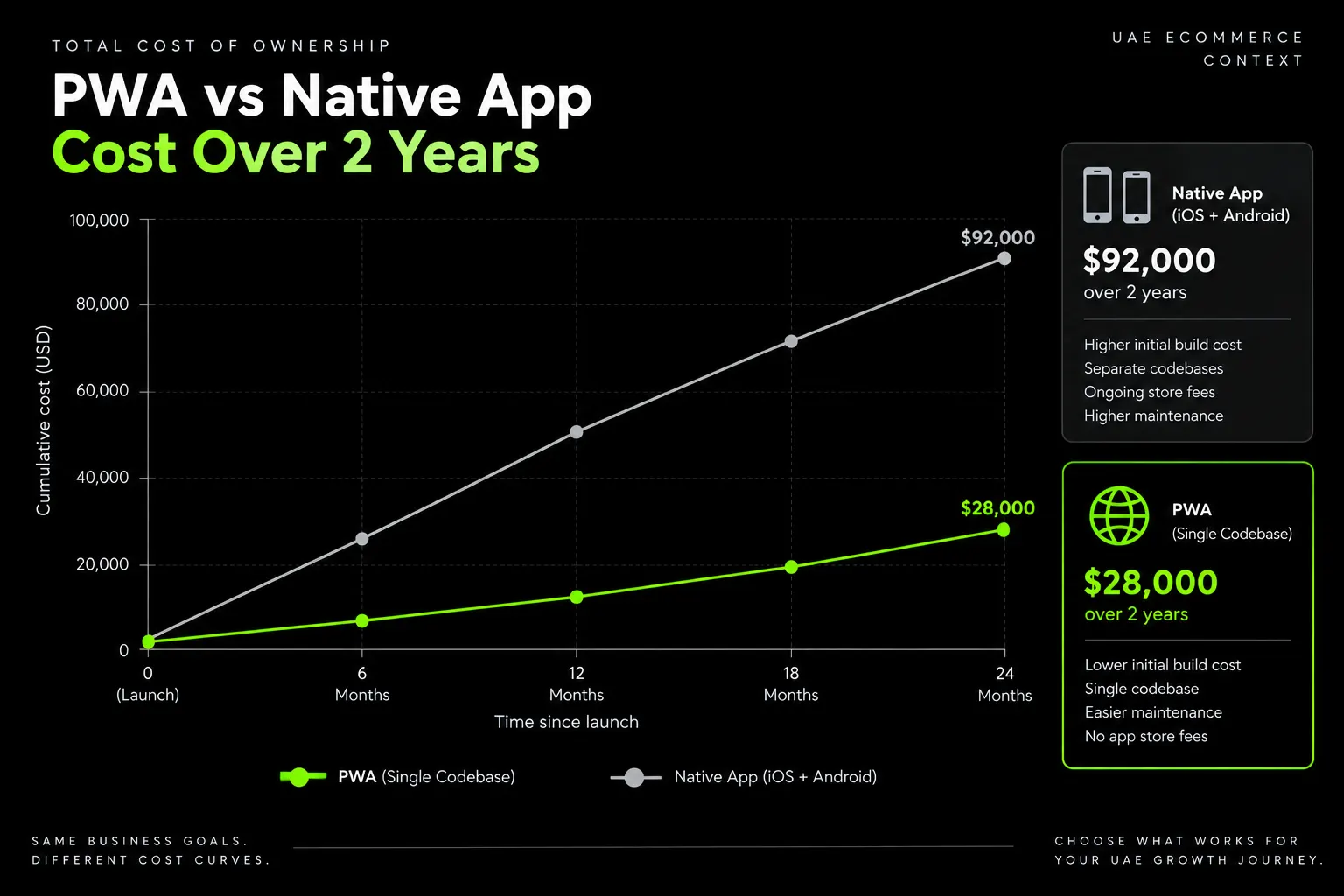
A PWA is a single codebase that works across devices and platforms. A native app typically means separate iOS and Android builds, or a cross-platform framework that still adds meaningfully more development and ongoing maintenance cost than a PWA.
This difference alone often settles the decision for an early-stage brand with a limited budget.
App Store Presence And Discoverability
A native app lives in the App Store and Google Play, which brings both a discovery channel and, as covered below, a trust signal in this specific market.
A PWA does not have an app-store listing, though some platforms now support adding a PWA to a home screen with an app-like icon, narrowing but not eliminating this gap.
That home-screen installability, sometimes called an "installed PWA," gives a returning customer a one-tap icon without ever going through an app-store download or review process, a middle ground worth knowing about specifically because most generic comparisons present app-store presence as a binary that a PWA simply lacks.
SEO And Indexability
A PWA is a website first, fully crawlable and indexable by search engines. A native app is not; its content is invisible to organic search unless a brand also maintains a fully indexable web presence alongside it.
For a brand relying on any organic search traffic, this is a real structural advantage PWAs hold that native apps cannot match on their own and it is a factor global comparisons cover correctly but rarely connect back to a specific market's actual search behavior, which for many UAE categories still includes meaningful organic discovery alongside the social-driven traffic covered below.
The UAE-Specific Factors That Actually Decide This
This is the section missing from every competing page on this topic, and it is where the real decision gets made for a brand actually operating in this market.
App-Store Trust Culture
In the UAE and wider GCC, a meaningful share of consumers associate having a dedicated app with legitimacy, particularly for brands competing against established regional players.
Noon, Namshi and similar regional marketplaces have built strong native-app habits among their customer base, and a newer brand competing in a category where shoppers are used to an app-first experience may face a credibility gap without one.
This matters more for brands entering categories already shaped by app-first competitors than for brands in categories where browser-based shopping is already the norm.
A grocery or fast-fashion brand competing directly against a native-app-first incumbent faces a different trust bar than a niche home goods or specialty beauty brand entering a category where most competitors, regional and international alike, still sell primarily through a website.
COD And Delivery-Update Push Notifications
This is the most decisive and least discussed factor in the entire comparison. Cash-on-delivery remains a substantial payment method in UAE ecommerce, commonly cited somewhere in the 40% to 60% range of transactions depending on category and source, which means a large share of orders depend on the customer being reliably informed about delivery timing so they have cash ready and are actually present.
Native app push notifications remain more consistently reliable for this purpose than browser-based push, particularly on iOS, where PWA push notification support has historically lagged behind Android.
A brand with heavy COD reliance is trading some of that delivery-notification reliability if it launches PWA-only, and this is a genuinely UAE-relevant trade-off that a generic global comparison has no reason to even mention.
Many UAE brands currently bridge this gap by pairing a PWA with WhatsApp Business notifications for order confirmation and delivery updates, which sidesteps the browser push reliability issue entirely by using a channel customers already check constantly, though this requires its own integration work and message-template setup rather than coming free with either the PWA or the native option.
WhatsApp And Instagram-Driven Social Commerce Traffic
WhatsApp is used by roughly 85% of the UAE's population aged 16 to 64, and a large share of ecommerce discovery and pre-purchase conversation in this market happens on WhatsApp and Instagram rather than through organic search.
UAE social commerce has been growing at a rapid year-on-year pace, and a majority of UAE social media users report having completed a purchase through a social platform directly.
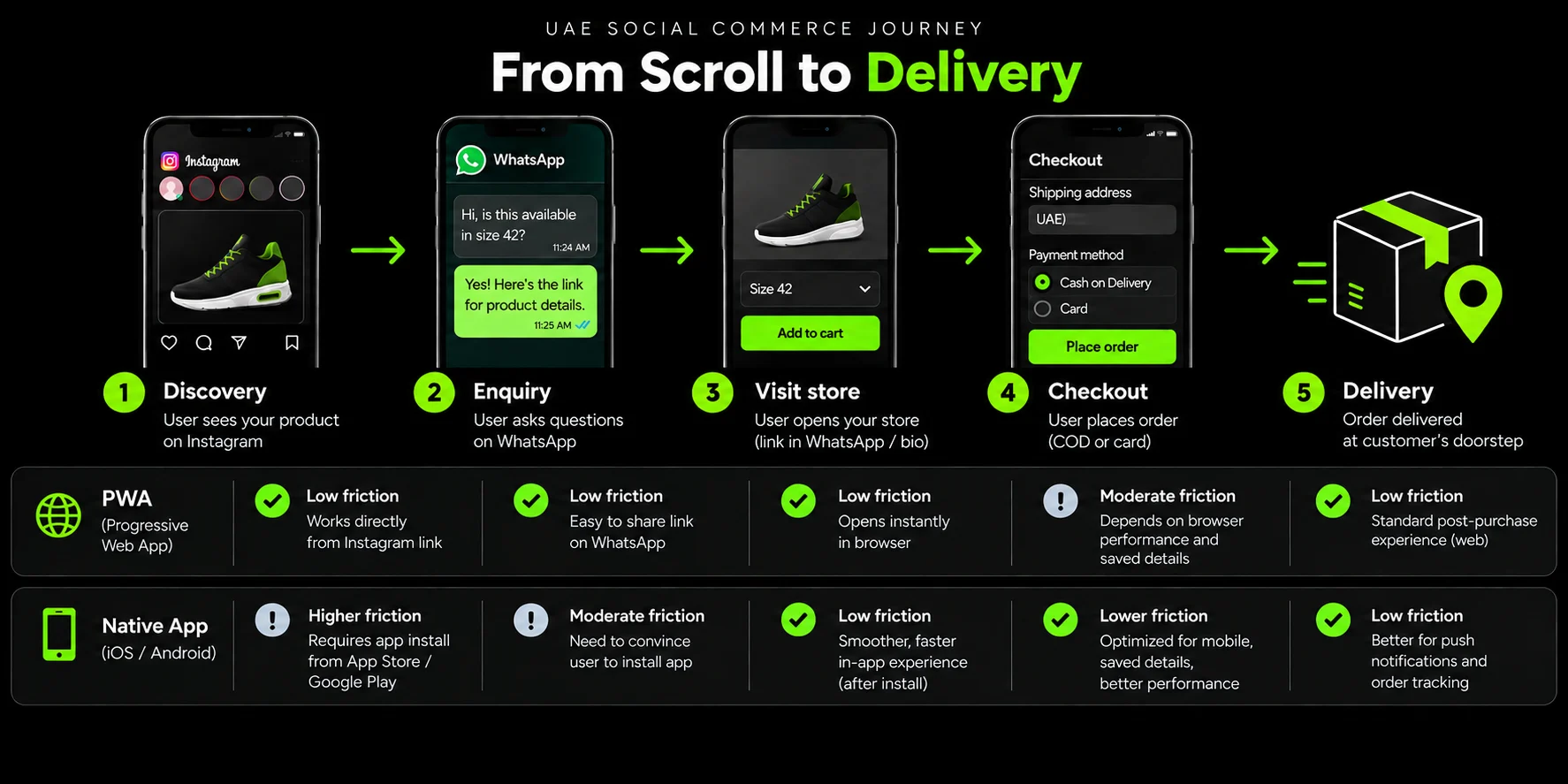
A customer clicking through from an Instagram ad or a WhatsApp catalog link into a native app is immediately asked to download and install something before they can even see the product, which is real friction at exactly the point of highest purchase intent.
A PWA removes that friction entirely, since the same click lands directly on a fast-loading page ready to shop. For a brand whose traffic is dominated by social and paid campaign clicks rather than repeat direct visits, this friction difference alone can be decisive.
Network And Device Variability Across A Large Expat, Multi-Nationality Customer Base
The UAE's population includes a wide range of device types, connection qualities, and data plans across its large expat community.
A PWA's smaller footprint and lower data demands compared to a full native app download can matter meaningfully for customers on limited data plans or older devices, a consideration that is easy to overlook when a brand's own team is testing on flagship phones with unlimited data.
Arabic RTL Support And Localization
Both approaches can support Arabic and right-to-left layouts, but the implementation differs. A PWA inherits RTL support from standard web development practices already well established for ecommerce sites.
A native app needs RTL handled separately within each platform's native UI framework, which can mean duplicated localization work across iOS and Android that a PWA's single codebase avoids.
Weighing PWA Vs. Native For Your UAE Brand?
The right answer depends on your specific traffic mix, repeat-purchase behavior, and COD reliance, not a generic global rule. Suplex assesses these specifically before recommending a mobile strategy.
When A PWA Is The Right Call For A UAE Brand
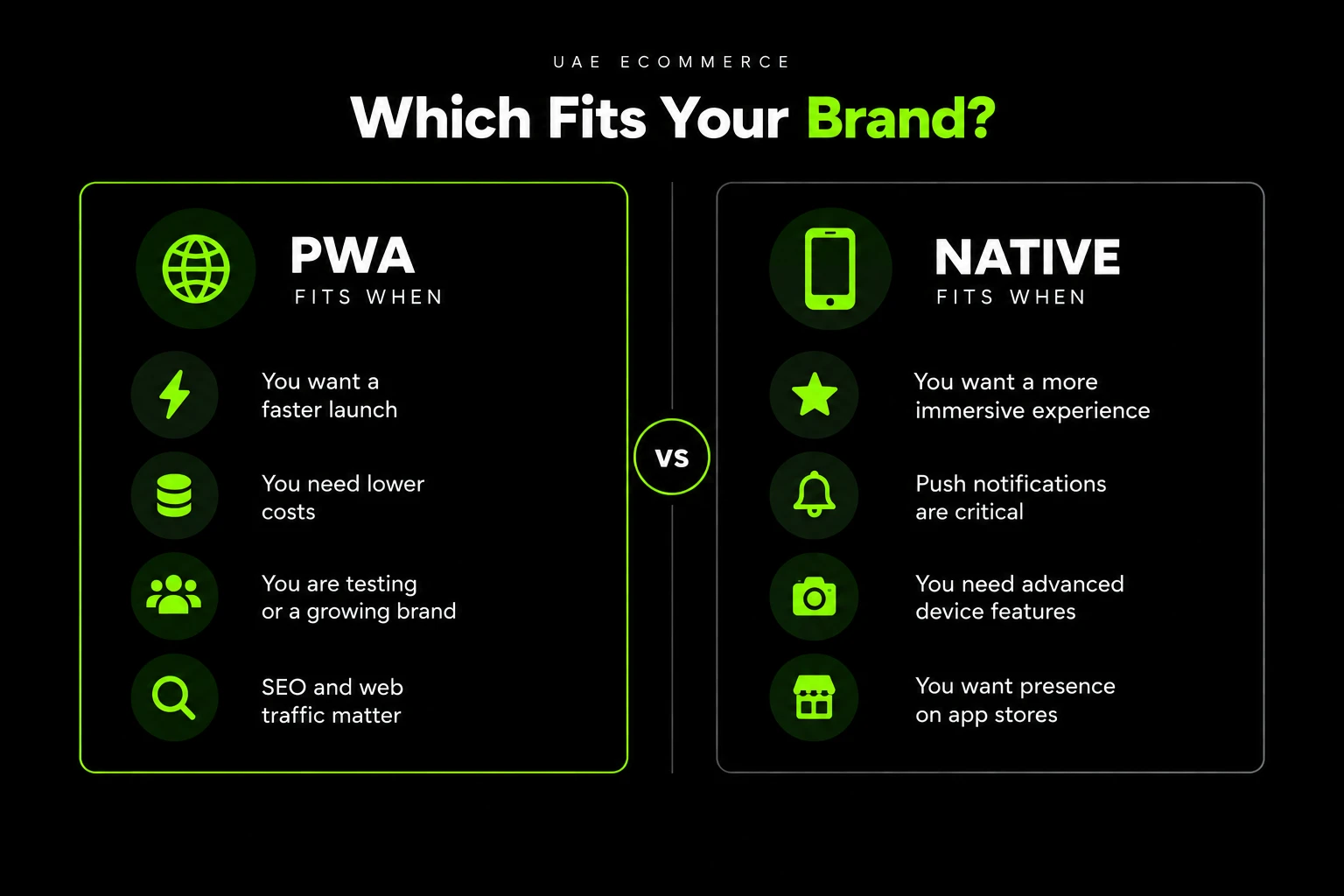
For most brands at this stage, a PWA is the more sensible starting point.
Early-Stage And Growth-Stage Brands Prioritizing Speed To Launch
A PWA gets a brand to market faster on a single codebase, without the added timeline of building and submitting separate iOS and Android apps through each platform's review process.
For a brand still validating product-market fit, this speed advantage is usually worth more than the trust signal a native app would add.
Brands Whose Traffic Is Dominated By Social And Paid Campaign Clicks
If the bulk of a brand's traffic arrives through Instagram, TikTok, or WhatsApp links rather than direct or organic search, a PWA removes the install friction that would otherwise sit directly in the path of highest purchase intent.
Major PWA implementations at global scale, Alibaba and Trivago among the most commonly cited, have demonstrated meaningful conversion improvements specifically by removing this kind of friction for exactly this type of traffic.
The same logic applies with even more force in the UAE specifically, where the share of ecommerce traffic arriving through social and messaging platforms rather than search is typically higher than in more search-dominant Western markets, which means the conversion cost of install friction is proportionally larger here too.
Budget-Conscious Brands Wanting One Codebase Across Devices
A single PWA codebase, maintained once, is simply cheaper to build and keep updated than two separate native codebases.
For a brand where every development dollar needs to justify itself against growth spend, this is a real and ongoing cost difference, not just a one-time launch cost saving.
A feature update, a new checkout field, a redesigned category page, a seasonal promotion mechanic, gets built and shipped once on a PWA instead of twice across iOS and Android, which compounds meaningfully over a year of ongoing iteration.
When A Native App Is Worth The Investment
Native earns its cost once specific conditions are in place, not as a default upgrade path.
Brands With High Repeat-Purchase Frequency And Loyalty Program Needs
A brand with genuinely high repeat-purchase frequency, where customers are buying regularly rather than occasionally, gets more value from a native app's deeper loyalty and personalization capabilities and from the habit-forming presence of a home-screen icon customers open directly rather than returning through a search or a social link each time.
Brands Relying Heavily On Push Notifications For COD Confirmation And Delivery Tracking
Given the COD notification reliability gap covered above, a brand with heavy COD volume and a customer base that has shown it responds well to app-based delivery tracking has a concrete, UAE-specific reason to invest in native, beyond the general trust-signal argument.
Brands With Strong Existing App-Store Brand Recognition
Regional marketplaces and established retailers, noon and Namshi among the clearest examples, have built customer habits around native apps at a scale that makes a native presence close to table stakes for brands competing directly in their categories.
A newer, smaller brand entering one of these categories inherits some of that expectation even before it has built its own repeat-purchase base.
This does not mean every brand in fashion or general marketplace categories needs to match noon's or Namshi's investment level on day one, but it does mean the competitive bar for what "legitimate" looks like in that specific category is already set higher than in a category without an established app-first leader.
A Practical Decision Framework For UAE Ecommerce Brands
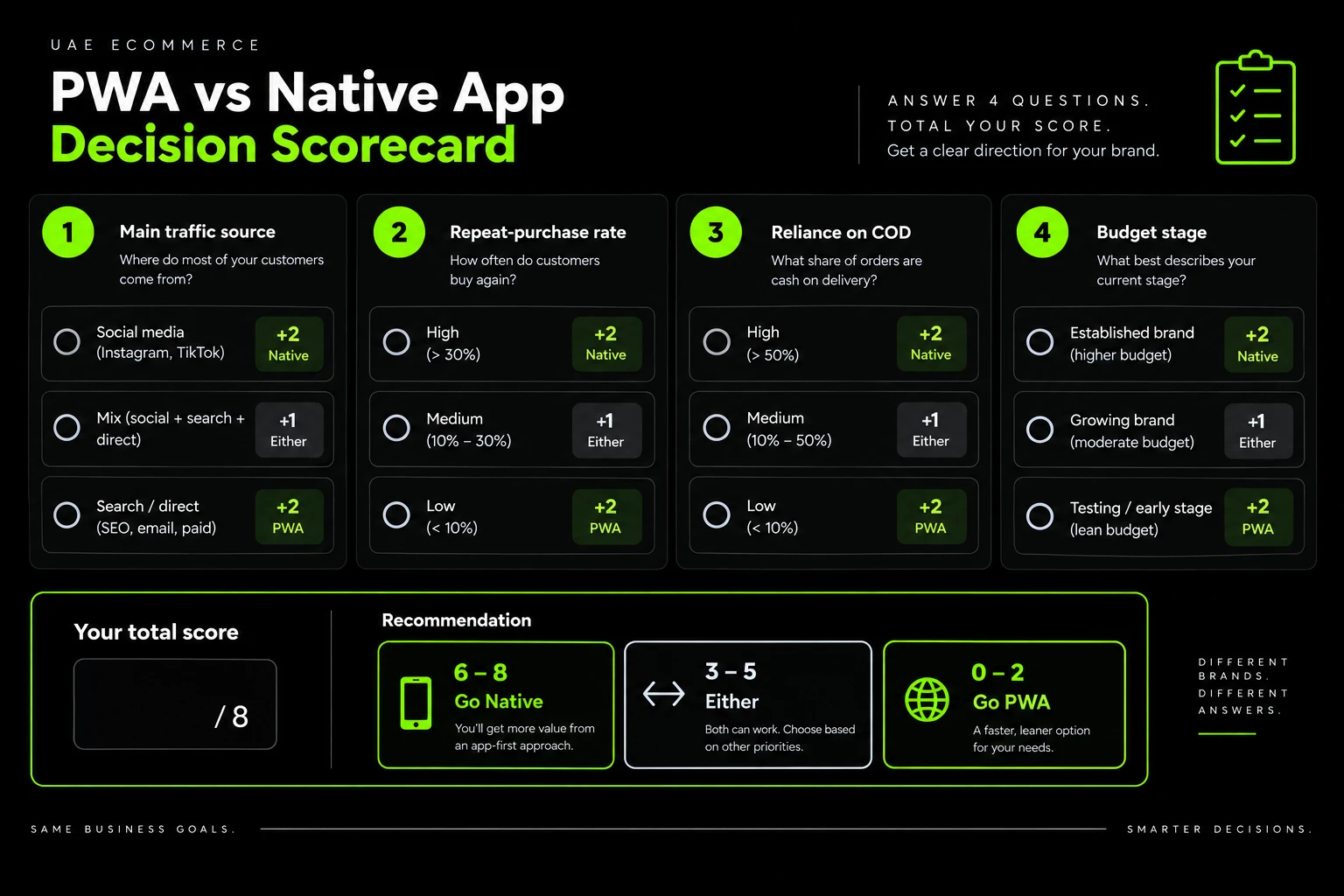
Score your brand against these four factors before choosing either path.
Step 1: Map Your Traffic Sources
Pull your actual traffic breakdown. A brand dominated by search-friendly or PWA-friendly traffic, organic search, direct visits, paid search, scores toward PWA.
A brand dominated by app-store-driven discovery or an existing native-app customer base scores toward native.
Step 2: Assess Your Repeat-Purchase And Loyalty Needs
Pull your actual repeat-purchase rate from your existing data if you have it. A low repeat-purchase rate, common for early-stage brands still building their customer base, scores toward PWA, since the ongoing value native's loyalty features add scales with how often customers actually return.
Step 3: Weigh COD And Delivery Notification Reliability Requirements
Pull your actual COD share of total orders. A brand with heavy COD reliance and a customer base sensitive to delivery timing accuracy scores toward native, given the notification reliability gap.
A brand with lower COD reliance, more prepaid or card transactions, scores toward PWA, since the notification gap matters less when fewer orders depend on it.
If your COD share sits in the middle of the range, consider the WhatsApp Business notification bridge covered earlier as a way to keep the delivery-communication reliability advantage without committing to native on that factor alone.
Step 4: Budget For Phase Two, Not Just Launch
Whichever path you choose first, budget with the other option in mind for later, rather than treating the initial choice as final.
This is less about picking the "right" answer today and more about not architecting yourself into a costly rebuild when the second phase becomes necessary.
A realistic two-year budget plan for a PWA-first brand should set aside a rough allocation for a potential native build once repeat-purchase and COD data justify it, rather than treating the PWA launch budget as the full and final mobile strategy spend.
Can You Start With A PWA And Add A Native App Later?
For most growing UAE brands, this is not a hypothetical, it is the realistic path.
The Hybrid Path Most Growing Brands Actually Take
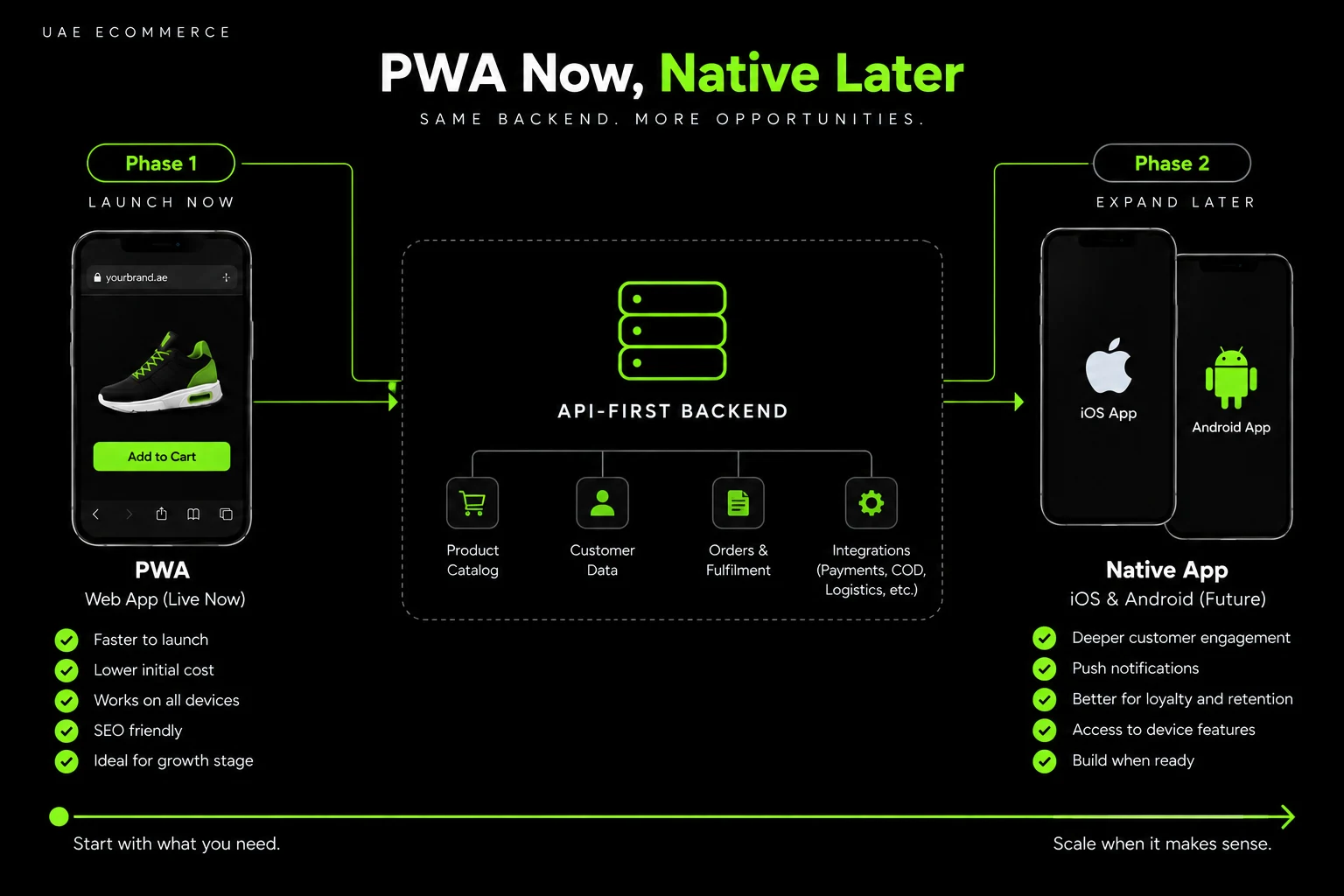
Launching PWA-first to validate traffic and repeat-purchase patterns, then adding a native app once the data actually justifies the investment, is the path most growing brands take in practice rather than committing to native before they have the volume to justify it.
This sequencing also means the native app, when it is built, gets built around real usage data rather than assumptions made before launch.
What To Architect Now So A Future Native App Isn't A Full Rebuild
The decision that actually protects this path is architectural, not sequential: build the PWA on a backend with a clean, well-structured API layer from the start, so a future native app can consume the same product, inventory, and order data without a parallel system being built from scratch.
A PWA built without this consideration can mean a native app later requires rebuilding the entire data layer rather than just the native frontend on top of what already exists. This is exactly the kind of decision that is cheap to get right at the start and expensive to retrofit later.
In practice, this means treating the PWA's backend as a proper API-first commerce layer from day one, product data, inventory, pricing, and order management exposed through endpoints a native app can call directly later, rather than a PWA frontend built tightly coupled to its own backend in a way that assumes it will always be the only client.
How We Help UAE Brands Choose The Right Mobile Strategy
Our approach at Suplex starts with assessing a brand's actual traffic sources, repeat-purchase behavior, and COD reliance before recommending PWA or native, rather than defaulting to whichever we happen to build most often.
We have built PWA-first ecommerce experiences for UAE and GCC brands specifically architected so a future native build, when the numbers justify it, does not mean starting from zero.
We would rather help a brand avoid over-investing in a native app before its traffic and retention numbers actually justify the cost, than sell a native build a brand is not ready to get value from.
If you are weighing this decision for your own brand, Suplex offers a mobile strategy assessment to work through your specific traffic, repeat-purchase, and COD numbers before you commit either way.
PWA vs Native App: Choosing the Right Path for UAE Ecommerce Growth
The right choice between a PWA and a native app for a UAE ecommerce brand depends on traffic source, repeat-purchase behavior, and COD reliance, the regional realities that generic global comparisons ignore entirely.
For most early and growth-stage brands, a PWA is the sensible starting point: faster to launch, frictionless for the social and paid traffic that dominates discovery in this market, and cheaper to build and maintain on a single codebase.
Native earns its investment once repeat-purchase volume, COD-driven notification needs, or category-specific app-store trust expectations genuinely justify it, and the smartest path for most growing brands is architecting the PWA now so that native, when it becomes worth building, is an addition rather than a rebuild.
Run your own traffic, repeat-purchase, and COD numbers through the framework above rather than defaulting to whichever option feels like the more ambitious choice, since ambition alone has never been the right basis for a platform decision.
Frequently Asked Questions
Is a PWA good enough for an ecommerce brand in the UAE?
For most early-stage and growth-stage brands, yes. A well-built PWA handles performance, offline functionality, and Arabic RTL support competently, and it removes the install friction that costs conversions on social and paid traffic. Brands with heavy COD reliance or strong app-store-driven competition should weigh the native-specific factors covered above before deciding PWA alone is sufficient long-term.
Do UAE customers expect brands to have a native app?
It depends heavily on category. In categories shaped by app-first regional players like noon and Namshi, some customers do associate a native app with legitimacy. In categories without that established app-first pattern, a fast, well-designed PWA is generally sufficient and does not carry the same trust gap.
Can a PWA send push notifications for COD and delivery updates?
PWAs can send push notifications, and this capability has improved significantly, particularly on Android. Reliability still tends to lag native apps, especially on iOS, which matters specifically for a market where COD volume and delivery-notification accuracy are closely linked, as covered in the UAE-specific factors above.
How much does a native ecommerce app cost compared to a PWA?
A native app, particularly building separately for iOS and Android, typically costs meaningfully more than a PWA both to build initially and to maintain ongoing, since a PWA runs on one codebase across devices while native apps generally require platform-specific development and updates. Request a scope-specific estimate rather than relying on a generic industry figure, since the gap varies with feature complexity.
Does a PWA work well with Instagram and WhatsApp shopping traffic?
Yes, and this is one of the clearest advantages a PWA holds in this specific market. A customer clicking a WhatsApp or Instagram link lands directly on a fast-loading shopping experience with no install step required, which removes friction at exactly the point of highest purchase intent, something a native app cannot replicate without first winning a download.
Can I launch with a PWA and build a native app later?
Yes, and this is the path most growing UAE brands actually take. The key is architecting the PWA's backend and API layer with a future native app in mind from the start, so the native build later becomes a new frontend on existing infrastructure rather than a full system rebuild.
Is PWA still relevant in 2026, or should UAE brands go straight to native?
PWAs remain highly relevant, particularly given how much UAE ecommerce traffic arrives through social and paid channels where install friction directly costs conversions. Going straight to native makes sense primarily for brands with strong existing app-store brand recognition, high repeat-purchase volume, or heavy COD reliance where notification reliability is a proven, specific need, not as a default starting point.
Hi, I’m Rishabh Jain
I believe great design has the power to shape perception, build trust, and move businesses forward. That belief is what led me to found Suplex Design Studio, a global branding and packaging studio working with FMCG and D2C brands across markets.I started suplex at 25 with a clear intent, to create design that is strategic, thoughtful, and commercially meaningful. By 28, the studio had scaled globally, guided by a strong foundation in Integrated Design that I developed during my academic journey in London, where I was honoured with the Dean’s Award.
Over the years, I’ve had the opportunity to work with 100+ brands, from Fortune 500 organizations to family-run businesses, helping them build packaging and brand systems that create recall, relevance, and long-term value.
Suplex’s work has been recognized internationally, including the Manifest Award (2024), the Clutch Global Award (2025), and features on platforms such as Packaging of the World, The Dieline, and the World Brand Design Society.
None of this would be possible without the people behind the work. I’m deeply grateful to the suplex team, whose commitment, creativity, and attention to detail turn ideas into meaningful brand experiences every day.
At the heart of my work is a simple philosophy, design should be intentional, honest, and built to last, and that continues to guide everything we create at suplex.


































Let’s Make It Happen
E-Commerce Success Stories
%201.avif)






.avif)
.avif)
Build Your D2C Business The Right Way
Build It With Suplex.


