Best Ecommerce Platform For Luxury Brands: A Decision Framework
.avif)
Best Ecommerce Platform For Luxury Brands: A Decision Framework
The best ecommerce platform for a luxury brand depends on your scale, operational complexity and growth plans.
Many established luxury brands run on the same platforms as leading DTC businesses, while others require more advanced architecture.
Choose a platform based on your business requirements, not assumptions about luxury.
This article compares the leading ecommerce platforms by brand scale and complexity, with real brand examples to help you make the right decision.
Why "Luxury" Isn't One Ecommerce Platform Decision
Most guides talk about "luxury" as if it's a single category with one correct platform. It isn't. Scale, catalogue complexity, and market count matter far more than the word "luxury" itself.
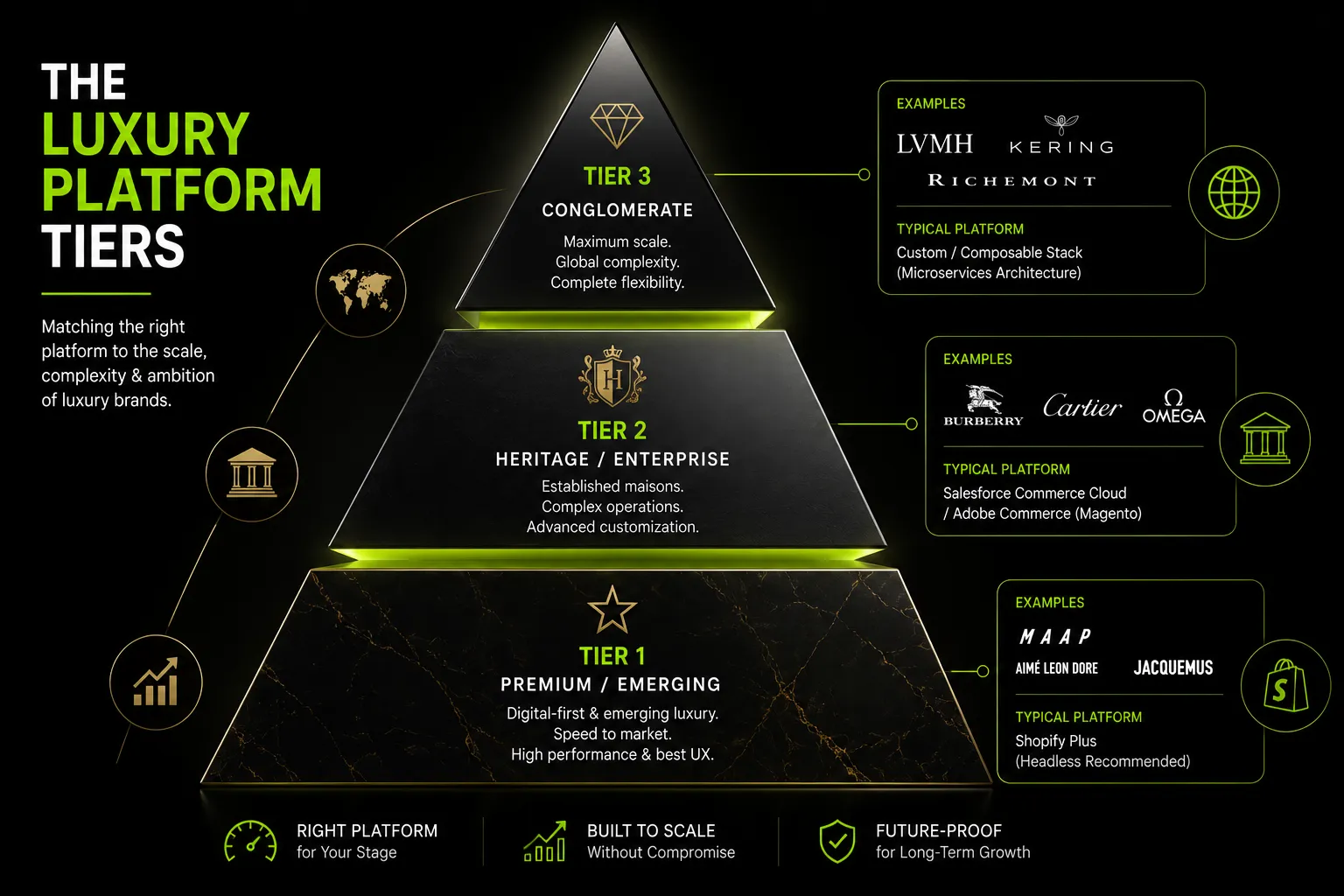
The Luxury Platform Tiers
Tier 1, Premium/Emerging Luxury: single-brand, a high design bar, a moderate SKU count, one or a few markets. Shopify Plus fits comfortably here, and this is where most brands reading a "best platform for luxury" guide actually sit.
Tier 2, Heritage/Enterprise Luxury: multi-region operations, complex B2B and wholesale running alongside DTC, and larger catalogue and merchandising complexity than a single-brand operation. This is Adobe Commerce or Salesforce Commerce Cloud territory.
Tier 3, Conglomerate Scale: multi-brand houses managing dozens of sub-brands across dozens of markets simultaneously. This is where fully custom enterprise platforms, Oracle Commerce, SAP Commerce Cloud, proprietary builds, genuinely make sense.
Most existing content implicitly benchmarks every luxury brand against Tier 3 examples, Louis Vuitton, Gucci, which misleads a brand doing $3M to $30M in revenue into thinking they need infrastructure built for a multi-brand conglomerate they aren't, and likely won't be for years.
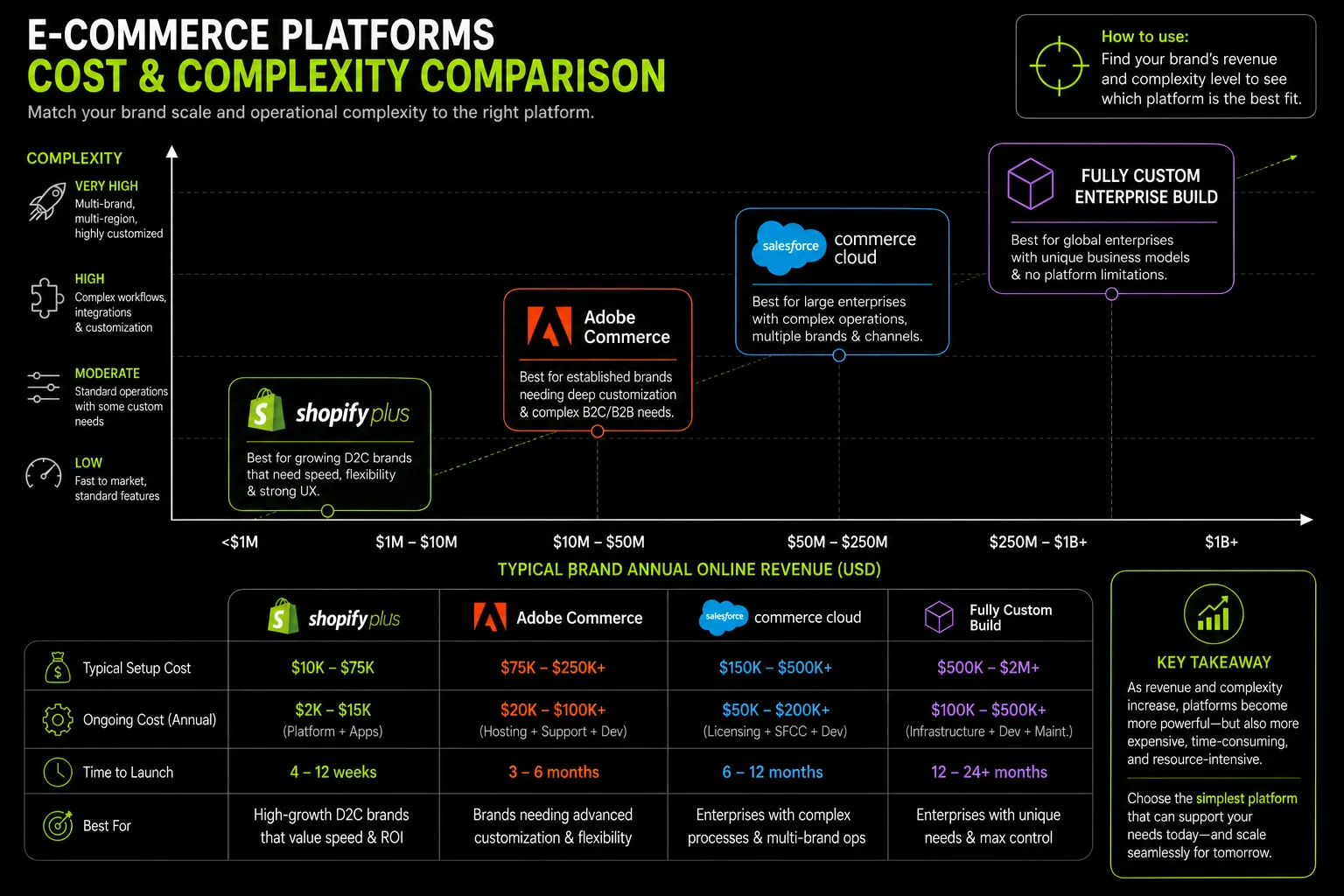
We place a brand's actual tier before recommending a platform. The mistake we see most often is a Tier 1 brand being sold Tier 2 infrastructure it doesn't need yet, or won't for years.
Debunking The "Luxury Needs Custom-Built Everything" Myth
This assumption drives more over-investment than any other decision in early-stage luxury ecommerce. Here's the actual evidence against it.
Real Luxury And Premium Brands Running On Shopify Plus
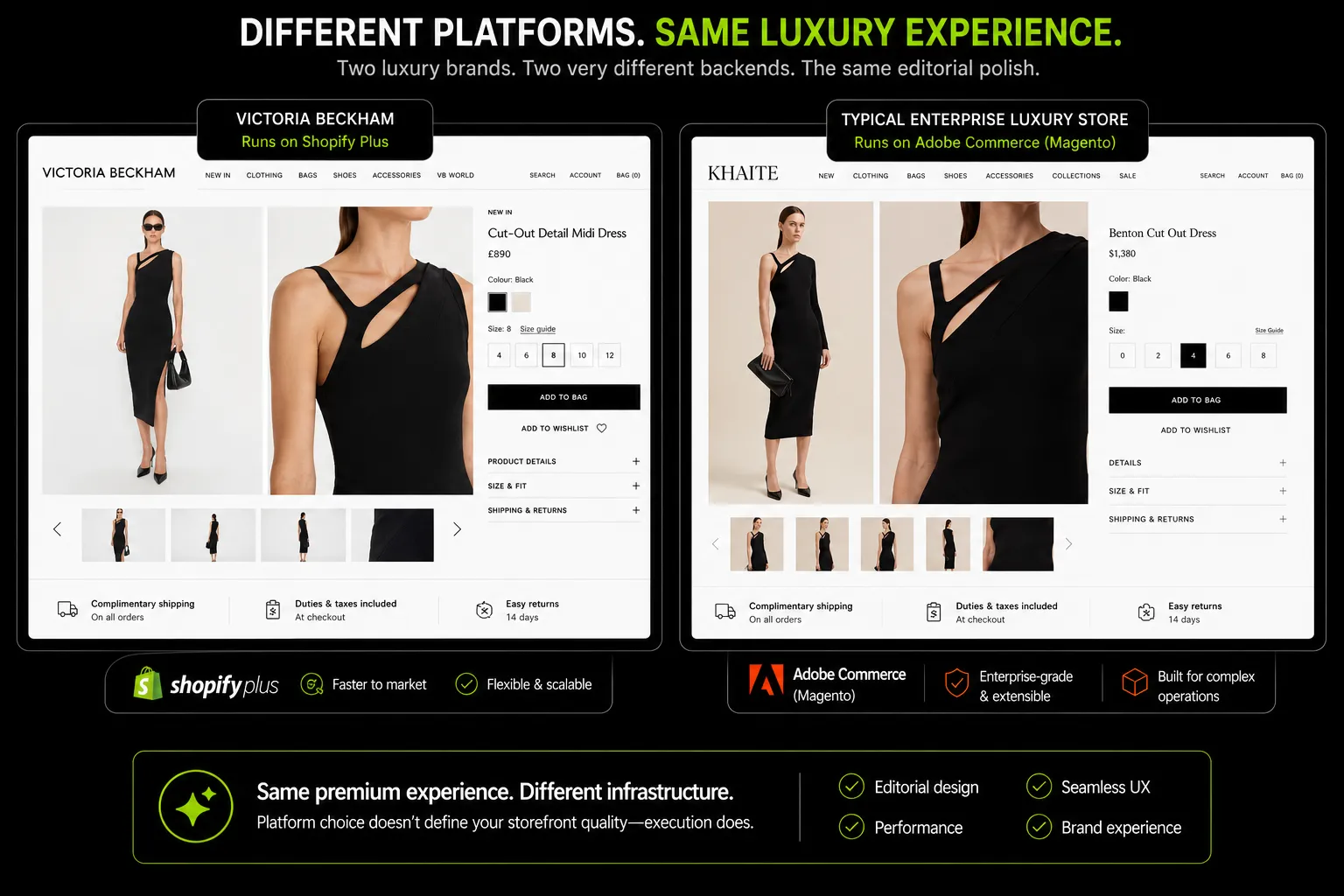
Victoria Beckham and Khaite are the two most consistently cited, well-documented examples of genuinely luxury fashion labels running on Shopify Plus with fully bespoke, editorial-grade storefronts.
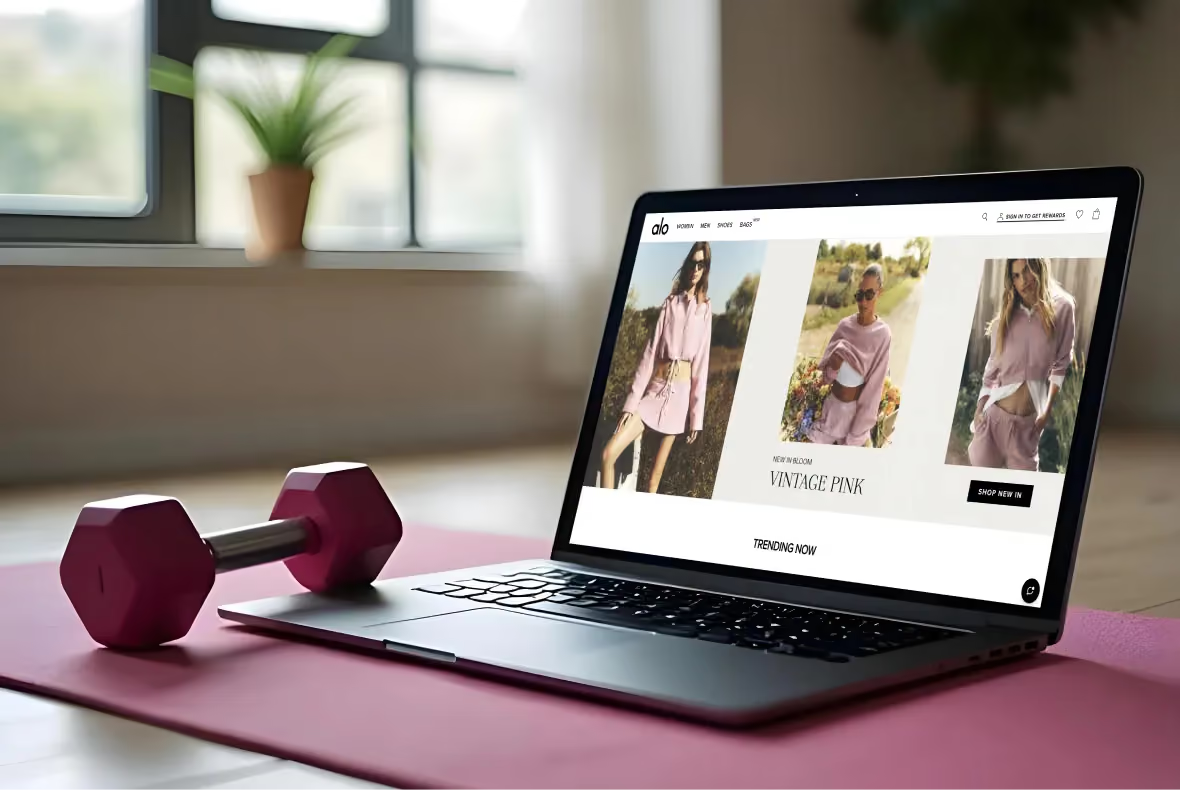
Alo Yoga is another relevant premium example, worth a closer look given our own audit work on the brand.
Here's why this works, not just that it does: Shopify Plus's headless Hydrogen framework separates the front-end design layer from the backend entirely.
A brand can achieve a fully custom look and genuine editorial storytelling without inheriting the Magento or Salesforce-level backend complexity they don't actually need at their current scale.
The platform stopped being a limiting factor on design quality years ago, it's now an infrastructure choice, not a design ceiling.
Shopify Plus reportedly powers several thousand global brands at the enterprise tier, and that scale is worth noting as context for why "Shopify" no longer signals template-store limitations the way it may have in years past.
When Enterprise Platforms Actually Make Sense
Being honest about the other side matters here too. Louis Vuitton, built on Oracle Commerce through a specialised systems integrator and Gucci, running on Powerfront alongside SAP Commerce Cloud, aren't on enterprise platforms because they're "more luxury" than Victoria Beckham.
They're there because they're managing dozens of regional storefronts, complex localisation, and multi-brand infrastructure that genuinely exceeds what a Shopify Plus setup is built to handle.
The actual driver is conglomerate-scale multi-region complexity. The assumed driver, luxury brand prestige, is a different thing entirely.
Conflating the two is exactly what leads brands at $5M revenue to chase infrastructure built for organisations managing 70+ sub-brands across 100+ markets.
What Actually Matters When Choosing A Platform For A Premium Or Luxury Brand
Once tier is established, here's what to actually evaluate a platform against, the practical criteria a brand can act on.
Design Flexibility Without Developer Bottlenecks
A platform that requires a developer for every homepage update, a common complaint against Adobe Commerce and Magento setups, creates friction that compounds over time.
A small in-house team should be able to manage day-to-day content while developers focus on deeper customisation work, not get bottlenecked waiting on a dev ticket to change a banner.
Checkout Trust And High-AOV Conversion Behaviour
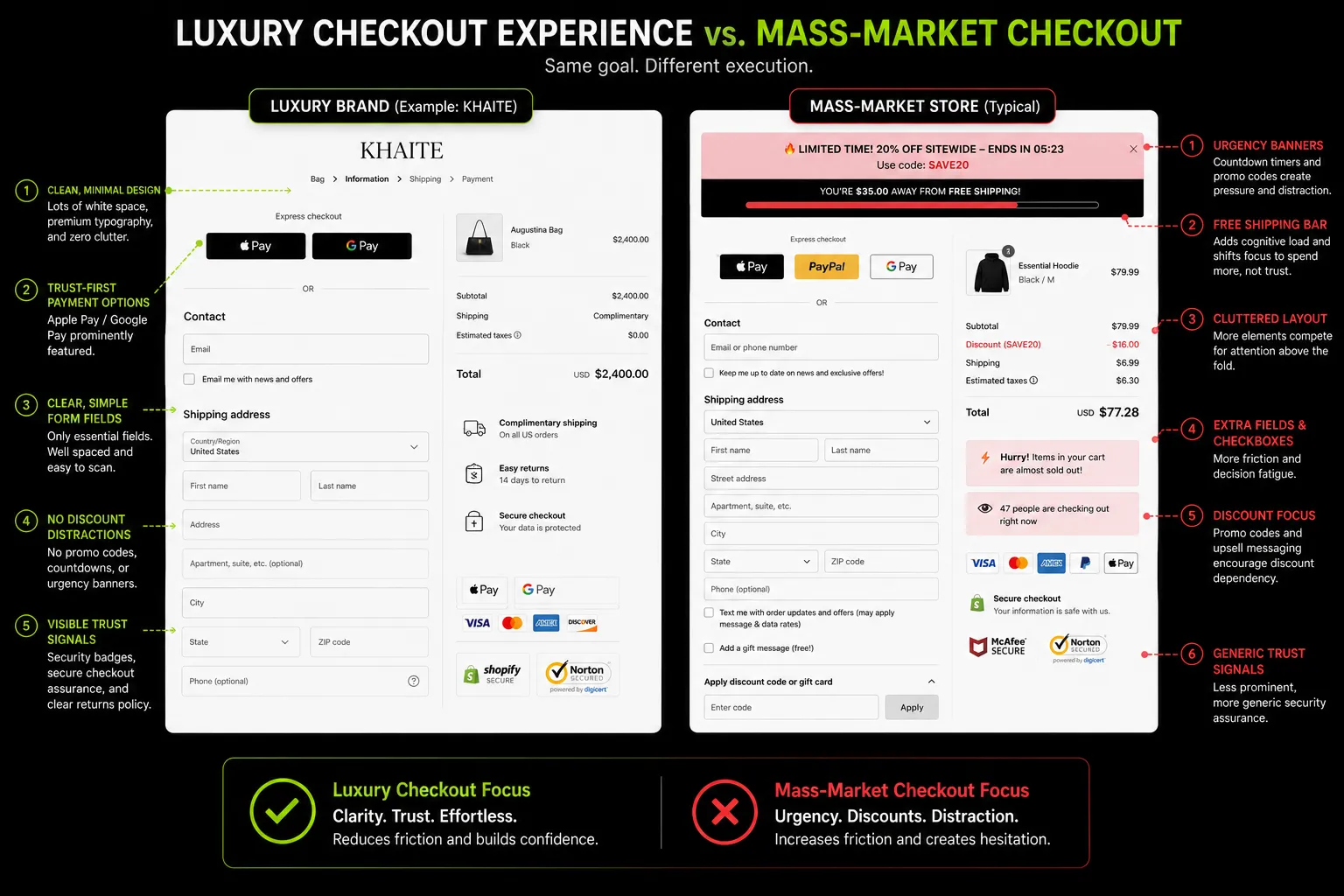
Luxury and premium checkout behaviour differs meaningfully from mass-market DTC. Higher price anchoring means trust signals, payment security cues and a checkout that doesn't feel like a discount retailer's flow all weigh more heavily on whether a high-value cart actually converts.
A shopper about to spend AED 3,000 on a single item scrutinises the checkout experience differently than one spending AED 150.
Clienteling, Personalization and Editorial Storytelling
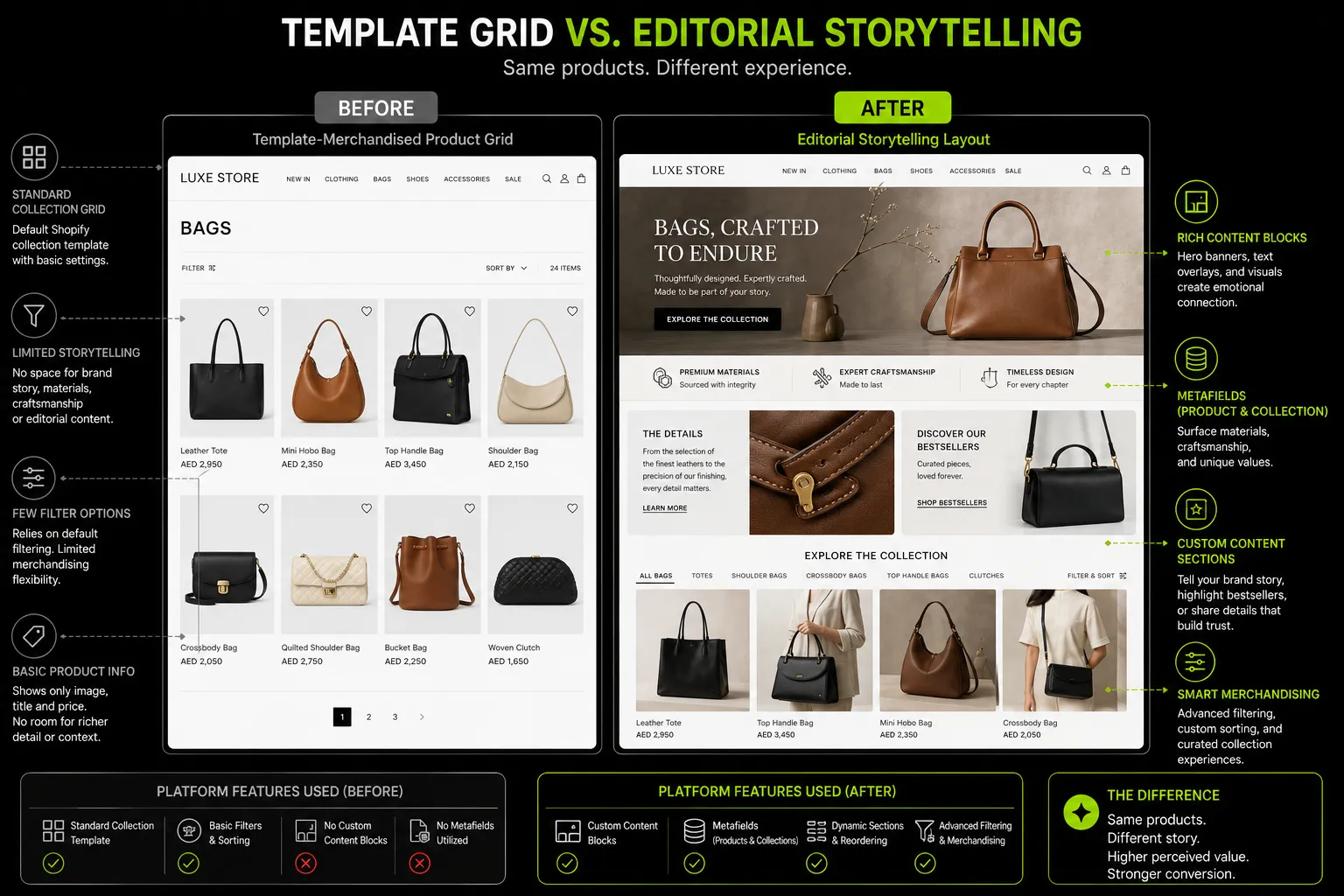
The brands succeeding in luxury ecommerce share a pattern: editorial-quality storytelling and clienteling-style personalization, not template-based merchandising or discount-driven retention tactics.
This isn't purely a design concern, it's a platform requirement. Rich content blocks, structured metafields, and app-layer personalization capability all need to exist at the platform level before the storytelling and clienteling experience can actually be built on top of them.
International And Multi-Currency Complexity
This is where the tier framework matters most practically. A single-market premium brand has very different platform needs than one launching across UAE, UK and US simultaneously.
Multi-currency display, market-specific pricing, and localisation all pull differently depending on how many markets a brand is actually operating in right now, not how many it might enter eventually.
Suplex's Approach To Platform Selection For Premium And Luxury Brands
We start platform recommendations from brand tier and growth trajectory, not from a default preference for any single platform. The right answer for a brand at $2M revenue with UAE ambitions looks genuinely different from one at $20M with existing multi-region operations already running.
As a Shopify and Shopify Plus Partner, our default recommendation for premium and emerging luxury brands is grounded in what the platform can actually do at the design and headless level today, not the template-store reputation it carried years ago and that some founders still assume applies.
This discipline shows up in prior work we've done in premium and luxury-adjacent categories. Celesti (premium skincare) involved a Shopify build with measurable conversion improvement.
Miho (contemporary fashion) involved persona-driven wireframing and typography system work.
Both reflect the same design and UX discipline that premium and luxury positioning genuinely requires, regardless of which platform tier a brand ultimately lands on.
Platform choice is a business decision tied to the growth stage, not a prestige signal. Over-investing in enterprise infrastructure too early is as costly a mistake as under-investing in design quality, both waste budget that should be going toward the thing that actually moves a luxury brand forward.
Platform Choice For UAE and Gulf Luxury And Premium Brands
Gulf luxury shopping behaviour has specific expectations that a generic global platform guide won't cover. Here's what changes for this market.
The In-Boutique Standard Extends Online
Gulf luxury and premium shoppers expect a digital experience that matches the in-boutique service standard they're used to.
This raises the bar on site performance, imagery quality, and checkout trust signals well beyond what's typical for mass-market DTC in the same region.
A slow-loading product page or grainy imagery reads as a mismatch against the brand promise, in a way that a mass-market shopper might tolerate but a luxury shopper won't.
BNPL Matters Even At Premium Price Points
COD is less dominant at higher price points than in mass-market Gulf ecommerce, but BNPL providers popular in the region, Tabby and Tamara, are increasingly expected even in premium and luxury categories. Platform choice needs to support clean integration of these payment methods without the checkout ever looking discount-driven, a poorly integrated BNPL widget can undercut the premium feel a luxury brand has spent the rest of the site building.
Arabic Content Needs The Same Editorial Polish
Arabic content and RTL design need to carry the same editorial polish as the English site. A luxury brand that treats Arabic as an afterthought translation sends a signal that undermines the premium positioning the rest of the site works hard to convey. This isn't a nice-to-have for this market, it's a direct extension of brand credibility.
Seasonal Spikes Hit Premium Categories Harder
Ramadan and gifting-season demand spikes are particularly pronounced in premium and luxury categories across the Gulf. Platform scalability during these windows matters more here than in steady-state Western markets, where demand curves stay relatively flat year-round.
We've built premium and luxury-tier storefronts for UAE and Gulf brands, combining Shopify Plus's design flexibility with the regional payment, language, and seasonal considerations that matter most to this audience, as a Shopify, Meta, and Google Partner working across the region.
Frequently Asked Questions
What ecommerce platform do luxury brands use?
It depends on scale. Premium and emerging luxury brands (Victoria Beckham, Khaite) commonly use Shopify Plus for its design flexibility and headless capabilities. Heritage and conglomerate-scale luxury houses (Louis Vuitton, Gucci) typically use enterprise platforms like Oracle Commerce or SAP Commerce Cloud, driven by multi-region and multi-brand complexity rather than luxury status alone.
Do luxury brands use Shopify?
Yes. Several genuinely luxury and premium fashion labels run on Shopify Plus, including Victoria Beckham and Khaite, using the platform's headless framework to achieve fully custom, editorial-quality storefronts without inheriting the developer overhead of legacy enterprise platforms.
What ecommerce platform does Louis Vuitton use?
Louis Vuitton's global ecommerce presence has been built on Oracle Commerce, implemented through a specialised systems integrator across multiple regional storefronts. This reflects the brand's multi-market, conglomerate-scale complexity rather than a general "luxury brands need this platform" rule.
Is Shopify good enough for a luxury brand?
For most premium and emerging luxury brands, yes. Shopify Plus's headless (Hydrogen) framework allows a fully custom front-end design while keeping merchandising, payments, and infrastructure managed. It becomes a less natural fit only at true conglomerate scale, with dozens of sub-brands and regional storefronts to manage centrally.
What's the difference between Shopify Plus and Adobe Commerce for luxury ecommerce?
Shopify Plus generally offers faster time-to-market and easier day-to-day management for a single premium brand, with lower total cost of ownership. Adobe Commerce (Magento) offers deeper out-of-the-box B2B and multi-brand complexity handling, but typically requires more developer resource for routine updates.
How much does a luxury ecommerce platform cost?
Shopify Plus typically starts around $2,300+ per month at the enterprise tier, before development and design costs. Enterprise platforms like Adobe Commerce or Salesforce Commerce Cloud generally involve higher licensing and implementation costs, often justified only at the multi-region, multi-brand complexity level.
Can a small luxury brand compete with big names online without a huge budget?
Yes. Platform cost is no longer the main barrier to a premium-feeling storefront, Shopify Plus's design flexibility means smaller premium brands can achieve editorial-quality storefronts comparable to much larger names. The differentiator is design and content discipline, not platform spend.
Hi, I’m Rishabh Jain
I believe great design has the power to shape perception, build trust, and move businesses forward. That belief is what led me to found Suplex Design Studio, a global branding and packaging studio working with FMCG and D2C brands across markets.I started suplex at 25 with a clear intent, to create design that is strategic, thoughtful, and commercially meaningful. By 28, the studio had scaled globally, guided by a strong foundation in Integrated Design that I developed during my academic journey in London, where I was honoured with the Dean’s Award.
Over the years, I’ve had the opportunity to work with 100+ brands, from Fortune 500 organizations to family-run businesses, helping them build packaging and brand systems that create recall, relevance, and long-term value.
Suplex’s work has been recognized internationally, including the Manifest Award (2024), the Clutch Global Award (2025), and features on platforms such as Packaging of the World, The Dieline, and the World Brand Design Society.
None of this would be possible without the people behind the work. I’m deeply grateful to the suplex team, whose commitment, creativity, and attention to detail turn ideas into meaningful brand experiences every day.
At the heart of my work is a simple philosophy, design should be intentional, honest, and built to last, and that continues to guide everything we create at suplex.



















Let’s Make It Happen
E-Commerce Success Stories
%201.avif)






.avif)
.avif)
Build Your D2C Business The Right Way
Build It With Suplex.


