Custom vs Template Ecommerce Website: The Honest Decision Guide
.avif)
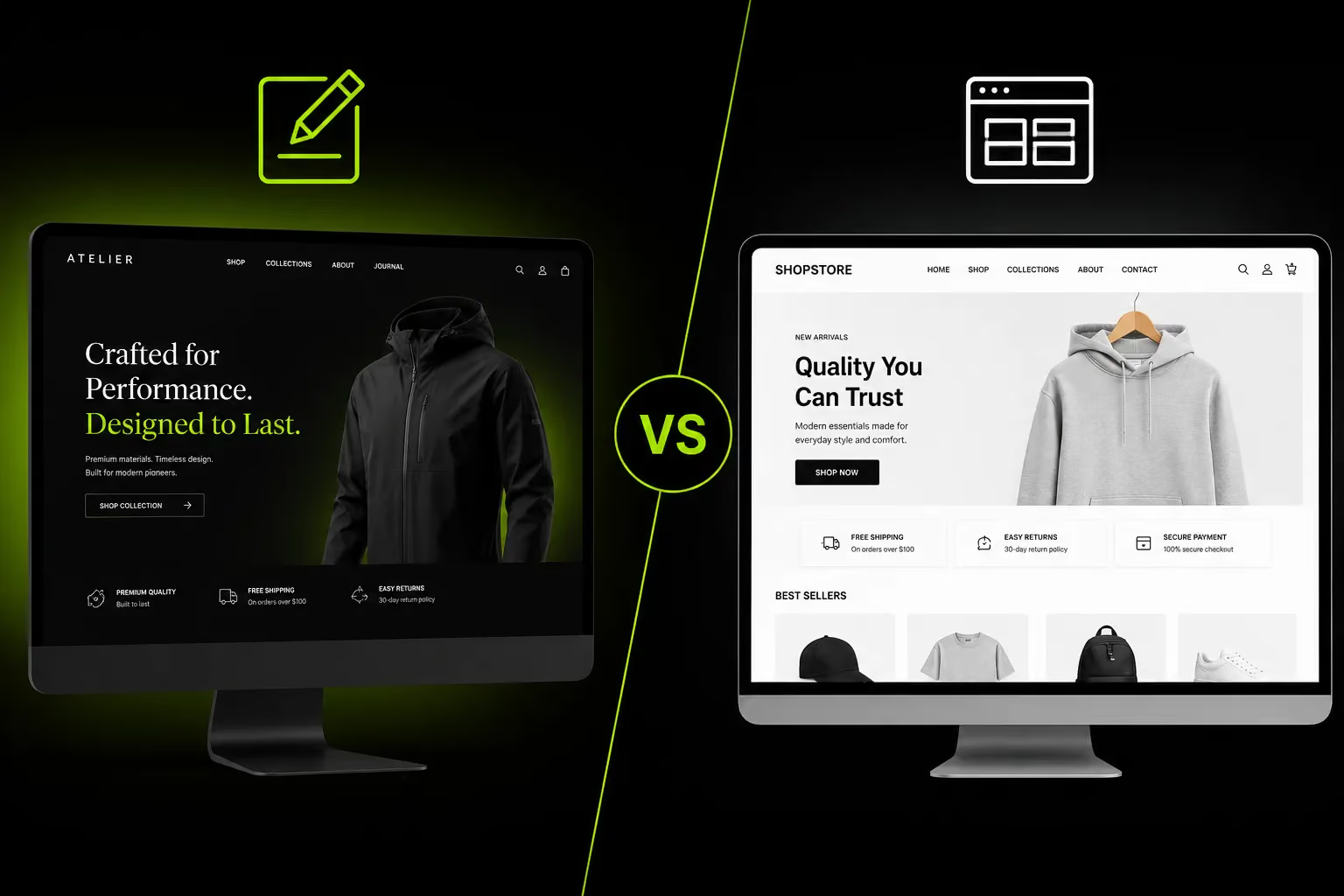
Custom vs Template Ecommerce Website: The Honest Decision Guide
The custom vs. template ecommerce debate is a false binary. There are five build options, and most brands should choose one of the middle options.
A well-chosen premium template with targeted customisation delivers 80–90% of the commercial benefit of a fully custom build for most brands below $2M annual revenue at 20–30% of the cost.
Above $5M, that calculatiCustom vs Template Ecommerce Website: The Honest on Inverts. The question is where your brand sits on that spectrum.
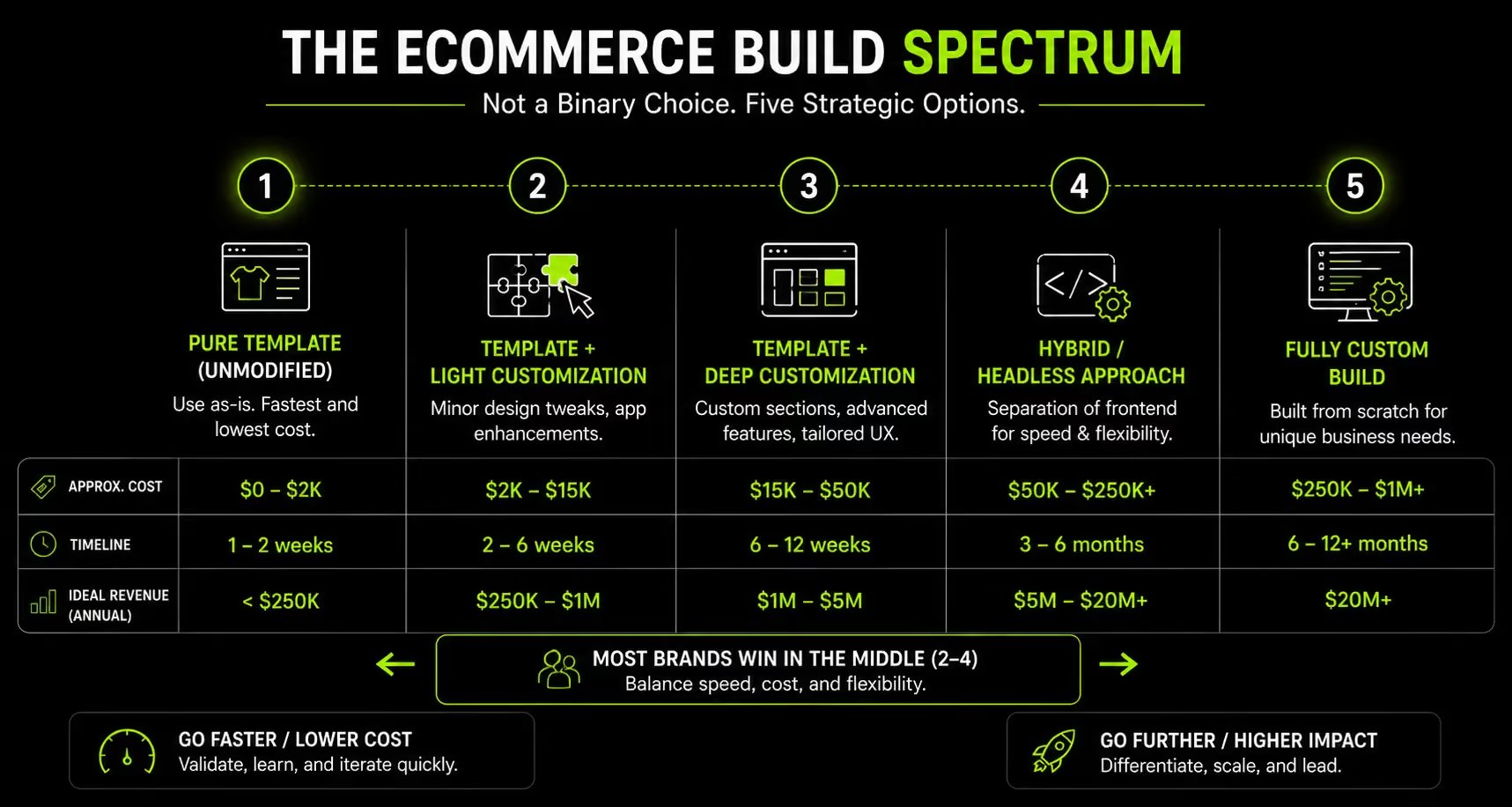
The Spectrum: Why Custom vs Template Is the Wrong Frame
Most ecommerce content presents this as a two-option decision. The reality is a five-point spectrum, and choosing the wrong position in either direction is a commercially expensive mistake.
The Five Positions on the Build Spectrum
Position 1 Template as-is:
A premium Shopify theme installed, content added, brand colours applied, nothing else changed.
- Cost: $400–$2,000 all-in including theme purchase and basic setup
- Timeline: 1–2 weeks
- Best for: Brands validating product-market fit, first-time Shopify stores, dropshipping operations, standard catalogue structures with no differentiation requirement
Position 2 Template With Brand Customisation:
A premium theme with brand-specific colour system, typography, adjusted section layouts, custom homepage design, and product page modifications without significantly touching the underlying Liquid code.
- Cost: $2,000–$6,000 all-in
- Timeline: 2–4 weeks
- Best for: Early-stage D2C brands that need a professional result faster than a full custom build allows
Position 3 Semi-Custom (The Most Underbuilt Option In Ecommerce):
A premium theme used as the structural foundation, with significant custom Liquid sections built for the brand's specific requirements, a custom product configurator, bespoke hero layout, custom collection page design and specific trust signal components.
The platform and checkout infrastructure are template-based; the design and key UX sections are custom.
- Cost: $5,000–$20,000 depending on scope
- Timeline: 4–8 weeks
- Best for: Growing brands above $300K annual revenue where template limitations are visible but a full custom build cannot yet be justified
Position 4 Custom Theme On A Managed Platform :
A fully custom Liquid or Hydrogen theme built from a blank canvas on Shopify or Shopify Plus, using the platform's commerce infrastructure (checkout, cart, payment processing, inventory) while the entire visual layer is bespoke. No template DNA.
- Cost: $25,000–$80,000
- Timeline: 3–5 months
- Best for: Brands above $2M–$5M annual revenue where brand differentiation is a commercial advantage and the conversion improvement from a purpose-built experience justifies the investment
Position 5 Fully Custom Platform Build:
The entire ecommerce stack built from scratch custom frontend, custom backend, custom checkout. No platform.
- Cost: $80,000–$500,000+
- Timeline: 6–18 months
- Best for: Enterprise brands with requirements that no existing platform can meet, complex simultaneous B2B and D2C functionality, or organisations with large in-house engineering teams who justify ongoing maintenance
Most ecommerce content frames Positions 1 and 5 as the choice. Most brands should be evaluating Positions 2, 3, and 4.
The semi-custom approach (Position 3) is the most commercially underserved option; it produces the best ROI for growing brands and is the least visible path in the market because template vendors do not sell it and custom build agencies often skip straight to Position 4 proposals.
If you are uncertain which position is right for your brand, a platform consultation with clear commercial criteria produces a faster and more accurate answer than evaluating demos.
What You Actually Get With a Template Honestly
Templates are not inferior by default. They are appropriate for specific brand stages and commercially wrong for others. Here is an honest assessment of both.
What Templates Do Well
Speed To Market:
A well-chosen premium template can be live in 2–4 weeks. For an early-stage brand, this is not just a cost saving, it is market timing.
Being live and generating revenue 10 weeks earlier than a custom build allows is a commercial advantage that strongly favours the template-first path at an early stage.
Performance When Properly Implemented:
One of the most important findings from analysis of 200+ website builds across 2023–2026: well-implemented templates match custom sites for speed, SEO and conversion rates when content quality is equal.
A well-configured Dawn or Impulse store with proper image optimisation and a disciplined app stack achieves competitive Core Web Vitals scores.
The template is not inherently a performance liability. What is a liability is what gets added on top of it over time.
Feature Access Without Development.
Shopify's Online Store 2.0 architecture sections everywhere, JSON templates, app blocks means marketing teams can update content, run A/B tests on landing pages and add seasonal sections without developer involvement.
This operational velocity is a genuine commercial advantage over custom builds where every content change requires developer time.
Lower Total Risk At Early Stage.
A brand spending $5,000 on a template build and later spending $50,000 on a custom build has made two sequentially correct decisions.
A brand spending $50,000 on a custom build before validating product-market fit has made one expensive gamble. The template-first path carries lower irreversible cost.
Where Templates Genuinely Struggle
Performance Degradation From App Bloat.
This is a template's primary structural weakness, and it compounds over time. A store that launches with five apps and adds 15 more over two years accumulates significant third-party JavaScript, with every app increasing page weight.
A store running 10 apps can add 500ms to 1 second of load time from third-party scripts alone. Each additional second of load time can reduce conversions by up to 7%, causing performance and revenue losses to compound.
Templates are not the problem undisciplined app usage is. But because templates make app installation so easy, excessive app usage is more likely.
This is one of the most common issues we find in Shopify audits: underperforming stores with quality themes running 20+ apps, many of which solve problems that a targeted custom section could address with far less performance overhead.
Code Loaded For Features You Do Not Use.
Templates serve the widest range of possible stores. A fashion brand using Impulse loads code for the lookbook, mega menu, countdown timer and video backgrounds whether or not those features are activated.
This unused code adds to page weight. A custom build loads only what the specific store requires.
Visual Differentiation Ceiling:
A recognised theme is recognisable. A brand running Prestige looks like a brand running Prestige to anyone who has seen enough Shopify stores.
For brands where visual distinctiveness is a commercial advantage, premium positioning, brand-as-product, competitor differentiation the template's ubiquity is a genuine liability.
Complex Functionality Limits:
Product configurators, custom checkout logic, bespoke B2B pricing tiers, complex bundle builders, and subscription-with-one-time hybrid cart logic are not template features.
They require either apps (which add performance cost) or custom development. As operational complexity grows, the template becomes a ceiling rather than a foundation.
What You Actually Get With a Custom Build Honestly
Custom builds have genuine commercial advantages at the right scale and are unjustified investments below a specific revenue threshold. Both sides deserve honest treatment.
What Custom Builds Genuinely Deliver
Conversion Architecture Designed For Your Customer Journey:
A custom build is designed around your customer's decision journey, your product's purchase barriers and your brand's visual identity.
When the standard ecommerce journey doesn't match how customers actually buy, this tailored approach can deliver measurable conversion improvements.
Performance Without App Compromise:
A custom theme loads only the code your store needs eliminating unused features, redundant scripts, and many third-party app performance penalties.
Brands like Chassis Unlimited achieved 150% faster load times after moving to a custom Shopify Plus build, while Clé Tile cut maintenance costs by 90% and improved load times by 63%.
Integration engineering:
Complex ERP, CRM, PIM, and inventory integrations work best when engineered natively rather than forced into template app blocks.
A custom build aligns data flows, UI, and business logic, eliminating manual workarounds. Clé Tile's migration reduced maintenance costs by 90%, largely by replacing the operational complexity of its Magento and WordPress stack.
Brand Differentiation Of Compounds:
A custom build is the only way to produce a store that cannot be replicated by a competitor purchasing the same theme.
When brand experience is the primary competitive advantage, custom development is the investment that protects it.
Long-Term Tco Advantage At Scale:
A $30,000 custom build running cleanly for 5 years with minimal maintenance can cost less than a $5,000 template with $2,000/year in plugins, periodic developer hours for conflict resolution.
A $40,000 rebuild in year 3 when accumulated technical debt makes further customisation impossible.
Where Custom Builds Are Unjustified
Below the revenue threshold where ROI closes:
At $500K annual revenue, a 0.5% conversion rate improvement adds about $2,500 per year, making a $40,000 custom build difficult to justify.
At $5M revenue, the same improvement generates around $25,000 annually, reducing payback to under two years.
For most brands, custom Shopify development delivers the strongest ROI above $5M in annual revenue, while below $1M–$2M the economics rarely support it.
When The Constraint Isn't The Build:
Custom development solves architectural problems not weak positioning, poor product photography, low-quality traffic, or product-market fit.
Without fixing these first, a custom build simply creates a more expensive underperforming store. Before investing, confirm that the real constraint is your website architecture.
When Time to Market is The Priority:
A custom build typically takes 3–5 months. For brands entering a time-sensitive market, launching first on a premium template and developing a custom build in parallel is often the smarter commercial strategy..
For brands at the scale where custom development is clearly the right investment, our custom Shopify themes service covers the full process from architecture to launch.
The Real Costs: What to Budget at Each Level
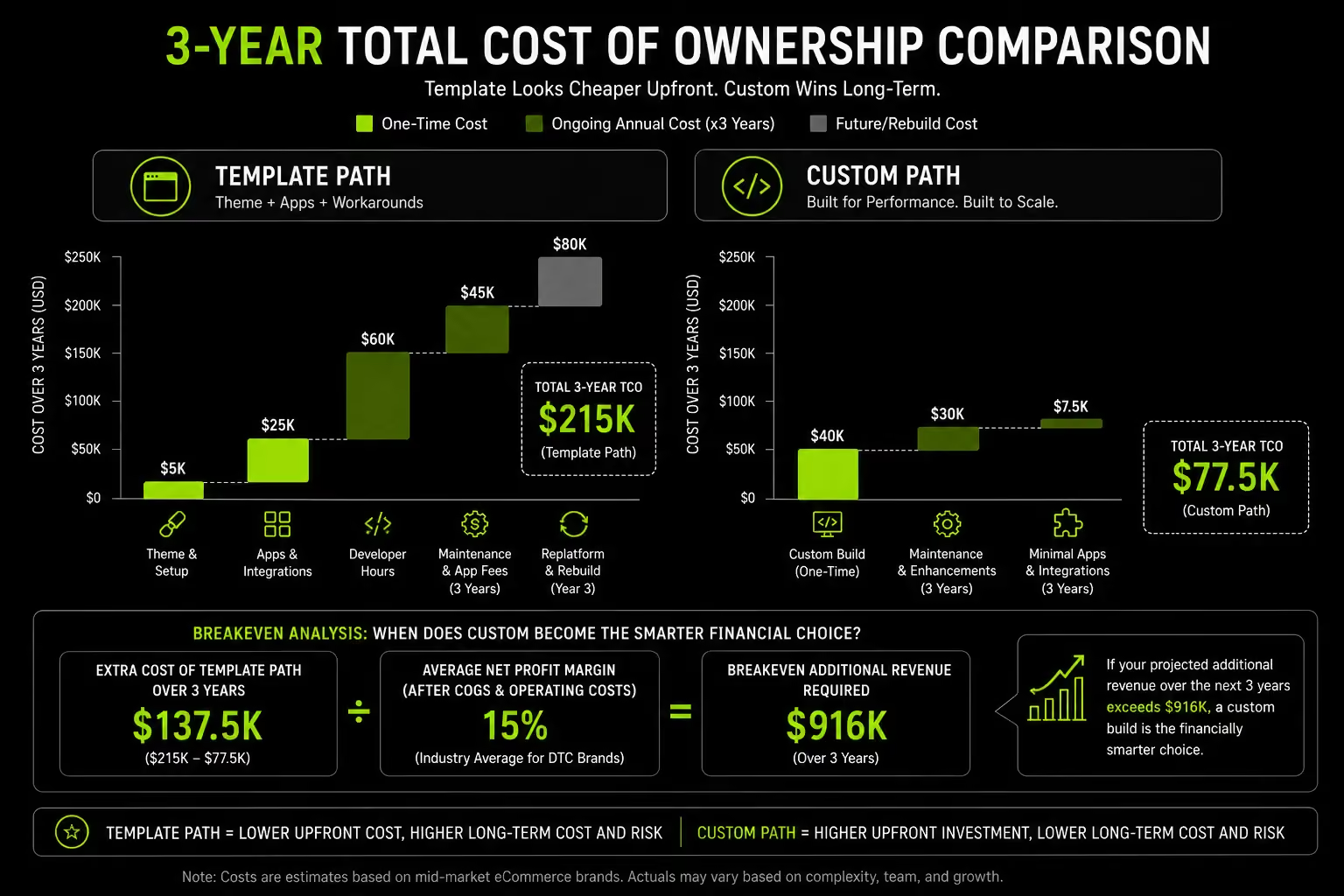
Cost by Build Type:
The Hidden Costs That Change the TCO Calculation
Most comparisons quote the build cost. The commercially correct comparison includes ongoing costs on both paths.
Template Ongoing Costs:
- Monthly app subscriptions: $200–$800/month for a typical growth-stage store app stack (reviews, email, loyalty, upsell, analytics, subscriptions)
- Developer hours for app conflict resolution and periodic customisation: $1,000–$5,000/year
- Performance optimisation as apps accumulate: $2,000–$8,000 every 12–18 months
- Rebuild cost when template limits are reached: $20,000–$60,000 at years 2–4
Custom Build Ongoing Costs:
- Developer maintenance for Shopify API updates: $3,000–$12,000/year
- Performance monitoring: lower than template (cleaner codebase)
- Feature additions: more expensive per feature (no app install option)
- Retained development resource required
The 3-Year Tco Worked Example:
Template path (Shopify Advanced + 15 apps + periodic developer hours + mid-term rebuild):
- Year 1: $8,000 (build) + $4,800 (apps) + $3,000 (developer hours) = $15,800
- Year 2: $4,800 (apps) + $3,000 (developer hours) + $5,000 (performance work) = $12,800
- Year 3: $4,800 (apps) + $40,000 (rebuild when limits hit) = $44,800
- 3-year total: ~$73,400
Custom path (custom Shopify theme, clean codebase, minimal app dependency):
- Year 1: $60,000 (build) + $6,000 (maintenance) + $2,400 (minimal apps) = $68,400
- Year 2: $6,000 (maintenance) + $2,400 (apps) = $8,400
- Year 3: $6,000 (maintenance) + $2,400 (apps) + $10,000 (feature additions) = $18,400
- 3-year total: ~$95,200
The 3-year TCO difference is $21,800. The custom build breaks even if it generates approximately $21,800 in additional revenue over 3 years through better conversion, performance, or reduced operational overhead.
At $2M annual revenue, a 0.4% CVR improvement generates $24,000 in year one. This is the revenue level where the custom build's economics begin to work.
Performance: The Data Behind the Debate
The performance argument for custom builds is real but more nuanced than "custom is always faster."
Custom vs Template Performance: What the Data Actually Shows
When Custom Genuinely Outperforms:
A properly built custom Shopify theme loads only the code required for the specific store.
In controlled comparisons, custom Shopify themes consistently achieve higher Lighthouse scores than equivalent template-based stores.
Chassis Unlimited's custom build achieved 150% faster loading with a directly correlated 30% bounce rate reduction.
When Templates Match Or Exceed Custom:
Analysis of 200+ website builds found no measurable SEO ranking advantage for custom sites vs premium templates when content quality is equal.
A Dawn or Crave store with proper WebP images, correct lazy loading, disciplined app usage (under 8 apps), and deferred non-critical scripts achieves competitive Core Web Vitals scores.
Well-optimised Liquid stores hit 2.0s LCP within the range where further improvement produces diminishing conversion returns.
The Real Performance Culprit Is App Bloat:
The honest explanation for most template performance problems: it is not the template. It is what gets added to it.
Every Shopify app that injects JavaScript adds render-blocking scripts that delay page interactivity. The average app adds 50–100ms of additional load time.
At 10 apps, that is 500ms to 1 second of additional load from app scripts alone before any other performance issues are considered.
The path to resolving this is not necessarily a custom build. It is:
- Auditing the app stack and removing apps with no measurable commercial benefit
- Replacing multiple-app solutions with a single custom Liquid section
- Deferring non-critical app scripts from the critical rendering path
- Moving to AJAX for cart and wishlist functionality to eliminate full page reloads
This performance optimisation intervention, a core part of our Shopify audit work, often recovers 0.5-1.5 seconds of LCP on a template store for $3,000–$8,000, versus $50,000+ for a full custom rebuild.
The correct diagnostic question before committing to a custom build: is the performance problem architectural (intrinsic to the template's code structure) or operational (caused by app accumulation)? That answer determines whether the solution is a targeted optimization or a full rebuild.
For brands whose Shopify store is running slow despite basic optimisation, a proper audit is the fastest way to identify the actual source before making a build decision.
SEO Does Custom Win on Search?
The SEO argument is the most commonly overstated case for custom builds.
Where Custom Has Genuine SEO Advantages
- Technical architecture control:
Custom builds provide greater control over URL structures, schema markup, internal linking, and rendering—areas where managed platforms impose limits. - Performance as an SEO signal:
Faster custom builds improve Core Web Vitals (LCP, INP, CLS), which are Google ranking signals. The SEO advantage is incremental but meaningful in competitive search results. - Crawl efficiency for large catalogues:
With less unused code, custom builds are crawled more efficiently than template stores. For large catalogues, this can improve crawl budget utilisation and product indexation.
Where the SEO Case for Custom Is Overstated
Custom builds do not automatically rank better than premium templates. When content quality is equal, the biggest SEO drivers are content, internal linking, backlinks and structured data all achievable on a well-configured template.
A brand spending $50,000 on a custom build for SEO alone is often a poorer investment than spending $5,000 on a template and $45,000 on content and link building.
Custom development is justified for SEO only when template limitations prevent solving specific technical SEO issues.
For a detailed pre-build or post-build diagnostic, our ecommerce website audit checklist covers the technical SEO variables to evaluate before committing to a rebuild.
The Decision Framework: Which Build Level Is Right for Your Brand
This is the most commercially important section in the post, a structured framework that makes the decision actionable.
The Revenue Threshold Decision
Under $500k Annual Revenue, Template Or Semi-Custom
The ROI for a full custom build rarely works at this stage. Invest in a premium template with brand customisation, and direct the remaining budget toward product photography, paid acquisition, and email marketing, where returns are typically higher.
$500k–$2m Annual Revenue, Semi-CustomA semi-custom build offers the best ROI. Start with a premium Shopify theme and add custom sections for high-impact areas like product pages, collection pages, and trust signals. Typical cost: $8,000–$20,000.
$2M–$5M annual revenue, Custom Shopify themeThis is the typical ROI inflection point. A custom theme improves conversion, performance, and maintainability, with benefits extending to paid advertising efficiency, SEO, and lower long-term development costs.
Above $5M annual revenue, Custom delivers the highest ROIAt this scale, gains from conversion improvements, faster performance, lower app costs, stronger brand differentiation and complex integrations often justify a $50,000–$120,000 investment within 18–24 months.
This is also the stage where upgrading to Shopify Plus often becomes part of the decision.
The Constraint-Based Decision
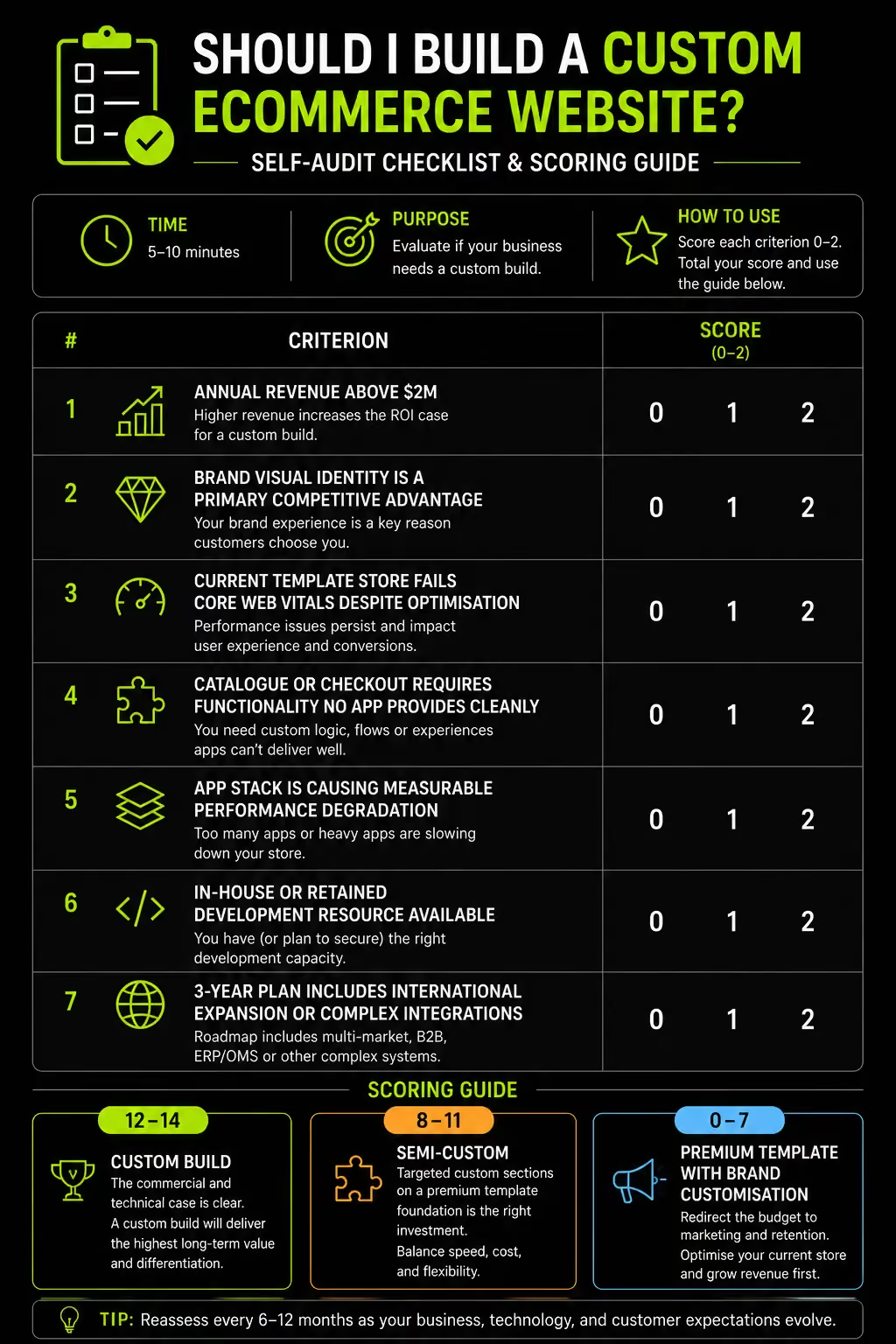
Revenue is not the only decision variable. Three constraints justify earlier-than-threshold custom investment:
Constraint 1: Catalogue or business logic exceeds template capability. Product configurators, complex bundle logic, bespoke B2B pricing, subscription-with-one-time hybrid cart, or custom checkout fields that require Shopify Functions.
If your business requires a feature that no combination of available apps provides cleanly, custom development is the correct solution regardless of revenue level.
Constraint 2: Brand differentiation is the primary commercial advantage. For a luxury, premium lifestyle or design-led brand where the store experience is a meaningful part of what customers are buying, template ubiquity is a commercial liability that justifies earlier custom investment.
Constraint 3: Performance has been optimised and is still a confirmed conversion constraint. After a thorough app stack audit, image optimisation and script deferral.
If the store's LCP is still above 3.5 seconds and analytics show high mobile bounce rates correlated with load time the performance problem is architectural and a custom build is the correct solution.
The Build Decision Checklist
The Middle Path Semi-Custom in Practice
Semi-custom is the most commercially underserved build approach and the one that resolves the binary for most brands. Here is what it actually means in practice.
What Semi-Custom Actually Means
Semi-custom is not a template with different colours. It is a premium theme used as the structural and commerce infrastructure foundation, with specific page sections that drive the brand's commercial differentiation built as custom Liquid components on top.
What Is Typically Custom In A Semi-Custom Build:
- Product page architecture custom review placement, custom trust signal layout, bespoke variant selector design, custom delivery messaging component
- Homepage hero and editorial sections brand-specific layouts that no template section exactly replicates
- Collection page design custom grid logic, custom filter UI, bespoke collection header treatment
- Custom cross-sell and upsell components designed for the brand's specific product relationships rather than a generic app widget
What Remains Template-Based:
- Platform infrastructure (checkout, cart, payment processing, order management)
- Theme update pathway most semi-custom builds retain the theme's update capability for major releases
- App block integration points OS 2.0 compatibility maintained
The commercial logic: the sections that drive the brand's commercial differentiation (product page, homepage, collection page) are custom.
The sections that are operational infrastructure (checkout, cart, account pages) remain template-based because custom checkout on Shopify requires Plus and for most brands below the Plus threshold, the template checkout is adequate.
Semi-Custom on Shopify: What the Development Looks Like
A semi-custom Shopify build typically involves:
- Theme selection: choosing the premium theme that provides the best structural foundation for the brand's catalogue and commerce requirements (Impulse, Prestige, Stiletto or Dawn as a clean base).
Our best Shopify templates for clothing brands guide covers which base works for which brand type.
- Custom Section Development: 4–10 custom Liquid sections built to brand specification, each with appropriate schema editor integration (OS 2.0 compatible, marketer-editable without developer involvement)
- Performance Audit: reviewing the base theme's JavaScript architecture and identifying optimisation opportunities before any app installation
- App stack Discipline: installing only apps whose functionality cannot be achieved with custom Liquid, and configuring them for minimal performance impact
- Brand System Integration: custom CSS design system ensuring brand typography, spacing, colour, and component design is consistent across all template and custom sections
Cost: $8,000–$20,000. Timeline: 4–8 weeks. Result: a store that looks and feels custom for the 80% of the experience customers actually interact with, running on stable template infrastructure for the 20% that is commerce plumbing.
At Suplex, semi-custom builds deliver the strongest commercial ROI. For brands generating $500K–$3M in annual revenue, they provide 80–90% of the visual and functional benefits of a full custom build at just 25–40% of the cost.
This makes them ideal for brands that have outgrown a standard template but aren't ready to justify a fully custom investment.
Our custom Shopify theme service includes both semi-custom and full custom builds, tailored to each brand's stage of growth.
Custom and Template Ecommerce Websites in the UAE What Changes
UAE fashion and ecommerce brands have specific requirements that change the custom vs template calculus and that every competing guide ignores entirely.
UAE-specific build considerations
Arabic Rtl As A Design System Requirement:
For UAE brands, Arabic RTL support is often the biggest factor in the custom vs. template decision. Template-based RTL typically works but can create inconsistencies in navigation, icons, breadcrumbs, forms, and layouts.
A semi-custom or custom build integrates RTL into the design system from the start, ensuring consistent directionality, Arabic-optimised typography and properly functioning carousels, galleries, and navigation.
For brands serving Arabic-first customers, this can have a meaningful impact on user experience and conversion.
For brands setting up bilingual operations, our international ecommerce setup service covers the full RTL and multilingual configuration process including which template structures support bilingual implementation most cleanly.
Payment Gateway And COD Integration:
UAE payment providers such as Telr, PayTabs, Tap Payments, Tabby, Tamara, and COD solutions all work well on template-based Shopify stores.
However, brands needing deeply integrated payment experiences especially Shopify Plus merchants using Checkout Extensibility benefit from custom or semi-custom development, where these integrations can be built natively rather than layered through apps.
Mobile-First UAE Consumer Context:
The UAE has one of the highest smartphone penetration rates globally. A custom or semi-custom build that prioritises mobile performance, specifically the product page experience on a 6-inch screen.
Produces measurable conversion improvement in a market where mobile is the primary shopping device. Template mobile performance is adequate; custom mobile architecture is optimised.
Uae Brand Positioning And Premium Expectations:
UAE consumers have high expectations for premium ecommerce design. Because popular Shopify themes are widely recognised, visual differentiation matters more.
For premium brands, a semi-custom or custom build often delivers stronger commercial value at a lower revenue threshold than in less design-conscious markets.
Our Loomsona case study covers how we approached this for a UAE fashion brand Arabic RTL built natively into the design system, a semi-custom product page architecture for modest fashion category logic, and mobile performance as the primary optimisation target.
How We Approach This Decision at Suplex
At Suplex, we deliver everything from template configurations to fully custom Shopify Plus builds. Because we work across the entire spectrum, we recommend the solution that best fits a brand's commercial stage.
Most of our UAE and Gulf ecommerce projects are semi-custom builds: a premium Shopify theme enhanced with custom Liquid sections for high-impact areas like product pages, collection pages and homepages.
While standard components such as checkout and accounts remain theme-based. This delivers much of the benefit of a custom build at a significantly lower cost.
Before recommending any build, we ask one question: Is the constraint architectural or operational? If the problem can be solved with targeted optimisation or a semi-custom enhancement, a full rebuild is unnecessary.
That's why every Shopify audit begins with diagnosis before recommendations. In many cases, we've identified a $5K–$8K optimization that solved a problem clients had been quoted $50K+ to fix with a complete rebuild.
Frequently Asked Questions
What Is The Difference Between A Custom And Template Ecommerce Website?
A template website uses a shared design framework, while a custom website is built specifically for one brand. Most businesses achieve the best ROI with a semi-custom approach.
How Much Does A Custom Ecommerce Website Cost?
Template builds: $2K–$6K. Semi-custom: $5K–$20K. Custom Shopify themes: $25K–$80K. Shopify Plus builds: $40K–$120K. Fully custom platforms: $80K–$500K+.
Is A Custom Ecommerce Website Better Than A Template?
It depends. Above $5M annual revenue, custom often delivers the best ROI. Between $500K–$2M, a semi-custom build usually offers the best balance of cost and performance.
Do Custom Ecommerce Websites Perform Better For Seo?
Not automatically. Content quality, backlinks, and structured data matter more than build type. Custom is most beneficial when template limitations create technical SEO issues.
Why Do Template Ecommerce Websites Get Slow Over Time?
Usually because of app bloat. Too many third-party apps add unnecessary scripts and slow the site. An app audit can often restore performance without a full rebuild.
What Is A Semi-Custom Ecommerce Website?
A semi-custom build combines a premium theme with custom sections for key pages like the homepage, product pages, and collections. It offers many benefits of custom development at a lower cost.
When Should I Switch From A Template To A Custom Ecommerce Website?
Consider switching once you're above $1.5M–$2M in annual revenue and your store has confirmed architectural limitations that optimisation or semi-custom improvements can't solve.
Hi, I’m Rishabh Jain
I believe great design has the power to shape perception, build trust, and move businesses forward. That belief is what led me to found Suplex Design Studio, a global branding and packaging studio working with FMCG and D2C brands across markets.I started suplex at 25 with a clear intent, to create design that is strategic, thoughtful, and commercially meaningful. By 28, the studio had scaled globally, guided by a strong foundation in Integrated Design that I developed during my academic journey in London, where I was honoured with the Dean’s Award.
Over the years, I’ve had the opportunity to work with 100+ brands, from Fortune 500 organizations to family-run businesses, helping them build packaging and brand systems that create recall, relevance, and long-term value.
Suplex’s work has been recognized internationally, including the Manifest Award (2024), the Clutch Global Award (2025), and features on platforms such as Packaging of the World, The Dieline, and the World Brand Design Society.
None of this would be possible without the people behind the work. I’m deeply grateful to the suplex team, whose commitment, creativity, and attention to detail turn ideas into meaningful brand experiences every day.
At the heart of my work is a simple philosophy, design should be intentional, honest, and built to last, and that continues to guide everything we create at suplex.






























Let’s Make It Happen
E-Commerce Success Stories
%201.avif)






.avif)
.avif)
Build Your D2C Business The Right Way
Build It With Suplex.


