Marketplace vs Own Ecommerce Site: Pros, Cons, and How to Choose in 2026
.avif)
Marketplace vs Own Ecommerce Site: Pros, Cons, and How to Choose in 2026
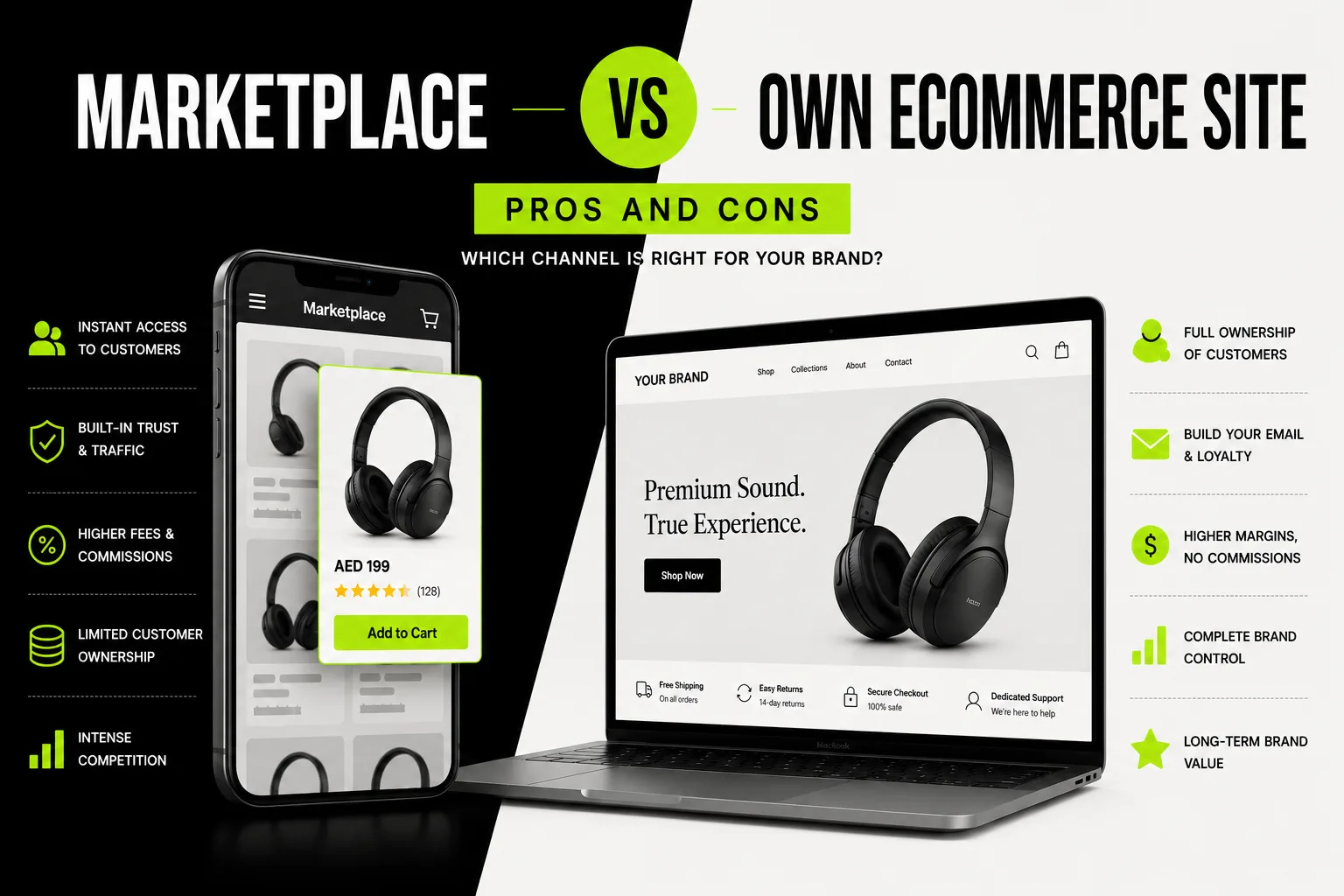
Marketplace vs Own Ecommerce Site is one of the biggest decisions for ecommerce brands.
Selling on Amazon, Noon or Namshi offers instant reach, while your own online store gives you greater control over branding, customer data and profitability.
This Suplex blog post compares the pros, costs and trade-offs to help you choose the right strategy for your stage of growth.
What Each Channel Actually Is: Clearing the Definitions
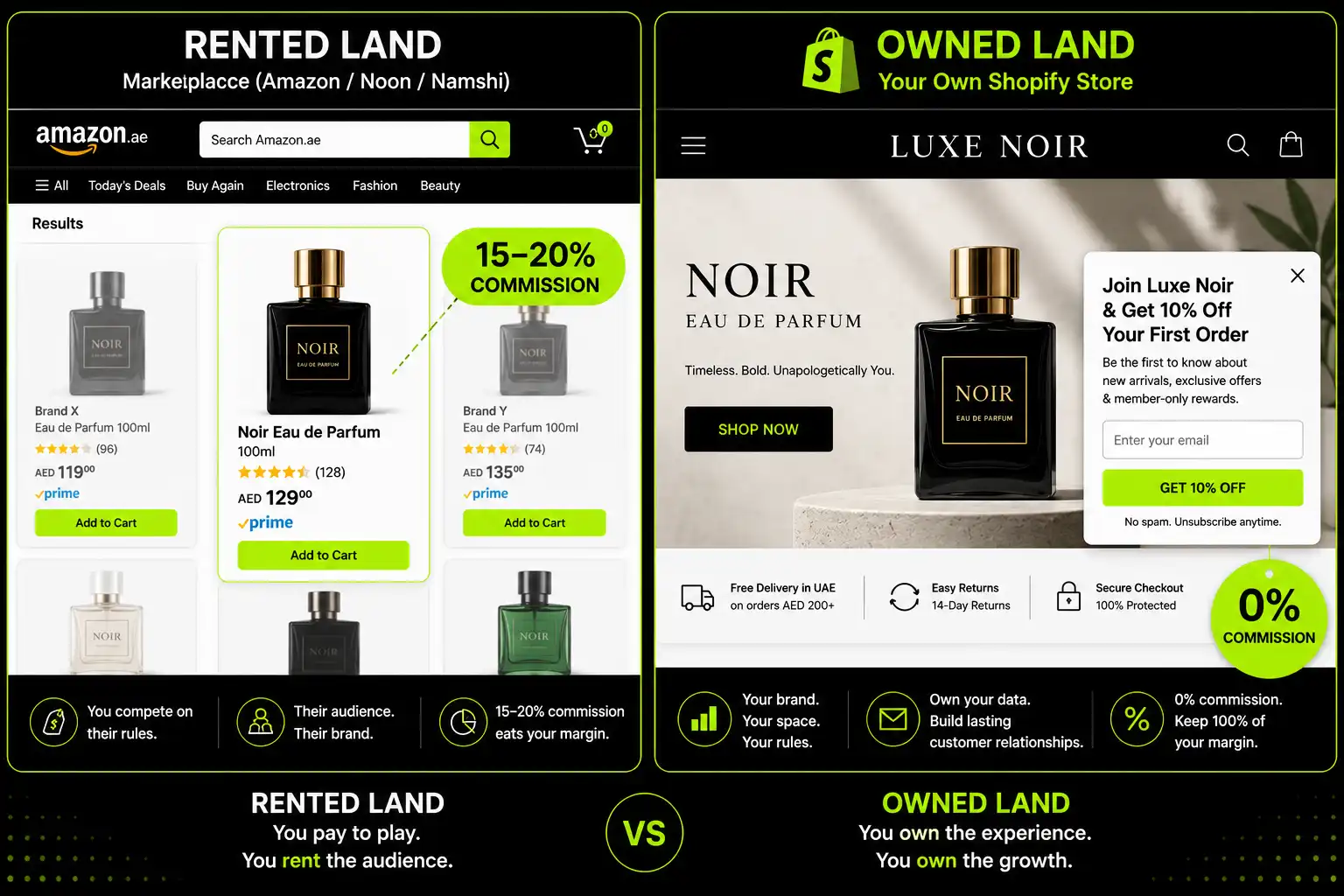
Before comparing, it’s worth defining the two channels. Many founders use “ecommerce platform” and “marketplace” interchangeably. They aren’t the same thing.
What a Marketplace Is
A marketplace is a shared digital mall. Multiple sellers list products to one large, pre-built audience. The platform manages discovery, trust, payments, and often fulfillment. You supply inventory. The customer belongs to the platform, not to you.
Global examples: Amazon, eBay, Etsy, Walmart Marketplace.
Examples: Amazon.ae, Noon, Namshi, Ounass, Talabat, Carrefour UAE.
The marketplace gives you instant access to millions of active shoppers. In return, it takes a commission typically 5% to 27% per sale plus fulfilment fees if you use its logistics.
What an Own Ecommerce Store Is
An own store is a brand-owned digital shop. You control the experience, the data, the pricing, and the direct relationship with every buyer. Built on platforms like Shopify, WooCommerce, or BigCommerce.
The trade-off in one sentence: marketplaces give you traffic. Own stores give you control. Most commercially mature brands need both.
Marketplace Pros: What Marketplaces Do Better Than Own Stores
Marketplaces aren’t the enemy. They solve real problems, especially early on. Here’s where they win.
Built-In Traffic and Instant Audience
The single most commercially powerful marketplace advantage: you don't build the audience from scratch. Amazon delivers billions of monthly visits globally.
Amazon UAE has over 6 million active users. Noon has approximately 5 million. Namshi reaches around 1.2 million across the UAE and GCC.
A brand that launches its own Shopify store on day one faces a cold-start problem: the store exists, but no one is visiting. Every visitor has to be acquired through paid ads, content, or social all of which cost money and take time.
A brand that lists on Amazon UAE or Noon on day one is immediately discoverable by millions of active shoppers. Marketplaces reduce customer acquisition cost by roughly 30–50% compared to standalone stores.
For early-stage brands validating product-market fit in the UAE, this is a commercially significant advantage that own-store advocates frequently understate.
Operational Simplicity
Marketplaces handle infrastructure, payments, security, and often fulfillment. A seller on Noon can go live within 48 hours, receive weekly payment settlements, and use Noon Express (Fulfilled by Noon) to outsource inventory storage and delivery entirely.
For founders who want to focus on product and sourcing rather than ecommerce operations, this simplicity has genuine commercial value.
Running a Shopify store maintaining the theme, managing apps, handling checkout issues, operating email marketing, running paid acquisition is a full operational workload. The marketplace removes this from the plate, at a cost.
Trust Transfer
Marketplace trust transfers immediately to listed brands. A customer who has bought dozens of times from Amazon.ae trusts the checkout process, the returns policy and the delivery promise regardless of which seller they're buying from. A new brand on its own website has to earn that trust independently.
For categories where purchase hesitation is high electronics, supplements, skincare selling through a trusted marketplace can produce higher initial conversion rates than a brand-new standalone store, simply because the customer's trust in the platform extends to the seller.
Lower Upfront Investment
Launching a marketplace seller account requires no theme selection, no web development, no payment gateway configuration, no SSL setup. Total upfront cost for a Noon or Amazon UAE seller account is a fraction of even a basic Shopify store setup.
For brands testing new markets, a UAE brand testing Saudi demand, or an Indian brand testing UAE demand marketplace entry is the commercially rational, low-risk validation approach.
Marketplace Cons: The Real Costs Beyond the Commission
The headline problem is fees. But the bigger dangers are structural and compound quietly.
Commission Fees Compress Margins at Scale
Commission rates eat a permanent slice of every sale.
- Amazon: 15% on footwear, 17% on clothing over $20; category range 6–45%.
- Noon: 4–27% depending on category; shipping roughly 10% extra.
- Namshi: approximately 12–18% commission.
A brand with a 40% gross margin on its own store might operate at a 20–25% margin on a marketplace. Over AED 1 million in annual revenue, a 15% average commission means AED 150,000 leaves your business every year. That money could fund an entire owned channel.
A brand that shifts 30% of marketplace sales to its own site can increase total revenue 12% without spending more on ads purely by recouping those fees.
You Own No Customer Data
This is the single biggest commercial disadvantage in 2026. When a customer buys from you on Noon or Amazon.ae, you get a name and delivery address.
You don’t get their email. You can’t retarget them. You can’t invite them to a loyalty programme. You can’t send a replenishment reminder.
Post-iOS 14 and with third-party cookies gone, first-party data email, SMS opt-ins, purchase history is the most valuable marketing asset a brand can own.
Marketplace-only sellers accumulate years of transactions and zero ability to contact those buyers again without paying another commission.
Suplex Insight: This is the conversation we have most often with UAE brands selling on Noon or Amazon for two or three years. Revenue looks healthy. Margins are squeezed but okay.
Yet there’s no customer list, no email programme, no way to reach past buyers directly. The brand has been generating revenue for the marketplace’s audience, not building its own.
Platform Dependency and Account Risk
Every marketplace seller operates at the discretion of the platform. Commission rates can rise Amazon raised FBA fees in both 2024 and 2025.
Category policies can change. Listing suppression can happen algorithmically. Account suspension sometimes without notice or clear explanation terminates all revenue from that channel instantly.
Brands that have built 80%+ of their revenue on a single marketplace carry this risk permanently. Channel concentration above 80% in any single marketplace triggers a valuation haircut when businesses are sold, because buyers price the platform dependency directly into the acquisition multiple.
Even profitable, growing Amazon FBA catalogues typically trade at only 2.5–4× SDE, because buyers underwrite that platform risk.
No Brand Control
You operate at the platform’s discretion. Fees change. Categories get restricted. Accounts get suspended sometimes without clear warning.
If 80% or more of your revenue comes from a single marketplace, your entire business sits on rented land. Buyers apply a valuation haircut to such businesses because the risk is real.
Even profitable FBA-only catalogs trade at 2.5–4× SDE, while DTC-owning brands command 1–2× higher multiples at the same revenue.
Own Ecommerce Store Pros: What a DTC Store Gives You That Marketplaces Never Can
Marketplaces are excellent for acquiring customers. But an owned ecommerce store is where you build a real business.
Every customer, every purchase, and every improvement increases the value of an asset that you control, not a platform that can change its rules overnight.
You Own the Customer Relationship
Every order on your Shopify store becomes a long-term business asset.
Instead of losing customers after checkout, you can build relationships through email, SMS, and WhatsApp (especially valuable for UAE and Gulf brands). Every new customer expands your audience, making future sales cheaper and more profitable.
That means you can:
- Recover 5–9% of abandoned carts with automated emails.
- Send replenishment reminders for consumable products.
- Launch new collections to previous buyers.
- Build loyalty and VIP programmes.
- Drive repeat purchases without paying for marketplace traffic again.
On Amazon, Noon, or Namshi, these relationships belong to the marketplace, not your brand.
Keep More Profit from Every Sale
The fastest way to improve profitability isn't always selling more. It's keeping more of what you already earn.
Without marketplace commissions of 15–20%, the same product can generate a 37–42% net margin instead of 22%, simply because you remove the commission layer.
Example
- Annual revenue: $1,000,000
- Marketplace commission: 15%
- Fees paid to the marketplace: $150,000 per year
If you shift just 30% of sales to your own store, you could retain around $45,000 annually enough to fund premium photography, better marketing, CRO improvements, or a Shopify Plus subscription several times over.
Create a Brand Experience Customers Remember
A marketplace product page looks almost identical for every seller.
Your own store doesn't.
You control every part of the customer journey from your homepage and product pages to storytelling, imagery, checkout, and post-purchase experience.
That means you can build:
- A premium visual identity.
- Rich editorial content and buying guides.
- Personalised shopping experiences.
- Custom loyalty programmes.
- Optimised product discovery and navigation.
- A checkout designed to maximise conversions.
For luxury and premium brands, this experience is often the product's biggest competitive advantage.
Build a More Valuable Business
Revenue is important. Ownership is even more valuable.
Businesses that own their customer data, first-party marketing channels, and direct customer relationships typically command 1–2× higher acquisition multiples than marketplace-only businesses with similar revenue.
That's because buyers aren't just acquiring sales—they're acquiring an audience they can continue to market to.
The strongest ecommerce brands in 2026 don't rely on a single channel. They combine:
- A DTC website: for branding, customer relationships, and profit.
- Amazon, Noon and other marketplaces: for customer acquisition.
- Retail and wholesale partners: for additional scale and credibility.
This diversified approach creates a stronger, more resilient business that's worth significantly more over the long term.
Own Ecommerce Store Pros: What a DTC Store Does That Marketplaces Cannot
The owned channel is where long-term brand value accumulates. Here’s exactly what you gain.
Full Ownership of Customer Data and Relationships
Every customer who buys through an owned Shopify store can be captured into an owned marketing channel through email, SMS, or WhatsApp for UAE/Gulf brands. Over time, this list compounds: each new customer adds to the addressable audience the brand can reach for near-zero marginal cost.
Post-purchase email flows recovering 5–9% of abandoned carts. Replenishment reminders for consumable products. New-collection announcements to past buyers. Loyalty programme communications. All of this is possible with an owned store. None of it is possible through a marketplace.
DTC brands that own their customer relationship email, SMS, and first-party data trade at 1–2× higher valuations than marketplace-only businesses at the same revenue. The first-party data asset is what buyers actually pay for at exit.
Full Margin Retention
Without a 15–20% commission on every sale, the margin economics change fundamentally. A product earning 22% net margin on a marketplace can earn 37–42% net margin through an owned store same product, same price, minus the commission layer.
At $1M annual revenue, a 15% commission represents $150,000 a year flowing to the marketplace. Recapturing even 30% of that revenue through an owned channel represents roughly $45,000 annually which funds significant brand investment, improved photography, or the cost of a Shopify Plus subscription many times over.
Brand Experience and Differentiation
An owned store is the only channel where a brand can deliver its complete visual identity, brand world, editorial content, and customer experience without platform constraints. For a luxury or premium brand, the brand experience is the commercial proposition and it can't be delivered on a marketplace.
This extends to product discovery architecture, personalisation, post-purchase communication, loyalty programmes, and the full range of conversion optimisation decisions a brand can make on its own infrastructure but can't make on Noon or Amazon.
Business Valuation Premium
The highest-multiple ecommerce businesses in 2026 are omnichannel: a DTC site as the primary brand expression, Amazon and Walmart Marketplace as discovery channels, and retail wholesale Target, Whole Foods, REI, specialty distribution as scale and credibility.
DTC brands with strong first-party data, direct customer relationships, and diversified channels command 1–2× higher acquisition multiples than marketplace-only businesses at identical revenue. For any brand owner with an exit horizon, this isn't a theoretical consideration, it's a financial one.
See also: D2C data analytics
Own Ecommerce Store Cons: What Own Stores Cannot Do That Marketplaces Can
Honesty about the limitations builds a practical strategy, not a one-sided argument.
You Must Build and Pay for All Traffic
On a marketplace, traffic shows up because the platform already acquired it. On your own store, every visitor must be earned or bought through paid ads, SEO, content, influencer partnerships, or email.
For a new brand launching in the UAE with no audience, the cold-start traffic cost can be AED 5,000–15,000 in the first 90 days before the store generates sustainable revenue.
For a brand launching in the UAE without an existing audience, the cold-start cost of driving meaningful traffic to an own Shopify store can run $5,000–$15,000 in the first 90 days before the store is generating sustainable revenue. This is a real cost that marketplaces eliminate at launch.
Operational Complexity
Running an own ecommerce store is a multi-disciplinary operation: platform management, app stack maintenance, payment gateway configuration, shipping carrier integration, email marketing flows, analytics, SEO, content, and customer service. Each of these is either time or money.
For a two-person founder team focused on product development and operations, this overhead can be the difference between a successful launch and a distracted one.
Higher Upfront Investment
A properly localised Shopify store for the UAE with COD, Tabby/Tamara BNPL, UAE payment gateways like Telr or PayTabs, Arabic RTL layout.
Email marketing integration costs AED 3,000–15,000 to build and AED 400–800 per month in platform and app fees. That’s real capital that marketplaces don’t demand at launch.
The Comparison Framework: Six Commercial Dimensions
A clear, structured view of how the two channels stack up on the dimensions that matter most.
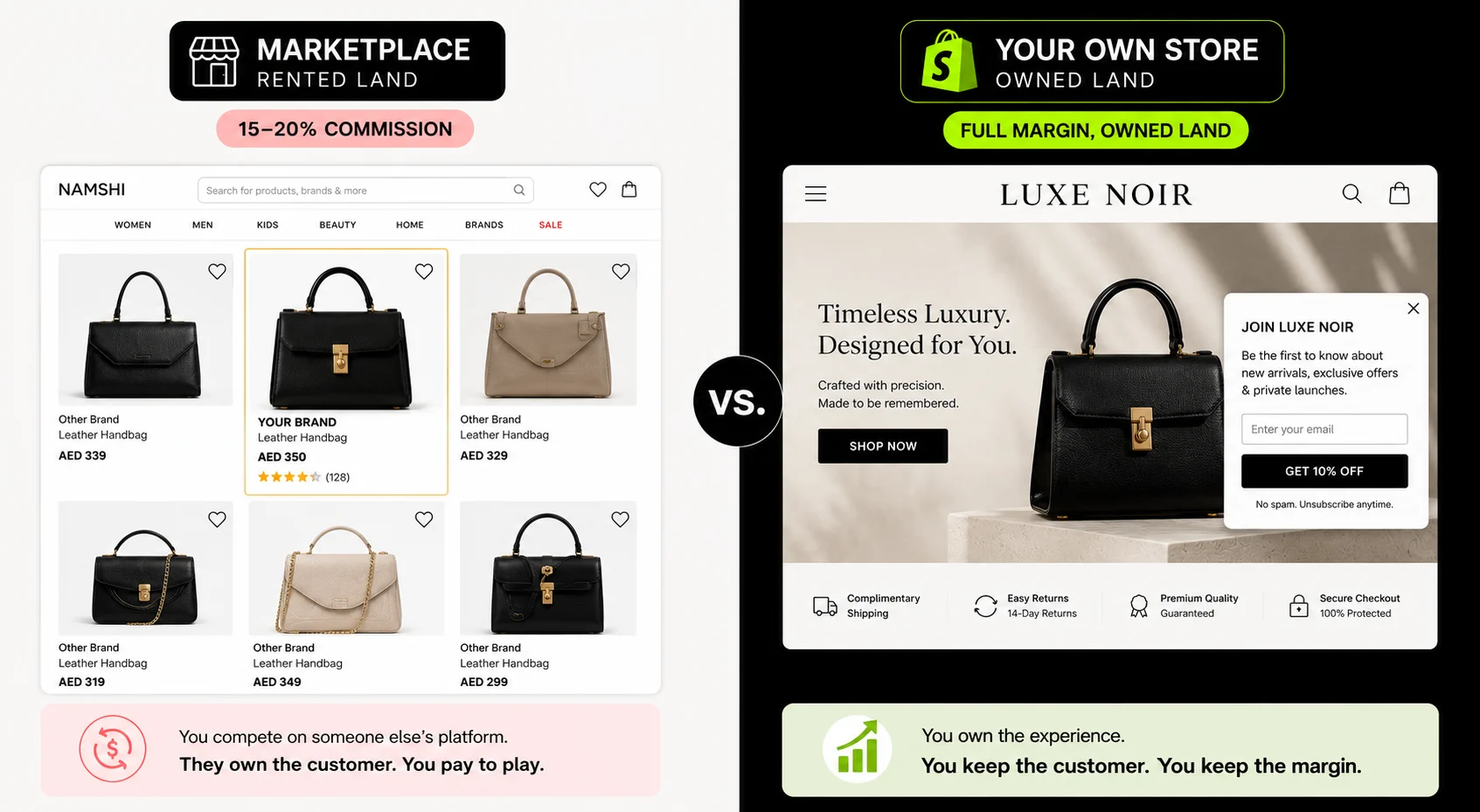
The Margin Arithmetic Worked Example
Scenario: a UAE fashion brand selling a dress at AED 350
On Namshi (commission ~15%):
- Sale price: AED 350
- Namshi commission (15%): AED 52.50
- Fulfilment/returns provision: AED 25
- Net revenue before COGS: AED 272.50
- Effective margin on a 40% COGS product: approximately 22%
On own Shopify store:
- Sale price: AED 350
- Shopify platform cost per order (Basic plan): ~AED 3
- Payment gateway fee (~2.5%): AED 8.75
- Shipping (branded): AED 15
- Net revenue before COGS: AED 323.25
- Effective margin on the same product: approximately 37%
The 15-percentage-point margin gap, at AED 1M annual revenue, is AED 150,000 a year flowing to the marketplace versus the brand's own P&L. Over three years of growth, that compounds into the capital that funds owned-channel infrastructure.
Worth noting: this arithmetic ignores the traffic cost of the own store (paid ads, SEO), which has to be subtracted.
At an early stage, the marketplace may still be more profitable overall thanks to lower CAC. At scale once the brand has an owned email list, strong SEO, and returning customers the own-store margin economics improve dramatically.

The UAE and Gulf Marketplace Landscape What's Different About This Market
Global advice often says “sell on Amazon.” In the GCC, category fit dictates the right marketplace.
The UAE Marketplace Ecosystem: Who Does What
- Amazon.ae: Over 6 million active users. Best for electronics, general merchandise, and international brands. FBA available. In December 2025, Amazon.ae began same-day export shipping to Riyadh and Manama, enabling GCC-wide fulfilment from a single UAE hub.
- Noon: Roughly 5 million active users across UAE, KSA, and Egypt. Best for FMCG, fashion, beauty, electronics, and groceries. Commission 4–27%; shipping about 10%. Noon activated 20 additional dark stores in January 2026, covering 85% of urban households with 12-minute delivery. Surpassed $1 billion in seller sales in 2025.
- Namshi (owned by Noon): About 1.2 million active users. Curated fashion, footwear, beauty. Commission 12–18%. Manages fulfilment; same-day delivery in Dubai. Best for fashion and lifestyle brands targeting younger Gulf consumers.
- Ounass: Luxury-focused. Average order value $550; 89-minute delivery in Abu Dhabi. The regional Net-a-Porter equivalent.
- Talabat / Carrefour UAE: For food, grocery, and FMCG. Not for fashion or beauty brands.
A fashion brand on Amazon.ae may underperform the same brand on Namshi because the shopper profiles and platform experience differ. Category-platform fit is the most commonly misunderstood marketplace decision in the UAE.
The First-Party Data Problem Is More Acute in the UAE
The UAE's mobile-first shopping behaviour smartphones processed roughly 78.67% of 2025 UAE orders makes WhatsApp the highest-ROI owned channel in the Gulf market.
Brands that build an owned Shopify store with WhatsApp marketing integration (via Klaviyo WhatsApp or the Meta WhatsApp Business API) are effectively building the GCC equivalent of a highly optimised email programme.
Brands selling exclusively on Noon or Amazon UAE get none of this capability. They accumulate revenue without accumulating the communication infrastructure that makes repeat purchase profitable.
Remember: Noon is your customer acquisition channel. Shopify is your brand's home. The brands that succeed long-term own their channel.
See also: What does a Shopify expert in Dubai actually do
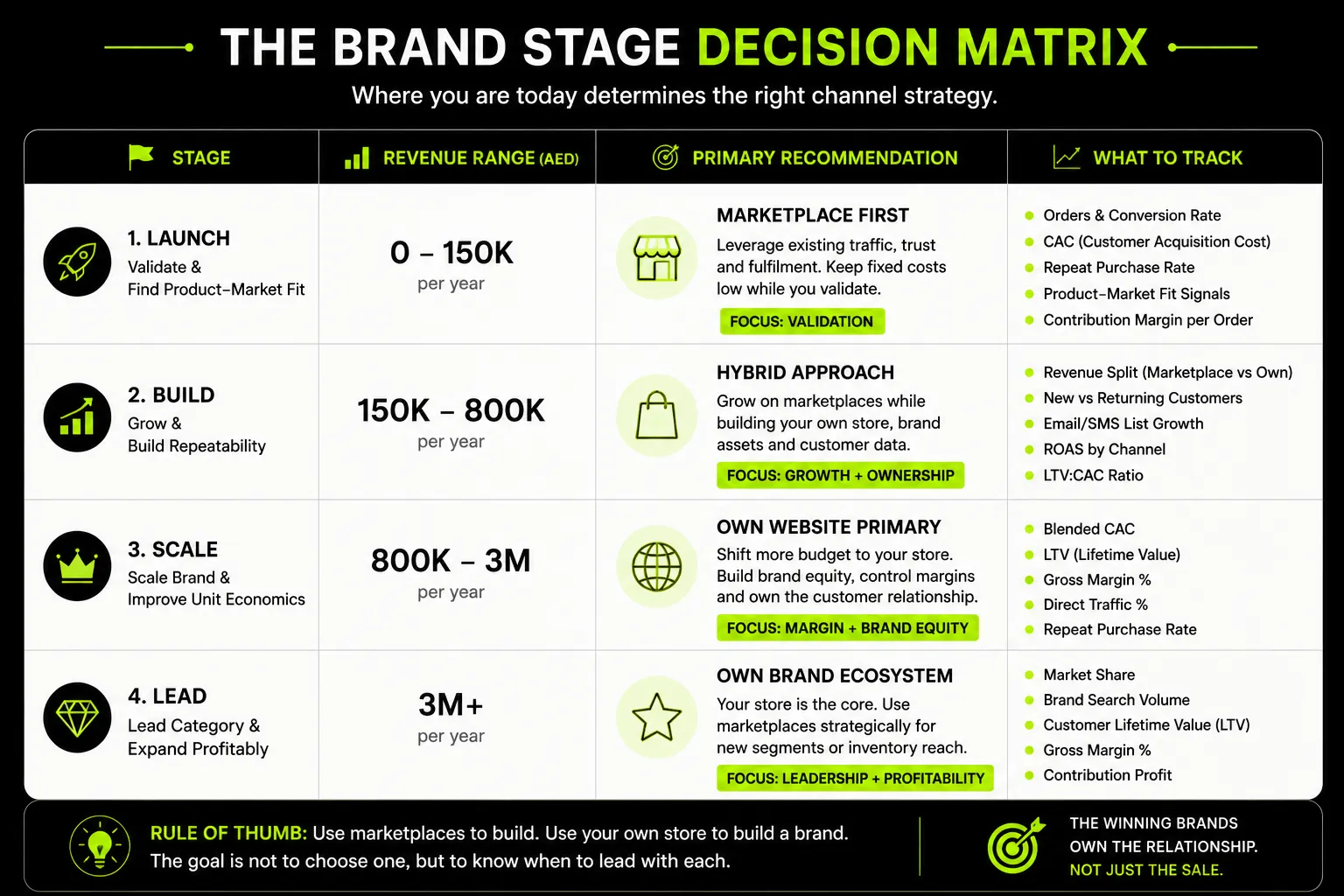
The Decision Framework: Which Stage Are You At?
The right channel strategy depends entirely on your brand’s revenue stage and data maturity. This framework tells you what to prioritise now.
The Brand Stage Decision Matrix
The Hybrid Strategy How the Best Brands Run Both
Almost no successful brand operates exclusively on one channel. The hybrid model works, but only if you operationalise it correctly.
Marketplace as Discovery, Own Store as Retention
The correct mental model: the marketplace is a paid customer acquisition channel where you pay 15–20% commission per order in exchange for that customer's first purchase.
The own store is the retention channel, where that customer returns for their second, third, and tenth purchase without any commission cost.
The economics compound over time:
- First Purchase: marketplace (acquisition cost = commission). Customer data captured: none.
- Second Purchase: if the customer returns to the marketplace, commission is paid again.
- If redirected to the own store after the first purchase: the second purchase happens through Shopify no commission, email captured, loyalty programme entry, and repeat-purchase economics improve from order two onward.
Every customer retained through their own channel after their first marketplace purchase is a commission recovered on every future order.
How to Move Marketplace Customers to Your Own Store
Without violating marketplace terms:
- Product Packaging: Every order fulfilled by you includes an insert with a QR code to your website, a first-purchase discount code, or a loyalty programme invite. This is the primary mechanism.
- Post Purchase Search: Customers who want to reorder often Google your brand name. Ensure your own store ranks above your marketplace listing for your brand terms.
- Social Media: Marketplace listings can include social handles. Customers who follow you on Instagram or TikTok can be retargeted and redirected to your own store.
- Customer service Excellence: Quick, personal, helpful responses on the marketplace make buyers more likely to seek you out directly next time.
Inventory and Operations Across Both Channels
Running both channels simultaneously creates real operational complexity. The most common pain point: selling out on one channel without visibility on the other.
Shopify as The Inventory Master: Shopify's multichannel inventory management or a third-party multichannel tool connects Shopify inventory to marketplace listings. When a unit sells at Noon, Shopify inventory decreases.
When a unit sells on Shopify, the Noon listing decrements. This prevents overselling and the negative seller metrics that follow.
Pricing Parity Policy: Most marketplace agreements require that your marketplace listing price doesn't exceed your own website price. Maintain pricing parity, or a modest own-website advantage (an exclusive member discount, for instance) never charge more on your own site than on the marketplace.
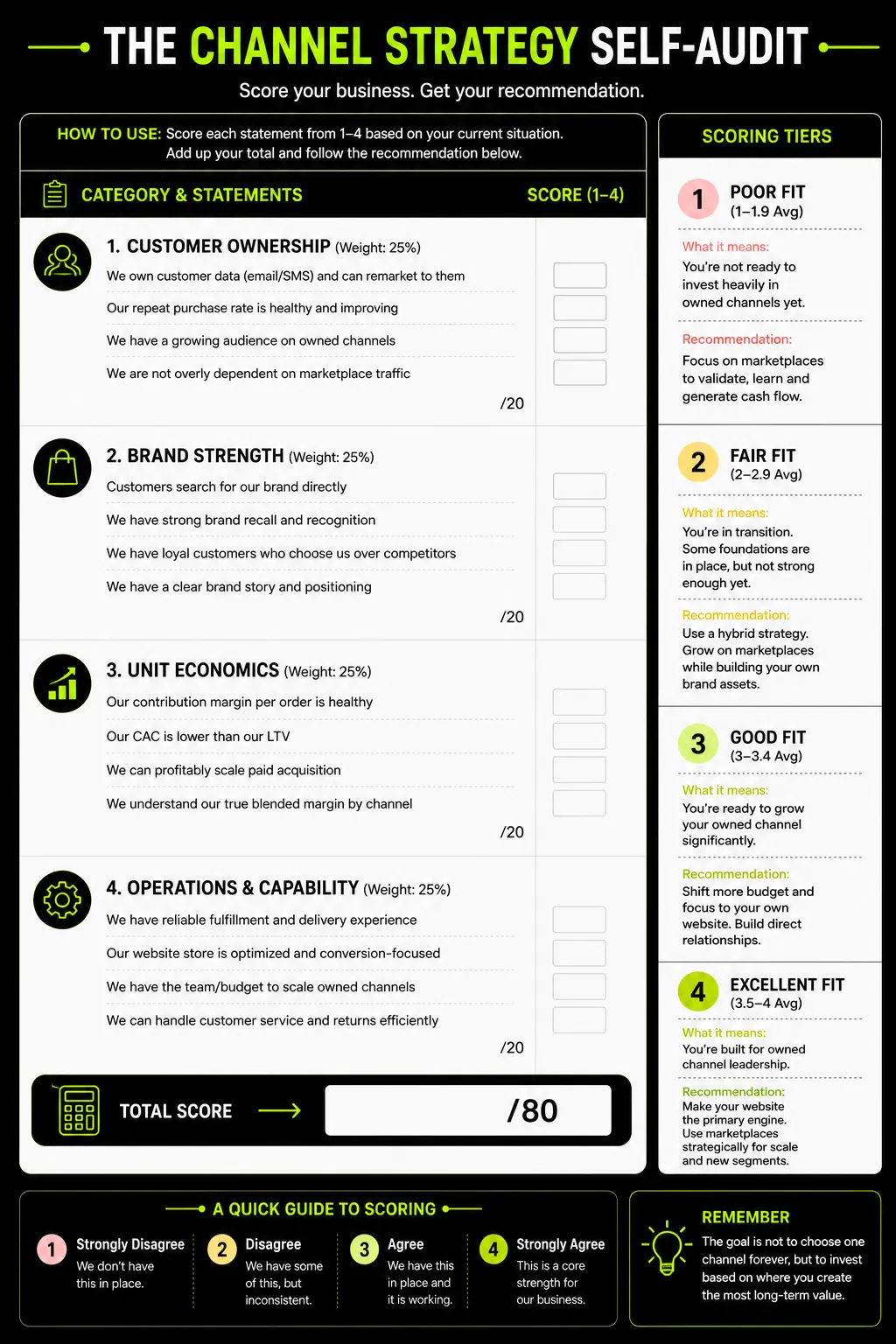
The Self-Audit Checklist: Where Are You and What Should You Do Next?
Score each item: 0 = No, 1 = Partially, 2 = Yes
Product and Market Validation
Customer Data and Retention
Own Store Infrastructure
Channel Diversification
Scoring and recommendations:
- 22–28 Strong multi-channel maturity: Focus on retention optimisation and LTV maximisation. Consider brand equity investment (custom theme, editorial content, loyalty programme).
- 14–21 Growing in the right direction: Your next priority is increasing your own-store revenue share to 30%+. Invest in email marketing and own-store conversion optimization.
- 7–13 Marketplace-dependent with early own-channel signs: Build the own-store infrastructure now, before marketplace dependency deepens. Start with email capture and post-purchase flows.
- 0–6 Marketplace-only or pre-launch: Validate on the marketplace first. Build own-store basics (domain, landing page, email capture) while doing so. Don't invest in a full own-store build until demand is confirmed.
How We Help Brands Build Their Own Channel at Suplex
At Suplex, we often help UAE brands decide when to move beyond Amazon UAE or Noon. Our advice is simple: start building your own store sooner than you think. Marketplaces drive sales, but they own the customer relationship. Every marketplace order without email capture is a customer you have to pay to reach again.
The most successful brands follow the same path: validate demand on marketplaces, launch a Shopify store once revenue justifies it and run both channels together.
Over time, the owned store becomes the brand's most valuable asset through customer data, repeat purchases, and higher lifetime value.
We build Shopify stores tailored for the UAE with COD, Tabby, Tamara, Telr, PayTabs, Arabic RTL and automated email marketing from day one helping brands grow their owned channel without sacrificing marketplace revenue.
Brands like Miduty, Loomsona, Kimi, and Celesti demonstrate how an owned store strengthens customer relationships, brand positioning, and long-term profitability.
If you're currently marketplace-dependent and want to understand what building an owned channel would cost, what it would produce, and in what timeframe it pays back, our platform consultation starts with the numbers.
Frequently Asked Questions
What are the pros and cons of selling on a marketplace vs your own ecommerce site?
Marketplaces offer instant traffic and low setup costs but charge commissions and limit customer ownership. Your own store gives you full control, higher margins, and customer data, but you must generate your own traffic.
Should I sell on Amazon or my own website?
Both. Start with Amazon to validate demand, then launch your own Shopify store to build your brand, customer list, and repeat sales.
What are the disadvantages of selling on a marketplace?
High commissions, no customer data, platform dependency, and limited branding make long-term growth harder.
What is the difference between a marketplace and an ecommerce website?
A marketplace sells products from many brands and owns the customer relationship. An ecommerce website is your own store, where you control the brand, customer data, and experience.
Which UAE marketplaces should I sell on?
Amazon UAE for general retail, Noon for FMCG and fashion, Namshi for fashion, Ounass for luxury, and Talabat or Carrefour UAE for food and groceries.
How much does marketplace commission cost compared to running a Shopify store?
Marketplaces typically charge 4–27% per sale. Shopify has a monthly subscription and payment processing fees but no marketplace commission.
Can I sell on both a marketplace and my own website?
Yes. Most successful brands use marketplaces for customer acquisition and their own store for retention, repeat purchases, and brand growth.
Hi, I’m Rishabh Jain
I believe great digital experiences have the power to shape perception, build trust, and move businesses forward. That belief led me to found Suplex Design Studio, a global digital design and development studio helping FMCG and D2C brands build websites and digital experiences that are strategic, thoughtful, and commercially meaningful.
I started Suplex at 25 with a clear intent, to create digital experiences that look appealing, work seamlessly, and help D2C businesses grow. By 28, the studio had scaled globally, guided by a strong foundation in integrated design that I developed during my academic journey in London, where I was honoured with the Dean’s Award.
Over the years, I’ve had the opportunity to work with 100+ brands, from Fortune 500 organisations to family-run businesses, helping them build websites, e-commerce experiences, and digital products that create clarity, credibility, and long-term value.
Our work has been recognised internationally, including the Manifest Award (2024), the Clutch Global Award (2025), and features across platforms such as The Dieline, Packaging of the World, and the World Brand Design Society.
None of this would be possible without the people behind the work. I’m deeply grateful to the Suplex team, whose commitment, creativity, and attention to detail turn ideas into meaningful digital experiences every day.
At the heart of our work is a simple philosophy, digital design should be intentional, functional, and built to create real business value. That continues to guide everything we create at Suplex.


































Let’s Make It Happen
E-Commerce Success Stories
%201.avif)






.avif)
.avif)
Build Your D2C Business The Right Way
Build It With Suplex.


