What's Included in a Professional Shopify Audit?
.avif)

What's Included in a Professional Shopify Audit?
A professional Shopify audit is a structured, expert-led review of your store's technical performance, SEO, user experience, conversion path, and security.
It ends with a prioritized report with clear recommendations. A free automated scan only flags issues. It does not tell you which problems to fix first or how they could affect your revenue.
If you have already run your store through PageSpeed Insights or a free Shopify app and gotten a list of 40 warnings, you already know the problem.
A list of issues is not a plan. You still don't know which three of those 40 are costing you sales this month and which 37 you can ignore for a year.
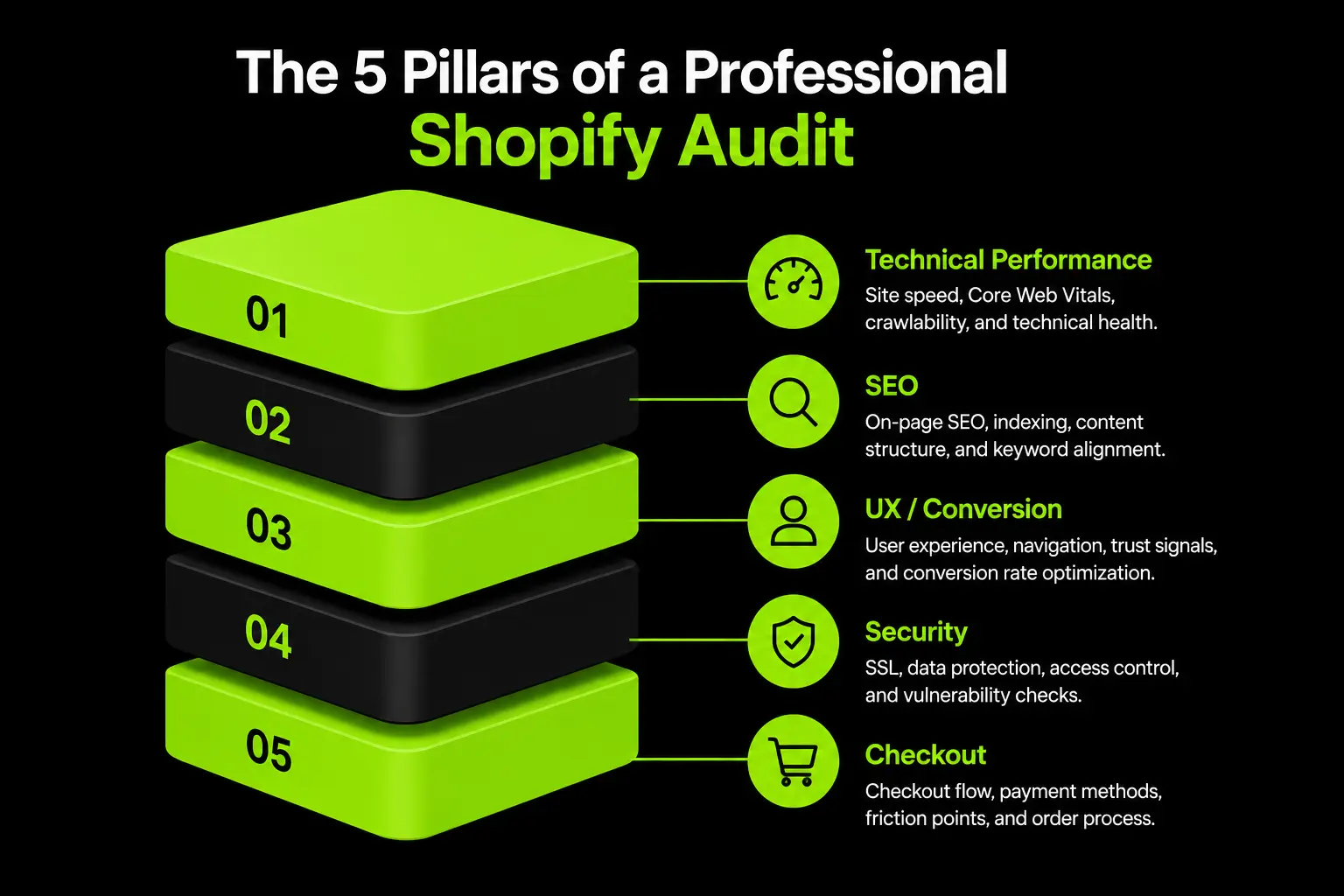
What a Professional Audit Actually Covers
A real audit does not stop at one layer. It looks at how technical issues, SEO gaps, and UX friction interact, because a slow product page is rarely just a speed problem. It's usually also a conversion problem and sometimes an SEO problem too.
Technical Performance and Core Web Vitals
This layer measures how your store actually loads and runs for real visitors, not how it performs in a lab test with no apps installed.
An auditor checks Largest Contentful Paint, Cumulative Layout Shift, and Interaction to Next Paint on your real product and collection pages, on mobile devices, under your actual app load. Most Shopify stores run 15 to 30 apps by the time they've been live for a year.
Each one adds a script. A theme that scored well in a demo often loads in 5 to 6 seconds on mobile once your review widget, upsell app, and loyalty program are all running at the same time.
The cost of ignoring this layer is measurable. Google's own research has found that as page load time goes from one second to three seconds, the probability of a mobile visitor bouncing increases by 32 percent.
For a store making $50,000 a month, even a small increase in bounce rate on your top landing pages can mean lost sales every month. A technical audit shows how much revenue is at risk instead of leaving the problem as a vague concern.
A technical audit also covers:
- Image compression and lazy loading across product galleries
- Theme code bloat from unused apps or leftover liquid snippets
- Third-party script load order and render-blocking JavaScript
- Mobile-specific performance, tested separately from desktop
- Server response times during traffic spikes, not just average load
SEO: On-Page, Technical, and Structured Data
SEO in an audit means checking whether search engines can find, crawl, and understand your store. It covers your site structure, pages, metadata, internal links, and technical setup. It also goes beyond keywords in product descriptions.
This covers technical SEO (crawlability, indexation, XML sitemaps, canonical tags), on-page SEO (title tags, meta descriptions, header structure, internal linking), and structured data (product schema, review schema, breadcrumb schema).
Shopify's default collection and variant URL handling creates duplicate content issues on almost every store that hasn't specifically addressed it. An audit catches this.
A free checklist usually tells you to "check for duplicate content" without telling you where Shopify creates it by default.
For stores selling into more than one country, this section should also flag hreflang errors and market-specific content gaps, since these are invisible in a standard SEO scan but directly affect how you rank in each market.
A common example: a store running Shopify's default collection filtering creates several URL variations of the same collection page, one for each filter combination a shopper applies. Search engines can index all of them as separate pages with near-identical content.
Left unmanaged, this dilutes ranking signals that should be concentrated on one canonical version of that collection. A free SEO checker rarely flags this because it isn't checking your filtered URLs at all. An audit does, because it crawls the store the way a search engine actually does.
Conversion and UX: Where Users Actually Get Stuck
This is what makes a business audit different from a technical audit. It looks at where real visitors leave your site before they complete a purchase.
An auditor reviews navigation clarity, product page architecture, trust signal placement, mobile usability, and cart behavior using session recordings, heatmaps, and GA4 funnel data where available, not guesswork.
A low add-to-cart rate on one collection can come from several things: how the price is shown, a missing size guide, slow-loading product photos, or a lack of trust signals. An expert review helps find the actual problem instead of making you guess from a checklist.
Take a fashion store where one product line has half the add-to-cart rate of the rest of the catalog. A free tool will not flag this because tools like PageSpeed and broken-link checkers do not measure how often shoppers add products to their carts.
A low add-to-cart rate can have several causes. An audit checks the product copy, image loading speed, trust signals, and price display to see what is making shoppers hesitate.
Once you identify the problem, the fix can take two hours. You find it by watching how real shoppers use the site.
Security, Apps and Technical Debt
Every app you install adds a line item to your monthly bill and a potential point of failure to your store. A security-focused review checks:
- Which installed apps are actually still active versus dormant and still injecting code
- Whether checkout and customer data handling meet current compliance standards
- Outdated theme customizations that create conflicts with Shopify platform updates
- Access permissions across staff accounts and connected apps
- SSL configuration and payment gateway security settings
Technical debt is cumulative. A store that's had four different developers touch the theme over three years usually has liquid code fighting itself in ways a business owner has no way to see without someone opening the code.
An audit can uncover five or six apps that are still charging the store every month for features it stopped using a year ago. Those apps may also be adding unnecessary code to every page.
Removing them can be the fastest way to improve performance. A free scanner cannot identify them because it cannot see your app costs or Shopify admin.
Checkout and Payment Flow Specifically
Checkout deserves its own line item because it is frequently where the highest-value friction sits, even on a store that performs well everywhere else.
A checkout-specific review looks at the number of steps to complete a purchase, whether express checkout options (Shop Pay, Apple Pay, Google Pay) are enabled and visible, which payment methods are offered relative to what your actual customers use, and whether cost-related surprises (shipping fees, taxes) appear too late in the flow.
For merchants selling into the UAE and GCC specifically, this also means checking whether cash on delivery is available where it should be, since COD still meaningfully affects conversion in this region.
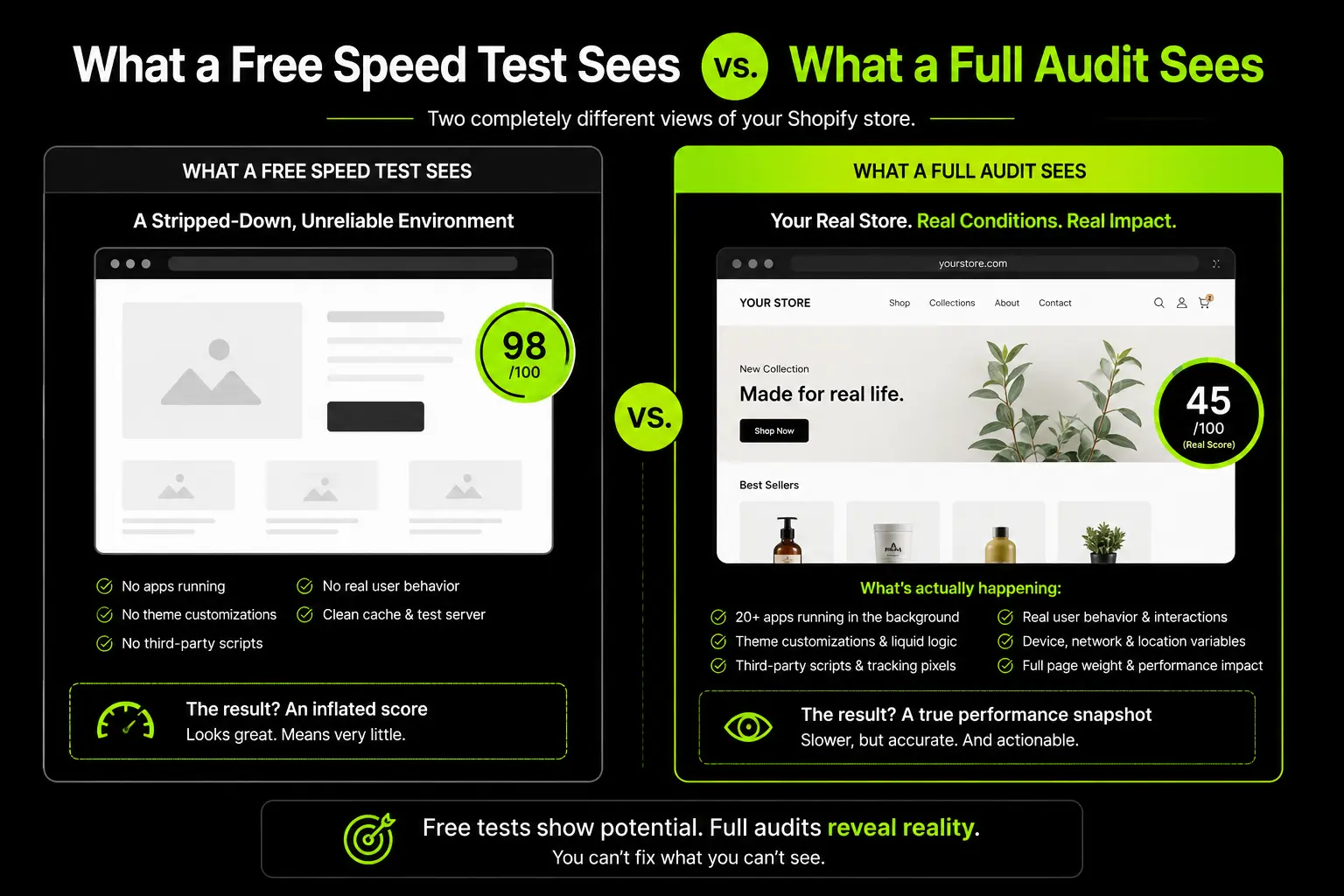
Can AI or Free Tools Already Do This?
This is the question most people ask before paying for an audit. Automated tools are useful for finding basic technical problems. They are not enough when you need to understand what is hurting sales and what to fix first.
What Automated Tools Catch Well
PageSpeed Insights, Lighthouse, and free SEO checkers are good at exactly what they're built for: flagging discrete, rule-based issues. Missing alt text.
A slow-loading hero image. A broken link. An AI tool asked to "audit my Shopify store" can scan your page content and list similar surface problems in seconds.
What They Consistently Miss
None of these tools can tell you that your bounce rate on mobile product pages is high because your size guide requires a second click that most shoppers never make.
They can't watch a real session recording and notice that shoppers keep hovering over your shipping cost without adding to cart. They flag that an image is large. They cannot tell you that this particular image, on this particular page, is the reason a $180 order abandons.
Automated tools also have no sense of your business context. A tool might flag 40 issues on your store with equal weight. It has no way to know that three of them are costing you five figures a month in lost conversions and the other 37 are cosmetic and can wait a year.
Why "Flagging an Issue" Isn't the Same as "Explaining What to Fix First"
An automated scanner gives you a flat list of issues. An expert audit puts them in order. That requires looking at your margins, traffic sources, customers, and the likely impact of each fix on sales. Some fixes can increase revenue; others only make the report look better.
If you've run a free scan and ended up with 40 issues and no idea where to start, that's where a paid audit helps. Imagine two stores getting the same 40-item automated report.
One store’s developer works through the list from item one onward. Three weeks later, they finally reached item 34, the checkout issue that was costing the store sales.
The other store gets an expert audit first, which tells them the checkout issue is the only item worth touching this month and the other 39 can wait. Same starting data. Very different outcome, because one process has judgment built in and the other doesn't.
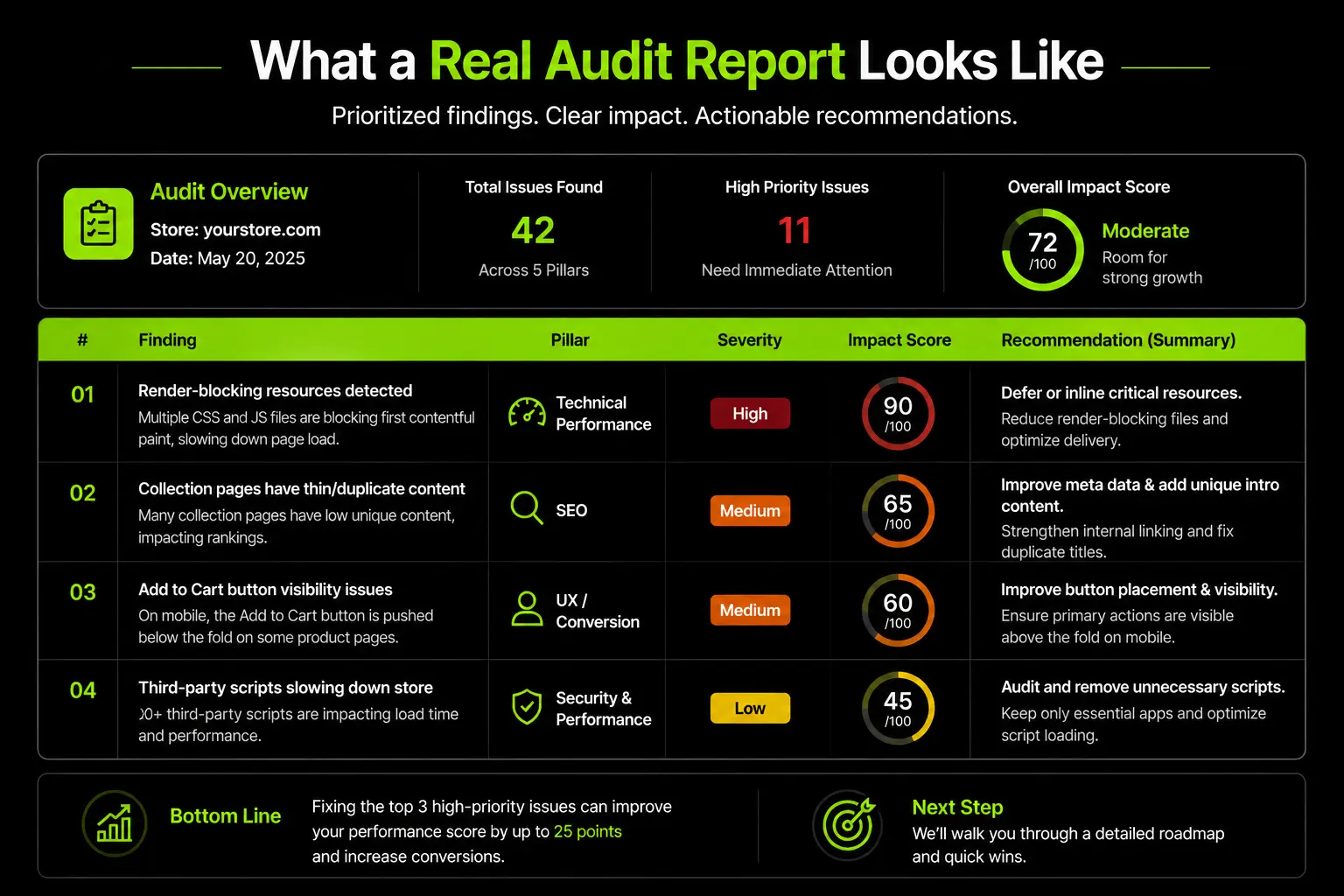
What a Professional Audit Report Actually Looks Like
Most people considering an audit have never seen one. The format matters because a poorly structured report can bury useful findings under a long list of minor issues.
Prioritized Findings, Not a Raw Issue List
A report structured well groups findings by the layer they affect (technical, SEO, UX, security) and then ranks within each group. You should be able to open the document and know within two minutes what the top three problems are, without reading forty pages first.
Severity and Business Impact Scoring
Each finding should carry two scores: how severe the underlying problem is on its own, and how much revenue or visibility it's likely costing. A checkout step that adds friction for every single customer scores high on both.
A missing alt tag on a rarely-visited blog image scores low on both, even though a free tool would flag it with the same visual weight as the checkout issue.
Specific, Actionable Recommendations, Not Generic Advice
“Improve page speed” is too vague to act on. “Compress and lazy-load the 12 product images on your top 5 collection pages. They are adding 1.8 seconds to mobile load time.” tells your developer exactly what to fix.
That level of detail is a big part of what you are paying for.
A generic recommendation leaves your developer to do the investigation. They still have to find the 12 images and verify the 1.8-second figure before they can start fixing the problem.
A specific recommendation removes that step entirely. Your developer opens the report, sees the exact pages and the exact fix, and starts work the same day. On a small in-house team, that difference alone can save a week of back-and-forth per finding.
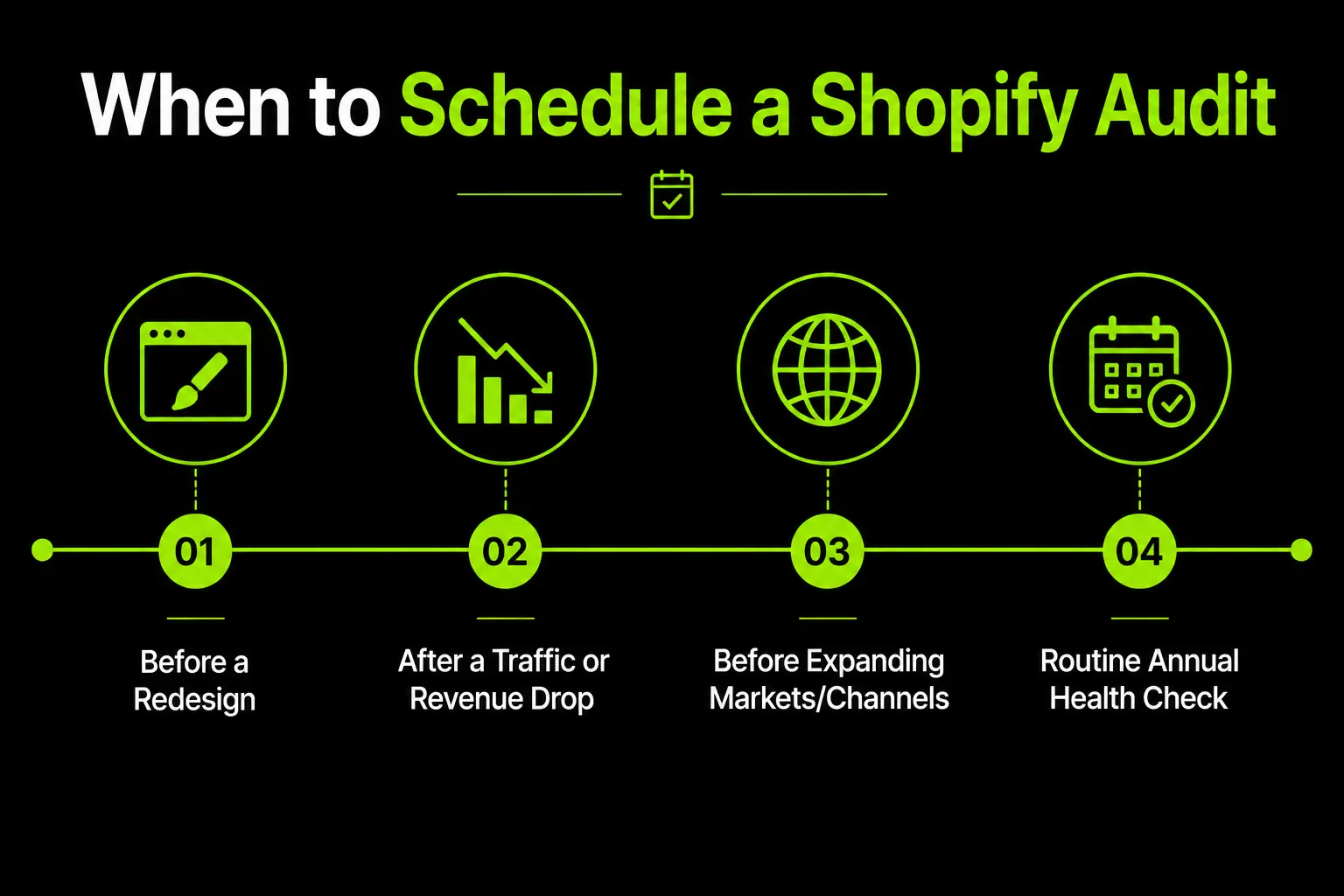
Who Should Get a Professional Audit, and When
An audit isn't something you need constantly. It's most valuable at specific decision points, when you're about to spend money or when something has changed and you don't know why.
Before a Redesign or Platform Migration
A redesign that starts without an audit risks rebuilding the same problems in a new theme. An audit tells you which issues are actually structural (navigation, checkout, product architecture) versus which ones are purely visual, so your redesign budget goes toward fixing what's actually broken.
After a Traffic or Conversion Drop With No Obvious Cause
If your numbers drop and you can't point to a clear reason (a platform change, a marketing shift, a seasonal pattern), an audit is faster than guessing. It can identify whether the cause is technical (a broken tracking pixel, a theme update that slowed load times), or on-site (a UX change that quietly hurt conversion).
Before Scaling Into a New Market
If you're planning to sell into the UAE or wider GCC, an audit before launch should specifically surface gaps in Arabic RTL support, local payment gateway coverage, multi-currency handling, and VAT-compliant checkout.
These are exactly the technical requirements covered in Suplex's guide to localizing a D2C website for the Middle East, and catching the gaps before launch is far cheaper than fixing them after.
As a Regular Health Check for High-Volume Stores
For stores doing meaningful volume, an annual audit catches the technical debt that accumulates from app installs, theme edits, and staff changes over a year, before it compounds into something expensive to unwind.
See It In Practice: Public Audit Examples
Most agencies describe their audit process in the abstract. It's more useful to see one applied to a real, recognizable store, which is why Suplex publishes a number of its audits openly rather than only describing the process in general terms.
What an Audit Looks At on a Major DTC Brand
Suplex's public audit of Alo Yoga is a useful example, because it shows how a brand with strong visual identity and polished product photography can still carry real UX and conversion gaps, in this case around review visibility and trust signal placement, that pure branding doesn't fix.
The Dyson audit shows the same principle from a different angle: a homepage video bug and a missed opportunity to surface existing product copy near the buy box, both fixable without a redesign.
The Fenty Beauty audit breaks down what a near-perfect shade grid and shoppable feed look like when they're working correctly, useful as a reference point for what "good" actually looks like in practice.
Reading two or three of these side by side is a faster way to understand what an audit actually finds than reading a description of the methodology alone.
How Suplex Approaches Shopify Audits
Suplex runs audits as a single cross-disciplinary review rather than handing separate layers to separate teams. Technical performance, SEO, UX, and security are assessed together, because the issues found in one layer are usually connected to the others.
A low add-to-cart rate can have several causes. Check the product copy, image loading speed, trust signals, and price display to see what is making shoppers hesitate.
Suplex has run this process on Shopify stores across fashion, beauty, wellness, and FMCG, for brands ranging from early-stage UAE startups to established DTC names, and every audit is delivered as a prioritized roadmap rather than a raw list.
For merchants specifically building for or expanding into the UAE and GCC, Suplex's Shopify audit service also checks Arabic RTL implementation, local payment gateway coverage, and Shopify Markets configuration as standard, not as an add-on.
If you already have a general idea of what's wrong with your store but don't know what to fix first, an audit gives you a clear plan. You can also use the DIY audit checklist to run a first check yourself before getting an expert review.
Not Sure What's Actually Wrong With Your Store? A free tool will give you a list. Suplex will tell you what to fix first and why it matters to your revenue. Book a full Shopify audit and get a prioritized report within one to two weeks. Get Your Shopify Store Audited
Frequently Asked Questions
Can ChatGPT or AI Tools Do a Shopify Audit?
AI tools can spot obvious problems quickly, such as missing alt text, slow pages, and broken links. They cannot tell you which problems are hurting sales or why shoppers are struggling to use your store. Those issues often require a closer review or watching real users interact with the site.
How Long Does a Professional Shopify Audit Take?
Typically one to two weeks depending on store size and audit scope, covering technical performance, SEO, UX and conversion, and security review, followed by a prioritized written report.
What's the Difference Between a Free Audit and a Paid One?
Free tools and checklists identify individual issues. A paid, expert-led audit adds prioritization, business-impact context, and specific recommendations tailored to your store, rather than a generic issue list.
Should I Get an Audit Before or After a Redesign?
Before, ideally. An audit surfaces the actual problems worth solving, which prevents a redesign that looks better but doesn't fix the underlying issues driving lost conversions.
What Does a Shopify Audit Report Actually Include?
A prioritized list of findings scored by severity and business impact, specific recommendations for each issue, and enough context to understand why each item matters, rather than a raw list of flagged issues.
How Often Should an Established Store Get Audited?
Annually is reasonable for most stores, or sooner after a significant traffic or conversion drop, a platform migration, or before expanding into a new market with different technical requirements.
Does a Shopify Audit Cover Payment and Checkout Issues?
Yes. A thorough audit specifically reviews checkout flow and payment options, since this is often where the highest-value friction and conversion loss occurs, even when the rest of the site performs well.
Hi, I’m Rishabh Jain
I believe great digital experiences have the power to shape perception, build trust, and move businesses forward. That belief led me to found Suplex Design Studio, a global digital design and development studio helping FMCG and D2C brands build websites and digital experiences that are strategic, thoughtful, and commercially meaningful.
I started Suplex at 25 with a clear intent, to create digital experiences that look appealing, work seamlessly, and help D2C businesses grow. By 28, the studio had scaled globally, guided by a strong foundation in integrated design that I developed during my academic journey in London, where I was honoured with the Dean’s Award.
Over the years, I’ve had the opportunity to work with 100+ brands, from Fortune 500 organisations to family-run businesses, helping them build websites, e-commerce experiences, and digital products that create clarity, credibility, and long-term value.
Our work has been recognised internationally, including the Manifest Award (2024), the Clutch Global Award (2025), and features across platforms such as The Dieline, Packaging of the World, and the World Brand Design Society.
None of this would be possible without the people behind the work. I’m deeply grateful to the Suplex team, whose commitment, creativity, and attention to detail turn ideas into meaningful digital experiences every day.
At the heart of our work is a simple philosophy, digital design should be intentional, functional, and built to create real business value. That continues to guide everything we create at Suplex.






































Let’s Make It Happen
E-Commerce Success Stories
%201.avif)






.avif)

.avif)
Build Your D2C Business The Right Way
Build It With Suplex.


