Signs Your Shopify Agency Isn't Working (And What to Do)
.avif)
Signs Your Shopify Agency Isn't Working (And What to Do)
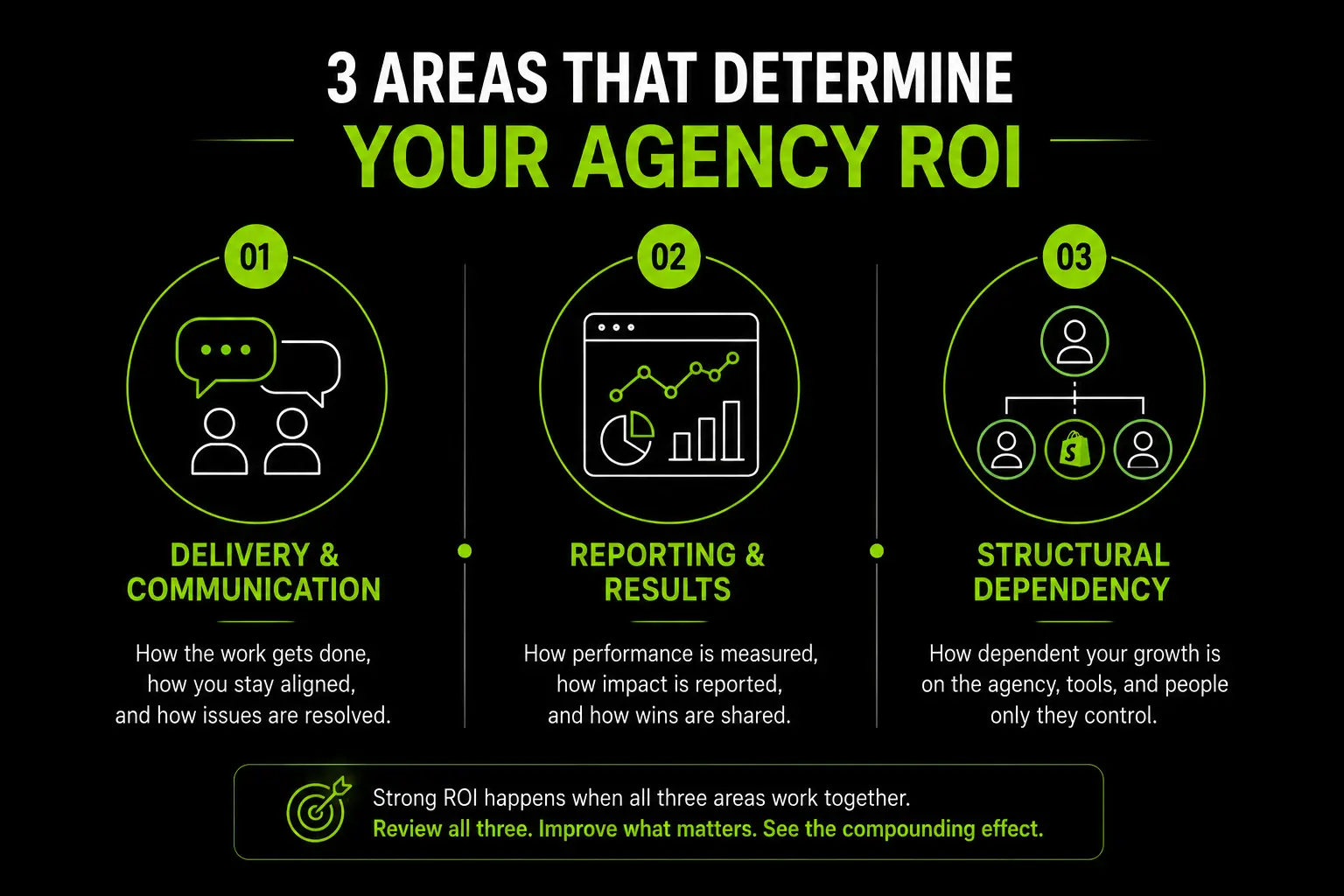
Signs that your Shopify agency is underperforming usually show up in three areas: communication and delivery, reporting, and how dependent you have become on the agency.
The third problem is easy to overlook. If the agency controls basic store changes, important systems, or information you need to run the store, moving to another agency can take more time and cost more than it should.
If the relationship isn't working as it should, check these three areas before you decide whether to stay or move on.
The Three Categories of Warning Signs
Most problems show up in three areas. Communication usually starts to slip first, then reporting becomes harder to follow. Dependence on the agency often becomes clear only when you try to move the work elsewhere.
Delivery and Communication Breakdown
This is the most visible category and the one every founder already recognizes: slower replies, missed deadlines, growing friction over small requests. It's also the category most existing advice stops at.
Unclear or Missing Results Reporting
Activity isn't the same as outcome. A report full of hours logged and tickets closed can still leave you with no idea whether your store is actually performing better than it was three months ago.
Structural Dependency: The Sign Most Founders Miss
This is what determines how easily you can fix the first two problems. If you do not have full access to your store and its code, moving away from the agency can be difficult even after you identify the problems.
Delivery and Communication Warning Signs
These are the signs that show up first and get noticed fastest, since they interrupt your week directly. They're worth naming specifically rather than lumping together as "poor communication."
Deadlines Slip Without Clear Explanation, Repeatedly
One missed deadline with a reasonable explanation, such as a family emergency or a third-party API outage, is not a red flag. Projects run into unexpected problems. Repeated missed deadlines with unclear or changing explanations are a different matter.
If you're hearing "almost there" for the third consecutive week with no specifics on what's actually blocking the work, that's the signal, not the single miss itself.
Keep a written record instead of relying on memory. A missed deadline in week one with a clear explanation, such as “the payment gateway sandbox went down and was fixed by Thursday,” is easy to put in context later.
If the same vague answer comes up in weeks three, five, and seven “just finishing up a few things” without any details, that is a pattern worth taking seriously.
Keep a record of the dates and reasons given for delays. That gives you something concrete to discuss when you raise the issue with the agency.
Every Small Request Turns Into a Change Order Conversation
Reasonable agencies absorb small tweaks, a button color, a copy change, a minor layout adjustment, as part of normal working.
If every request under an hour of work triggers a separate quote and approval cycle, the relationship has shifted from collaborative to transactional in a way that slows you down constantly.
Your Point of Contact Keeps Changing
Some staff turnover is unavoidable at any agency. A pattern of repeated, unexplained changes to your point of contact means you're re-explaining context every few weeks and losing institutional knowledge about your own project each time it happens.
Questions Get Answered Slower Over Time, Not Faster
Response times should usually get faster as the agency gets familiar with your store and how you work. If replies take longer at month six than they did at month one, your account may have become less of a priority for the agency.
Reporting and Results Warning Signs
Once communication problems are resolved, look at the reporting. A store can appear to be doing well while important problems in sales or performance go unnoticed.
You Can't Get a Straight Answer on What's Actually Improved
Ask your agency directly: what's better about the store today than it was three months ago, in numbers. If the answer is vague, general, or redirected to a list of completed tasks instead of a business metric, that's worth noting.
Ask for one specific number your current conversion rate compared with three months ago. An agency that tracks your store closely should be able to give you the numbers quickly, often from a dashboard they already use.
An agency that needs a week to "pull the data together" for a single metric either isn't tracking it in the first place, or isn't confident about what it will show once you see it.
Reports Focus on Activity Instead of Outcomes
A monthly update listing 40 hours worked and 12 tickets closed tells you the agency was busy. It says nothing about whether your conversion rate moved, whether page speed improved, or whether the checkout changes they shipped actually reduced cart abandonment.
A report full of completed tasks can look useful while telling you very little about the results. Check whether the agency is showing what changed for your store, not just what work it completed.
No Baseline Was Ever Established, So Nothing Can Be Compared
Without a clear starting point, the agency cannot show whether its work actually improved the store. You need the numbers from before the work began so you can compare them with the results later.
If you never recorded conversion rate, page speed, or average order value before the work started, ask the agency for those numbers now. If they cannot provide them or work them out from past data, take that as a warning sign.
If you've read a guide on measuring Shopify agency ROI and found you can't actually answer the questions it raises, that gap is itself a warning sign worth taking seriously here.
The Sign Most Founders Miss: Structural Dependency
This is where a service problem can become a much bigger problem. You may not notice the dependency until you need to make a change, switch agencies, or access something the agency controls.
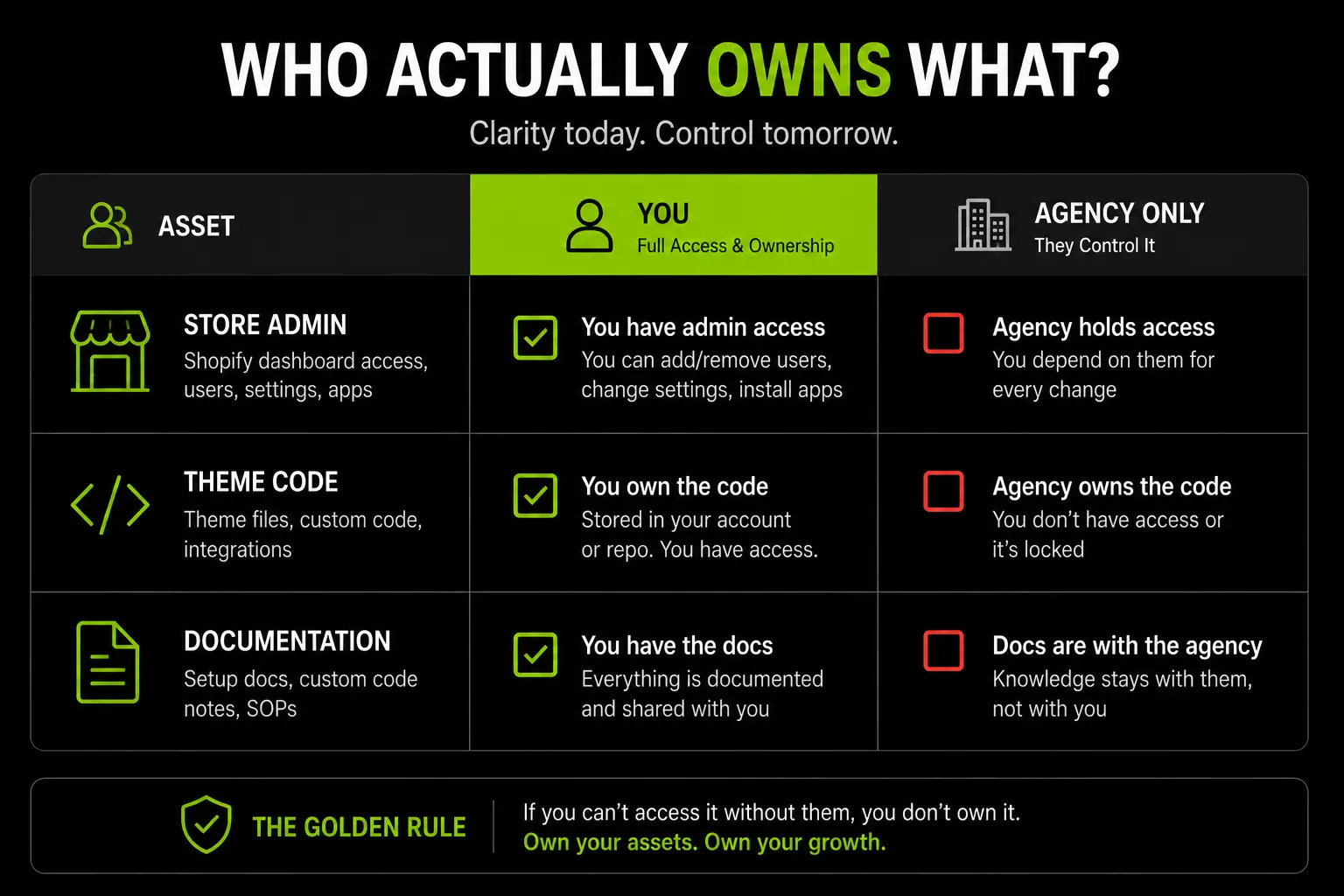
You Don't Have Full Admin Access to Your Own Store
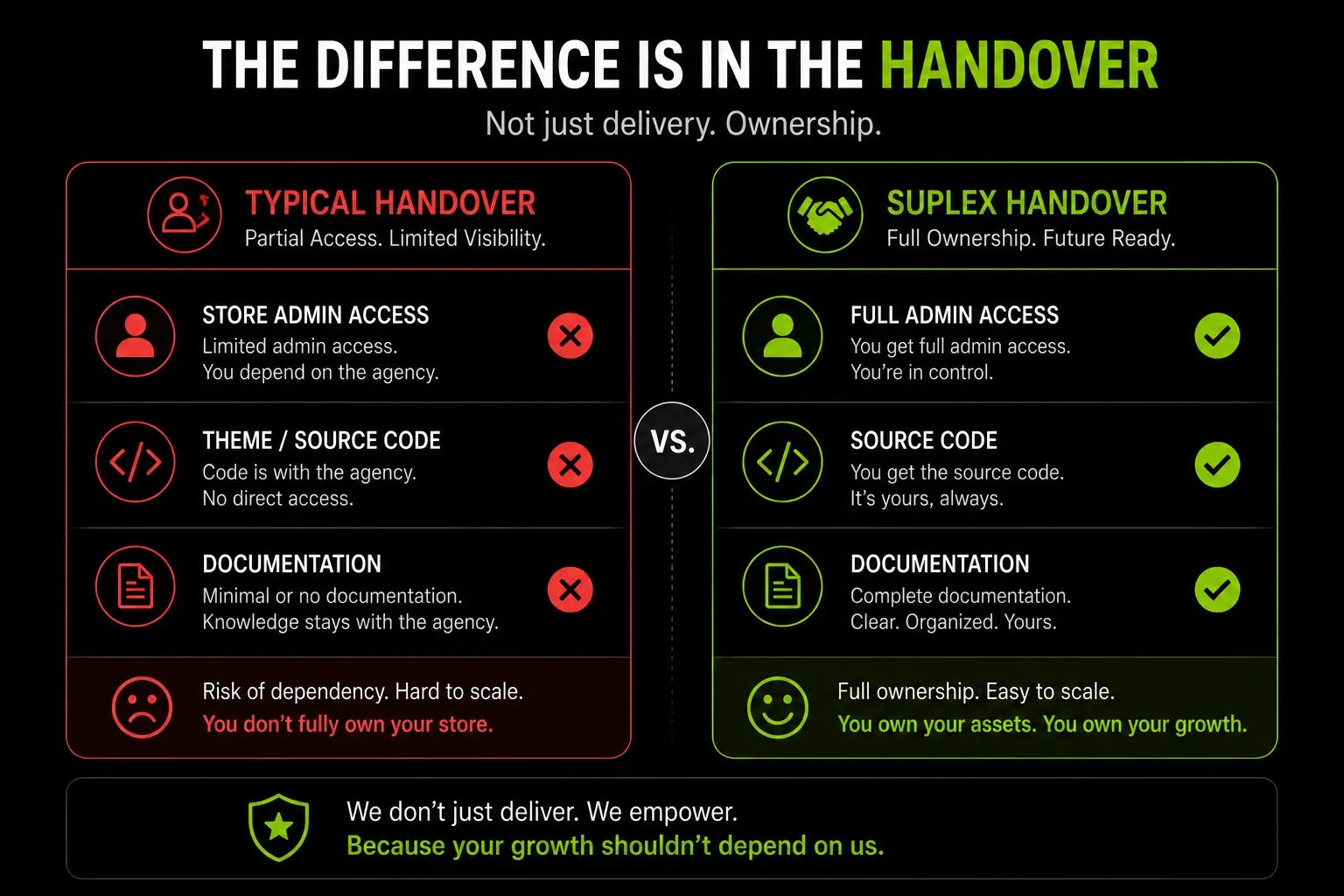
Some agencies retain the store owner role and grant clients staff-level access instead. This means you can't manage billing, can't add or remove other staff accounts and technically don't own your own Shopify instance. This should never be standard practice, regardless of who built or manages the store.
Nobody Else Could Pick Up the Codebase Without Starting Over
Ask a direct, uncomfortable question: if you handed your theme files to a different developer tomorrow, could they understand and work with what's there, or would they need to rebuild from scratch because of undocumented customizations, no version history, or code that only makes sense to the person who wrote it?
You can check this directly. Is your theme stored in a Git repository that you can access, with a history of changes? Or does each update overwrite the previous version without a record of what changed or why?
Do you have a short document explaining what each custom app or Liquid section does? If the answer is no, a new developer may spend the first two weeks figuring out how the store works instead of making improvements.
Getting a Quote From Another Agency Feels Harder Than It Should
If requesting a competing quote means asking your current agency for access you don't already have, that friction is itself a form of lock-in. A healthy relationship doesn't require permission from your current vendor to explore alternatives.
Small Fixes Always Require Paying the Same Agency, With No Alternative
If every small fix has to go through the same agency because no one else has access to the store or knows how it works, you have a dependency problem. You are paying the agency to keep access to your own store.
A concrete version of this: a brand realizes, only when trying to switch agencies eighteen months in, that they never had their own copy of the theme source code. Every customization lived on the agency's development store, with no repository the brand controlled.
The dependency only became clear when they tried to leave. By then, getting the code, documentation, and systems out of the agency’s control would have cost more than starting again.
This is why your handover checklist should include the source files, admin ownership, and documentation. A working store alone is not enough. If those items were missing from the original agreement, the dependency was part of the project from the start.
One Bad Sign vs. a Pattern: How to Tell the Difference
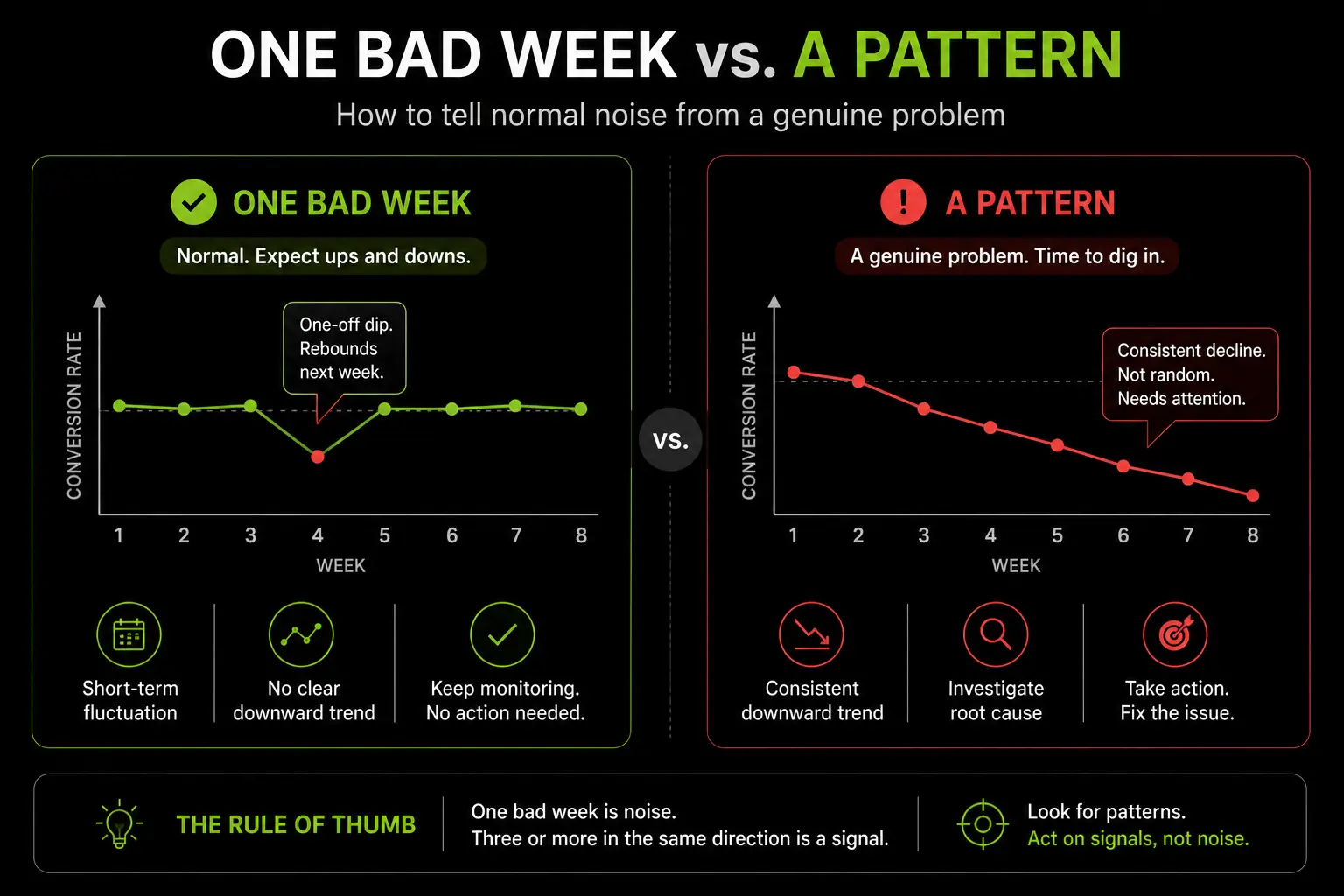
One problem on its own does not tell you much. Look for the same problems happening repeatedly. That pattern tells you more about how the agency is actually performing.
Every Agency Relationship Has an Off Week
A developer gets sick. A launch coincides with a public holiday. A single reporting cycle gets rushed because of an unrelated fire drill on another client's account. None of this, on its own, means the relationship has failed.
How to Tell a Rough Patch From a Real Problem
Check whether the problem keeps happening over at least two reporting or billing cycles. When you raise it, pay attention to the response. A good agency should address the issue directly and explain what it will do to fix it.
An agency that says, “You’re right. Here’s what happened, and here’s how we’ll fix it,” is taking the problem seriously. If the agency keeps saying “everything’s fine” while the same issue continues, that response is a stronger reason to reconsider the relationship.
What to Do If You Recognize These Signs
Spotting the pattern is the first step. What you do next can decide whether you fix the relationship calmly or end up dealing with a costly mess later.
Have the Direct Conversation Before Assuming the Worst
Many agency relationships can improve after a clear conversation. Bring specific examples: three missed deadlines with dates, two reports with no outcome data, or a list of the access you are missing. Be precise about the problem and what you expect to change. It is much harder to dismiss a documented issue than a general complaint.
Request Full Access and Documentation as a Test
Start by getting control of your store. Ask for full admin access, a copy of the theme source code, and documentation for any custom integrations. A healthy agency should provide these without making the process difficult.
Pushback, delay, or partial access is itself a direct answer to the question you're actually asking, whether you're dependent on them or genuinely partnered with them.
Know What "Good" Looks Like Before You Compare Alternatives
If the conversation and the access test confirm a real problem, the next step is finding a replacement, and that comparison works better with a structured method than a gut reaction to price.
Suplex's guide to comparing Shopify agency proposals walks through exactly how to normalize scope across multiple quotes so you're not comparing incomparable numbers on your way out of a bad situation and into another one.
How Suplex Handles Access and Independence
Suplex gives clients full ownership and access from the start. Every client keeps store owner-level admin access, and the theme source code is stored where the client can access it rather than only on an agency-managed development store.
The same approach applies from the first engagement. A platform consultation includes documentation of what you will own after the work is complete. For clients moving into a build, e-commerce store setup includes admin ownership and source-code access as part of the project.
The reason is simple, clients should be able to leave without losing control of their store. If you continue working with Suplex, it should be because you want to, not because you have to.
A Quick Self-Check
Run through these five questions honestly. They take two minutes and tell you more than a gut feeling will.
Frequently Asked Questions
What's the Clearest Sign a Shopify Agency Relationship Has Gone Wrong?
Structural dependency, not having full access to your own store or codebase, is the most serious, since it limits your options even if other issues like communication and reporting are also present. Delivery and communication problems are more visible but often easier to address directly.
Is It Normal to Not Have Full Admin Access to My Own Shopify Store?
No. You should have full admin-level access to your own store regardless of who built or manages it. If you don't, that's worth raising directly and resolving, not something to accept as standard practice.
How Do I Know If Slow Communication Is a Real Problem or Just a Busy Period?
Look for a pattern over multiple weeks, not a single instance. One slow week with a reasonable explanation is normal. Repeated unexplained delays, or delays that get worse over time, are a genuine signal.
What Should I Do Before Deciding to Switch Agencies?
Have a direct conversation about the specific issues first, and request full access and documentation as a test of how easily you actually could switch. This clarifies whether the problem is fixable or structural.
Why Don't Agency Reports Always Show Real Business Impact?
Some agencies report on activity, hours worked, tasks completed, because it's easier to track than outcomes, especially without an established baseline. Ask directly for outcome-based reporting tied to your business metrics.
Can I Request My Source Code and Access at Any Time?
You should be able to, and a reasonable agency will provide it without resistance. Difficulty or pushback when requesting your own assets is itself one of the clearer warning signs covered in this piece.
How Do I Compare a New Agency Once I've Decided to Switch?
Use a structured comparison method rather than judging proposals on price alone, since agencies often scope the same project differently. Suplex's guide on comparing Shopify agency proposals covers this in detail.
Hi, I’m Rishabh Jain
I believe great digital experiences have the power to shape perception, build trust, and move businesses forward. That belief led me to found Suplex Design Studio, a global digital design and development studio helping FMCG and D2C brands build websites and digital experiences that are strategic, thoughtful, and commercially meaningful.
I started Suplex at 25 with a clear intent, to create digital experiences that look appealing, work seamlessly, and help D2C businesses grow. By 28, the studio had scaled globally, guided by a strong foundation in integrated design that I developed during my academic journey in London, where I was honoured with the Dean’s Award.
Over the years, I’ve had the opportunity to work with 100+ brands, from Fortune 500 organisations to family-run businesses, helping them build websites, e-commerce experiences, and digital products that create clarity, credibility, and long-term value.
Our work has been recognised internationally, including the Manifest Award (2024), the Clutch Global Award (2025), and features across platforms such as The Dieline, Packaging of the World, and the World Brand Design Society.
None of this would be possible without the people behind the work. I’m deeply grateful to the Suplex team, whose commitment, creativity, and attention to detail turn ideas into meaningful digital experiences every day.
At the heart of our work is a simple philosophy, digital design should be intentional, functional, and built to create real business value. That continues to guide everything we create at Suplex.






































Let’s Make It Happen
E-Commerce Success Stories
%201.avif)






.avif)

.avif)
Build Your D2C Business The Right Way
Build It With Suplex.


