What Does an AI for Shopify Service Actually Include?
.avif)
What Does an AI for Shopify Service Actually Include?
An AI for Shopify service is not the same thing as Shopify's built-in AI features, Shopify Magic and Sidekick, which are free and already included on every store.
A real AI implementation service covers custom work layered on top, search and personalization, catalog-scale content generation, AI customer service trained on your specific catalog and policies, and increasingly, optimizing your store to be discoverable and purchasable by AI shopping agents.
This Suplex post covers a genuinely fast-moving area of the Shopify platform. It reflects Shopify's publicly stated agentic commerce capabilities as of August 2026 and is worth revisiting if you're reading it much later, since this space is evolving quickly.
The Confusion This Term Creates and Why It Matters
"AI for Shopify" gets used to describe two genuinely different things, and most merchants encounter the confusing version first, which is why this needs sorting out before anything else.
"AI for Shopify" usually means a Tool. As a Service, It Means Something Else.
Search "AI for Shopify" and nearly everything you find is a tool: an app you install, a chatbot widget, an AI store builder. As a service offering from an agency, "AI for Shopify" means something structurally different: custom implementation work scoped to your specific store, catalog, and customer base, not a tool you click to activate.
This distinction is the single biggest source of confusion for anyone evaluating this kind of engagement. If you're picturing an agency "adding AI" the way you'd install an app, that's a reasonable assumption and it's also the wrong one. A real AI-for-Shopify service is closer to a development engagement than an app installation.
Every search result for the exact tool-shopping queries, "AI store builder for Shopify," "AI chatbot for Shopify," "AI SEO for Shopify," answers a genuinely different question than the one someone typing "AI for Shopify service" is actually asking.
That mismatch is worth naming directly, because it means most of what you'll find while researching this topic on your own answers the wrong question entirely.
What's Already Free and Built In vs. What Needs Custom Work
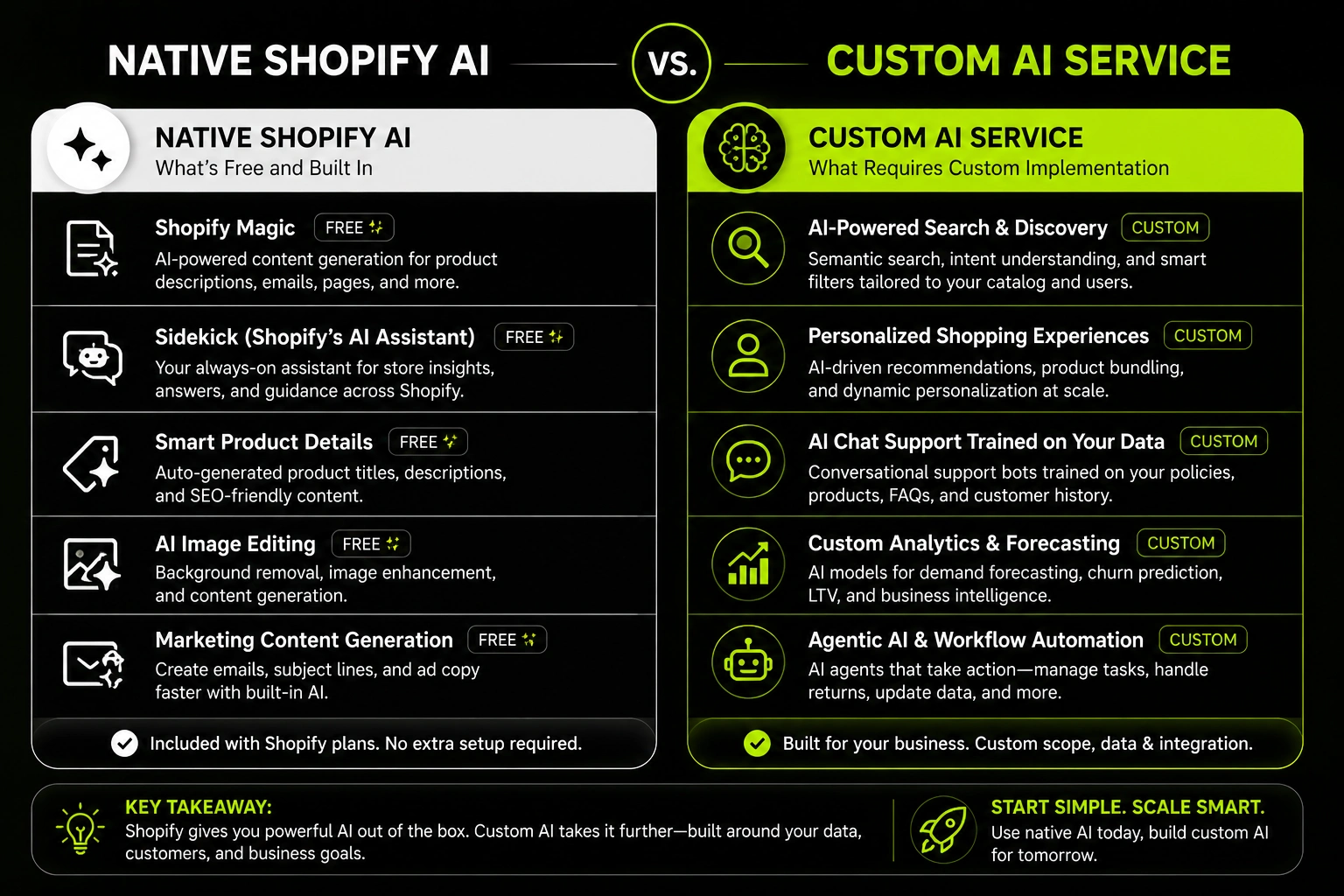
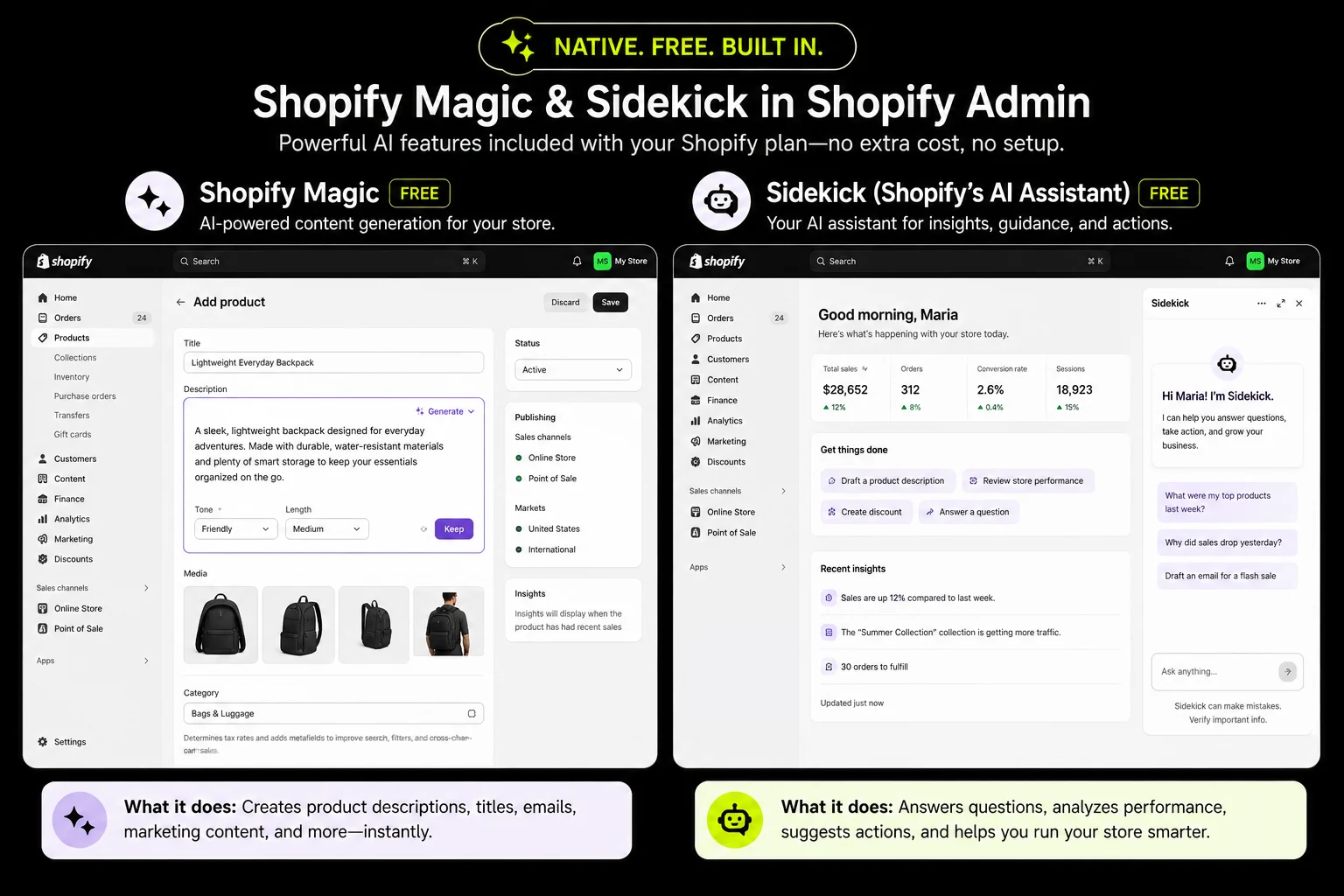
Shopify Magic, which generates product descriptions, edits images, and drafts marketing copy, and Sidekick, Shopify's AI assistant for store management tasks, are native features included with every Shopify store at no additional cost. Neither one needs an agency to "add" it. They're already there, waiting to be turned on.
What a paid AI service actually covers sits outside that native layer, semantic search that understands intent rather than matching keywords, a personalization engine trained on your specific customer behavior.
An AI support agent that knows your actual return policy and shipping zones rather than giving generic answers, and increasingly, making sure your product data is structured correctly for AI shopping agents to find and recommend you. None of that is a toggle in Shopify's admin. It's implementation work.
What a Real AI-for-Shopify Service Actually Covers
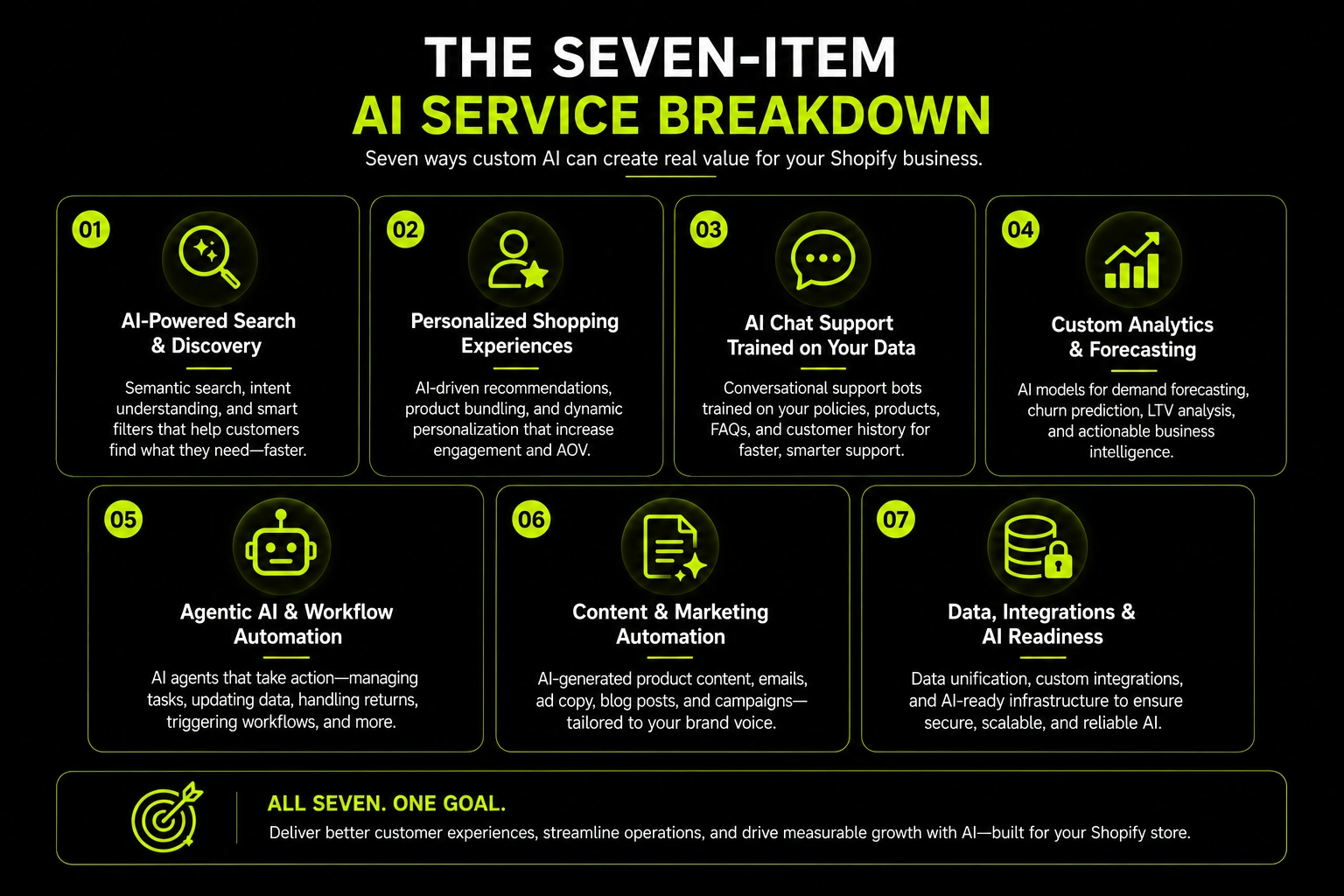
This is the comprehensive breakdown missing from nearly everything else written on this exact phrase. Seven categories cover most of what a legitimate implementation service actually does.
1. AI-Powered Product Search and Discovery
Shopify's default search matches keywords literally, which means a query like "waterproof jacket under 300 AED" often returns weak or irrelevant results, since the store's default search doesn't understand price constraints or descriptive intent the way a shopper means them.
A properly implemented semantic or vector search understands what the shopper is actually asking for and returns results that match the intent, not just the words.
This is genuinely one of the highest-impact areas covered here, since search-to-purchase conversion is directly measurable, and a shopper who gives up on a bad search result rarely comes back to try again.
The technical implementation typically involves converting your product catalog into vector embeddings, numerical representations that capture meaning rather than just keywords, so a search for "something to keep me warm hiking" can match a fleece jacket even if the product listing never uses the word "warm."
2. Personalization and Recommendation Engines
A personalization engine uses a shopper's browsing and purchase behavior to surface products they're actually likely to want, rather than showing every visitor the same generic "you might also like" row.
Done well, this is trained on your store's specific customer data, not a generic recommendation model applied identically across every Shopify store using the same app.
3. AI Customer Service Trained on Your Catalog and Policies
A generic chatbot app answers generic questions with generic scripted responses. A properly implemented AI customer service agent is trained specifically on your actual return policy, your actual shipping zones and your actual product specifications, which is the difference between a customer getting a real answer and getting redirected to a human anyway.
The gap between these two shows up fastest at the exact moment a customer needs a specific answer: "does this ship to Sharjah" or "can I return this after 20 days."
A generic bot without store-specific training either guesses or deflects. A properly trained one answers correctly.
Training this kind of agent well requires more than uploading a policy document once. It means keeping the underlying data current as policies change, testing it against the actual questions your support team fields most often and setting clear escalation rules for when a question genuinely needs a human, rather than letting the AI guess at something it isn't confident about.
4. Catalog-Scale Content Generation
Writing product descriptions, metafields, and alt text for a catalog of a few dozen products is manageable manually.
Doing it for a catalog of a few thousand SKUs, consistently, with proper keyword and structured-data considerations built in, is a different kind of problem, and it's one AI genuinely solves well when the underlying prompts and structure are set up correctly.
This overlaps with Shopify Magic's native content generation, but at catalog scale, the difference is in the systematic setup, consistent tone, structured metafields, and SEO consideration across thousands of entries, not the one-off generation Shopify Magic handles product by product.
5. Merchandising Intelligence
Demand forecasting and dynamic bundling use historical sales data to predict what's likely to sell and suggest product combinations that increase average order value, both of which go beyond what Shopify's native tools handle out of the box.
This category sits closer to data science than content generation and it's where AI implementation work overlaps most directly with a store's broader analytics setup.
6. AI-Assisted Development Using Shopify's AI Toolkit
Shopify has built AI-assisted tooling into its developer platform itself, letting development teams build and extend stores faster using AI-assisted code generation and configuration.
This is a genuinely different category from customer-facing AI, since it's about how the store gets built, not what shoppers interact with directly.
7. Agentic Commerce Readiness
The newest category covers optimizing a store so AI shopping agents, not just human shoppers, can find, evaluate, and purchase products correctly. This is significant enough, and new enough, that it gets its own section below.
Agentic Commerce: The Newest and Least Understood Layer
Most merchants, and most competing content on this topic, still think "AI for Shopify" means chatbots and content generation. Agentic commerce is a genuinely different, newer layer, and it's moving fast enough that it deserves its own explanation.
What Happens When ChatGPT, Perplexity, or Google Shop on a Customer's Behalf
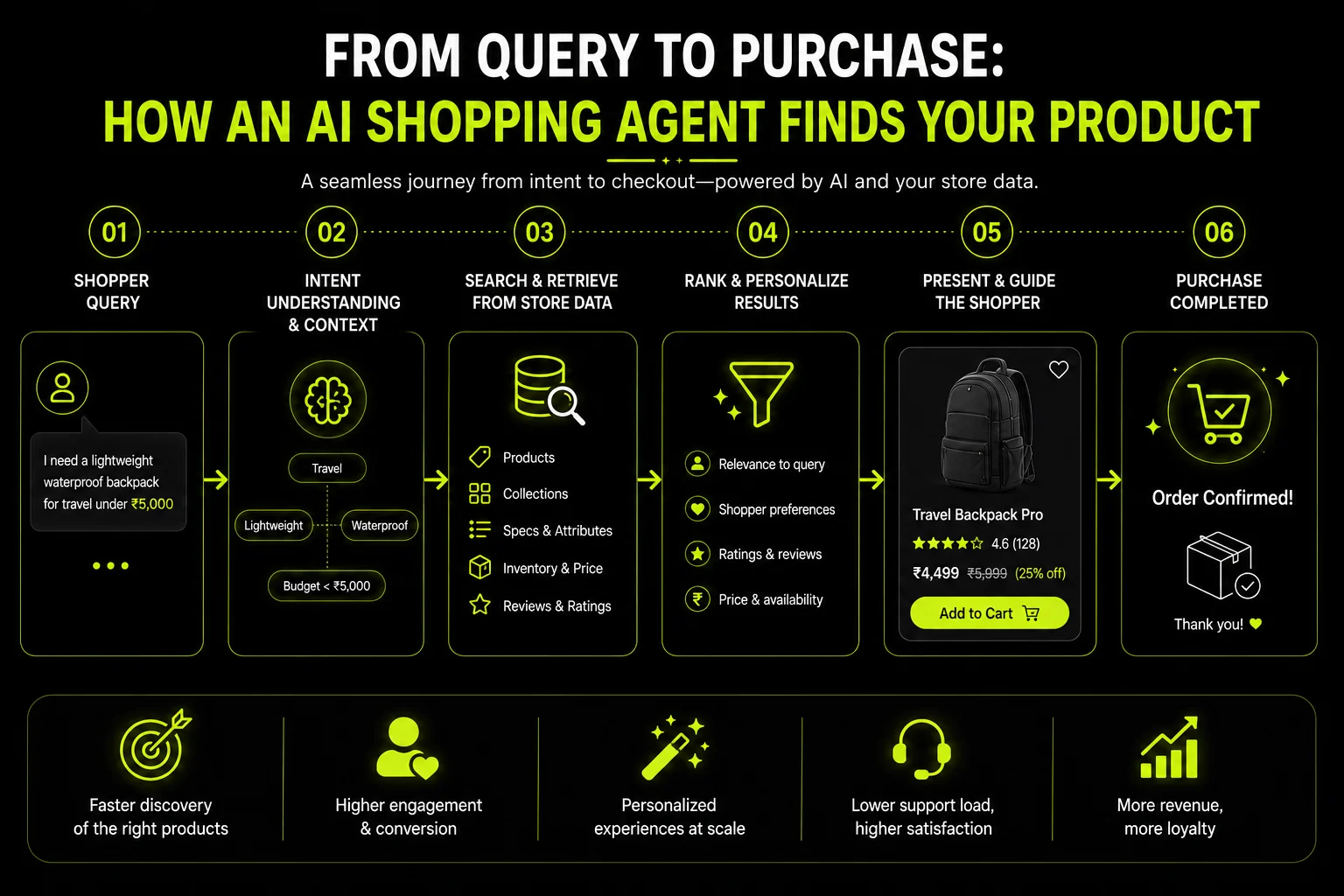
Agentic commerce refers to AI assistants like ChatGPT, Google's AI Mode, or Perplexity discovering, comparing, and increasingly completing purchases on a shopper's behalf, inside the conversation itself, rather than the shopper browsing your store directly.
Shopify has built infrastructure specifically for this: Agentic Storefronts, introduced in Shopify's Winter '26 Edition, and the Universal Commerce Protocol, an open standard Shopify co-developed with Google that lets AI agents discover products and complete transactions with any participating merchant.
The Universal Commerce Protocol is worth understanding at a basic level even if you never touch its technical details directly. It's an open standard, not a Shopify-exclusive lock-in, and it's backed by a coalition that includes major payment processors and retailers beyond Shopify itself.
In practice, this means that when a new AI platform adopts the protocol, stores already set up for it become discoverable there automatically, without needing a separate integration built for every individual AI platform that comes along.
Shopify has reported that AI-driven traffic to its merchants grew roughly eightfold year over year in early 2026, with orders originating from AI-powered searches growing at a considerably steeper rate over the same period.
Those are Shopify's own reported figures rather than independently audited numbers, but the direction is clear regardless of the exact multiple: AI-originated shopping traffic is growing fast, and it's growing from a low base.
Product Feed and Structured Data Requirements for AI Discoverability
AI shopping agents don't browse a store visually the way a human does. They read structured product data, titles, descriptions, pricing, inventory, and specifications, to decide what to recommend, which means precise, complete product data matters more for this channel than persuasive marketing copy does.
A product listed as "luxuriously soft premium cotton" gives an AI agent very little to work with. A listing specifying "100% GOTS-certified organic cotton, 200 GSM" gives the agent concrete attributes to match against a shopper's actual query.
This is a genuinely different discipline from writing copy that converts a human browsing casually, and it's one most product catalogs weren't originally built for.
This has a direct, practical implication for how product data gets written and maintained going forward. Marketing copy optimized purely for emotional appeal, without concrete, verifiable attributes woven in, is increasingly a liability for AI discoverability, even if it still reads well to a human.
The two goals aren't in conflict, but a catalog built exclusively for one no longer automatically serves the other.
Why This Is Becoming Part of "AI for Shopify," Not a Separate Service
Agentic commerce readiness increasingly sits inside the same AI-for-Shopify conversation as search and personalization, rather than existing as its own separate offering, because the underlying work, clean, structured, accurate product data, benefits AI shopping agents and Shopify's own on-site search and recommendation systems at the same time.
This is a genuinely fast-moving area, and it's worth saying plainly that specifics here will keep changing as Shopify, Google, and other platforms continue building out this infrastructure. The direction is clear enough to act on now. The exact mechanics are still being built.
Wondering whether your store needs custom AI work, or whether Shopify's free native tools already cover what you're looking for?
Suplex starts every AI engagement by auditing what's already native and free before scoping any custom work. Explore our AI for Shopify service to see how we approach this, or reach out directly if you want a straight read on your specific store.
What This Looks Like in Practice: Scope and Process
Beyond the feature list, it helps to know what actually happens once you engage someone for this kind of work. Three phases cover most of it.
Discovery: Auditing What's Already Native vs. What Needs Building
The engagement should start by auditing what your store already has access to natively, Shopify Magic, Sidekick, any AI features already active in your theme or apps, before scoping anything custom.
Paying for custom work that duplicates a free native feature is a preventable waste, and a good discovery phase catches this before any development starts.
Implementation: Integration, Training Data and Configuration
Once scope is confirmed, implementation covers integrating the chosen tools, feeding them your actual catalog, policy, and customer data, and configuring the logic that determines how they behave, how search ranks results, how a support agent phrases answers, how recommendations get weighted.
This is where most of the actual custom development happens.
Measurement: How Success Gets Tracked
A completed AI implementation should come with a clear way to measure whether it's working: search success rate and conversion lift for search AI, deflection rate and customer satisfaction for support AI, click-through and conversion lift for personalization and recommendations.
Our data analytics service covers how this measurement layer gets built and tracked over time, which matters just as much as the initial implementation.
How We Approach AI for Shopify at Suplex
We start every engagement from what's already native and free, then scope custom work only where it adds measurable value, which is the same discipline covered in the disambiguation section above applied directly to how we work.
If Shopify Magic or Sidekick already covers what a client needs, we say so, rather than proposing custom work to replace something free.
Our AI for Shopify service covers the implementation categories above, search, personalization, trained support, catalog-scale content, and merchandising intelligence, and our conversion rate optimization work often overlaps directly with search and personalization implementations, since both are ultimately aimed at the same outcome.
On agentic commerce specifically, we're honest that this is an active area of focus for us rather than a fully packaged, finished offering, given how quickly the underlying protocols and platform capabilities are still evolving.
Questions to Ask Before Hiring for This
These four questions cut through most of the vague framing that makes this category confusing to evaluate from the outside.
A vague or evasive answer to any of these four is worth treating as a real signal, not a minor gap. The ownership question in particular matters more than it first appears: if a provider won't confirm you keep your trained configuration and data after the engagement ends, switching providers later could mean starting the entire implementation over from zero.
Trying to work out what an AI for Shopify engagement should actually cover for your store? Talk to Suplex's founders directly and get a straight read on what's worth building versus what's already sitting free in your admin.
Frequently Asked Questions
Is "AI for Shopify" Just Shopify Magic and Sidekick?
No. Those are native, free features included with every Shopify store. An AI-for-Shopify service typically refers to custom work layered on top, search, personalization, trained customer service, and increasingly, optimizing for AI shopping agents.
Do I Need to Pay for AI Features on Shopify?
Basic AI features, Shopify Magic for content and images, Sidekick for store management, are included free. Paid AI services come in for custom implementations, semantic search, personalization engines, or catalog-scale automation beyond what's native.
What Is Agentic Commerce, and Does It Affect My Shopify Store?
Agentic commerce refers to AI assistants, like ChatGPT or Google's AI Mode, shopping and transacting on a customer's behalf. It affects discoverability, since stores need properly structured product data for AI agents to find and recommend them accurately.
Can AI Actually Improve My Product Search on Shopify?
Yes, meaningfully. Shopify's default search struggles with natural-language or descriptive queries. Semantic or vector search implementations understand intent rather than just matching keywords, which measurably improves search-to-purchase conversion.
How Is an AI Customer Service Implementation Different From a Basic Chatbot App?
A basic chatbot app answers generic questions. A properly implemented AI service is trained specifically on your catalog, policies, and common customer questions, giving accurate, store-specific answers rather than generic scripted responses.
How Do I Measure Whether an AI Implementation Is Working?
Track specific metrics tied to the feature: search success rate and conversion lift for search AI, deflection rate and satisfaction for customer service AI, and click-through or conversion lift for personalization and recommendations.
Is It Too Early to Invest in Agentic Commerce Readiness?
Not necessarily. Structured, accurate product data benefits both traditional SEO and AI discoverability, so the groundwork isn't wasted even as the agentic commerce landscape continues to develop quickly.
Hi, I’m Rishabh Jain
I believe great digital experiences have the power to shape perception, build trust, and move businesses forward. That belief led me to found Suplex Design Studio, a global digital design and development studio helping FMCG and D2C brands build websites and digital experiences that are strategic, thoughtful, and commercially meaningful.
I started Suplex at 25 with a clear intent, to create digital experiences that look appealing, work seamlessly, and help D2C businesses grow. By 28, the studio had scaled globally, guided by a strong foundation in integrated design that I developed during my academic journey in London, where I was honoured with the Dean’s Award.
Over the years, I’ve had the opportunity to work with 100+ brands, from Fortune 500 organisations to family-run businesses, helping them build websites, e-commerce experiences, and digital products that create clarity, credibility, and long-term value.
Our work has been recognised internationally, including the Manifest Award (2024), the Clutch Global Award (2025), and features across platforms such as The Dieline, Packaging of the World, and the World Brand Design Society.
None of this would be possible without the people behind the work. I’m deeply grateful to the Suplex team, whose commitment, creativity, and attention to detail turn ideas into meaningful digital experiences every day.
At the heart of our work is a simple philosophy, digital design should be intentional, functional, and built to create real business value. That continues to guide everything we create at Suplex.
































Let’s Make It Happen
E-Commerce Success Stories
%201.avif)






.avif)

.avif)
Build Your D2C Business The Right Way
Build It With Suplex.


