Ecommerce Personalization Examples: What's Actually Achievable at Every Budget (2026)
.avif)

Ecommerce Personalization Examples: What's Actually Achievable at Every Budget (2026)
Ecommerce Personalization Examples show how you can tailor your store using customer behaviour, purchase history, location, and preferences instead of giving every visitor the same experience.
Most guides rely on Amazon or Netflix, but those examples rarely explain what you can realistically build.
This blog post groups personalization examples by implementation complexity, so you can choose the right approach for your budget, growth stage, and technical capabilities.

The Three Tiers Of Ecommerce Personalization, Before The Examples
Every competing list treats personalization as one undifferentiated bucket of tactics. Tiering it by build complexity is what turns a listicle into an actual decision tool.
The Personalization Ladder
- Tier 1, Native/Free: Shopify's built-in behavioural data, free tools like Shopify's own Product Recommendations app, customer tags and metafields, basic Klaviyo segmentation. No dev budget required.
- Tier 2, App-Layer: Paid personalization apps (Nosto, Wisepops, AI-recommendation apps) that layer dynamic content, popups, and recommendation blocks on top of your existing theme. Moderate cost, fast to deploy.
- Tier 3, Custom-Built: Bespoke recommendation logic, dynamic pricing, CDP integrations, or fully custom product configurators. Requires real development resources and a clear ROI case before you commit.
Industry-reported figures put personalization's impact at roughly 10 to 25% AOV lift and 20 to 40% conversion lift, directional industry numbers, not a guarantee for your specific store.
Results vary hugely by category, traffic volume, and how well the personalization is actually targeted.
We start every personalization conversation by asking which tier a brand can realistically sustain, not which tier looks best in a case study.
Tier 1 Examples: Personalization You Can Ship This Month
These require no dev budget and no new software. If you're not already doing these, they're the highest-ROI-per-effort starting point available.
Behaviour-Based Product Recommendations (Native/Low-Cost)
A realistic Tier 1 starting stack: Shopify's native Product Recommendations app paired with basic Klaviyo behavioural segmentation. Both are already available inside tools most Shopify brands run anyway.
"Customers also bought" blocks are the highest ROI-per-effort personalization tactic available on Shopify, and most brands that skip them do so because of theme constraints, not cost. The feature is free.
What blocks adoption is usually a theme that doesn't have a clean slot for the recommendation block, or a merchandising team that never got around to configuring the underlying rules. Fix the theme placement once and the tactic runs itself from there.
Returning-Visitor Recognition And Recently Viewed
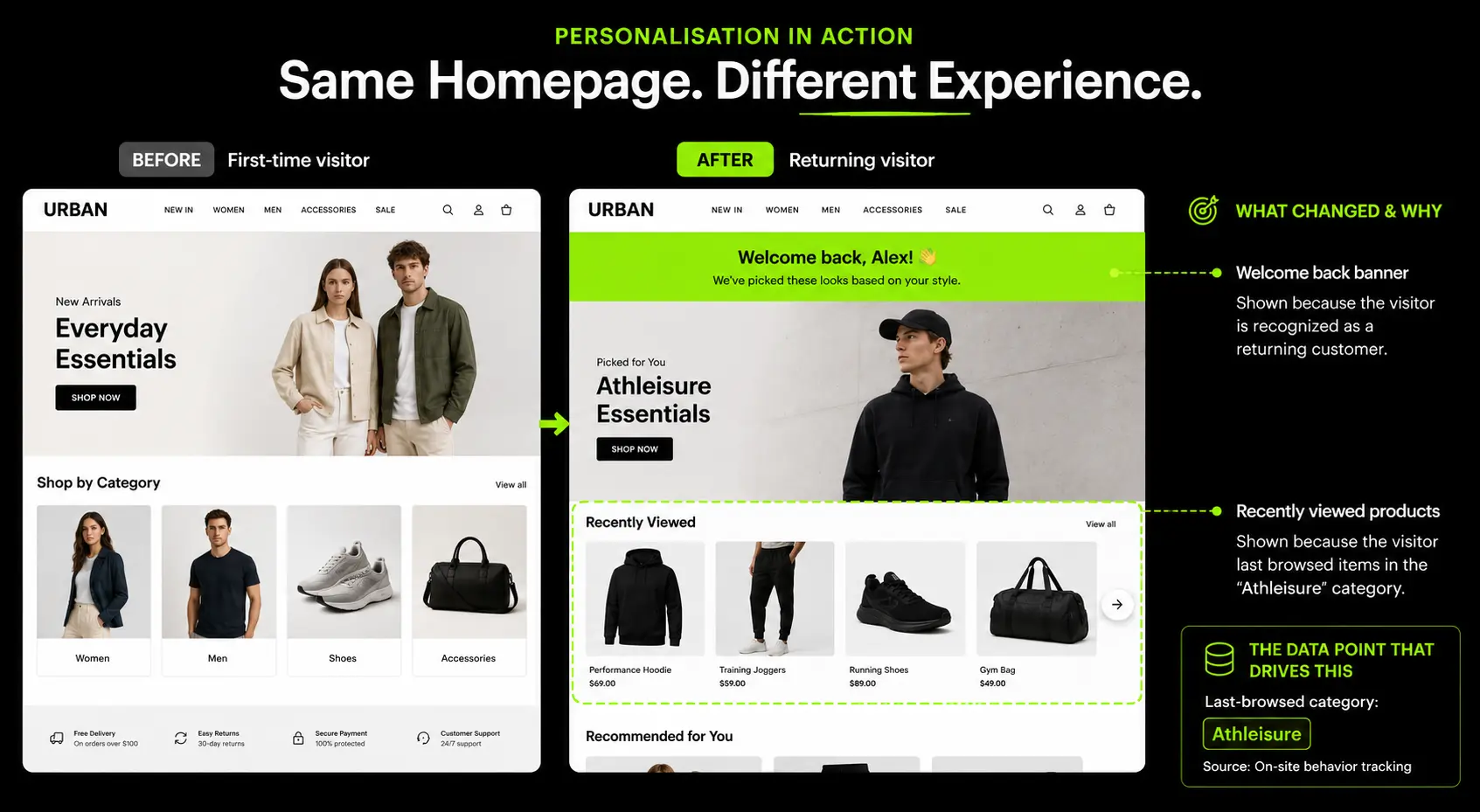
A generic homepage shown to a repeat visitor wastes their attention on content they've already seen once.
A "welcome back" message paired with a recently-viewed carousel does something more useful: it respects that this visitor already told you, through their own browsing, what they're interested in.
The commercial logic here isn't novelty, it's attention economics. A first-time visitor needs orientation. A returning visitor already has context and showing them the same generic homepage as a stranger wastes the one advantage you have: you already know what they were looking at.
Segmented Email and Sms Flows
Klaviyo's documented work with brands like Dagne Dover shows this in practice: matching SMS campaigns to specific collection pages a customer browsed, rather than sending the same blast to every subscriber.
Athena Club's approach uses search-intent signals to accelerate the customer's journey toward a relevant product, rather than starting every new subscriber at the same generic welcome sequence.
These are smaller, closer-to-reality examples than Amazon-scale personalization and both are achievable with a properly configured Klaviyo account, not custom development.
Tier 2 Examples: App-Layer Personalization Worth The Spend
Once Tier 1 is running and you're seeing real behavioural data accumulate, these paid tools start to earn their monthly cost.
Dynamic On-Site Content By Segment
Apps like Nosto pull a unified customer profile and adjust banners, offers, and homepage content based on segment, first-time visitor vs returning, high-AOV shopper vs price-sensitive shopper.
The mechanism underneath this isn't magic, it's segment logic paired with content blocks that swap based on which segment a visitor falls into.
Understanding that mechanism matters because it tells you what data you need to clean before the tool can do anything useful: segment definitions have to exist and be accurate before dynamic content can target them correctly.
Quiz-Based And Preference-Driven Personalization
Product quizzes, the pattern used by brands like Ekster in industry roundups, route shoppers to a filtered product set based on two or three questions.
This is a build a mid-size brand can realistically commission without a full development team.
When A Quiz Beats A Recommendation Engine:
Quizzes work better for considered-purchase categories, skincare, supplements, where preference data hasn't been captured yet because the customer hasn't purchased before.
A recommendation engine needs purchase or browsing history to work from, quizzes generate that signal upfront instead of waiting for it.
Recommendation engines work better for repeat-purchase, high-catalogue categories where you already have enough behavioural data to make a confident suggestion without asking the customer anything.

Dynamic Pricing And Personalized Offers
Free shipping threshold nudges and first-time discount timing are the most commercially sensitive tier of personalization, because they touch price directly.
This is where the risk of eroding trust runs highest if the personalization becomes too visible or starts to feel exploitative, a customer who notices they're being shown a different price than someone else, or a different discount timing designed to pressure a specific decision, reacts to that discovery worse than they would to no personalization at all.
Handle this tier carefully, and keep the logic behind offers and thresholds defensible if a customer ever asks about it directly.
Tier 3 Examples: Custom-Built Personalization, When It's Worth It
Most competitor "examples" pages implicitly pitch every brand toward this tier, because they're selling the software. Here's the honest version: most D2C and FMCG brands don't need this yet.
Custom Recommendation Logic and CDP Integration
A genuinely custom-built recommendation layer requires a customer data platform, event tracking that goes beyond what Shopify's native analytics capture, and a dedicated logic layer connecting the two. This is real infrastructure, not a plugin toggle.
Who this is genuinely for: high-catalogue, high-repeat-purchase brands with an actual data team to maintain the system. If you're running under a few hundred SKUs, or your repeat purchase rate is still in single digits, this tier is premature.
The traffic and catalogue thresholds where custom recommendation logic starts paying for itself sit well above where most growing D2C and FMCG brands operate.
Get Tier 1 and 2 working properly first, and let the data from those tiers tell you whether you've genuinely outgrown them.
Full Product Configurators And Build-Your-Own Experiences
The product-personaliser pattern, live preview updating as a customer makes selections, with dynamic pricing that adjusts alongside, shows up commonly in custom apparel and gifting categories.
A customer picking a monogram, a colourway, or a bundle sees the product and the price update in real time as they choose.
The engagement lift here, longer time on page, is worth reading as a leading indicator of purchase intent, not a vanity metric.
A customer spending three extra minutes configuring a product isn't wasting time, they're investing effort into a product they're now more likely to complete the purchase on, because they've already mentally committed to the specific version they built.
We scope Tier 3 work only after Tier 1 and 2 data show a brand has genuinely outgrown them, not because a competitor has a fancier recommendation engine.
This ties directly into custom web development and platform consultation, where we look at the actual traffic and catalogue numbers before scoping anything custom.
Suplex's Approach To Ecommerce Personalization
We recommend the level of personalization your business actually needs, not the most expensive solution.
Our process starts with data, not software. Personalization only works when behavioural and purchase data is accurate. Poor data creates poor recommendations that damage the customer experience.
This approach is built on the same UX and CRO principles we've applied across projects like Celesti (preference-driven conversion optimisation) and Miho (persona-led UX). Understanding customer intent always comes before implementing personalization.
Personalization Should Build Trust
- Aggressive discount triggers.
- Referencing data customers didn't knowingly share.
- Dynamic pricing that appears unfair.
Start with data customers have willingly provided, such as purchase history, browsing behaviour, and stated preferences. That's how personalization increases conversions without reducing trust.
Ecommerce Personalization For UAE and Gulf Brands
Generic "localise your language" advice doesn't go far enough for this market. Here's what actual regional personalization looks like.
Language And Currency Are Baseline, Not Personalization Anymore
Arabic and English toggling, AED display, these need to work seamlessly on any UAE store, but that alone isn't personalization in 2026, it's baseline UX.
If your store's only "personalization" is a language switcher, you haven't actually started yet. Treat this as table stakes and build the real personalization work on top of it.
Whatsapp-Based Segmentation Is A Genuine Gulf-Specific Channel
Brands increasingly route post-purchase and re-engagement messaging through WhatsApp Business flows rather than relying on email alone, reflecting how Gulf consumers actually prefer to communicate.
A segmentation strategy built purely around email misses a channel that regularly outperforms it for this audience.
If your re-engagement flows only live in Klaviyo email, you're likely missing the channel where a meaningful share of your audience would actually engage.
COD-Aware Personalization
Showing different urgency or trust messaging to segments more likely to select COD versus prepaid makes sense here, because the drop-off risk profile differs meaningfully between the two groups.
A COD-leaning segment responds to delivery timing clarity and trust signals around the COD process itself. A prepaid-leaning segment responds more to payment security messaging and price-related nudges.
Treating both segments identically wastes the signal you already have about which group a given shopper falls into.
Seasonal Personalization For Ramadan and EOSS
Pre-built segment logic for gifting-intent shoppers during Ramadan and EOSS (End of Season Sale) windows consistently outperforms static, always-on personalization rules.
These periods bring different shopper intent, more urgency, more gifting behaviour, different price sensitivity, than the rest of the year.
A personalization ruleset tuned for average annual behaviour will underperform during these spikes precisely when the traffic volume makes getting it right most valuable.
We've layered these Gulf-specific signals, language, WhatsApp, COD behaviour, seasonal timing, onto the standard personalization ladder for UAE D2C, beauty and FMCG clients as a Shopify, Meta and Google Partner working across the region.
The touchpoints aren't add-ons to a generic strategy, they're where the actual purchase decision gets made for a meaningful share of this audience.
This connects directly to the touchpoints we cover in ecommerce customer journey mapping, where WhatsApp and COD-specific friction show up as journey stages worth instrumenting before you personalize around them, mapping the friction comes first, fixing it with personalization comes second.
Frequently Asked Questions
What is ecommerce personalization?
Ecommerce personalization means using customer data, behaviour, purchase history, location, and preferences, to tailor what each shopper sees, rather than showing everyone the same store. This ranges from simple recently-viewed carousels to fully custom recommendation engines, and the right level depends on a brand's traffic, catalogue size, and data maturity.
What are some examples of ecommerce personalization?
Common examples include personalised product recommendations, segmented email and SMS campaigns, dynamic on-site banners by customer type, product quizzes that route shoppers to relevant items, and post-purchase flows tailored to what someone bought. The right mix depends on budget and available customer data, not just what's trending.
Do small ecommerce brands need personalization software?
Not necessarily. Many effective personalization tactics, behaviour-based email segmentation, native recommendation blocks, recently-viewed content, can be built with free or low-cost tools already available in Shopify. Paid personalization software becomes worth it once a brand has enough traffic and catalogue complexity to need automated, real-time logic.
How much does ecommerce personalization improve conversion rates?
Industry-reported figures suggest personalization can lift conversion rates by roughly 20 to 40% and average order value by 10 to 25%, though results vary significantly by category, traffic volume, and how well the personalization is targeted. These figures are directional benchmarks, not guarantees for any individual store.
What's the difference between personalization and customization in ecommerce?
Personalization is the business adjusting what a customer sees based on data, recommendations, content, offers. Customization is the customer actively choosing product options, size, colour, monogramming, configuration. Both improve engagement, but customization requires the shopper's direct input while personalization happens automatically in the background.
Can personalization hurt customer trust?
Yes, if it's too visible or feels invasive, aggressive discount timing, referencing data a customer didn't knowingly share, or over-personalising pricing can erode trust faster than generic content builds engagement. The safest approach starts with data customers have clearly opted into, like purchase history and stated preferences.
What tools do Shopify brands use for personalization?
Shopify's native Product Recommendations app and customer segmentation cover Tier 1 personalization for free. Klaviyo handles behaviour-based email and SMS flows. Apps like Nosto or AI-recommendation tools add dynamic on-site content. Custom recommendation engines and CDP integrations are typically reserved for high-traffic, high-catalogue brands with dedicated data resources.
Hi, I’m Rishabh Jain
I believe great design has the power to shape perception, build trust, and move businesses forward. That belief is what led me to found Suplex Design Studio, a global branding and packaging studio working with FMCG and D2C brands across markets.I started suplex at 25 with a clear intent, to create design that is strategic, thoughtful, and commercially meaningful. By 28, the studio had scaled globally, guided by a strong foundation in Integrated Design that I developed during my academic journey in London, where I was honoured with the Dean’s Award.
Over the years, I’ve had the opportunity to work with 100+ brands, from Fortune 500 organizations to family-run businesses, helping them build packaging and brand systems that create recall, relevance, and long-term value.
Suplex’s work has been recognized internationally, including the Manifest Award (2024), the Clutch Global Award (2025), and features on platforms such as Packaging of the World, The Dieline, and the World Brand Design Society.
None of this would be possible without the people behind the work. I’m deeply grateful to the suplex team, whose commitment, creativity, and attention to detail turn ideas into meaningful brand experiences every day.
At the heart of my work is a simple philosophy, design should be intentional, honest, and built to last, and that continues to guide everything we create at suplex.



















Let’s Make It Happen
E-Commerce Success Stories
%201.avif)






.avif)
.avif)
Build Your D2C Business The Right Way
Build It With Suplex.


