Shopify Agency ROI: How to Actually Measure It
.avif)
Shopify Agency ROI: How to Actually Measure It
Shopify agency ROI depends on whether the agency generated enough extra revenue or savings to cover its cost.
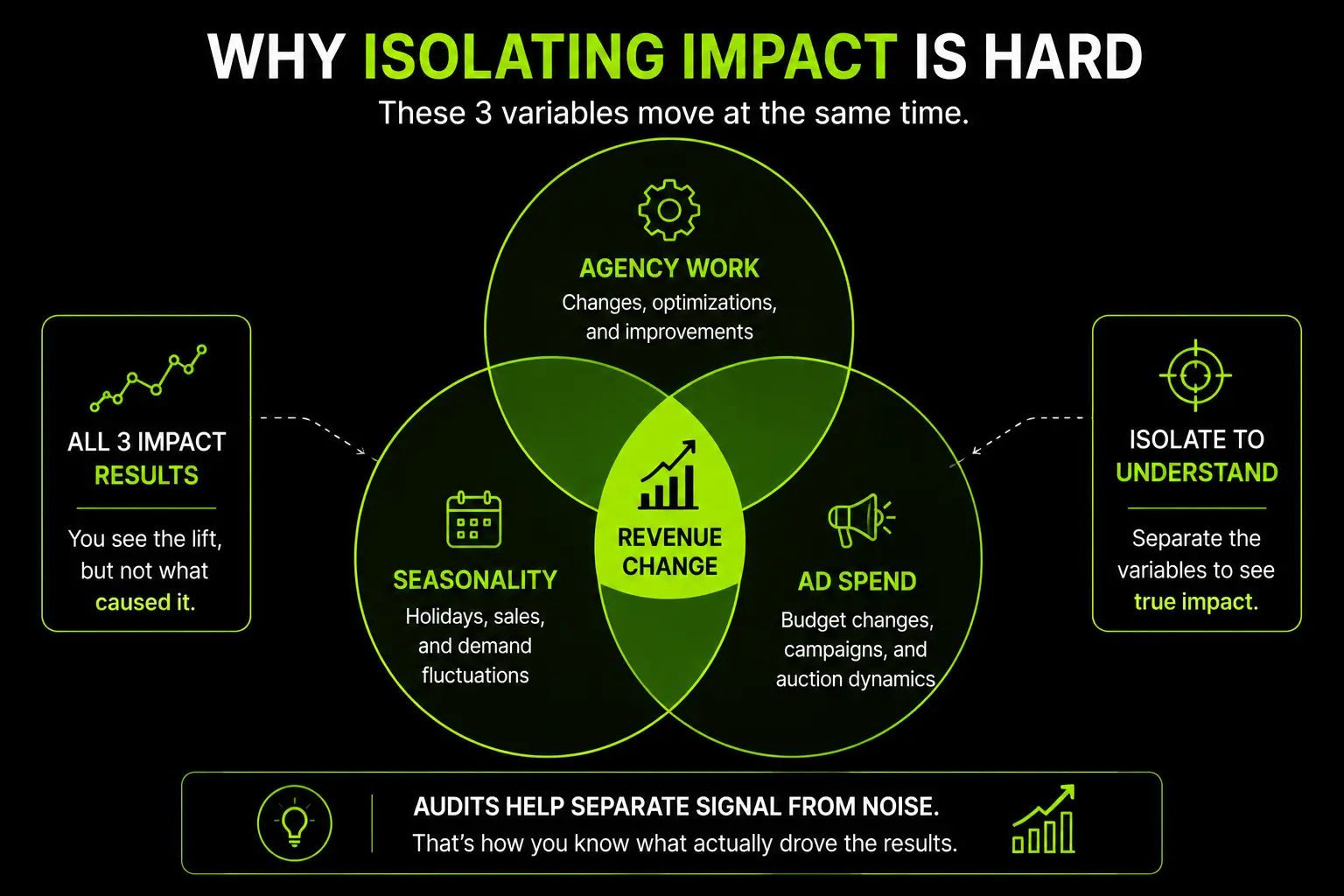
The calculation is simple. The difficult part is figuring out how much of the change came from the agency. Seasonality, ad spend, organic growth, pricing changes, and market conditions can all affect revenue at the same time.
A reliable ROI assessment accounts for these factors before assigning the results to the agency.
Why This Is Harder to Measure Than It Sounds
Shopify agency ROI looks simple when you only consider the formula, revenue gained minus agency cost.
The difficult part is proving how much of that revenue came from the agency’s work instead of changes in traffic, pricing, promotions, seasonality, or other factors.
The Attribution Problem: What Changed Because of the Agency vs. Everything Else
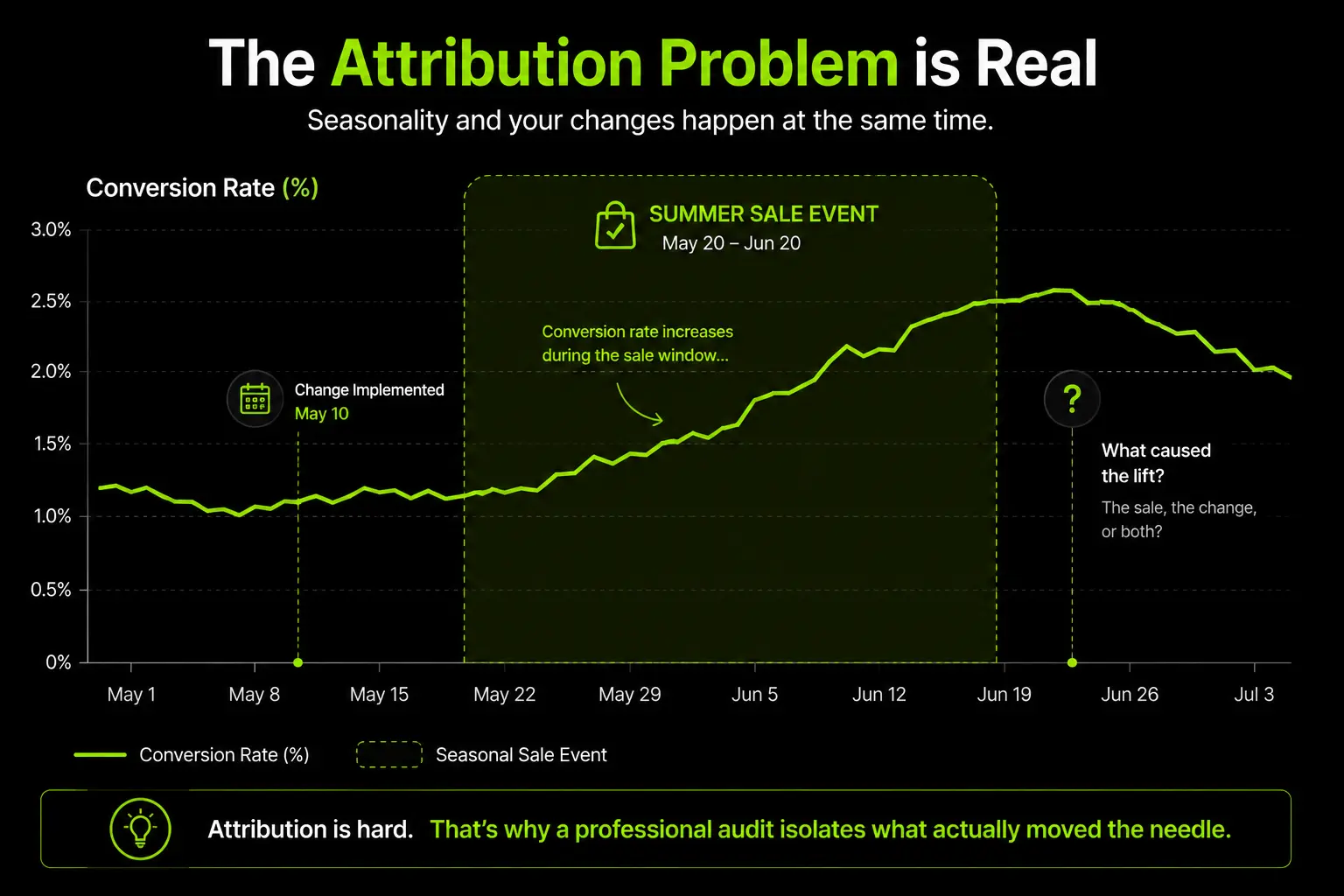
Say your conversion rate rose 12% in the two months after your agency shipped a new product page template. That sounds like a win until you check the calendar and notice it overlapped with your biggest sale event of the year.
Some of that lift came from design changes. Some of it came from a 20% discount code blasted to your entire list.
The real job is separating the agency’s impact from the promotion’s impact. If a store’s conversion rate rises 12% during a sale, you cannot assume the agency caused the full increase.
Give the agency too much credit, and you may pay more than necessary when the contract comes up for renewal. Give it too little credit, and you could drop an agency that is actually improving the store.
Both mistakes can lead to a bad renewal decision.
Why Vanity Metrics (Traffic, Page Views) Don't Answer the ROI Question
Traffic and page views show how many people visited your store. To measure the agency’s impact, you also need to track changes in purchases, order value, and repeat customers.
An agency can increase traffic through better SEO while your conversion rate stays flat. That does not automatically mean the work failed. If the goal was to bring more qualified visitors to the store, traffic and revenue from those visitors are the better measures.
Match each metric to the work the agency was hired to do. For a redesign, track conversion rate and revenue per session. For SEO, track organic traffic, qualified visitors, and revenue from organic search.
An SEO retainer should move organic traffic and, eventually, organic revenue. Mixing these up is where most ROI conversations go sideways.
Set a Baseline Before You Can Measure Anything
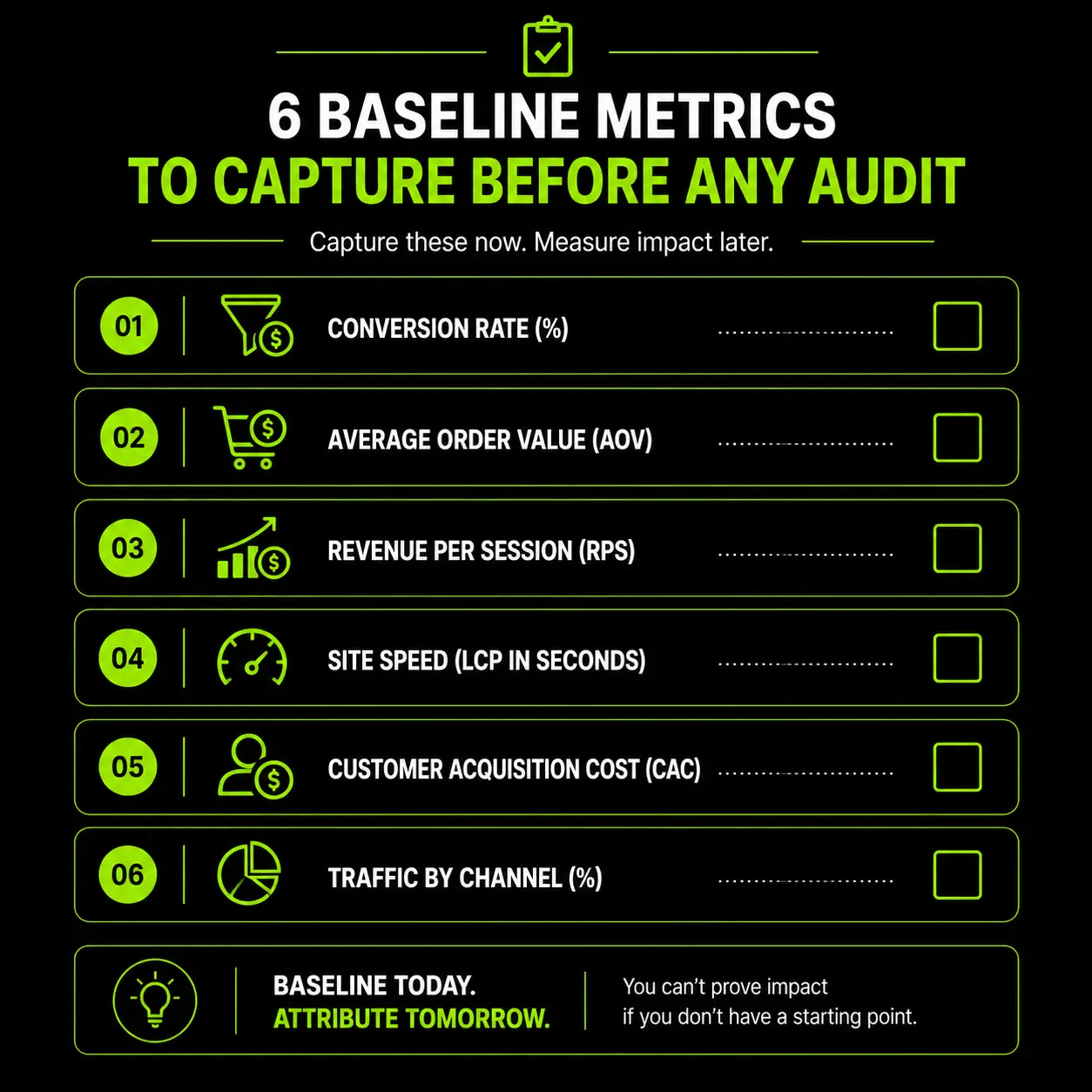
You need a clear starting point to measure any improvement. Record your key numbers before the agency starts, or record them now if the project is already three months underway and you have not tracked them yet.
What to Capture Before the Engagement Starts (or Right Now, If It Already Has)
If the engagement hasn't started yet, pull a 60 to 90 day average of your core numbers before work begins. If it's already underway, pull the same window from immediately before the agency started, using your Shopify analytics and Google Analytics data.
Your baseline snapshot should include:
- Conversion rate (site-wide and by top landing pages)
- Average order value
- Revenue per session
- Site speed (Core Web Vitals, specifically LCP and INP)
- Customer acquisition cost, if paid marketing is involved
- Traffic by channel, so you can separate organic lift from paid lift later
The Metrics That Actually Matter for a Shopify Engagement
Not every metric matters for every engagement. A redesign project and an ongoing conversion rate optimisation retainer should be measured against different baselines, because they're solving different problems.
The Metrics That Actually Tie to Agency Work
Shopify agency ROI guides give you a list of metrics and leave it there. What matters is choosing the right metric for the work your agency is doing.
Conversion Rate Lift (and How to Isolate It From Traffic Changes)
Conversion rate is the single best proxy for whether design, UX, or CRO work is doing its job. Isolate it from traffic changes by comparing conversion rate on a like-for-like traffic mix (same channels, similar volume) before and after the work shipped, rather than comparing raw sales totals.
Average Order Value and Revenue Per Session
AOV moves when merchandising, bundling, or upsell work changes. Revenue per session is the more honest number because it combines conversion rate and AOV into one figure that reflects total site performance per visitor.
Site Speed and Its Downstream Revenue Impact
Site speed work can be easy to measure and easy to overlook. A small improvement in load time can increase conversion rates, even when the design stays the same.
If your agency improved your store’s load time, compare your conversion rate before and after the change.
Customer Lifetime Value, If the Engagement Touches Retention
CLTV makes sense when the agency works on retention, such as email flows, loyalty programs, or the post-purchase experience.
If the project was only a storefront redesign, CLTV may not change much in the first few months. It usually takes longer to see a meaningful change.
Cost Per Acquisition, If the Engagement Touches Marketing-Adjacent Work
CAC belongs in the conversation only when the agency's work touches marketing-adjacent surfaces, like landing pages built for paid campaigns or checkout flow changes that affect conversion from paid traffic specifically.
Calculating the Actual Payback Period
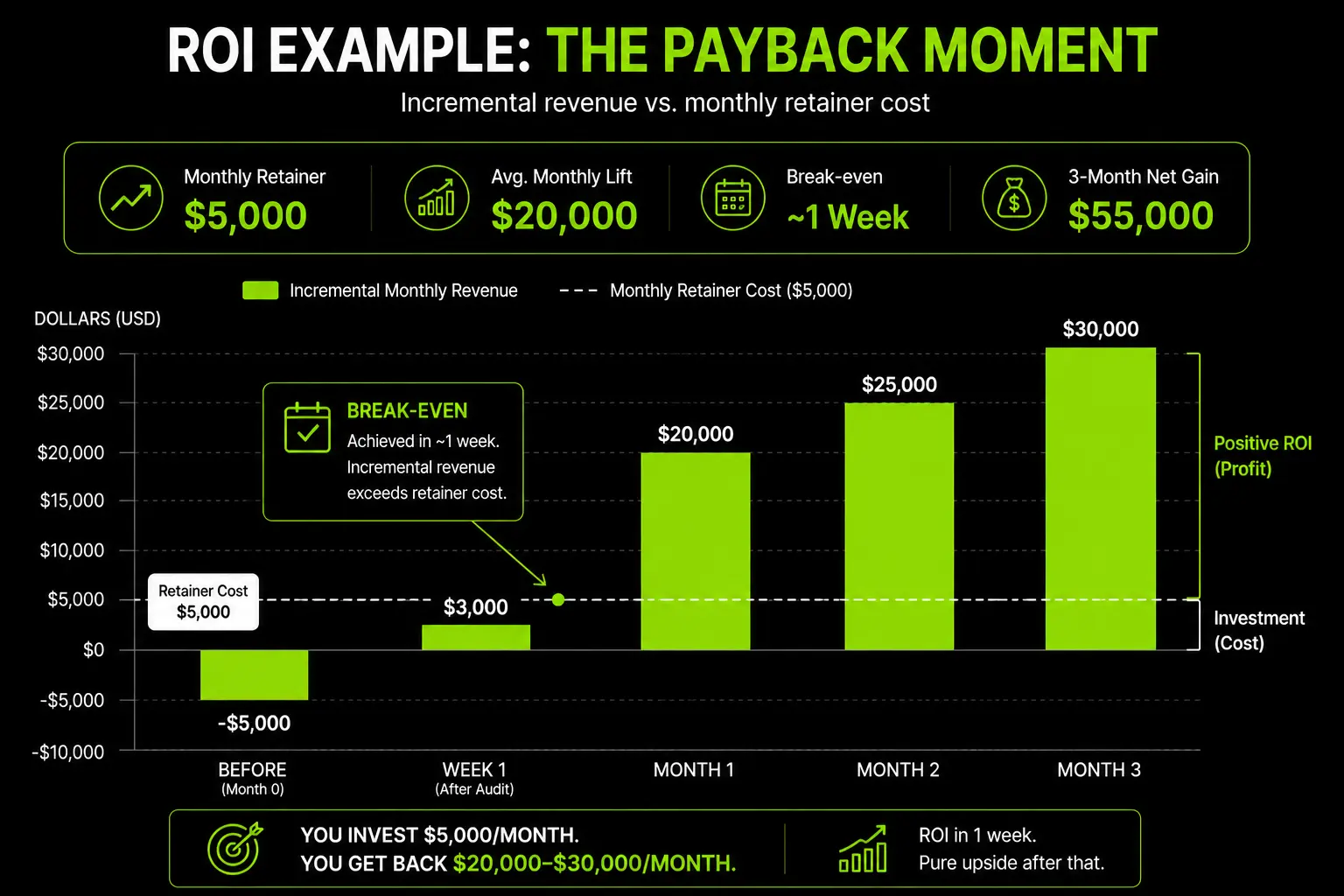
Once you have the right metrics, calculating ROI is simple. The more useful number is how long the extra revenue takes to cover the agency fee.
The Simple Formula: Incremental Revenue vs. Retainer or Project Cost
The formula: (incremental revenue minus retainer or project cost) divided by retainer or project cost. Incremental revenue is the revenue you can attribute specifically to the agency's work, not your total revenue for the period.
Why Payback Period Matters More Than a Raw ROI Percentage
A 300% ROI sounds impressive until you realize it took eighteen months to get there. A 90% ROI that pays back in ten weeks is often the better business decision, especially for a founder managing cash flow.
Payback period tells you how many months it took to recover the agency fee. That gives you a clearer answer to whether the investment was worth it.
A Worked Example: 6-Month Engagement, Real Numbers
A DTC skincare brand pays a Shopify agency AED 90,000 for a six-month CRO retainer. Conversion rate rises from 1.8% to 2.3% on comparable traffic.
At an average of 40,000 monthly sessions and AED 220 average order value, that 0.5 point lift works out to roughly AED 44,000 in incremental monthly revenue.
Over six months, that's approximately AED 264,000 in incremental revenue against AED 90,000 in cost. Payback period: just under two months. ROI: roughly 193%.
Not Sure If Your Current Numbers Add Up? Suplex builds measurement into every engagement from day one, so you're never reconstructing ROI months after the fact. Book a call and we'll walk through what a clean baseline looks like for your store.
Isolating the Agency's Impact From Everything Else
This is the part many Shopify agency ROI guides leave out. Without it, you cannot tell whether your ROI calculation reflects the agency’s actual impact.
Controlling for Seasonality (Ramadan, Sales Events, Q4)
If you sell into GCC markets, Ramadan alone can swing traffic and conversion patterns hard enough to make any agency look brilliant or useless, depending on timing.
Compare performance against the same period the previous year, not just the weeks immediately before the engagement, so seasonal patterns don't get mistaken for agency impact.
Controlling for Ad Spend and Marketing Changes Happening in Parallel
If your marketing team increased paid spend or launched a new campaign during the same window your agency shipped work, you have two variables moving at once.
Pull traffic-by-channel data and isolate organic and direct traffic performance separately from paid, since paid traffic swings are usually the biggest confounder.
Using a Holdout or Phased Rollout When Possible
The clearest way to measure impact is to test the change on half of your traffic and leave the other half unchanged. Then compare the results from both groups.
This isn't always practical for a full redesign, but it works well for individual page templates, checkout changes, or new features.
A phased rollout across product categories or regions gives you a similar comparison if a true holdout isn't feasible.
What Good ROI Actually Looks Like (Setting Realistic Expectations)
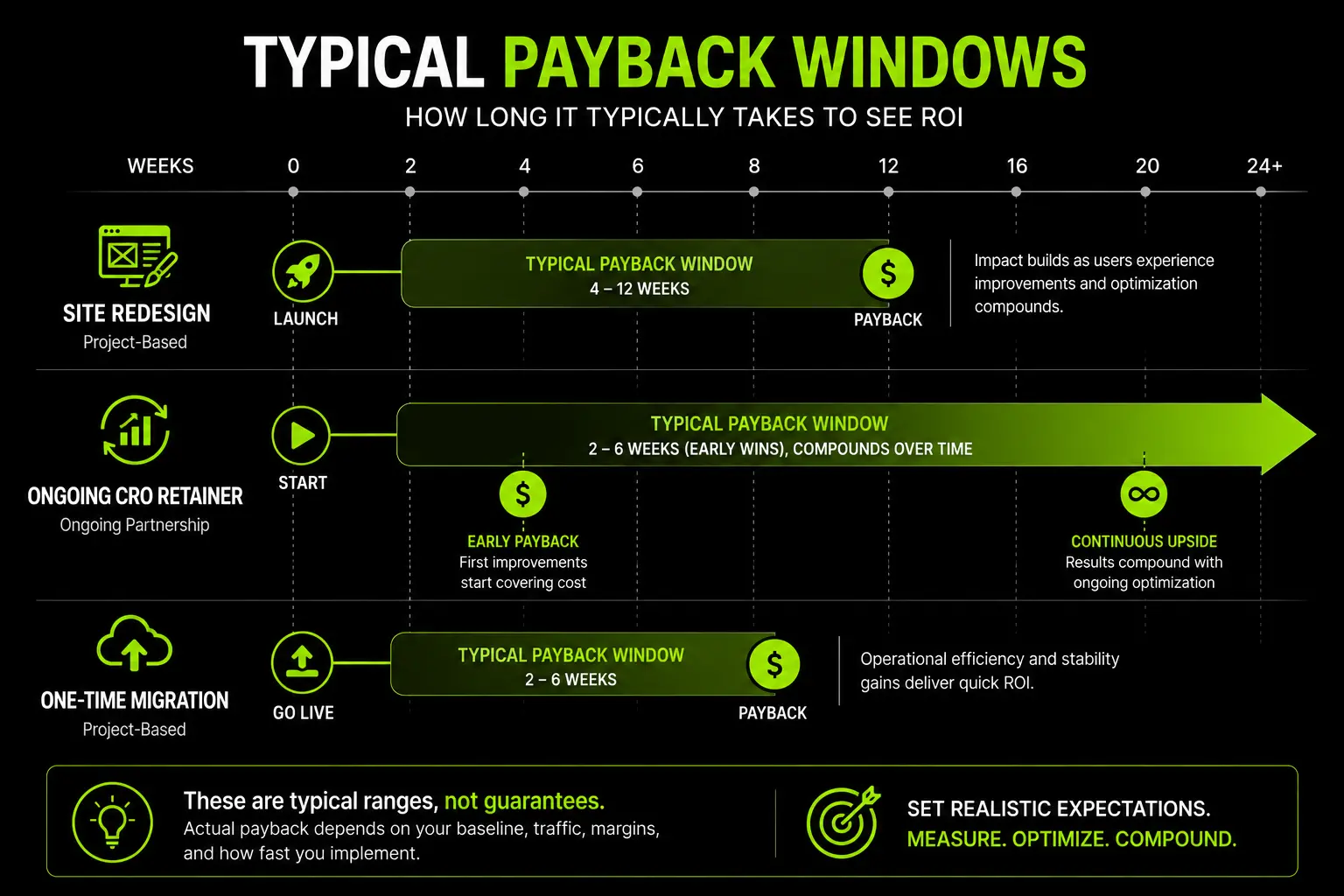
Not every Shopify project will pay back in two months. A redesign, SEO campaign, or long-term CRO project may need more time to show results. Set the payback period based on the type of work before deciding whether the agency is delivering value.
Realistic Timelines by Engagement Type (Redesign vs. Ongoing CRO vs. One-Time Migration)
A full redesign often takes three to six months post-launch before results stabilize, because traffic patterns and customer behavior need time to adjust to a new experience.
An ongoing CRO retainer should show incremental movement every month, since that's the nature of iterative testing.
A platform migration (Shopify Plus, for instance) rarely shows direct revenue ROI in the first quarter. Its value shows up as reduced downtime, faster checkout, and lower long-term maintenance cost.
When "No Measurable Lift Yet" Doesn't Mean the Engagement Failed
If you're two months into a six-month redesign and the numbers haven't moved, that's not automatically a red flag.
Ask what leading indicators are moving instead: bounce rate on new pages, time on site, add-to-cart rate. These often shift before revenue does.
A Decision Framework: Renew, Adjust, or Walk Away
Use this table before your next renewal conversation instead of relying on a gut feeling.
How We Approach Measurement and Reporting at Suplex
At Suplex, we measure the impact of an engagement from the start. We record the baseline before design or development begins, then track the metrics tied to the work we agreed to deliver. This gives clients a clear view of what changed during the engagement.
For clients running d2c data analytics alongside a redesign or CRO engagement, we build the measurement layer in parallel with the design work itself, so the two aren't disconnected efforts.
Our conversion rate optimisation engagements use the baseline recorded at kickoff. We compare results against that starting point throughout the engagement, so the benchmark stays consistent.
And when performance work is part of the scope, our performance optimisation reporting isolates speed-driven conversion changes from everything else happening on the site.
We'd rather show you a payback period you can trust than a percentage that looks good on a slide.
Ready to Build Measurement Into Your Next Engagement? Talk to our founders about how we set up baseline tracking and reporting before a single design file gets touched.
Frequently Asked Questions
What's a good ROI to expect from a Shopify agency?
It varies by engagement type, but a reasonable target is recovering the retainer or project cost through incremental revenue within three to six months for most CRO or redesign work. Migration and platform-setup projects often have longer, less direct payback timelines.
How do I isolate what the agency actually caused?
Compare performance against a clear pre-engagement baseline, control for known variables like seasonality and ad spend changes, and where possible, use phased rollouts so you can compare treated and untreated segments directly.
What metrics actually matter for measuring agency ROI?
It depends on the engagement scope. Conversion rate and revenue per session for CRO work, site speed and its downstream revenue impact for performance work, and CAC or CLTV if the scope touches marketing or retention.
How long should I wait before evaluating whether an engagement is working?
At least one full sales cycle, often three to six months, especially if your business has seasonal patterns. Evaluating too early risks killing a legitimately effective engagement before results have had time to show.
What if my metrics improved but I'm not sure the agency caused it?
This is common and worth investigating rather than assuming either way. Check whether other variables changed at the same time, such as ad spend, seasonality, or organic traffic shifts, before crediting or discounting the agency's work.
Should I set ROI targets before the engagement starts?
Yes. Agreeing on specific, measurable targets tied to the scope of work, not vague goals like "grow the business," makes the eventual ROI conversation far clearer for both sides.
What should I do if I can't get clear ROI data from my current agency?
Ask directly for baseline metrics, defined KPIs tied to scope, and regular reporting. An agency unable or unwilling to provide this is itself a signal worth factoring into a renewal decision.
Hi, I’m Rishabh Jain
I believe great digital experiences have the power to shape perception, build trust, and move businesses forward. That belief led me to found Suplex Design Studio, a global digital design and development studio helping FMCG and D2C brands build websites and digital experiences that are strategic, thoughtful, and commercially meaningful.
I started Suplex at 25 with a clear intent, to create digital experiences that look appealing, work seamlessly, and help D2C businesses grow. By 28, the studio had scaled globally, guided by a strong foundation in integrated design that I developed during my academic journey in London, where I was honoured with the Dean’s Award.
Over the years, I’ve had the opportunity to work with 100+ brands, from Fortune 500 organisations to family-run businesses, helping them build websites, e-commerce experiences, and digital products that create clarity, credibility, and long-term value.
Our work has been recognised internationally, including the Manifest Award (2024), the Clutch Global Award (2025), and features across platforms such as The Dieline, Packaging of the World, and the World Brand Design Society.
None of this would be possible without the people behind the work. I’m deeply grateful to the Suplex team, whose commitment, creativity, and attention to detail turn ideas into meaningful digital experiences every day.
At the heart of our work is a simple philosophy, digital design should be intentional, functional, and built to create real business value. That continues to guide everything we create at Suplex.

































Let’s Make It Happen
E-Commerce Success Stories
%201.avif)






.avif)

.avif)
Build Your D2C Business The Right Way
Build It With Suplex.


