What Should Be In A Shopify Development Contract? A Client's Protection Checklist
.avif)
What Should Be In A Shopify Development Contract? A Client's Protection Checklist
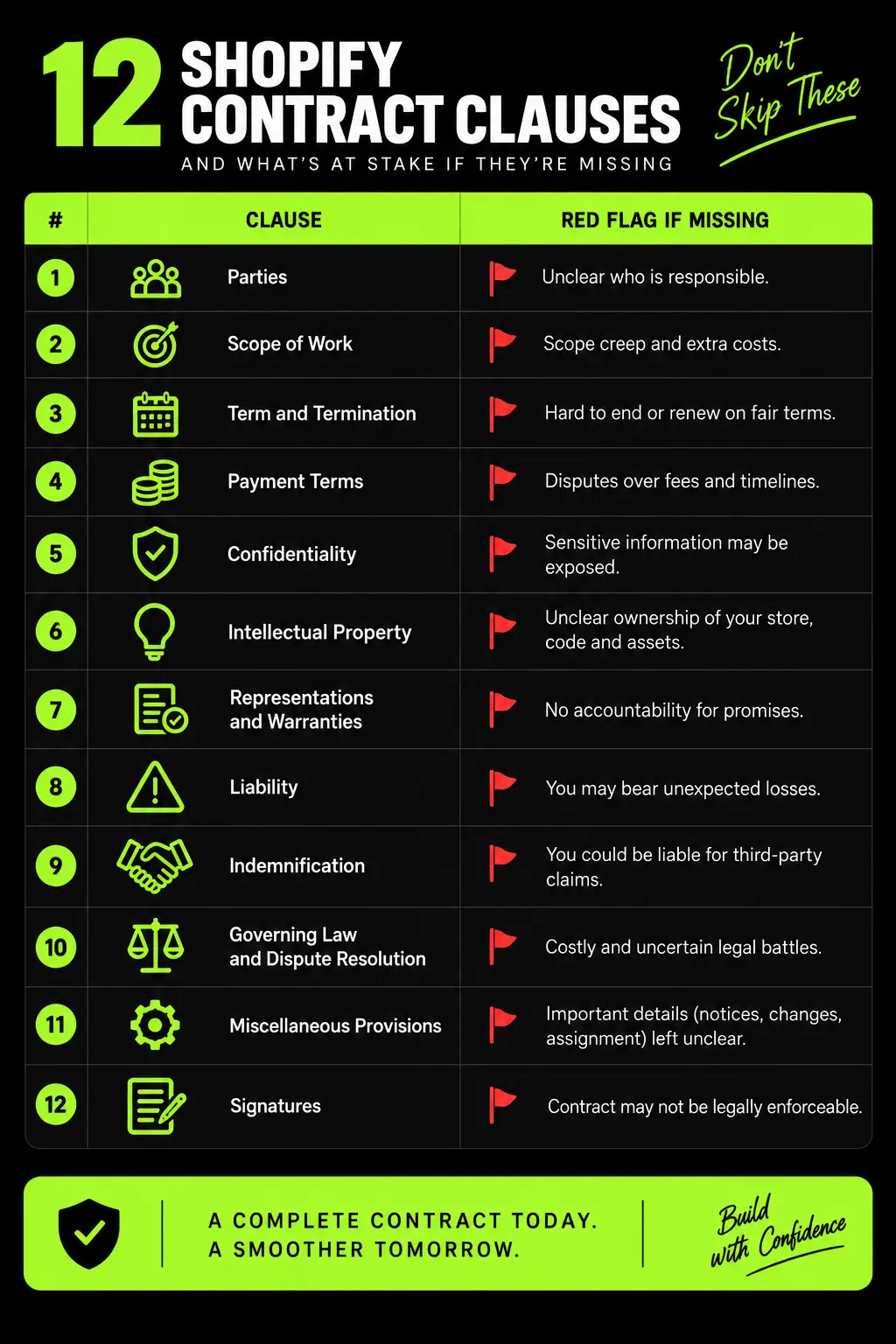
A Shopify development contract should clearly define twelve key areas, scope of work, payment terms, intellectual property and source code ownership, account access, revision limits, post-launch support, third-party app costs, confidentiality, termination and governing law.
These clauses establish who is responsible for what, what the project includes and what happens when circumstances change.
Many disputes between brands and Shopify developers arise because one or more of these terms were never clearly defined, rather than from bad faith.
Why Most Shopify Contracts Fail to Protect the Client
Many merchants treat a Shopify development contract as a formality. They review the agency’s proposal, agree on the price, sign it, and focus on getting the store built.
The problems usually surface later, when the scope changes, a deadline slips, ownership becomes unclear, or something breaks after launch.
A strong Shopify development contract should do more than describe what an agency plans to build. It should clearly define responsibilities, deliverables, payment terms, intellectual property, change requests, support, and what happens if the relationship ends.
The Gap Between a Proposal and a Real Contract
A proposal is primarily a sales document. It typically outlines the Shopify development services, estimated timeline, deliverables, and price. A contract goes further by establishing obligations and defining what happens when the project does not go according to plan.
For example, if an agency agrees to “build and launch a Shopify store,” does that include product migration, third party app configuration, custom functionality, SEO setup or post launch bug fixes? If these details are not documented, both parties can have very different expectations.
What Happens When Scope, Ownership, or Support Terms Are Undefined
Unclear Scope Leads To Scope Creep: Work that a merchant assumed was included can become a change request and an additional charge.
Unclear Ownership Can Create Intellectual Property Disputes: The contract should specify who owns custom theme code, designs, content, integrations, and other project deliverables after payment, while distinguishing these from pre existing developer or third party assets.
Unclear Support Terms Create Post Launch Disputes: A merchant may expect bugs to be fixed at no additional cost, while the developer may treat every post launch request as billable work.
A well drafted Shopify development agreement removes these ambiguities before they become expensive problems. It gives both parties a clear reference point for scope, ownership, payment, changes, support, and termination.
The Core Clauses Every Shopify Development Contract Needs
Before signing a Shopify development agreement, make sure these 12 areas are covered in writing. Each addresses a common source of disputes between merchants and Shopify developers or agencies.
1. Scope of Work and Deliverables
Define exactly what the developer will deliver. Include page and template counts, features, custom development, integrations, migration limits, and the environments being configured.
An “ecommerce website” is vague; “a 12-page custom Shopify theme with Klaviyo and Recharge integrations” creates a measurable scope. Include an out-of-scope section as well.
2. Timeline, Milestones, and Client Dependencies
Set dates for each project phase and identify what the agency needs from you, such as content, product data, approvals, or credentials. This prevents delays from being attributed to either party without context.
3. Payment Structure
State the deposit, milestone payments, due dates, and whether the project is fixed-price or hourly. For fixed-price builds, milestone payments generally provide better protection than paying the entire fee upfront.
Also specify what happens when a payment is late.
4. IP Ownership and Source Code Rights
The contract should clearly state who owns custom code, designs, documentation, and other deliverables after payment. If the agency retains rights to pre-existing frameworks or reusable components, those exceptions should be identified explicitly.
5. Store and Account Ownership
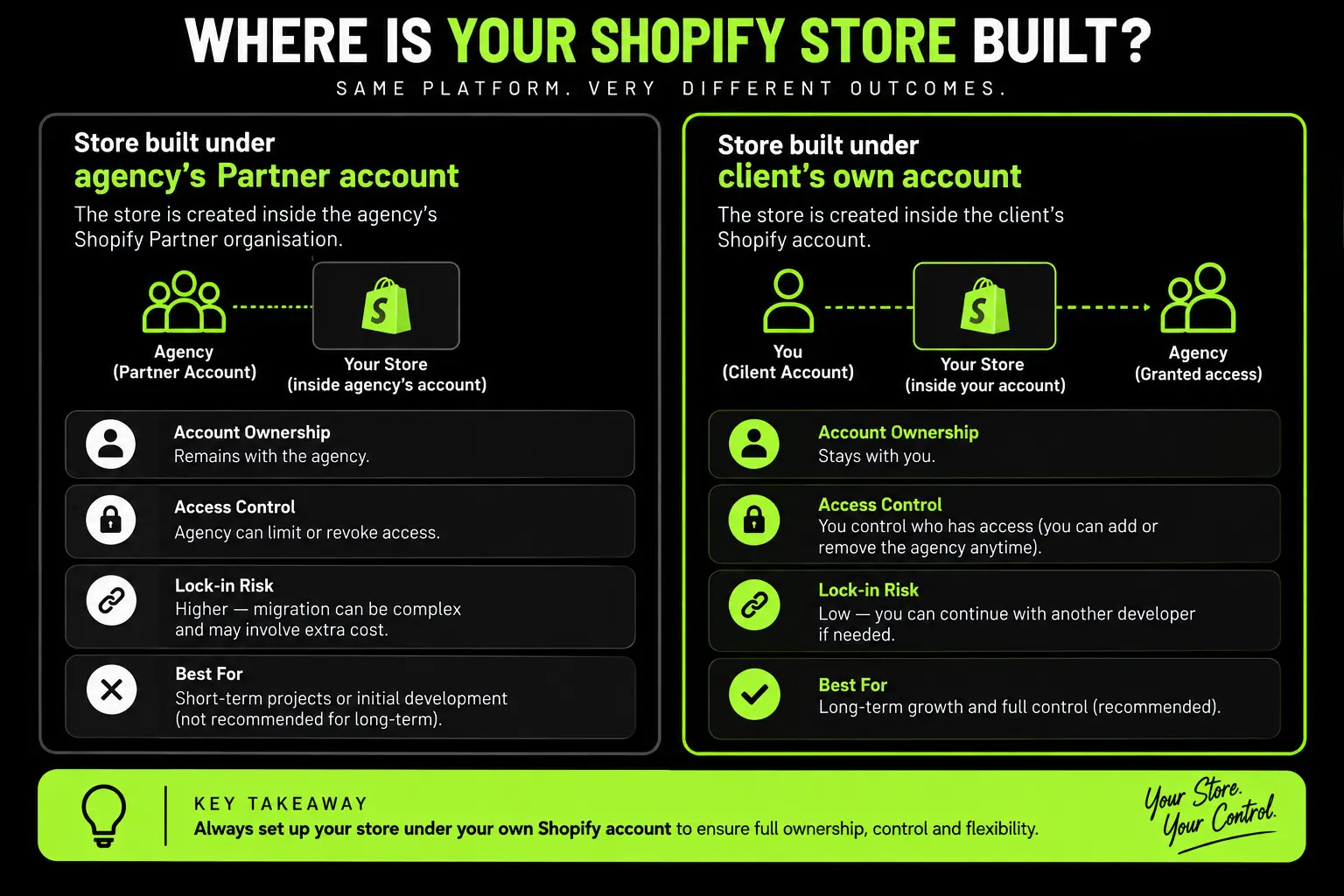
The merchant should ultimately control the Shopify store, domain, billing account, and administrator access. If a Shopify Partner account or development store is used during the build, specify when ownership transfers and what access the agency retains afterward.
6. Revisions and Change Requests
Define the number of included revision rounds and establish a written process for additional work. A change request should identify the additional cost and potential timeline impact before the work begins.
7. Third-Party Apps and Subscription Costs
List required Shopify apps and integrations, who pays for them, and whether they involve recurring fees. Also disclose any referral or partner commissions the agency receives where relevant.
8. Post-Launch Warranty and Bug Fixes
Specify a warranty period, such as 30, 60, or 90 days, for defects caused by the agency's work. Clearly distinguish bugs from new features, which should normally be treated as additional work.
9. Ongoing Maintenance and SLA Terms
If post-launch support is included, define the monthly hours or deliverables, exclusions, response times, escalation process, and treatment of unused hours.
10. Confidentiality and Data Protection
Protect customer information, business data, credentials, designs, and other confidential information. Where personal data is processed, the agreement should also address applicable privacy and data protection obligations.
11. Termination and Kill Fee
Specify how either party can terminate the agreement, the required notice, payment for completed work, treatment of work in progress, and the handover of accounts, files, source code, and other project assets.
12. Liability, Indemnification, Acceptance Criteria, and Governing Law
Define what “completed” means through measurable acceptance criteria. The agreement should also address liability limits, indemnification, security responsibilities, dispute resolution, and the governing law and jurisdiction.
The goal is not to make the contract unnecessarily complicated. It is to eliminate assumptions. A strong Shopify development contract tells both sides what will be delivered, who owns it, what it costs, what happens when plans change, and how either party can exit the relationship.
Fixed Price vs. Milestone vs. Hourly: Which Payment Structure Protects You Best
The payment structure does more than determine when you pay. It determines how project risk and leverage are shared between you and the Shopify developer.
When Fixed Price Makes Sense
A fixed-price contract works well when the scope is genuinely clear. Theme customisation, a defined number of pages, specific app integrations, or a migration with a known product count can fit this model.
The important caveat is that a fixed price does not mean unlimited work. If the scope is vague, the developer can treat unlisted requirements as additional work and issue change orders.
Before signing, make sure the contract clearly defines the deliverables, exclusions, revision limits, and additional-work rates.
When Milestone-Based Payment Is Safer
For larger or multi-phase Shopify projects, milestone-based payments generally provide better leverage than a large upfront payment.
A typical structure might be:
- 30% at signing and project kickoff
- 40% after staging approval and completion of agreed functionality
- 30% at launch and final handover
The percentages can vary, but the principle matters: each payment should be tied to an objectively defined deliverable. Avoid paying the entire project fee before the store is completed and handed over.
Red Flags in Hourly-Only Contracts
Hourly billing can make sense when requirements are likely to change. The problem is uncapped hourly billing.
Ask for:
- An estimated total number of hours
- A not-to-exceed cap
- A clear hourly rate card
- Weekly or biweekly time reports
- Written approval before the cap is exceeded
If the agency cannot estimate the work, consider paying for a short discovery and scoping phase first. That gives both sides a clearer basis for pricing the Shopify development project.
For most well-defined Shopify builds, fixed-price with milestone payments offers a strong balance of budget certainty and client leverage. Hourly billing is more appropriate when the scope is expected to evolve, provided you have a clear cap and reporting requirements.
Who Owns the Shopify Store After the Project Ends?
Store ownership is one of the easiest ways for a Shopify development project to create vendor lock-in. It may not seem important while the agency is building your store, but it becomes critical if you later want to switch developers, sell the business, or bring development in-house.
Store, Theme and App Ownership: What It Actually Means
“Ownership” covers several different assets and access rights. Your contract should address the Shopify store account, domain, custom theme code, custom applications, customer data, and third-party app subscriptions separately.
You do not own the Shopify platform itself. Instead, you control your merchant account and the store you operate on Shopify, subject to Shopify's terms. Ownership of custom code and other intellectual property depends on the agreement you have with the developer.
Why the Client Should Control the Shopify Account and Domain
Ideally, the store should be created under your Shopify account, with the agency added through Shopify's collaborator or appropriate access model.
This keeps billing, store administration, and account control with the merchant while giving the developer the permissions needed to do the work.
The domain should also be registered and controlled by the business, not the agency. App subscriptions should preferably be connected to accounts and billing information that you control.
If the agency needs to build the store through a Shopify Partner or client transfer store, the contract should clearly state when ownership will transfer, what must be handed over, and what access the agency retains afterward.
How to Avoid Vendor Lock-In
Before signing, confirm that:
- The Shopify store is created under your account or has a guaranteed transfer process.
- The domain is registered in your business's name and under your control.
- You have appropriate administrator access.
- App subscriptions and billing are accessible to you.
- Custom theme code and agreed project files will be handed over.
- Agency access will be removed or reduced after the engagement ends.
Account control is ultimately about leverage. If you control the store, domain, billing, and agreed project assets, changing developers is a business decision rather than a negotiation with your existing agency.
Post-Launch Support, Warranty, and Maintenance Terms
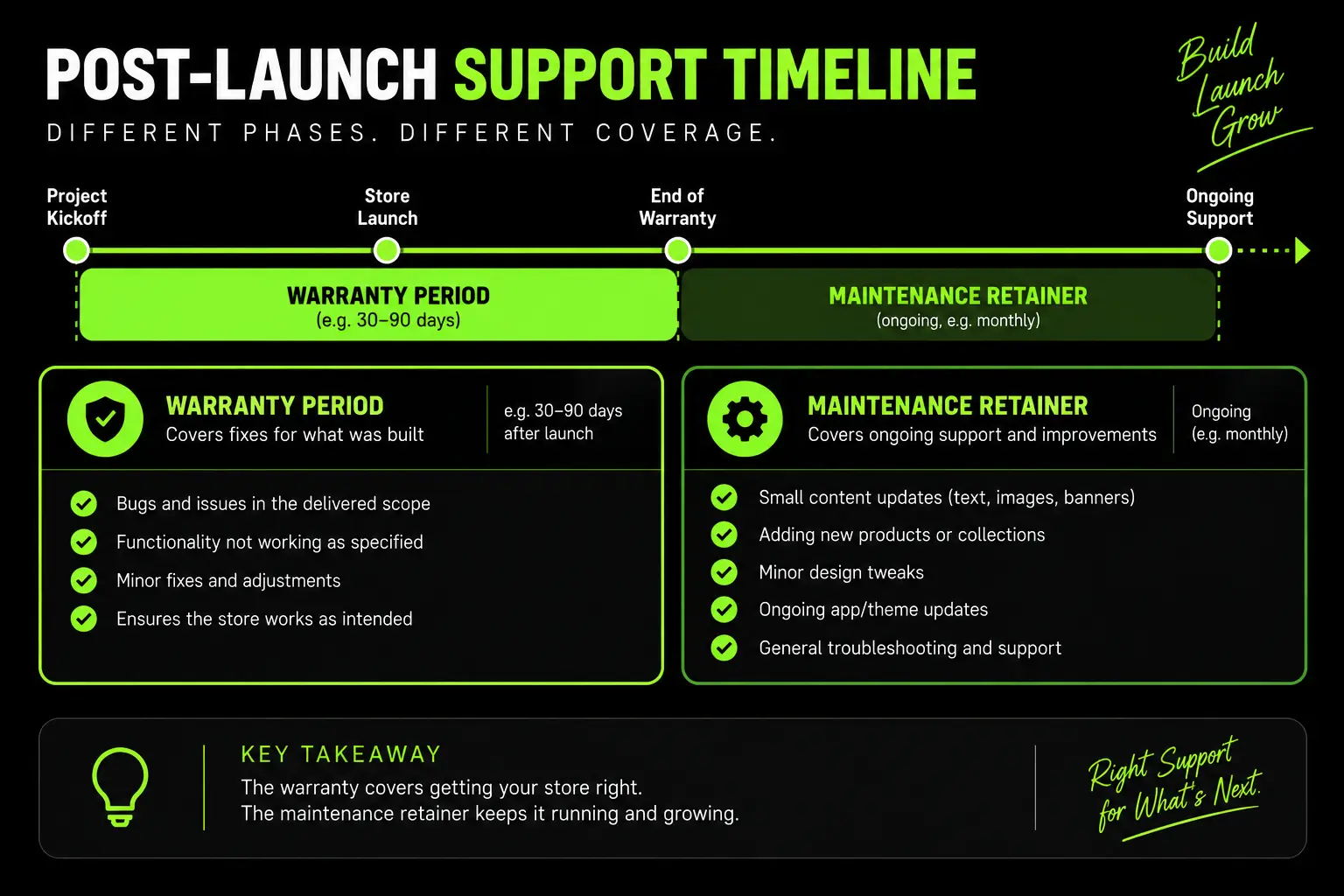
Launching your Shopify store is not the end of the project. The contract should explain what happens when something goes wrong after launch and what support, if any, you receive afterward.
Standard Bug-Fix Warranty Windows
A 30, 60, or 90-day warranty period is common for Shopify development projects, but the exact period should be agreed upon in writing.
The warranty should cover defects in the work delivered by the agency and specify when the coverage begins. Do not rely on a verbal promise that “post-launch issues are covered.”
What Is Covered vs. Billed as New Work
The contract should clearly distinguish between a bug and a new request.
Typically Covered: A checkout flow that does not work according to the agreed specification because of the agency's code, or a theme feature that fails under the conditions defined in the scope.
Typically Billed Separately: New features, design changes, content updates, changes to approved requirements, or problems caused by third-party apps or modifications made by someone else.
For Example: fixing a broken product filter that the agency built incorrectly is a warranty issue. Adding an entirely new filtering function after launch is additional development.
Should You Sign a Separate Maintenance Retainer?
Once the warranty expires, ongoing maintenance is usually better handled through a separate support or maintenance agreement. This can cover app updates, theme maintenance, performance issues, minor changes, and technical support.
If you use a retainer, define the services included, monthly hours, exclusions, response times, escalation process, and additional-work rates. Critical issues such as a broken checkout or store outage should have a faster response target than routine requests.
If you are unsure whether an agency's support model is right for your business, see our guide on questions to ask an ecommerce agency before signing a contract.
The key is to decide before launch whether you want ongoing support from the same agency, another developer, or an internal team. Your contract should make that transition straightforward.
Special Considerations for UAE and GCC-Based Contracts
If you are hiring a Shopify developer or ecommerce agency in the UAE or wider GCC, a few contract terms deserve extra attention. Licensing, VAT, jurisdiction, and cross-border payments can all affect your exposure.
Governing Law and Jurisdiction
Do not leave the governing law or dispute forum to a generic agency template.
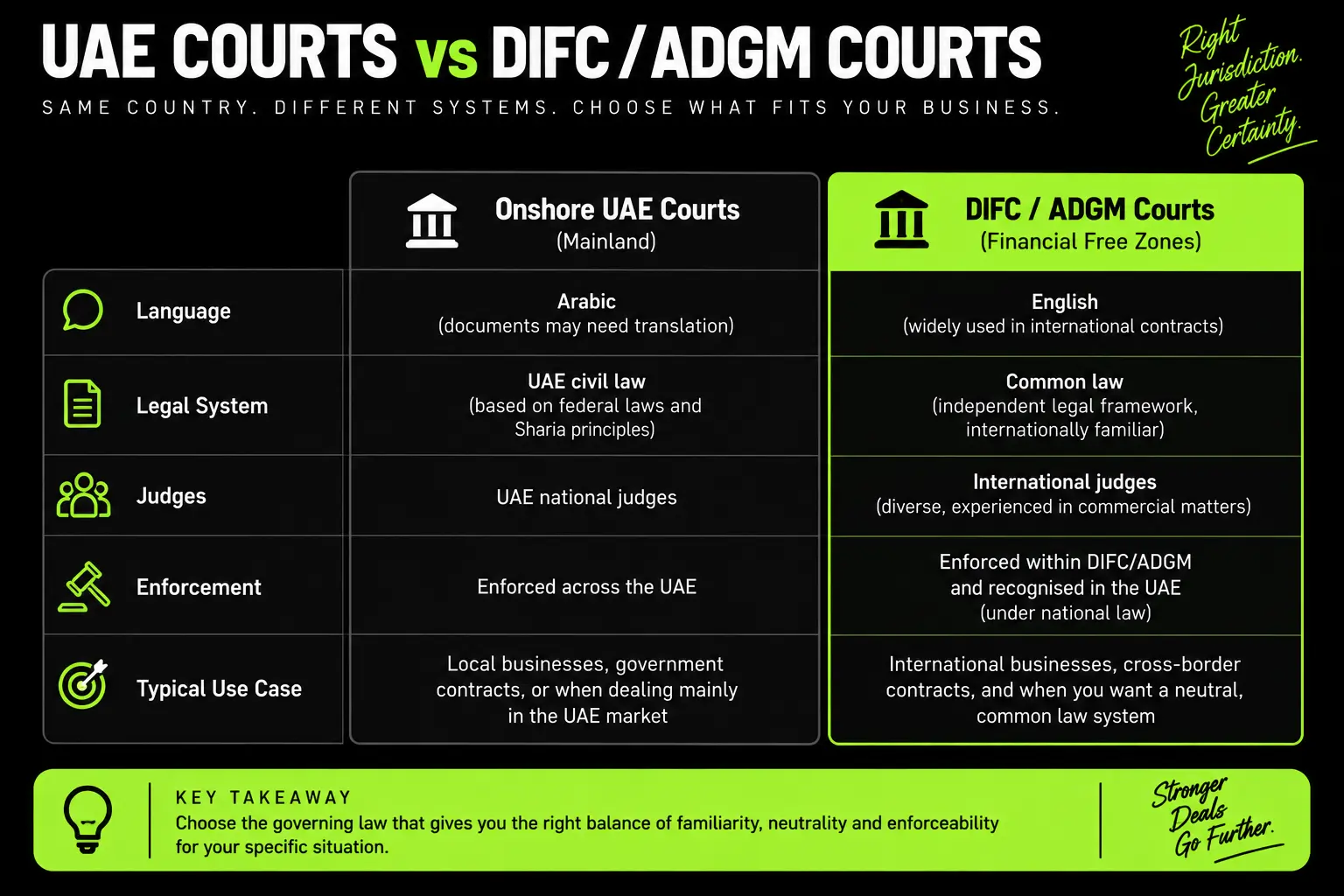
Depending on the parties and circumstances, a contract may specify UAE onshore courts, DIFC Courts, ADGM Courts, or another agreed forum. DIFC and ADGM have common-law-based court systems and generally conduct proceedings in English, while UAE onshore proceedings operate within the federal UAE legal system and generally use Arabic.
For cross-border contracts, clearly state both the governing law and dispute resolution forum. Because enforceability depends on the circumstances, it is worth having a UAE-qualified lawyer review this clause before signing.
VAT and Payment Terms
The contract should state whether fees are inclusive or exclusive of UAE VAT and clarify the applicable tax treatment.
For cross-border projects, also specify:
- Payment currency
- Exchange-rate mechanism, if applicable
- Payment method
- Bank or transfer charges
- Responsibility for transaction fees
This prevents unexpected costs caused by currency fluctuations or payment charges.
Verify the Agency's Trade Licence
Before signing, ask for the agency's current trade licence and legal business name. Check that its licensed activities are consistent with the services it is providing.
Where relevant, also confirm its VAT registration status and whether its free-zone or other licensing arrangements affect how it can contract with your business.
Force Majeure and Cross-Border Payments
The contract should explain what happens when events outside either party's reasonable control affect delivery or payment. This can include significant regulatory, banking, infrastructure, or other disruptions.
If the agency is based outside the UAE, make sure the agreement also covers payment deadlines, currency, transfer costs, and what happens if the relationship ends before the Shopify project is completed.
For more guidance on evaluating potential partners, see our guides on choosing an ecommerce development partner and top ecommerce development companies in Dubai.
Red Flags to Watch for Before Signing
If any of these are missing from the contract, pause.
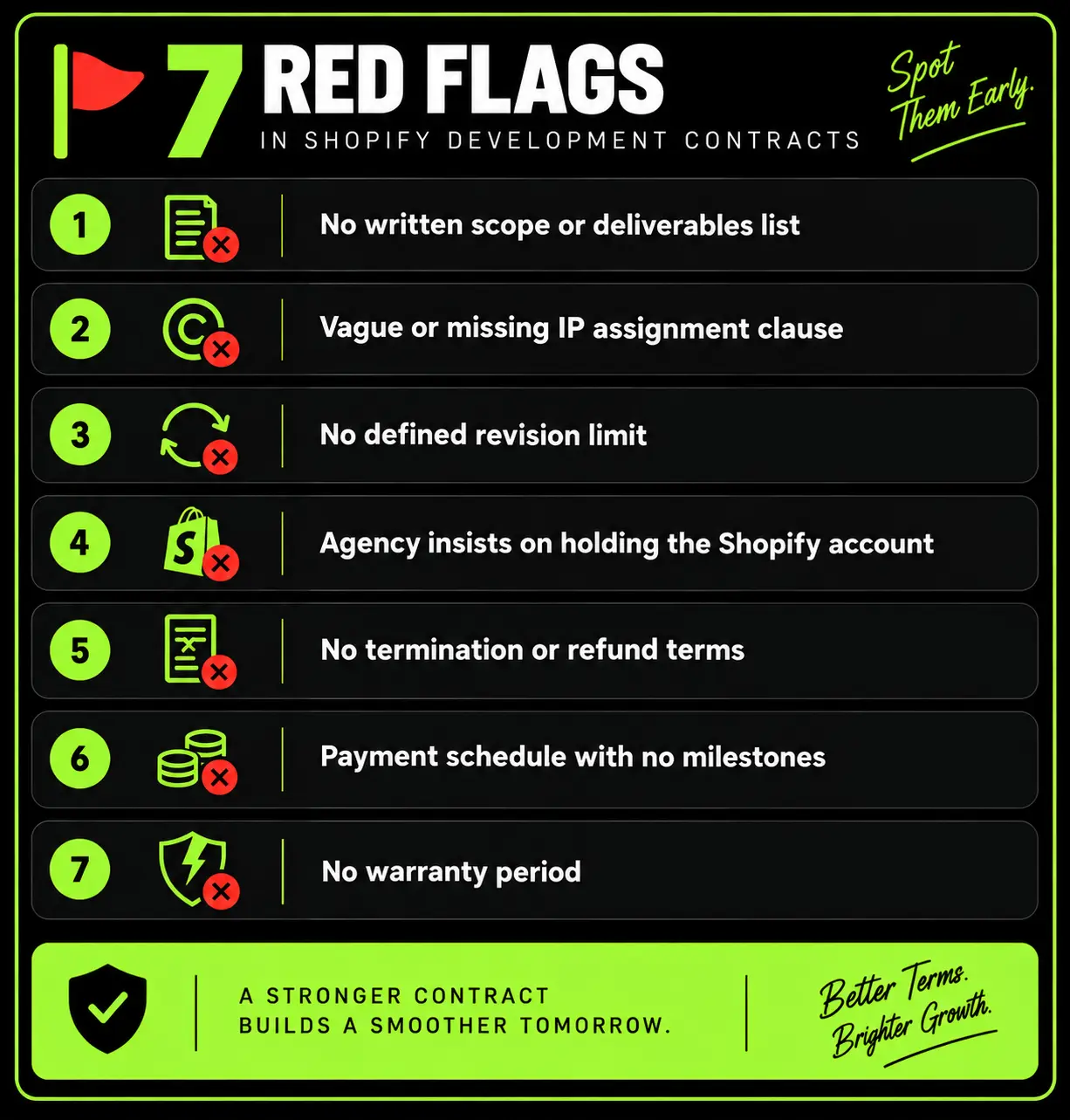
- 🚩 No Written Scope or Deliverables List: If the scope is vague, you will pay for clarity later through change orders.
- 🚩 Vague or Missing IP Assignment Clause: If ownership is not explicitly assigned to you, it may remain with the agency.
- 🚩 No Defined Revision Limit: Without a cap, the agency can bill for unlimited revisions, or claim the project is done after one round.
- 🚩 Agency Insists on Holding the Shopify Account: This creates vendor lock-in. Insist on the client transfer store model.
- 🚩 No Termination or Refund Terms: If you cannot exit cleanly, you do not have a contract. You have a hostage situation.
- 🚩 Payment Schedule With No Milestones: If the agency wants most of the money before staging, the incentive alignment is wrong.
- 🚩 No Warranty Period: If the store breaks after launch and there is no warranty, you pay to fix the agency's mistakes.
How We Structure Our Client Contracts
At Suplex, we believe a Shopify contract should make expectations clear before development begins.
Every project starts with a detailed scope of work covering deliverables, exclusions, timelines, responsibilities, milestones, and payment terms.
No vague promises. No “we’ll figure it out later.”
Your Shopify store, domain, and agreed project deliverables should remain under your control. We work with your Shopify account rather than creating unnecessary agency dependency.
Our payment structure is milestone-based, with payments tied to agreed deliverables. If the scope changes, we document the change and agree on the additional cost before starting.
Support After Launch
Our standard warranty includes 30 days of bug fixes at no additional cost. Ongoing maintenance is available separately with defined services and response times.
Have a Shopify contract from another agency? We can review it and flag important clauses that need attention or clarification.
Explore our Shopify development services or learn how to brief a Shopify agency.
Frequently Asked Questions
Who owns the Shopify store after the developer finishes the project?
Ownership depends entirely on what the contract says and which account the store was built under. If the contract does not explicitly assign IP and the store was built under the agency's own Shopify Partner account, you may not have clear ownership even after paying in full, which is why this needs to be settled before the project starts.
How much deposit should I pay a Shopify agency or developer?
Deposits commonly range from 20% to 50% of the total project cost, often around 30%, with the remainder tied to milestones. A deposit above 50% with no milestone structure behind it shifts most of the risk onto you.
Is a fixed-price or hourly contract better for a Shopify project?
Fixed price suits a well-defined, smaller-scope build. Milestone-based payment usually suits larger or custom projects better than either pure fixed price or open-ended hourly billing, since it ties payment to verified progress.
What happens if my Shopify agency misses the launch deadline?
This depends on what the contract specifies. A well-drafted contract defines what counts as a missed deadline, whether penalties or remedies apply, and how client-side delays, such as late content delivery, are treated separately from agency-side delays.
Do I need a separate maintenance contract after my Shopify site launches?
Not immediately if you have a standard bug-fix warranty period covering the weeks right after launch. Once that period ends, ongoing updates and monitoring typically need a separate maintenance retainer if you want continued support from the same agency.
Should I sign an NDA with my Shopify developer?
It is reasonable to request one, particularly if you are sharing customer data, unreleased product information, or proprietary business processes during the project. Most agencies will sign a standard mutual NDA without pushback.
What's a reasonable revision limit to include in a Shopify contract?
Two to three rounds of revisions per major phase, such as design and development, is a common standard. Beyond that, additional revisions are usually billed separately, which the contract should state explicitly to avoid disagreement later.
Hi, I’m Rishabh Jain
I believe great design has the power to shape perception, build trust, and move businesses forward. That belief is what led me to found Suplex Design Studio, a global branding and packaging studio working with FMCG and D2C brands across markets.I started suplex at 25 with a clear intent, to create design that is strategic, thoughtful, and commercially meaningful. By 28, the studio had scaled globally, guided by a strong foundation in Integrated Design that I developed during my academic journey in London, where I was honoured with the Dean’s Award.
Over the years, I’ve had the opportunity to work with 100+ brands, from Fortune 500 organizations to family-run businesses, helping them build packaging and brand systems that create recall, relevance, and long-term value.
Suplex’s work has been recognized internationally, including the Manifest Award (2024), the Clutch Global Award (2025), and features on platforms such as Packaging of the World, The Dieline, and the World Brand Design Society.
None of this would be possible without the people behind the work. I’m deeply grateful to the suplex team, whose commitment, creativity, and attention to detail turn ideas into meaningful brand experiences every day.
At the heart of my work is a simple philosophy, design should be intentional, honest, and built to last, and that continues to guide everything we create at suplex.






































Let’s Make It Happen
E-Commerce Success Stories
%201.avif)






.avif)

.avif)
Build Your D2C Business The Right Way
Build It With Suplex.


