Shopify Vs Zid: Is Zid Even The Right Comparison For Your Brand?
.avif)

Shopify Vs Zid: Is Zid Even The Right Comparison For Your Brand?
Shopify vs Zid helps you choose the right platform based on your target market and growth plans. Zid is designed for Saudi merchants with local commerce workflows, while Shopify supports brands selling across the GCC and internationally.
This Suplex guide explains Zid's strengths, its ideal use cases and the key differences from Shopify.
For shared GCC ecommerce considerations, including payments, ZATCA compliance and localisation, also read our Shopify vs Salla comparison
What Makes Zid Different From Salla And Shopify
Zid isn't interchangeable with Salla, despite both being Saudi-native, Arabic-first platforms. Here's what actually sets it apart.
A More Opinionated, Saudi-Only Platform
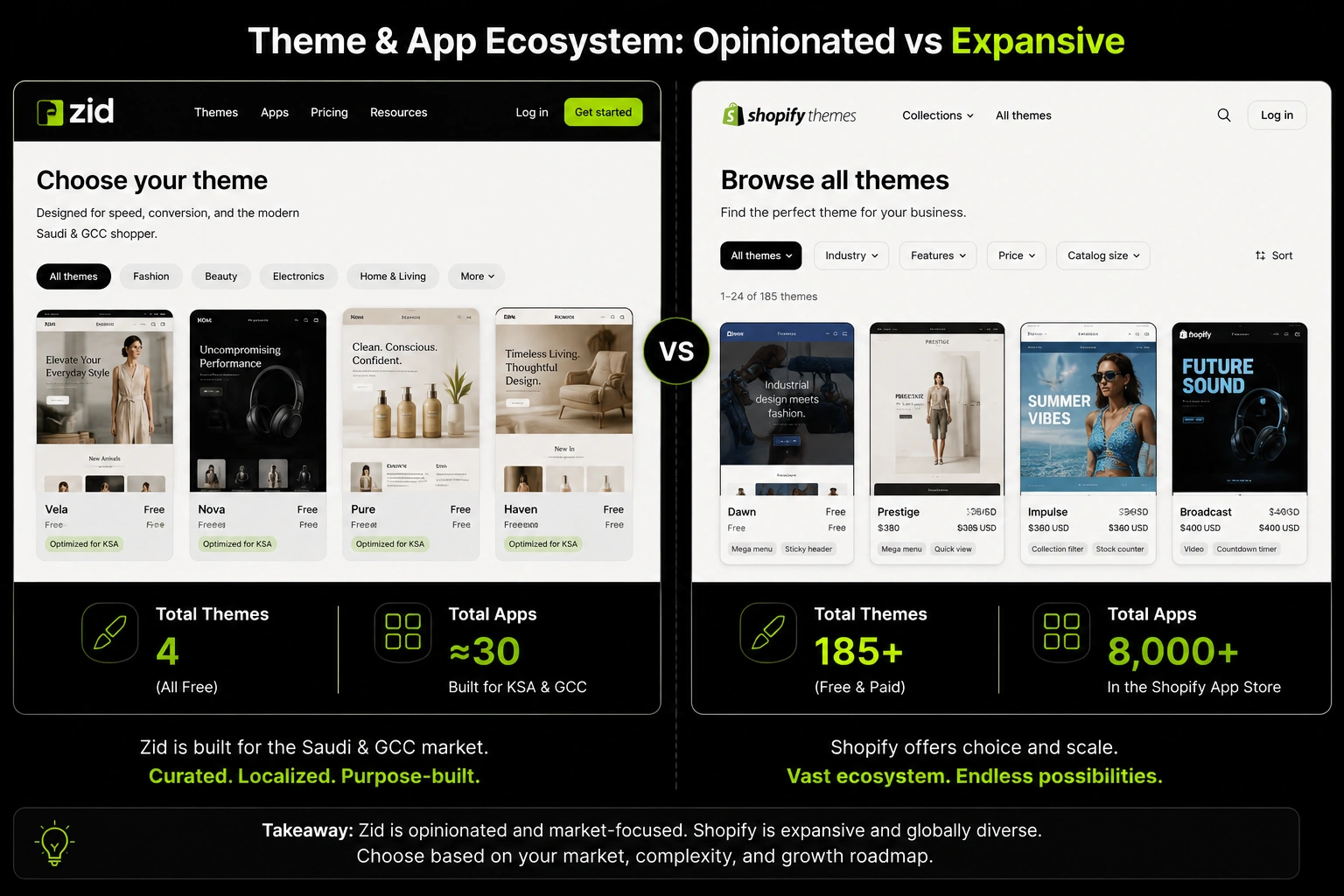
Zid is consistently described across independent sources as narrower and more opinionated than both Salla and Shopify, fewer themes, fewer apps, less to configure overall. Frame this honestly as a genuine tradeoff, not a weakness.
Less choice can mean faster, more reliable launches for merchants who don't want to manage complexity, at the direct cost of the customization depth Shopify offers.
For a founder who wants to launch quickly without making dozens of configuration decisions, an opinionated platform removes decision fatigue. For a founder with specific design ambitions or complex functional requirements, the same opinionated structure becomes a ceiling rather than a convenience.
Zid's scale is worth citing as context here. The platform has reportedly raised around $59M in funding and processes several billion dollars in annual transaction volume.
That establishes it as a serious, well-capitalized platform rather than a niche local tool, relevant context for any decision-maker weighing it seriously rather than dismissing it on name recognition alone.
The No-Commission Positioning
Zid markets itself as a platform with no commission on orders and no mandatory paid apps for core functionality. Treat these as Zid's stated positioning rather than independently verified facts.
Platform pricing, included features, and commercial terms can change over time. Before making a platform decision, verify the latest pricing and policies directly with Zid instead of relying solely on third-party comparisons.
Lower platform costs can be a meaningful advantage, but they should be evaluated alongside scalability, ecosystem, integrations, and long-term operating costs.
A structured platform consultation helps assess the total cost of ownership rather than comparing pricing claims in isolation.
Where Zid Fits Alongside Salla (Not A Duplicate Comparison)
Zid and Salla share real overlap, both Saudi-native, both Arabic-first, both offering native local payment and shipping integrations. Rather than re-explaining that shared ground here, our dedicated Shopify vs Salla comparison covers it in full.
What's specifically different about Zid, beyond that shared foundation, is its more curated, opinionated approach and reportedly stronger Saudi shipping integrations specifically.
Where Salla positions itself as a broader Saudi-plus-expanding-Gulf platform, Zid's identity stays more tightly focused on doing the core Saudi ecommerce workflow exceptionally well, rather than building outward reach as a primary strategic direction.
When Zid Vs Shopify Is Actually The Right Question
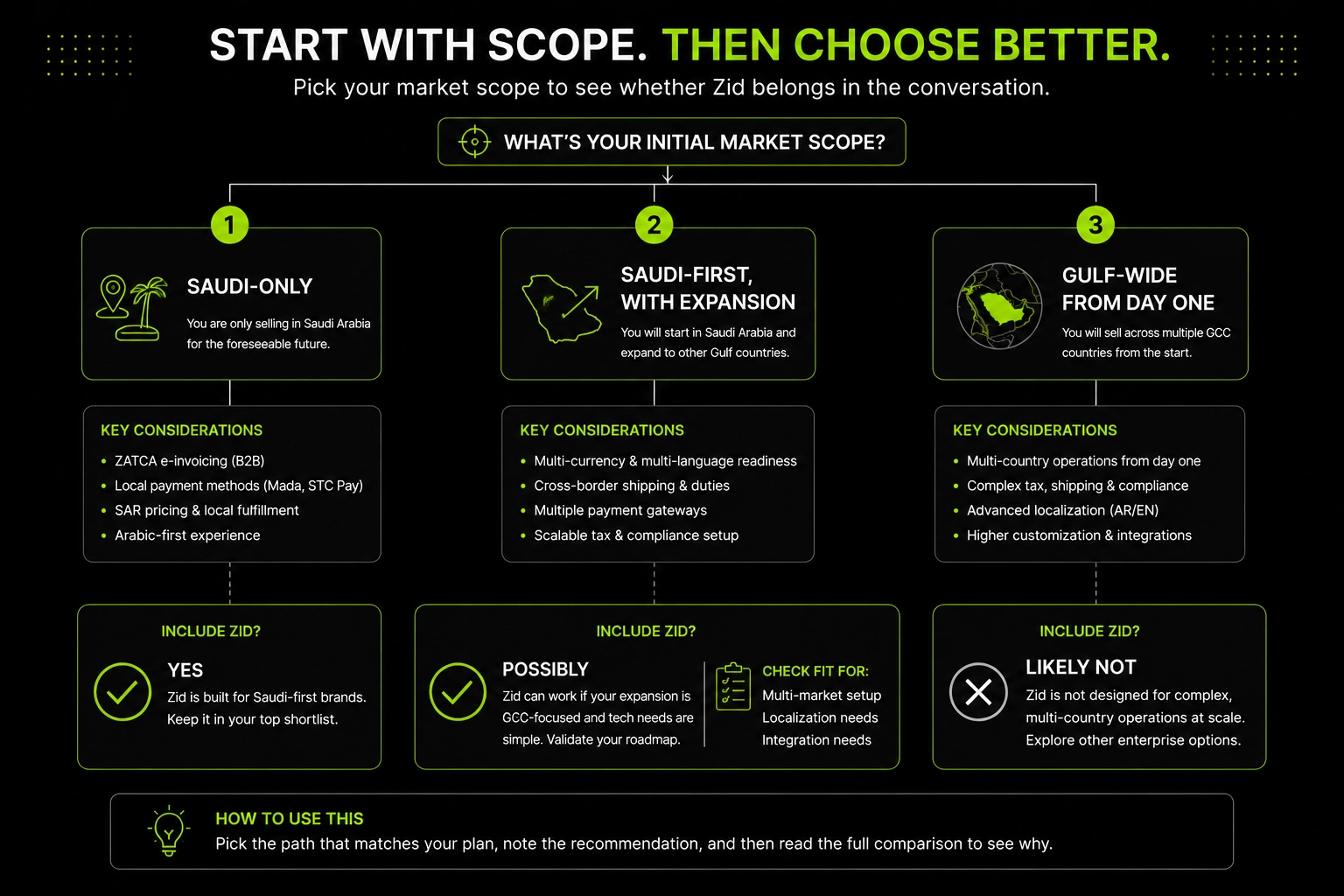
This is the section that makes this comparison genuinely useful rather than a redundant feature table. Most existing comparison content treats Salla, Zid and Shopify as three equally viable options regardless of target market.
That's a mistake for a UAE-based reader specifically, and here's the honest scope check to run before any feature comparison at all.
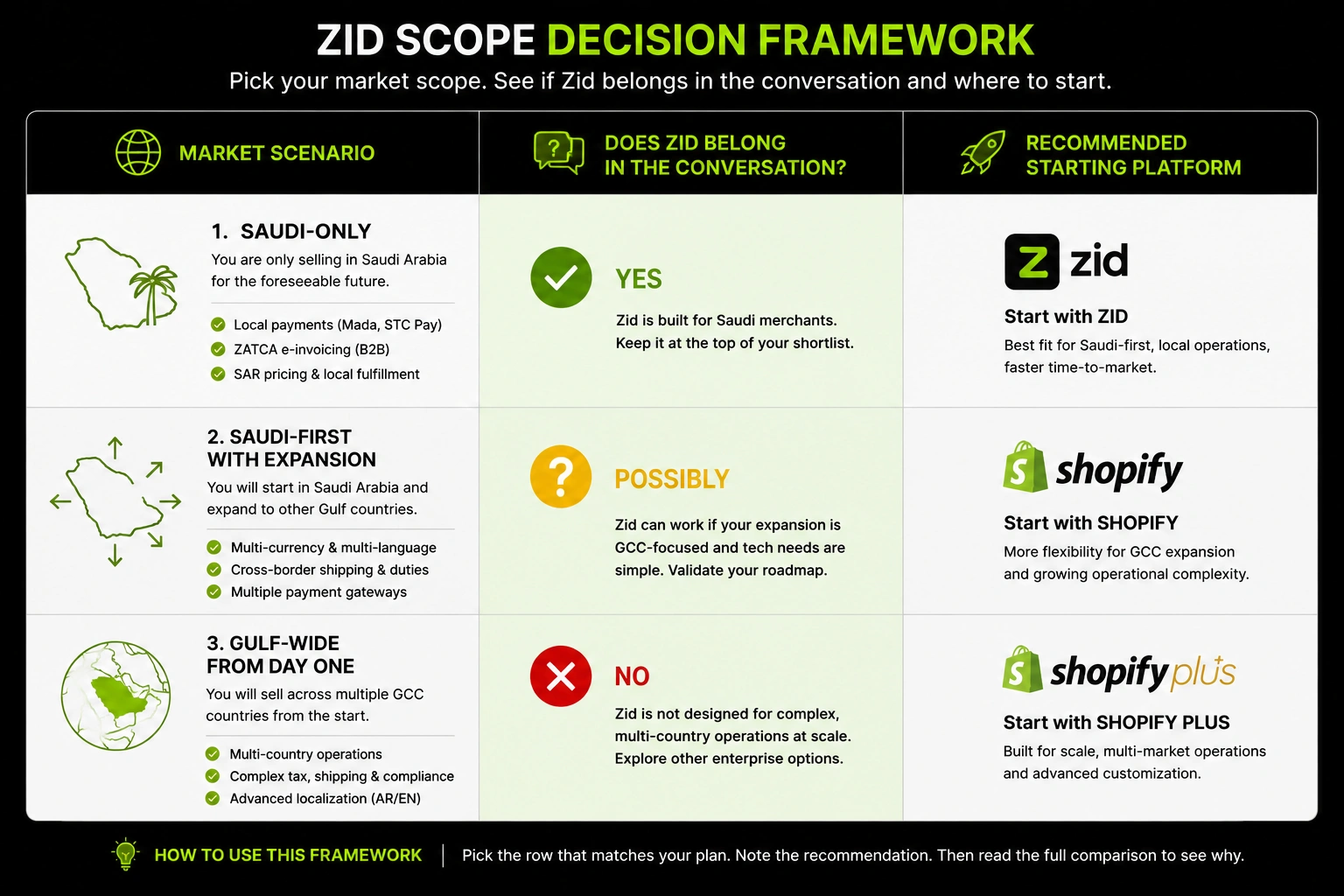
Saudi-Only, Fast Local Launch, Prefer Fewer Decisions
Zid's opinionated, bundled approach is a legitimate contender here. If your brand's first and only near-term market is Saudi Arabia and your priority is launching quickly without managing a large stack of configuration decisions, Zid's narrower feature set works in your favour rather than against you.
Saudi-First But With UAE Or Wider Gulf Expansion Planned Within 1-2 Years
This is where the decision gets genuinely harder, and where most brands searching this comparison actually sit.
Weigh Zid's Saudi-only focus carefully against Shopify's stronger multi-market tooling, since a later platform migration off Zid is disruptive, content, catalogue structure and integrations don't transfer automatically, and a migration means real rebuild work, not a simple export and import.
If Gulf expansion within the next year or two is a genuine plan rather than a vague aspiration, that timeline should weigh heavily in the initial platform decision.
Starting on Shopify from day one, even for a Saudi-first launch, avoids a migration that becomes progressively more expensive the longer the store has been operating and accumulating content, orders, and integrations on Zid.
A practical way to test whether your expansion plan is genuine rather than aspirational: do you have an actual timeline, a target market, and a rough sense of what the Gulf-wide operation would need functionally, or is it more of a "we'd like to eventually" statement without specifics attached?
A brand with a concrete 18-month UAE launch plan already in motion should weigh that heavily toward starting on Shopify now.
A brand with a vague, unscheduled sense that Gulf expansion "would be nice someday" has more room to start on Zid and revisit the platform question once expansion actually becomes concrete, since that revisit costs less the earlier it happens in the store's life.
UAE-First Or Gulf-Wide From Day One
Zid is generally not the relevant comparison here. Shopify, or Salla given its broader regional reach, are the more applicable options for a brand building UAE-first or across the Gulf simultaneously from launch.
Zid's integrations and market focus simply weren't built with this scope in mind and evaluating it seriously against Shopify for a UAE-first launch is close to comparing the wrong two options entirely.
Feature Comparison: Where It's Genuinely Relevant
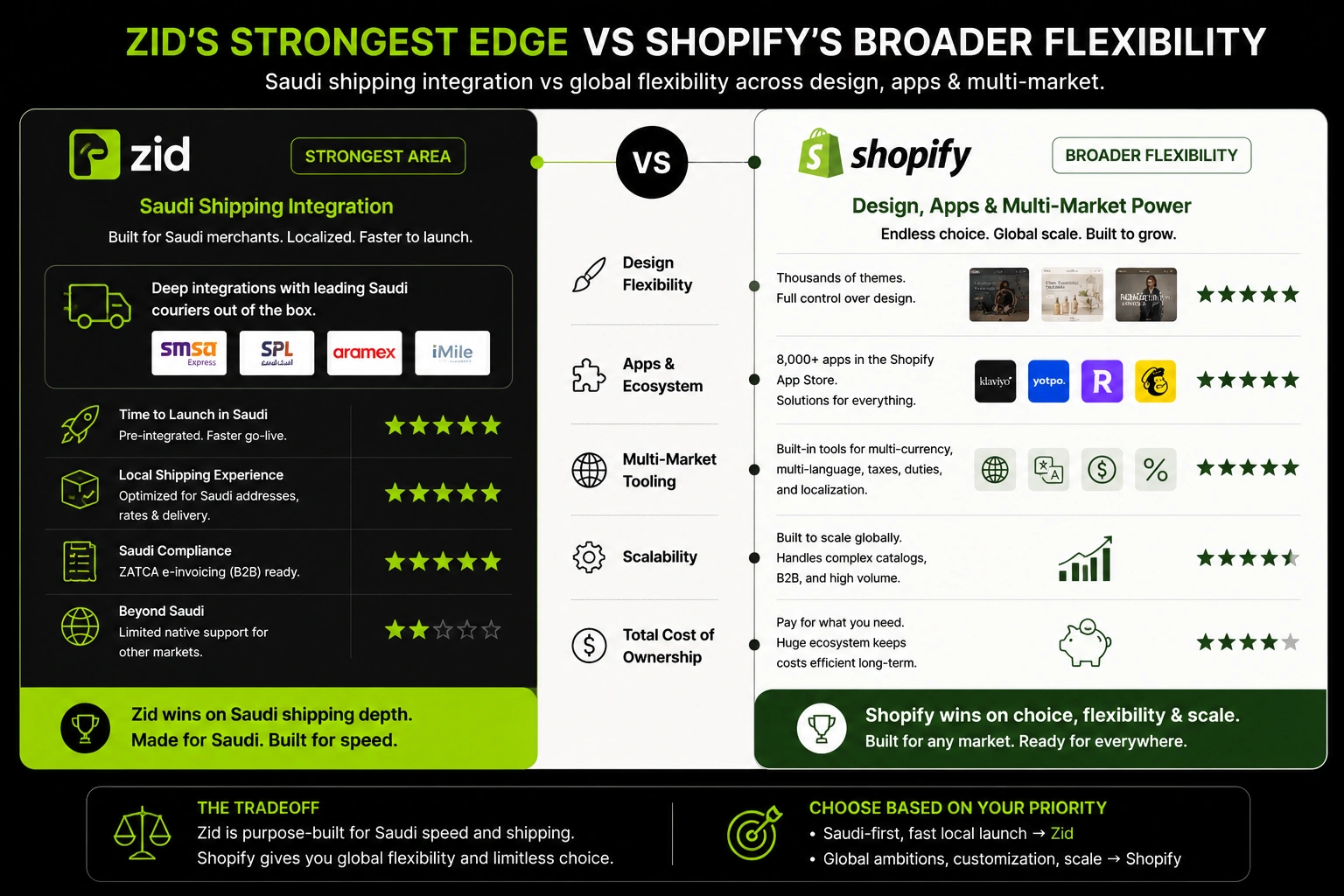
Since Zid's relevant use case is narrower than Salla's or Shopify's, this comparison stays tighter and more targeted than a full feature-by-feature breakdown would be.
Be specific about the one area Zid is repeatedly cited as strongest: Saudi shipping integration.
Multiple independent sources point to this as a genuine differentiator, not marketing spin, Zid's local carrier relationships and shipping workflow reportedly outperform what a Shopify store typically achieves through third-party apps alone.
Be equally honest about where Shopify's much larger app ecosystem and design flexibility remain the clear advantage.
A brand with more complex or ambitious storefront needs, deep customization, multi-market operations, a sophisticated app stack, will hit Zid's opinionated ceiling well before it hits Shopify's, in the same way covered for Salla in our companion comparison piece.
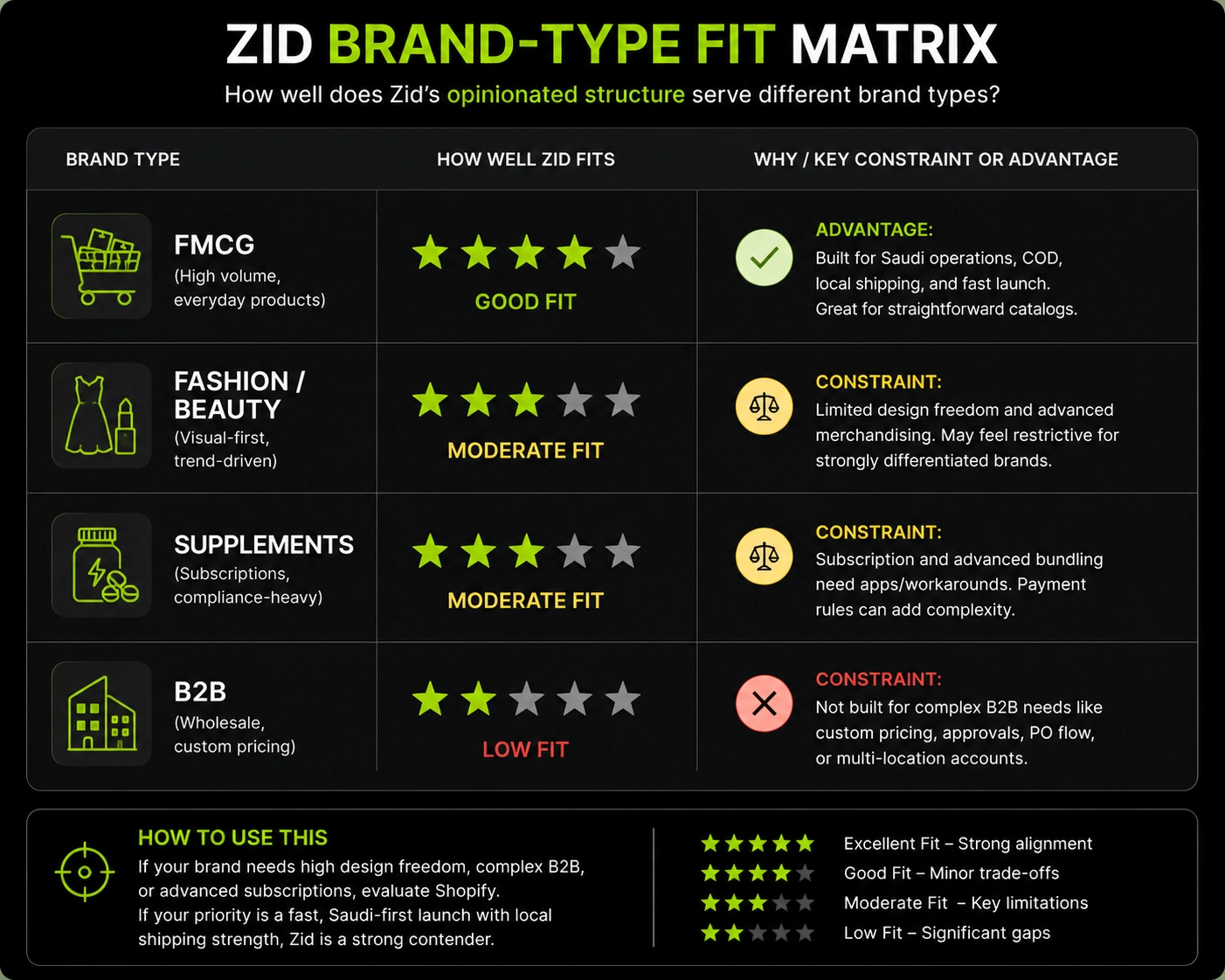
How Zid's Opinionated Approach Plays Out By Brand Type
A platform description like "more opinionated, fewer choices" stays abstract until you map it against how different brand types actually experience that constraint. Here's what it looks like in practice across a few common categories.
FMCG and Grocery-Adjacent Brands
For a fast-moving consumer goods brand selling a straightforward catalogue, snacks, household products, everyday essentials, Zid's opinionated structure tends to be an asset rather than a limitation.
These brands typically don't need deep design customization or complex product configuration logic. What they need is a fast, reliable checkout, strong local shipping, and minimal ongoing platform management overhead. This is close to the ideal use case Zid was built for.
Fashion And Beauty Brands With Design Ambitions
This is where the opinionated structure starts to show its ceiling. A fashion or beauty brand building toward the kind of editorial storytelling and visual differentiation covered in our guide to choosing a Shopify theme will likely find Zid's theme library limiting sooner than expected.
The platform wasn't built to support the depth of visual customization these categories often need to differentiate against competitors, and a brand in this position should weigh that constraint carefully against Zid's speed-to-launch advantage before committing.
Supplement and Subscription-Model Brands
Subscription and replenishment mechanics, covered in depth in our guide to choosing an ecommerce platform for supplement brands, are a genuine test case for Zid's app ecosystem depth.
Confirm directly whether Zid's native or available subscription billing options match what your specific replenishment model needs, dosage-based variants, flexible billing intervals, pause-and-resume functionality, before assuming Zid's broader "no required paid apps" positioning extends cleanly to this specific functional area.
B2B And Wholesale-Adjacent Brands
For brands running any meaningful wholesale or B2B operation alongside direct-to-consumer sales, both Zid and Shopify have real limitations worth investigating directly.
This isn't a category where either platform has an obvious, uncontested advantage. Confirm current B2B feature depth directly with Zid rather than assuming parity with Shopify's expanded B2B tooling or Salla's B2B capabilities, since this is an area where platform capabilities shift meaningfully over time and a comparison written even a year ago may already be describing a different feature set than what's actually live today.
What A Genuine Zid Evaluation Actually Requires
If your brand does fall into the Saudi-only or Saudi-first-with-later-expansion category, here's what an honest evaluation of Zid should actually involve, beyond taking either Zid's own marketing or a generic comparison article at face value.
Confirm The Commission And App Claims Directly
Zid's stated no-commission, no-required-paid-apps positioning is a real selling point if it holds up under your specific use case. But "no required paid apps for core functionality" leaves room for what counts as core versus what counts as an add-on your brand actually needs.
Before treating this as a settled cost advantage, get a direct answer from Zid on which specific features your brand needs, subscription billing, advanced filtering, loyalty mechanics, fall inside that core functionality versus which ones require a paid add-on.
Test The Shipping Integration Against Your Actual Carrier Mix
Zid's reputation for strong Saudi shipping integration is well documented, but "strong shipping integration" means something different depending on which specific carriers your brand actually uses and which regions within Saudi Arabia you're shipping to most heavily.
Confirm the specific carriers Zid integrates with natively, and whether your planned fulfilment partners are among them, before assuming this advantage applies automatically to your specific operation.
A brand shipping primarily within Riyadh and Jeddah may find this integration depth largely irrelevant if their fulfillment partner isn't among Zid's native connections, while a brand relying on wider Saudi coverage may find it genuinely decisive.
Map Your Actual Design Requirements Against Zid's Theme Library
An opinionated platform with fewer themes works well until your brand's specific design requirements exceed what those themes can express.
Before committing, look through Zid's actual available themes with your brand's real product photography and content in mind, not just a generic sense of whether the platform "looks fine."
A brand with strong editorial or premium positioning ambitions may find Zid's theme library genuinely limiting in a way that only becomes obvious once real content is loaded in.
The same principle covered in our guide to choosing a Shopify theme applies here in reverse: architecture and flexibility matter more once real content and growth enter the picture than a demo store ever reveals.
Load your own product images and copy into a Zid trial before making a final call, the same way you'd stress-test a Shopify theme rather than judging it from a polished demo alone, since a demo store is built to flatter the platform, not to represent your actual catalogue.
Plan For The Migration Question Now, Not Later
Even if Zid is the right starting point today, ask the migration question honestly before launching rather than after.
If there's any real chance your brand expands beyond Saudi Arabia within two to three years, understand upfront what migrating off Zid would actually involve, catalogue rebuild, content rebuild, integration rebuild, so that decision isn't a surprise made under pressure once expansion plans firm up.
This planning step matters more than it might seem at first, because the cost of migration compounds with time. A brand six months into a Zid launch has a relatively contained catalogue and content base to rebuild elsewhere.
A brand three years in, with thousands of orders, an established customer base, accumulated reviews, and deep integration with local operations, faces a materially more disruptive migration if Gulf expansion becomes a firm plan later.
Neither scenario means avoiding Zid entirely, it means going in with eyes open about what a later transition actually costs, rather than discovering that cost only once the decision to expand has already been made.
Suplex's Approach To Saudi And Gulf-Wide Platform Decisions
We start every platform recommendation with market strategy, not platform features. The first question is simple:
- Are you launching Saudi Arabia only?
- Are you planning to expand across the GCC in the near future?
The answer determines whether Zid belongs in the conversation before any feature comparison begins.
For brands launching exclusively in Saudi Arabia and prioritising speed, simplicity, and local workflows, Zid can be the right starting point.
Although we specialise in Shopify and Shopify Plus, we recommend the platform that best fits your commercial objectives rather than defaulting to our own service offering.
Platform selection is only one part of the decision. As a Meta and Google Partner, we apply the same technical standards regardless of platform, including:
- Accurate conversion tracking
- Product feed optimisation
- WhatsApp attribution
- Marketing measurement and reporting
These foundations have a greater impact on paid media performance than the platform alone.
The final decision should reflect your long-term expansion plans. A platform consultation helps align your technology stack with your growth strategy, while an international ecommerce setup ensures your store can support new markets as your business expands beyond Saudi Arabia.
Zid, Shopify and UAE-First Brands: A Direct Answer
Given Zid's narrow scope, this section can be more direct than the equivalent section in our Salla comparison. Here's the straightforward answer for a UAE-based reader.
Zid Is Generally Not Relevant For A UAE-First Brand
For a brand whose first or primary market is the UAE, Zid is generally not a relevant option today. Its focus and integrations are built around the Saudi market specifically, without the broader Gulf reach Salla has begun developing into the UAE and Egypt.
Evaluating Zid seriously for a UAE-first launch means comparing against a platform whose core strength was never built for your actual target market.
The One Scenario Where Zid Becomes Relevant For A UAE Brand
Zid becomes relevant for a UAE-based brand only in one specific scenario: expanding into, or launching, a dedicated Saudi-market storefront alongside an existing UAE operation.
Even in that scenario, the two-storefront attribution and reconciliation considerations covered in our Salla comparison apply equally here, running separate stores for separate markets without a unified cross-domain tagging approach creates the same finance-and-marketing reconciliation problems regardless of whether the Saudi-specific storefront runs on Salla, Zid, or a second Shopify instance.
Start The Conversation With The Right Platform For Your Actual Scope
Brands genuinely building Gulf-wide from the start are better served starting the platform conversation with Shopify or Salla for Saudi-inclusive plans and only evaluating Zid specifically once a dedicated Saudi-market storefront becomes a concrete near-term plan rather than a hypothetical future consideration.
Bringing Zid into an early-stage UAE-first platform conversation, before Saudi expansion is even confirmed, adds evaluation complexity without a corresponding decision benefit.
We've advised UAE-based brands on exactly this kind of market-sequencing decision, including when a Saudi-specific storefront on a platform like Zid genuinely makes sense as a deliberate, separate build rather than a default choice made out of confusion about which platform fits which market.
Frequently Asked Questions
Is Zid like Shopify?
Broadly, both let you build and run an online store, but Zid is Saudi-built and Saudi-focused, more opinionated with fewer themes and apps, while Shopify is a global platform with far greater design and app ecosystem depth. Zid is generally the faster, simpler option for a Saudi-only launch.
Does Zid charge commission on orders?
Zid's own positioning states no commission on orders and no required paid apps for core functionality, unlike some other platforms. Pricing and terms can change, so this should be confirmed directly with Zid rather than relied on from any third-party comparison, including this one.
Is Zid available outside Saudi Arabia?
Zid's focus and integrations are built specifically around the Saudi market. Unlike Salla, which has developing reach into the UAE and Egypt, there's little indication Zid has meaningfully expanded beyond Saudi Arabia, making it a narrower choice for brands with Gulf-wide ambitions.
Should a UAE brand consider Zid?
Generally no, unless the brand is specifically planning a dedicated Saudi-market storefront alongside its UAE operations. For a UAE-first or Gulf-wide launch, Shopify or Salla are typically the more relevant starting points given their broader regional reach.
How is Zid different from Salla?
Both are Saudi-native, Arabic-first platforms with local payment and shipping integrations, but Zid is generally described as more opinionated (fewer themes and apps, less configuration) with particularly strong Saudi shipping integration, while Salla has broader regional reach into the UAE and Egypt.
Is Zid a legitimate, well-funded platform?
Yes. Zid has reportedly raised significant funding (around $59M) and processes several billion dollars in annual transaction volume, indicating a well-capitalized, established platform rather than a niche local tool, though brands should verify current figures directly with Zid.
Can I migrate from Zid to Shopify later?
Migration is possible but involves rebuilding content, catalogue structure, and integrations rather than a direct transfer, similar to most cross-platform migrations. This is worth factoring into the initial decision, a brand planning eventual Gulf-wide expansion may be better served starting on Shopify rather than migrating later.
Hi, I’m Rishabh Jain
I believe great design has the power to shape perception, build trust, and move businesses forward. That belief is what led me to found Suplex Design Studio, a global branding and packaging studio working with FMCG and D2C brands across markets.I started suplex at 25 with a clear intent, to create design that is strategic, thoughtful, and commercially meaningful. By 28, the studio had scaled globally, guided by a strong foundation in Integrated Design that I developed during my academic journey in London, where I was honoured with the Dean’s Award.
Over the years, I’ve had the opportunity to work with 100+ brands, from Fortune 500 organizations to family-run businesses, helping them build packaging and brand systems that create recall, relevance, and long-term value.
Suplex’s work has been recognized internationally, including the Manifest Award (2024), the Clutch Global Award (2025), and features on platforms such as Packaging of the World, The Dieline, and the World Brand Design Society.
None of this would be possible without the people behind the work. I’m deeply grateful to the suplex team, whose commitment, creativity, and attention to detail turn ideas into meaningful brand experiences every day.
At the heart of my work is a simple philosophy, design should be intentional, honest, and built to last, and that continues to guide everything we create at suplex.
































Let’s Make It Happen
E-Commerce Success Stories
%201.avif)






.avif)
.avif)
Build Your D2C Business The Right Way
Build It With Suplex.


