BigCommerce vs Shopify: The 2026 Comparison That Actually Reflects What Changed
.avif)

BigCommerce vs Shopify: The 2026 Comparison That Actually Reflects What Changed
BigCommerce vs Shopify comparisons have changed as both platforms have evolved.
BigCommerce restructured its pricing and introduced a new fee for third-party payment gateways, while Shopify made its B2B features available across all paid plans.
This Suplex guide reflects both changes without relying on outdated assumptions.
As a Shopify Partner, we recommend Shopify where it makes sense, but we'll also tell you when BigCommerce is the better choice.
What Changed in 2026 Read This Before Anything Else
Three structural changes landed in the first half of 2026. They have rewritten the honest answer to BigCommerce vs Shopify.
Change 1 : BigCommerce’s June 2026 Pricing Restructure
BigCommerce renamed every plan and quietly retired its oldest selling point.
On June 1, 2026, BigCommerce renamed its plans: Standard → Core, Plus → Growth, Pro → Scale, Enterprise → Performance. The cosmetic part doesn’t matter. The Open Payment Provider Fee does.
The OPPF charges 2% on Core, 1% on Growth, and 0.6% on Scale for any gateway not on BigCommerce’s embedded provider list.
That list includes Stripe, PayPal/Braintree, Adyen, Checkout.com, Klarna, and Afterpay. Every other gateway now triggers the fee.
Telr, PayTabs, Tap Payments, Network International, Tabby, Tamara all the UAE and GCC regional gateways are excluded and therefore subject to the fee.
Purchase orders and manual offline payments are also caught unless processed through an embedded provider. For B2B operations that rely on invoice‑style payments, the OPPF is a direct new cost.
BigCommerce’s “zero transaction fees” argument is gone for any brand not on the embedded list.
Change 2: Shopify Opens B2B to Every Paid Plan (April 2026)
BigCommerce’s second big differentiator narrowed in a single product update.
In April 2026, Shopify made B2B features available on all paid plans. Company profiles, custom pricing catalogs, volume discounts, payment terms and vaulted cards now work on Shopify Basic ($39/month). Before this, B2B required Shopify Plus at $2,300/month.
The B2B toolset on lower Shopify plans is not as deep as BigCommerce’s Performance tier B2B Edition. Approval workflows, buyer hierarchies and advanced quote‑to‑cash are still richer on BigCommerce.
But for mid‑market wholesale, Shopify now covers the core requirement. The gap that BigCommerce leaned on has been cut in half.
Change 3: BigCommerce Discontinues Native Google/Meta Integrations (March 2026)
Feature regression that most comparisons still haven’t noticed.
In March 2026, BigCommerce removed native Google Ads and Meta (Facebook/Instagram) integrations. The recommended replacement is Feedonomics.
Shopify’s native multichannel sellingGoogle, Facebook, Instagram, Amazon, eBay, TikTokis now broader out of the box. This is a new feature gap for brands that want plug‑and‑play sales channels.
The Platform Fundamentals: What Has Not Changed
These structural facts remain the same and still influence real‑world decisions.
What Each Platform Is
The DNA of each platform hasn’t changed, and that matters for long‑term fit.
Shopify was built only for commerce. Checkout, payment infrastructure, app ecosystem, and operational scaling are the product.
It powers 4.8 million+ stores and processes $378 billion in GMV (2025). BigCommerce pitches itself as “Open SaaS” with more native features, fewer app dependencies and open APIs. It has around 90,000 active stores and was taken private in 2024 at a $1.8B valuation.
Pricing Now Structurally Equivalent at Base Level
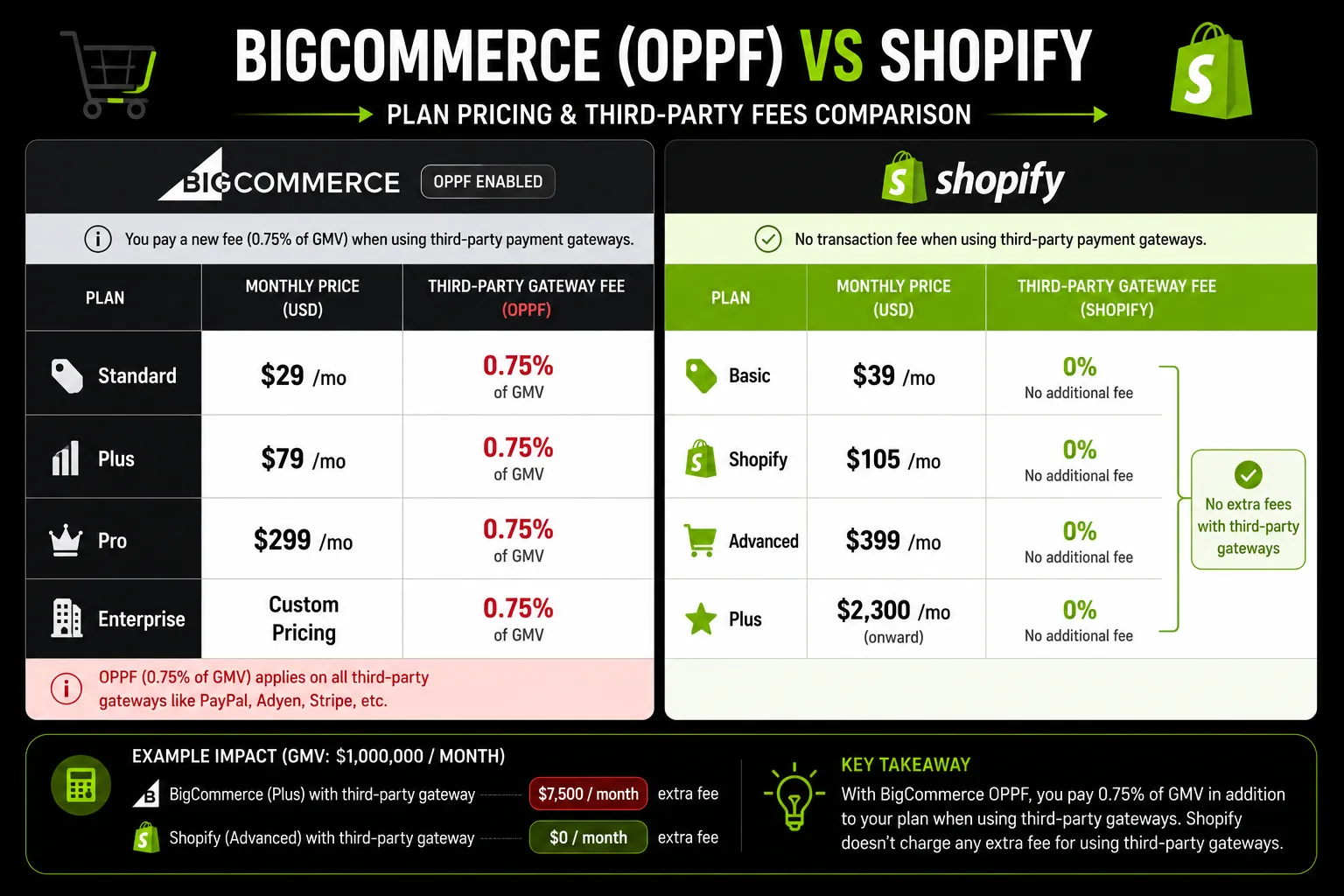
Plan prices are almost identical, but fee layers now match too.
Shopify plans (2026):
- Basic: $39/month
- Shopify: $105/month
- Advanced: $399/month
- Plus: $2,300+/month
BigCommerce plans (post‑June 2026):
- Core: $39/month
- Growth: $105/month
- Scale: $399/month
- Performance: $1,499+/month
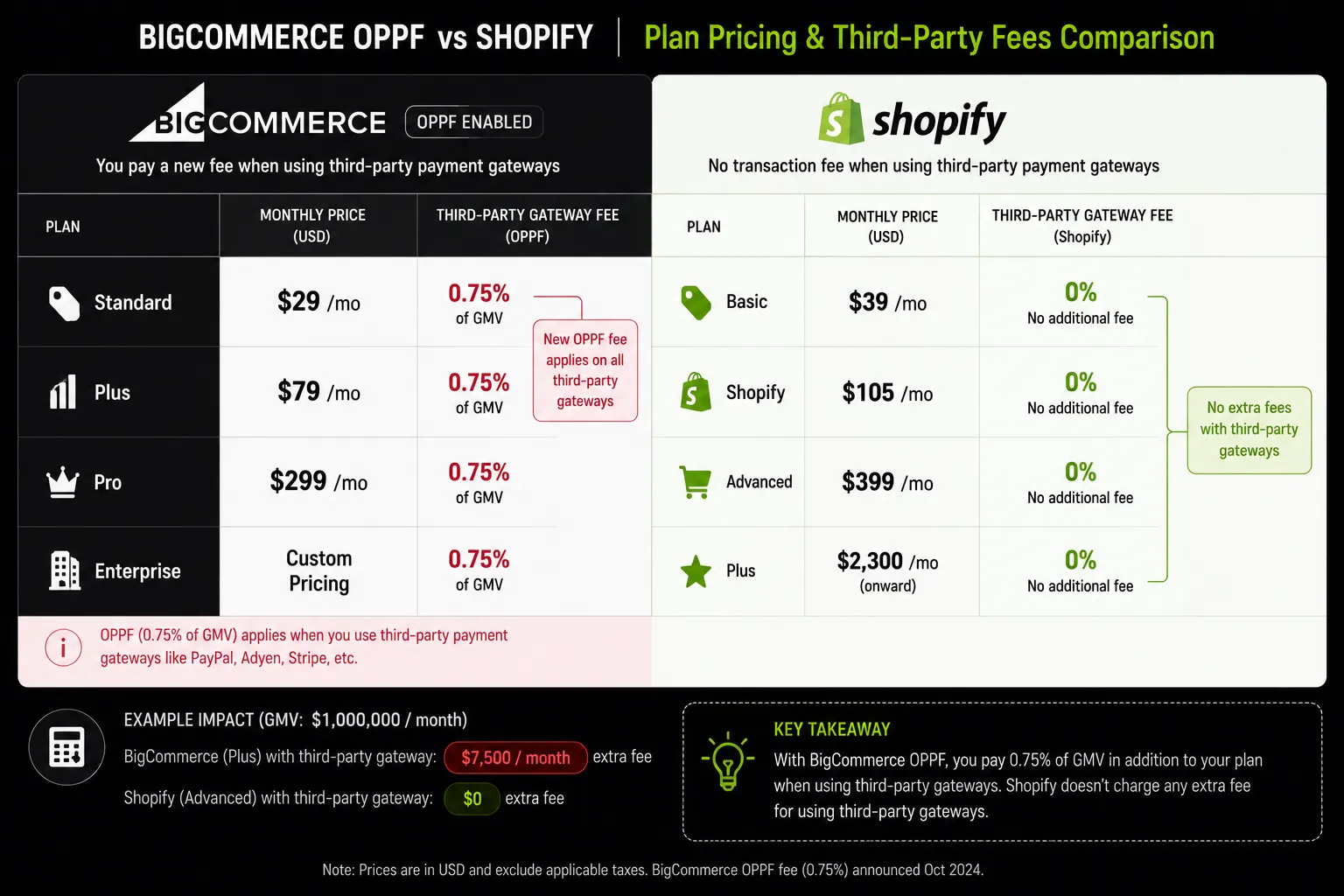
On top of plan prices, Shopify charges 2% (Basic), 1% (Shopify plan), or 0.5% (Advanced) on third‑party gateways.
Shopify Payments eliminates that fee. BigCommerce’s OPPF is 2%, 1%, or 0.6% on non‑embedded gateways.
For UAE brands using Telr, PayTabs, or Tap Payments, both platforms now carry comparable third‑party gateway fees. The old “BigCommerce is cheaper” logic no longer holds for those stores.
App Ecosystem: Shopify’s Clearest Remaining Advantage
When your needs go beyond native, Shopify has 8,000+ apps. BigCommerce has about 1,200.
BigCommerce bundles more native features, so many stores won’t miss the missing apps. But if your requirements outgrow native (subscriptions, advanced loyalty, custom checkout logic), Shopify’s app ecosystem offers more tested, merchant‑validated options.
Variant Architecture: BigCommerce’s Structural Advantage That Has Not Changed
600 SKUs per product vs 100 variants with 3 options. This is the one spec that still tips the decision outright.
For fashion brands with 15 colours × 10 sizes, paint brands with hundreds of swatches, or any complex product matrix, BigCommerce remains the correct structural choice.
Shopify Functions on Plus provides a partial workaround, but it’s developer‑dependent and not native.
URL Architecture BigCommerce’s SEO Flexibility Advantage
BigCommerce lets you write any URL structure you want. Shopify enforces /products/, /collections/, /blogs/.
For stores with existing SEO authority built on custom URLs, BigCommerce’s flexibility is valuable. For new stores, Shopify’s fixed prefixes don’t hurt SEOyou build authority from scratch either way.
Ease of Use Shopify’s Structural Operational Advantage
Shopify Online Store 2.0 lets marketing teams update pages, launch promos, and iterate without a developer.
BigCommerce’s theme editor demands more developer time for equivalent content changes. Lean teams without a dedicated developer will move faster on Shopify.
The Decision Framework: Who Should Actually Choose Each Platform
The right platform depends on your business model, payment stack, and catalogue complexity. This is not a universal answer.
Choose Shopify When
- Most D2C, fashion, beauty, and mid‑market B2B brands will land here in 2026.
- You are launching or scaling a D2C brand. Shopify has the fastest time to market, the best checkout (Shop Pay), and a clear upgrade path from Basic to Plus.
- Your B2B requirements are mid‑market. With the April 2026 expansion, company accounts, custom pricing, and payment terms are available on the $39 plan.
- You use Shopify Payments (or plan to when available in your country). The 0% transaction fee on Shopify Payments is a genuine cost advantage.
- Your team is lean. Marketing and merchandising staff can manage the store without developer tickets.
- You need the largest app ecosystem. Over 8,000 apps means almost any functionality is available and tested.
- You plan to sell across multiple GCC markets. Shopify Markets handles multi‑currency, local payment methods, and market‑specific checkout better than BigCommerce’s multi‑storefront.
Choose BigCommerce When
BigCommerce still holds specific, defensible advantages for a minority of brands.
- - Your catalogue legitimately exceeds 100 variants per product and 3 options. Shopify Functions workarounds are not equivalent. If the variant limit is a hard operational constraint, BigCommerce is the answer.
- - You process payments exclusively through Stripe, PayPal, Adyen, or Checkout.com. The OPPF never applies, and the zero‑fee advantage remains intact.
- - You run enterprise B2B with complex buyer hierarchies, approval workflows, and quote‑to‑cash processes. BigCommerce Performance tier’s B2B Edition is still deeper than Shopify Plus B2B.
- - Your SEO strategy depends on custom URL structures, and you are building on BigCommerce natively (not migrating from a legacy store with custom URLs).
- - You already have a capable BigCommerce development team and established infrastructure. The cost and disruption of migration are real factors in the ROI.
The Brand‑Stage Decision Overlay
Need a recommendation for your exact setup?
Suplex offers a platform consultation that starts with your payment stack, catalogue architecture, and GCC market requirements. Book a platform consultation
BigCommerce vs Shopify for UAE and Gulf Brands: The Comparison That No Other Guide Makes
The June 2026 OPPF hits UAE merchants harder than most. Regional gateway fees now apply on both platforms, and that changes the TCO conversation.
The OPPF Specifically Harms UAE BigCommerce Merchants
Telr, PayTabs, Tap Payments, Network International, Tabby, and Tamara are not on BigCommerce’s embedded list. Every transaction through these gateways now incurs the OPPF.
For years, UAE brands chose BigCommerce in part because Shopify Payments wasn’t available and BigCommerce had no transaction fees.
That advantage is dead. On a Growth plan processing AED 200,000/month through Tabby and PayTabs, the 1% OPPF costs AED 2,000/month in new fees.
Shopify Advanced with a third‑party gateway fee of 0.5% costs AED 1,000/month. The “cheaper because no transaction fees” claim no longer checks out for UAE brands on regional gateways.
COD Consideration
COD orders may be OPPF‑exempt if processed as a native manual payment method.
BigCommerce’s clause says offline orders and manual payment methods including POs are subject to the fee in some configurations.
COD processed purely as a manual payment (no gateway) might not trigger the OPPF. UAE brands with heavy COD volume (20%–25% of orders) should verify this directly with BigCommerce before committing.
Shopify’s UAE Advantage Strengthened in 2026
Three factors shifted the Gulf equation.
First, Shopify Payments UAE is in a staged rollout. When fully available, it eliminates Shopify’s third‑party gateway fee entirely. Second, Shopify Markets handles multi‑currency, localised checkout and GCC‑specific payment methods better than BigCommerce’s multi‑storefront.
Third, B2B features now come standard on all plans, which matters for UAE wholesale brands that previously needed Plus.
If you operate in the UAE and KSA corridor, our International ecommerce setup service is built around these exact market dynamics.
Shopify Plus vs BigCommerce Performance: The Enterprise Comparison
At enterprise scale, both platforms are capable. The decision splits on checkout depth, B2B maturity, and campaign automation.
Where Shopify Plus Wins at Enterprise
Checkout customisation, flash sale automation, and multi‑store management are Plus strengths.
- Checkout Extensibility: Custom fields, upsells, trust badges, and payment logic without full checkout rebuilds.
- Launchpad: Schedule price drops, theme changes, and inventory holds for Eid, DSF, White Friday, or BFCM. BigCommerce has no native equivalent.
- Organisation Admin: Manage multiple stores, staff permissions, and cross‑store analytics from one dashboard.
- No GMV‑based forced upgrades: A store doing $50M pays the same base Plus fee as one doing $5M. BigCommerce Performance pricing scales with GMV.
- Shop Pay: Network‑effect accelerated checkout. Shopify reports up to 50% conversion lift vs guest checkout.
Where BigCommerce Performance Still Wins at Enterprise
Enterprise B2B depth, variant handling, and a lower entry price keep Performance relevant.
- B2B Edition depth: Buyer portals, approval hierarchies, advanced quote‑to‑cash, and customer‑specific catalogues are still more native and robust than Shopify Plus B2B.
- 600 SKUs per product: For manufacturers or specialty retailers with complex product matrices, this remains a hard requirement.
- Catalyst headless: A React‑based composable frontend that competes with Hydrogen.
- Lower entry price: $1,499+/month vs $2,300+/month for Plus. If you don’t need checkout extensibility or Launchpad, Performance can cost less.
How Suplex Approaches This Comparison With Clients
We are a Shopify Partner. Our default recommendation is Shopify and we tell you that upfront. We also run a platform consultation that asks four questions before any recommendation: What gateways do you use?
What does your product matrix really look like? Is your B2B complexity mid‑market or enterprise? Where are your markets?
For the majority of our UAE and UK clients D2C supplements (Miduty case study), fashion (Loomsona), premium brands (Celesti) Shopify wins on app ecosystem, checkout conversion, Launchpad for Gulf retail peaks, and the new B2B inclusion.
The June 2026 fee changes also simplified the conversation: BigCommerce no longer has a fee advantage for UAE regional gateway users
We pause and ask deeper questions when a brand’s variant count genuinely exceeds 100 per product, or when the payment stack is 100% Stripe/Adyen and BigCommerce Performance’s B2B depth is non‑negotiable.
For a brand like Tea Culture of the World that runs both D2C and wholesale, we examine which side carries more GMV and complexity before recommending.
If you’re on BigCommerce evaluating whether the June 2026 OPPF has altered your platform economics, or if you’re choosing between the two for a new build, our platform consultation starts with your specific payment stack, catalogue architecture, and GCC market requirements. We’ll tell you if Shopify fits, and we’ll tell you if BigCommerce does.
Frequently Asked Questions
Is BigCommerce better than Shopify?
It depends on your situation, and the answer changed in 2026. BigCommerce historically won on zero transaction fees and native B2B. Both advantages narrowed significantly. For most D2C brands and mid‑market B2B, Shopify is now the stronger choice. BigCommerce remains better for complex enterprise B2B and catalogues that exceed 100 variants.
What are the transaction fees on BigCommerce vs Shopify in 2026?
Shopify charges 0.5%–2% on third‑party gateways (0% with Shopify Payments). BigCommerce introduced the Open Payment Provider Fee on June 1, 2026: 2% (Core), 1% (Growth), 0.6% (Scale) on any gateway not on its embedded list. For UAE brands using Telr, PayTabs, or Tap Payments, both platforms now carry comparable fees.
What is BigCommerce’s Open Payment Provider Fee and how does it affect the comparison?
The OPPF is a new fee on orders processed through non‑embedded gateways. It retired BigCommerce’s “no transaction fees” argument. Brands using Stripe, PayPal, Adyen, or Checkout.com are unaffected. Brands on any other gatewayincluding most UAE regional processorsnow pay the fee.
How does Shopify’s April 2026 B2B expansion change the comparison?
Core B2B features, company profiles, custom pricing, payment terms are now included on all paid plans, from $39/month. This narrows BigCommerce’s B2B advantage for mid‑market wholesale. Enterprise‑scale B2B with complex hierarchies and quote workflows still has more native depth on BigCommerce Performance.
Which platform is better for UAE ecommerce brands?
In 2026, Shopify is generally stronger. The OPPF applies to UAE regional gateways not on BigCommerce’s embedded list, removing the zero‑fee benefit. Both platforms now carry similar third‑party fees. Shopify adds better GCC multi‑currency support via Markets, Tabby/Tamara BNPL integrations, and Launchpad for Eid and DSF campaigns.
What does BigCommerce do better than Shopify in 2026?
- 600 SKUs per product vs 100
- Fully customisable URLs
- Deeper native B2B on Performance tier (buyer portals, approval workflows)
- Zero OPPF for brands on embedded providers only
- Lower enterprise entry price ($1,499+ vs $2,300+)
Is Shopify still worth it in 2026?
Yes. Shopify powers over 4.8 million stores and processed $378B in GMV in 2025. The B2B expansion, Shopify Payments rollout, Shop Pay conversion lift, and Launchpad automation make it the default correct choice for most D2C, fashion, and growing brands.
Hi, I’m Rishabh Jain
I believe great design has the power to shape perception, build trust, and move businesses forward. That belief is what led me to found Suplex Design Studio, a global branding and packaging studio working with FMCG and D2C brands across markets.I started suplex at 25 with a clear intent, to create design that is strategic, thoughtful, and commercially meaningful. By 28, the studio had scaled globally, guided by a strong foundation in Integrated Design that I developed during my academic journey in London, where I was honoured with the Dean’s Award.
Over the years, I’ve had the opportunity to work with 100+ brands, from Fortune 500 organizations to family-run businesses, helping them build packaging and brand systems that create recall, relevance, and long-term value.
Suplex’s work has been recognized internationally, including the Manifest Award (2024), the Clutch Global Award (2025), and features on platforms such as Packaging of the World, The Dieline, and the World Brand Design Society.
None of this would be possible without the people behind the work. I’m deeply grateful to the suplex team, whose commitment, creativity, and attention to detail turn ideas into meaningful brand experiences every day.
At the heart of my work is a simple philosophy, design should be intentional, honest, and built to last, and that continues to guide everything we create at suplex.































Let’s Make It Happen
E-Commerce Success Stories
%201.avif)






.avif)

.avif)
Build Your D2C Business The Right Way
Build It With Suplex.


