Hidden Costs in a Shopify Development Contract to Watch For
.avif)

Hidden Costs in a Shopify Development Contract to Watch For
Hidden costs in a Shopify development contract rarely come from the headline price. They come from what the contract doesn't define.
Undefined revision limits, vague change-order terms and unclear ownership clauses are where projects quietly grow 40 to 80 percent past the original quote.
This piece covers contract terms specifically, not Shopify's own platform fees, which we cover separately in our hidden costs of Shopify guide.
Why Contract Structure Costs More Than the Headline Price
The number in the proposal email is rarely the number you end up paying. What determines your real cost is how the contract handles the things that weren't fully specified at signing.
The Difference Between a Platform Cost and a Contract Cost
A platform cost is something Shopify itself charges, like transaction fees or app subscriptions. A contract cost is something your agreement with the agency creates, like a billed change order or an extra revision round.
These are two entirely different categories, and confusing them is how brands miss the real risk sitting in front of them.
The confusion is understandable, because both categories eventually show up as money leaving your account, and both feel like the same kind of surprise when they land. But they have completely different fixes.
A platform cost is something you negotiate with Shopify or work around with app choices. A contract cost is something you prevent entirely by getting the agreement structured correctly before work starts, which is the whole reason this piece exists as its own guide.
If you came here looking for Shopify's transaction fees, app costs, or theme pricing, our platform hidden costs guide covers that ground directly.
This piece is about what happens inside your agency contract specifically, regardless of which platform you're building on.
Why Projects Without a Detailed Scope Document Blow Past Their Quote
A scope document translates your brief into specific, itemized deliverables, features, and pages. Without one, "the project" means something slightly different to you than it does to your agency, and that gap gets expensive fast.
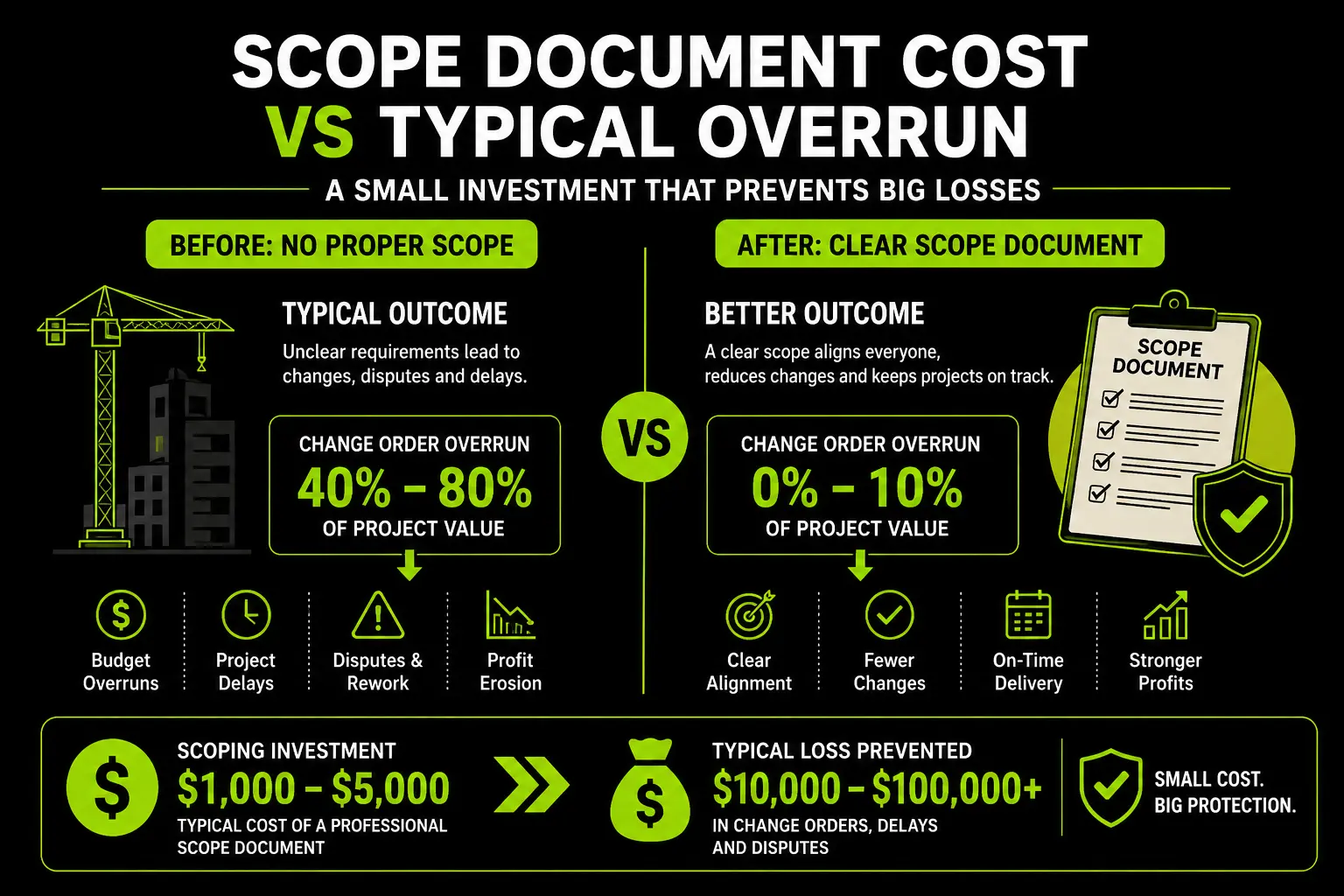
Industry figures on this are consistent: projects without a formal scope document commonly run 40 to 80 percent over their original quote, almost entirely through change requests that were never clearly excluded from the original price.
A modest upfront investment in proper scoping, $1,000 to $5,000 for a mid-sized Shopify build, routinely prevents overruns many times that size.
If you haven't seen our guide to briefing a Shopify agency, a strong brief is the input that makes a strong scope document possible in the first place.
Scope Creep: The Single Biggest Cost Driver
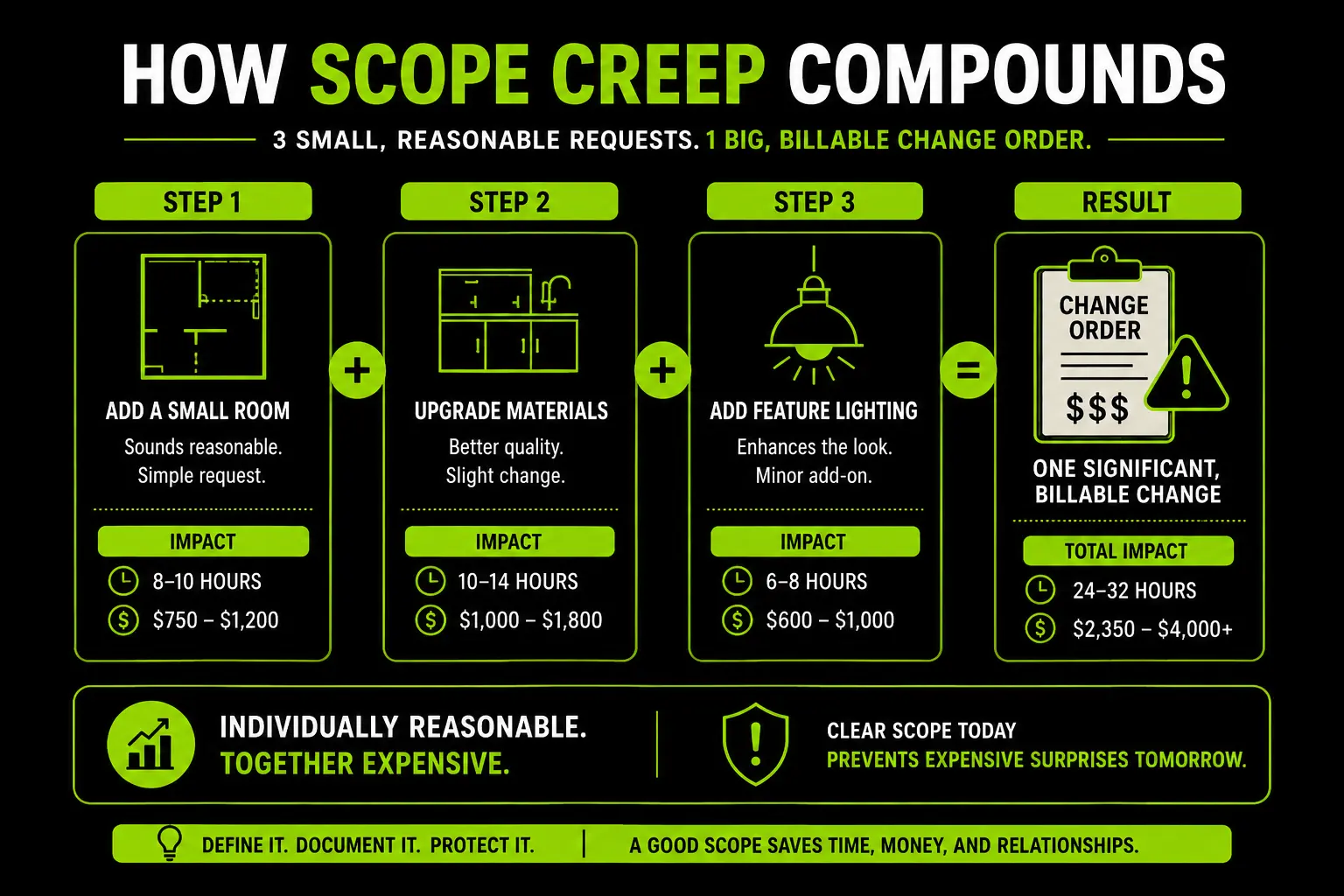
Scope creep is the single largest cost driver across nearly every Shopify project that runs over budget. It rarely arrives as one large addition. It arrives as a series of small ones that compound.
What Counts as "In Scope" vs. a "Change Request"
Anything explicitly listed in your scope document is in scope. Anything added, changed, or discovered after that document is signed is technically a change request, whether or not it feels like a small ask in the moment.
This distinction matters because most contracts are written to protect the agency's time, not the brand's budget, which is reasonable from the agency's side but means the brand needs to understand the mechanism clearly.
A "quick addition" during a design review is, contractually, almost always a change request the moment it wasn't in the original document, regardless of how minor it looks on screen.
Why Vague Scope Language Favors Whoever Didn't Write the Contract
Most Shopify agency contracts are drafted by the agency, using language they're familiar with and you likely aren't. Vague terms like "standard integrations" or "reasonable revisions" get interpreted in whichever direction benefits the party who wrote them, which is rarely the brand.
Ask for specific numbers wherever the contract uses a vague qualifier. "Standard integrations" should list the actual apps and services by name.
"Reasonable revisions" should state an actual number of rounds. If a term can't be made specific, that's worth flagging before signing, not after a dispute starts.
None of this requires an adversarial tone. A reputable agency should be able to answer "what exactly does this clause mean in practice" without hesitation and most will welcome the question, since a clearer contract protects them from disputes just as much as it protects you.
If a request for specifics gets brushed off or met with reassurance instead of an actual answer, treat that as useful information about how the rest of the project is likely to go.
The Review-Phase Trap: Where Scope Creep Usually Starts
Design review is where scope creep most commonly begins, because every small addition feels reasonable in isolation.
A brand asks for "just one more section" on the homepage, not realizing that under most contracts, that single request is formally a billable change order.
Picture a founder reviewing homepage mockups who asks for a testimonials section that wasn't in the original wireframes, then a trust-badge row below it, then a slightly different hero layout. None of these feels like a big deal on its own.
Together, they can add a full week of design and development time that the original quote never accounted for, and by the time an invoice reflects it, the brand is often surprised.
The fix isn't to stop giving feedback during review. It's to ask, at the point each request comes up, whether it's a change to something already scoped or an addition to it.
A good agency will tell you honestly which one it is, and a written scope document makes that answer obvious instead of a judgment call made under time pressure.
If the answer is "addition," that's the moment to decide together whether it's worth a change order now or a note for a future phase, rather than letting it slide in quietly and surface later on an invoice.
Revision Limits: The Clause Everyone Skims
Revision limits sit in nearly every agency contract, and almost nobody reads them closely until they hit the cap mid-project.
Why "Unlimited Revisions" Almost Never Actually Means Unlimited
"Unlimited revisions" in marketing copy usually means unlimited revisions within a defined scope and timeframe, not truly unlimited changes forever. The fine print, if it exists, caps rounds at two or three before hourly billing kicks in.
Ask Directly: does "unlimited" mean unlimited rounds, or unlimited minor tweaks within an agreed number of rounds?
These are very different guarantees and the answer should be in writing, not left to a sales conversation you can't reference later.
How Revision Rounds Get Defined, and Redefined, Mid-Project
A "round" means one consolidated batch of feedback reviewed and addressed together, not an open-ended back-and-forth. Sending feedback five separate times across two weeks can, depending on the contract, count as multiple rounds rather than one.
Confirm how a round is actually defined and delivered before the project starts. Is feedback collected once from your whole team and submitted together, or can each stakeholder send notes separately as they come up? The second approach burns through revision rounds far faster than most brands expect.
What a Fair Revision Clause Actually Looks Like
A fair clause names an exact number of rounds (commonly two to three), defines what counts as a round, and states a clear hourly or fixed rate for anything beyond that limit. Nothing here should require guesswork once you're mid-project.
Fixed Price vs. Time and Materials: Which Hides More Cost Risk
Neither pricing model removes cost risk. Each one simply moves the risk into a different part of the process, and knowing where it lands helps you manage it.
Most agencies present one model as inherently safer than the other, usually whichever model they default to internally, but that framing oversimplifies the actual trade-off. Fixed-price and time-and-materials aren't a safe option and a risky one.
They're two different places for the same underlying risk to live, and the right choice depends on how settled your scope actually is, not on which model sounds more reassuring in a sales conversation.
How Fixed-Price Contracts Push Risk Into the Change-Order Process
A fixed-price contract caps your total cost for the defined scope, but every change outside that scope becomes a formal, separately priced change order.
The risk doesn't disappear. It relocates into how strictly (or loosely) change orders get approved and priced.
How Time-and-Materials Contracts Push Risk Into Scope Discipline
A time-and-materials contract bills for actual hours worked, which offers flexibility for an evolving project but requires real discipline on your side to track hours and keep requests focused.
Without that discipline, costs can drift upward gradually, in a way that's harder to point to as a single "change order" moment.
Which Model Fits a Well-Scoped Project vs. an Evolving One
A well-defined project with a clear, stable scope favors fixed-price, since the cap gives you cost certainty and the scope document keeps change orders rare.
A project that's genuinely still evolving, such as a build tied to a business model that's still being finalized, often fits time-and-materials better, provided you're actively managing hours against a budget ceiling.
Migration and Integration Limits Buried in the Fine Print
Quotes often look comparable on the surface while hiding very different limits on what's actually included. These three line items are where that gap usually lives.
Product and SKU Migration Caps
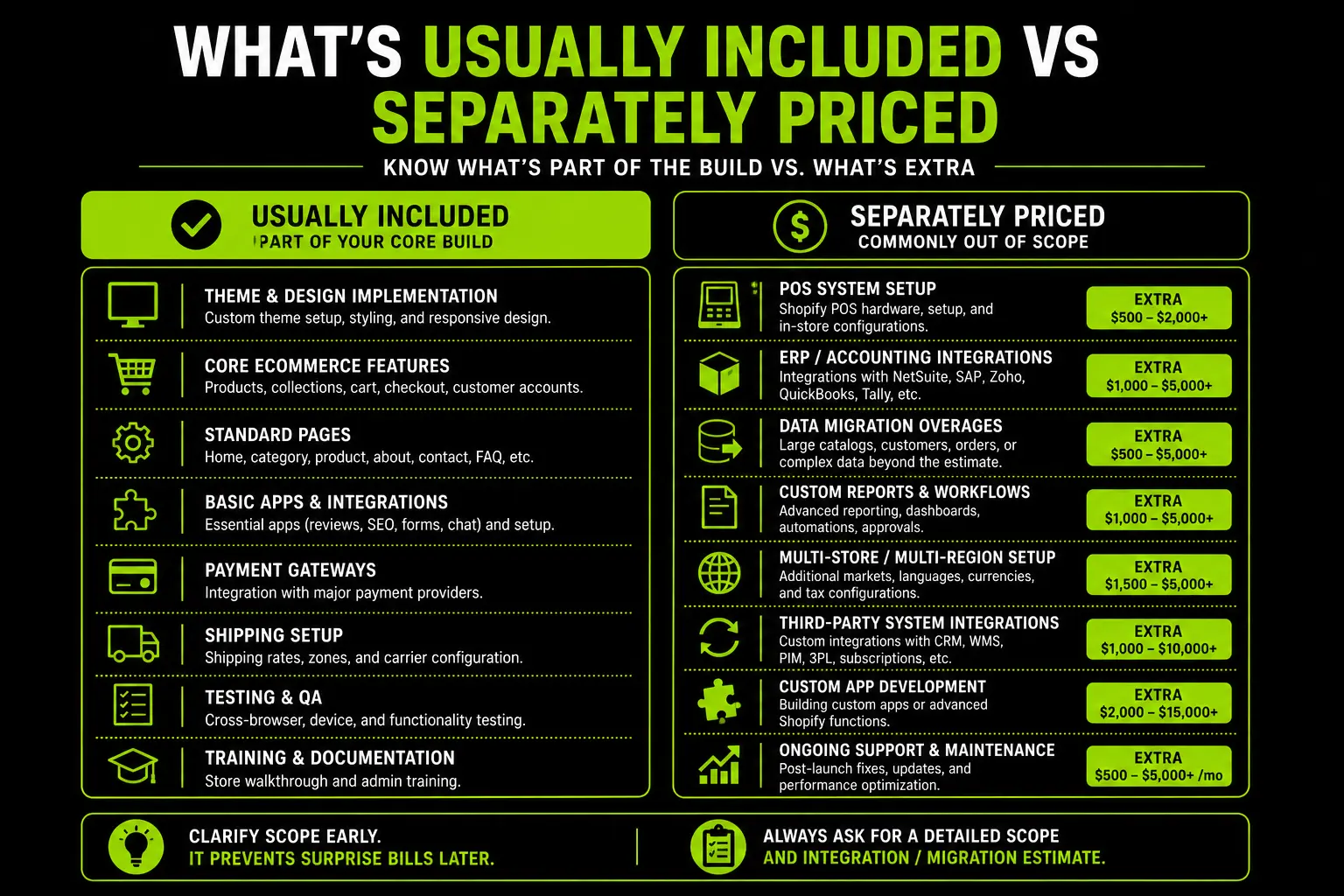
Many quotes specify a cap, such as "up to 5,000 products," beyond which additional migration work is billed separately.
If your catalog is close to or exceeds a stated cap, confirm the per-product cost for anything above it before signing, not after the migration starts.
This matters more than it sounds, because product counts rarely stay static during a migration project that takes weeks or months.
If your catalog grows by a few hundred SKUs while the project is underway, and your contract has a hard cap, you could cross the threshold without anyone flagging it until the final invoice.
Ask how the agency handles a catalog that grows or changes during the project, rather than focusing only on the initial product limit.
Third-Party Integration Scope
"Integration included" can mean anything from a basic app installation to fully custom API work, and the difference in cost is substantial.
Ask specifically whether an integration means configuring an existing app's standard settings, or building custom logic to connect it to your other systems.
POS, ERP, and Other Systems Priced Separately
Point-of-sale, ERP, and similar system integrations are almost always priced outside the core Shopify build, even when a proposal mentions them in passing.
If your business runs on a POS or ERP system, get a specific, itemized quote for that integration rather than assuming it's bundled into the headline number.
Ownership and IP Clauses: What You Should Own After Final Payment
Ownership clauses decide what you actually walk away with once the project ends and the final invoice is paid. This is where a completed project and a genuinely owned one can quietly diverge.
Custom Code and Theme Work: Confirming Transfer, Not Assuming It
Confirm explicitly, in writing, that custom theme code and development built specifically for your store transfers to your ownership once payment is complete. This should never be an assumption based on the project simply being "for you."
Payment should be tied to a clear trigger, such as final payment completion, rather than vague terms like “project end” or “on delivery.
Some agreements transfer ownership only after the final invoice clears in full, which is reasonable, but it should be stated as a clear condition rather than left ambiguous.
If a dispute over a final payment ever arises, that clause is what determines whether you have any claim to the code that's already running your store.
Reusable Agency Components vs. Work Built Specifically for You
Some agencies build on top of reusable internal frameworks or components they use across multiple clients, which is normal and reasonable. W
hat matters is a clear line between those shared components and the custom work built specifically for your store, since only the latter should be exclusively yours.
Account and Credential Access as Part of the Contract, Not an Afterthought
Admin access, source code repositories, and third-party credentials should be named explicitly as contract deliverables, not left to a verbal handover conversation after launch.
Our Shopify agency deliverables checklist covers exactly what a complete handover should include, item by item, if you want the fuller picture beyond the contract language itself.
Post-Launch and Ongoing Cost Clauses
The costs that show up months after signing are often the ones a brand has the least leverage to negotiate, simply because the project already feels finished by the time they surface.
What "Support Included" Actually Covers
"Support included" means bug fixes only, not new features, content updates, or design changes, even though brands often assume it covers all three. Get a specific written list of what counts as a bug fix versus billable new work before you need to ask mid-dispute.
Hosting, Maintenance, and Retainer Costs Not Mentioned in the Original Quote
Ongoing maintenance retainers, priority support tiers, or hosting-adjacent fees sometimes appear only after launch, once the brand has less room to negotiate than they did during initial scoping.
Ask directly during the proposal stage whether any recurring costs exist beyond Shopify's own subscription fee, and get them itemized in writing.
Ask the agency to break down your expected monthly costs for the first year after launch, including platform fees, apps, maintenance, and other recurring expenses. This gives you a realistic view of what the store will cost to operate beyond the initial build.
That conversation tends to surface retainer expectations, app renewal costs, and support tier pricing that a one-line proposal summary easily leaves out and it's far easier to negotiate before signing than three months into a support relationship you didn't fully understand.
Rush Fees and Priority Support Add-Ons
Rush fees for expedited turnaround and priority support add-ons for faster response times are both legitimate, common charges, but they should be disclosed as optional add-ons upfront, not discovered when you actually need speed and have no choice but to pay.
[Screenshot Suggestion 2: Screenshot of a sample post-launch support tier comparison table, showing what's included at each support level, placed after the post-launch costs section.]
What to Ask Before You Sign: A Practical Checklist
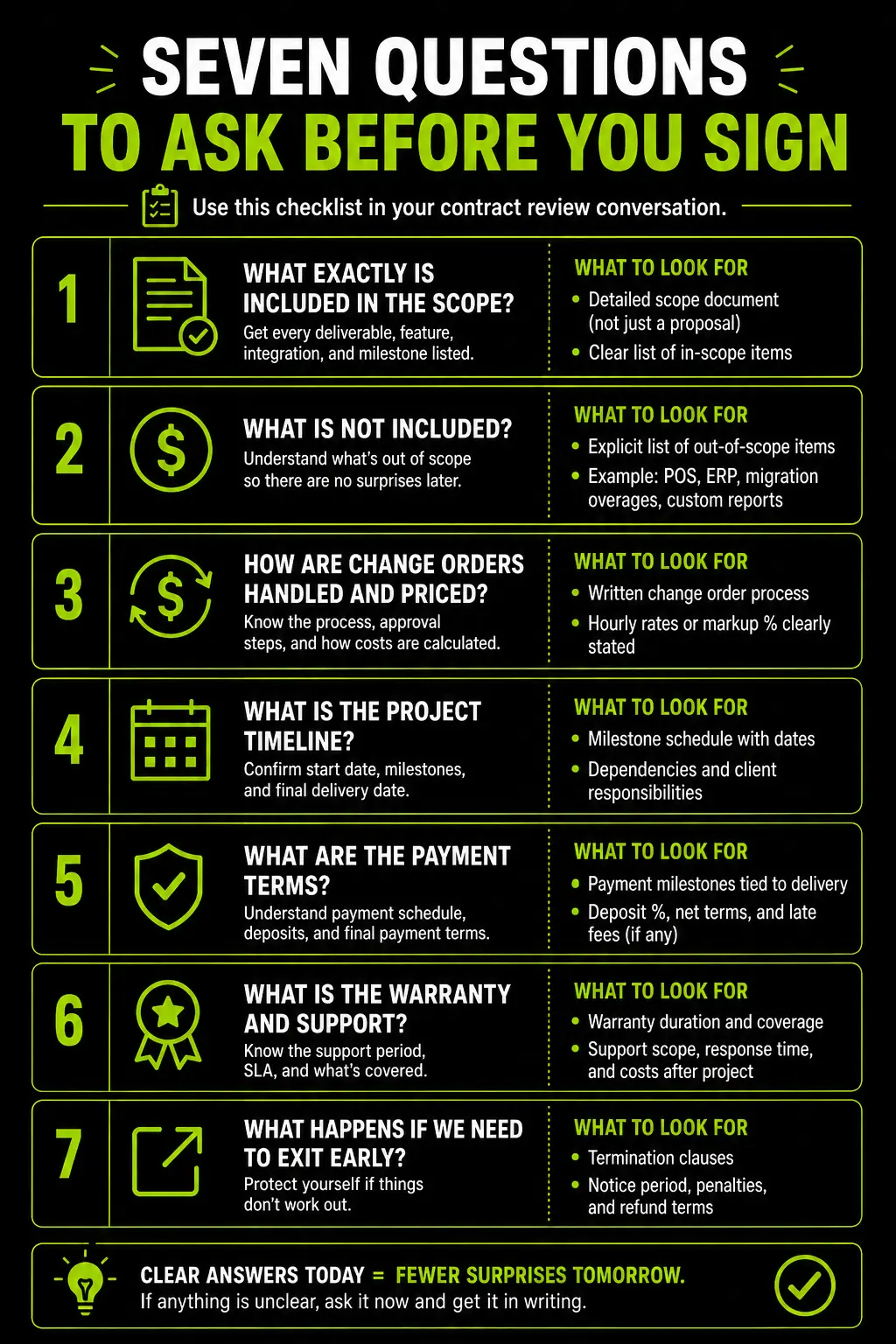
Run through these seven items directly with your agency before signing anything. Every one of them should have a clear, written answer, not a verbal reassurance.
How We Structure Contracts and Scope at Suplex
Scoping discipline upfront is the actual cost-protection mechanism on any Shopify project, and we treat it as standard practice rather than a defensive measure added after a bad experience elsewhere.
Every ecommerce store setup we run starts with a detailed, written scope document, clearly defined revision rounds, and a transparent change-order process agreed before development begins.
If you're still working out scope or comparing quotes, our platform consultation service is a useful place to start, since getting the scope right upfront is what actually prevents the cost overruns this piece covers.
Frequently Asked Questions
What's the Biggest Hidden Cost in a Shopify Development Contract?
Scope creep driven by vague or missing scope definitions. Projects without a detailed scope document commonly run 40 to 80 percent over the original quote, almost always through undefined change requests rather than the headline price.
What's a Normal Number of Revision Rounds to Expect?
Two to three rounds is common in most agency contracts. Beyond that, revisions are billed separately. Confirm exactly what counts as a "revision" versus new work before signing.
Is Fixed-Price or Time-and-Materials Better for a Shopify Project?
Fixed-price works best for a well-scoped, well-defined project since it caps cost but pushes changes into formal change orders. Time-and-materials suits an evolving project but requires more scope discipline to control cost.
Do I Own the Code After My Shopify Project Is Finished?
You should, for custom work built specifically for your store. Confirm this explicitly in the contract. Some agencies retain ownership of reusable internal components, which is normal, but your custom build shouldn't be one of them.
What Counts as a "Change Order" Versus Normal Project Work?
Anything outside the original scope document, including features added after design approval, extra revision rounds beyond the agreed limit, and requirements discovered mid-project that weren't part of initial scoping.
Hi, I’m Rishabh Jain
I believe great design has the power to shape perception, build trust, and move businesses forward. That belief is what led me to found Suplex Design Studio, a global branding and packaging studio working with FMCG and D2C brands across markets.I started suplex at 25 with a clear intent, to create design that is strategic, thoughtful, and commercially meaningful. By 28, the studio had scaled globally, guided by a strong foundation in Integrated Design that I developed during my academic journey in London, where I was honoured with the Dean’s Award.
Over the years, I’ve had the opportunity to work with 100+ brands, from Fortune 500 organizations to family-run businesses, helping them build packaging and brand systems that create recall, relevance, and long-term value.
Suplex’s work has been recognized internationally, including the Manifest Award (2024), the Clutch Global Award (2025), and features on platforms such as Packaging of the World, The Dieline, and the World Brand Design Society.
None of this would be possible without the people behind the work. I’m deeply grateful to the suplex team, whose commitment, creativity, and attention to detail turn ideas into meaningful brand experiences every day.
At the heart of my work is a simple philosophy, design should be intentional, honest, and built to last, and that continues to guide everything we create at suplex.






































Let’s Make It Happen
E-Commerce Success Stories

%201.avif)






.avif)

.avif)
Build Your D2C Business The Right Way
Build It With Suplex.


