In-House Dev Team vs. Shopify Agency: A Decision Framework
.avif)
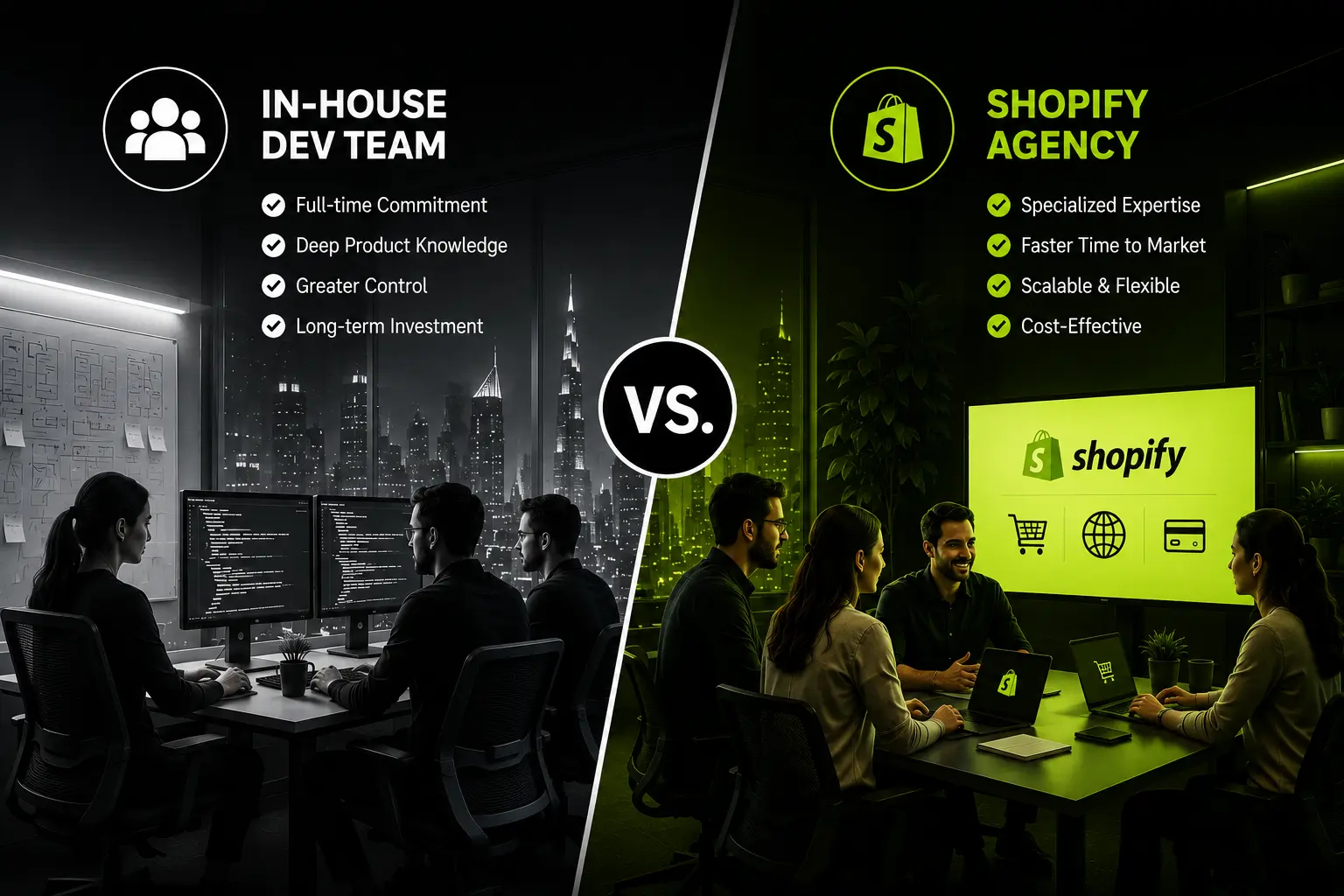
In-House Dev Team vs. Shopify Agency: A Decision Framework
In-house dev team vs Shopify agency comes down to three factors, total cost of ownership, not just salary versus retainer, how much specialist skill breadth your business genuinely needs and how difficult specialized Shopify talent actually is to hire in your market.
For GCC-based brands specifically, talent scarcity often tips this decision earlier than budget alone would suggest, a factor most Western-market comparison guides skip entirely.
Why This Decision Is Bigger Than "Cost Per Hour"
Comparing an in-house salary to an agency's hourly or retainer rate feels like a straightforward comparison. It isn't, because the two numbers aren't actually measuring the same thing.
Salary Is Not the Same as Total Cost of Ownership
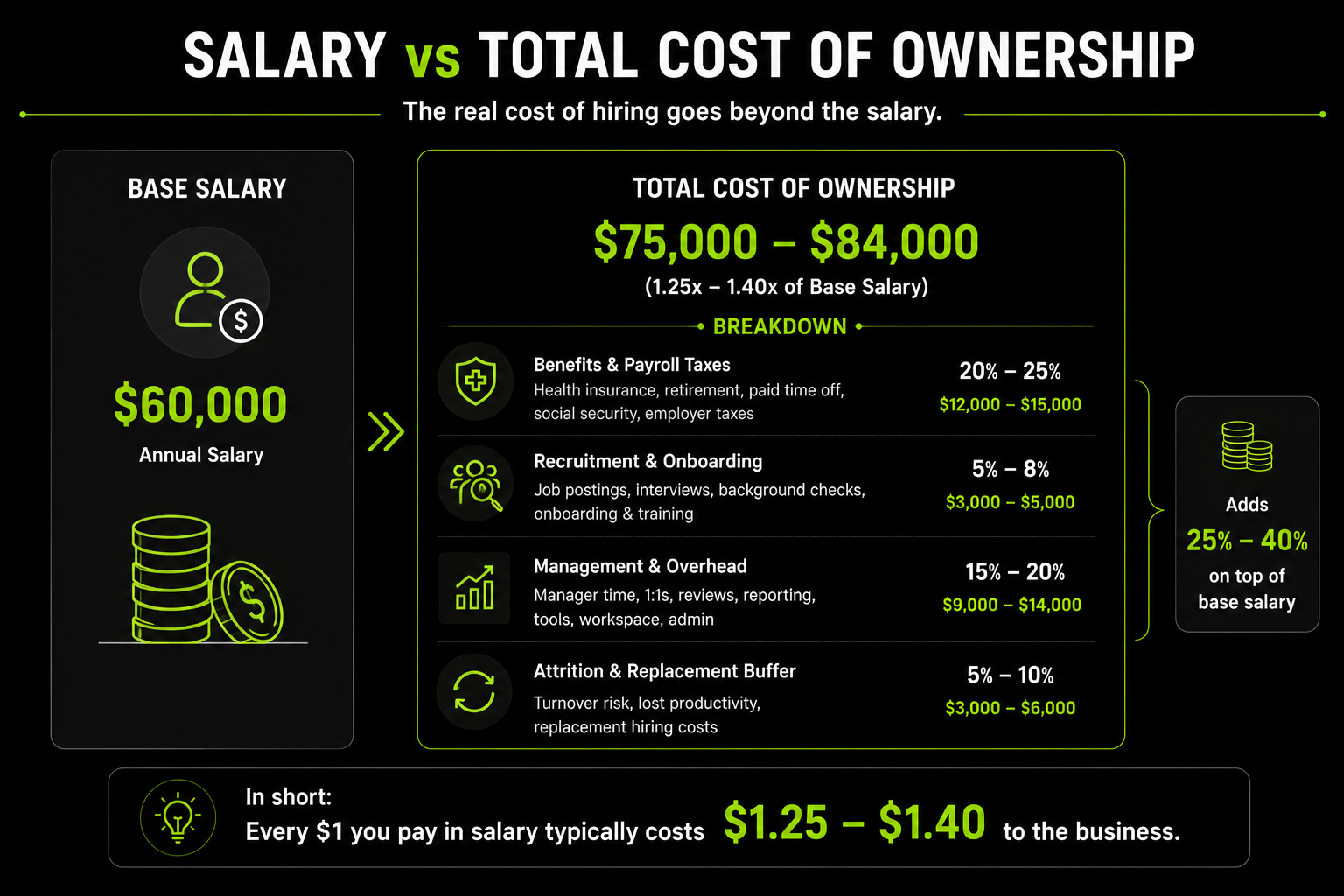
A quoted salary is the starting point of an in-house hire's real cost, not the full number. Once you add benefits, recruitment costs and the management time it takes to actually run that hire's work.
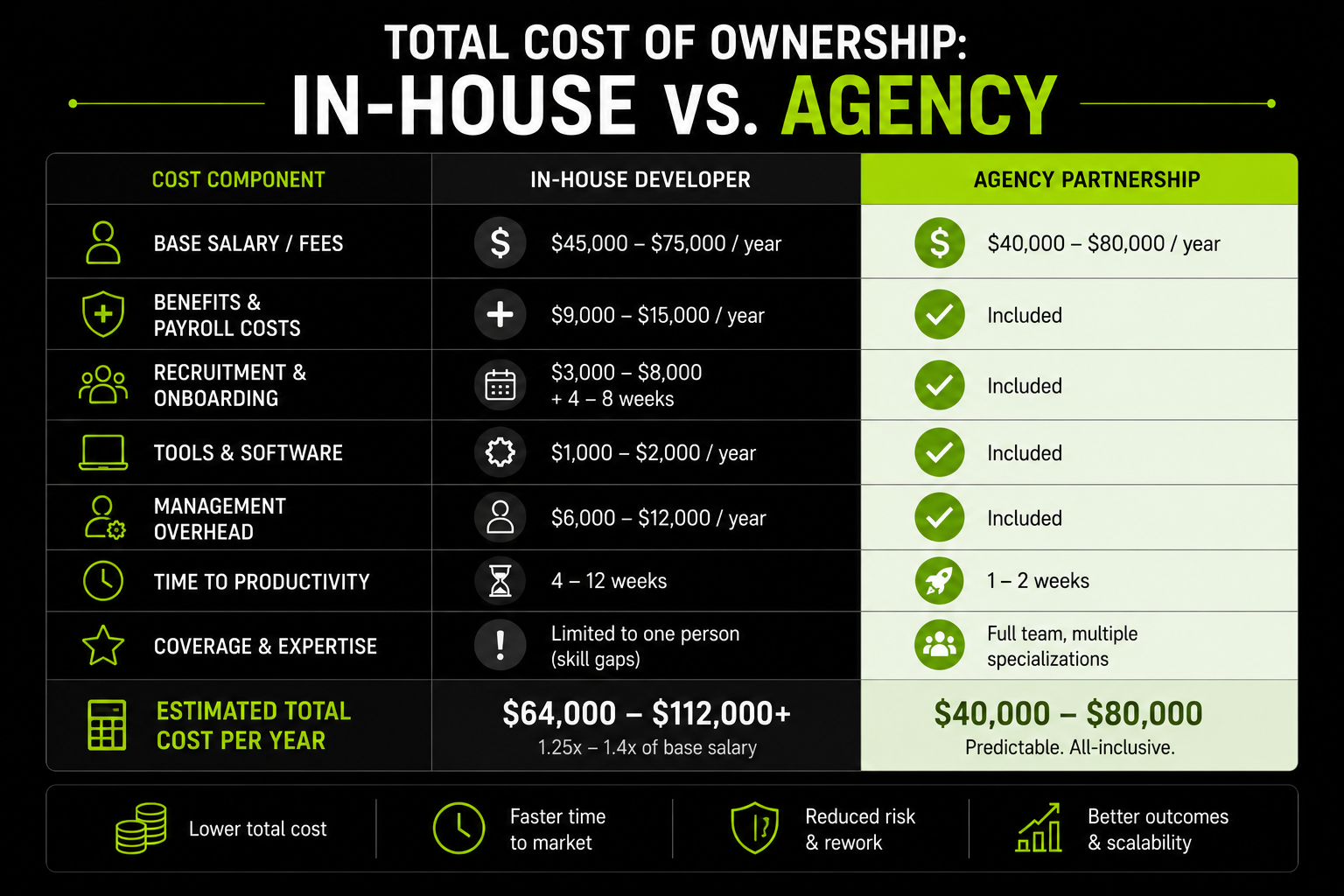
The fully loaded cost typically lands somewhere between 1.25 and 1.4 times the base salary, a figure most in-house cost comparisons simply leave out.
If a developer's salary is one number in your budget spreadsheet, and an agency retainer is another, the two aren't comparable until you've added recruitment, onboarding, benefits and management overhead to the first one.
Skipping that step is the single most common reason this decision gets made on incomplete information.
Recruitment alone is worth breaking out specifically, since it's easy to underestimate. Sourcing, screening, and interviewing candidates for a specialized technical role takes real hours.
Whether that's your own time or a recruiter's fee and it happens again every time a hire doesn't work out or eventually leaves.
None of that shows up in a job posting's salary line, but all of it belongs in an honest comparison against an agency's retainer.
The Real Comparison: A Team's Worth of Skills vs. One or Two Hires
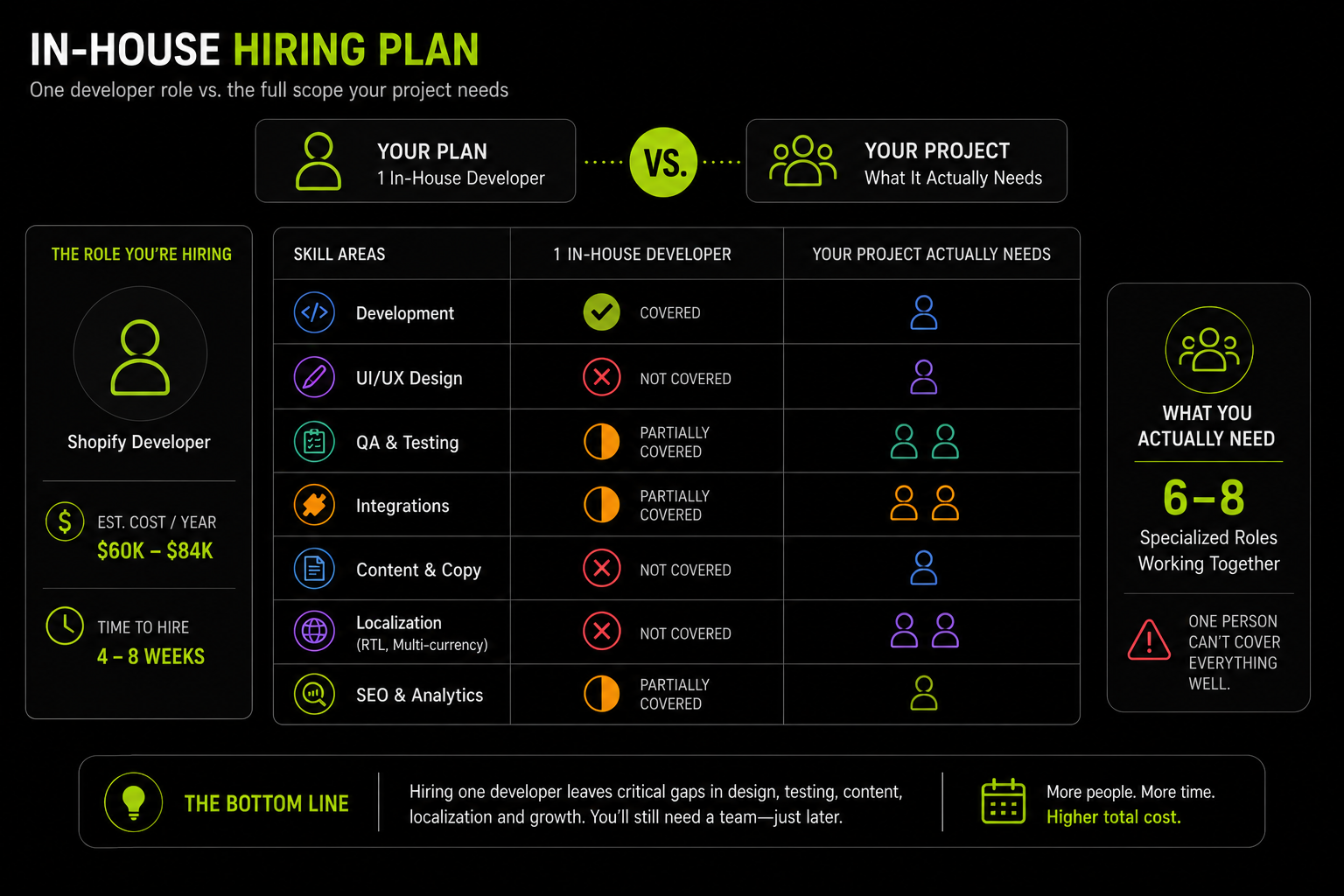
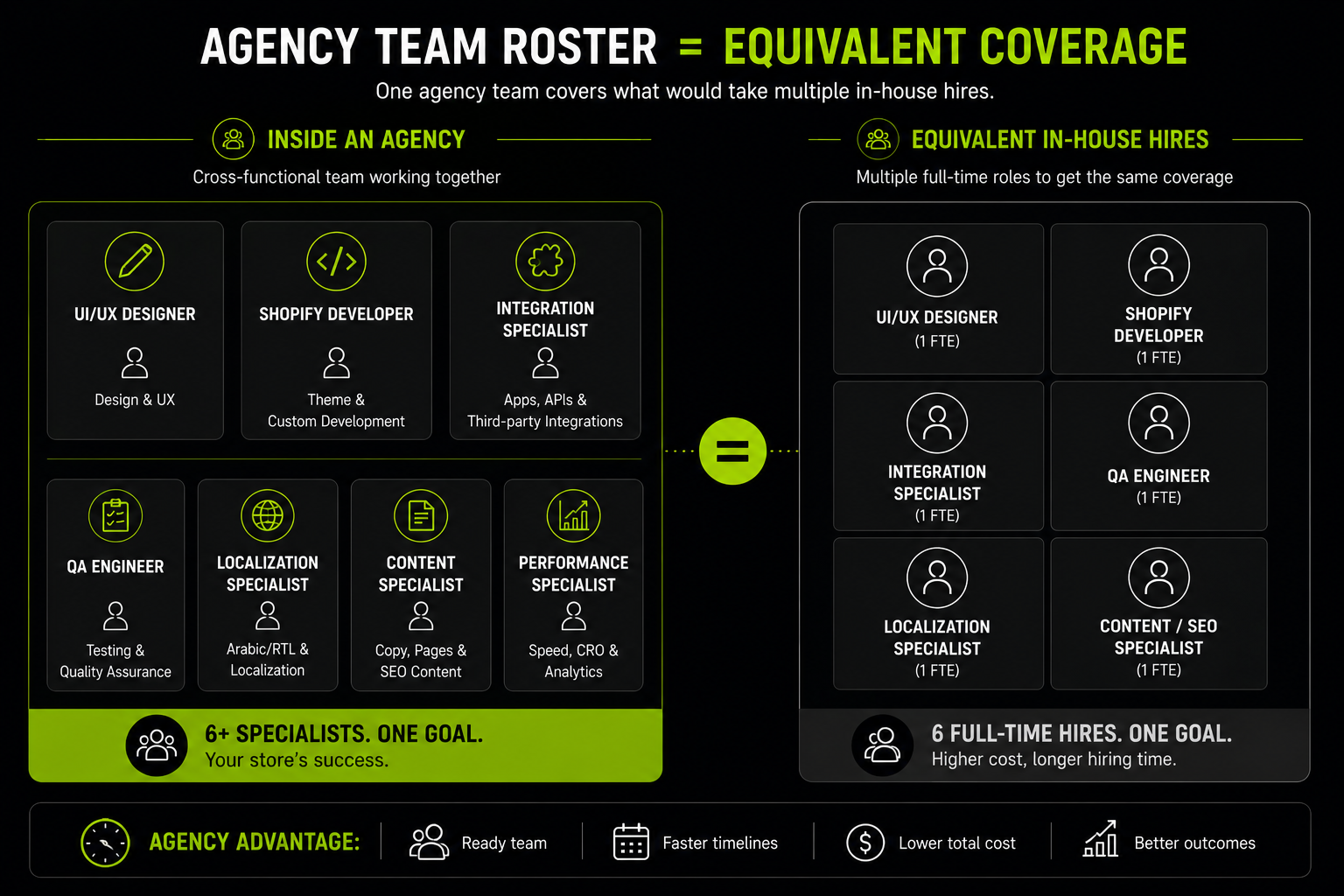
"In-house" doesn't mean one developer covering everything an agency team covers. It means either accepting real gaps in skill coverage, or hiring multiple people, a developer, a designer, someone with QA discipline, to actually match what a multi-disciplinary agency team provides as standard.
This is the scaled-up version of the same reframe that applies when comparing a freelancer to an agency: the real variable isn't cost, it's how many distinct, interdependent skills the work needs, and whether one or two in-house hires genuinely cover that range.
Our freelancer versus agency guide walks through this at the individual-hire level, and the same logic applies here at team scale.
What In-House Actually Requires (Beyond One Developer)
Most brands considering in-house hiring picture one strong developer solving their Shopify needs. What that one hire realistically covers, and where the gaps show up, matters more than the hiring decision itself.
The Skill Set a Single In-House Hire Realistically Covers
A strong in-house Shopify developer typically covers Liquid theme development, general app configuration, and day-to-day store maintenance well.
That's a genuinely useful, valuable skill set, and it's also a narrower range than most brands assume when they picture "an in-house Shopify person."
Job postings for this kind of role often list a long, aspirational skill set, theme development, design sensibility, QA discipline, integration work, localization, that reflects what the business needs rather than what a single realistic candidate actually brings.
It's worth writing the job description around what one strong generalist genuinely covers well, then planning separately, honestly, for the skills that fall outside that range.
Where Gaps Appear: Design, QA, Specialist Platform Knowledge
Design, structured QA, and specialist areas like RTL layout behavior or regional payment gateway configuration sit outside what a single developer hire typically covers, even a very skilled one. These gaps don't show up during hiring.
They show up mid-project, once work that needs a second or third skill area actually arrives.
Picture a brand that hires one strong Liquid developer in-house, confident the hire covers their Shopify needs, then discovers mid-project that RTL checkout QA and regional payment gateway integration both need skills that developer simply doesn't have.
This is the same interdependency problem covered in our freelancer versus agency guide, scaled up to a full-time hire instead of a contract engagement, and it's just as real at this scale.
The difference at this scale is that the fix costs more. A freelancer engagement missing a skill can be supplemented with a second short-term hire relatively quickly.
An in-house team missing a skill either means a second full hiring cycle, months of search time for a role you didn't originally budget for, or bringing in outside specialist help anyway, which raises the question of whether the original in-house hire actually reduced your dependency on external partners at all.
Management Overhead: Who Manages the Developer You Just Hired?
An in-house developer needs direction, priorities, and someone reviewing their work, which is itself a real time cost, usually falling to a founder or a non-technical manager who wasn't planning to take on that role. This overhead rarely appears in the original hiring decision, but it shows up every week once the hire is in place.
If nobody on your existing team has the technical background to review a developer's work, set priorities, and catch problems early, that management gap becomes a real risk on its own, separate from whatever skill gaps the hire has. It's worth naming honestly before hiring, not discovering three months in.
A founder spending several hours a week reviewing code they don't fully understand, or approving technical decisions based on trust rather than genuine evaluation, is paying a real cost that doesn't show up on any invoice.
That time has an opportunity cost of its own, pulled away from other parts of running the business, and it's worth weighing as part of the true cost of an in-house hire rather than treating it as free because no line item captures it.
The GCC Hiring Reality Most Comparisons Don't Address
Most comparison content on this topic is written against US or UK hiring markets, where specialized Shopify talent is genuinely easier to find. That assumption doesn't hold for GCC-based brands, and it changes the calculus meaningfully.
Why Specialized Shopify Talent Is Harder to Source Locally in the UAE
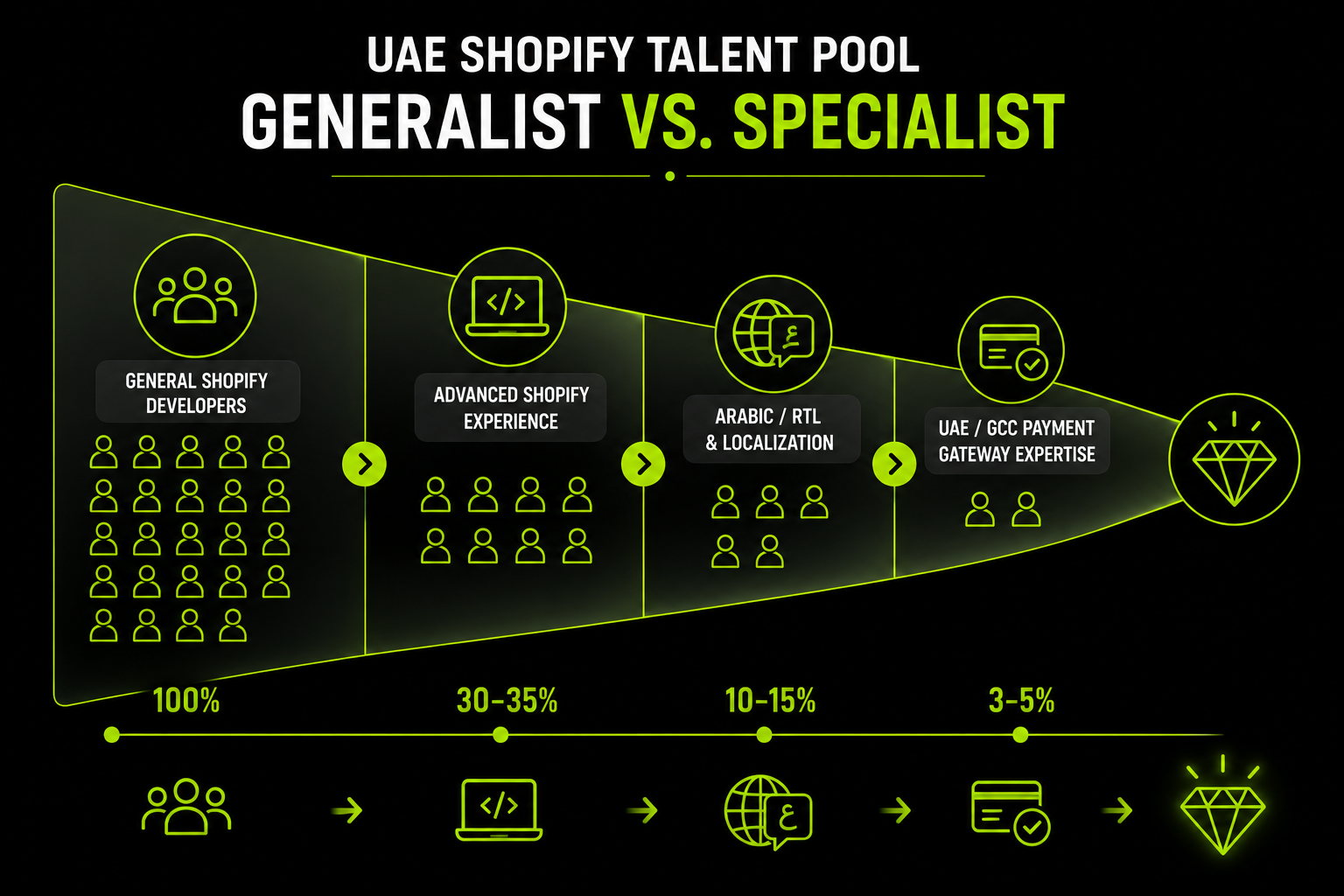
Shopify development talent exists in the UAE, but the narrower combination this region actually needs, Shopify plus Arabic and RTL experience plus regional payment gateway familiarity with providers like Telr, PayTabs, or Tap Payments, is a genuinely smaller pool than broader Shopify hiring markets in the US or UK.
A developer with strong general Shopify experience from Western markets has almost certainly never configured a UAE-specific payment gateway or built for genuine RTL behavior beyond a basic layout flip.
Hiring for that combination locally takes real search time, and settling for a partial match is how the same skill gaps covered above end up baked into an in-house hire from day one.
Most salary and hiring-timeline benchmarks circulating online are built on US or UK data, where the developer pool is larger and more standardized.
Applying those benchmarks directly to a UAE hiring search tends to understate both the time it takes to find the right person and the salary needed to retain them once found, since a smaller specialist pool has more leverage in salary negotiations than a broader one does.
Visa, Sponsorship, and Onboarding Timelines vs. an Agency's Immediate Availability
Hiring in the UAE involves visa sponsorship, onboarding logistics, and a hiring timeline that commonly runs six to twelve weeks from decision to a productive first day, compared to an agency engagement that can typically start within days once a scope is agreed.
For a brand with an urgent launch deadline or a time-sensitive market opportunity, that timeline gap alone can be decisive, regardless of how the longer-term cost comparison plays out. It's worth weighing explicitly rather than assuming hiring speed won't matter.
This timeline isn't unique to Shopify roles specifically, but it compounds with the narrower talent pool covered above. A broader hiring market can sometimes offset a slow process by having more candidates in the pipeline simultaneously.
A narrow specialist pool doesn't have that cushion, so the visa and onboarding timeline tends to stack directly on top of an already longer search, rather than running in parallel with it.
The Real Cost of a Bad In-House Hire in a Small, Specialized Market
In a narrow local talent pool, a bad hire costs more than the wasted salary. It costs the recruitment cycle spent finding them, the months of underperforming or misdirected work and then a second full hiring cycle to replace them, all while your Shopify needs sit unmet or poorly handled in the meantime.
This risk is proportionally larger in a small, specialized market than in a deep one, simply because a second attempt at hiring the right combination of skills takes just as long as the first did, with no larger pool to draw from the second time around.
A brand in a deep hiring market can often course-correct within weeks. A brand in a narrow one is looking at the same multi-month cycle twice, which is a meaningful part of why some GCC-based brands find a hybrid model, covered later in this guide, a more resilient starting point than a full in-house commitment made too early.
When In-House Genuinely Makes Sense
In-house hiring is the right call for a specific category of brand, and this section makes that case directly and fairly.
High, Continuous Development Volume That Justifies a Full-Time Team
A brand with a constant stream of development work, ongoing feature builds, frequent testing, regular platform updates, generates enough continuous demand that a full-time team's cost is justified by the volume of work it's actually doing, rather than sitting partially idle between projects.
The practical test here is utilization. If an in-house hire would realistically have Shopify-related work to do most weeks of the year, the fully loaded cost of that hire is being put to genuine use.
If the workload is closer to a few concentrated bursts a year with quieter stretches between them, that same hire is being paid a full-time cost for part-time utilization, which is exactly the scenario an agency or hybrid model tends to serve more efficiently.
Deep Institutional Knowledge That's Expensive to Rebuild Each Engagement
An internal team accumulates knowledge about your specific store, your customers' behavior, and your past decisions that compound in value over time.
Rebuilding that context with a new external partner for every engagement has a real cost, one that becomes more significant the longer a brand has been operating and the more complex its history gets.
This is the strongest, most genuinely underrated argument for in-house hiring at scale, and it's worth taking seriously rather than treating it as a soft, hard-to-quantify benefit.
A developer who already knows why a particular checkout customization exists, what broke the last time a certain app was updated, and how your specific customer base behaves during peak sale periods makes faster, better-informed decisions than any new partner starting from scratch, no matter how skilled that partner is.
Brands at Shopify Plus Scale With Ongoing, Complex Feature Development
At genuine Shopify Plus scale, running continuous A/B testing, checkout customization work, and platform-level feature development, an internal team's accumulated knowledge of the store's architecture becomes a real, compounding asset rather than overhead.
Research on internal Shopify Plus teams consistently points to this scale, high, continuous complexity, as the point where in-house genuinely pays for itself.
Our Shopify Plus service covers what a Plus-level engagement looks like in practice, whether you're staffing that work internally or bringing in specialist support.
When an Agency Genuinely Makes Sense
The mirror case is just as real. An agency can be the better option when your development needs are temporary, broad, or time-sensitive.
Project-Based or Seasonal Development Needs
A defined project, a redesign, migration, or seasonal campaign build has a clear start and end. That makes it a poor match for a permanent hire and a strong match for an engagement that can scale down when the work is complete.
Hiring permanently for temporary demand creates a problem once the project ends:
- The hire's workload drops sharply.
- You have to find lower-priority work to keep them occupied.
- You're still carrying the full cost of the employee.
An agency engagement can simply conclude or scale down when the defined work is finished, without leaving you managing an underutilized hire afterward.
Full Skill Coverage Without Five Separate Hires
A typical digital project may require design, development, QA, and localization. Building that coverage in-house could mean hiring four or five specialists individually.
An agency can provide the same breadth of capability through a standing team, without the cost and management overhead of maintaining that many permanent roles.
Run the comparison honestly:
- Five specialist hires
- Fully loaded at roughly 1.25–1.4× salary each
- Management and coordination across five people
- Ongoing employment costs even when project demand falls
That can create a substantial permanent cost structure.
An agency team, by contrast, can be scoped to the work actually required. Unless your development volume is high enough to keep all five specialists busy full time, that flexibility can make the agency the more efficient option.
Faster Time-to-Start Than a Full Hiring Cycle Allows
An agency engagement can typically begin within days of a signed scope. A genuine in-house search can take six to twelve weeks in this market.
For time-sensitive work, that difference can be decisive.
The advantage matters most when you're working against a deadline you don't control, such as:
- A seasonal sales event
- A competitor launch
- A partnership go-live date
- A fixed campaign deadline
In these situations, the cost of missing the date may outweigh the difference in hiring costs.
Speed to start should therefore be evaluated as its own factor, separate from the total cost comparison covered in the next section.
Cost Comparison: Total Cost of Ownership
This table compares both paths on total cost of ownership, not just the headline salary or retainer number.
For a fuller picture of platform-level costs that sit alongside whichever hiring path you choose, our hidden costs of Shopify guide covers the platform side of the total cost equation.
Redundancy deserves a closer look on its own, since it's easy to underweight until it's tested. With one or two in-house hires, a single resignation or extended absence can stall development entirely until a replacement is found and onboarded, a process that, as covered above, commonly takes six to twelve weeks in this market.
An agency's team structure means a single person's absence rarely stops work outright, since responsibilities and context are already distributed across more than one person by design.
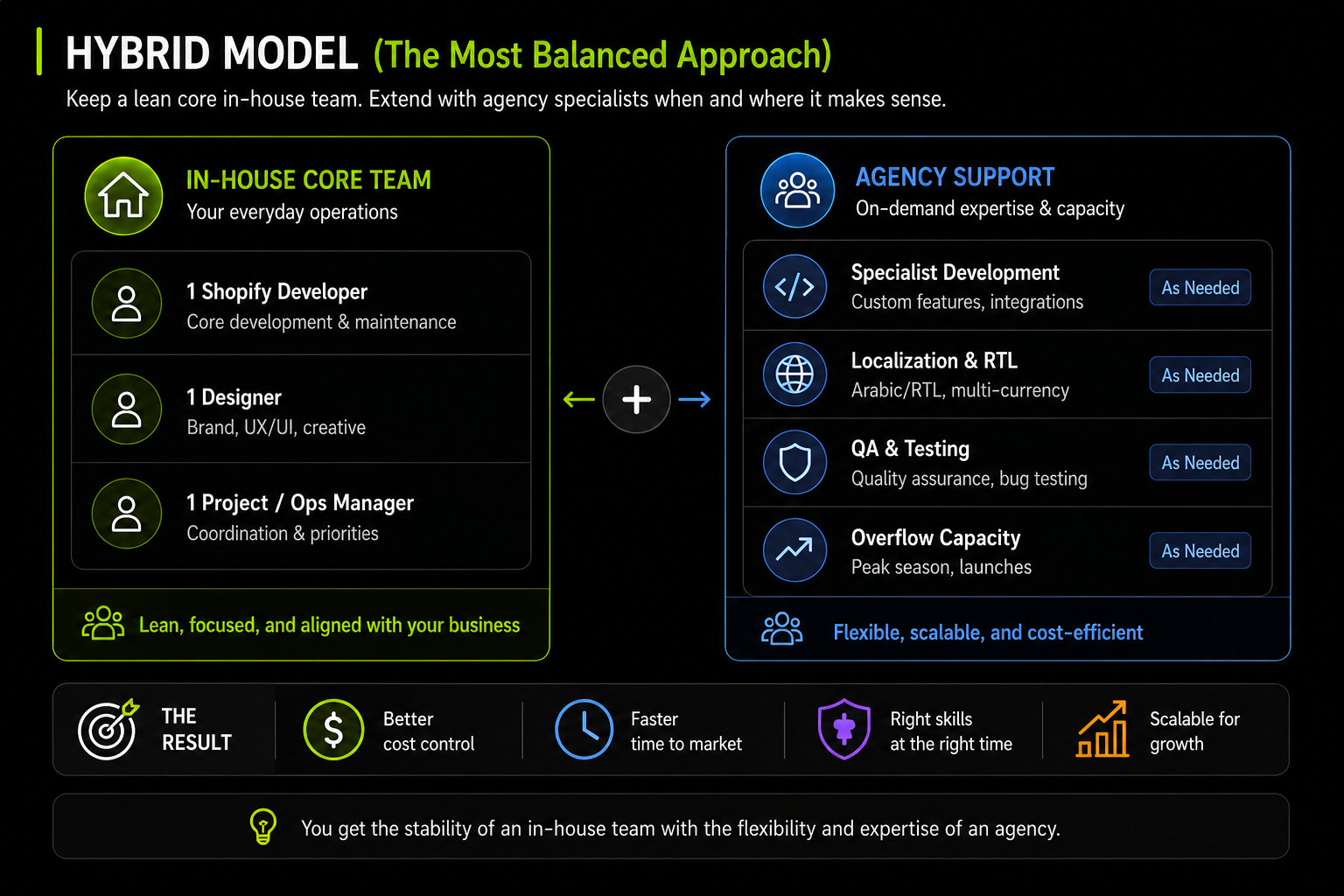
The Hybrid Model Most Growing Brands Actually Land On
Most brands don't permanently pick one path. The realistic middle ground is worth naming plainly, since forcing a binary choice misses how this decision actually plays out for most growing businesses.
A Small In-House Team for Day-to-Day Ops, an Agency for Specialist and Overflow Work
A lean internal team handling routine day-to-day operations, content updates, small fixes, order management, paired with an agency for specialist work, localization, platform migrations, complex integrations and overflow capacity during high-demand periods, covers both the continuous baseline and the specialist edges without overpaying for either.
This model tends to be the most cost-efficient shape for a growing GCC brand specifically, because it sidesteps the hardest part of the local hiring problem, sourcing rare specialist combinations like RTL and regional payment expertise, while still keeping routine operational costs low through a smaller, more generalist internal hire.
When to Introduce In-House Hiring After Starting With an Agency
Many brands launch and scale with an agency, then introduce in-house hiring once development volume becomes continuous enough, ongoing feature work, frequent testing, regular platform iteration, to justify a full-time team.
Starting with an agency and adding in-house capacity later is a common, sensible sequence, not a sign the original decision was wrong.
The signal worth watching for is when routine requests to an agency start feeling repetitive and predictable rather than specialized, small content updates, minor fixes, recurring reporting.
That's usually the point where an internal hire for day-to-day work starts to pay for itself, while specialist and project work continues to make sense as agency-supported engagements.
A Simple Decision Framework
Three Questions to Ask Before Choosing Either Path
Answer these three questions honestly, using your actual numbers rather than rough impressions.
- Does our development need to be continuous or project-based?
- Can we realistically hire and retain the specialist skills we need locally, within a reasonable timeline?
- What's our actual fully loaded cost per path, salary plus overhead versus retainer plus scope, not just the headline number?
A continuous need, a realistic local hiring path, and a favorable fully loaded cost all pointing the same direction makes the decision straightforward.
When the answers pull in different directions, which is common, that's usually the signal that a hybrid model, not a strict either/or choice, is the right starting point.
If you're still working out the scope of what you'd hand to either path, our guide to briefing a Shopify agency is a useful starting point regardless of which direction you lean.
How We Work Alongside In-House Teams at Suplex
We work as the specialist and overflow partner for brands with lean in-house teams as often as we work as a brand's primary development partner and we're upfront about which one fits a given situation.
At genuine scale, high, continuous development volume with institutional knowledge that compounds over time, in-house is genuinely the right call, and we'd rather say that plainly than pitch an engagement that doesn't match where a brand actually is.
For brands with an existing internal team that needs specialist support, RTL and localization work, platform migrations, Shopify Plus feature development, our platform consultation service starts from what your team already covers well, then scopes support around the actual gaps rather than duplicating what you've already built internally.
Frequently Asked Questions
Is It Cheaper to Hire an In-House Shopify Developer or Use an Agency?
It depends on volume and duration. In-house can be more cost-effective for continuous, high-volume work once you factor in full team coverage, but agencies are usually cheaper for project-based or seasonal needs once total cost of ownership is included.
What Does "Total Cost of Ownership" Mean for an In-House Hire?
It includes salary plus benefits, recruitment costs, management overhead, and the cost of any skill gaps you still need to fill separately, typically 1.25 to 1.4 times base salary once fully loaded.
Is It Harder to Hire Shopify Developers in the UAE Than Elsewhere?
Generally yes, especially for developers with combined Shopify, Arabic and RTL, and regional payment gateway experience. This narrower local talent pool is a real factor GCC-based brands should weigh alongside cost.
Can I Start With an Agency and Build an In-House Team Later?
Yes, and many growing brands do exactly this, using an agency to launch and scale, then hiring in-house once development volume becomes continuous enough to justify a full-time team.
What's the Biggest Risk of Going In-House Too Early?
Hiring one developer and assuming they cover design, QA, and specialist platform knowledge as well. Gaps usually surface mid-project rather than during hiring, when they're more expensive to fix.
Do Agencies Work Alongside an Existing In-House Team?
Yes, this is common. Agencies often support in-house teams with specialist work, such as localization, platform migrations, or complex integrations, or provide overflow capacity during high-demand periods.
At What Point Does a Brand Typically Justify an In-House Shopify Team?
Usually once development needs become continuous rather than project-based, ongoing feature work, frequent A/B testing, or Shopify Plus-scale complexity where institutional knowledge compounds in value over time.
Hi, I’m Rishabh Jain
I believe great digital experiences have the power to shape perception, build trust, and move businesses forward. That belief led me to found Suplex Design Studio, a global digital design and development studio helping FMCG and D2C brands build websites and digital experiences that are strategic, thoughtful, and commercially meaningful.
I started Suplex at 25 with a clear intent, to create digital experiences that look appealing, work seamlessly, and help D2C businesses grow. By 28, the studio had scaled globally, guided by a strong foundation in integrated design that I developed during my academic journey in London, where I was honoured with the Dean’s Award.
Over the years, I’ve had the opportunity to work with 100+ brands, from Fortune 500 organisations to family-run businesses, helping them build websites, e-commerce experiences, and digital products that create clarity, credibility, and long-term value.
Our work has been recognised internationally, including the Manifest Award (2024), the Clutch Global Award (2025), and features across platforms such as The Dieline, Packaging of the World, and the World Brand Design Society.
None of this would be possible without the people behind the work. I’m deeply grateful to the Suplex team, whose commitment, creativity, and attention to detail turn ideas into meaningful digital experiences every day.
At the heart of our work is a simple philosophy, digital design should be intentional, functional, and built to create real business value. That continues to guide everything we create at Suplex.





































Let’s Make It Happen
E-Commerce Success Stories
%201.avif)






.avif)
.avif)
Build Your D2C Business The Right Way
Build It With Suplex.


